

The DOI matches its Crossref record; 32 of the 32 references it cites were found in a registry or an index.
Cromolyn Reduces Levels of the Alzheimer’s Disease-Associated Amyloid β-Protein by Promoting Microglial Phagocytosis
Open accessAbstract
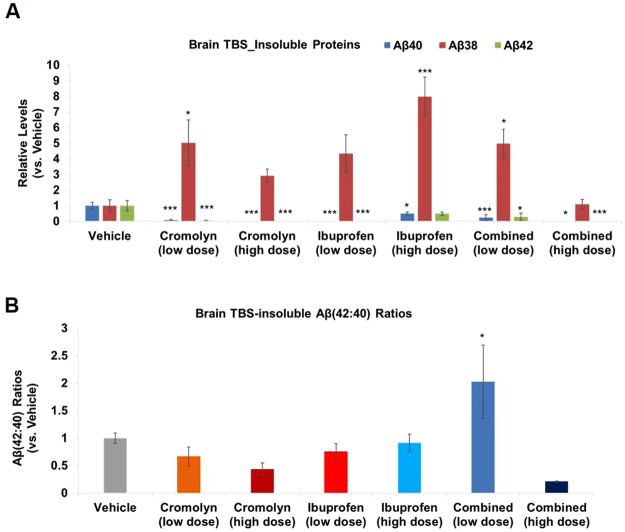
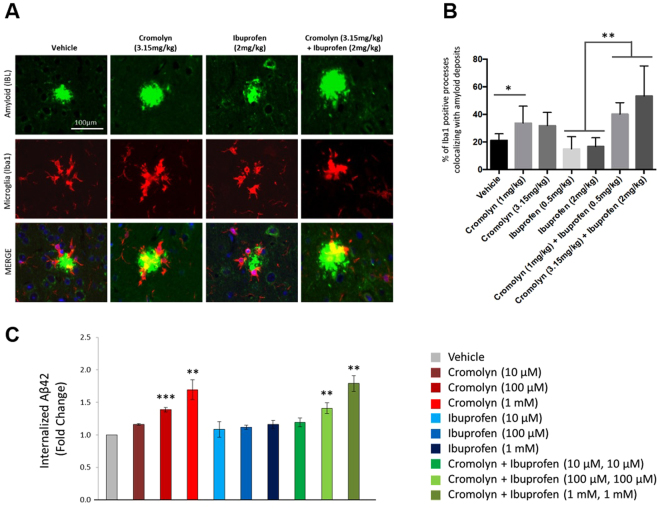
Amyloid-beta protein (Aβ) deposition is a pathological hallmark of Alzheimer’s disease (AD). Aβ deposition triggers both pro-neuroinflammatory microglial activation and neurofibrillary tangle formation. Cromolyn sodium is an asthma therapeutic agent previously shown to reduce Aβ levels in transgenic AD mouse brains after one-week of treatment. Here, we further explored these effects as well as the mechanism of action of cromolyn, alone, and in combination with ibuprofen in APP Swedish-expressing Tg2576 mice. Mice were treated for 3 months starting at 5 months of age, when the earliest stages of β-amyloid deposition begin. Cromolyn, alone, or in combination with ibuprofen, almost completely abolished longer insoluble Aβ species, i.e. Aβ40 and Aβ42, but increased insoluble Aβ38 levels. In addition to its anti-aggregation effects on Aβ, cromolyn, alone, or plus ibuprofen, but not ibuprofen alone, increased microglial recruitment to, and phagocytosis of β-amyloid deposits in AD mice. Cromolyn also promoted Aβ42 uptake in microglial cell-based assays. Collectively, our data reveal robust effects of cromolyn, alone, or in combination with ibuprofen, in reducing aggregation-prone Aβ levels and inducing a neuroprotective microglial activation state favoring Aβ phagocytosis versus a pro-neuroinflammatory state. These findings support the use of cromolyn, alone, or with ibuprofen, as a potential AD therapeutic.
Overview
The claims and statistics of this paper haven’t been checked yet.
Run the check — free, no account needed. It reads the open-access text and checks the sources it cites.
Integrity signals
Registry
Cites
Statistics
Figures
Verification
Claims the paper makes
The claims and statistics of this paper haven’t been checked yet.
Run the check — free, no account needed. It reads the open-access text and checks the sources it cites.
Claims other papers make about this one
Each is checked against this paper’s own text: does it say what the citing paper says it does?
In the citing paper
“An efficacy study in in vivo AD mouse model evidenced better effects of the drug combination compared with cromolyn and ibuprofen alone.59”
From From combinations to multitarget-directed ligands: A continuum in Alzheimer’s disease polypharmacology (2021) · cites this paper as [59]
Self-check
Percentages, sums and reported differences re-computed from the paper’s own numbers.
The self-check needs the paper’s full text.
Citations
Cites
The Amyloid Hypothesis of Alzheimer’s Disease: Progress and Problems on the Road to Therapeutics
Hardy, J., & Selkoe, D. J. (2002) · Science · doi:10.1126/science.1072994 · Cited by 13,864
Amyloid oligomers exacerbate tau pathology in a mouse model of tauopathy
Selenica, M.-L. B., Brownlow, M., Jimenez, J. P., Lee, D. C., Pena, G., Dickey, C. A., Gordon, M. N., & Morgan, D. (2013) · Neurodegenerative Diseases · doi:10.1159/000337230 · Cited by 10,359
Correlative Memory Deficits, Aβ Elevation, and Amyloid Plaques in Transgenic Mice
Hsiao, K., Chapman, P., Nilsen, S., Eckman, C., Harigaya, Y., Younkin, S., Yang, F., & Cole, G. (1996) · Science · doi:10.1126/science.274.5284.99 · Cited by 4,210
Neurovascular pathways to neurodegeneration in Alzheimer’s disease and other disorders
Zlokovic, B. V. (2011) · Nature Reviews Neuroscience · doi:10.1038/nrn3114 · Cited by 2,969
Karran, E., Mercken, M., & Strooper, B. D. (2011) · Nature Reviews Drug Discovery · doi:10.1038/nrd3505 · Cited by 2,188
Intracellular amyloid-β in Alzheimer's disease
LaFerla, F. M., Green, K. N., & Oddo, S. (2007) · Nature Reviews Neuroscience · doi:10.1038/nrn2168 · Cited by 1,942
Twenty years of the Alzheimer's disease amyloid hypothesis: a genetic perspective
Tanzi, R. E., & Bertram, L. (2005) · Cell · doi:10.1016/j.cell.2005.02.008 · Cited by 1,849
Self-citationMicroglial Dysfunction and Defective β-Amyloid Clearance Pathways in Aging Alzheimer's Disease Mice
Hickman, S. E., Allison, E. K., & El Khoury, J. (2008) · The Journal of Neuroscience · doi:10.1523/jneurosci.0616-08.2008 · Cited by 1,329
A three-dimensional human neural cell culture model of Alzheimer’s disease
Choi, S. H., Kim, Y. H., Hebisch, M., Sliwinski, C., Lee, S., D’Avanzo, C., Chen, H., Hooli, B., Asselin, C., Muffat, J., et al. (2014) · Nature · doi:10.1038/nature13800 · Cited by 1,195
Self-citationCummings, J. L. (2004) · New England Journal of Medicine · doi:10.1056/nejmra040223 · Cited by 1,152
Cited by
Sorted by citations
Items 101–105 of 105
Conceptual search for MTDs of plant natural compounds for multifactorial Alzheimer's disease therapy
Kim, C. (2026) · Elsevier eBooks · doi:10.1016/b978-0-443-45844-6.00026-3
Bhattacharya, H., Chakraborty, P., & Dewanjee, S. (2026) · International review of neurobiology · doi:10.1016/bs.irn.2026.08.022
Sharma, N., & An, S. S. A. (2026) · Molecules · doi:10.3390/molecules31183274
Elmaleh, D. R., Gupta, A., Brazier, D., Garofano, W., & Conti, P. S. (2026) · Journal of Alzheimer s Disease · doi:10.1177/13872877261498247
Self-citation
Metadata
- Authors
- Zhang, C., Griciuc, A., Hudry, E., Wan, Y., Quinti, L., Ward, J., Forte, A. M., Shen, X., Ran, C., Elmaleh, D. R., & Tanzi, R. E.
- Affiliations
- Harvard University (US)
- Corresponding author
- Tanzi, Rudolph E.
- Venue
- Scientific Reports
- Published
- 2018-01-18
- Volume
- 8
- Issue
- 1
- Pages
- 1144-1144
- ISSN
- 2045-2322 (ISSN-L)
- PMC
- PMC5773545
- OpenAlex
- W2782619707
- Cited by
- 99
- References
- 32
- Citations by year
- 2026: 8 · 2025: 11 · 2024: 9 · 2023: 15 · 2022: 15 · 2021: 16 · 2020: 14 · 2019: 6 · 2018: 3
- FWCI
- 6.69
- Type
- journal article
- Language
- en
- Open access
- gold
- doi.org
- Locations
- Scientific Reports (publishedVersion, cc-by)
- PubMed Central (publishedVersion, cc-by)
- PubMed (publishedVersion)
- Digital Access to Scholarship at Harvard (DASH) (Harvard University) (submittedVersion, cc-by)
- DOAJ (DOAJ: Directory of Open Access Journals) (submittedVersion)
- Funders
- Cure Alzheimer's Fund
- National Institute on Aging (R00AG047336)
- Topics
- Life Sciences › Neuroscience › Cellular and Molecular Neuroscience › Alzheimer's disease research and treatments
- Life Sciences › Neuroscience › Neurology › Neuroinflammation and Neurodegeneration Mechanisms
- Health Sciences › Medicine › Psychiatry and Mental health › Dementia and Cognitive Impairment Research
- Keywords
- disodium cromoglycate, amyloid-beta, Alzheimer's disease, microglial phagocytosis, ibuprofen, amyloid-beta aggregation, amyloid-beta 42, Aβ40, microglial recruitment, neuroinflammation, Tg2576 mice, anti-aggregation therapy
- MeSH terms
- Alzheimer Disease, Animals, Brain, Disease Models, Animal, Cromolyn Sodium, Drug Combinations, Humans, Ibuprofen, Male, Mice, Transgenic, Neurons, Peptide Fragments, Phagocytosis, Gene Expression, Amyloid beta-Peptides, Amyloid beta-Protein Precursor, Microglia, Neuroprotective Agents, Anti-Asthmatic Agents, Transgenes, Mice, Drug Repositioning
About these checks
Registry, retraction, Cites and statistics results are computed, not judged, with one exception: a printed reference that no index lists is read once by a model before it counts as a citation error. Claims are extracted by a model and kept only when their quote appears verbatim in the text; each cited source is then checked, with a model’s help, for whether it says what the claim relies on. Those verdicts can be wrong — read the claim’s quote and the cited source before relying on one.
Statistics and arithmetic are recomputed, not judged.
Confidence bands are shown only for fields calibrated on our annotated test set. None is calibrated yet, so no band is shown.
What counts as a claim ›How we measure confidence ›How we check this ›
Are you an author, or do you see a problem with this page? Request a review
