

Investigating the origins of eastern Polynesians using genome-wide data from the Leeward Society Isles
Open accessThe DOI matches its Crossref record; 80 of the 80 references it cites were found in a registry or an index.
Abstract
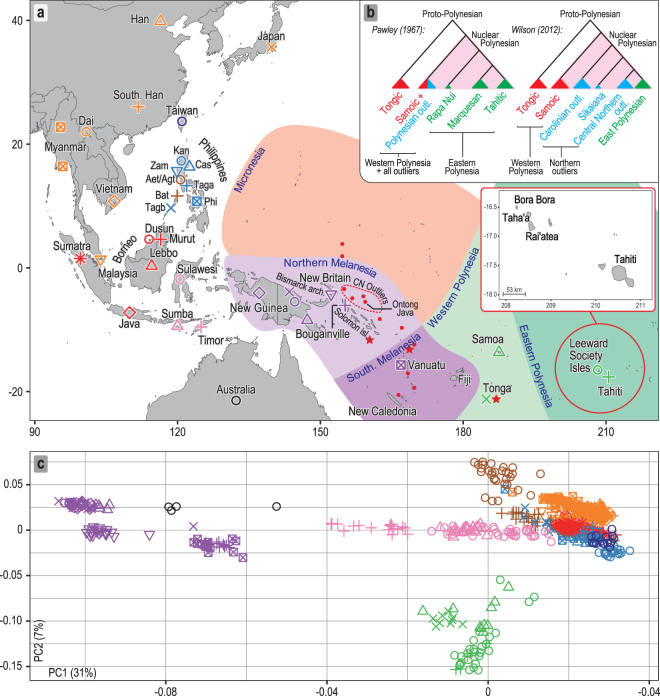
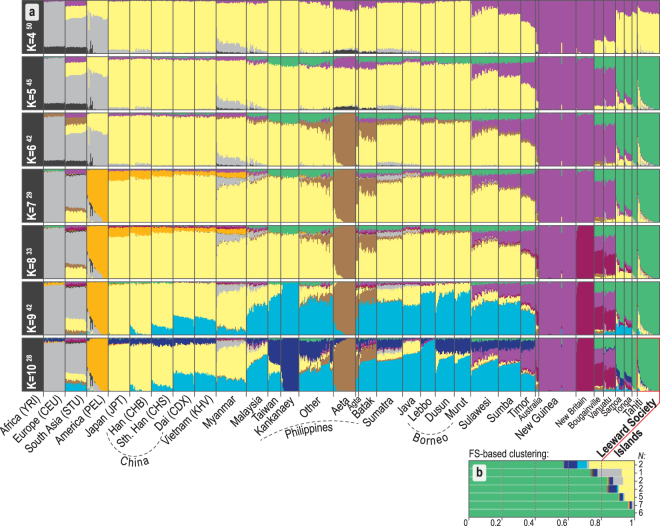
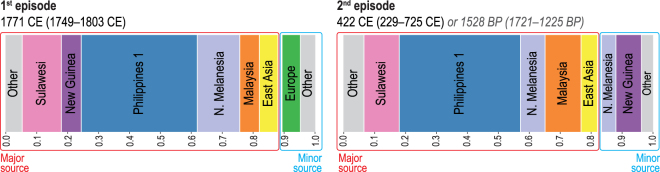
The debate concerning the origin of the Polynesian speaking peoples has been recently reinvigorated by genetic evidence for secondary migrations to western Polynesia from the New Guinea region during the 2nd millennium BP. Using genome-wide autosomal data from the Leeward Society Islands, the ancient cultural hub of eastern Polynesia, we find that the inhabitants’ genomes also demonstrate evidence of this episode of admixture, dating to 1,700–1,200 BP. This supports a late settlement chronology for eastern Polynesia, commencing ~1,000 BP, after the internal differentiation of Polynesian society. More than 70% of the autosomal ancestry of Leeward Society Islanders derives from Island Southeast Asia with the lowland populations of the Philippines as the single largest potential source. These long-distance migrants into Polynesia experienced additional admixture with northern Melanesians prior to the secondary migrations of the 2nd millennium BP. Moreover, the genetic diversity of mtDNA and Y chromosome lineages in the Leeward Society Islands is consistent with linguistic evidence for settlement of eastern Polynesia proceeding from the central northern Polynesian outliers in the Solomon Islands. These results stress the complex demographic history of the Leeward Society Islands and challenge phylogenetic models of cultural evolution predicated on eastern Polynesia being settled from Samoa.
Overview
The claims and statistics of this paper haven’t been checked yet.
Free: it reads the open-access text and checks the first 5 claims that cite a source we can check. Create a free account to check every claim.
Integrity signals
Registry
Cites
Statistics
Figures
Verification
Claims the paper makes
The claims and statistics of this paper haven’t been checked yet.
Free: it reads the open-access text and checks the first 5 claims that cite a source we can check. Create a free account to check every claim.
Claims other papers make about this one
Each is checked against this paper’s own text: does it say what the citing paper says it does?
The cited source says what the claim attributes to it.
In the citing paper
“Previous region-wide Polynesian genetics studies have considered only globin gene polymorphisms14, or have been restricted to near (western) Polynesia15 and the Society Islands16 and lacked an ancestry-specific approach.”
From Paths and timings of the peopling of Polynesia inferred from genomic networks (2021) · cites this paper as [16]
Self-check
Percentages, sums and reported differences re-computed from the paper’s own numbers.
The self-check needs the paper’s full text.
Citations
Cites
Bayesian Phylogenetics with BEAUti and the BEAST 1.7
Drummond, A. J., Suchard, M. A., Xie, D., & Rambaut, A. (2012) · Molecular Biology and Evolution · doi:10.1093/molbev/mss075 · Cited by 10,063
Fast model-based estimation of ancestry in unrelated individuals
Alexander, D. H., Novembre, J., & Lange, K. (2009) · Genome Research · doi:10.1101/gr.094052.109 · Cited by 9,898
genepop’007: a complete re‐implementation of the genepop software for Windows and Linux
ROUSSET, F. (2008) · Molecular Ecology Resources · doi:10.1111/j.1471-8286.2007.01931.x · Cited by 8,497
An integrated map of genetic variation from 1,092 human genomes
The 1000 Genomes Project Consortium (2012) · Nature · doi:10.1038/nature11632 · Cited by 7,711
Relaxed Phylogenetics and Dating with Confidence
Drummond, A. J., Ho, S. Y. W., Phillips, M. J., & Rambaut, A. (2006) · PLoS Biology · doi:10.1371/journal.pbio.0040088 · Cited by 6,463
Self-citationJakobsson, M., & Rosenberg, N. A. (2007) · Bioinformatics · doi:10.1093/bioinformatics/btm233 · Cited by 6,290
Lanfear, R., Calcott, B., Ho, S. Y. W., & Guindon, S. (2012) · Molecular Biology and Evolution · doi:10.1093/molbev/mss020 · Cited by 5,732
Self-citationPopulation Structure and Eigenanalysis
Patterson, N., Price, A. L., & Reich, D. (2006) · PLoS Genetics · doi:10.1371/journal.pgen.0020190 · Cited by 5,280
A second generation human haplotype map of over 3.1 million SNPs
The International HapMap Consortium (2007) · Nature · doi:10.1038/nature06258 · Cited by 4,438
Robust relationship inference in genome-wide association studies
Manichaikul, A., Mychaleckyj, J. C., Rich, S. S., Daly, K., Sale, M., & Chen, W.-M. (2010) · Bioinformatics · doi:10.1093/bioinformatics/btq559 · Cited by 3,541
Research works printed but not linked: 1
- Burley, D. & Addison, D. In The Oxford Handbook of Prehistoric Oceania (eds Cochrane Ethan & Hunt Terry) (Oxford University Press, 2014).
Cited by
Elhaik, E. (2022) · Scientific Reports · doi:10.1038/s41598-022-14395-4 · Cited by 293
Gayden, T., Sepulveda, F. E., Khuong-Quang, D.-A., Pratt, J., Valera, E. T., Garrigue, A., Kelso, S., Sicheri, F., Mikael, L. G., Hamel, N., et al. (2018) · Nature Genetics · doi:10.1038/s41588-018-0251-4 · Cited by 220
Paths and timings of the peopling of Polynesia inferred from genomic networks
Ioannidis, A. G., Blanco-Portillo, J., Sandoval, K., Hagelberg, E., Barberena-Jonas, C., Hill, A. V. S., Rodríguez-Rodríguez, J. E., Fox, K., Robson, K., Haoa-Cardinali, S., et al. (2021) · Nature · doi:10.1038/s41586-021-03902-8 · Cited by 124
Reconstruction of the Austronesian Diaspora in the Era of Genomics
Chambers, G. K., & Edinur, H. A. (2020) · Human Biology · doi:10.13110/humanbiology.92.4.04 · Cited by 83
Horwood, P. F., Tarantola, A., Goarant, C., Matsui, M., Klement-Frutos, E., Umezaki, M., Navarro, S., & Greenhill, A. R. (2019) · Frontiers in Immunology · doi:10.3389/fimmu.2019.02184 · Cited by 81
Episodes of Diversification and Isolation in Island Southeast Asian and Near Oceanian Male Lineages
Karmin, M., Flores, R., Saag, L., Hudjashov, G., Brucato, N., Darusallam, C. C., Larena, M., Endicott, P., Jakobsson, M., Lansing, J. S., et al. (2022) · Molecular Biology and Evolution · doi:10.1093/molbev/msac045 · Cited by 69
“…et al.2013; Carmi et al. 2014; Ball et al. 2014; Karmin et al. 2015; Bergstro¨m et al. 2016; Ilum € ae et al. 2016; Malaspinas et al. 2016; Mallick et al. 2016; Poznik et al. 2016; Vernot et al. 2016; Zheng-Bradley et al. 2017; Hudjashov et al. 2018; Bergstro¨m et al. 2020; Byrska-Bishop 2021).”
Self-citationMudd‐Martin, G., Cirino, A. L., Barcelona, V., Fox, K., Hudson, M. L., Sun, Y. V., Taylor, J. Y., & Cameron, V. A. (2021) · Circulation Genomic and Precision Medicine · doi:10.1161/hcg.0000000000000084 · Cited by 64
The Northern Outliers–East Polynesian Hypothesis expanded
Wilson, W. H. (2018) · Waka Kuaka | The Journal of the Polynesian Society · doi:10.15286/jps.127.4.389-423 · Cited by 53
The Marquesans at the fringes of the Austronesian expansion
Palencia-Madrid, L., Baeta, M., Villaescusa, P., Núńez, C., de Pancorbo, M. M., Luis, J. R., Fadhlaoui‐Zid, K., Somarelli, J. A., Garcia‐Bertrand, R., & Herrera, R. J. (2019) · European Journal of Human Genetics · doi:10.1038/s41431-019-0336-2 · Cited by 48
Self-citationTätte, K., Metspalu, E., Post, H., Palencia-Madrid, L., Luis, J. R., Reidla, M., Tamm, E., IlumäE, A.-M., de Pancorbo, M. M., Garcia‐Bertrand, R., et al. (2022) · Scientific Reports · doi:10.1038/s41598-022-08910-w · Cited by 43
Self-citationThe evolutionary history and human settlement of Australia and the Pacific
Gosling, A. L., & Matisoo-Smith, E. A. (2018) · Current Opinion in Genetics & Development · doi:10.1016/j.gde.2018.06.015 · Cited by 30
Genomic evidence supports the “long chronology” for the peopling of Sahul
Gandini, F., Almeida, M., Foody, M. G. B., Nagle, N., Bergström, A., Olivieri, A., Rodrigues, S., Fichera, A., Oteo‐García, G., Torroni, A., et al. (2025) · Science Advances · doi:10.1126/sciadv.ady9493 · Cited by 17
Self-citationMortuary practices of the first Polynesians: formative ethnogenesis in the Kingdom of Tonga
Valentin, F., Clark, G., Parton, P., & Reepmeyer, C. (2020) · Antiquity · doi:10.15184/aqy.2020.89 · Cited by 15
Artifact geochemistry demonstrates long-distance voyaging in the Polynesian Outliers
Hermann, A., Gutierrez, P., Chauvel, C., Maury, R. C., Liorzou, C., Willie, E., Phillip, I., Forkel, R., Rzymski, C., & Bedford, S. (2023) · Science Advances · doi:10.1126/sciadv.adf4487 · Cited by 14
“While historical linguistics and archeological investigations have favored the latter hypothesis with an origin in West Polynesia ( 9 , 11 , 14 , 17 ), recent work based on limited linguistic and genomic evidence ( 71 , 72 ) has claimed an origin of eastern Polynesians in northern Outlier islands.”
BackgroundEpidemiology of Treated Epilepsy in New Zealand Children: A Focus on Ethnicity
Ali, S. S., Stanley, J., Davis, S. L., Keenan, N. F., Scheffer, I. E., & Sadleir, L. G. (2021) · Neurology · doi:10.1212/wnl.0000000000012784 · Cited by 12
“The indigenous peoples, Polynesians, share common ancestry demonstrated by their linguistic, cultural, and genetic similarities.(9) The New Zealand census gathers data on 2 Polynesian ethnic groups: M aori, the “tangata whenua” (people of the land) of New Zealand, and Pacific Peoples.”
BackgroundUnderstanding the human settlement of the Pacific – Are we there yet?
Matisoo-Smith, E. A., & Gosling, A. L. (2025) · Journal of Archaeological Science · doi:10.1016/j.jas.2025.106307 · Cited by 10
Chiang, C. W. K. (2021) · Frontiers in Genetics · doi:10.3389/fgene.2021.643883 · Cited by 9
“…people from locations such as Taiwan or the Philippines migrated to the remote reaches of Oceania and Western Polynesia about 2,000–3,000 years ago (Bellwood, 2011; Skoglund et al., 2016; Gosling and Matisoo-Smith, 2018; Hudjashov et al., 2018; Lipson et al., 2018; Posth et al., 2018).”
BackgroundUnravelling the determinants of human health in French Polynesia: the MATAEA project
Teiti, I., Aubry, M., Fernandes‐Pellerin, S., Patin, É., Madec, Y., Boucheron, P., Vanhomwegen, J., Torterat, J., Lastère, S., Olivier, S., et al. (2023) · Frontiers in Epidemiology · doi:10.3389/fepid.2023.1201038 · Cited by 10
“To help elucidate these gaps, a few genetic studies including samples from Pacific 92 populations have been conducted over the past five years (2-6).”
BackgroundReciprocity, Risk, and Rivalry: Variability in Central East Polynesian Exchange Networks
Allen, M. S. (2025) · Journal of World Prehistory · doi:10.1007/s10963-025-09189-1 · Cited by 8
Sino-Tibetan archaeolinguistics
Bradley, D. T. C., Li, L., Ning, C., & Martello, R. D. (2025) · Oxford University Press eBooks · doi:10.1093/oxfordhb/9780192868350.013.22 · Cited by 5
Post-Austronesian migrational wave of West Polynesians to Micronesia
Palencia-Madrid, L., Baeta, M., Kleinbielen, T., Toro-Delgado, N., Villaescusa, P., Sanchez-Bustamante, E., de Pancorbo, M. M., Luis, J. R., Ware, K. E., Somarelli, J. A., et al. (2022) · Gene · doi:10.1016/j.gene.2022.146357 · Cited by 5
Self-citationLuis, J. R., Palencia-Madrid, L., Runfeldt, G., Garcia‐Bertrand, R., & Herrera, R. J. (2024) · Scientific Reports · doi:10.1038/s41598-024-52293-z · Cited by 5
Self-citationThe Oxford Handbook of Archaeology and Language
Robbeets, M., & Hudson, M. (2025) · Oxford University Press eBooks · doi:10.1093/oxfordhb/9780192868350.001.0001 · Cited by 6
Vesakoski, O., Salmela, E., & Piezonka, H. (2025) · Oxford University Press eBooks · doi:10.1093/oxfordhb/9780192868350.013.19 · Cited by 5
Niger-Congo archaeolinguistics, including Bantu
Bostoen, K. A. G., Coutros, P. R., & Schlebusch, C. M. (2025) · Oxford University Press eBooks · doi:10.1093/oxfordhb/9780192868350.013.30 · Cited by 11
Genetic origins of the Kiritimati population from central-eastern Micronesia
Larena, M., Chowdhury, A. E., Kels, M. J. T., Tätte, K., Metspalu, M., Schlebusch, C. M., Garcia‐Bertrand, R., & Herrera, R. J. (2025) · Genome Biology and Evolution · doi:10.1093/gbe/evaf046 · Cited by 3
“Consistent with historical records and prior research, we confirmed the existence of West Eurasian ancestry in Guam, Society, and Marquesas Island groups (Z > 3) (Hudjashov et al. 2018; Liu et al. 2022; Tätte et al. 2022).”
Self-citationArchaeolinguistics of Papuan languages
Schapper, A., Gaffney, D., & Brucato, N. (2025) · Oxford University Press eBooks · doi:10.1093/oxfordhb/9780192868350.013.26 · Cited by 3
Austronesian archaeolinguistics
Spriggs, M., Geraghty, P., & Liu, Y.-C. (2025) · Oxford University Press eBooks · doi:10.1093/oxfordhb/9780192868350.013.25 · Cited by 3
Bowern, C., Llamas, B., Miceli, L., Tobler, R., & Veth, P. (2025) · Oxford University Press eBooks · doi:10.1093/oxfordhb/9780192868350.013.27 · Cited by 4
Genetic insights into the origin, admixture, and migration of the early Austronesian peoples
Ko, A. M., Tu, H., & Ko, Y. (2025) · Journal of Human Genetics · doi:10.1038/s10038-025-01380-8 · Cited by 3
“…this interpretation is questionable, as evidence supports that their ancestral haplogroups such as B4 ’ 5, B4, B4a, and B4a1 lineages originated in mainland China [38, 40, 41], with sublineages subsequently appearing in Taiwan, ISEA, and Oceania [5, 37, 39, 42], not from ISEA to Taiwan (Fig.”
Hafted stone and shell tools in the Asia Pacific regionPreprint
Buckley, C. (2023) · PsyArXiv (OSF Preprints) · doi:10.31234/osf.io/8cwa2 · Cited by 3
Pagel, M. D. (2025) · Oxford University Press eBooks · doi:10.1093/oxfordhb/9780192868350.013.2 · Cited by 2
Vea-Simpson, L. (2024) · The International Journal of Social Sustainability in Economic Social and Cultural Context · doi:10.18848/2325-1115/cgp/v20i01/137-168 · Cited by 2
Historical comparative linguistics and language classification
Barlow, R., & Campbell, L. R. (2025) · Oxford University Press eBooks · doi:10.1093/oxfordhb/9780192868350.013.3 · Cited by 3
Bayesian phylogenetics for language prehistory— and archaeology
Heggarty, P., & Powell, A. (2025) · Oxford University Press eBooks · doi:10.1093/oxfordhb/9780192868350.013.11 · Cited by 3
Wichmann, S. (2025) · Oxford University Press eBooks · doi:10.1093/oxfordhb/9780192868350.013.6 · Cited by 3
Indo-European archaeolinguistics
Lubotsky, A., & Pronk, T. (2025) · Oxford University Press eBooks · doi:10.1093/oxfordhb/9780192868350.013.18 · Cited by 2
Archaeological perspectives on conflict and warfare in Australia and the Pacific
Clark, G., & Litster, M. (2022) · ANU Press eBooks · doi:10.22459/ta54.2021.01 · Cited by 2
“Feeling at home in Vanuatu”: Integration of newcomers from the East during the last millennium
Zinger, W., Valentin, F., Spriggs, M., Bedford, S., Flexner, J. L., Willie, E., Kuautonga, T., & Détroit, F. (2024) · PLoS ONE · doi:10.1371/journal.pone.0290465 · Cited by 2
A population history of Tokelau – genetic variation and change in atoll populations
Gosling, A. L., Lord, E., Boocock, J., Cameron‐Christie, S., Horsburgh, K. A., Kardailsky, O., Prost, S., Wilcox, S., Addison, D., Thompson, A. M., et al. (2021) · The Journal of Island and Coastal Archaeology · doi:10.1080/15564894.2021.1901805 · Cited by 2
“…(Myres et al. 2011) was also present at low frequency (overall frequency of 9.7% in Tokelau), which corresponds well with historic records of European (particularly Portuguese) men joining the community after the depopulation crises caused by the Peruvian labor trade (Huntsman and Hooper 1996).”
BackgroundResultInfluentialMABEL COOK COLE'S PHILIPPINE FOLK TALES: AN ETHNOASTRONOMICAL ANALYSIS
Cruz, R. A. B. D., Orchiston, W., Bautista, R. A., Tucio, P., Torres, J. R. F., & Guido, R. M. D. (2022) · Journal of Astronomical History and Heritage · doi:10.3724/sp.j.1440-2807.2022.02.06 · Cited by 3
Archaeolinguistics of the languages of the Andes
Urban, M., Barbieri, C., & Rademaker, K. (2025) · Oxford University Press eBooks · doi:10.1093/oxfordhb/9780192868350.013.33 · Cited by 1
The archaeolinguistics of Kalahari Basin area languages
Güldemann, T., Smith, A. B., & Bajić, V. (2025) · Oxford University Press eBooks · doi:10.1093/oxfordhb/9780192868350.013.31 · Cited by 5
Ehret, C., Schoenbrun, D. L., Brandt, S., & Keita, S. O. Y. (2025) · Oxford University Press eBooks · doi:10.1093/oxfordhb/9780192868350.013.28 · Cited by 1
Sear, D., Peaple, M. D., Langdon, P. G., Skinner, D. T., Joshi, M., Matthews, A. J., Hipkiss, C. V., Osborn, T., Inglis, G. N., & Sheffield, J. (2026) · Journal of Pacific Archaeology · doi:10.70460/jpa.v16i2.399 · Cited by 1
aDNA, ethnography, and facial approximations of the Teouma Lapita burials (c. 3000BP)
Hayes, S., Buckley, H. R., Valentin, F., Bedford, S., & Spriggs, M. (2023) · Journal of Archaeological Science · doi:10.1016/j.jas.2023.105916 · Cited by 2
Palaeosiberian archaeolinguistics
Potter, B. A., & Vajda, E. J. (2025) · Oxford University Press eBooks · doi:10.1093/oxfordhb/9780192868350.013.21 · Cited by 1
Archaeolinguistics and the languages of hunter-gatherers
Evans, N. (2025) · Oxford University Press eBooks · doi:10.1093/oxfordhb/9780192868350.013.13 · Cited by 2
Transeurasian archaeolinguistics
Robbeets, M., Hudson, M. J., & Ning, C. (2025) · Oxford University Press eBooks · doi:10.1093/oxfordhb/9780192868350.013.20 · Cited by 2
Dunn, M. G. (2025) · Oxford University Press eBooks · doi:10.1093/oxfordhb/9780192868350.013.7 · Cited by 1
Hafted stone tools in the Asia Pacific regionPreprint
Buckley, C. (2022) · PsyArXiv (OSF Preprints) · doi:10.31234/osf.io/kt8br · Cited by 1
Robbeets, M., & Hudson, M. J. (2025) · Oxford University Press eBooks · doi:10.1093/oxfordhb/9780192868350.002.0009 · Cited by 1
Herrera, R. J., & Garcia‐Bertrand, R. (2018) · Elsevier eBooks · doi:10.1016/b978-0-12-804124-6.00009-4
Self-citationEmerging Global Population Health Risks: From Epidemiological Perspectives
(2024) · Frontiers research topics · doi:10.3389/978-2-8325-5352-7
Archaeolinguistics: Combining archaeology, genes, and language
Robbeets, M. (2025) · Oxford University Press eBooks · doi:10.1093/oxfordhb/9780192868350.013.1 · Cited by 2
Guo, J., Fan, Z., Yang, W., & Wang, C. (2025) · Oxford University Press eBooks · doi:10.1093/oxfordhb/9780192868350.013.24
Iversen, R., & Riede, F. (2025) · Oxford University Press eBooks · doi:10.1093/oxfordhb/9780192868350.013.35
(2025) · Oxford University Press eBooks · doi:10.1093/oxfordhb/9780192868350.002.0006
(2025) · Oxford University Press eBooks · doi:10.1093/oxfordhb/9780192868350.002.0011
Prehistoric language change in social context
Bakker, P. (2025) · Oxford University Press eBooks · doi:10.1093/oxfordhb/9780192868350.013.8 · Cited by 1
Robbeets, M., & Hudson, M. J. (2025) · Oxford University Press eBooks · doi:10.1093/oxfordhb/9780192868350.013.37
The relationship between genetics, language, and culture
Mace, R. H. (2025) · Oxford University Press eBooks · doi:10.1093/oxfordhb/9780192868350.013.12
Cultural reconstruction: How to infer the cultural environment of ancestral speakers
Epps, P. L., & Khanina, O. (2025) · Oxford University Press eBooks · doi:10.1093/oxfordhb/9780192868350.013.5 · Cited by 3
Evans, B. (2025) · Oxford University Press eBooks · doi:10.1093/oxfordhb/9780192868350.013.4
Archaeology and language change in the Bronze Age
Hudson, M. J., Bjørn, R., & Spengler, R. N. (2025) · Oxford University Press eBooks · doi:10.1093/oxfordhb/9780192868350.013.15
(2025) · Oxford University Press eBooks · doi:10.1093/oxfordhb/9780192868350.002.0004
(2025) · Oxford University Press eBooks · doi:10.1093/oxfordhb/9780192868350.002.0007
Archaeology and language dynamics in the medieval and early modern eras
Hudson, M. J., Harland, J. M., & Crowther, A. (2025) · Oxford University Press eBooks · doi:10.1093/oxfordhb/9780192868350.013.17 · Cited by 1
Nilo-Saharan archaeolinguistics
Dimmendaal, G. J., & Babiker, H. M. A. (2025) · Oxford University Press eBooks · doi:10.1093/oxfordhb/9780192868350.013.29
Farming and language dispersals consequent upon the oldest developments of food production
Bellwood, P. S. (2025) · Oxford University Press eBooks · doi:10.1093/oxfordhb/9780192868350.013.14
Barbieri, C., & Widmer, P. (2025) · Oxford University Press eBooks · doi:10.1093/oxfordhb/9780192868350.013.36 · Cited by 1
Ancient states and the rise of writing
Haicheng, W. (2025) · Oxford University Press eBooks · doi:10.1093/oxfordhb/9780192868350.013.16
Archaeolinguistics of language families and contact areas of Amazonia
van Gijn, R., Arias, L., & de Souza, J. G. (2025) · Oxford University Press eBooks · doi:10.1093/oxfordhb/9780192868350.013.34 · Cited by 2
Climate change and ecological collapse
Herrera, R. J., & Garcia‐Bertrand, R. (2025) · Elsevier eBooks · doi:10.1016/b978-0-443-28919-4.00009-x
Self-citationKaute, an endemic Polynesian hibiscus?
Thomson, L. A. J., Geraghty, P., & Wilson, W. H. (2020) · University of the South Pacific Electronic Research Repository (The University of the South Pacific)
Minding the Gaps: 15 more years of rethinking Polynesian origins
Matisoo-Smith, E. A., Whitelaw, B., Collins, C., & Gosling, A. L. (2026) · Journal of Pacific Archaeology · doi:10.70460/jpa.v16i2.396
Munda ja austroneesia keeli kõnelevate rahvaste populatsioonigeneetilised kujunemislood
Tätte, K. (2026) · DSpace repository (University of Tartu)
The Fire of Māui: A Case Study in Narrative Transmission
Stoddart, D. (2025) · Otago University Research Archive (University of Otago)
Metadata
- Authors
- Hudjashov, G., Endicott, P., Post, H., Nagle, N., Ho, S. Y. W., Lawson, D. J., Reidla, M., Karmin, M., Rootsi, S., Metspalu, E., Saag, L., Villems, R., Cox, M. P., Mitchell, R. J., Garcia-Bertrand, R. L., Metspalu, M., & Herrera, R. J.
- Affiliations
- Estonian Biocentre (EE)
- Musée de l'Homme (FR)
- La Trobe University (AU)
- The University of Sydney (AU)
- University of Bristol (GB)
- Massey University (NZ)
- Corresponding author
- Endicott, Phillip
- ORCID
- Venue
- Scientific Reports
- Published
- 2018-01-29
- Volume
- 8
- Issue
- 1
- Pages
- 1823-1823
- ISSN
- 2045-2322 (ISSN-L)
- PMC
- PMC5789021
- OpenAlex
- W2794964940
- Cited by
- 72
- References
- 80
- Citations by year
- 2026: 2 · 2025: 44 · 2024: 2 · 2023: 4 · 2022: 5 · 2021: 7 · 2020: 2 · 2019: 2 · 2018: 4
- FWCI
- 22.82
- Type
- journal article
- Language
- en
- Open access
- gold
- doi.org
- Licence
- cc-by
- creativecommons.org/licenses/by/4.0 (tdm)
- creativecommons.org/licenses/by/4.0 (vor)
- Locations
- Scientific Reports (publishedVersion, cc-by)
- PubMed Central (publishedVersion, cc-by)
- PubMed (publishedVersion)
- Explore Bristol Research (publishedVersion, cc-by)
- HAL (submittedVersion)
- DOAJ (DOAJ: Directory of Open Access Journals) (submittedVersion, cc-by-sa)
- Bristol Research (University of Bristol) (submittedVersion, cc-by)
- Funders
- National Geographic Society
- Wellcome Trust (104125/Z/14/Z)
- Royal Society
- European Commission (FP7-PEOPLE-2012-IRSES, 2014‐2020, 2020 ‘, 318979, 15-0012, 2014-2020.4.01.16-0271, 2014-2020.4.01.16-0030, 2014-2020.4.01.16-0024, 2014-2020.4.01.16-0125)
- Royal Society Te Apārangi (RDF-10-MAU-001)
- Massey University
- Tartu Ülikool
- Australian Research Council
- European Regional Development Fund (2014-2020’, 2014-2020.4.01.16-0125, 2014-2020.4.01.16-0024, 2014-2020.4.01.16-0030, 16-0125, .4.01.16-0024, 2014–2020.4.01.16–0271, 15-0012)
- FP7 People: Marie-Curie Actions (FP7-PEOPLE-2012-IRSES-number 318979)
- Topics
- Social Sciences › Anthropology › Pacific and Southeast Asian Studies
- Life Sciences › Biochemistry, Genetics and Molecular Biology › Genetics › Forensic and Genetic Research
- Life Sciences › Biochemistry, Genetics and Molecular Biology › Genetics › Genetic diversity and population structure
- Keywords
- Polynesian origins, Eastern Polynesia, secondary migration, admixture, New Guinea, Island Southeast Asia, Philippines, mitochondrial DNA, Y chromosome, settlement chronology, demographic history
- MeSH terms
- DNA, Mitochondrial, Emigration and Immigration, Genetics, Population, Haplotypes, Humans, Male, New Guinea, Philippines, Phylogeny, Polynesia, Genetic Variation, Genome, Chromosomes, Human, Y
About these checks
Registry, retraction, Cites and statistics results are computed, not judged, with one exception: a printed reference that no index lists is read once by a model before it counts as a citation error. Claims are extracted by a model and kept only when their quote appears verbatim in the text; each cited source is then checked, with a model’s help, for whether it says what the claim relies on. Those verdicts can be wrong — read the claim’s quote and the cited source before relying on one.
Statistics and arithmetic are recomputed, not judged.
Confidence bands are shown only for fields calibrated on our annotated test set. None is calibrated yet, so no band is shown.
What counts as a claim ›How we measure confidence ›How we check this ›
Are you an author, or do you see a problem with this page? Request a review
Data sources
Bibliographic data: Semantic Scholar, OpenAlex, Crossref.
Contains information from the Semantic Scholar Academic Graph Datasets, made available under the ODC Attribution License (ODC-BY 1.0).
Semantic Scholar’s data is described in: Kinney, R., et al. (2023). The Semantic Scholar Open Data Platform. arXiv:2301.10140.
