

The DOI matches its Crossref record; 1 of the 1 references it cites were found in a registry or an index.
Optimization by Self-Organized Criticality
Open accessAbstract
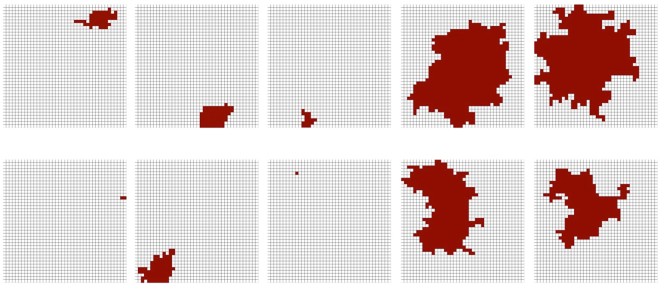
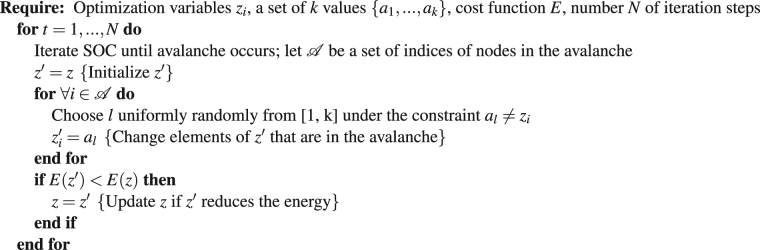
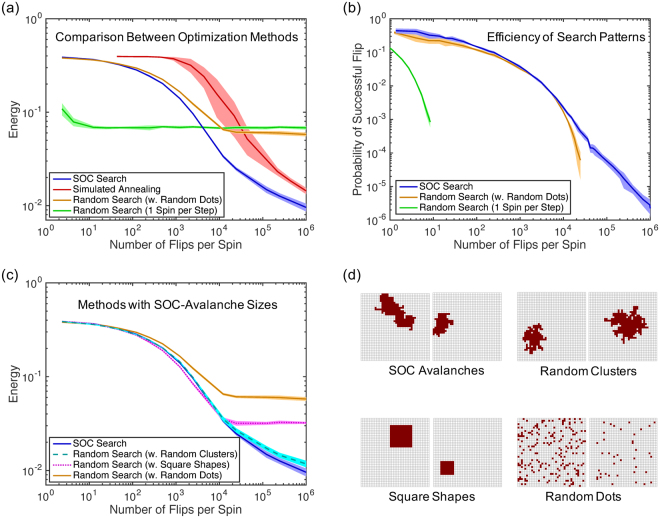
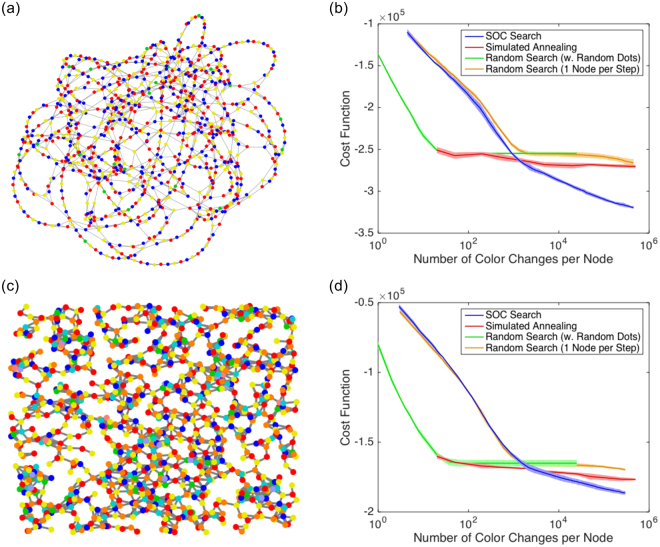
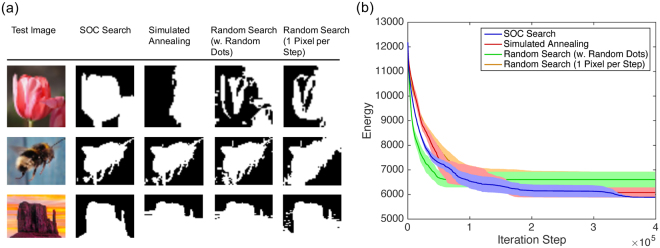
Self-organized criticality (SOC) is a phenomenon observed in certain complex systems of multiple interacting components, e.g., neural networks, forest fires, and power grids, that produce power-law distributed avalanche sizes. Here, we report the surprising result that the avalanches from an SOC process can be used to solve non-convex optimization problems. To generate avalanches, we use the Abelian sandpile model on a graph that mirrors the graph of the optimization problem. For optimization, we map the avalanche areas onto search patterns for optimization, while the SOC process receives no feedback from the optimization itself. The resulting method can be applied without parameter tuning to a wide range of optimization problems, as demonstrated on three problems: finding the ground-state of an Ising spin glass, graph coloring, and image segmentation. We find that SOC search is more efficient compared to other random search methods, including simulated annealing, and unlike annealing, it is parameter free, thereby eliminating the time-consuming requirement to tune an annealing temperature schedule.
Overview
The claims and statistics of this paper haven’t been checked yet.
Run the check — free, no account needed. It reads the open-access text and checks the sources it cites.
Integrity signals
Registry
Cites
Statistics
Figures
Verification
Claims the paper makes
The claims and statistics of this paper haven’t been checked yet.
Run the check — free, no account needed. It reads the open-access text and checks the sources it cites.
Claims other papers make about this one
Each is checked against this paper’s own text: does it say what the citing paper says it does?
The source backs part of the claim, not all of it — or backs it for a different population, condition or comparison.
In the citing paper
“Hierarchical organization, modularity, and self-organized criticality (SOC) may promote both integrated information maximization and free energy minimization (Friston et al., 2012a, 2014; Vázquez-Rodríguez et al., 2017; Hoffmann and Payton, 2018; Salehipour et al., 2018; Khajehabdollahi et al., 2019), potentially suggesting major points of intersection between FEP-AI and IIT across a wide range of”
From An Integrated World Modeling Theory (IWMT) of Consciousness (2020) · cites this paper as Hoffmann and Payton, 2018
Experimental — accuracy not yet measured
Self-check
Percentages, sums and reported differences re-computed from the paper’s own numbers.
The self-check needs the paper’s full text.
Citations
Cites
Real-Time Computation at the Edge of Chaos in Recurrent Neural Networks
Bertschinger, N., & Natschläger, T. (2004) · Neural Computation · doi:10.1162/089976604323057443 · Cited by 833
Research works printed but not linked: 23
- Beggs, J. M. & Plenz, D. Neuronal avalanches in neocortical circuits. Journal of Neuroscience 23, 11167–11177 (2003). · DOI · Paper page
- Chialvo, D. R. Emergent complex neural dynamics. Nature Physics 6, 744–750 (2010). · DOI · Paper page
- Hesse, J. & Gross, T. Self-organized criticality as a fundamental property of neural systems. Frontiers in Systems Neuroscience 8, 166 (2014). · DOI · Paper page
- Meisel, C., Storch, A., Hallmeyer-Elgner, S., Bullmore, E. & Gross, T. Failure of adaptive self-organized criticality during epileptic seizure attacks. PLOS Computational Biology 8, 1–8 (2012). · DOI
- Bak, P., Tang, C. & Wiesenfeld, K. Self-organized criticality: An explanation of the 1/f noise. Physical Review Letters 59, 381–384 (1987). · DOI
- Brochini, L. et al. Phase transitions and self-organized criticality in networks of stochastic spiking neurons. Scientific Reports 6, 35831 (2016). · DOI
- Beggs, J. M. & Timma, N. Being critical of criticality in the brain. Frontiers in Physiology 3, 163 (2012). · DOI
- Dehghani, N. et al. Avalanche analysis from multielectrode ensemble recordings in cat, monkey, and human cerebral cortex during wakefulness and sleep. Frontiers in Physiology 3, 302 (2012). · DOI
- Kinouchi, O. & Copelli, M. Optimal dynamical range of excitable networks at criticality. Nature Physics 2, 348–351 (2006). · DOI · Paper page
- Stepp, N., Plenz, D. &Srinivasa, N. Synaptic plasticity enables adaptive self-tuning critical networks. PLOS Computational Biology 11 (2015). · DOI
- Kirkpatrick, S., C. D. Gelatt, J. & Vecchi, M. P. Optimization by simulated annealing. Science 220, 671–682 (1983). · DOI · Paper page
- Frette, V. et al. Avalanche dynamics in a pile of rice. Nature 379, 49–52 (1996). · DOI
- Dhar, D. Self-organized critical state of sandpile automaton models. Physical Review Letters 64, 1613 (1990). · DOI
- Boettcher, S. & Percus, A. G. Optimization with extremal dynamics. Physical Review Letters 86, 5211–5214 (2001). · DOI
- Santoro, G. E., Martonak, R., Tosatti, E. & Car, R. Theory of quantum annealing of an Ising spin glass. Science 295, 2427–2430 (2002). · DOI · Paper page
- Marx, D. Graph colouring problems and their applications in scheduling. Periodica Polytechnica, Electrical Engineering 48, 11–16 (2004).
- Chaitin, G. J. Register allocation and spilling via graph colouring. In Proc. 1982 SIGPLAN Symposium on Compiler Construction, 98–105 (1982). · DOI
- Johnson, D. S., Aragon, C. R., McGeoch, L. A. & Schevon, C. Optimization by simulated annealing: An experimental evaluation; part II. graph coloring and number partitioning. Operations Research 39, 378–406 (1991). · DOI
- Watts, D. J. & Strogatz, S. H. Collective dynamics of “small-world” networks. Nature 393, 440–442 (1998). · DOI · Paper page
- Long, J., Shelhamer, E. &Darrell, T. Fully convolutional networks for semantic segmentation. In 2015 IEEE Conference on Computer Vision and Pattern Recognition (CVPR), 3431–3440 (2015). · DOI · Paper page
- Geman, S. & Geman, D. Stochastic relaxation, Gibbs distributions and Bayesian restoration of images. IEEE Transactions on Pattern Analysis and Machine Intelligence 6, 721–741 (1984). · DOI · Paper page
- Kato, Z. & Pong, T.-C. A Markov random field image segmentation model for color textured images. Image and Vision Computing 24, 1103–1114 (2006). · DOI
- Kohli, P. & Torr, P. H. S. Efficiently solving dynamic Markov random fields using graph cuts. In IEEE International Conference on Computer Vision, 922–929 (2005). · DOI
Cited by
Sorted by citations
Safron, A. (2020) · Frontiers in Artificial Intelligence · doi:10.3389/frai.2020.00030 · Cited by 133
Radiolysis Generates a Complex Organosynthetic Chemical Network
Adam, Z., Fahrenbach, A. C., Jacobson, S. M., Kacar, B., & Zubarev, D. Y. (2019) · doi:10.26434/chemrxiv.10148684 · Cited by 34
Metadata
- Authors
- Hoffmann, H., & Payton, D. W.
- Affiliations
- HRL Laboratories (United States) (US)
- Corresponding author
- Hoffmann, Heiko
- Venue
- Scientific Reports
- Published
- 2018-02-05
- Volume
- 8
- Issue
- 1
- Pages
- 2358-2358
- ISSN
- 2045-2322 (ISSN-L)
- PMC
- PMC5799203
- OpenAlex
- W2806907131
- Cited by
- 65
- References
- 1
- Citations by year
- 2026: 3 · 2025: 5 · 2024: 13 · 2023: 10 · 2022: 9 · 2021: 9 · 2020: 9 · 2019: 5 · 2018: 2
- FWCI
- 3.38
- Type
- journal article
- Language
- en
- Open access
- gold
- doi.org
- Locations
- Scientific Reports (publishedVersion, cc-by)
- PubMed Central (publishedVersion, cc-by)
- PubMed (publishedVersion)
- DOAJ (DOAJ: Directory of Open Access Journals) (submittedVersion)
- Topics
- Physical Sciences › Physics and Astronomy › Condensed Matter Physics › Theoretical and Computational Physics
- Physical Sciences › Computer Science › Artificial Intelligence › Metaheuristic Optimization Algorithms Research
- Physical Sciences › Physics and Astronomy › Statistical and Nonlinear Physics › Complex Network Analysis Techniques
- Keywords
- self-organized criticality, non-convex optimization, Abelian sandpile model, avalanches, power-law distribution, Ising spin glass, ground state search, graph coloring, image segmentation, parameter-free optimization, simulated annealing comparison
About these checks
Registry, retraction, Cites and statistics results are computed, not judged, with one exception: a printed reference that no index lists is read once by a model before it counts as a citation error. Claims are extracted by a model and kept only when their quote appears verbatim in the text; each cited source is then checked, with a model’s help, for whether it says what the claim relies on. Those verdicts can be wrong — read the claim’s quote and the cited source before relying on one.
Statistics and arithmetic are recomputed, not judged.
Confidence bands are shown only for fields calibrated on our annotated test set. None is calibrated yet, so no band is shown.
What counts as a claim ›How we measure confidence ›How we check this ›
Are you an author, or do you see a problem with this page? Request a review
