

Elements of the complete blood count associated with cardiovascular disease incidence: Findings from the EPIC-NL cohort study
Open accessThe DOI matches its Crossref record; 50 of the 50 references it cites were found in a registry or an index.
Abstract
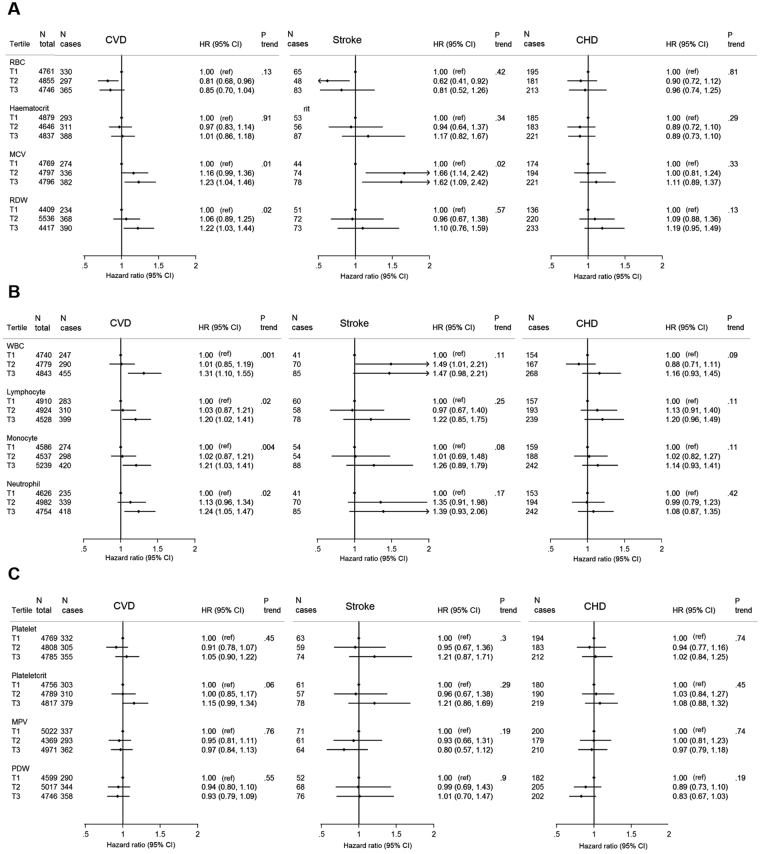
All blood cells (white blood cells [WBC], red blood cells [RBC] and platelets) can play a role in atherosclerosis. Complete blood count (CBC) is widely available in clinical practice but utility as potential risk factors for cardiovascular disease (CVD) is uncertain. Our aim was to assess the associations of pre-diagnostic CBC with incidence of CVD in 14,362 adults free of CVD and aged 47.8 (±11.7) years at baseline, followed-up for 11.4 years (992 incident cases). Cox proportional hazards regressions were used to estimate HRs and 95%CI. Comparing the top (T3) to bottom (T1) tertile, increased total WBC, lymphocyte, monocyte and neutrophil counts were associated with higher CVD risk: 1.31 (1.10; 1.55), 1.20 (1.02; 1.41), 1.21 (1.03; 1.41) and 1.24 (1.05; 1.47), as well as mean corpuscular volume (MCV: 1.23 [1.04; 1.46]) and red cell distribution width (RDW: 1.22 [1.03; 1.44]). Platelets displayed an association for count values above the clinically normal range: 1.49 (1.00; 2.22). To conclude, total and differential WBC count, MCV, RDW and platelet count likely play a role in the aetiology of CVD but only WBC provide a modest improvement for the prediction of 10-year CVD risk over traditional CVD risk factors in a general population.
Overview
The claims and statistics of this paper haven’t been checked yet.
Free: it reads the open-access text and checks the first 5 claims that cite a source we can check. Create a free account to check every claim.
Integrity signals
Registry
Cites
Statistics
Figures
Verification
Claims the paper makes
The claims and statistics of this paper haven’t been checked yet.
Free: it reads the open-access text and checks the first 5 claims that cite a source we can check. Create a free account to check every claim.
Claims other papers make about this one
Each is checked against this paper’s own text: does it say what the citing paper says it does?
The check wasn’t confident either way, so it gives no verdict — never disputed.
In the citing paper
“In addition, compared to absolute cell counts, CBC-based ratios are considered more stable and sensitive indicators [16,17].”
From Complete blood count-based inflammation indexes and symptom severity in people with bipolar disorder: an analysis based on structural equation modelling (2026) · cites this paper as [17]
Experimental — accuracy not yet measured
Self-check
Percentages, sums and reported differences re-computed from the paper’s own numbers.
The self-check needs the paper’s full text.
Citations
Cites
A Proportional Hazards Model for the Subdistribution of a Competing Risk
Fine, J. P., & Gray, R. J. (1999) · Journal of the American Statistical Association · doi:10.1080/01621459.1999.10474144 · Cited by 14,290 · cited 1×
“A competing risk model was fitted to estimate cause-specific sub hazard ratios 26 for CHD and stroke, with the other outcome taken as a competing risk in the analysis.”
Immunity, Inflammation, and Cancer
Grivennikov, S. I., Greten, F. R., & Karin, M. (2010) · Cell · doi:10.1016/j.cell.2010.01.025 · Cited by 10,755 · cited 1×
“…analyses were conducted by (1) excluding prevalent cancer cases at baseline due to the potential modifications of the blood count by cancer 27 and the increased cardiovascular risk of cancer patients 28 ; (2) excluding participants with less than two years of follow-up to avoid reverse…”
European Guidelines on cardiovascular disease prevention in clinical practice (version 2012)
Authors/Task Force Members:, Perk, J., De Backer, G., Gohlke, H., Graham, I., Reiner, Ž., Verschuren, M., Albus, C., Benlian, P., Boysen, G., et al. (2012) · European Heart Journal · doi:10.1093/eurheartj/ehs092 · Cited by 8,490
Self-citationInflammation in atherosclerosis
Libby, P. (2002) · Nature · doi:10.1038/nature01323 · Cited by 8,315
2016 European Guidelines on cardiovascular disease prevention in clinical practice
Piepoli, M. F., Hoes, A. W., Agewall, S., Albus, C., Brotons, C., Catapano, A. L., Cooney, M.-T., Corrà, U., Cosyns, B., Deaton, C., et al. (2016) · European Heart Journal · doi:10.1093/eurheartj/ehw106 · Cited by 6,457
Self-citationEstimation of ten-year risk of fatal cardiovascular disease in Europe: the SCORE project
Conroy, R. (2003) · European Heart Journal · doi:10.1016/s0195-668x(03)00114-3 · Cited by 5,290
Danesh, J., Collins, R., Appleby, P., & Peto, R. (1998) · JAMA · doi:10.1001/jama.279.18.1477 · Cited by 2,026 · cited 1×
“Sensitivity analyses were conducted by (1) excluding prevalent cancer cases at baseline due to the potential modifications of the blood count by cancer27 and the increased cardiovascular risk of cancer patients28; (2) excluding participants with less than two years of follow-up to avoid reverse causality, as a change…”
MethodAuthors/Task Force Members, Piepoli, M. F., Hoes, A. W., Agewall, S., Albus, C., Brotons, C., Catapano, A. L., Cooney, M.-T., Corrà, U., Cosyns, B., et al. (2016) · European Journal of Preventive Cardiology · doi:10.1177/2047487316653709 · Cited by 1,334
Self-citationRed blood cell distribution width: A simple parameter with multiple clinical applications
Salvagno, G. L., Sanchis-Gomar, F., Picanza, A., & Lippi, G. (2015) · Critical Reviews in Clinical Laboratory Sciences · doi:10.3109/10408363.2014.992064 · Cited by 1,236
C-reactive protein, fibrinogen, and cardiovascular disease prediction
The Emerging Risk Factors Collaboration (2012) · New England Journal of Medicine · doi:10.1056/nejmoa1107477 · Cited by 1,150
Research works printed but not linked: 1
- WHO. ICD-10: International Statistical Classification of Diseases and Related Health Problems -10th revision, edition 2010. Volume 2 -Instruction manual. Geneva, Switzerland, WHO Press (2011).
Cited by
Items 101–121 of 121
Assessment of Haematological and Respiratory Health Risk from Air Pollution
Chowdhury, M., Ghosh, B., Rabha, R., & Padhy, P. K. (2025) · Springer eBooks · doi:10.1007/978-3-031-84408-9_7 · Cited by 1
Sleep variability and cardiovascular health in undergraduate college students
Katulka, E. K. (2020) · Library, Museums and Press - UDSpace (University of Delaware) · doi:10.58088/83me-az82
Saeed, M., & Tian, X. (2021) · Springer eBooks · doi:10.1007/978-3-030-22009-9_1071
Saeed, M., & Tian, X. (2019) · Springer eBooks · doi:10.1007/978-3-319-69892-2_1071-1
Determination of angiotensin-converting enzyme concentration in cardiovascular patients
AlBayati, M. M., & Al-Nahi, A. S. (2022) · International Journal of Health Sciences · doi:10.53730/ijhs.v6ns3.8541
Research Progress on Platelet and Aging-Related Diseases
李, 静. (2022) · Advances in Clinical Medicine · doi:10.12677/acm.2022.12101320
Onyebuenyi, M. O., Udokang, N.-A., Out, I. S., & Kekii, G. B. (2023) · Open Access Research Journal of Biology and Pharmacy · doi:10.53022/oarjbp.2023.9.2.0057
Onyebuenyi, M. O., Otu, I. S., Udokang, N.-A., Princewill Chike, R., & Chinko, B. C. (2024) · World Journal of Advanced Research and Reviews · doi:10.30574/wjarr.2024.21.2.0376
A retrospective cohort study of myocarditis prevalence and diagnosis in Al‐Baha region, Saudi Arabia
Alghamdi, R. A., Alyahyawi, H. E., Albanghali, M. A., & Almalki, S. S. R. (2024) · Saudi Journal for Health Sciences · doi:10.4103/sjhs.sjhs_176_23
Amalia, M., Saputri, F. C., Sauriasari, R., & Widyantoro, B. (2024) · AIP conference proceedings · doi:10.1063/5.0218103
Marko, O., Vrenjo, K., & Sulçe, M. (2024) · Central European Journal of Sport Sciences and Medicine · doi:10.18276/cej.2024.3-03
Mustafa, B. K., Abdullah, S. M., Wsoo, M. A., IBRAHIM, R., & Kheder, R. K. (2025) · South Eastern European Journal of Public Health · doi:10.70135/seejph.vi.3339
Etude du lien entre la MASLD et l'athérosclérose : implication du récepteur nucléaire PPARα
Henry, D. (2024) · theses.fr (ABES) · doi:10.70675/573969cdz9f43z407fz8775zbacc66020c5a
Wang, K.-C., Lin, C.-L., Lin, C., Lee, Y.-T., Hsu, L., Chien, K., & Yeh, T. (2025) · PLoS ONE · doi:10.1371/journal.pone.0322645
“Most studies have shown the association between elevated neutrophil count and an increased CVD incidence [13–21] except a few studies with contradictory results [22,23].”
Mambo, A. M., Yang, Y., Mahulu, E. N., & Zhou, Z. (2024) · Figshare · doi:10.6084/m9.figshare.25546948
Mambo, A. M., Yang, Y., Mahulu, E. N., & Zhou, Z. (2024) · Figshare · doi:10.6084/m9.figshare.25547108
Menni, C., Louca, P., Berry, S. E., Vijay, A., Astbury, S., Leeming, E. R., Gibson, R., Asnicar, F., Piccinno, G., Wolf, J., et al. (2021) · Figshare · doi:10.6084/m9.figshare.13889152
Adherence, efficacy and patient perspective of a multi-disease, community-based exercise programme
Regan‐Moriarty, J. (2023) · Dublin City University Open Access Institutional Repository (Dublin City University)
Cheng, B.-J., Xie, M., Chen, H., Jiang, N., Zhu, X.-Y., Bambrick, H., Tong, M., & Liu, R. (2026) · Scientific Reports · doi:10.1038/s41598-025-32084-w
“Inflammatory markers (WBC, NEUT, NP, and PC) reflect systemic inflammation and have been associated with elevated cardiovascular risk 28 .”
Liu, Z., Huang, D., Hao, C., & He, Y. (2026) · European Journal of Applied Physiology · doi:10.1007/s00421-026-06253-2
“Other studies have demonstrated that increases in total WBC, neutrophil, monocyte, and lymphocyte counts are associated with higher risk of incident cardiovascular disease (Lassale et al. 2018).”
Xu, Y., 谢双锋, He, F., Song, F., Mao, Y.-H., Wang, R., Ni, H., & Yang, Y. (2026) · Experimental Gerontology · doi:10.1016/j.exger.2026.113279
Metadata
- Authors
- Lassale, C., Curtis, A., Abete, I., van der Schouw, Y. T., Verschuren, W. M. M., Lu, Y., & Bueno-de-Mesquita, H. B.
- Affiliations
- University College London (GB)
- Imperial College London (GB)
- University Medical Center Utrecht (NL)
- University of California, Irvine (US)
- University of Malaya (MY)
- Corresponding author
- Lassale, Camille
- Venue
- Scientific Reports
- Published
- 2018-02-19
- Volume
- 8
- Issue
- 1
- Pages
- 3290-3290
- ISSN
- 2045-2322 (ISSN-L)
- PMC
- PMC5818488
- OpenAlex
- W2791673123
- Semantic Scholar
- 9e052d238c8dcad946d88656f751b06e033d1aac
- Cited by
- 118
- References
- 50
- Citations by year
- 2026: 5 · 2025: 21 · 2024: 21 · 2023: 11 · 2022: 14 · 2021: 27 · 2020: 5 · 2019: 11 · 2018: 3
- FWCI
- 4.31
- Type
- journal article
- Language
- en
- Open access
- gold
- doi.org
- Licence
- cc-by
- creativecommons.org/licenses/by/4.0 (tdm)
- creativecommons.org/licenses/by/4.0 (vor)
- Locations
- Scientific Reports (publishedVersion, cc-by)
- Europe PMC (PubMed Central) (publishedVersion, cc-by)
- PubMed Central (publishedVersion, cc-by)
- PubMed (publishedVersion)
- Deposito Adademico Digital Universidad De Navarra (University of Navarra) (submittedVersion, cc-by)
- DOAJ (DOAJ: Directory of Open Access Journals) (submittedVersion)
- Utrecht University Repository (Utrecht University) (submittedVersion, other-oa)
- UCL Discovery (University College London) (submittedVersion)
- eScholarship (California Digital Library) (submittedVersion)
- Rivm Repository (Netherlands National Institute for Public Health and the Environment) (submittedVersion)
- Rivm (National Institute for Public Health and the Environment) (submittedVersion)
- Funders
- European Commission
- ZonMw
- KWF Kankerbestrijding
- World Cancer Research Fund
- Topics
- Health Sciences › Medicine › Oncology › Inflammatory Biomarkers in Disease Prognosis
- Health Sciences › Medicine › Cardiology and Cardiovascular Medicine › Cardiovascular Health and Risk Factors
- Health Sciences › Medicine › Cardiology and Cardiovascular Medicine › Lipoproteins and Cardiovascular Health
- Keywords
- complete blood count, cardiovascular disease incidence, white blood cell count, lymphocytes, monocytes, neutrophils, mean corpuscular volume, red cell distribution width, platelet count, atherosclerosis, cardiovascular risk prediction, EPIC-NL cohort
- MeSH terms
- Aged, Blood Cell Count, Cardiovascular Diseases, Erythrocyte Count, Erythrocyte Indices, Erythrocytes, Female, Humans, Leukocyte Count, Male, Middle Aged, Monocytes, Netherlands, Neutrophils, Risk Factors
About these checks
Registry, retraction, Cites and statistics results are computed, not judged, with one exception: a printed reference that no index lists is read once by a model before it counts as a citation error. Claims are extracted by a model and kept only when their quote appears verbatim in the text; each cited source is then checked, with a model’s help, for whether it says what the claim relies on. Those verdicts can be wrong — read the claim’s quote and the cited source before relying on one.
Statistics and arithmetic are recomputed, not judged.
Confidence bands are shown only for fields calibrated on our annotated test set. None is calibrated yet, so no band is shown.
What counts as a claim ›How we measure confidence ›How we check this ›
Are you an author, or do you see a problem with this page? Request a review
Data sources
Bibliographic data: Semantic Scholar, OpenAlex, Crossref.
Contains information from the Semantic Scholar Academic Graph Datasets, made available under the ODC Attribution License (ODC-BY 1.0).
Semantic Scholar’s data is described in: Kinney, R., et al. (2023). The Semantic Scholar Open Data Platform. arXiv:2301.10140.
