

Elements of the complete blood count associated with cardiovascular disease incidence: Findings from the EPIC-NL cohort study
Open accessThe DOI matches its Crossref record; 50 of the 50 references it cites were found in a registry or an index.
Abstract
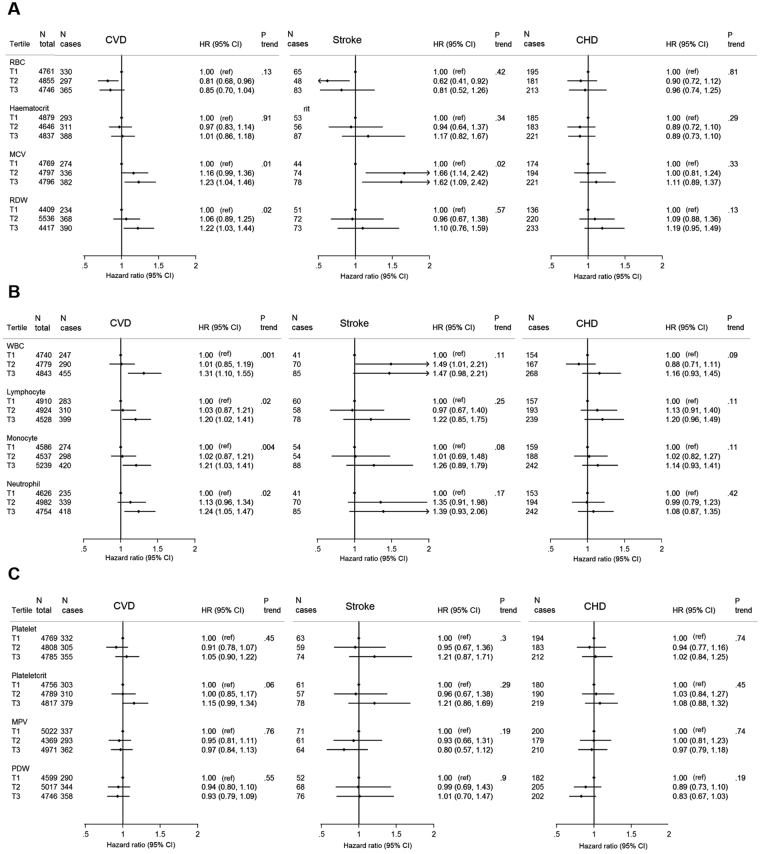
All blood cells (white blood cells [WBC], red blood cells [RBC] and platelets) can play a role in atherosclerosis. Complete blood count (CBC) is widely available in clinical practice but utility as potential risk factors for cardiovascular disease (CVD) is uncertain. Our aim was to assess the associations of pre-diagnostic CBC with incidence of CVD in 14,362 adults free of CVD and aged 47.8 (±11.7) years at baseline, followed-up for 11.4 years (992 incident cases). Cox proportional hazards regressions were used to estimate HRs and 95%CI. Comparing the top (T3) to bottom (T1) tertile, increased total WBC, lymphocyte, monocyte and neutrophil counts were associated with higher CVD risk: 1.31 (1.10; 1.55), 1.20 (1.02; 1.41), 1.21 (1.03; 1.41) and 1.24 (1.05; 1.47), as well as mean corpuscular volume (MCV: 1.23 [1.04; 1.46]) and red cell distribution width (RDW: 1.22 [1.03; 1.44]). Platelets displayed an association for count values above the clinically normal range: 1.49 (1.00; 2.22). To conclude, total and differential WBC count, MCV, RDW and platelet count likely play a role in the aetiology of CVD but only WBC provide a modest improvement for the prediction of 10-year CVD risk over traditional CVD risk factors in a general population.
Overview
The claims and statistics of this paper haven’t been checked yet.
Free: it reads the open-access text and checks the first 5 claims that cite a source we can check. Create a free account to check every claim.
Integrity signals
Registry
Cites
Statistics
Figures
Verification
Claims the paper makes
The claims and statistics of this paper haven’t been checked yet.
Free: it reads the open-access text and checks the first 5 claims that cite a source we can check. Create a free account to check every claim.
Claims other papers make about this one
Each is checked against this paper’s own text: does it say what the citing paper says it does?
The check wasn’t confident either way, so it gives no verdict — never disputed.
In the citing paper
“In addition, compared to absolute cell counts, CBC-based ratios are considered more stable and sensitive indicators [16,17].”
From Complete blood count-based inflammation indexes and symptom severity in people with bipolar disorder: an analysis based on structural equation modelling (2026) · cites this paper as [17]
Experimental — accuracy not yet measured
Self-check
Percentages, sums and reported differences re-computed from the paper’s own numbers.
The self-check needs the paper’s full text.
Citations
Cites
A Proportional Hazards Model for the Subdistribution of a Competing Risk
Fine, J. P., & Gray, R. J. (1999) · Journal of the American Statistical Association · doi:10.1080/01621459.1999.10474144 · Cited by 14,290 · cited 1×
“A competing risk model was fitted to estimate cause-specific sub hazard ratios 26 for CHD and stroke, with the other outcome taken as a competing risk in the analysis.”
Immunity, Inflammation, and Cancer
Grivennikov, S. I., Greten, F. R., & Karin, M. (2010) · Cell · doi:10.1016/j.cell.2010.01.025 · Cited by 10,755 · cited 1×
“…analyses were conducted by (1) excluding prevalent cancer cases at baseline due to the potential modifications of the blood count by cancer 27 and the increased cardiovascular risk of cancer patients 28 ; (2) excluding participants with less than two years of follow-up to avoid reverse…”
European Guidelines on cardiovascular disease prevention in clinical practice (version 2012)
Authors/Task Force Members:, Perk, J., De Backer, G., Gohlke, H., Graham, I., Reiner, Ž., Verschuren, M., Albus, C., Benlian, P., Boysen, G., et al. (2012) · European Heart Journal · doi:10.1093/eurheartj/ehs092 · Cited by 8,490
Self-citationInflammation in atherosclerosis
Libby, P. (2002) · Nature · doi:10.1038/nature01323 · Cited by 8,315
2016 European Guidelines on cardiovascular disease prevention in clinical practice
Piepoli, M. F., Hoes, A. W., Agewall, S., Albus, C., Brotons, C., Catapano, A. L., Cooney, M.-T., Corrà, U., Cosyns, B., Deaton, C., et al. (2016) · European Heart Journal · doi:10.1093/eurheartj/ehw106 · Cited by 6,457
Self-citationEstimation of ten-year risk of fatal cardiovascular disease in Europe: the SCORE project
Conroy, R. (2003) · European Heart Journal · doi:10.1016/s0195-668x(03)00114-3 · Cited by 5,290
Danesh, J., Collins, R., Appleby, P., & Peto, R. (1998) · JAMA · doi:10.1001/jama.279.18.1477 · Cited by 2,026 · cited 1×
“Sensitivity analyses were conducted by (1) excluding prevalent cancer cases at baseline due to the potential modifications of the blood count by cancer27 and the increased cardiovascular risk of cancer patients28; (2) excluding participants with less than two years of follow-up to avoid reverse causality, as a change…”
MethodAuthors/Task Force Members, Piepoli, M. F., Hoes, A. W., Agewall, S., Albus, C., Brotons, C., Catapano, A. L., Cooney, M.-T., Corrà, U., Cosyns, B., et al. (2016) · European Journal of Preventive Cardiology · doi:10.1177/2047487316653709 · Cited by 1,334
Self-citationRed blood cell distribution width: A simple parameter with multiple clinical applications
Salvagno, G. L., Sanchis-Gomar, F., Picanza, A., & Lippi, G. (2015) · Critical Reviews in Clinical Laboratory Sciences · doi:10.3109/10408363.2014.992064 · Cited by 1,236
C-reactive protein, fibrinogen, and cardiovascular disease prediction
The Emerging Risk Factors Collaboration (2012) · New England Journal of Medicine · doi:10.1056/nejmoa1107477 · Cited by 1,150
Mean platelet volume as a predictor of cardiovascular risk: a systematic review and meta‐analysis
CHU, S. G., BECKER, R. C., BERGER, P. B., BHATT, D. L., EIKELBOOM, J. W., KONKLE, B., MOHLER, E. R., REILLY, M. P., & BERGER, J. S. (2010) · Journal of Thrombosis and Haemostasis · doi:10.1111/j.1538-7836.2009.03584.x · Cited by 1,043 · cited 1×
“The MPV, which is related to platelet activity (larger platelets are metabolically and enzymatically more active and have greater prothrombotic potential), have not been consistently associated with CHD in previously healthy patients, but more consistently so with stroke 45 .”
Which White Blood Cell Subtypes Predict Increased Cardiovascular Risk?
Horne, B. D., Anderson, J. L., John, J. M., Weaver, A., Bair, T. L., Jensen, K. R., Renlund, D. G., & Muhlestein, J. B. (2005) · Journal of the American College of Cardiology · doi:10.1016/j.jacc.2005.02.054 · Cited by 967 · cited 2×
“A meta-analysis in 2004 4 found only neutrophils to be associated with CHD, which was confirmed in subsequent studies 38,39 .”
Wareham, N. J., Jakes, R. W., Rennie, K. L., Schuit, J., Mitchell, J., Hennings, S., & Day, N. E. (2003) · Public Health Nutrition · doi:10.1079/phn2002439 · Cited by 850 · cited 1×
“This index has been validated and widely used in analyses in the EPIC study 22 .”
Thaulow, E., Erikssen, J., Sandvik, L., Stormorken, H., & Cohn, P. F. (1991) · Circulation · doi:10.1161/01.cir.84.2.613 · Cited by 458 · cited 2×
“One cohort study reported an increased risk of CHD mortality in men in the top quartile of platelet counts 43 , while another observed an increased risk of incident CVD for platelet counts > 300 vs 200–250 10 9 /L 19 , in line with our results of an elevated CVD and CHD risk in the high ( > 400) vs…”
Danesh, J. (2000) · European Heart Journal · doi:10.1053/euhj.1999.1699 · Cited by 339
Low Lymphocyte Count and Cardiovascular Diseases
Nunez, J., Minana, G., Bodi, V., Nunez, E., Sanchis, J., Husser, O., & Llacer, A. (2011) · Current Medicinal Chemistry · doi:10.2174/092986711796391633 · Cited by 297
Pizzulli, L. (1998) · European Heart Journal · doi:10.1053/euhj.1997.0747 · Cited by 265
Guasti, L., Castiglioni, L., Maroni, L., Marino, F., Squizzato, A., Ageno, W., Gianni, M., Gaudio, G., Grandi, A., Cosentino, M., et al. (2011) · Thrombosis and Haemostasis · doi:10.1160/th11-02-0096 · Cited by 250
Cohort Profile: The EPIC-NL study
Beulens, J. W. J., Monninkhof, E. M., Verschuren, W. M. M., Schouw, Y. T. V. D., Smit, J., Ocke, M. C., Jansen, E. H. J. M., Dieren, S. V., Grobbee, D. E., Peeters, P. H. M., et al. (2010) · International Journal of Epidemiology · doi:10.1093/ije/dyp217 · Cited by 206 · cited 1×
“The cohort profile has been published elsewhere 20 .”
Self-citationMadjid, M., & Fatemi, O. (2013) · Europe PMC (PubMed Central) · Cited by 204
WHEELER, J. (2004) · European Heart Journal · doi:10.1016/j.ehj.2004.05.002 · Cited by 200 · cited 2×
“A meta-analysis in 2004 4 found only neutrophils to be associated with CHD, which was confirmed in subsequent studies 38,39 .”
Vinholt, P. J., Hvas, A., Frederiksen, H., Bathum, L., Jørgensen, M. K., & Nybo, M. (2016) · Thrombosis Research · doi:10.1016/j.thromres.2016.08.012 · Cited by 155 · cited 3×
“…an increased risk of CHD mortality in men in the top quartile of platelet counts 43 , while another observed an increased risk of incident CVD for platelet counts > 300 vs 200–250 10 9 /L 19 , in line with our results of an elevated CVD and CHD risk in the high ( > 400) vs normal (150–400) range.”
The reliability of cause-of-death coding in The Netherlands
Harteloh, P., de Bruin, K., & Kardaun, J. W. P. F. (2010) · European Journal of Epidemiology · doi:10.1007/s10654-010-9445-5 · Cited by 151 · cited 1×
“Accuracy of cause of death claim in the register was assessed in a study where causes of death were coded again two years after initial coding, and agreement was 82% for coronary heart disease, and 79% for stroke 24 .”
Chen, P., Sung, F. C., Chien, K., Hsu, H. C., Su, T., & Lee, Y.-T. (2009) · American Journal of Epidemiology · doi:10.1093/aje/kwp360 · Cited by 132 · cited 1×
“A handful of studies reported associations between RDW and CVD in general populations 12–15, 33,34 , with four stemming from two cohorts ( the”
Luca, G. D., Venegoni, L., Iorio, S., Secco, G. G., Cassetti, E., Verdoia, M., Schaffer, A., Coppo, L., Bellomo, G., Marino, P. N., et al. (2010) · Platelets · doi:10.3109/09537104.2010.494743 · Cited by 122 · cited 8×
“One study investigated the role of PDW 46 and showed no association with CHD.”
InfluentialSöderholm, M., Borné, Y., Hedblad, B., Persson, M., & Engström, G. (2015) · PLoS ONE · doi:10.1371/journal.pone.0124957 · Cited by 117 · cited 1×
“A handful of studies reported associations between RDW and CVD in general populations 12–15, 33,34 , with four stemming from two cohorts ( the”
Fukuta, H., Ohte, N., Mukai, S., Saeki, T., Asada, K., Wakami, K., & Kimura, G. (2009) · International Heart Journal · doi:10.1536/ihj.50.301 · Cited by 116
Weitzman, D., Raz, R., Steinvil, A., Zeltser, D., Berliner, S. A., Chodick, G., Shalev, V., & Arbel, Y. (2013) · Thrombosis and Haemostasis · doi:10.1160/th13-07-0567 · Cited by 104 · cited 1×
“A handful of studies reported associations between RDW and CVD in general populations 12–15, 33,34 , with four stemming from two cohorts ( the”
Platelets and Cardiovascular Disease
Gregg, D., & Goldschmidt‐Clermont, P. J. (2003) · Circulation · doi:10.1161/01.cir.0000086897.15588.4b · Cited by 103
Skjelbakken, T., Lappegård, J., Ellingsen, T. S., Barrett-Connor, E. L., Brox, J. H., Løchen, M., Njølstad, I., Wilsgaard, T., Mathiesen, E. B., Brækkan, S. K., et al. (2014) · Journal of the American Heart Association · doi:10.1161/jaha.114.001109 · Cited by 102
Quitting Smoking May Restore Hematological Characteristics within Five Years
Tiel, E. V. (2002) · Annals of Epidemiology · doi:10.1016/s1047-2797(01)00282-4 · Cited by 101
Shah, A. D., Denaxas, S., Nicholas, O., Hingorani, A. D., & Hemingway, H. (2016) · Open Heart · doi:10.1136/openhrt-2016-000477 · Cited by 100 · cited 1×
“A recent UK large cohort study did not find any association of eosinophils or lymphocytes with stroke or CHD 40 .”
Cardiovascular disease in cancer survivors
Okwuosa, T. M., Anzevino, S., & Rao, R. (2017) · Postgraduate Medical Journal · doi:10.1136/postgradmedj-2016-134417 · Cited by 97 · cited 1×
“…cancer cases at baseline due to the potential modifications of the blood count by cancer 27 and the increased cardiovascular risk of cancer patients 28 ; (2) excluding participants with less than two years of follow-up to avoid reverse causality, as a change in blood count may be the consequence…”
Peters, S. A. E., Woodward, M., Rumley, A., Tunstall-Pedoe, H. D., & Lowe, G. D. O. (2016) · European Journal of Preventive Cardiology · doi:10.1177/2047487316672004 · Cited by 91
Rana, J. S., Boekholdt, S. M., Ridker, P. M., Jukema, J. W., Luben, R., Bingham, S. A., Day, N. E., Wareham, N. J., Kastelein, J. J. P., & Khaw, K. ‐. (2007) · Journal of Internal Medicine · doi:10.1111/j.1365-2796.2007.01864.x · Cited by 89
Relative elevation in baseline leukocyte count predicts first cerebral infarction
Elkind, M. S. V., Sciacca, R. R., Boden-Albala, B., Rundek, T., Paik, M. C., & Sacco, R. L. (2005) · Neurology · doi:10.1212/01.wnl.0000165989.12122.49 · Cited by 83 · cited 1×
“Our results for stroke are concordant with the literature 41,42 as neutrophils were the only component of the WBC count associated with stroke but we did not detect a significant association between neutrophils and CHD.”
Borné, Y., Smith, J. G., Melander, O., & Engström, G. (2014) · Heart · doi:10.1136/heartjnl-2013-305028 · Cited by 81
Red cell distribution width is associated with future risk of incident stroke: The Tromsø Study
Ellingsen, T. S., Skjelbakken, T., Mathiesen, E. B., Njølstad, I., Wilsgaard, T., Brox, J. H., Brækkan, S. K., Hansen, J., & Lappegård, J. (2015) · Thrombosis and Haemostasis · doi:10.1160/th15-03-0234 · Cited by 71
Waterhouse, D. F. (2008) · Vascular Health and Risk Management · doi:10.2147/vhrm.2008.04.01.177 · Cited by 48
Blood cells characteristics as determinants of acute myocardial infarction
Cemin, R., Donazzan, L., Lippi, G., Clari, F., & Daves, M. (2011) · Clinical Chemistry and Laboratory Medicine (CCLM) · doi:10.1515/cclm.2011.183 · Cited by 45
Red Cell Distrubition Width (RDW): A novel risk factor for cardiovascular disease
Uyarel, H., Işık, T., Ayhan, E., & Ergelen, M. (2011) · International Journal of Cardiology · doi:10.1016/j.ijcard.2011.10.126 · Cited by 43
A U-shaped relationship between haematocrit and mortality in a large prospective cohort study
Boffetta, P., Islami, F., Vedanthan, R., Pourshams, A., Kamangar, F., Khademi, H., Etemadi, A., Salahi, R., Semnani, S., Emadi, A., et al. (2013) · International Journal of Epidemiology · doi:10.1093/ije/dyt013 · Cited by 41
Puddu, P. E., Lanti, M., Menotti, A., Mancini, M., Zanchetti, A., Círillo, M., Angeletti, M., & Panarelli, W. (2002) · Acta Cardiologica · doi:10.2143/ac.57.3.2005387 · Cited by 35
Luca, G. D., Secco, G. G., Verdoia, M., Cassetti, E., Schaffer, A., Coppo, L., & Marino, P. N. (2013) · Blood Coagulation & Fibrinolysis · doi:10.1097/mbc.0b013e32836577a8 · Cited by 34 · cited 1×
“as potential contributors of CVD risk but results are conflicting 17–19 .”
Increased Mean Platelet Volume after Oestrogen Replacement Therapy
Ranganath, L. R., Christofides, J. A., & Semple, M. J. (1996) · Annals of Clinical Biochemistry International Journal of Laboratory Medicine · doi:10.1177/000456329603300612 · Cited by 31 · cited 1×
“A role of sex hormones on PDW has been shown in women, as postmenopausal women (lower estradiol levels) had less platelet activation than premenopausal women, whereas hormone replacement therapy can increase MPV and platelet activity 47 .”
Huh, J. Y., Ross, G. W., Chen, R., Abbott, R. D., Bell, C., Willcox, B. J., Launer, L. J., Petrovitch, H., Kaya, B., & Masaki, K. (2015) · Journal of the American Geriatrics Society · doi:10.1111/jgs.13298 · Cited by 26
Do novel biomarkers add to existing scores of total cardiovascular risk?
Backer, G. D., Graham, I. M., & Cooney, M. T. (2012) · European Journal of Preventive Cardiology · doi:10.1177/2047487312448988 · Cited by 21
Sharp, D. S., Ben‐Shlomo, Y., Beswick, A. D., Andrew, M. E., & Elwood, P. C. (2005) · Platelets · doi:10.1080/09537100500124491 · Cited by 17
Franczuk, P., Kaczorowski, M., Kucharska, K., Franczuk, J., Josiak, K., Zimoch, W., Kosowski, M., Reczuch, K. W., Majda, J., Banasiak, W., et al. (2015) · Cardiology Journal · doi:10.5603/cj.a2015.0031 · Cited by 15
Waterhouse, D. F. (2008) · Vascular Health and Risk Management · doi:10.2147/vhrm.s2240
Research works printed but not linked: 1
- WHO. ICD-10: International Statistical Classification of Diseases and Related Health Problems -10th revision, edition 2010. Volume 2 -Instruction manual. Geneva, Switzerland, WHO Press (2011).
Cited by
Jin, Z., Wu, Q., Chen, S., Gao, J., Li, X., Zhang, X., Zhou, Y., He, D., Cheng, Z., Zhu, Y., et al. (2021) · Journal of Inflammation Research · doi:10.2147/jir.s283835 · Cited by 312
Genomics of hypertension: the road to precision medicine
Padmanabhan, S., & Dominiczak, A. F. (2021) · Nature Reviews Cardiology · doi:10.1038/s41569-020-00466-4 · Cited by 217
Neutrophil counts and cardiovascular disease
Luo, J., Thomassen, J. Q., Nordestgaard, B. G., Tybjærg-Hansen, A., & Frikke-Schmidt, R. (2023) · European Heart Journal · doi:10.1093/eurheartj/ehad649 · Cited by 167
“13 Other large-scale cohorts from Asia also found similar results, e.g. higher neutrophil and monocyte counts, but not lymphocyte counts, were associated with higher risk of cardiovascular risk in the Chinese Dongfeng–Tongji cohort ( n = 26 655), 14 whereas individuals with higher lymphocytes and…”
ResultSeo, I., & Lee, Y. (2022) · Biomedicines · doi:10.3390/biomedicines10112697 · Cited by 203
Xu, C., Liang, J., Xu, S., Liu, Q., Xu, J., & Gu, A. (2020) · Journal of Hazardous Materials · doi:10.1016/j.jhazmat.2020.123134 · Cited by 101
Metadata
- Authors
- Lassale, C., Curtis, A., Abete, I., van der Schouw, Y. T., Verschuren, W. M. M., Lu, Y., & Bueno-de-Mesquita, H. B.
- Affiliations
- University College London (GB)
- Imperial College London (GB)
- University Medical Center Utrecht (NL)
- University of California, Irvine (US)
- University of Malaya (MY)
- Corresponding author
- Lassale, Camille
- Venue
- Scientific Reports
- Published
- 2018-02-19
- Volume
- 8
- Issue
- 1
- Pages
- 3290-3290
- ISSN
- 2045-2322 (ISSN-L)
- PMC
- PMC5818488
- OpenAlex
- W2791673123
- Cited by
- 118
- References
- 50
- Citations by year
- 2026: 5 · 2025: 21 · 2024: 21 · 2023: 11 · 2022: 14 · 2021: 27 · 2020: 5 · 2019: 11 · 2018: 3
- FWCI
- 4.31
- Type
- journal article
- Language
- en
- Open access
- gold
- doi.org
- Licence
- cc-by
- creativecommons.org/licenses/by/4.0 (tdm)
- creativecommons.org/licenses/by/4.0 (vor)
- Locations
- Scientific Reports (publishedVersion, cc-by)
- Europe PMC (PubMed Central) (publishedVersion, cc-by)
- PubMed Central (publishedVersion, cc-by)
- PubMed (publishedVersion)
- Deposito Adademico Digital Universidad De Navarra (University of Navarra) (submittedVersion, cc-by)
- DOAJ (DOAJ: Directory of Open Access Journals) (submittedVersion)
- Utrecht University Repository (Utrecht University) (submittedVersion, other-oa)
- UCL Discovery (University College London) (submittedVersion)
- eScholarship (California Digital Library) (submittedVersion)
- Rivm Repository (Netherlands National Institute for Public Health and the Environment) (submittedVersion)
- Rivm (National Institute for Public Health and the Environment) (submittedVersion)
- Funders
- European Commission
- ZonMw
- KWF Kankerbestrijding
- World Cancer Research Fund
- Topics
- Health Sciences › Medicine › Oncology › Inflammatory Biomarkers in Disease Prognosis
- Health Sciences › Medicine › Cardiology and Cardiovascular Medicine › Cardiovascular Health and Risk Factors
- Health Sciences › Medicine › Cardiology and Cardiovascular Medicine › Lipoproteins and Cardiovascular Health
- Keywords
- complete blood count, cardiovascular disease incidence, white blood cell count, lymphocytes, monocytes, neutrophils, mean corpuscular volume, red cell distribution width, platelet count, atherosclerosis, cardiovascular risk prediction, EPIC-NL cohort
- MeSH terms
- Aged, Blood Cell Count, Cardiovascular Diseases, Erythrocyte Count, Erythrocyte Indices, Erythrocytes, Female, Humans, Leukocyte Count, Male, Middle Aged, Monocytes, Netherlands, Neutrophils, Risk Factors
About these checks
Registry, retraction, Cites and statistics results are computed, not judged, with one exception: a printed reference that no index lists is read once by a model before it counts as a citation error. Claims are extracted by a model and kept only when their quote appears verbatim in the text; each cited source is then checked, with a model’s help, for whether it says what the claim relies on. Those verdicts can be wrong — read the claim’s quote and the cited source before relying on one.
Statistics and arithmetic are recomputed, not judged.
Confidence bands are shown only for fields calibrated on our annotated test set. None is calibrated yet, so no band is shown.
What counts as a claim ›How we measure confidence ›How we check this ›
Are you an author, or do you see a problem with this page? Request a review
Data sources
Bibliographic data: Semantic Scholar, OpenAlex, Crossref.
Contains information from the Semantic Scholar Academic Graph Datasets, made available under the ODC Attribution License (ODC-BY 1.0).
Semantic Scholar’s data is described in: Kinney, R., et al. (2023). The Semantic Scholar Open Data Platform. arXiv:2301.10140.
