

Oligonucleotide conjugated multi-functional adeno-associated viruses
Open accessThe DOI matches its Crossref record; 55 of the 56 references it cites were found in a registry or an index.
Abstract
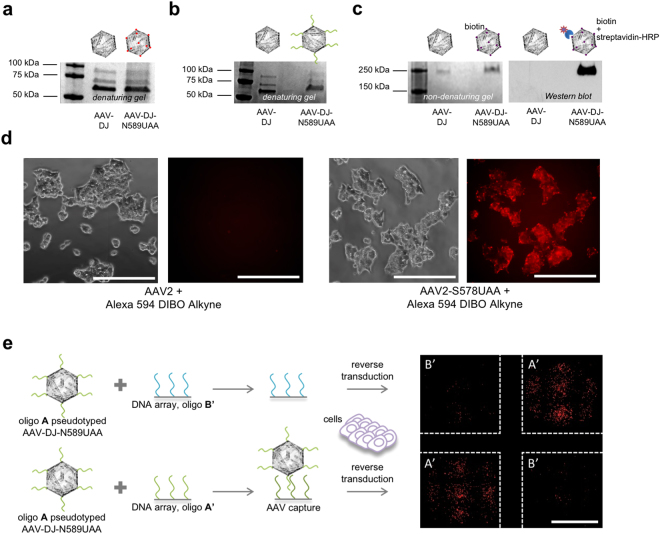
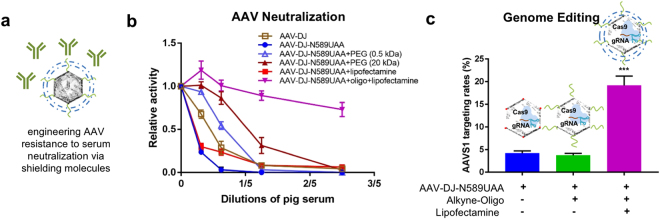
Recombinant adeno-associated viruses (AAVs) are among the most commonly used vehicles for in vivo gene delivery. However, their tropism is limited, and additionally their efficacy can be negatively affected by prevalence of neutralizing antibodies in sera. Methodologies to systematically engineer AAV capsid properties would thus be of great relevance. In this regard, we develop here multi-functional AAVs by engineering precision tethering of oligonucleotides onto the AAV surface, and thereby enabling a spectrum of nucleic-acid programmable functionalities. Towards this, we engineered genetically encoded incorporation of unnatural amino acids (UAA) bearing bio-orthogonal chemical handles onto capsid proteins. Via these we enabled site-specific coupling of oligonucleotides onto the AAV capsid surface using facile click chemistry. The resulting oligo-AAVs could be sequence specifically labeled, and also patterned in 2D using DNA array substrates. Additionally, we utilized these oligo conjugations to engineer viral shielding by lipid-based cloaks that efficaciously protected the AAV particles from neutralizing serum. We confirmed these ‘cloaked AAVs’ retained full functionality via their ability to transduce a range of cell types, and also enable robust delivery of CRISPR-Cas9 effectors. Taken together, we anticipate this programmable oligo-AAV system will have broad utility in synthetic biology and AAV engineering applications.
Overview
The claims and statistics of this paper haven’t been checked yet.
Free: it reads the open-access text and checks the first 5 claims that cite a source we can check. Create a free account to check every claim.
Integrity signals
Registry
Cites
Statistics
Figures

Verification
Claims the paper makes
The claims and statistics of this paper haven’t been checked yet.
Free: it reads the open-access text and checks the first 5 claims that cite a source we can check. Create a free account to check every claim.
Claims other papers make about this one
Each is checked against this paper’s own text: does it say what the citing paper says it does?
In the citing paper
“However, the packaging yields were signi fi cantly lowered.”
From A versatile toolkit for overcoming AAV immunity (2022) · cites this paper as [139]
In the citing paper
“A more recent study applied click chemistry to speci fi cally introduce unnatural amino acids (UAA), which can be tethered with various small molecules and polymers, into capsid proteins (139). This study showed that the resultant chemically modi fi ed AAV, oligo-AAV, had improved resistance against NAbs compared with previous polymer-conjugated AAVs.”
From A versatile toolkit for overcoming AAV immunity (2022) · cites this paper as [139]
Self-check
Percentages, sums and reported differences re-computed from the paper’s own numbers.
The self-check needs the paper’s full text.
Citations
Cites
Folding DNA to create nanoscale shapes and patterns
Rothemund, P. W. K. (2006) · Nature · doi:10.1038/nature04586 · Cited by 7,354
Agard, N. J., Prescher, J. A., & Bertozzi, C. R. (2004) · Journal of the American Chemical Society · doi:10.1021/ja044996f · Cited by 3,017
Self-assembly of DNA into nanoscale three-dimensional shapes
Douglas, S. M., Dietz, H., Liedl, T., Högberg, B., Graf, F., & Shih, W. M. (2009) · Nature · doi:10.1038/nature08016 · Cited by 2,571
Manno, C. S., Pierce, G. F., Arruda, V. R., Glader, B., Ragni, M., Rasko, J. J. E., Ozelo, M. C., Hoots, K., Blatt, P., Konkle, B., et al. (2006) · Nature Medicine · doi:10.1038/nm1358 · Cited by 2,163
Adenovirus-Associated Virus Vector–Mediated Gene Transfer in Hemophilia B
Nathwani, A. C., Tuddenham, E. G. D., Rangarajan, S., Rosales, C., McIntosh, J., Linch, D. C., Chowdary, P., Riddell, A., Pie, A. J., Harrington, C., et al. (2011) · New England Journal of Medicine · doi:10.1056/nejmoa1108046 · Cited by 1,864
Expanding the Genetic Code of Escherichia coli
Wang, L., Brock, A., Herberich, B., & Schultz, P. G. (2001) · Science · doi:10.1126/science.1060077 · Cited by 1,499
Analysis of AAV Serotypes 1–9 Mediated Gene Expression and Tropism in Mice After Systemic Injection
Zincarelli, C., Soltys, S., Rengo, G., & Rabinowitz, J. E. (2008) · Molecular Therapy · doi:10.1038/mt.2008.76 · Cited by 1,490
Folding DNA into Twisted and Curved Nanoscale Shapes
Dietz, H., Douglas, S. M., & Shih, W. M. (2009) · Science · doi:10.1126/science.1174251 · Cited by 1,335
Three-Dimensional Structures Self-Assembled from DNA Bricks
Ke, Y., Ong, L. L., Shih, W. M., & Yin, P. (2012) · Science · doi:10.1126/science.1227268 · Cited by 1,246
Cre-dependent selection yields AAV variants for widespread gene transfer to the adult brain
Deverman, B. E., Pravdo, P. L., Simpson, B. P., Kumar, S. R., Chan, K. Y., Banerjee, A., Wu, W.-L., Yang, B., Huber, N., Pasca, S. P., et al. (2016) · Nature Biotechnology · doi:10.1038/nbt.3440 · Cited by 1,061
Cited by
Adeno-associated virus vector as a platform for gene therapy delivery
Wang, D., Tai, P. W. L., & Gao, G. (2019) · Nature Reviews Drug Discovery · doi:10.1038/s41573-019-0012-9 · Cited by 2,444
Base editing: advances and therapeutic opportunities
Porto, E. M., Komor, A. C., Slaymaker, I. M., & Yeo, G. W. (2020) · Nature Reviews Drug Discovery · doi:10.1038/s41573-020-0084-6 · Cited by 476
AAV vectors: The Rubik’s cube of human gene therapy
Pupo, A., Fernández, A., Low, S. H., François, A., Suárez-Amarán, L., & Samulski, R. J. (2022) · Molecular Therapy · doi:10.1016/j.ymthe.2022.09.015 · Cited by 360
AAV vectors applied to the treatment of CNS disorders: Clinical status and challenges
Kang, L., Jin, S., Wang, J., Lv, Z., Xin, C., Tan, C., Zhao, M., Wang, L., & Liu, J. (2023) · Journal of Controlled Release · doi:10.1016/j.jconrel.2023.01.067 · Cited by 131
Using genetically incorporated unnatural amino acids to control protein functions in mammalian cells
Nödling, A. R., Spear, L. A., Williams, T., Luk, L. Y. P., & Tsai, Y.-H. (2019) · Essays in Biochemistry · doi:10.1042/ebc20180042 · Cited by 71
Metadata
- Authors
- Katrekar, D., Moreno, A. M., Chen, G., Worlikar, A., & Mali, P.
- Affiliations
- University of California San Diego (US)
- Corresponding author
- Mali, Prashant
- Venue
- Scientific Reports
- Published
- 2018-02-26
- Volume
- 8
- Issue
- 1
- Pages
- 3589-3589
- ISSN
- 2045-2322 (ISSN-L)
- PMC
- PMC5827683
- OpenAlex
- W2795699681
- Cited by
- 57
- References
- 56
- Citations by year
- 2026: 6 · 2025: 8 · 2024: 5 · 2023: 8 · 2022: 7 · 2021: 6 · 2020: 8 · 2019: 7 · 2018: 2
- FWCI
- 3.47
- Type
- journal article
- Language
- en
- Open access
- gold
- doi.org
- Licence
- cc-by
- creativecommons.org/licenses/by/4.0 (tdm)
- creativecommons.org/licenses/by/4.0 (vor)
- Locations
- Scientific Reports (publishedVersion, cc-by)
- PubMed Central (publishedVersion, cc-by)
- PubMed (publishedVersion)
- DOAJ (DOAJ: Directory of Open Access Journals) (submittedVersion, cc-by-sa)
- eScholarship (California Digital Library) (submittedVersion)
- eScholarship (California Digital Library) (submittedVersion, cc-by)
- Funders
- U.S. Department of Veterans Affairs (CDA 16-150)
- Burroughs Wellcome Fund (1013926)
- March of Dimes Foundation (5-FY15-450)
- National Institutes of Health
- University of California, San Diego (RO1CA222826)
- National Human Genome Research Institute (R01HG009285)
- National Cancer Institute (R01CA222826)
- Topics
- Life Sciences › Biochemistry, Genetics and Molecular Biology › Genetics › Virus-based gene therapy research
- Life Sciences › Biochemistry, Genetics and Molecular Biology › Molecular Biology › RNA Interference and Gene Delivery
- Life Sciences › Biochemistry, Genetics and Molecular Biology › Molecular Biology › CRISPR and Genetic Engineering
- Keywords
- adeno-associated virus, oligonucleotide conjugation, capsid engineering, unnatural amino acids, bioorthogonal chemistry, click chemistry, neutralizing antibodies, CRISPR/Cas9 delivery, in vivo gene delivery, viral tropism
- MeSH terms
- CRISPR-Associated Protein 9, Dependovirus, Amino Acids, Animals, Genetic Vectors, Humans, Oligonucleotides, Swine, Transduction, Genetic, Transfection, Genetic Therapy, Capsid Proteins, Antibodies, Neutralizing, HEK293 Cells, Click Chemistry
About these checks
Registry, retraction, Cites and statistics results are computed, not judged, with one exception: a printed reference that no index lists is read once by a model before it counts as a citation error. Claims are extracted by a model and kept only when their quote appears verbatim in the text; each cited source is then checked, with a model’s help, for whether it says what the claim relies on. Those verdicts can be wrong — read the claim’s quote and the cited source before relying on one.
Statistics and arithmetic are recomputed, not judged.
Confidence bands are shown only for fields calibrated on our annotated test set. None is calibrated yet, so no band is shown.
What counts as a claim ›How we measure confidence ›How we check this ›
Are you an author, or do you see a problem with this page? Request a review
How to cite
Cite CoChat for the checks on this page, and the paper for its own findings.
- This page
- CoChat. (2026). Citation check: Oligonucleotide conjugated multi-functional adeno-associated viruses. https://app.cochat.ai/papers/10.1038/s41598-018-21742-x
- The paper
- Katrekar, D., Moreno, A. M., Chen, G., Worlikar, A., & Mali, P. (2018). Oligonucleotide conjugated multi-functional adeno-associated viruses. Scientific Reports. https://doi.org/10.1038/s41598-018-21742-x
Data sources
Bibliographic data: Semantic Scholar, OpenAlex, Crossref.
Contains information from the Semantic Scholar Academic Graph Datasets, made available under the ODC Attribution License (ODC-BY 1.0).
Semantic Scholar’s data is described in: Kinney, R., et al. (2023). The Semantic Scholar Open Data Platform. arXiv:2301.10140.
