

Analysis of Long Term Study Indicates Both Agronomic Optimal Plant Density and Increase Maize Yield per Plant Contributed to Yield Gain
Open accessThe DOI matches its Crossref record; 36 of the 36 references it cites were found in a registry or an index.
Abstract
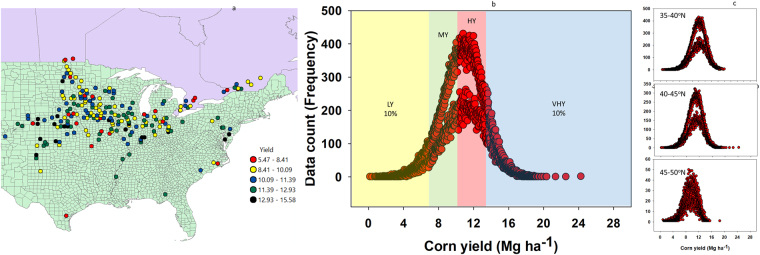
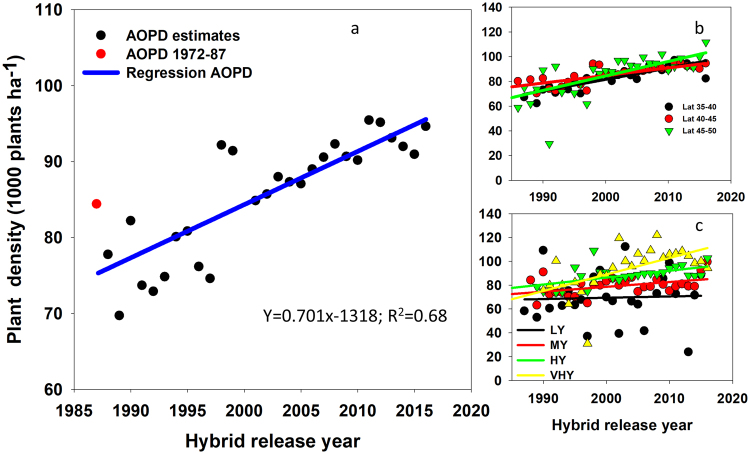
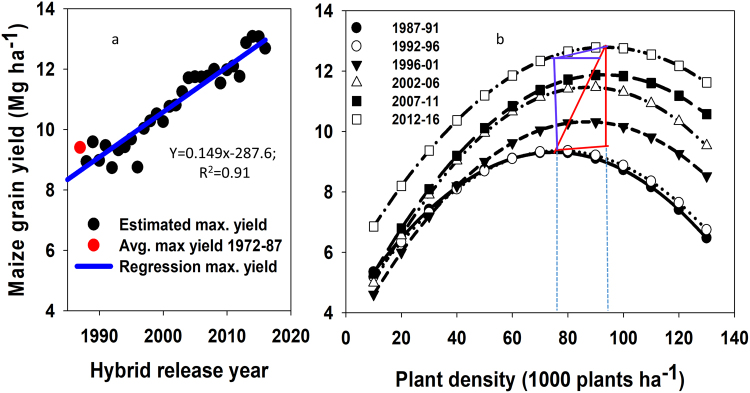
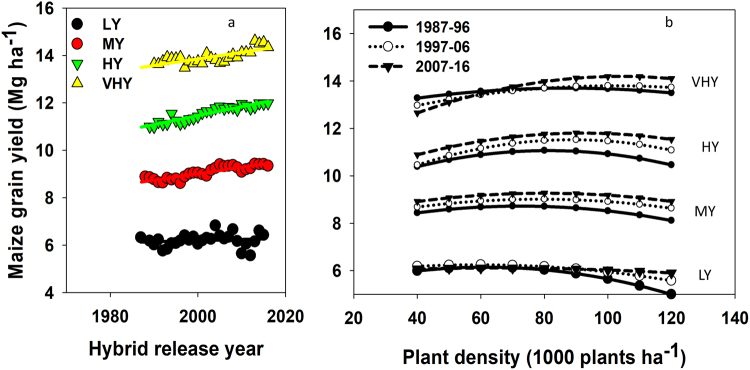
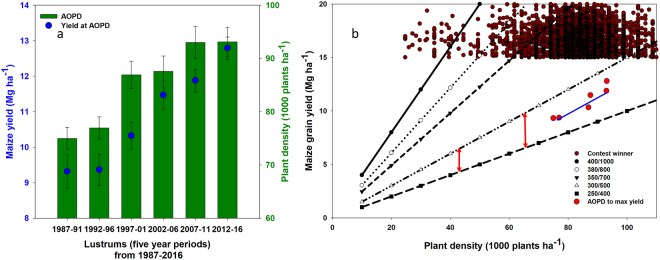
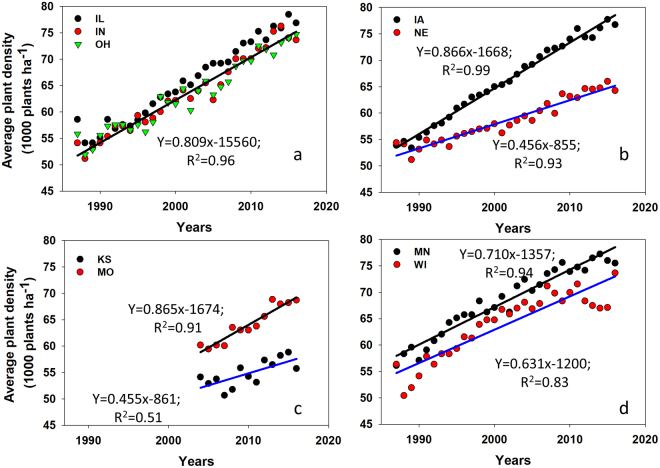
Concurrent to yield, maize ( Zea Mays L.) plant density has significantly increased over the years. Unlike yield, however, the rate of change in plant density and its contribution to maize yield gain are rarely reported. The main objectives of this study were to examine the trend in the agronomic optimum plant density (AOPD) and quantify the contribution of plant density to yield gain. Maize hybrid by seeding rate trials were conducted from 1987–2016 across North America (187,662 data points). Mixed model, response surface, and simple linear regression analyses were applied on the meta-data. New outcomes from this analysis are: (i) an increase in the AOPD at rate of 700 plant ha −1 yr −1 , (ii) increase in the AOPD of 1386, 580 and 404 plants ha −1 yr −1 for very high yielding (VHY, > 13 Mg ha −1 ), high yielding (HY, 10–13 Mg ha −1 ) and medium yielding (MY, 7–10 Mg ha −1 ), respectively, with a lack of change for the low yielding (LY, < 7 Mg ha −1 ) environment; (iii) plant density contribution to maize yield gain ranged from 8.5% to 17%, and (iv) yield improvement was partially explained by changes in the AOPD but we also identified positive impacts on yield components as other sources for yield gain.
Overview
The claims and statistics of this paper haven’t been checked yet.
Free: it reads the open-access text and checks the first 5 claims that cite a source we can check. Create a free account to check every claim.
Integrity signals
Registry
Cites
Statistics
Figures
Verification
Claims the paper makes
The claims and statistics of this paper haven’t been checked yet.
Free: it reads the open-access text and checks the first 5 claims that cite a source we can check. Create a free account to check every claim.
Claims other papers make about this one
Each is checked against this paper’s own text: does it say what the citing paper says it does?
The source backs part of the claim, not all of it — or backs it for a different population, condition or comparison.
In the citing paper
“Elements of the theory and practice for exploiting G–M technology combinations, within the context of G × E × M interactions, as defined above, can be recognised in the well-documented contributions of hybrid-by-density interactions to the historical increase in on-farm yield productivity of maize in the US corn-belt (Duvick et al. 2004, Duvick 2005a, b; Hammer et al. 2009; Assefa et al. 2018).”
From Tackling G × E × M interactions to close on-farm yield-gaps: creating novel pathways for crop improvement by predicting contributions of genetics and management to crop productivity (2021) · cites this paper as Assefa et al. 2018
Experimental — accuracy not yet measured
Self-check
Percentages, sums and reported differences re-computed from the paper’s own numbers.
The self-check needs the paper’s full text.
Citations
Cites
The Contribution of Breeding to Yield Advances in maize (Zea mays L.)
Duvick, D. N. (2005) · Advances in Agronomy · doi:10.1016/s0065-2113(05)86002-x · Cited by 1,214 · cited 2×
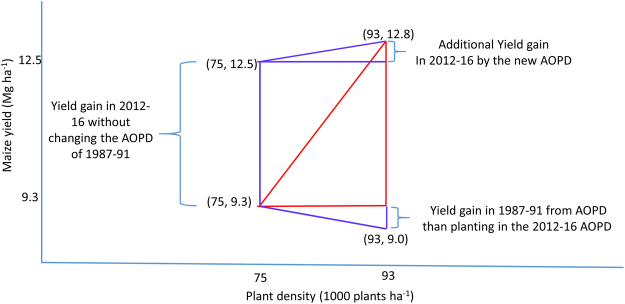
“Using the first approach, yield gain due to changes in plant density was calculated as the difference between (1) yield gain in 2012–16 compared with 1987–91 both at the new AOPD (Eq.”
MethodGreater Sensitivity to Drought Accompanies Maize Yield Increase in the U.S. Midwest
Lobell, D. B., Roberts, M. J., Schlenker, W., Braun, N., Little, B. B., Rejesus, R. M., & Hammer, G. L. (2014) · Science · doi:10.1126/science.1251423 · Cited by 1,094
Yield potential, yield stability and stress tolerance in maize
Tollenaar, M., & Lee, E. A. (2002) · Field Crops Research · doi:10.1016/s0378-4290(02)00024-2 · Cited by 717 · cited 1×
“− − − − − Yield Yield Mg ha Mg ha Mg ha 12 5 9 3 3 2 (7) 2012 16,75 1987 91,75 1 1 1”
Duvick, D. N., & Cassman, K. G. (1999) · Crop Science · doi:10.2135/cropsci1999.3961622x · Cited by 706
Yield Improvement in Temperate Maize is Attributable to Greater Stress Tolerance
Tollenaar, M., & Wu, J. (1999) · Crop Science · doi:10.2135/cropsci1999.3961597x · Cited by 609
Ciampitti, I. A., & Vyn, T. J. (2012) · Field Crops Research · doi:10.1016/j.fcr.2012.03.008 · Cited by 572
Self-citationSangoi, L. (2001) · Ciência Rural · doi:10.1590/s0103-84782001000100027 · Cited by 371
Tokatlidis, I. S., & Koutroubas, S. D. (2004) · Field Crops Research · doi:10.1016/j.fcr.2003.11.013 · Cited by 320 · cited 1×
“− − − − − Yield Yield Mg ha Mg ha Mg ha 12 8 9 3 3 5 (8) 2012 16,93 1987 91,75 1 1 1”
Response of Brazilian maize hybrids from different eras to changes in plant density
Sangoi, L., Gracietti, M. A., Rampazzo, C., & Bianchetti, P. (2002) · Field Crops Research · doi:10.1016/s0378-4290(02)00124-7 · Cited by 280
Yield Responses to Planting Density for US Modern Corn Hybrids: A Synthesis‐Analysis
Assefa, Y., Vara Prasad, P. V., Carter, P., Hinds, M., Bhalla, G., Schon, R., Jeschke, M., Paszkiewicz, S., & Ciampitti, I. A. (2016) · Crop Science · doi:10.2135/cropsci2016.04.0215 · Cited by 198 · cited 1×
“The yield-density relationship within 40–100 thousand plants ha−1 can be described as declining, constant, increasing to a plateau, and ever-increasing for LY, MY, HY, and VHY environments, respectively; in agreement to Assefa et al.16.”
ResultSelf-citationFifty Years of Minnesota Corn Production: Sources of Yield Increase1
Cardwell, V. B. (1982) · Agronomy Journal · doi:10.2134/agronj1982.00021962007400060013x · Cited by 189
Genetic Yield Improvement of U.S. Maize Cultivars under Varying Fertility and Climatic Environments1
Castleberry, R. M., Crum, C. W., & Krull, C. F. (1984) · Crop Science · doi:10.2135/cropsci1984.0011183x002400010008x · Cited by 186
Genetic Contributions to Yield Gains of U.S. Hybrid Maize, 1930 to 1980
Duvick, D. N. (1984) · CSSA Special Publications · doi:10.2135/cssaspecpub7.c2 · Cited by 184
Trends and Variability in U.S. Corn Yields Over the Twentieth Century
Kucharik, C. J., & Ramankutty, N. (2005) · Earth Interactions · doi:10.1175/ei098.1 · Cited by 139
Improving Drought Tolerance in Maize
Barker, T., Campos, H., Cooper, M., Dolan, D., Edmeades, G., Habben, J., Schussler, J., Wright, D., & Zinselmeier, C. (2005) · Plant Breeding Reviews · doi:10.1002/9780470650301.ch7 · Cited by 135
Yield potential and yield stability of Argentine maize hybrids over 45 years of breeding
Matteo, J. A. D., Ferreyra, J. M., Cerrudo, A., Echarte, L., & Andrade, F. H. (2016) · Field Crops Research · doi:10.1016/j.fcr.2016.07.023 · Cited by 130
Qian, C., Yu, Y., Gong, X., Jiang, Y., Zhao, Y., Yang, Z., Hao, Y., Li, L., Song, Z., & Zhang, W. (2016) · The Crop Journal · doi:10.1016/j.cj.2016.04.004 · Cited by 100 · cited 1×
“− − − − − Yield Yield Mg ha Mg ha Mg ha 12 5 9 3 3 2 (4) 2012 16,75 1987 91,75 1 1 1”
Evaluating Management Factor Contributions to Reduce Corn Yield Gaps
Ruffo, M. L., Gentry, L. F., Henninger, A. S., Seebauer, J. R., & Below, F. E. (2015) · Agronomy Journal · doi:10.2134/agronj14.0355 · Cited by 96
A Theory to Explain the Relationship Between Corn Population and Grain Yield1
Duncan, W. G. (1984) · Crop Science · doi:10.2135/cropsci1984.0011183x002400060032x · Cited by 94
Optimum Plant Population of Bt and Non‐Bt Corn in Wisconsin
Stanger, T. F., & Lauer, J. G. (2006) · Agronomy Journal · doi:10.2134/agronj2005.0144 · Cited by 94
Planting Date Effects on Bt and Non‐Bt Corn in the Mid‐South USA
Bruns, H. A., & Abbas, H. K. (2006) · Agronomy Journal · doi:10.2134/agronj2005.0143 · Cited by 87
Adapting maize crop to climate change
Tokatlidis, I. S. (2012) · Agronomy for Sustainable Development · doi:10.1007/s13593-012-0108-7 · Cited by 84
Kernel Growth Rate and Duration in Maize as Affected by Plant Density and Genotype1
Poneleit, C. G., & Egli, D. B. (1979) · Crop Science · doi:10.2135/cropsci1979.0011183x001900030027x · Cited by 77
Maize Yield Potential and Density Tolerance
Gonzalez, V. H., Tollenaar, M., Bowman, A., Good, B., & Lee, E. A. (2018) · Crop Science · doi:10.2135/cropsci2016.06.0547 · Cited by 73
Estimation du progrès génétique réalisé chez le maïs grain en France entre 1950 et 1985
DERIEUX, M., DARRIGRAND, M., GALLAIS, A., BARRIERE, Y., BLOC, D., & MONTALANT, Y. (1987) · Agronomie · doi:10.1051/agro:19870101 · Cited by 58
PLANT-TO-PLANT VARIABILITY OF MAIZE PLANTS GROWN AT DIFFERENT DENSITIES
Daynard, T. B., & MULDOON, J. F. (1983) · Canadian Journal of Plant Science · doi:10.4141/cjps83-005 · Cited by 58
Dryland Corn in Western Kansas
Norwood, C. A. (2001) · Agronomy Journal · doi:10.2134/agronj2001.933540x · Cited by 55
Fractal Description of Temporal Yield Variability of 10 Crops in the United States
Eghball, B., & Power, J. F. (1995) · Agronomy Journal · doi:10.2134/agronj1995.00021962008700020003x · Cited by 53
Alessi, J., & Power, J. F. (1974) · Agronomy Journal · doi:10.2134/agronj1974.00021962006600020037x · Cited by 46
Dryland and Irrigated Corn Yield with Climate, Management, and Hybrid Changes from 1939 through 2009
Assefa, Y., Roozeboom, K. L., Staggenborg, S., & Du, J. (2012) · Agronomy Journal · doi:10.2134/agronj2011.0242 · Cited by 43
Self-citationOptimizing Corn Seeding Rates Using a Field's Corn Suitability Rating
Woli, K. P., Burras, C. L., Abendroth, L., & Elmore, R. W. (2014) · Agronomy Journal · doi:10.2134/agronj14.0054 · Cited by 42
Is There a Role for Sink Size in Understanding Maize Population–Yield Relationships?
Egli, D. B. (2015) · Crop Science · doi:10.2135/cropsci2015.04.0227 · Cited by 40
Smith, S. J., Cooper, M., Gogerty, J., Löffler, C. M., Borcherding, D., & Wright, K. (2014) · CSSA special publication - Crop Science Society of America · doi:10.2135/cssaspecpub33.c6 · Cited by 40
Self-citationAverbeke, W. V., & Marais, J. N. (1992) · South African Journal of Plant and Soil · doi:10.1080/02571862.1992.10634627 · Cited by 28
Friedman, S. P. (2016) · Soil Science Society of America Journal · doi:10.2136/sssaj2015.11.0395 · Cited by 19
Changes in Dynamic Leaf Traits in Maize Associated with Year of Hybrid Release
Luetchens, J., & Lorenz, A. J. (2018) · Crop Science · doi:10.2135/cropsci2017.04.0256 · Cited by 6
Research works printed but not linked: 2
- Assefa Y A New Insight into Corn Yield-Trend from 1987 through 2016 Crop Sci. 2017 56 2802 2817 10.2135/cropsci2016.04.0215 · DOI · Paper page
- Russell WA Agronomic performance of maize cultivars representing different eras of breeding Maydica 1984 29 375 390
Cited by
China can be self-sufficient in maize production by 2030 with optimal crop management
Luo, N., Meng, Q., Feng, P., Qu, Z., Yu, Y., Liu, D. L., Müller, C., & Wang, P. (2023) · Nature Communications · doi:10.1038/s41467-023-38355-2 · Cited by 211
Maize smart-canopy architecture enhances yield at high densities
Tian, J., Wang, C., Chen, F., Qin, W., Yang, H., Zhao, S., Xia, J., Du, X., Zhu, Y., Wu, L., et al. (2024) · Nature · doi:10.1038/s41586-024-07669-6 · Cited by 187
How to increase maize production without extra nitrogen input
Hou, P., Liu, Y., Liu, W., Liu, G., Xie, R., Wang, K., Ming, B., Wang, Y., Zhao, R., Zhang, W., et al. (2020) · Resources, Conservation and Recycling · doi:10.1016/j.resconrec.2020.104913 · Cited by 162
Bastos, L. M., Carciochi, W., Lollato, R. P., Jaenisch, B. R., Rezende, C. R., Schwalbert, R., Vara Prasad, P. V., Zhang, G., Fritz, A. K., Foster, C., et al. (2020) · Frontiers in Plant Science · doi:10.3389/fpls.2020.00054 · Cited by 164
Self-citationChanges in the drought sensitivity of US maize yields
Lobell, D. B., Deines, J. M., & Tommaso, S. D. (2020) · Nature Food · doi:10.1038/s43016-020-00165-w · Cited by 180
Metadata
- Authors
- Assefa, Y., Carter, P., Hinds, M., Bhalla, G., Schon, R., Jeschke, M., Paszkiewicz, S., Smith, S., & Ciampitti, I. A.
- Affiliations
- Kansas State University (US)
- Pioneer Hi-Bred (US)
- Iowa State University (US)
- Corresponding author
- Assefa, Yared
- Ciampitti, Ignacio A.
- Venue
- Scientific Reports
- Published
- 2018-03-21
- Volume
- 8
- Issue
- 1
- Pages
- 4937-4937
- ISSN
- 2045-2322 (ISSN-L)
- PMC
- PMC5862987
- OpenAlex
- W2806985348
- Cited by
- 222
- References
- 36
- Citations by year
- 2026: 30 · 2025: 37 · 2024: 40 · 2023: 31 · 2022: 31 · 2021: 21 · 2020: 18 · 2019: 14
- FWCI
- 22.39
- Type
- journal article
- Language
- en
- Open access
- gold
- doi.org
- Licence
- cc-by
- creativecommons.org/licenses/by/4.0 (tdm)
- creativecommons.org/licenses/by/4.0 (vor)
- Locations
- Scientific Reports (publishedVersion, cc-by)
- Europe PMC (PubMed Central) (publishedVersion, cc-by)
- PubMed Central (publishedVersion, cc-by)
- PubMed (publishedVersion)
- DOAJ (DOAJ: Directory of Open Access Journals) (submittedVersion)
- Topics
- Life Sciences › Agricultural and Biological Sciences › Agronomy and Crop Science › Crop Yield and Soil Fertility
- Life Sciences › Agricultural and Biological Sciences › Plant Science › Soybean genetics and cultivation
- Life Sciences › Agricultural and Biological Sciences › Agronomy and Crop Science › Agricultural Productivity and Crop Improvement
- Keywords
- maize, plant density, yield improvement, yield components, seeding rate, maize hybrids, long-term trends
- MeSH terms
- Crop Production, Zea mays, North America, Time Factors
About these checks
Registry, retraction, Cites and statistics results are computed, not judged, with one exception: a printed reference that no index lists is read once by a model before it counts as a citation error. Claims are extracted by a model and kept only when their quote appears verbatim in the text; each cited source is then checked, with a model’s help, for whether it says what the claim relies on. Those verdicts can be wrong — read the claim’s quote and the cited source before relying on one.
Statistics and arithmetic are recomputed, not judged.
Confidence bands are shown only for fields calibrated on our annotated test set. None is calibrated yet, so no band is shown.
What counts as a claim ›How we measure confidence ›How we check this ›
Are you an author, or do you see a problem with this page? Request a review
Data sources
Bibliographic data: Semantic Scholar, OpenAlex, Crossref.
Contains information from the Semantic Scholar Academic Graph Datasets, made available under the ODC Attribution License (ODC-BY 1.0).
Semantic Scholar’s data is described in: Kinney, R., et al. (2023). The Semantic Scholar Open Data Platform. arXiv:2301.10140.
