

Analysis of Long Term Study Indicates Both Agronomic Optimal Plant Density and Increase Maize Yield per Plant Contributed to Yield Gain
Open accessThe DOI matches its Crossref record; 36 of the 36 references it cites were found in a registry or an index.
Abstract
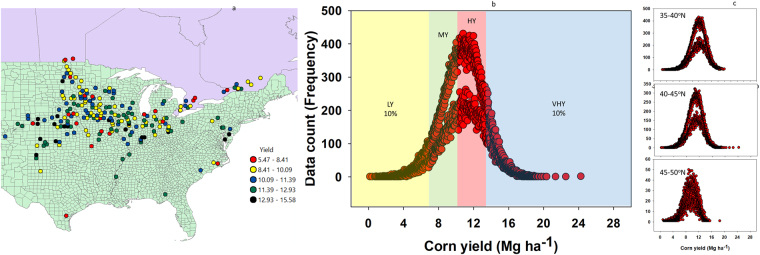
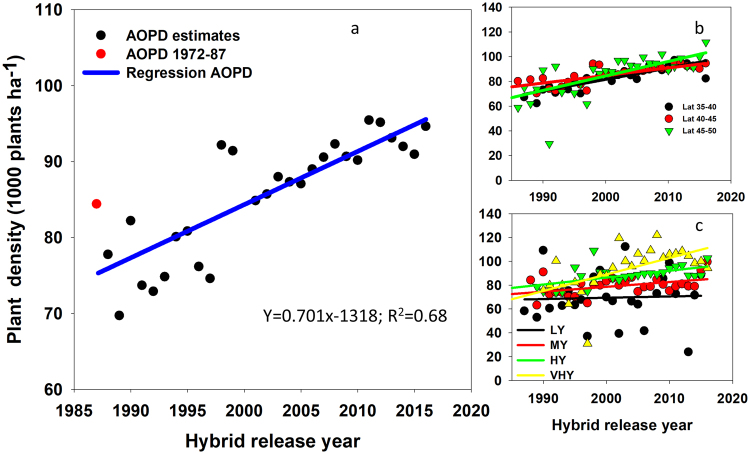
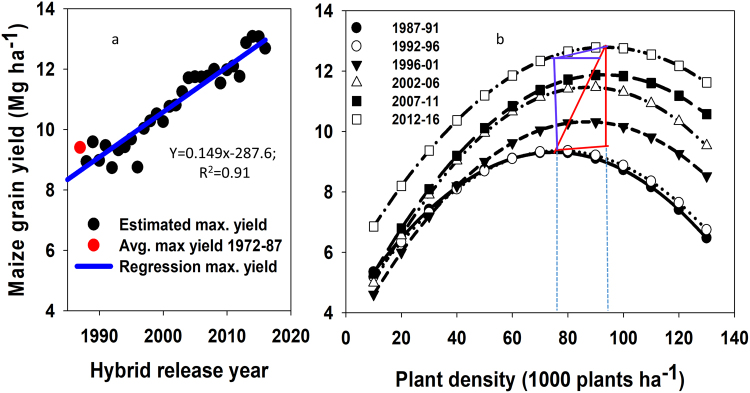
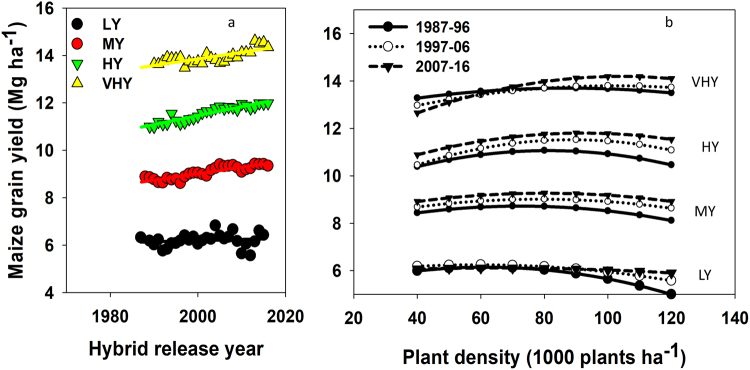
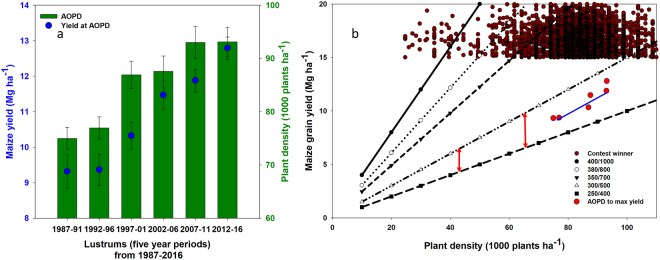
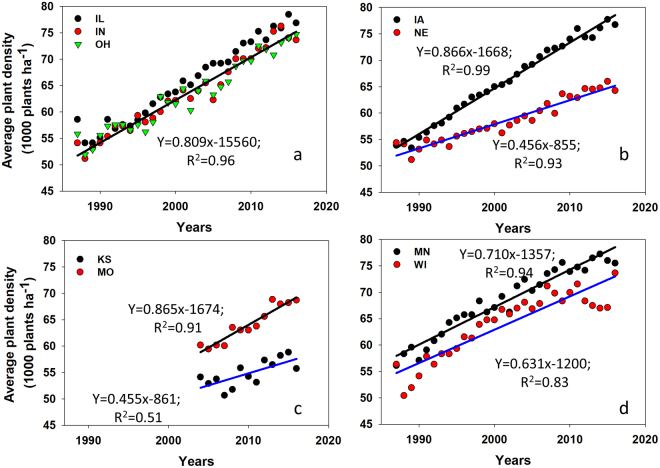
Concurrent to yield, maize ( Zea Mays L.) plant density has significantly increased over the years. Unlike yield, however, the rate of change in plant density and its contribution to maize yield gain are rarely reported. The main objectives of this study were to examine the trend in the agronomic optimum plant density (AOPD) and quantify the contribution of plant density to yield gain. Maize hybrid by seeding rate trials were conducted from 1987–2016 across North America (187,662 data points). Mixed model, response surface, and simple linear regression analyses were applied on the meta-data. New outcomes from this analysis are: (i) an increase in the AOPD at rate of 700 plant ha −1 yr −1 , (ii) increase in the AOPD of 1386, 580 and 404 plants ha −1 yr −1 for very high yielding (VHY, > 13 Mg ha −1 ), high yielding (HY, 10–13 Mg ha −1 ) and medium yielding (MY, 7–10 Mg ha −1 ), respectively, with a lack of change for the low yielding (LY, < 7 Mg ha −1 ) environment; (iii) plant density contribution to maize yield gain ranged from 8.5% to 17%, and (iv) yield improvement was partially explained by changes in the AOPD but we also identified positive impacts on yield components as other sources for yield gain.
Overview
The claims and statistics of this paper haven’t been checked yet.
Free: it reads the open-access text and checks the first 5 claims that cite a source we can check. Create a free account to check every claim.
Integrity signals
Registry
Cites
Statistics
Figures
Verification
Claims the paper makes
The claims and statistics of this paper haven’t been checked yet.
Free: it reads the open-access text and checks the first 5 claims that cite a source we can check. Create a free account to check every claim.
Claims other papers make about this one
Each is checked against this paper’s own text: does it say what the citing paper says it does?
The source backs part of the claim, not all of it — or backs it for a different population, condition or comparison.
In the citing paper
“Elements of the theory and practice for exploiting G–M technology combinations, within the context of G × E × M interactions, as defined above, can be recognised in the well-documented contributions of hybrid-by-density interactions to the historical increase in on-farm yield productivity of maize in the US corn-belt (Duvick et al. 2004, Duvick 2005a, b; Hammer et al. 2009; Assefa et al. 2018).”
From Tackling G × E × M interactions to close on-farm yield-gaps: creating novel pathways for crop improvement by predicting contributions of genetics and management to crop productivity (2021) · cites this paper as Assefa et al. 2018
Experimental — accuracy not yet measured
Self-check
Percentages, sums and reported differences re-computed from the paper’s own numbers.
The self-check needs the paper’s full text.
Citations
Cites
The Contribution of Breeding to Yield Advances in maize (Zea mays L.)
Duvick, D. N. (2005) · Advances in Agronomy · doi:10.1016/s0065-2113(05)86002-x · Cited by 1,214 · cited 2×
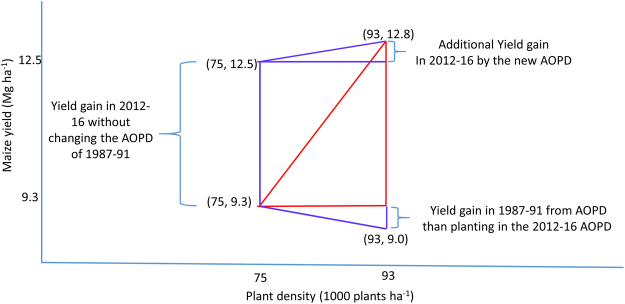
“Using the first approach, yield gain due to changes in plant density was calculated as the difference between (1) yield gain in 2012–16 compared with 1987–91 both at the new AOPD (Eq.”
MethodGreater Sensitivity to Drought Accompanies Maize Yield Increase in the U.S. Midwest
Lobell, D. B., Roberts, M. J., Schlenker, W., Braun, N., Little, B. B., Rejesus, R. M., & Hammer, G. L. (2014) · Science · doi:10.1126/science.1251423 · Cited by 1,094
Yield potential, yield stability and stress tolerance in maize
Tollenaar, M., & Lee, E. A. (2002) · Field Crops Research · doi:10.1016/s0378-4290(02)00024-2 · Cited by 717 · cited 1×
“− − − − − Yield Yield Mg ha Mg ha Mg ha 12 5 9 3 3 2 (7) 2012 16,75 1987 91,75 1 1 1”
Duvick, D. N., & Cassman, K. G. (1999) · Crop Science · doi:10.2135/cropsci1999.3961622x · Cited by 706
Yield Improvement in Temperate Maize is Attributable to Greater Stress Tolerance
Tollenaar, M., & Wu, J. (1999) · Crop Science · doi:10.2135/cropsci1999.3961597x · Cited by 609
Ciampitti, I. A., & Vyn, T. J. (2012) · Field Crops Research · doi:10.1016/j.fcr.2012.03.008 · Cited by 572
Self-citationSangoi, L. (2001) · Ciência Rural · doi:10.1590/s0103-84782001000100027 · Cited by 371
Tokatlidis, I. S., & Koutroubas, S. D. (2004) · Field Crops Research · doi:10.1016/j.fcr.2003.11.013 · Cited by 320 · cited 1×
“− − − − − Yield Yield Mg ha Mg ha Mg ha 12 8 9 3 3 5 (8) 2012 16,93 1987 91,75 1 1 1”
Response of Brazilian maize hybrids from different eras to changes in plant density
Sangoi, L., Gracietti, M. A., Rampazzo, C., & Bianchetti, P. (2002) · Field Crops Research · doi:10.1016/s0378-4290(02)00124-7 · Cited by 280
Yield Responses to Planting Density for US Modern Corn Hybrids: A Synthesis‐Analysis
Assefa, Y., Vara Prasad, P. V., Carter, P., Hinds, M., Bhalla, G., Schon, R., Jeschke, M., Paszkiewicz, S., & Ciampitti, I. A. (2016) · Crop Science · doi:10.2135/cropsci2016.04.0215 · Cited by 198 · cited 1×
“The yield-density relationship within 40–100 thousand plants ha−1 can be described as declining, constant, increasing to a plateau, and ever-increasing for LY, MY, HY, and VHY environments, respectively; in agreement to Assefa et al.16.”
ResultSelf-citation
Research works printed but not linked: 2
- Assefa Y A New Insight into Corn Yield-Trend from 1987 through 2016 Crop Sci. 2017 56 2802 2817 10.2135/cropsci2016.04.0215 · DOI · Paper page
- Russell WA Agronomic performance of maize cultivars representing different eras of breeding Maydica 1984 29 375 390
Cited by
China can be self-sufficient in maize production by 2030 with optimal crop management
Luo, N., Meng, Q., Feng, P., Qu, Z., Yu, Y., Liu, D. L., Müller, C., & Wang, P. (2023) · Nature Communications · doi:10.1038/s41467-023-38355-2 · Cited by 211
Maize smart-canopy architecture enhances yield at high densities
Tian, J., Wang, C., Chen, F., Qin, W., Yang, H., Zhao, S., Xia, J., Du, X., Zhu, Y., Wu, L., et al. (2024) · Nature · doi:10.1038/s41586-024-07669-6 · Cited by 187
How to increase maize production without extra nitrogen input
Hou, P., Liu, Y., Liu, W., Liu, G., Xie, R., Wang, K., Ming, B., Wang, Y., Zhao, R., Zhang, W., et al. (2020) · Resources, Conservation and Recycling · doi:10.1016/j.resconrec.2020.104913 · Cited by 162
Bastos, L. M., Carciochi, W., Lollato, R. P., Jaenisch, B. R., Rezende, C. R., Schwalbert, R., Vara Prasad, P. V., Zhang, G., Fritz, A. K., Foster, C., et al. (2020) · Frontiers in Plant Science · doi:10.3389/fpls.2020.00054 · Cited by 164
Self-citationChanges in the drought sensitivity of US maize yields
Lobell, D. B., Deines, J. M., & Tommaso, S. D. (2020) · Nature Food · doi:10.1038/s43016-020-00165-w · Cited by 180
Integrating genetic gain and gap analysis to predict improvements in crop productivity
Cooper, M., Tang, T., Gho, C., Hart, T., Hammer, G., & Messina, C. (2020) · Crop Science · doi:10.1002/csc2.20109 · Cited by 130
Genetic modification can improve crop yields — but stop overselling it
Khaipho-Burch, M., Cooper, M., Crossa, J. L., de León, N., Holland, J. B., Lewis, R. S., McCouch, S. R., Murray, S. C., Rabbi, I. Y., Ronald, P. C., et al. (2023) · Nature · doi:10.1038/d41586-023-02895-w · Cited by 154
Yan, Y., Duan, F., Li, X., Zhao, R., Hou, P., Zhao, M., Li, S., Wang, Y., Dai, T., & Zhou, W. (2024) · PLANT PHYSIOLOGY · doi:10.1093/plphys/kiae204 · Cited by 152
“Increasing planting density has been shown to improve maize yield by an average of 17% to 20% (Assefa et al. 2018).”
BackgroundCooper, M., Voss-Fels, K. P., Messina, C. D., Tang, T., & Hammer, G. L. (2021) · Theoretical and Applied Genetics · doi:10.1007/s00122-021-03812-3 · Cited by 119
Perez, R. P. A., Fournier, C., Cabrera‐Bosquet, L., Artzet, S., Pradal, C., Brichet, N., Chen, T., Chapuis, R., Welcker, C., & Tardieu, F. (2019) · Plant Cell & Environment · doi:10.1111/pce.13539 · Cited by 142
“…light interception by hybrids belonging to each generation of selection was also considered at different plant densities, because it has been argued that a major cause of genetic progress of maize yield is the ability of recent hybrids to grow at high densities (Duvick 2005; Assefa et al. 2018).”
BackgroundInfluentialSoybean Seed Yield Response to Plant Density by Yield Environment in North America
Carciochi, W. D., Schwalbert, R. A., Andrade, F. H., Corassa, G. M., Carter, P. M., Gaspar, A. P., Schmidt, J., & Ciampitti, I. A. (2019) · Agronomy Journal · doi:10.2134/agronj2018.10.0635 · Cited by 129
Self-citationImproving maize grain yield by matching maize growth and solar radiation
Yang, Y., Xu, W., Hou, P., Liu, G., Liu, W., Wang, Y., Zhao, R., Ming, B., Xie, R., Wang, K., et al. (2019) · Scientific Reports · doi:10.1038/s41598-019-40081-z · Cited by 107
Guo, Q. Q., Huang, G., Guo, Y., Zhang, M., Zhou, Y., & Duan, L. (2021) · Field Crops Research · doi:10.1016/j.fcr.2021.108141 · Cited by 103
Liu, G., Yang, Y., Guo, X., Liu, W., Xie, R., Ming, B., Xue, J., Wang, K., Li, S., & Hou, P. (2022) · Resources Conservation and Recycling · doi:10.1016/j.resconrec.2022.106656 · Cited by 115
Improving C4 photosynthesis to increase productivity under optimal and suboptimal conditions
Sales, C. R. G., Wang, Y., Evers, J. B., & Kromdijk, J. (2021) · Journal of Experimental Botany · doi:10.1093/jxb/erab327 · Cited by 92
Optimized canopy structure improves maize grain yield and resource use efficiency
Liu, G., Yang, Y., Liu, W., Guo, X., Xie, R., Ming, B., Xue, J., Zhang, G., Li, R., Wang, K., et al. (2022) · Food and Energy Security · doi:10.1002/fes3.375 · Cited by 98
Can We Harness “Enviromics” to Accelerate Crop Improvement by Integrating Breeding and Agronomy?
Cooper, M., & Messina, C. D. (2021) · Frontiers in Plant Science · doi:10.3389/fpls.2021.735143 · Cited by 110
Moving toward short stature maize: The effect of plant height on maize stalk lodging resistance
Stubbs, C. J., Kunduru, B., Bokros, N. T., Verges, V. L., Porter, J., Cook, D. D., DeBolt, S., McMahan, C. S., Sekhon, R. S., & Robertson, D. J. (2023) · Field Crops Research · doi:10.1016/j.fcr.2023.109008 · Cited by 86
Liu, G., Yang, H. S., Xie, R., Yang, Y., Liu, W., Guo, X., Xue, J., Ming, B., Wang, K., Hou, P., et al. (2021) · Field Crops Research · doi:10.1016/j.fcr.2021.108223 · Cited by 89
Curín, F., Severini, A. D., González, F. G., & Otegui, M. E. (2019) · Field Crops Research · doi:10.1016/j.fcr.2019.107683 · Cited by 80
Welcker, C., Spencer, N. A.-S., Turc, O., Granato, Í. S. C., Chapuis, R., Madur, D., Beauchêne, K., Gouesnard, B., Draye, X., Palaffre, C., et al. (2022) · Nature Communications · doi:10.1038/s41467-022-30872-w · Cited by 85
Planting Green Effects on Corn and Soybean Production
Reed, H. K., Karsten, H. D., Curran, W. S., Tooker, J. F., & Duiker, S. W. (2019) · Agronomy Journal · doi:10.2134/agronj2018.11.0711 · Cited by 78
Building bridges between agribusiness innovation and smallholder farmers: A review
Gaffney, J., Challender, M., Califf, K. E., & Harden, K. (2019) · Global Food Security · doi:10.1016/j.gfs.2018.12.008 · Cited by 89
Agronomic optimal plant density for yield improvement in the major maize regions of China
Luo, N., Wang, X., Hou, J., Wang, Y., Wang, P., & Meng, Q. (2020) · Crop Science · doi:10.1002/csc2.20000 · Cited by 73
Reproductive resilience but not root architecture underpins yield improvement under drought in maize
Messina, C. D., McDonald, D., Poffenbarger, H., Clark, R., Salinas, A., Fang, Y., Gho, C., Tang, T., Graham, G., Hammer, G., et al. (2021) · Journal of Experimental Botany · doi:10.1093/jxb/erab231 · Cited by 67
“In the USA, long-term crop improvement in temperate maize has resulted from pedigree breeding combined with reciprocal recurrent selection to improve hybrid performance (Duvick, 2001), and the optimization of agronomic practices such as planting density (Duvick, 2005; Cooper et al., 2014b; Assefa et al., 2018).”
BackgroundCoordinating maize source and sink relationship to achieve yield potential of 22.5 Mg ha-1
Liu, G., Yang, Y., Guo, X., Liu, W., Xie, R., Ming, B., Xue, J., Wang, K., Li, S., & Hou, P. (2022) · Field Crops Research · doi:10.1016/j.fcr.2022.108544 · Cited by 63
Cooper, M., Messina, C. D., Tang, T., Gho, C., Powell, O. M., Podlich, D. W., Technow, F., & Hammer, G. L. (2022) · Plant Breeding Reviews · doi:10.1002/9781119874157.ch8 · Cited by 56
Duan, F., Wei, Z., Soualiou, S., & Zhou, W. (2023) · Field Crops Research · doi:10.1016/j.fcr.2023.108874 · Cited by 58
Shi, Q., Xia, Y. Q., Wang, Q., Lv, K., Yang, H., Cui, L., Sun, Y., Wang, X., Tao, Q., Song, X., et al. (2024) · Molecular Plant · doi:10.1016/j.molp.2024.06.014 · Cited by 52
Nitrogen Uptake and Response to Radiation Distribution in the Canopy of High‐Yield Maize
Liu, G., Hou, P., Xie, R., Ming, B., Wang, K., Liu, W., Yang, Y., Xu, W., Chen, J., & Li, S. (2019) · Crop Science · doi:10.2135/cropsci2018.09.0567 · Cited by 50
Wang, X., Wang, X., Xu, C., Tan, W., Wang, P., & Meng, Q. (2019) · Crop Science · doi:10.2135/cropsci2019.04.0218 · Cited by 70
Shao, H., Wu, X., Duan, J., Zhu, F., Chi, H., Liu, J., Shi, W., Xu, Y., Wei, Z., & Mi, G. (2024) · Field Crops Research · doi:10.1016/j.fcr.2024.109430 · Cited by 58
Zhang, G., Ming, B., Shen, D., Xie, R., Hou, P., Xue, J., Wang, K., & Li, S. (2021) · Agriculture · doi:10.3390/agriculture11040313 · Cited by 54
Chen, F., Liu, J., Liu, Z., Chen, Z., Ren, W., Gong, X., Wang, L., Cai, H., Pan, Q., Yuan, L., et al. (2020) · Advances in agronomy · doi:10.1016/bs.agron.2020.10.005 · Cited by 51
Planting Arrangement and Effects of Planting Density on Tropical Fruit Crops—A Review
Haque, M. A., & Sakimin, S. Z. (2022) · Horticulturae · doi:10.3390/horticulturae8060485 · Cited by 43
“The probability of negative effects increases when the density reaches the optimal level for a given area [20].”
BackgroundJin, Z., Archontoulis, S. V., & Lobell, D. B. (2019) · Field Crops Research · doi:10.1016/j.fcr.2019.04.013 · Cited by 50
Frédette, C., Labrecque, M., Comeau, Y., & Brisson, J. (2019) · Journal of Environmental Management · doi:10.1016/j.jenvman.2019.06.010 · Cited by 54
Corn variable-rate seeding decision based on gradient boosting decision tree model
Du, Z., Li, Y., Zhang, D., Cui, T., He, X., Xiao, T., Xie, C., & Li, H. (2022) · Computers and Electronics in Agriculture · doi:10.1016/j.compag.2022.107025 · Cited by 51
Liu, W., Zhou, J., Zhang, T., Zhang, P., Yao, M., Li, J., Sun, Z., Ma, G., Chen, X., & Hu, J. (2024) · Agriculture · doi:10.3390/agriculture15010008 · Cited by 43
Liu, L., Sadras, V. O., Xu, J., Hu, C., Yang, X., & Zhang, S. (2021) · Advances in agronomy · doi:10.1016/bs.agron.2021.02.005 · Cited by 39
Song, Q., Liu, F., Bu, H., & Zhu, X. (2023) · Plant Phenomics · doi:10.34133/plantphenomics.0075 · Cited by 40
Cossani, C. M., & Sadras, V. O. (2021) · Evolutionary Applications · doi:10.1111/eva.13265 · Cited by 40
“The interaction between genotype and stand density is common in maize, highlighting genotype- dependent variation in response to competition (Assefa et al., 2018; Hernández et al., 2014; Tollenaar, 1989; Zhai et al., 2021).”
BackgroundSihi, D., Dari, B., Kuruvila, A. P., Jha, G., & Basu, K. (2022) · Frontiers in Sustainable Food Systems · doi:10.3389/fsufs.2022.847892 · Cited by 36
“…footprint (McLennon et al., 2021), involvement of soil conservation practices e.g., zero or minimum tillage, cover crops, increased planting density and optimizing row spaces have also helped in increasing crop yields (Basche et al., 2016; Assefa et al., 2018; Licht et al., 2019) across the CONUS.”
BackgroundHou, S., Ren, H., Fan, F., Zhao, M., Zhou, W., Zhou, B., & Li, C. (2023) · Geoderma · doi:10.1016/j.geoderma.2023.116325 · Cited by 37
How does increasing planting density affect nitrogen use efficiency of maize: A global meta-analysis
Shao, H., Wu, X., Chi, H., Zhu, F., Liu, J., Duan, J., Shi, W., Xu, Y., & Mi, G. (2024) · Field Crops Research · doi:10.1016/j.fcr.2024.109369 · Cited by 39
Bernhard, B. J., & Below, F. E. (2020) · Agronomy Journal · doi:10.1002/agj2.20206 · Cited by 45
“Some hybrids exhibit a positive yield response to higher plant populations while other hybrids yield less or have no yield response to higher plant populations (Assefa et al., 2018; Duvick & Cassman, 1999; Gonzalez, Tollenaar, Bowman, Good, & Lee, 2018; Grassini, Thorburn, Burr, & Cassman, 2011; Hashemi, Herbert, & Pu…”
BackgroundHeat stress to jeopardize crop production in the US Corn Belt based on downscaled CMIP5 projections
Yang, M., & Wang, G. (2023) · Agricultural Systems · doi:10.1016/j.agsy.2023.103746 · Cited by 38
Wang, Q., Guo, Q., Shi, Q., Yang, H., Liu, M., Niu, Y., Quan, S., Xu, D., Chen, X., Li, L., et al. (2024) · Molecular Plant · doi:10.1016/j.molp.2024.05.001 · Cited by 41
Zhou, Y., Kusmec, A., & Schnable, P. S. (2024) · The Plant Cell · doi:10.1093/plcell/koae007 · Cited by 38
“Era hybrid studies, which compare hybrids released in different years, demonstrate that at current plant densities modern hybrids have lower per plant grain yields but an improved tolerance to high plant densities (Duvick and Cassman 1999; Duvick 2005; Assefa et al. 2018).”
Improved plant yield efficiency alleviates the erratic optimum density in maize
Mylonas, I. G., Sinapidou, E., Remountakis, E., Sistanis, I., Pankou, C. I., Ninou, E. G., Papadopoulos, I. I., Papathanasiou, F., Lithourgidis, A., Gekas, F., et al. (2020) · Agronomy Journal · doi:10.1002/agj2.20187 · Cited by 38
Wu, X., Tong, L., Kang, S., Du, T., Ding, R., Li, S., & Chen, Y. (2023) · Journal of the Science of Food and Agriculture · doi:10.1002/jsfa.12602 · Cited by 40
“8-10 Although optimal planting density and yield per plant jointly increase yield in the long run, 11,12 optimal planting density and maximum yield per plant cannot be achieved simultaneously over a period of time.”
Effect of tillers on corn yield: Exploring trait plasticity potential in unpredictable environments
Veenstra, R. L., Messina, C. D., Berning, D., Haag, L. A., Carter, P. M., Hefley, T. J., Prasad, P. V. V., & Ciampitti, I. A. (2021) · Crop Science · doi:10.1002/csc2.20576 · Cited by 39
Self-citationBreeding effects on canopy light attenuation in maize: a retrospective and prospective analysis
Lacasa, J., Ciampitti, I. A., Amas, J. I., Curín, F., Luque, S. F., & Otegui, M. E. (2021) · Journal of Experimental Botany · doi:10.1093/jxb/erab503 · Cited by 32
Self-citationDu, Z., Li, Y., Zhang, D., Cui, T., He, X., Xiao, T., Li, H., Xing, S., & Xie, C. (2023) · The Science of The Total Environment · doi:10.1016/j.scitotenv.2023.167597 · Cited by 30
Breaking the field phenotyping bottleneck in maize with autonomous robots
DeBruin, J. L., Aref, T., Tirado, S. B., Hensley, R., Underwood, H., McGuire, M., Soman, C., Nystrom, G., Parkinson, E., Li, C., et al. (2025) · Communications Biology · doi:10.1038/s42003-025-07890-7 · Cited by 41
Relationships between combined and individual field crops’ biomass and planting density
Friedman, S. P. (2023) · Field Crops Research · doi:10.1016/j.fcr.2023.109188 · Cited by 28
Vojnov, B., Jačimović, G., Šeremešıć, S., Pezo, L. L., Lončar, B. L., Krstić, Đ., Vujić, S., & Ćupina, B. (2022) · Agronomy · doi:10.3390/agronomy12112670 · Cited by 30
“[77,78] found that plant density (the number of plants per unit area) is a decisive factor in maize production, but the optimal plant density is not always the same, but rather varies depending on the year.”
BackgroundPathways to increase maize yield in Northwest China: A multi-year, multi-variety analysis
Wang, Y., Zhang, G., Li, R., Wang, K., Ming, B., Hou, P., Xie, R., Xue, J., & Li, S. (2023) · European Journal of Agronomy · doi:10.1016/j.eja.2023.126892 · Cited by 25
Lu, J., Xu, Y., Meng, Z., Cao, M., Liu, S., Kato‐Noguchi, H., Yu, W., Jin, B., & Wang, L. (2021) · Industrial Crops and Products · doi:10.1016/j.indcrop.2021.114055 · Cited by 28
Li, C., Li, Y., Song, G., Yang, D., Xia, Z., Sun, C., Zhao, Y., Hou, M., Zhang, M., Qi, Z., et al. (2023) · The Plant Journal · doi:10.1111/tpj.16260 · Cited by 25
Leng, P., Khan, S. U., Zhang, D., Zhou, G., Zhang, X., Zheng, Y., Wang, T., & Zhao, J. Y. (2022) · International Journal of Molecular Sciences · doi:10.3390/ijms23158410 · Cited by 23
Dias, F. S., Rezende, W. M., Zuffo, L. T., Caixeta, D. G., Massensini, M. A., Ribeiro, J. I., & DeLima, R. O. (2019) · Agronomy Journal · doi:10.2134/agronj2018.12.0765 · Cited by 28
Zhang, G., Shen, D., Ming, B., Xie, R., Hou, P., Xue, J., Wang, K., & Li, S. (2022) · Agriculture · doi:10.3390/agriculture12091322 · Cited by 22
Eco‐physiology of maize crops under combined stresses
Cagnola, J. I., D’Andrea, K. E., Rotili, D. H., Mercau, J. L., Ploschuk, E. L., Maddonni, G. Á., Otegui, M. E., & Casal, J. J. (2023) · The Plant Journal · doi:10.1111/tpj.16595 · Cited by 24
Corn response to later than traditional planting dates in the Texas High Plains
Jiang, W., Thapa, S., Jessup, K. E., Hao, B., Hou, X., Marek, T. H., Becker, J., Bell, J., & Xue, Q. (2020) · Crop Science · doi:10.1002/csc2.20042 · Cited by 21
Techniques for photosynthesis phenomics: gas exchange, fluorescence, and reflectance spectrums
Song, Q., & Zhu, X. (2024) · Crop and Environment · doi:10.1016/j.crope.2024.05.002 · Cited by 29
Maize long-term genetic progress explains current dominance over sorghum in Argentina
Parra, G., Borrás, L., & Gambín, B. L. (2020) · European Journal of Agronomy · doi:10.1016/j.eja.2020.126122 · Cited by 24
Che, Y., Wang, Q., Zhou, L., Wang, Q., Li, B., & Ma, Y. (2022) · Precision Agriculture · doi:10.1007/s11119-022-09915-1 · Cited by 20
“Plant counting was an important reference index for evaluating the quality of maize seed and machine planting, and also helpful for making up the yield losses by reseeding and transplanting in time (Assefa et al., 2018; Li et al., 2018; Ranđelović et al., 2020).”
BackgroundTang, Q., Ren, J., Du, X., Niu, S., Liu, S., Wei, D., Zhang, Y., Bian, D., Cui, Y., & Gao, Z. (2022) · Frontiers in Plant Science · doi:10.3389/fpls.2022.1035254 · Cited by 19
“0% of maize grain yield, is the most effective way to improve yield (Assefa et al., 2018).”
BackgroundShen, D., Wang, K., Zhou, L., Fang, L., Wang, Z., Fu, J., Zhang, T., Liang, Z., Xie, R., Ming, B., et al. (2024) · Agronomy · doi:10.3390/agronomy14020400 · Cited by 28
“Previous studies have reported an increase in planting density as the most effective way to improve maize yield per unit area [ Previous studies have reported an increase in planting density as the most effective way to improve maize yield per unit area [13,30,31].”
BackgroundEcological factors regulate stalk lodging within dense planting maize
Kong, F., Liu, F., Li, X., Yin, P., Lan, T., Feng, D., Bi, S., Lei, E., Li, Z., Wang, X., et al. (2024) · Field Crops Research · doi:10.1016/j.fcr.2024.109529 · Cited by 18
Yield improvement and yield components: A comparison of corn and soybean
Egli, D. B. (2023) · Crop Science · doi:10.1002/csc2.20925 · Cited by 27
Liu, D., Ning, Q., Zhai, L., Teng, F., Li, Y., Zhao, R., Xiong, Q. P., Zhan, J., Li, Z., Yang, F., et al. (2024) · Plant Biotechnology Journal · doi:10.1111/pbi.14382 · Cited by 21
Stack, G. M., Carlson, C. H., Toth, J. A., Philippe, G., Crawford, J. L., Hansen, J. L., Viands, D. R., Rose, J. K. C., & Smart, L. B. (2023) · Plant Direct · doi:10.1002/pld3.503 · Cited by 19
“Moving toward a high-density production system, where individual plants are smaller but production per unit area is greater, has been effective in increasing yields across dozens of cropping systems (Assefa et al., 2018; Duvick, 2005; Postma et al., 2021).”
BackgroundBaum, M. E., Sawyer, J. E., Castellano, M. J., & Archontoulis, S. V. (2024) · Agronomy Journal · doi:10.1002/agj2.21596 · Cited by 18
Reinventing a sustainable Green Revolution by breeding and planting semi-dwarf maize
Xiao, S., Song, W., Wang, R., Zhang, S., Liu, M., Zhang, R., Xu, T., Hui, L., Hu, J. H., Xing, J., et al. (2025) · Molecular Plant · doi:10.1016/j.molp.2025.08.011 · Cited by 20
Zhou, M., Yongcui, W., Gu, J., Ma, N., Hou, W., Sun, J., Fan, X., & Yin, G. (2025) · Agricultural Water Management · doi:10.1016/j.agwat.2025.109671 · Cited by 20
Relaxing non-photochemical quenching (NPQ) to improve photosynthesis in crops
Kromdijk, J., & Walter, J. (2022) · Burleigh Dodds series in agricultural science · doi:10.19103/as.2022.0119.09 · Cited by 18
Yang, H., Zhang, Z., Zhang, N., Li, T., Wang, J., Zhang, Q., Xue, J., Zhu, W., & Xu, S. (2024) · Frontiers in Plant Science · doi:10.3389/fpls.2024.1371394 · Cited by 23
Li, C., Tong, B., Jia, M., Xu, H., Wang, J., & Sun, Z.-M. (2024) · Frontiers in Plant Science · doi:10.3389/fpls.2024.1434926 · Cited by 17
Historical Trends in Sweet Corn Plant Density Tolerance Using Era Hybrids (1930–2010s)
Dhaliwal, D. S., Ainsworth, E. A., & Williams, M. (2021) · Frontiers in Plant Science · doi:10.3389/fpls.2021.707852 · Cited by 17
Crop attributes explaining current grain yield dominance of maize over sorghum
Parra, G., Borrás, L., & Gambín, B. L. (2021) · Field Crops Research · doi:10.1016/j.fcr.2021.108346 · Cited by 21
Tolimir, M., Gajić, B., Kresović, B., Životić, L., Gajić, K., Brankov, M., & Todorović, M. (2024) · Agricultural Water Management · doi:10.1016/j.agwat.2024.109009 · Cited by 20
Karkanis, A., Athanasiadou, D., Giannoulis, K. D., Karanasou, K., Zografos, S., Souipas, S., Bartzialis, D., & DANALATOS, N. G. (2020) · Agronomy · doi:10.3390/agronomy10020266 · Cited by 14
Sun, X., Li, X., Jiang, W., Zhao, M., Gao, Z., Ge, J., Sun, Q., Ding, Z., & Zhou, B. (2023) · Plants · doi:10.3390/plants12102000 · Cited by 14
“Discussion Modifying canopy architecture is an important way to achieve high yield for maize under high-density conditions [29].”
BackgroundDo higher temperatures influence how yields respond to increasing planting density?
Wang, R., Rejesus, R. M., Tack, J., & Aglasan, S. (2021) · Agricultural and Resource Economics Review · doi:10.1017/age.2021.10 · Cited by 17
“Previous studies have typically assumed a quadratic specification for planting density (see Assefa et al. (2018) for example). However, a linear specification is appropriate in our case given that the range of our planting density data does not usually reach the reported “optimal” planting density levels recommended f…”
BackgroundInfluentialZhang, M., Zhao, X., Han, X., Chen, Y., Dang, P., Xue, J., Qin, X., & Siddique, K. H. M. (2025) · Agronomy for Sustainable Development · doi:10.1007/s13593-025-01027-0 · Cited by 13
“Identifying optimal planting densities is crucial for increasing food production (Assefa et al. 2018).”
Optimizing Nitrogen Dosage and Planting Density to Improve Japonica Rice Yield
Zhao, L., Zhou, H., Tang, L. R., Yong-guang, N. A., Duan, S., Zheng, D., Feng, N., & Shen, X. (2024) · Agronomy · doi:10.3390/agronomy14081738 · Cited by 16
“In cold rice cultivation, the RND1 (108 kg ha − 1 compared to 33.3 × 10 4 hills ha − 1 ) interaction mode represented a novel combination for achieving high-yield and high-efficiency rice cultivation.”
BackgroundInfluentialHong, B., Huang, C. Z., Chen, Z., Chen, H., Wang, J., Liu, X., Wang, Z., Lin, Y.-H., Chen, X., Shen, S., et al. (2025) · The Crop Journal · doi:10.1016/j.cj.2024.12.012 · Cited by 13
Mapping QTL for flowering time-related traits under three plant densities in maize
Wang, L., Zhou, Z., Li, R., Weng, J., Zhang, Q., Li, X., Wang, B., Zhang, W., Song, W., & Li, X. (2020) · The Crop Journal · doi:10.1016/j.cj.2020.07.009 · Cited by 13
Corn yield components can be stabilized via tillering in sub-optimal plant densities
Veenstra, R. L., Messina, C. D., Berning, D., Haag, L. A., Carter, P., Hefley, T. J., Prasad, P. V. V., & Ciampitti, I. A. (2023) · Frontiers in Plant Science · doi:10.3389/fpls.2022.1047268 · Cited by 12
“Furthermore, as growers have intensified plant density and breeders have enhanced genetic tolerance to increased plant density over time, the expression of corn plasticity may have been constrained (Russell, 1991; Duvick et al., 2004; Assefa et al., 2018).”
BackgroundSelf-citationLG1 promotes preligule band formation through directly activating ZmPIN1 genes in maize
Zhong, Z., Yao, M., Cao, Y., Kong, D., Wang, B., Wang, Y., Shen, R., Wang, H., & Liu, Q. (2025) · Journal of genetics and genomics/Journal of Genetics and Genomics · doi:10.1016/j.jgg.2025.01.014 · Cited by 15
Crop resilience via inter-plant spacing brings to the fore the productive ideotype
Tokatlidis, I. S. (2022) · Frontiers in Plant Science · doi:10.3389/fpls.2022.934359 · Cited by 18
“Differences in grain yield between old and recently released hybrid varieties are more a function of density rather than plant yield potential (Ciampitti and Vyn, 2014; Assefa et al., 2018; Gonzalez et al., 2018).”
BackgroundAmanjyoti, Singh, J., Sowdhanya, D., Rasane, P., Singh, J., Erċışlı, S., Verma, H., & Ullah, R. (2024) · Springer eBooks · doi:10.1007/978-981-97-2542-7_3 · Cited by 11
50 years of breeding to improve yield: how maize stands up to climate change
Cagnola, J. I., Rotili, D. H., Otegui, M. E., & Casal, J. J. (2025) · Philosophical Transactions of the Royal Society B Biological Sciences · doi:10.1098/rstb.2024.0250 · Cited by 14
Intra‐specific competition affects the density tolerance and grain yield of maize hybrids
Zhai, L., Li, H., Song, S., Zhai, L., Ming, B., Li, S., Xie, R., Jia, X., & Zhang, L. (2020) · Agronomy Journal · doi:10.1002/agj2.20438 · Cited by 15
Wu, W., Zhang, L., Chu, Z., Yue, W., Xu, Y., Peng, C., Chen, X., Jing, L., Ma, W., & Wang, S. (2023) · Agronomy · doi:10.3390/agronomy13030846 · Cited by 13
Methodology of Analyzing Maize Density Loss in Smallholder’s Fields and Potential Optimize Approach
An, Z., Wang, C., Jiao, X., Kong, Z., Jiang, W., Zhang, D., Ma, W., & Zhang, F. S. (2021) · Agriculture · doi:10.3390/agriculture11060480 · Cited by 11
“In modern agricultural production, the highest maize yield per unit area is mostly achieved in high density plantings [32,33].”
BackgroundLai, Z., Kou, H., Fan, J., Yang, R., Xu, X., Zhang, F., & Li, S. (2022) · Water · doi:10.3390/w15010163 · Cited by 10
“Previous studies [15,16] have demonstrated that there is a clear parabolic relationship between yield components and planting density.”
Shao, G., Cheng, H., Dai, H., Zhang, H., Ai, J., Liu, K., Li, Z., Zamanian, K., & Qian, X. (2022) · Archives of Agronomy and Soil Science · doi:10.1080/03650340.2022.2142573 · Cited by 10
“The improvement of maize grain yields worldwide is mainly due to the improved genotypes and agronomic management (Tollenaar and Lee 2002; Duvick 2005; Assefa et al. 2018), such as the increase in fertilizer inputs (Zhu and Chen 2002).”
Background
Metadata
- Authors
- Assefa, Y., Carter, P., Hinds, M., Bhalla, G., Schon, R., Jeschke, M., Paszkiewicz, S., Smith, S., & Ciampitti, I. A.
- Affiliations
- Kansas State University (US)
- Pioneer Hi-Bred (US)
- Iowa State University (US)
- Corresponding author
- Assefa, Yared
- Ciampitti, Ignacio A.
- Venue
- Scientific Reports
- Published
- 2018-03-21
- Volume
- 8
- Issue
- 1
- Pages
- 4937-4937
- ISSN
- 2045-2322 (ISSN-L)
- PMC
- PMC5862987
- OpenAlex
- W2806985348
- Cited by
- 222
- References
- 36
- Citations by year
- 2026: 30 · 2025: 37 · 2024: 40 · 2023: 31 · 2022: 31 · 2021: 21 · 2020: 18 · 2019: 14
- FWCI
- 22.39
- Type
- journal article
- Language
- en
- Open access
- gold
- doi.org
- Licence
- cc-by
- creativecommons.org/licenses/by/4.0 (tdm)
- creativecommons.org/licenses/by/4.0 (vor)
- Locations
- Scientific Reports (publishedVersion, cc-by)
- Europe PMC (PubMed Central) (publishedVersion, cc-by)
- PubMed Central (publishedVersion, cc-by)
- PubMed (publishedVersion)
- DOAJ (DOAJ: Directory of Open Access Journals) (submittedVersion)
- Topics
- Life Sciences › Agricultural and Biological Sciences › Agronomy and Crop Science › Crop Yield and Soil Fertility
- Life Sciences › Agricultural and Biological Sciences › Plant Science › Soybean genetics and cultivation
- Life Sciences › Agricultural and Biological Sciences › Agronomy and Crop Science › Agricultural Productivity and Crop Improvement
- Keywords
- maize, plant density, yield improvement, yield components, seeding rate, maize hybrids, long-term trends
- MeSH terms
- Crop Production, Zea mays, North America, Time Factors
About these checks
Registry, retraction, Cites and statistics results are computed, not judged, with one exception: a printed reference that no index lists is read once by a model before it counts as a citation error. Claims are extracted by a model and kept only when their quote appears verbatim in the text; each cited source is then checked, with a model’s help, for whether it says what the claim relies on. Those verdicts can be wrong — read the claim’s quote and the cited source before relying on one.
Statistics and arithmetic are recomputed, not judged.
Confidence bands are shown only for fields calibrated on our annotated test set. None is calibrated yet, so no band is shown.
What counts as a claim ›How we measure confidence ›How we check this ›
Are you an author, or do you see a problem with this page? Request a review
Data sources
Bibliographic data: Semantic Scholar, OpenAlex, Crossref.
Contains information from the Semantic Scholar Academic Graph Datasets, made available under the ODC Attribution License (ODC-BY 1.0).
Semantic Scholar’s data is described in: Kinney, R., et al. (2023). The Semantic Scholar Open Data Platform. arXiv:2301.10140.
