

Negative association between resilience and event-related potentials evoked by negative emotion
Open accessThe DOI matches its Crossref record; 33 of the 34 references it cites were found in a registry or an index.
Abstract
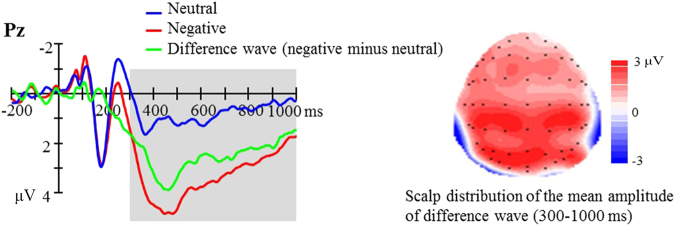
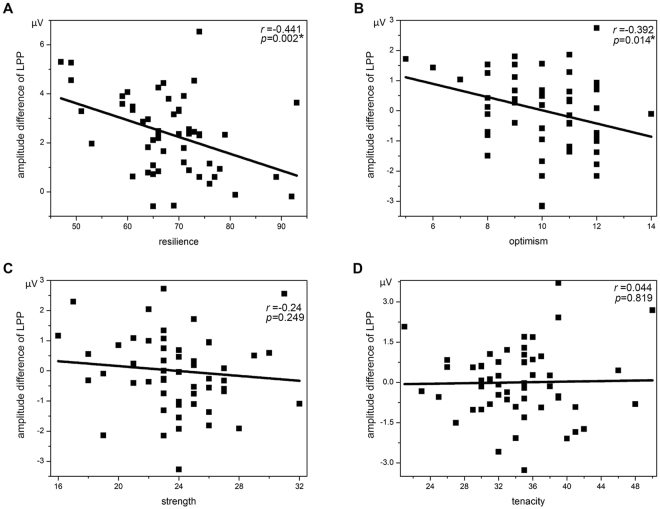
Individuals with low level of resilience are documented to be less capable of regulating negative emotion. To investigate the underlying neurophysiology, the present study examined the relationship between resilience and the late positive potential (LPP) evoked by emotionally negative pictures. Fifty-four participants watched negative and neutral pictures passively while their electroencephalogram (EEG) was recorded to assess LPP. Participants also completed the Connor-Davidson Resilience Scale (CD-RISC) for assessment of their resilience levels. We found that resilience was negatively correlated with the LPP response to negative emotional pictures. Additionally, this negative correlation was mainly driven by optimism, one of the three composite factors that contribute to resilience. Our results showed a neurophysiological correlate for the effect of resilience on negative emotion, and suggested a predictive value of optimism in identifying individuals potentially sensitive to affective interruptions.
Overview
The claims and statistics of this paper haven’t been checked yet.
Free: it reads the open-access text and checks the first 5 claims that cite a source we can check. Create a free account to check every claim.
Integrity signals
Registry
Cites
Statistics
Figures
Verification
Claims the paper makes
The claims and statistics of this paper haven’t been checked yet.
Free: it reads the open-access text and checks the first 5 claims that cite a source we can check. Create a free account to check every claim.
Claims other papers make about this one
Each is checked against this paper’s own text: does it say what the citing paper says it does?
In the citing paper
“Among healthy adults, self-reported resilience was correlated with decreased electroencephalogram (EEG) responsivity to adverse images227.”
From Psychobiological factors of resilience and depression in late life (2019) · cites this paper as [227]
Self-check
Percentages, sums and reported differences re-computed from the paper’s own numbers.
The self-check needs the paper’s full text.
Citations
Cites
Development of a new resilience scale: The Connor-Davidson Resilience Scale (CD-RISC)
Connor, K. M., & Davidson, J. R. T. (2003) · Depression and Anxiety · doi:10.1002/da.10113 · Cited by 11,793
Resilient Individuals Use Positive Emotions to Bounce Back From Negative Emotional Experiences.
Tugade, M. M., & Fredrickson, B. L. (2004) · Journal of Personality and Social Psychology · doi:10.1037/0022-3514.86.2.320 · Cited by 3,947
The metatheory of resilience and resiliency
Richardson, G. E. (2002) · Journal of Clinical Psychology · doi:10.1002/jclp.10020 · Cited by 2,509
A Solution for Reliable and Valid Reduction of Ocular Artifacts, Applied to the P300 ERP
Semlitsch, H. V., Anderer, P., Schuster, P., & Presslich, O. (1986) · Psychophysiology · doi:10.1111/j.1469-8986.1986.tb00696.x · Cited by 2,020
Automatic vigilance: The attention-grabbing power of negative social information.
Pratto, F., & John, O. P. (1991) · Journal of Personality and Social Psychology · doi:10.1037/0022-3514.61.3.380 · Cited by 1,592
Psychological resilience, positive emotions, and successful adaptation to stress in later life.
Ong, A. D., Bergeman, C. S., Bisconti, T. L., & Wallace, K. A. (2006) · Journal of Personality and Social Psychology · doi:10.1037/0022-3514.91.4.730 · Cited by 1,547
Event-Related Potentials, Emotion, and Emotion Regulation: An Integrative Review
Hajcak, G., MacNamara, A., & Olvet, D. M. (2010) · Developmental Neuropsychology · doi:10.1080/87565640903526504 · Cited by 1,370
Ito, T. A., Larsen, J. T., Smith, N. K., & Cacioppo, J. T. (1998) · Journal of Personality and Social Psychology · doi:10.1037/0022-3514.75.4.887 · Cited by 1,340
Not all emotions are created equal: The negativity bias in social–emotional development
Vaish, A., Grossmann, T., & Woodward, A. (2008) · Psychological Bulletin · doi:10.1037/0033-2909.134.3.383 · Cited by 1,191
Yu, X., & Zhang, J. (2007) · Social Behavior and Personality: an international journal · doi:10.2224/sbp.2007.35.1.19 · Cited by 1,064
Neural Substrate of the Late Positive Potential in Emotional Processing
Liu, Y., Huang, H., McGinnis-Deweese, M., Keil, A., & Ding, M. (2012) · The Journal of Neuroscience · doi:10.1523/jneurosci.3109-12.2012 · Cited by 413
Resilience in response to life stress: the effects of coping style and cognitive hardiness
Beasley, M., Thompson, T., & Davidson, J. (2003) · Personality and Individual Differences · doi:10.1016/s0191-8869(02)00027-2 · Cited by 403
Optimism, Vulnerability, and self-beliefs as health-related cognitions: A systematic overview
Schwarzer, R. (1994) · Psychology & Health · doi:10.1080/08870449408407475 · Cited by 383
The late positive potential: a neurophysiological marker for emotion regulation in children
Dennis, T. A., & Hajcak, G. (2009) · Journal of Child Psychology and Psychiatry · doi:10.1111/j.1469-7610.2009.02168.x · Cited by 335
Education, Vulnerability, and Resilience after a Natural Disaster
Frankenberg, E., Sikoki, B., Sumantri, C., Suriastini, W., & Thomas, D. (2013) · Ecology and Society · doi:10.5751/es-05377-180216 · Cited by 279
New, A. S., Fan, J., Murrough, J. W., Liu, X., Liebman, R. E., Guise, K. G., Tang, C. Y., & Charney, D. S. (2009) · Biological Psychiatry · doi:10.1016/j.biopsych.2009.05.020 · Cited by 252
Behavioral control, the medial prefrontal cortex, and resilience
Maier, S. F., Amat, J., Baratta, M. V., Paul, E., & Watkins, L. R. (2006) · Dialogues in Clinical Neuroscience · doi:10.31887/dcns.2006.8.4/smaier · Cited by 231
Scali, J., Gandubert, C., Ritchie, K., Soulier, M., Ancelin, M.-L., & Chaudieu, I. (2012) · PLoS ONE · doi:10.1371/journal.pone.0039879 · Cited by 219
Kukihara, H., Yamawaki, N., Uchiyama, K., Arai, S., & Horikawa, E. (2014) · Psychiatry and Clinical Neurosciences · doi:10.1111/pcn.12159 · Cited by 201
Lee, J.-S., Ahn, Y.-S., Jeong, K.-S., Chae, J.-H., & Choi, K.-S. (2014) · Journal of Affective Disorders · doi:10.1016/j.jad.2014.02.031 · Cited by 188
Age and Gender Effects on Resilience in Children and Adolescents
Sun, J., & Stewart, D. (2007) · International Journal of Mental Health Promotion · doi:10.1080/14623730.2007.9721845 · Cited by 181
New, A. S., Fan, J., Murrough, J. W., Liu, X., Liebman, R. E., & Guise, K. G. (2009) · PsycEXTRA Dataset · doi:10.1037/e717692011-018 · Cited by 172
Kisley, M. A., Wood, S., & Burrows, C. L. (2007) · Psychological Science · doi:10.1111/j.1467-9280.2007.01988.x · Cited by 150
Neural markers of positive reappraisal and their associations with trait reappraisal and worry.
Moser, J. S., Hartwig, R., Moran, T. P., Jendrusina, A. A., & Kross, E. (2014) · Journal of Abnormal Psychology · doi:10.1037/a0035817 · Cited by 127
Wood, S., & Kisley, M. A. (2006) · Psychology and Aging · doi:10.1037/0882-7974.21.4.815 · Cited by 116
Increasing optimism abolishes pain-induced impairments in executive task performance
Boselie, J. J. L. M., Vancleef, L. M. G., Smeets, T., & Peters, M. L. (2014) · Pain · doi:10.1016/j.pain.2013.10.014 · Cited by 96
Temperament and emotion regulation: the role of autonomic nervous system reactivity
Stifter, C. A., Dollar, J. M., & Cipriano, E. A. (2011) · Developmental Psychobiology · doi:10.1002/dev.20519 · Cited by 74
Dolcos, S., Hu, Y., Iordan, A. D., Moore, M., & Dolcos, F. (2016) · Social Cognitive and Affective Neuroscience · doi:10.1093/scan/nsv106 · Cited by 70
Davidson, J., Stein, D. J., Rothbaum, B. O., Pedersen, R., Szumski, A., & Baldwin, D. S. (2012) · Journal of Psychopharmacology · doi:10.1177/0269881111413821 · Cited by 55
Schäfer, J., Wïttchen, H., Höfler, M., Heinrich, A., Zimmermann, P. L., Siegel, S., & Schönfeld, S. (2015) · Journal of Behavior Therapy and Experimental Psychiatry · doi:10.1016/j.jbtep.2015.03.010 · Cited by 53
Ho, N. S. P., Sun, D., Ting, K. H., Chan, C. C. H., & Lee, T. M. C. (2015) · Evidence-based Complementary and Alternative Medicine · doi:10.1155/2015/212368 · Cited by 32
Are Happy Faces Attractive? The Roles of Early vs. Late Processing
Sun, D., Chan, C. C. H., Fan, J., Wu, Y., & Lee, T. M. C. (2015) · Frontiers in Psychology · doi:10.3389/fpsyg.2015.01812 · Cited by 22
Autonomic Mechanisms of Emotional Reactivity and Regulation
Uy, C. C., Jeffrey, I. A., Wilson, M., Aluru, V., Madan, A., Lu, Y., & Raghavan, P. (2013) · Psychology · doi:10.4236/psych.2013.48095 · Cited by 17
Cited by
Psychobiological factors of resilience and depression in late life
Laird, K. T., Krause, B., Funes, C., & Lavretsky, H. (2019) · Translational Psychiatry · doi:10.1038/s41398-019-0424-7 · Cited by 229
Camitan, D. S., & Bajin, L. N. (2021) · Frontiers in Psychology · doi:10.3389/fpsyg.2021.558930 · Cited by 49
Negative emotion reduces visual working memory recall variability: A meta-analytical review.
Xie, W., Ye, C., & Zhang, W. (2023) · Emotion · doi:10.1037/emo0001139 · Cited by 43
Tai, A. P.-L., Leung, M.-K., Geng, X., & Lau, W. K. (2023) · Frontiers in Behavioral Neuroscience · doi:10.3389/fnbeh.2023.1175064 · Cited by 38
Bizri, M., Ibrahim, N., Beyrouthy, C., Yamout, D., Tamim, H., Abiad, J., & Ghazeeri, G. S. (2022) · PLoS ONE · doi:10.1371/journal.pone.0269700 · Cited by 25
“Although moderate, the negative correlation between the negative affect of PANAS and CD-RISC establishes an extension of the findings where resilience is not considered a trait only but also a process based on myriad stressors and the negative affects coupled with it [23].”
Background
Metadata
- Authors
- Chen, D., Wu, J., Yao, Z., Lei, K., Luo, Y., & Li, Z.
- Affiliations
- Shenzhen University (CN)
- Chinese Academy of Sciences (CN)
- Corresponding author
- Luo, Yuejia
- Li, Zhihao
- Venue
- Scientific Reports
- Published
- 2018-05-08
- Volume
- 8
- Issue
- 1
- Pages
- 7149-7149
- ISSN
- 2045-2322 (ISSN-L)
- PMC
- PMC5940768
- OpenAlex
- W2802887804
- Cited by
- 23
- References
- 34
- Citations by year
- 2026: 2 · 2025: 5 · 2024: 1 · 2023: 5 · 2022: 5 · 2021: 4 · 2019: 1
- FWCI
- 1.47
- Type
- journal article
- Language
- en
- Open access
- gold
- doi.org
- Licence
- cc-by
- creativecommons.org/licenses/by/4.0 (tdm)
- creativecommons.org/licenses/by/4.0 (vor)
- Locations
- Scientific Reports (publishedVersion, cc-by)
- Europe PMC (PubMed Central) (publishedVersion, other-oa)
- PubMed Central (publishedVersion, cc-by)
- PubMed (publishedVersion)
- Institutional Repository of Institute of Psychology, Chinese Academy of Sciences (Institute of Psychology, Chinese Academy of Sciences) (submittedVersion)
- DOAJ (DOAJ: Directory of Open Access Journals) (submittedVersion, cc-by-sa)
- Radboud Repository (Radboud University) (submittedVersion)
- Radboud Repository (Radboud University) (submittedVersion, other-oa)
- Greater South Information System
- Funders
- National Natural Science Foundation of China (31671169, 31530031)
- Topics
- Social Sciences › Psychology › Clinical Psychology › Resilience and Mental Health
- Social Sciences › Psychology › Applied Psychology › Optimism, Hope, and Well-being
- Life Sciences › Neuroscience › Cognitive Neuroscience › Neural and Behavioral Psychology Studies
- Keywords
- resilience, optimism, late positive potential, negative emotions, emotional pictures, event-related potentials, emotion regulation, neurophysiological correlates, emotional vulnerability
- MeSH terms
- Adult, Electroencephalography, Emotions, Evoked Potentials, Female, Humans, Male, Photic Stimulation, Resilience, Psychological, Young Adult
About these checks
Registry, retraction, Cites and statistics results are computed, not judged, with one exception: a printed reference that no index lists is read once by a model before it counts as a citation error. Claims are extracted by a model and kept only when their quote appears verbatim in the text; each cited source is then checked, with a model’s help, for whether it says what the claim relies on. Those verdicts can be wrong — read the claim’s quote and the cited source before relying on one.
Statistics and arithmetic are recomputed, not judged.
Confidence bands are shown only for fields calibrated on our annotated test set. None is calibrated yet, so no band is shown.
What counts as a claim ›How we measure confidence ›How we check this ›
Are you an author, or do you see a problem with this page? Request a review
Data sources
Bibliographic data: Semantic Scholar, OpenAlex, Crossref.
Contains information from the Semantic Scholar Academic Graph Datasets, made available under the ODC Attribution License (ODC-BY 1.0).
Semantic Scholar’s data is described in: Kinney, R., et al. (2023). The Semantic Scholar Open Data Platform. arXiv:2301.10140.
