

Prior object-knowledge sharpens properties of early visual feature-detectors
Open accessThe DOI matches its Crossref record; 86 of the 86 references it cites were found in a registry or an index.
Abstract
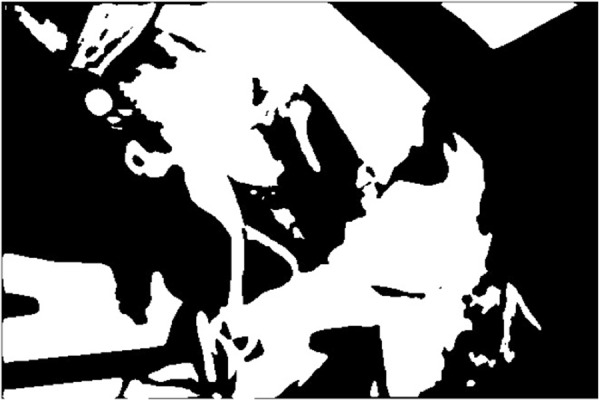
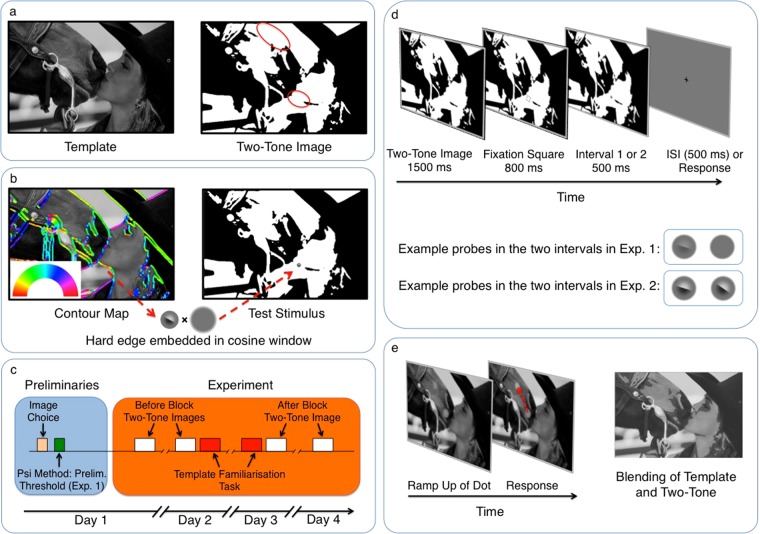
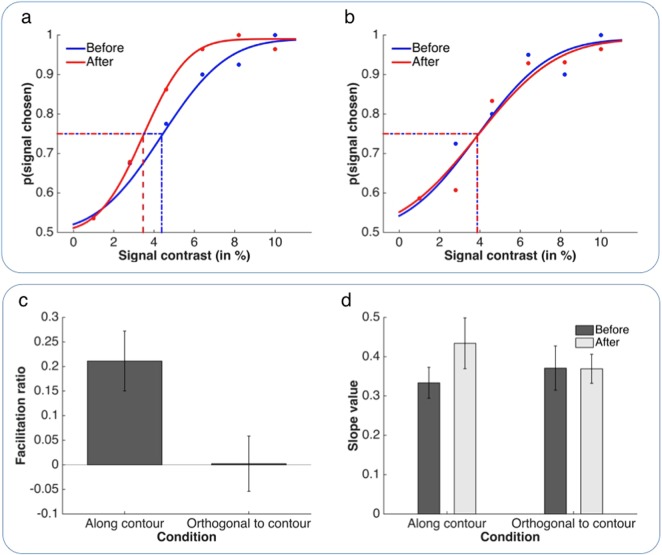
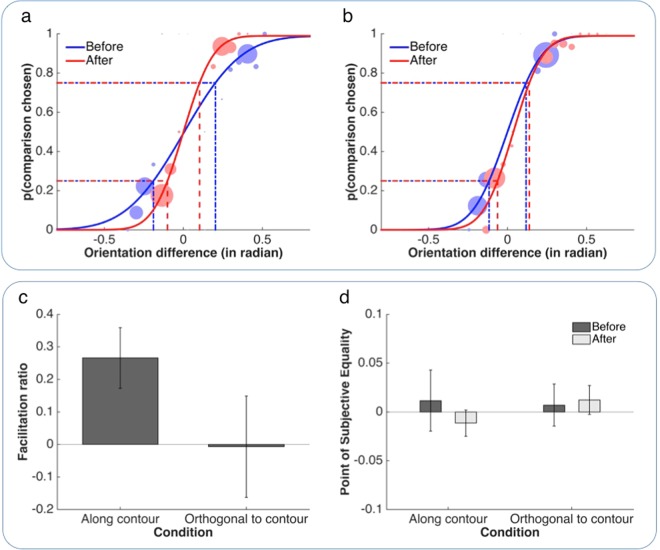
Early stages of visual processing are carried out by neural circuits activated by simple and specific features, such as the orientation of an edge. A fundamental question in human vision is how the brain organises such intrinsically local information into meaningful properties of objects. Classic models of visual processing emphasise a one-directional flow of information from early feature-detectors to higher-level information-processing. By contrast to this view, and in line with predictive-coding models of perception, here, we provide evidence from human vision that high-level object representations dynamically interact with the earliest stages of cortical visual processing. In two experiments, we used ambiguous stimuli that, depending on the observer’s prior object-knowledge, can be perceived as either coherent objects or as a collection of meaningless patches. By manipulating object knowledge we were able to determine its impact on processing of low-level features while keeping sensory stimulation identical. Both studies demonstrate that perception of local features is facilitated in a manner consistent with an observer’s high-level object representation (i.e., with no effect on object-inconsistent features). Our results cannot be ascribed to attentional influences. Rather, they suggest that high-level object representations interact with and sharpen early feature-detectors, optimising their performance for the current perceptual context.
Overview
The claims and statistics of this paper haven’t been checked yet.
Free: it reads the open-access text and checks the first 5 claims that cite a source we can check. Create a free account to check every claim.
Integrity signals
Registry
Cites
Statistics
Figures
Verification
Claims the paper makes
The claims and statistics of this paper haven’t been checked yet.
Free: it reads the open-access text and checks the first 5 claims that cite a source we can check. Create a free account to check every claim.
Claims other papers make about this one
Each is checked against this paper’s own text: does it say what the citing paper says it does?
The source backs part of the claim, not all of it — or backs it for a different population, condition or comparison.
In the citing paper
“Conversely, PP provides a satisfying explanation of these copious backward connections, impugning their consignment to mere recurrent modulations in feedforward schema.”
From Evaluating the neurophysiological evidence for predictive processing as a model of perception (2020) · cites this paper as [206]
Experimental — accuracy not yet measuredThe source backs part of the claim, not all of it — or backs it for a different population, condition or comparison.
In the citing paper
“Although the debate about PP's empirical grounding is currently unsettled, the theory can nevertheless be regarded as a milestone in cognitive neuroscience, spurring efforts to recognize the importance of backward connections in the architecture of the neocortex and the role of prediction in sensory processing.”
From Evaluating the neurophysiological evidence for predictive processing as a model of perception (2020) · cites this paper as [206]
Experimental — accuracy not yet measured
Self-check
Percentages, sums and reported differences re-computed from the paper’s own numbers.
The self-check needs the paper’s full text.
Citations
Cites
Brainard, D. H. (1997) · Spatial Vision · doi:10.1163/156856897x00357 · Cited by 19,702
Receptive fields, binocular interaction and functional architecture in the cat’s visual cortex
Hubel, D. H., & Wiesel, T. N. (1962) · The Journal of Physiology · doi:10.1113/jphysiol.1962.sp006837 · Cited by 13,680
Kass, R. E., & Raftery, A. E. (1995) · Journal of the American Statistical Association · doi:10.1080/01621459.1995.10476572 · Cited by 12,558
Neural Mechanisms of Selective Visual Attention
Desimone, R., & Duncan, J. (1995) · Annual Review of Neuroscience · doi:10.1146/annurev.ne.18.030195.001205 · Cited by 8,388
The free-energy principle: a unified brain theory?
Friston, K. (2010) · Nature Reviews Neuroscience · doi:10.1038/nrn2787 · Cited by 8,120
The fusiform face area: a module in human extrastriate cortex specialized for face perception
Kanwisher, N., McDermott, J., & Chun, M. M. (1997) · The Journal of Neuroscience · doi:10.1523/jneurosci.17-11-04302.1997 · Cited by 7,738
Kleiner, M., Brainard, D. H., & Pelli, D. G. (2007) · MPG.PuRe (Max Planck Society) · Cited by 6,195
Rao, R. P. N., & Ballard, D. H. (1999) · Nature Neuroscience · doi:10.1038/4580 · Cited by 5,483
Receptive fields of single neurones in the cat's striate cortex
Hubel, D. H., & Wiesel, T. N. (1959) · The Journal of Physiology · doi:10.1113/jphysiol.1959.sp006308 · Cited by 4,653
DISCHARGE PATTERNS AND FUNCTIONAL ORGANIZATION OF MAMMALIAN RETINA
Kuffler, S. W. (1953) · Journal of Neurophysiology · doi:10.1152/jn.1953.16.1.37 · Cited by 2,609
Research works printed but not linked: 3
- De Valois, R. L. & De Valois, K. K. Spatial Vision. (Oxford University Press, 1991).
- Pasupathy, A. in Fundamentals of Vision: Low and Mid-Level Processes in Perception (eds. Martinez-Conde, S., Macknik, S., Martinez, M., Alonso, J. M. & Tse, P.) 154, 293–313 (Elsevier, 2006).
- Marr, D. Vision. (The MIT Press, 1982).
Cited by
Items 101–129 of 129
Nánay, B. (2023) · Oxford University Press eBooks · doi:10.1093/oso/9780198809500.003.0023
Nánay, B. (2023) · Oxford University Press eBooks · doi:10.1093/oso/9780198809500.003.0026
Clinical Applications of Mental Imagery
Nánay, B. (2023) · Oxford University Press eBooks · doi:10.1093/oso/9780198809500.003.0030
Nánay, B. (2023) · Oxford University Press eBooks · doi:10.1093/oso/9780198809500.003.0007
Nánay, B. (2023) · Oxford University Press eBooks · doi:10.1093/oso/9780198809500.002.0006
Nánay, B. (2023) · Oxford University Press eBooks · doi:10.1093/oso/9780198809500.002.0005
Nánay, B. (2023) · Oxford University Press eBooks · doi:10.1093/oso/9780198809500.003.0019
Editor's evaluation: Action does not enhance but attenuates predicted touch
Ahmed, A. A. (2023) · eLife · doi:10.7554/elife.90912.sa0
Zheng, Z., Trübutschek, D., Huang, S., Cai, Y., & Melloni, L. (2024) · PsyArXiv (OSF Preprints) · doi:10.31234/osf.io/9dysm
Gambi, C., Zhang, F., & Pickering, M. J. (2024) · Journal of Neurolinguistics · doi:10.1016/j.jneuroling.2024.101229
“…the current state of the speech motor system is not directly observable, and thus a model of this system (an “ observer ” ) is used to generate (Teufel, Dakin, & Fletcher, 2018), the impoverished sensory information typically prevents us from recognising what it depicts (i.e., compare it to…”
Semantic priming modulates the strength and direction of the Kanizsa illusion
Litvak, N. D., Tal, A., & Mudrik, L. (2025) · Communications Psychology · doi:10.1038/s44271-025-00268-9
“These predictions are continuously updated through feedforward and feedback connections 7,10 and are re fl ected in processes of neural re-organization and synapse strength modulation 11,12 .”
Evolving object concepts in the adult brain: An electrophysiological investigation
Unger, K., Kacin, M., & Rahman, R. A. (2025) · Cognitive Affective & Behavioral Neuroscience · doi:10.3758/s13415-025-01299-9
“This finding aligns with theoretical proposals that the P1 reflects recurrent feedback activation processes from higher brain areas to early sensory regions (Klimesch, 2011; Teufel et al., 2018).”
Three grades of subject-dependency in object perception
Ivy, S., & Mroczko-Wąsowicz, A. (2025) · Synthese · doi:10.1007/s11229-025-05182-5
“…are detectable at early stages of perception in the primary visual cortex (V1) when amodal completion occurs; and further, the occurrence of amodal completion vis a vis mental imagery is often only possible after familiarization with perceptual objects (Naselaris et al., 2015; Teufel et al., 2018).”
Labelling and iconicity facilitate visual categorisation and discrimination
Scott, J., Foley, R., & Božić, M. (2025) · Language and Cognition · doi:10.1017/langcog.2025.10023
“Such accounts characterise cognitive functions such as categorisation and discrimination as ‘ best guesses ’ derived from an interplay between prior knowledge and the available sensory data (Clark, 2013; Fletcher & Frith, 2009; Friston & Kiebel, 2009; Teufel et al., 2018).”
Labelling and Iconicity Facilitate Visual Perception and CategorisationPreprint
Scott, J., Foley, R., & Božić, M. (2025) · PsyArXiv (OSF Preprints) · doi:10.31234/osf.io/uefvs_v3
Attention and Explicit Knowledge Drive Predictive Sharpening in Early Visual Cortex
Sabio‐Albert, M., Richter, D., Fuentemilla, L., & Pérez-Bellido, A. (2026) · Journal of Cognitive Neuroscience · doi:10.1162/jocn.a.2689
The Nature and Mechanisms of Psychotic Experiences in Borderline Personality Disorder
Peitzmeier, C. (2023) · Apollo (University of Cambridge) · doi:10.17863/cam.106782
Gotsis, S. (2023) · ANU Open Research (Australian National University) · doi:10.25911/xpae-a195
Window views in the built environment: preferences and behaviours
Batool, A. (2021) · Nottingham ePrints (University of Nottingham) · Cited by 3
The role of conscious awareness in perceptual learning
Halchin, A.-M. (2023) · ORCA Online Research @Cardiff (Cardiff University)
Towards Understanding and Developing Open-Ended Intelligences for Infinite Worlds
Madani, O. (2026) · Studies in computational intelligence · doi:10.1007/978-3-032-13977-1_29
MooneyMaker: A Python package to create ambiguous two-tone images
Reining, L. C., Matthies, T., Haussner, L., Turon, R., & Wallis, T. S. A. (2026) · Journal of Vision · doi:10.1167/jov.26.10.8
“This confirms previous findings that prior knowledge about the content of a Mooney image can greatly enhance its interpretability (Dolan et al., 1997; Hegd´e & Kersten, 2010; Teufel et al., 2018) and that showing the template image is an effective way to provide this prior knowledge.”
InfluentialRoux-Sibilon, A. (2020) · theses.fr (ABES) · doi:10.70675/c687f5caz1eabz4b18zaf72z1b6a3e898d78 · Cited by 3
Etude de l'influence des processus prédictifs sur la perception visuelle subjective
Rossel, P. (2023) · theses.fr (ABES) · doi:10.70675/83d02a65z92c7z43adza63ez56c54bdc9370
Disambiguation of two-tone images aligns object representations in the EEGPreprint
Kessler, R., Finnemann, J., & Skeide, M. A. (2026) · bioRxiv (Cold Spring Harbor Laboratory) · doi:10.64898/2026.06.05.730193
Gravitational expectations simultaneously attract and repel perceptionPreprint
Simpson, N., Rittershofer, K., Ward, E. K., Mazor, M., & Press, C. (2026) · bioRxiv (Cold Spring Harbor Laboratory) · doi:10.64898/2026.06.15.732061
“…counterintuitive because people are usually biased towards, not away from , perceiving what they expect (Bar et al., 2006; de Lange et al., 2018; Sterzer et al., 2010; Teufel et al., 2018; Yuille & Kersten, 2006) – a bias which is thought to render perception more accurate in a noisy sensory world.”
Rideaux, R., Hu, Z., Chidley, K., Cloos, M. A., Schwarzkopf, D. S., & Mattingley, J. B. (2026) · bioRxiv (Cold Spring Harbor Laboratory) · doi:10.64898/2026.07.05.736624
Temporal confounds emulate multivariate fMRI measures of perceptual learning
Milne, G. A., Stäubli, K. E., Chow-Wing-Bom, H. T., Greenwood, J. A., Kok, P., Maimon-Mor, R. O., & Dekker, T. (2026) · Imaging Neuroscience · doi:10.1162/imag.a.1435
Metadata
- Authors
- Teufel, C., Dakin, S. C., & Fletcher, P. C.
- Affiliations
- Cardiff University (GB)
- University of Auckland (NZ)
- University of Cambridge (GB)
- Corresponding author
- Teufel, Christoph
- Venue
- Scientific Reports
- Published
- 2018-07-18
- Volume
- 8
- Issue
- 1
- Pages
- 10853-10853
- ISSN
- 2045-2322 (ISSN-L)
- PMC
- PMC6051992
- OpenAlex
- W2809827720
- Cited by
- 119
- References
- 86
- Citations by year
- 2026: 5 · 2025: 11 · 2024: 7 · 2023: 44 · 2022: 9 · 2021: 15 · 2020: 15 · 2019: 12 · 2018: 1
- FWCI
- 6.40
- Type
- journal article
- Language
- en
- Open access
- gold
- doi.org
- Licence
- cc-by
- creativecommons.org/licenses/by/4.0 (tdm)
- creativecommons.org/licenses/by/4.0 (vor)
- Locations
- Scientific Reports (publishedVersion, cc-by)
- Europe PMC (PubMed Central) (publishedVersion, cc-by)
- PubMed Central (publishedVersion, cc-by)
- PubMed (publishedVersion)
- ORCA Online Research @Cardiff (Cardiff University) (acceptedVersion)
- DOAJ (DOAJ: Directory of Open Access Journals) (submittedVersion)
- ResearchSpace (University of Auckland) (submittedVersion, cc-by)
- Apollo (University of Cambridge) (submittedVersion, cc-by)
- Apollo (cc-by)
- Funders
- Wellcome Trust (WT095692MA)
- Bernard Wolfe Health Neuroscience Fund
- Topics
- Life Sciences › Neuroscience › Cognitive Neuroscience › Visual perception and processing mechanisms
- Physical Sciences › Computer Science › Computer Vision and Pattern Recognition › Visual Attention and Saliency Detection
- Life Sciences › Neuroscience › Cognitive Neuroscience › Face Recognition and Perception
- Keywords
- predictive coding, object representation, ambiguous stimuli, top-down modulation, object perception, visual cortex
- MeSH terms
- Adolescent, Adult, Attention, Female, Humans, Male, Orientation, Photic Stimulation, Visual Cortex, Visual Perception, Young Adult
About these checks
Registry, retraction, Cites and statistics results are computed, not judged, with one exception: a printed reference that no index lists is read once by a model before it counts as a citation error. Claims are extracted by a model and kept only when their quote appears verbatim in the text; each cited source is then checked, with a model’s help, for whether it says what the claim relies on. Those verdicts can be wrong — read the claim’s quote and the cited source before relying on one.
Statistics and arithmetic are recomputed, not judged.
Confidence bands are shown only for fields calibrated on our annotated test set. None is calibrated yet, so no band is shown.
What counts as a claim ›How we measure confidence ›How we check this ›
Are you an author, or do you see a problem with this page? Request a review
Data sources
Bibliographic data: Semantic Scholar, OpenAlex, Crossref.
Contains information from the Semantic Scholar Academic Graph Datasets, made available under the ODC Attribution License (ODC-BY 1.0).
Semantic Scholar’s data is described in: Kinney, R., et al. (2023). The Semantic Scholar Open Data Platform. arXiv:2301.10140.
