

Prior object-knowledge sharpens properties of early visual feature-detectors
Open accessThe DOI matches its Crossref record; 86 of the 86 references it cites were found in a registry or an index.
Abstract
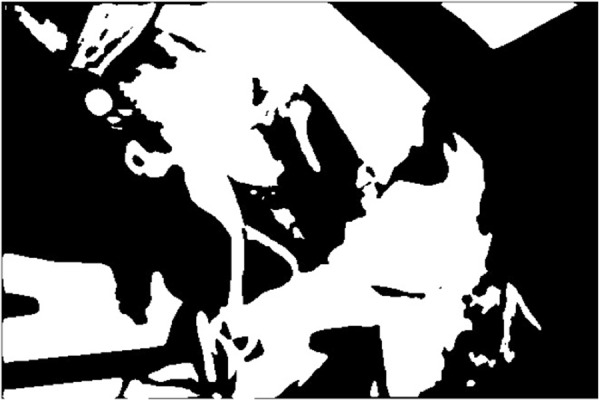
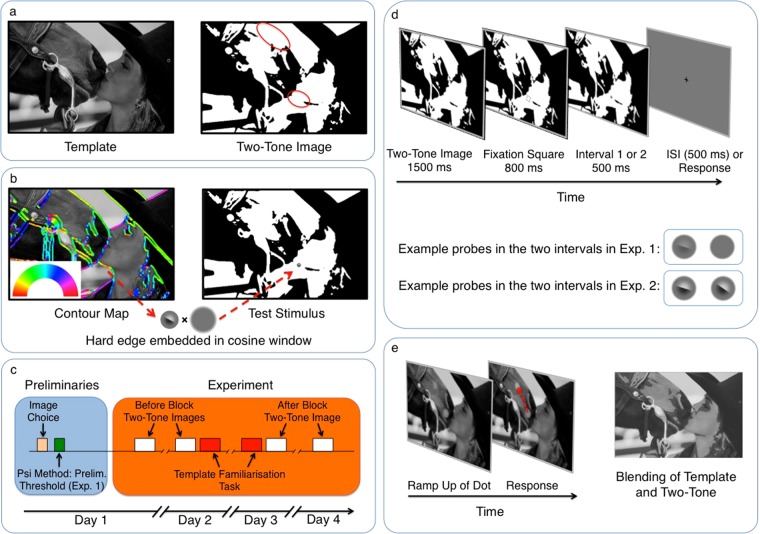
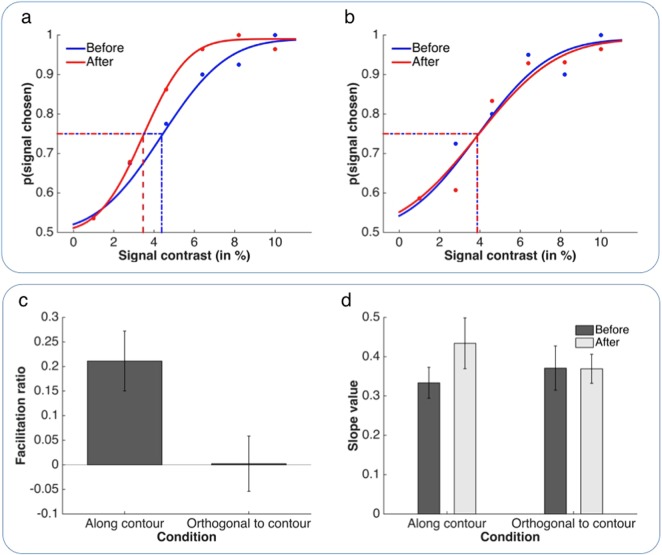
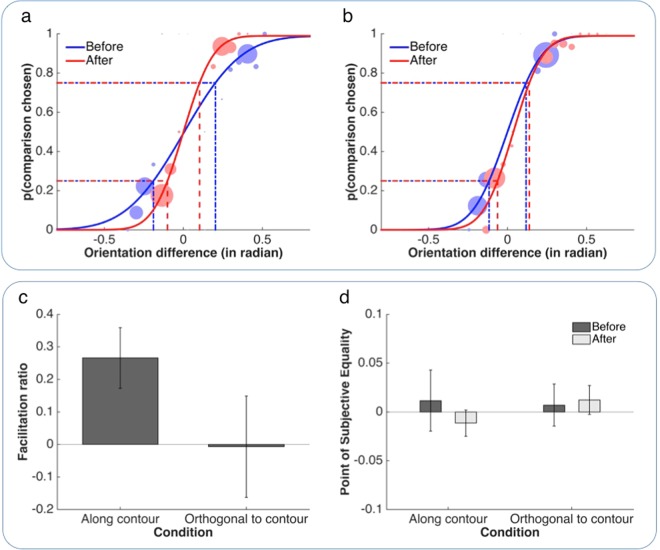
Early stages of visual processing are carried out by neural circuits activated by simple and specific features, such as the orientation of an edge. A fundamental question in human vision is how the brain organises such intrinsically local information into meaningful properties of objects. Classic models of visual processing emphasise a one-directional flow of information from early feature-detectors to higher-level information-processing. By contrast to this view, and in line with predictive-coding models of perception, here, we provide evidence from human vision that high-level object representations dynamically interact with the earliest stages of cortical visual processing. In two experiments, we used ambiguous stimuli that, depending on the observer’s prior object-knowledge, can be perceived as either coherent objects or as a collection of meaningless patches. By manipulating object knowledge we were able to determine its impact on processing of low-level features while keeping sensory stimulation identical. Both studies demonstrate that perception of local features is facilitated in a manner consistent with an observer’s high-level object representation (i.e., with no effect on object-inconsistent features). Our results cannot be ascribed to attentional influences. Rather, they suggest that high-level object representations interact with and sharpen early feature-detectors, optimising their performance for the current perceptual context.
Overview
The claims and statistics of this paper haven’t been checked yet.
Free: it reads the open-access text and checks the first 5 claims that cite a source we can check. Create a free account to check every claim.
Integrity signals
Registry
Cites
Statistics
Figures
Verification
Claims the paper makes
The claims and statistics of this paper haven’t been checked yet.
Free: it reads the open-access text and checks the first 5 claims that cite a source we can check. Create a free account to check every claim.
Claims other papers make about this one
Each is checked against this paper’s own text: does it say what the citing paper says it does?
The source backs part of the claim, not all of it — or backs it for a different population, condition or comparison.
In the citing paper
“Conversely, PP provides a satisfying explanation of these copious backward connections, impugning their consignment to mere recurrent modulations in feedforward schema.”
From Evaluating the neurophysiological evidence for predictive processing as a model of perception (2020) · cites this paper as [206]
Experimental — accuracy not yet measuredThe source backs part of the claim, not all of it — or backs it for a different population, condition or comparison.
In the citing paper
“Although the debate about PP's empirical grounding is currently unsettled, the theory can nevertheless be regarded as a milestone in cognitive neuroscience, spurring efforts to recognize the importance of backward connections in the architecture of the neocortex and the role of prediction in sensory processing.”
From Evaluating the neurophysiological evidence for predictive processing as a model of perception (2020) · cites this paper as [206]
Experimental — accuracy not yet measured
Self-check
Percentages, sums and reported differences re-computed from the paper’s own numbers.
The self-check needs the paper’s full text.
Citations
Cites
Brainard, D. H. (1997) · Spatial Vision · doi:10.1163/156856897x00357 · Cited by 19,702
Receptive fields, binocular interaction and functional architecture in the cat’s visual cortex
Hubel, D. H., & Wiesel, T. N. (1962) · The Journal of Physiology · doi:10.1113/jphysiol.1962.sp006837 · Cited by 13,680
Kass, R. E., & Raftery, A. E. (1995) · Journal of the American Statistical Association · doi:10.1080/01621459.1995.10476572 · Cited by 12,558
Neural Mechanisms of Selective Visual Attention
Desimone, R., & Duncan, J. (1995) · Annual Review of Neuroscience · doi:10.1146/annurev.ne.18.030195.001205 · Cited by 8,388
The free-energy principle: a unified brain theory?
Friston, K. (2010) · Nature Reviews Neuroscience · doi:10.1038/nrn2787 · Cited by 8,120
The fusiform face area: a module in human extrastriate cortex specialized for face perception
Kanwisher, N., McDermott, J., & Chun, M. M. (1997) · The Journal of Neuroscience · doi:10.1523/jneurosci.17-11-04302.1997 · Cited by 7,738
Kleiner, M., Brainard, D. H., & Pelli, D. G. (2007) · MPG.PuRe (Max Planck Society) · Cited by 6,195
Rao, R. P. N., & Ballard, D. H. (1999) · Nature Neuroscience · doi:10.1038/4580 · Cited by 5,483
Receptive fields of single neurones in the cat's striate cortex
Hubel, D. H., & Wiesel, T. N. (1959) · The Journal of Physiology · doi:10.1113/jphysiol.1959.sp006308 · Cited by 4,653
DISCHARGE PATTERNS AND FUNCTIONAL ORGANIZATION OF MAMMALIAN RETINA
Kuffler, S. W. (1953) · Journal of Neurophysiology · doi:10.1152/jn.1953.16.1.37 · Cited by 2,609
Research works printed but not linked: 3
- De Valois, R. L. & De Valois, K. K. Spatial Vision. (Oxford University Press, 1991).
- Pasupathy, A. in Fundamentals of Vision: Low and Mid-Level Processes in Perception (eds. Martinez-Conde, S., Macknik, S., Martinez, M., Alonso, J. M. & Tse, P.) 154, 293–313 (Elsevier, 2006).
- Marr, D. Vision. (The MIT Press, 1982).
Cited by
The generation and propagation of the human alpha rhythm
Halgren, M., Ulbert, I., Bastuji, H., Fabó, D., Erőss, L., Rey, M., Devinsky, O., Doyle, W. K., Mak-McCully, R., Halgren, E., et al. (2019) · Proceedings of the National Academy of Sciences · doi:10.1073/pnas.1913092116 · Cited by 425
Evaluating the neurophysiological evidence for predictive processing as a model of perception
Walsh, K. S., McGovern, D. P., Clark, A., & O'Connell, R. G. (2020) · Annals of the New York Academy of Sciences · doi:10.1111/nyas.14321 · Cited by 333
The Perceptual Prediction Paradox
Press, C., Kok, P., & Yon, D. (2020) · Trends in Cognitive Sciences · doi:10.1016/j.tics.2019.11.003 · Cited by 246
Effects of Language on Visual Perception
Lupyan, G., Abdel Rahman, R., Boroditsky, L., & Clark, A. (2020) · Trends in Cognitive Sciences · doi:10.1016/j.tics.2020.08.005 · Cited by 243
Forms of prediction in the nervous system
Teufel, C., & Fletcher, P. C. (2020) · Nature Reviews Neuroscience · doi:10.1038/s41583-020-0275-5 · Cited by 155
“Panel g is adapted from reF.(6), CC-BY-4.”
Self-citationAction sharpens sensory representations of expected outcomes
Yon, D., Gilbert, S. J., de Lange, F. P., & Press, C. (2018) · Nature Communications · doi:10.1038/s41467-018-06752-7 · Cited by 145
Mental Imagery: Philosophy, Psychology, Neuroscience
Nánay, B. (2023) · doi:10.1093/oso/9780198809500.001.0001 · Cited by 137
Predictive processing of scenes and objects
Peelen, M. V., Berlot, E., & de Lange, F. P. (2023) · Nature Reviews Psychology · doi:10.1038/s44159-023-00254-0 · Cited by 73
“These activity modulations can be understood as resulting from feedback from the lateral occipital cortex, which helps to disambiguate representations at earlier levels 86 .”
Increased weighting on prior knowledge in Lewy body-associated visual hallucinations
Zarkali, A., Adams, R. A., Psarras, S., Leyland, L.-A., Rees, G., & Weil, R. S. (2019) · Brain Communications · doi:10.1093/braincomms/fcz007 · Cited by 64
“In an equal variance signal detection theory model, a simpler explanation is that prior knowledge leads to sensory sharpening or lowering of the noise distribution which has been previously suggested in a similar task (Teufel et al., 2018): this effect may be greater in those with least sensory precision.”
BackgroundImage content is more important than Bouma’s Law for scene metamers
Wallis, T. S. A., Funke, C. M., Ecker, A. S., Gatys, L. A., Wichmann, F. A., & Bethge, M. (2019) · eLife · doi:10.7554/elife.42512 · Cited by 75
“The importance of these mechanisms could be examined in future studies, and potentially dissociated from the local information discussed above, by using image manipulations thought to disrupt the activity of global grouping mechanisms such as polarity inversion or image two-toning (Neri, 2017; Balas, 2012; Teufel et a…”
BackgroundIndividual differences in the effects of priors on perception: A multi-paradigm approach
Tulver, K., Aru, J., Rutiku, R., & Bachmann, T. (2019) · Cognition · doi:10.1016/j.cognition.2019.03.008 · Cited by 63
Pedziwiatr, M. A., Kümmerer, M., Wallis, T. S. A., Bethge, M., & Teufel, C. (2020) · Cognition · doi:10.1016/j.cognition.2020.104465 · Cited by 38
Self-citationWolf, C., & Lappe, M. (2021) · Cognitive Neurodynamics · doi:10.1007/s11571-020-09661-y · Cited by 41
Action does not enhance but attenuates predicted touch
Job, X., & Kilteni, K. (2023) · eLife · doi:10.7554/elife.90912 · Cited by 32
Disco Time: The Relationship Between Perceived Duration and Tempo in Music
Hammerschmidt, D., Wöllner, C., London, J., & Burger, B. (2021) · Music & Science · doi:10.1177/2059204320986384 · Cited by 32
“The authors argued that the TAE might be an auditory example of perceptual sharpening (Kok et al., 2012; Teufel et al., 2018), as prior knowledge of a perceptual target sharpens the contrast between low-level features.”
BackgroundInfluence of peripheral vision on object categorization in central vision
Roux-Sibilon, A., Trouilloud, A., Kauffmann, L., Guyader, N., Mermillod, M., & Peyrin, C. (2019) · Journal of Vision · doi:10.1167/19.14.7 · Cited by 29
Rossel, P., Peyrin, C., Roux-Sibilon, A., & Kauffmann, L. (2022) · Journal of Experimental Psychology Human Perception & Performance · doi:10.1037/xhp0000993 · Cited by 28
“This results in a sharper representation of expected stimuli in these areas which would in turn lead to a sharper percept (de Lange et al., 2018; Han & VanRullen, 2016; Kok et al., 2012; Teufel et al., 2018; Yon et al., 2018).”
BackgroundMethodResultInfluentialInstant Effects of Semantic Information on Visual Perception
Enge, A., Suess, F., & Rahman, R. A. (2023) · Journal of Neuroscience · doi:10.1523/jneurosci.2038-22.2023 · Cited by 32
Effects of Language on Visual PerceptionPreprint
Lupyan, G., Rahman, R. A., Boroditsky, L., & Clark, A. (2020) · PsyArXiv (OSF Preprints) · doi:10.31234/osf.io/pztmc · Cited by 23
“[12,13]), there is relative consensus that what we perceive is importantly shaped by prior experience, (e.”
BackgroundLittle, P., & Firestone, C. (2021) · Psychological Science · doi:10.1177/0956797620939942 · Cited by 24
Hayes, T. R., & Henderson, J. M. (2022) · Cognition · doi:10.1016/j.cognition.2022.105231 · Cited by 21
Rossel, P., Peyrin, C., & Kauffmann, L. (2023) · Vision Research · doi:10.1016/j.visres.2023.108191 · Cited by 21
Parametric Image Reconstruction for Edge Recovery From Synthetic Aperture Radar Echoes
Zeng, T., Wei, Y., Ding, Z., Chen, X., Wang, Y., Fan, Y., & Long, T. (2020) · IEEE Transactions on Geoscience and Remote Sensing · doi:10.1109/tgrs.2020.3006884 · Cited by 18
“First, in visual processing in the human brain, the edges of a target, as simple and specific features, can directly activate neural circuits [6], [7].”
BackgroundTapping doesn’t help: Synchronized self-motion and judgments of musical tempo
London, J., Thompson, M. R., Burger, B., Hildreth, M., & Toiviainen, P. (2019) · Attention Perception & Psychophysics · doi:10.3758/s13414-019-01722-7 · Cited by 18
The perceptual prediction paradoxPreprint
Press, C., Kok, P., & Yon, D. (2019) · PsyArXiv (OSF Preprints) · doi:10.31234/osf.io/hdsmz · Cited by 16
Spatial structure, phase, and the contrast of natural images
Rideaux, R., West, R. K., Wallis, T. S. A., Bex, P. J., Mattingley, J. B., & Harrison, W. J. (2022) · Journal of Vision · doi:10.1167/jov.22.1.4 · Cited by 15
Evaluating cognitive penetrability of perception across the senses
Vetter, P., Badde, S., Ferrè, E. R., Seubert, J., & Shinn‐Cunningham, B. G. (2024) · Nature Reviews Psychology · doi:10.1038/s44159-024-00382-1 · Cited by 16
“2e) increases visual sensitivity to edge detection in these images, even when the images are task-irrelevant, attention is controlled and visual stimulation remains identical 42 (see also ref.”
Makowski, D., Te, A., Kirk, S., Liang, N. Z., & Chen, S. A. (2023) · Scientific Reports · doi:10.1038/s41598-023-33148-5 · Cited by 19
Perceptual reorganization from prior knowledge emerges late in childhood
Milne, G. A., Lisi, M., McLean, A., Zheng, R., Groen, I. I. A., & Dekker, T. M. (2024) · iScience · doi:10.1016/j.isci.2024.108787 · Cited by 12
“Given the proposed need for priorknowledgetoresolveedgeinformationfor two-tonerecognition, 22,30 weassessedhowtwo-tonetransformation alteredvarioussum-mary statistics of image edge information.”
BackgroundMethodRapid serial blinks: An index of temporally increased cognitive load
Nomura, R., & Maruno, S. (2019) · PLoS ONE · doi:10.1371/journal.pone.0225897 · Cited by 11
Increased associative interference under high cognitive load
Baror, S., & Bar, M. (2022) · Scientific Reports · doi:10.1038/s41598-022-05722-w · Cited by 11
What is So Special About Contemporary CG Faces? Semiotics of MetaHumans
Giuliana, G. T. (2022) · Topoi · doi:10.1007/s11245-022-09814-0 · Cited by 21
“2012) is related to the early stage of visual processing (such as edge detection) influenced by higher level representations related to prior knowledge (Teufel et al. 2018).”
BackgroundFast and robust visual object recognition in young children
Ayzenberg, V., Sener, S. B., Novick, K., & Lourenco, S. F. (2025) · Science Advances · doi:10.1126/sciadv.ads6821 · Cited by 14
Knowledge-driven perceptual organization reshapes information sampling via eye movements.
Pedziwiatr, M. A., Hagen, E. V. D., & Teufel, C. (2023) · Journal of Experimental Psychology Human Perception & Performance · doi:10.1037/xhp0001080 · Cited by 9
Self-citationPerceptual Priors Update Contextual Feedback Processing in V1
Lazarova, Y., Huang, Y., Muckli, L. F., & Petro, L. S. (2025) · Topics in Cognitive Science · doi:10.1111/tops.70018 · Cited by 8
Hu, Z., Tran, D. M. D., & Rideaux, R. (2025) · Imaging Neuroscience · doi:10.1162/imag.a.152 · Cited by 9
“Similarly, Teufel et al. (2018) reported lower detection and discrimination thresholds for expected stimuli.”
Contrast versus identity encoding in the face image follow distinct orientation selectivity profiles
Jacobs, C., Petras, K., Moors, P., & Goffaux, V. (2020) · PLoS ONE · doi:10.1371/journal.pone.0229185 · Cited by 8
“[33] this was implicitly so, while in Neri [34] participants explicitly judged the alignment of a Gabor patch to a local contour.”
BackgroundMethodInfluentialSubjective visibility report is facilitated by conscious predictions only
Alilović, J., Slagter, H. A., & van Gaal, S. (2020) · Consciousness and Cognition · doi:10.1016/j.concog.2020.103048 · Cited by 10
Hertz, U., Blakemore, C., & Frith, C. (2020) · Journal of Experimental Psychology Human Perception & Performance · doi:10.1037/xhp0000749 · Cited by 8
Nánay, B. (2023) · Oxford University Press eBooks · doi:10.1093/oso/9780198809500.003.0013 · Cited by 7
Effects of false statements on visual perception hinge on social suggestibility.
Anlló, H., Watanabe, K., Sackur, J., & de Gardelle, V. (2022) · Journal of Experimental Psychology Human Perception & Performance · doi:10.1037/xhp0001024 · Cited by 7
Does prior knowledge increase or decrease perceived visual complexity of texture images?
Li, L., & Choi, W. (2023) · Heliyon · doi:10.1016/j.heliyon.2023.e15559 · Cited by 5
“In experiments which use Mooney images, with the help of prior knowledge, a set of meaningless 2D black-and-white patches can be coherently perceived as a well-constructed two-tone image [37,38].”
MethodFraming Effects in Object Perception
Ivy, S., & Mroczko-Wąsowicz, A. (2025) · Review of Philosophy and Psychology · doi:10.1007/s13164-024-00763-8 · Cited by 6
“For example, these interactions include changes to early feature-detectors in the retina, shaping and sharpening their properties (Teufel et al. 2018; Hosoya et al. 2005).”
Steady-state visually evoked potential is modulated by the difference of recognition condition
Minami, T., Azuma, K., & Nakauchi, S. (2020) · PLoS ONE · doi:10.1371/journal.pone.0235309 · Cited by 4
“To investigate Eureka process, several studies have used ambiguous 2-tone (black and white) images [2, 3, 4, 5, 6, 7, 8, 9,10].”
BackgroundA Content-adaptive Visibility Predictor for Perceptually Optimized Image Blending
Fukiage, T., & Oishi, T. (2023) · ACM Transactions on Applied Perception · doi:10.1145/3565972 · Cited by 4
Dual representation of lexical uncertainty in human cortexPreprint
Guilleminot, P. H., & Morillon, B. (2025) · bioRxiv (Cold Spring Harbor Laboratory) · doi:10.1101/2025.08.08.669343 · Cited by 4
Zheng, Z., Trübutschek, D., Huang, S., Cai, Y., & Melloni, L. (2025) · Cognition · doi:10.1016/j.cognition.2025.106104 · Cited by 3
Faster But Less Precise: Expectation Enhances Response Speed While Reducing Sensory Fidelity
Hu, Z., Tran, D. M. D., & Rideaux, R. (2026) · Journal of Neuroscience · doi:10.1523/jneurosci.0154-26.2026 · Cited by 3
“Numerous studies have attributed attenuated neural responses to expected stimuli as signatures of e ffi cient coding and ful fi lled predictions (Kok et al., et al., 2012a; Teufel et al., 2018; Yon et al., 2018).”
A psychophysical evaluation of techniques for Mooney image generation
Reining, L. C., & Wallis, T. S. A. (2024) · PeerJ · doi:10.7717/peerj.18059 · Cited by 3
“Normally, these principles are used to fi ll in missing edges and complete contours in Mooney images to enable object perception ( Teufel, Dakin & Fletcher, 2018 ).”
BackgroundMethodInfluentialLondon, J., Burger, B., Thompson, M. R., Hildreth, M., Wilson, J., Schally, N., & Toiviainen, P. (2019) · Music Perception An Interdisciplinary Journal · doi:10.1525/mp.2019.37.1.26 · Cited by 3
Subjective visibility report is facilitated by conscious predictions onlyPreprint
Alilović, J., Slagter, H. A., & van Gaal, S. (2020) · bioRxiv (Cold Spring Harbor Laboratory) · doi:10.1101/2020.07.08.193037 · Cited by 3
“, 2018), improve sensitivity of early feature-detectors (Teufel et al., 2018) and sharpen neural representations in sensory brain regions (Kok, Jehee et al.”
Influence of «sensory prehistory» on the ambiguous stimuli processing in the human brain
Kuc, A. K., Александрович, М. В., & Hramov, A. (2022) · Izvestiya VUZ Applied Nonlinear Dynamics · doi:10.18500/0869-6632-2022-30-1-57-75 · Cited by 2
Effects of predictions robustness and object-based predictions on subjective visual perception
Carrez-Corral, C., Peyrin, C., Rossel, P., & Kauffmann, L. (2025) · Attention Perception & Psychophysics · doi:10.3758/s13414-025-03150-2 · Cited by 2
“Such “sharper” neural representation would in turn be translated into an enhanced (or sharper) perception of objects (Han & VanRullen, 2016; Kok et al., 2012; Teufel et al., 2018; Yon & Press, 2017).”
Human sensory adaptation to the ecological structure of environmental statistics
Neri, P. (2024) · Journal of Vision · doi:10.1167/jov.24.3.3 · Cited by 3
“To provide one example, detection of oriented wavelets inserted into degraded scenes may improve following acquisition of higher-level knowledge about the scene, despite no change in physical content of the image (Teufel et al., 2018).”
BackgroundPredictive processing: Is the future just a memory?
França, T. F. A. (2020) · European Journal of Neuroscience · doi:10.1111/ejn.14874 · Cited by 2
“For starters, some recent studies show that top-down projections may actually sharpen the representation of predicted signals (Teufel et al., 2018), something that has been incorporated in the theory (Teufel & Fletcher, 2020).”
Nilsson, D. (2021) · Cambridge University Press eBooks · doi:10.1017/9781108946339.002 · Cited by 3
Hurlbert, A. C. (2021) · Cambridge University Press eBooks · doi:10.1017/9781108946339.004 · Cited by 2
Nánay, B. (2023) · Oxford University Press eBooks · doi:10.1093/oso/9780198809500.003.0004 · Cited by 2
Nánay, B. (2023) · Oxford University Press eBooks · doi:10.1093/oso/9780198809500.003.0031 · Cited by 2
Nánay, B. (2023) · Oxford University Press eBooks · doi:10.1093/oso/9780198809500.003.0003 · Cited by 1
Nánay, B. (2023) · Oxford University Press eBooks · doi:10.1093/oso/9780198809500.003.0028 · Cited by 1
Ascenzi, B. M. (2024) · Elsevier eBooks · doi:10.1016/b978-0-12-822404-5.00025-5 · Cited by 1
Lin, W., Zeng, H., He, Y., & Qian, J. (2026) · Cortex · doi:10.1016/j.cortex.2026.04.007 · Cited by 1
Mental Imagery versus Imagination
Nánay, B. (2023) · Oxford University Press eBooks · doi:10.1093/oso/9780198809500.003.0022 · Cited by 2
Nánay, B. (2023) · Oxford University Press eBooks · doi:10.1093/oso/9780198809500.003.0027 · Cited by 1
Enhanced Metacognition for Unexpected Action Outcomes
Yon, D. (2026) · Quarterly Journal of Experimental Psychology · doi:10.1177/17470218261426195 · Cited by 2
“…Press et al., 2020; Yuille & Kersten, 2006), which assume that our sensory representations are weighted towards predicted outcomes – making us more likely to see, hear or feel sensory events that we expect to occur (Powers et al., 2017; Teufel et al., 2018; Thomas et al., 2020; Yon et al., 2020).”
High-level stimulus template modulates neuronal response at the earlier processing stagesPreprint
Александрович, М. В., Kuc, A. K., Frolov, N. S., Kurkin, S., & Hramov, A. E. (2020) · bioRxiv (Cold Spring Harbor Laboratory) · doi:10.1101/2020.04.14.041202 · Cited by 1
“For instance, the bulk of literature suggests that top-down expectations lead to the formation of stimulus templates (Kok et al., 2014, 2017; Teufel et al., 2018).”
BackgroundIndividual differences in the effects of priors: a multi-paradigm approachPreprint
Tulver, K., Aru, J., Rutiku, R., & Bachmann, T. (2019) · PsyArXiv (OSF Preprints) · doi:10.31234/osf.io/wsn5a · Cited by 1
Conflicting Bottom-up and Top-down Signals during Misrecognition of Visual ObjectsPreprint
Abdelhack, M., & Kamitani, Y. (2019) · bioRxiv (Cold Spring Harbor Laboratory) · doi:10.1101/521252
“Although those areas have been reported to exhibit sharpening behavior (Kok et al., 2012; Abdelhack and Kamitani, 2018; Teufel et al., 2018), the current results indicate that this may not be sufficient to change the original category identity.”
ResultCrawford, C. S. (2021) · Cambridge University Press eBooks · doi:10.1017/9781108946339.006
Rovelli, C. (2021) · Cambridge University Press eBooks · doi:10.1017/9781108946339.005
Hackford, S. (2021) · Cambridge University Press eBooks · doi:10.1017/9781108946339.007
Effect of prehistory on the ambiguous stimuli processing in the human brain
Kuc, A. K. (2021) · Scientific School Dynamics of Complex Networks and their Applications (DCNA) · doi:10.1109/dcna53427.2021.9586879
Blake, A., Crawford, C. S., Fletcher, P. C., Hackford, S., Hurlbert, A. C., Nilsson, D., & Rovelli, C. (2021) · Cambridge University Press eBooks · doi:10.1017/9781108946339
Self-citationSheppard, M. (2021) · Cambridge University Press eBooks · doi:10.1017/9781108946339.001
Kuc, A. K., & Александрович, М. В. (2022) · Computational Biophysics and Nanobiophotonics · doi:10.1117/12.2626391
Fabian, A. C., Gibson, J., Sheppard, M., & Weyand, S. N. (2021) · Cambridge University Press eBooks · doi:10.1017/9781108946339.009
Blake, A. (2021) · Cambridge University Press eBooks · doi:10.1017/9781108946339.008
Fletcher, P. C. (2021) · Cambridge University Press eBooks · doi:10.1017/9781108946339.003
Self-citationNánay, B. (2023) · Oxford University Press eBooks · doi:10.1093/oso/9780198809500.003.0002 · Cited by 1
Nánay, B. (2023) · Oxford University Press eBooks · doi:10.1093/oso/9780198809500.003.0008
Mental Imagery in Psychology and Neuroscience
Nánay, B. (2023) · Oxford University Press eBooks · doi:10.1093/oso/9780198809500.003.0001
Nánay, B. (2023) · Oxford University Press eBooks · doi:10.1093/oso/9780198809500.002.0007
Top-Down Influences on Perception and Mental Imagery
Nánay, B. (2023) · Oxford University Press eBooks · doi:10.1093/oso/9780198809500.003.0011
Nánay, B. (2023) · Oxford University Press eBooks · doi:10.1093/oso/9780198809500.003.0006 · Cited by 1
Perception/Mental Imagery Mixed Cases
Nánay, B. (2023) · Oxford University Press eBooks · doi:10.1093/oso/9780198809500.003.0009
Nánay, B. (2023) · Oxford University Press eBooks · doi:10.1093/oso/9780198809500.003.0010
Nánay, B. (2023) · Oxford University Press eBooks · doi:10.1093/oso/9780198809500.003.0012
Nánay, B. (2023) · Oxford University Press eBooks · doi:10.1093/oso/9780198809500.003.0005
Nánay, B. (2023) · Oxford University Press eBooks · doi:10.1093/oso/9780198809500.003.0017
Nánay, B. (2023) · Oxford University Press eBooks · doi:10.1093/oso/9780198809500.003.0024
Nánay, B. (2023) · Oxford University Press eBooks · doi:10.1093/oso/9780198809500.003.0029
Sensory Substitution and Echolocation
Nánay, B. (2023) · Oxford University Press eBooks · doi:10.1093/oso/9780198809500.003.0015
Nánay, B. (2023) · Oxford University Press eBooks · doi:10.1093/oso/9780198809500.003.0018
Sense Modalities in Mental Imagery
Nánay, B. (2023) · Oxford University Press eBooks · doi:10.1093/oso/9780198809500.003.0014
Nánay, B. (2023) · Oxford University Press eBooks · doi:10.1093/oso/9780198809500.002.0003
Nánay, B. (2023) · Oxford University Press eBooks · doi:10.1093/oso/9780198809500.003.0020
Nánay, B. (2023) · Oxford University Press eBooks · doi:10.1093/oso/9780198809500.003.0016
Nánay, B. (2023) · Oxford University Press eBooks · doi:10.1093/oso/9780198809500.003.0025
Nánay, B. (2023) · Oxford University Press eBooks · doi:10.1093/oso/9780198809500.003.0021
Metadata
- Authors
- Teufel, C., Dakin, S. C., & Fletcher, P. C.
- Affiliations
- Cardiff University (GB)
- University of Auckland (NZ)
- University of Cambridge (GB)
- Corresponding author
- Teufel, Christoph
- Venue
- Scientific Reports
- Published
- 2018-07-18
- Volume
- 8
- Issue
- 1
- Pages
- 10853-10853
- ISSN
- 2045-2322 (ISSN-L)
- PMC
- PMC6051992
- OpenAlex
- W2809827720
- Cited by
- 119
- References
- 86
- Citations by year
- 2026: 5 · 2025: 11 · 2024: 7 · 2023: 44 · 2022: 9 · 2021: 15 · 2020: 15 · 2019: 12 · 2018: 1
- FWCI
- 6.40
- Type
- journal article
- Language
- en
- Open access
- gold
- doi.org
- Licence
- cc-by
- creativecommons.org/licenses/by/4.0 (tdm)
- creativecommons.org/licenses/by/4.0 (vor)
- Locations
- Scientific Reports (publishedVersion, cc-by)
- Europe PMC (PubMed Central) (publishedVersion, cc-by)
- PubMed Central (publishedVersion, cc-by)
- PubMed (publishedVersion)
- ORCA Online Research @Cardiff (Cardiff University) (acceptedVersion)
- DOAJ (DOAJ: Directory of Open Access Journals) (submittedVersion)
- ResearchSpace (University of Auckland) (submittedVersion, cc-by)
- Apollo (University of Cambridge) (submittedVersion, cc-by)
- Apollo (cc-by)
- Funders
- Wellcome Trust (WT095692MA)
- Bernard Wolfe Health Neuroscience Fund
- Topics
- Life Sciences › Neuroscience › Cognitive Neuroscience › Visual perception and processing mechanisms
- Physical Sciences › Computer Science › Computer Vision and Pattern Recognition › Visual Attention and Saliency Detection
- Life Sciences › Neuroscience › Cognitive Neuroscience › Face Recognition and Perception
- Keywords
- predictive coding, object representation, ambiguous stimuli, top-down modulation, object perception, visual cortex
- MeSH terms
- Adolescent, Adult, Attention, Female, Humans, Male, Orientation, Photic Stimulation, Visual Cortex, Visual Perception, Young Adult
About these checks
Registry, retraction, Cites and statistics results are computed, not judged, with one exception: a printed reference that no index lists is read once by a model before it counts as a citation error. Claims are extracted by a model and kept only when their quote appears verbatim in the text; each cited source is then checked, with a model’s help, for whether it says what the claim relies on. Those verdicts can be wrong — read the claim’s quote and the cited source before relying on one.
Statistics and arithmetic are recomputed, not judged.
Confidence bands are shown only for fields calibrated on our annotated test set. None is calibrated yet, so no band is shown.
What counts as a claim ›How we measure confidence ›How we check this ›
Are you an author, or do you see a problem with this page? Request a review
Data sources
Bibliographic data: Semantic Scholar, OpenAlex, Crossref.
Contains information from the Semantic Scholar Academic Graph Datasets, made available under the ODC Attribution License (ODC-BY 1.0).
Semantic Scholar’s data is described in: Kinney, R., et al. (2023). The Semantic Scholar Open Data Platform. arXiv:2301.10140.
