

Prior object-knowledge sharpens properties of early visual feature-detectors
Open accessThe DOI matches its Crossref record; 86 of the 86 references it cites were found in a registry or an index.
Abstract
Early stages of visual processing are carried out by neural circuits activated by simple and specific features, such as the orientation of an edge. A fundamental question in human vision is how the brain organises such intrinsically local information into meaningful properties of objects. Classic models of visual processing emphasise a one-directional flow of information from early feature-detectors to higher-level information-processing. By contrast to this view, and in line with predictive-coding models of perception, here, we provide evidence from human vision that high-level object representations dynamically interact with the earliest stages of cortical visual processing. In two experiments, we used ambiguous stimuli that, depending on the observer’s prior object-knowledge, can be perceived as either coherent objects or as a collection of meaningless patches. By manipulating object knowledge we were able to determine its impact on processing of low-level features while keeping sensory stimulation identical. Both studies demonstrate that perception of local features is facilitated in a manner consistent with an observer’s high-level object representation (i.e., with no effect on object-inconsistent features). Our results cannot be ascribed to attentional influences. Rather, they suggest that high-level object representations interact with and sharpen early feature-detectors, optimising their performance for the current perceptual context.
Overview
The claims and statistics of this paper haven’t been checked yet.
Free: it reads the open-access text and checks the first 5 claims that cite a source we can check. Create a free account to check every claim.
Integrity signals
Registry
Cites
Statistics
Figures
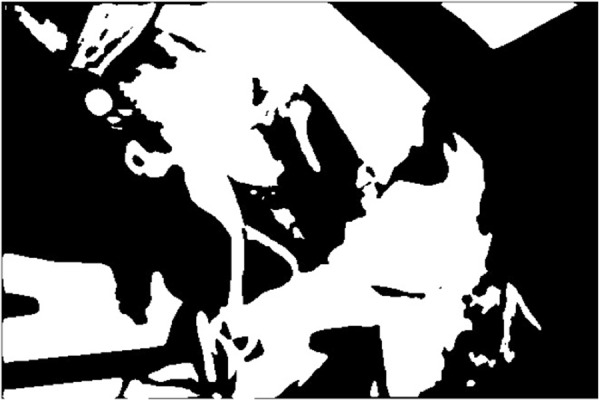
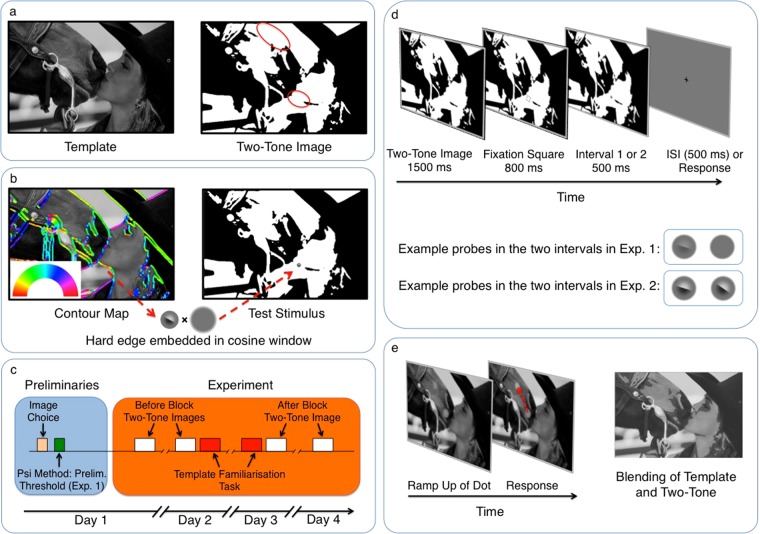
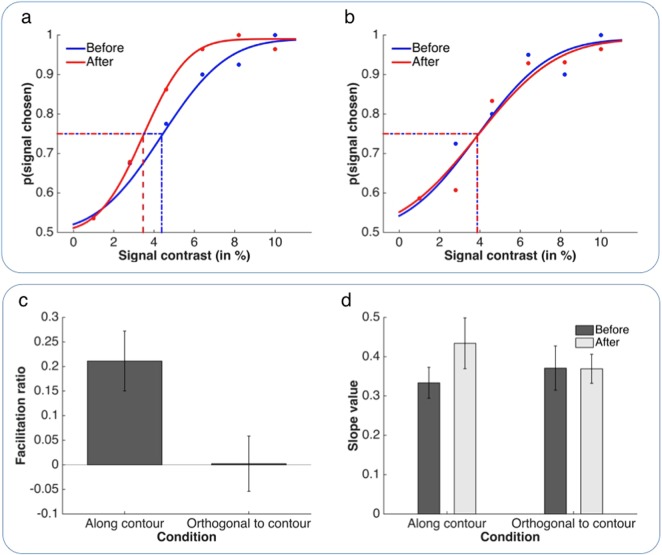
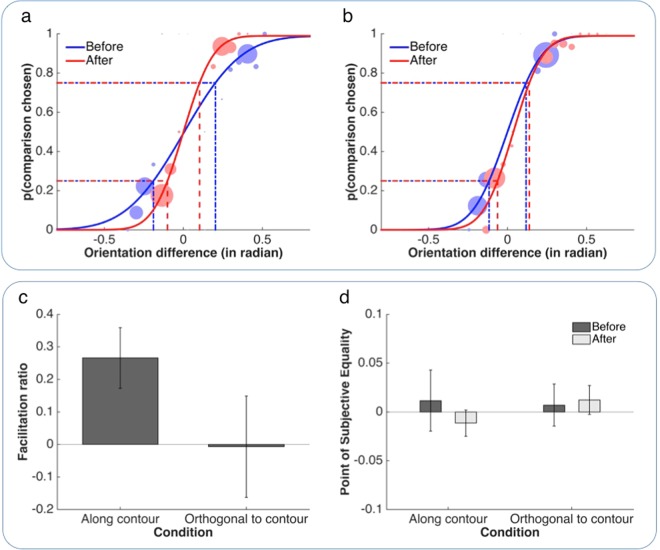
Verification
Claims the paper makes
The claims and statistics of this paper haven’t been checked yet.
Free: it reads the open-access text and checks the first 5 claims that cite a source we can check. Create a free account to check every claim.
Claims other papers make about this one
Each is checked against this paper’s own text: does it say what the citing paper says it does?
The source backs part of the claim, not all of it — or backs it for a different population, condition or comparison.
In the citing paper
“Conversely, PP provides a satisfying explanation of these copious backward connections, impugning their consignment to mere recurrent modulations in feedforward schema.”
From Evaluating the neurophysiological evidence for predictive processing as a model of perception (2020) · cites this paper as [206]
Experimental — accuracy not yet measuredThe source backs part of the claim, not all of it — or backs it for a different population, condition or comparison.
In the citing paper
“Although the debate about PP's empirical grounding is currently unsettled, the theory can nevertheless be regarded as a milestone in cognitive neuroscience, spurring efforts to recognize the importance of backward connections in the architecture of the neocortex and the role of prediction in sensory processing.”
From Evaluating the neurophysiological evidence for predictive processing as a model of perception (2020) · cites this paper as [206]
Experimental — accuracy not yet measured
Self-check
Percentages, sums and reported differences re-computed from the paper’s own numbers.
The self-check needs the paper’s full text.
Citations
Cites
Brainard, D. H. (1997) · Spatial Vision · doi:10.1163/156856897x00357 · Cited by 19,702
Receptive fields, binocular interaction and functional architecture in the cat’s visual cortex
Hubel, D. H., & Wiesel, T. N. (1962) · The Journal of Physiology · doi:10.1113/jphysiol.1962.sp006837 · Cited by 13,680
Kass, R. E., & Raftery, A. E. (1995) · Journal of the American Statistical Association · doi:10.1080/01621459.1995.10476572 · Cited by 12,558
Neural Mechanisms of Selective Visual Attention
Desimone, R., & Duncan, J. (1995) · Annual Review of Neuroscience · doi:10.1146/annurev.ne.18.030195.001205 · Cited by 8,388
The free-energy principle: a unified brain theory?
Friston, K. (2010) · Nature Reviews Neuroscience · doi:10.1038/nrn2787 · Cited by 8,120
The fusiform face area: a module in human extrastriate cortex specialized for face perception
Kanwisher, N., McDermott, J., & Chun, M. M. (1997) · The Journal of Neuroscience · doi:10.1523/jneurosci.17-11-04302.1997 · Cited by 7,738
Kleiner, M., Brainard, D. H., & Pelli, D. G. (2007) · MPG.PuRe (Max Planck Society) · Cited by 6,195
Rao, R. P. N., & Ballard, D. H. (1999) · Nature Neuroscience · doi:10.1038/4580 · Cited by 5,483
Receptive fields of single neurones in the cat's striate cortex
Hubel, D. H., & Wiesel, T. N. (1959) · The Journal of Physiology · doi:10.1113/jphysiol.1959.sp006308 · Cited by 4,653
DISCHARGE PATTERNS AND FUNCTIONAL ORGANIZATION OF MAMMALIAN RETINA
Kuffler, S. W. (1953) · Journal of Neurophysiology · doi:10.1152/jn.1953.16.1.37 · Cited by 2,609
Visual attention: The past 25 years
Carrasco, M. (2011) · Vision Research · doi:10.1016/j.visres.2011.04.012 · Cited by 2,483
Natural Image Statistics and Neural Representation
Simoncelli, E. P., & Olshausen, B. A. (2001) · Annual Review of Neuroscience · doi:10.1146/annurev.neuro.24.1.1193 · Cited by 2,460
Computing Bayes Factors by Combining Simulation and Asymptotic Approximations
Diciccio, T. J., Kass, R. E., Raftery, A., & Wasserman, L. (1997) · Journal of the American Statistical Association · doi:10.1080/01621459.1997.10474045 · Cited by 1,943
Decoding the visual and subjective contents of the human brain
Kamitani, Y., & Tong, F. (2005) · Nature Neuroscience · doi:10.1038/nn1444 · Cited by 1,829
Bar, M. (2004) · Nature Reviews Neuroscience · doi:10.1038/nrn1476 · Cited by 1,613
Top-down facilitation of visual recognition
Bar, M., Kassam, K. S., Ghuman, A. S., Boshyan, J., Schmid, A. M., Dale, A. M., Hämäläinen, M. S., Marinkovic, K., Schacter, D. L., Rosen, B. R., et al. (2006) · Proceedings of the National Academy of Sciences · doi:10.1073/pnas.0507062103 · Cited by 1,489
Hierarchical Bayesian inference in the visual cortex
Lee, T. S., & Mumford, D. (2003) · Journal of the Optical Society of America A · doi:10.1364/josaa.20.001434 · Cited by 1,473
Feature-based attention influences motion processing gain in macaque visual cortex
Treue, S., & Trujillo, J. C. M. (1999) · Nature · doi:10.1038/21176 · Cited by 1,465
Top-down influences on visual processing
Gilbert, C. D., & Li, W. (2013) · Nature Reviews Neuroscience · doi:10.1038/nrn3476 · Cited by 1,224
Population receptive field estimates in human visual cortex
Dumoulin, S. O., & Wandell, B. A. (2008) · NeuroImage · doi:10.1016/j.neuroimage.2007.09.034 · Cited by 1,182
The proactive brain: using analogies and associations to generate predictions
Bar, M. (2007) · Trends in Cognitive Sciences · doi:10.1016/j.tics.2007.05.005 · Cited by 1,144
Fechner, G. T. (1907) · doi:10.3931/e-rara-10879 · Cited by 1,021
Integrated model of visual processing
Bullier, J. (2001) · Brain Research Reviews · doi:10.1016/s0165-0173(01)00085-6 · Cited by 1,011
Feature-based attention in visual cortex
Maunsell, J. H. R., & Treue, S. (2006) · Trends in Neurosciences · doi:10.1016/j.tins.2006.04.001 · Cited by 954
Expectation (and attention) in visual cognition
Summerfield, C., & Egner, T. (2009) · Trends in Cognitive Sciences · doi:10.1016/j.tics.2009.06.003 · Cited by 950
Graham, N. V. S. (1989) · Oxford University Press eBooks · doi:10.1093/acprof:oso/9780195051544.001.0001 · Cited by 946
THE RESPONSE OF SINGLE OPTIC NERVE FIBERS OF THE VERTEBRATE EYE TO ILLUMINATION OF THE RETINA
Hartline, H. K. (1938) · American Journal of Physiology-Legacy Content · doi:10.1152/ajplegacy.1938.121.2.400 · Cited by 945
Kapadia, M. K., Ito, M., Gilbert, C. D., & Westheimer, G. (1995) · Neuron · doi:10.1016/0896-6273(95)90175-2 · Cited by 941
A feedforward architecture accounts for rapid categorization
Serre, T., Oliva, A., & Poggio, T. (2007) · Proceedings of the National Academy of Sciences · doi:10.1073/pnas.0700622104 · Cited by 918
Wiley Interdisciplinary Reviews: Cognitive Science
(2018) · Wiley Interdisciplinary Reviews Cognitive Science · doi:10.1002/(issn)1939-5086 · Cited by 875
Expectation in perceptual decision making: neural and computational mechanisms
Summerfield, C., & de Lange, F. P. (2014) · Nature Reviews Neuroscience · doi:10.1038/nrn3838 · Cited by 832
Polat, U., & Sagi, D. (1993) · Vision Research · doi:10.1016/0042-6989(93)90081-7 · Cited by 818
Less Is More: Expectation Sharpens Representations in the Primary Visual Cortex
Kok, P., Jehee, J. F. M., & de Lange, F. P. (2012) · Neuron · doi:10.1016/j.neuron.2012.04.034 · Cited by 798
Circuits for local and global signal integration in primary visual cortex
Angelucci, A., Levitt, J. B., Walton, E. J. S., Hupé, J.-M., Bullier, J., & Lund, J. S. (2002) · The Journal of Neuroscience · doi:10.1523/jneurosci.22-19-08633.2002 · Cited by 789
Specificity of monosynaptic connections from thalamus to visual cortex
Clay Reid, R., & Alonso, J.-M. (1995) · Nature · doi:10.1038/378281a0 · Cited by 730
Feature-Based Attention Increases the Selectivity of Population Responses in Primate Visual Cortex
Martinez-Trujillo, J. C., & Treue, S. (2004) · Current Biology · doi:10.1016/j.cub.2004.04.028 · Cited by 697
Visual Perception and the Statistical Properties of Natural Scenes
Geisler, W. S. (2008) · Annual Review of Psychology · doi:10.1146/annurev.psych.58.110405.085632 · Cited by 677
Bayesian adaptive estimation of psychometric slope and threshold
Kontsevich, L. L., & Tyler, C. W. (1999) · Vision Research · doi:10.1016/s0042-6989(98)00285-5 · Cited by 668
Population coding of shape in area V4
Pasupathy, A., & Connor, C. E. (2002) · Nature Neuroscience · doi:10.1038/972 · Cited by 552
Orientation selectivity, preference, and continuity in monkey striate cortex
Blasdel, G. (1992) · The Journal of Neuroscience · doi:10.1523/jneurosci.12-08-03139.1992 · Cited by 505
Shape perception reduces activity in human primary visual cortex
Murray, S. O., Kersten, D., Olshausen, B. A., Schrater, P., & Woods, D. L. (2002) · Proceedings of the National Academy of Sciences · doi:10.1073/pnas.192579399 · Cited by 496
Carrasco, M., Penpeci-Talgar, C., & Eckstein, M. (2000) · Vision Research · doi:10.1016/s0042-6989(00)00024-9 · Cited by 477
Huang, Y., & Rao, R. P. N. (2011) · WIREs Cognitive Science · doi:10.1002/wcs.142 · Cited by 470
Angelucci, A., & Bressloff, P. C. (2006) · Progress in Brain Research · doi:10.1016/s0079-6123(06)54005-1 · Cited by 453
Dynamics of subjective contour formation in the early visual cortex
Lee, T. S., & Nguyen, M. (2001) · Proceedings of the National Academy of Sciences · doi:10.1073/pnas.98.4.1907 · Cited by 428
Elias, P. (1955) · IEEE Transactions on Information Theory · doi:10.1109/tit.1955.1055126 · Cited by 428
Contextual Feedback to Superficial Layers of V1
Muckli, L., De Martino, F., Vizioli, L., Petro, L. S., Smith, F. W., Ugurbil, K., Goebel, R., & Yacoub, E. (2015) · Current Biology · doi:10.1016/j.cub.2015.08.057 · Cited by 423
How the brain learns to see objects and faces in an impoverished context
Dolan, R. J., Fink, G. R., Rolls, E., Booth, M., Holmes, A., Frackowiak, R. S. J., & Friston, K. J. (1997) · Nature · doi:10.1038/39309 · Cited by 386
Teufel, C., Subramaniam, N., Dobler, V., Perez, J., Finnemann, J., Mehta, P. R., Goodyer, I. M., & Fletcher, P. C. (2015) · Proceedings of the National Academy of Sciences · doi:10.1073/pnas.1503916112 · Cited by 308
Self-citationBayesian models of object perception
Kersten, D., & Yuille, A. (2003) · Current Opinion in Neurobiology · doi:10.1016/s0959-4388(03)00042-4 · Cited by 307
A Neural Representation of Prior Information during Perceptual Inference
Summerfield, C., & Koechlin, E. (2008) · Neuron · doi:10.1016/j.neuron.2008.05.021 · Cited by 305
van Kerkoerle, T., Self, M. W., & Roelfsema, P. R. (2017) · Nature Communications · doi:10.1038/ncomms13804 · Cited by 281
Representation of Angles Embedded within Contour Stimuli in Area V2 of Macaque Monkeys
Ito, M., & Komatsu, H. (2004) · The Journal of Neuroscience · doi:10.1523/jneurosci.4364-03.2004 · Cited by 273
Orientation-Selective Adaptation to First- and Second-Order Patterns in Human Visual Cortex
Larsson, J., Landy, M. S., & Heeger, D. J. (2006) · Journal of Neurophysiology · doi:10.1152/jn.00668.2005 · Cited by 234
Object-based attention: A tutorial review
Chen, Z. (2012) · Attention, Perception, & Psychophysics · doi:10.3758/s13414-012-0322-z · Cited by 231
Using Neuronal Populations to Study the Mechanisms Underlying Spatial and Feature Attention
Cohen, M. R., & Maunsell, J. H. R. (2011) · Neuron · doi:10.1016/j.neuron.2011.04.029 · Cited by 217
Perception of contours and shapes: Low and intermediate stage mechanisms
Loffler, G. (2008) · Vision Research · doi:10.1016/j.visres.2008.03.006 · Cited by 200
Ecological Cue-Validity of 'Proximity' and of Other Gestalt Factors
Brunswik, E., & Kamiya, J. (1953) · The American Journal of Psychology · doi:10.2307/1417965 · Cited by 190
Shape Perception Simultaneously Up- and Downregulates Neural Activity in the Primary Visual Cortex
Kok, P., & de Lange, F. P. (2014) · Current Biology · doi:10.1016/j.cub.2014.05.042 · Cited by 163
Receptive fields in human visual cortex mapped with surface electrodes
Yoshor, D., Bosking, W. H., Ghose, G. M., & Maunsell, J. H. R. (2007) · Cerebral Cortex · doi:10.1093/cercor/bhl138 · Cited by 152
Hupé, J.-M., James, A. C., Girard, P., & Bullier, J. (2001) · Journal of Neurophysiology · doi:10.1152/jn.2001.85.1.146 · Cited by 152
Single neuron studies of inferior temporal cortex
Gross, C. G. (2007) · Neuropsychologia · doi:10.1016/j.neuropsychologia.2007.11.009 · Cited by 139
Recovery of 3D volume from 2-tone images of novel objects
Moore, C., & Patrick Cavanagh, B. (1998) · Cognition · doi:10.1016/s0010-0277(98)00014-6 · Cited by 126
Perceptual grouping and inverse fMRI activity patterns in human visual cortex
Fang, F., Kersten, D., & Murray, S. O. (2008) · Journal of Vision · doi:10.1167/8.7.2 · Cited by 122
Recognition Alters the Spatial Pattern of fMRI Activation in Early Retinotopic Cortex
Hsieh, P.-J., Vul, E., & Kanwisher, N. (2010) · Journal of Neurophysiology · doi:10.1152/jn.00812.2009 · Cited by 114
How to (and how not to) think about top-down influences on visual perception
Teufel, C., & Nánay, B. (2016) · Consciousness and Cognition · doi:10.1016/j.concog.2016.05.008 · Cited by 108
Self-citationHow Animals See the WorldComparative Behavior, Biology, and Evolution of Vision
Lazareva, O. F., Shimizu, T., & Wasserman, E. A. (2012) · Oxford University Press eBooks · doi:10.1093/acprof:oso/9780195334654.001.0001 · Cited by 105
Illusory contours: a window onto the neurophysiology of constructing perception
Murray, M. M., & Herrmann, C. S. (2013) · Trends in Cognitive Sciences · doi:10.1016/j.tics.2013.07.004 · Cited by 92
Opening Up Vision: The Case Against Encapsulation
Ogilvie, R., & Carruthers, P. (2015) · Review of Philosophy and Psychology · doi:10.1007/s13164-015-0294-8 · Cited by 69
Subthreshold summation with illusory contours
Dresp, B., & Bonnet, C. (1995) · Vision Research · doi:10.1016/0042-6989(94)00204-y · Cited by 68
Seeing the last part of a hitting movement is enough to adapt to a temporal delay
de la Malla, C., López‐Moliner, J., & Brenner, E. (2012) · Journal of Vision · doi:10.1167/12.10.4 · Cited by 58
Features and the ‘primal sketch’
Morgan, M. J. (2011) · Vision Research · doi:10.1016/j.visres.2010.08.002 · Cited by 51
Semantic Control of Feature Extraction from Natural Scenes
Neri, P. (2014) · The Journal of Neuroscience · doi:10.1523/jneurosci.1755-13.2014 · Cited by 48
A Link between Visual Disambiguation and Visual Memory
Hegdé, J., & Kersten, D. (2010) · Journal of Neuroscience · doi:10.1523/jneurosci.4415-09.2010 · Cited by 44
Perceptual consequences of feature-based attentional enhancement and suppression
Ho, T. C., Brown, S. D., Abuyo, N. A., Ku, E.-H. J., & Serences, J. T. (2012) · Journal of Vision · doi:10.1167/12.8.15 · Cited by 40
Toward a Dynamical View of Object Perception
Peterson, M. A., & Cacciamani, L. (2013) · Advances in computer vision and pattern recognition · doi:10.1007/978-1-4471-5195-1_30 · Cited by 36
Recurrent Processing in the Formation of Shape Percepts
Drewes, J., Goren, G., Zhu, W., & Elder, J. H. (2016) · Journal of Neuroscience · doi:10.1523/jneurosci.2347-15.2016 · Cited by 34
Suppression effects in feature-based attention
Wang, Y., Miller, J. M., & Liu, T. (2015) · Journal of Vision · doi:10.1167/15.5.15 · Cited by 33
A neural implementation of Bayesian inference based on predictive coding
Spratling, M. (2016) · Connection Science · doi:10.1080/09540091.2016.1243655 · Cited by 32
(2016) · doi:10.1016/c2012-0-01278-1 · Cited by 21
Poom, L. (2001) · Vision Research · doi:10.1016/s0042-6989(01)00248-6 · Cited by 17
Influence of Parallel and Orthogonal Real Lines on Illusory Contour Perception
Dillenburger, B., & Roe, A. W. (2009) · Journal of Neurophysiology · doi:10.1152/jn.00001.2009 · Cited by 10
Detection of a Gabor patch superimposed on an illusory contour
Danilova, M. V., & Kojo, I. (2001) · Spatial Vision · doi:10.1163/15685680152691980 · Cited by 8
Can Subthreshold Summation Be Observed with the Ehrenstein Illusion?
Salvano-Pardieu, V., Wink, B., Taliercio, A., Manktelow, K. I., & Meigen, T. (2006) · Perception · doi:10.1068/p5187 · Cited by 5
Edge-induced illusory contours and visual detection: Subthreshold summation or spatial cueing?
Salvano-Pardieu, V., Wink, B., Taliercio, A., Fontaine, R., Manktelow, K. I., & Ehrenstein, W. H. (2009) · Visual Cognition · doi:10.1080/13506280902949312 · Cited by 3
Neurobiology of Perception of Illusory Contours in Animals
Nieder, A. (2012) · Oxford University Press eBooks · doi:10.1093/acprof:oso/9780195334654.003.0009 · Cited by 1
Research works printed but not linked: 3
- De Valois, R. L. & De Valois, K. K. Spatial Vision. (Oxford University Press, 1991).
- Pasupathy, A. in Fundamentals of Vision: Low and Mid-Level Processes in Perception (eds. Martinez-Conde, S., Macknik, S., Martinez, M., Alonso, J. M. & Tse, P.) 154, 293–313 (Elsevier, 2006).
- Marr, D. Vision. (The MIT Press, 1982).
Cited by
The generation and propagation of the human alpha rhythm
Halgren, M., Ulbert, I., Bastuji, H., Fabó, D., Erőss, L., Rey, M., Devinsky, O., Doyle, W. K., Mak-McCully, R., Halgren, E., et al. (2019) · Proceedings of the National Academy of Sciences · doi:10.1073/pnas.1913092116 · Cited by 425
Evaluating the neurophysiological evidence for predictive processing as a model of perception
Walsh, K. S., McGovern, D. P., Clark, A., & O'Connell, R. G. (2020) · Annals of the New York Academy of Sciences · doi:10.1111/nyas.14321 · Cited by 333
The Perceptual Prediction Paradox
Press, C., Kok, P., & Yon, D. (2020) · Trends in Cognitive Sciences · doi:10.1016/j.tics.2019.11.003 · Cited by 246
Effects of Language on Visual Perception
Lupyan, G., Abdel Rahman, R., Boroditsky, L., & Clark, A. (2020) · Trends in Cognitive Sciences · doi:10.1016/j.tics.2020.08.005 · Cited by 243
Forms of prediction in the nervous system
Teufel, C., & Fletcher, P. C. (2020) · Nature Reviews Neuroscience · doi:10.1038/s41583-020-0275-5 · Cited by 155
“Panel g is adapted from reF.(6), CC-BY-4.”
Self-citation
Metadata
- Authors
- Teufel, C., Dakin, S. C., & Fletcher, P. C.
- Affiliations
- Cardiff University (GB)
- University of Auckland (NZ)
- University of Cambridge (GB)
- Corresponding author
- Teufel, Christoph
- Venue
- Scientific Reports
- Published
- 2018-07-18
- Volume
- 8
- Issue
- 1
- Pages
- 10853-10853
- ISSN
- 2045-2322 (ISSN-L)
- PMC
- PMC6051992
- OpenAlex
- W2809827720
- Cited by
- 119
- References
- 86
- Citations by year
- 2026: 5 · 2025: 11 · 2024: 7 · 2023: 44 · 2022: 9 · 2021: 15 · 2020: 15 · 2019: 12 · 2018: 1
- FWCI
- 6.40
- Type
- journal article
- Language
- en
- Open access
- gold
- doi.org
- Licence
- cc-by
- creativecommons.org/licenses/by/4.0 (tdm)
- creativecommons.org/licenses/by/4.0 (vor)
- Locations
- Scientific Reports (publishedVersion, cc-by)
- Europe PMC (PubMed Central) (publishedVersion, cc-by)
- PubMed Central (publishedVersion, cc-by)
- PubMed (publishedVersion)
- ORCA Online Research @Cardiff (Cardiff University) (acceptedVersion)
- DOAJ (DOAJ: Directory of Open Access Journals) (submittedVersion)
- ResearchSpace (University of Auckland) (submittedVersion, cc-by)
- Apollo (University of Cambridge) (submittedVersion, cc-by)
- Apollo (cc-by)
- Funders
- Wellcome Trust (WT095692MA)
- Bernard Wolfe Health Neuroscience Fund
- Topics
- Life Sciences › Neuroscience › Cognitive Neuroscience › Visual perception and processing mechanisms
- Physical Sciences › Computer Science › Computer Vision and Pattern Recognition › Visual Attention and Saliency Detection
- Life Sciences › Neuroscience › Cognitive Neuroscience › Face Recognition and Perception
- Keywords
- predictive coding, object representation, ambiguous stimuli, top-down modulation, object perception, visual cortex
- MeSH terms
- Adolescent, Adult, Attention, Female, Humans, Male, Orientation, Photic Stimulation, Visual Cortex, Visual Perception, Young Adult
About these checks
Registry, retraction, Cites and statistics results are computed, not judged, with one exception: a printed reference that no index lists is read once by a model before it counts as a citation error. Claims are extracted by a model and kept only when their quote appears verbatim in the text; each cited source is then checked, with a model’s help, for whether it says what the claim relies on. Those verdicts can be wrong — read the claim’s quote and the cited source before relying on one.
Statistics and arithmetic are recomputed, not judged.
Confidence bands are shown only for fields calibrated on our annotated test set. None is calibrated yet, so no band is shown.
What counts as a claim ›How we measure confidence ›How we check this ›
Are you an author, or do you see a problem with this page? Request a review
Data sources
Bibliographic data: Semantic Scholar, OpenAlex, Crossref.
Contains information from the Semantic Scholar Academic Graph Datasets, made available under the ODC Attribution License (ODC-BY 1.0).
Semantic Scholar’s data is described in: Kinney, R., et al. (2023). The Semantic Scholar Open Data Platform. arXiv:2301.10140.
