

The case for rejecting the memristor as a fundamental circuit element
Open accessThe DOI matches its Crossref record; 30 of the 33 references it cites were found in a registry or an index, and 1 are not checked yet; 3 of the 23 sources its claims cite were checked for support.
Abstract
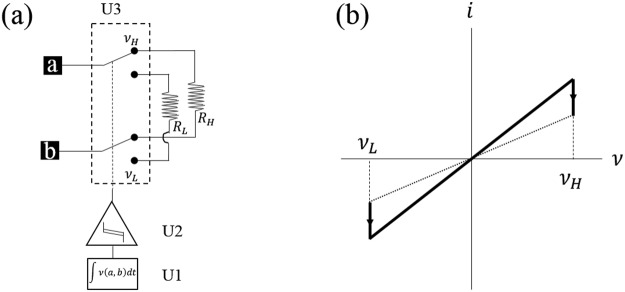
The memory resistor with the moniker memristor was a harmless postulate in 1971. Since 2008 a device that claims to be the memristor is on the prowl, seeking recognition as a fundamental circuit element, sometimes wanting electronics textbooks to be rewritten, always promising remarkable digital, analog and neuromorphic computing possibilities. A systematic discussion about the fundamental nature of the device is almost absent within the memristor community. Advocates use incomplete constitutive relationships, ignore concepts of activity/passivity and aver that nonlinearity is central to their case. Few researchers have examined these claims. Our report investigates the assertion that the memristor is a fundamental passive circuit element, from the fresh perspective that electrical engineering is the science of charge management. We demonstrate with a periodic table of fundamental elements that the 2008 memristor is not the 1971 postulate and neither of them is fundamental. The ideal memristor is an unphysical active device and any physically realizable memristor is a nonlinear composition of resistors with active hysteresis. We also show that there exists only three fundamental passive circuit elements.
Verified 2026-11-25 · 1 reference not checked yet
Overview
CoChat Summary
TL;DR
The paper argues that the memristor is not a fundamental passive circuit element and should not be added to the canonical set of electrical elements. Using a “periodic table” framework for charge- and flux-based relations, it concludes that only three fundamental passive elements exist: capacitor, resistor, and inductor.
Key findings
- The authors claim the 2008 HP memristor is not the same as the 1971 postulate, and that neither is fundamental; the ideal memristor is described as “an unphysical active device,” while any physically realizable memristor is “a nonlinear composition of resistors with active hysteresis.”
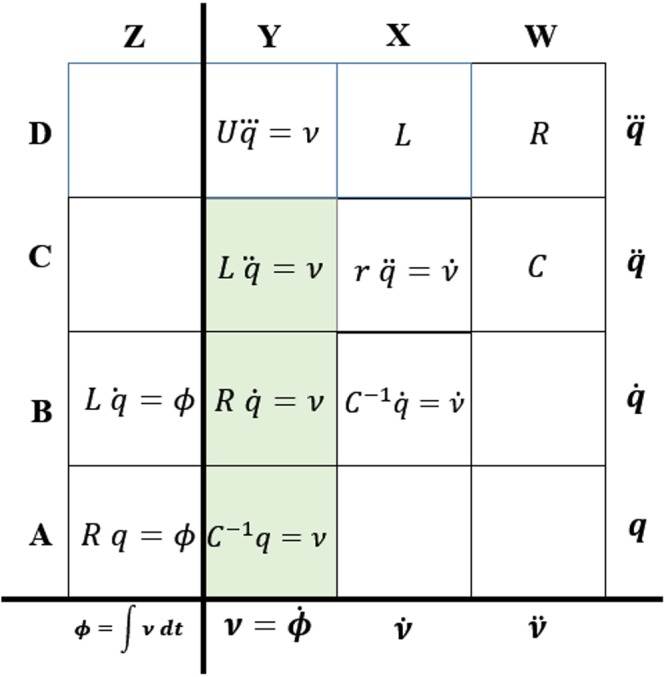
- Their periodic-table argument concludes that only three fundamental passive circuit elements exist: C, R, and L.
- They state the memristor cannot occupy the relevant slot because Rule 1 is violated: “only one fundamental element can occupy a slot,” and the resistor already occupies that slot.
- They also state Rule 2 is violated because memristor behavior depends on a time interval/integration and the observed switching is a transient event; they further argue that the memristor’s hysteresis implies activity, not passivity.
Methods
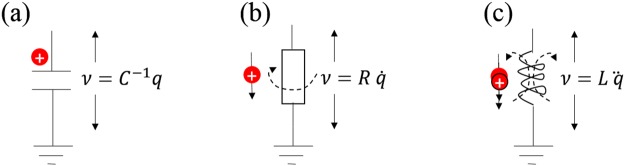
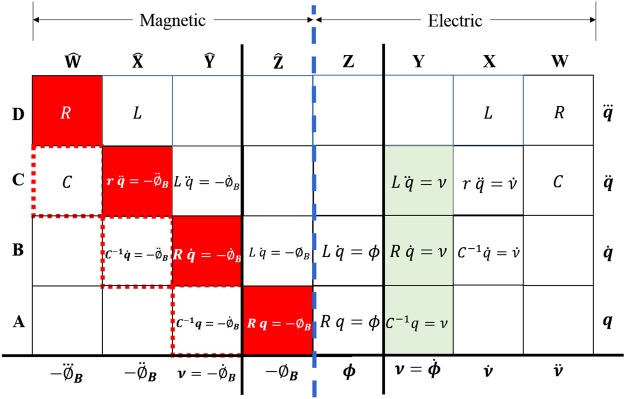
- The paper uses a conceptual/theoretical framework that treats charge as the “single fundamental electronic entity,” and builds a “periodic table” of passive elements in both charge-voltage and charge-flux (magnetic) domains.
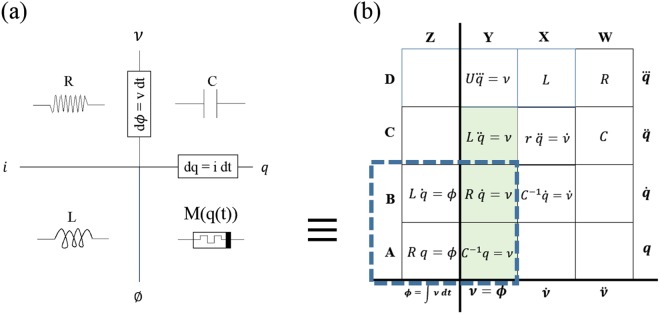
- It compares constitutive relations for capacitors, resistors, and inductors against the memristor’s proposed relations, including the 1971 and 2008 formulations and Strukov’s table.
- The analysis is primarily inspection- and argument-based, applying two explicit rules to the periodic-table framework; no datasets were generated or analyzed.
Limitations
- The paper itself does not present empirical experiments or new measurements; its arguments are theoretical and conceptual.
- The text makes evident that the conclusions depend on the authors’ chosen framework and rules for what counts as “fundamental” and on their interpretation of passivity/activity; this is an argumentative limitation (text-evident), not a stated one.
- The paper states no datasets were generated or analyzed, so there is no direct empirical validation within the study.
Model-written summary. Check it against the paper before relying on it.
Integrity signals
Registry
Cites
Statistics
Figures
Verification
Claims the paper makes
3 Valid · 1 Not valid · 12 Not checked · 43 Own results and interpretations
A result the paper states — it cites no source for it, so there is none to check. The quote shows it is in the paper.
In the paper
“Therefore the composite resistance is always positive.”
§ The case for rejecting the memristor as a fundamental circuit element > Results > What is Chua’s or HP’s memristor
plain- Asserted: passes — The authors put it forward as true.
- Checkable: passes — It can be checked against evidence.
- Load-bearing: passes — The paper’s conclusions depend on it.
- Based: passes — The paper gives a reason why it holds.
None of the sources cited for this claim have been checked yet.
In the paper
“The said model has also been demonstrated to exhibit correct temperature dependence w.r.t empirical data20.”
§ The case for rejecting the memristor as a fundamental circuit element > Results > What is Chua’s or HP’s memristor
What the sources say
- Not checked yetcites [20] Abraham I An Advection-Diffusion Model for the Vacancy Migration Memristor IEEE Access 2016 4 7747 7757 10.1109/ACCESS.2016.2621721 source
Checked before — its earlier verdict is held back until a new check runs.
boostedstates an association- Asserted: passes — The authors put it forward as true.
- Checkable: passes — It can be checked against evidence.
- Load-bearing: unclear — It is unclear whether the paper’s conclusions depend on it.
- Based: passes — The paper gives a reason why it holds.
- Not checked yet
A result the paper states — it cites no source for it, so there is none to check. The quote shows it is in the paper.
In the paper
“Of the three known fundamental elements, only the inductor and resistor appear in column Z.”
§ The case for rejecting the memristor as a fundamental circuit element > Results > Locating the fundamental elements
plain- Asserted: passes — The authors put it forward as true.
- Checkable: passes — It can be checked against evidence.
- Load-bearing: passes — The paper’s conclusions depend on it.
- Based: passes — The paper gives a reason why it holds.
A result the paper states — it cites no source for it, so there is none to check. The quote shows it is in the paper.
In the paper
“The model unambiguously reveals the presence of a non-dominant negative resistance.”
§ The case for rejecting the memristor as a fundamental circuit element > Results > What is Chua’s or HP’s memristor
boosted- Asserted: passes — The authors put it forward as true.
- Checkable: passes — It can be checked against evidence.
- Load-bearing: passes — The paper’s conclusions depend on it.
- Based: passes — The paper gives a reason why it holds.
In the paper
“The first evidence is the original model from HP. It looks like a potentiometer made of two resistors and a slider7.”
§ The case for rejecting the memristor as a fundamental circuit element > Results > What is Chua’s or HP’s memristor
What the sources say
- Not checked — no full text of the sourcecites [7] Strukov DB Snider GS Stewart DR Williams RS The missing memristor found Nature 2008 453 80 83 10.1038/nature06932 18451858 source
plain- Asserted: passes — The authors put it forward as true.
- Checkable: passes — It can be checked against evidence.
- Load-bearing: passes — The paper’s conclusions depend on it.
- Based: passes — The paper gives a reason why it holds.
26 more claims
Create a free account to see all 59 claims and to verify the 2 references still open.
- Probably not a substantial claim. 10
- It may state two separate claims as one. 21
- The quote only partly states this claim. 1
Citations
Cites
Strukov, D. B., Snider, G. S., Stewart, D. R., & Williams, R. S. (2008) · Nature · doi:10.1038/nature06932 · Cited by 11,828
Memristor—The Missing Circuit Element
Chua, L. (1971) · IEEE Transactions on Circuit Theory · doi:10.1109/tct.1971.1083337 · Cited by 10,268 · cited 1×
“Therefore equation (5) is not the constitutive relation for an inductor.”
BackgroundHorowitz, P., Hill, W., & Rollefson, R. J. (1990) · American Journal of Physics · doi:10.1119/1.16385 · Cited by 1,487 · cited 1×
“Equation (2) defines the resistor, making U in (A, Z) equal R as shown in Fig.”
MethodSPICE Model of Memristor with Nonlinear Dopant Drift
Biolek, Z., Biolek, D., & Biolková, V. (2009) · Brno University of Technology Digital Library (Brno University of Technology) · Cited by 1,355
VTEAM: A General Model for Voltage-Controlled Memristors
Kvatinsky, S., Ramadan, M., Friedman, E. G., & Kolodny, A. (2015) · IEEE Transactions on Circuits and Systems II: Express Briefs · doi:10.1109/tcsii.2015.2433536 · Cited by 838
How We Found The Missing Memristor
Williams, R. (2008) · IEEE Spectrum · doi:10.1109/mspec.2008.4687366 · Cited by 697 · cited 1×
“{R1̇, R2̇} = {ρ1nb ′ (t), −ρ2nb ′ (t)} (14)”
If it's pinched it's a memristor
Chua, L. (2014) · Semiconductor Science and Technology · doi:10.1088/0268-1242/29/10/104001 · Cited by 685
Tour, J. M., & He, T. (2008) · Nature · doi:10.1038/453042a · Cited by 504
Memristor Emulator for Memristor Circuit Applications
Kim, H., Sah, M. P., Yang, C., Cho, S., & Chua, L. O. (2012) · IEEE Transactions on Circuits and Systems I: Regular Papers · doi:10.1109/tcsi.2012.2188957 · Cited by 453
Fast Principal Component Analysis of Large-Scale Genome-Wide Data
(2014) · doi:10.1371/journal.pone.0093766 · Cited by 305
The International System of Units (SI)
(1984) · International Journal of Radiation Biology and Related Studies in Physics, Chemistry and Medicine · doi:10.1080/09553008414551141 · Cited by 254
Coulston, J. W., Wear, D. N., & Vose, J. M. (2015) · Scientific Reports · doi:10.1038/srep08002 · Cited by 204
Nonlinear Dynamics of a Locally-Active Memristor
Ascoli, A., Slesazeck, S., Mahne, H., Tetzlaff, R., & Mikolajick, T. (2015) · IEEE Transactions on Circuits and Systems I: Regular Papers · doi:10.1109/tcsi.2015.2413152 · Cited by 196
Memristive diode bridge with LCR filter
Corinto, F., & Ascoli, A. (2012) · Electronics Letters · doi:10.1049/el.2012.1480 · Cited by 189
The Missing Memristor has Not been Found
Vongehr, S., & Meng, X. (2015) · Scientific Reports · doi:10.1038/srep11657 · Cited by 131
On the physical properties of memristive, memcapacitive and meminductive systems
Di Ventra, M., & Pershin, Y. V. (2013) · Nanotechnology · doi:10.1088/0957-4484/24/25/255201 · Cited by 130 · cited 1×
“{?̇?C1, ?̇?C2} = {− j ω nb ′ (t), j ω nb ′ (t)} (13)”
(2013) · Cited by 128
Bridgman, P. W. (1915) · Physical Review · doi:10.1103/physrev.6.1 · Cited by 94
The Desired Memristor for Circuit Designers
Kvatinsky, S., Friedman, E. G., Kolodny, A., & Weiser, U. C. (2013) · IEEE Circuits and Systems Magazine · doi:10.1109/mcas.2013.2256257 · Cited by 84
メソ多孔性のデラフォサイト型CuCrO 2 とスピネル型CuCr 2 O 4 合成と触媒反応
Peng, Z., Yifeng, S., Chi, M., Park, J., Stucky Galen, D., McFarland, E. W., & Lian, G. (2013) · Nanotechnology · Cited by 41
Switching mechanisms in microscale memristors
Prodromakis, T., Michelakis, K., & Toumazou, C. (2010) · Electronics Letters · doi:10.1049/el.2010.2716 · Cited by 39 · cited 1×
“Therefore equation (5) is not the constitutive relation for an inductor.”
BackgroundA two-transistor non-ideal memristor emulator
Kalomiros, J., Stavrinides, S. G., & Corinto, F. (2016) · 2016 5th International Conference on Modern Circuits and Systems Technologies (MOCAST) · doi:10.1109/mocast.2016.7495164 · Cited by 35
Shock waves and commutation speed of memristors
Tang, S. H., Tesler, F., Gomez Marlasca, F., Lévy, P., Dobrosavljević, V., & Rozenberg, M. J. (2016) · Conicet · Cited by 28
純誘導負荷回路における高電流に対する4H-SiCサイリスタ(18kV級)の光学的トリガー
(2014) · Cited by 25
Memristor - Why Do We Have to Know About It?
Kumar, M. (2009) · IETE Technical Review · doi:10.4103/0256-4602.48462 · Cited by 24 · cited 1×
“12 Z1(∅) = − p ln ((α − 1)ef0nb∅−1∅ + (p − 1) α) f0(p − 1)∅ − 1 2(p − 1) (11)”
Shock Waves and Commutation Speed of Memristors
Tang, S., Tesler, F., Marlasca, F. G., Levy, P., Dobrosavljević, V., & Rozenberg, M. J. (2016) · Physical Review X · doi:10.1103/physrevx.6.011028 · Cited by 24
Memristor Equations: Incomplete Physics and Undefined Passivity/Activity
Sundqvist, K. M., Ferry, D. K., & Kish, L. B. (2017) · Fluctuation and Noise Letters · doi:10.1142/s0219477517710018 · Cited by 22
Second Law based definition of passivity/activity of devices
Sundqvist, K. M., Ferry, D. K., & Kish, L. B. (2017) · Physics Letters A · doi:10.1016/j.physleta.2017.08.039 · Cited by 10
An Advection-Diffusion Model for the Vacancy Migration Memristor
Abraham, I. (2016) · IEEE Access · doi:10.1109/access.2016.2621721 · Cited by 8
Self-citationQuasi-Linear Vacancy Dynamics Modeling and Circuit Analysis of the Bipolar Memristor
Abraham, I. (2014) · PLoS ONE · doi:10.1371/journal.pone.0111607 · Cited by 6
Self-citationComplex behavior in memristor circuits based on static nonlinear two-ports and dynamic bipole
Secco, J., Biey, M., Corinto, F., Ascoli, A., & Tetzlaff, R. (2015) · European Conference on Circuit Theory and Design · doi:10.1109/ecctd.2015.7300050 · Cited by 4
Research works printed but not linked: 4
- Johnson, H. W. & Graham, M. In High-Speed Digital Design, A Handbook of Black Magic 17–22 (Prentice Hall, Inc., 1993).
- Adee, S. The Mysterious Memristor. IEEE Spectrum (2008).
- Nalawade SS Varsharani ND Memristor The Fourth Fundamental Circuit Element Int. J. Recent Innov. Trends Comput. Commun. 2015 3 15 19
- Jeltsema, D. Memristors: The Rise and the Fall (?) In 21st International Symposium on Mathematical Theory of Networks and Systems 425–428 (2014).
Cited by
Recent advances in physical reservoir computing: A review
Tanaka, G., Yamane, T., Héroux, J. B., Nakane, R., Kanazawa, N., Takeda, S., Numata, H., Nakano, D., & Hirose, A. (2019) · Neural Networks · doi:10.1016/j.neunet.2019.03.005 · Cited by 2,146
“Although there are some debates about whether the memristor is truly counted as a fundamental passive circuit element (Abraham, 2018), memristive devices indeed exist in reality and are promising for computing.”
BackgroundExperimental photonic quantum memristor
Spagnolo, M., Morris, J., Piacentini, S., Antesberger, M., Massa, F., Crespi, A., Ceccarelli, F., Osellame, R., & Walther, P. J. (2022) · Nature Photonics · doi:10.1038/s41566-022-00973-5 · Cited by 177
“Evidently, equations (3) and (4) satisfy the form required by equations (1) and (2) and therefore define a memristive device with R(t) as the state variable.”
BackgroundMethodBisquert, J., & Guerrero, A. (2022) · Journal of the American Chemical Society · doi:10.1021/jacs.2c00777 · Cited by 139
Khot, A. C., Dongale, T. D., Nirmal, K. A., Sung, J. H., Lee, H. J., Nikam, R. D., & Kim, T. G. (2022) · ACS Applied Materials & Interfaces · doi:10.1021/acsami.1c23268 · Cited by 85
Memristive oscillator to memristive map, energy characteristic
Guo, Y., Ma, J., Zhang, X., & Hu, X. (2024) · Science China Technological Sciences · doi:10.1007/s11431-023-2637-1 · Cited by 66
“Both MFCM [54–56] and CCM [57–59] can save and contain field energy when they are incorporated into a linear or nonlinear circuit.”
Metadata
- Authors
- Abraham, I.
- Affiliations
- Intel (United States) (US)
- Corresponding author
- Abraham, Isaac
- ORCID
- Abraham, Isaac
- Venue
- Scientific Reports
- Published
- 2018-07-20
- Volume
- 8
- Issue
- 1
- Pages
- 10972-10972
- ISSN
- 2045-2322 (ISSN-L)
- PMC
- PMC6054652
- OpenAlex
- W2884413845
- Cited by
- 95
- References
- 33
- Citations by year
- 2026: 6 · 2025: 6 · 2024: 11 · 2023: 10 · 2022: 16 · 2021: 21 · 2020: 10 · 2019: 13 · 2018: 2
- FWCI
- 4.39
- Type
- journal article
- Language
- en
- Open access
- gold
- doi.org
- Licence
- cc-by
- creativecommons.org/licenses/by/4.0 (tdm)
- creativecommons.org/licenses/by/4.0 (vor)
- Locations
- Scientific Reports (publishedVersion, cc-by)
- Europe PMC (PubMed Central) (publishedVersion, cc-by)
- PubMed Central (publishedVersion, cc-by)
- PubMed (publishedVersion)
- arXiv (Cornell University) (submittedVersion)
- DOAJ (DOAJ: Directory of Open Access Journals) (submittedVersion)
- arXiv (Cornell University)
- Topics
- Physical Sciences › Engineering › Electrical and Electronic Engineering › Advanced Memory and Neural Computing
- Physical Sciences › Engineering › Electrical and Electronic Engineering › Electrical and Thermal Properties of Materials
- Physical Sciences › Engineering › Electrical and Electronic Engineering › Engineering and Technology Innovations
- Keywords
- memristors, passive components, constitutive equations, nonlinearity, hysteresis, charge management, active devices, neuromorphic computing
About these checks
Registry, retraction, Cites and statistics results are computed, not judged, with one exception: a printed reference that no index lists is read once by a model before it counts as a citation error. Claims are extracted by a model and kept only when their quote appears verbatim in the text; each cited source is then checked, with a model’s help, for whether it says what the claim relies on. Those verdicts can be wrong — read the claim’s quote and the cited source before relying on one.
The claim verdicts this report counts are experimental: their accuracy is not yet measured.
A language model drew the claims from the paper on 2026-09-29, under version 3 of the claim definition (model deepseek-v4.1-flash, prompt extract-v3).
A second model labelled each claim on 2026-09-29 (model jev-1.13-20260917, definition revision gold-guideline-v0.2).
Statistics and arithmetic are recomputed, not judged.
Confidence bands are shown only for fields calibrated on our annotated test set. None is calibrated yet, so no band is shown.
What counts as a claim ›How we measure confidence ›How we check this ›
Are you an author, or do you see a problem with this page? Request a review
Data sources
Bibliographic data: Semantic Scholar, OpenAlex, Crossref.
Contains information from the Semantic Scholar Academic Graph Datasets, made available under the ODC Attribution License (ODC-BY 1.0).
Semantic Scholar’s data is described in: Kinney, R., et al. (2023). The Semantic Scholar Open Data Platform. arXiv:2301.10140.
