

Skeletal muscle cutoff values for sarcopenia diagnosis using T10 to L5 measurements in a healthy US population
Open accessThe DOI matches its Crossref record; 46 of the 46 references it cites were found in a registry or an index.
Abstract
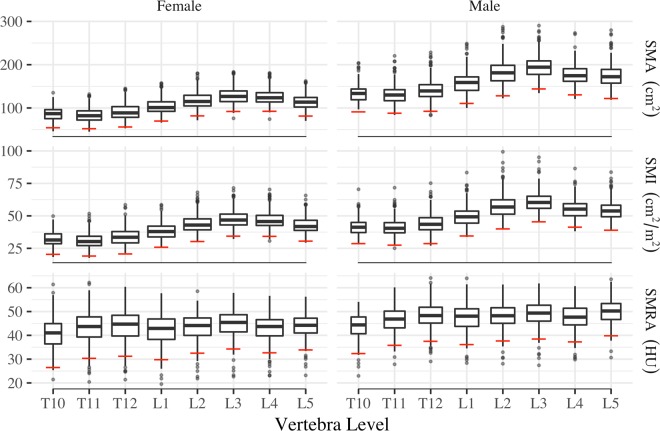
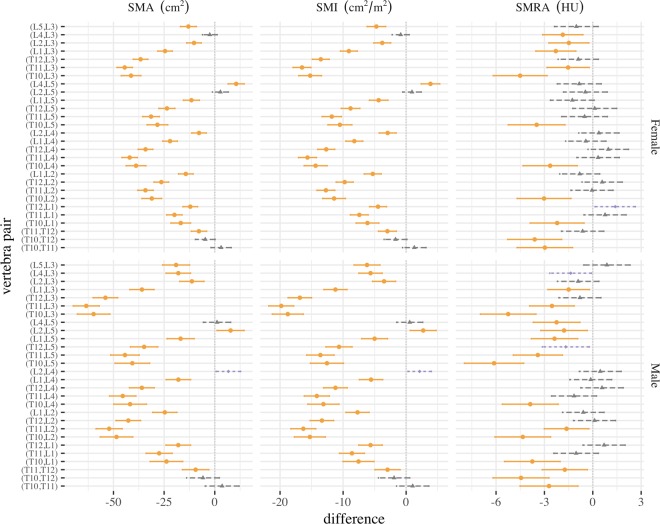
Measurements of skeletal muscle cross-sectional area, index, and radiation attenuation utilizing clinical computed tomography (CT) scans are used in assessments of sarcopenia, the loss of skeletal muscle mass and function associated with aging. To classify individuals as sarcopenic, sex-specific cutoffs for ‘low’ values are used. Conventionally, cutoffs for skeletal muscle measurements at the level of the third lumbar (L3) vertebra are used, however L3 is not included in several clinical CT protocols. Non-contrast-enhanced CT scans from healthy kidney donor candidates (age 18–40) at Michigan Medicine were utilized. Skeletal muscle area (SMA), index (SMI), and mean attenuation (SMRA) were measured at each vertebral level between the tenth thoracic (T10) and the fifth lumbar (L5) vertebra. Sex-specific means, standard deviations (s.d.), and sarcopenia cutoffs (mean-2 s.d.) at each vertebral level were computed. Associations between vertebral levels were assessed using Pearson correlations and Tukey’s difference test. Classification agreement between different vertebral level cutoffs was assessed using overall accuracy, specificity, and sensitivity. SMA, SMI, and SMRA L3 cutoffs for sarcopenia were 92.2 cm 2 , 34.4 cm 2 /m 2 , and 34.3 HU in females, and 144.3 cm 2 , 45.4 cm 2 /m 2 , and 38.5 HU in males, consistent with previously reported cutoffs. Correlations between all level pairs were statistically significant and high, ranging from 0.65 to 0.95 (SMA), 0.64 to 0.95 (SMI), and 0.63 to 0.95 (SMRA). SMA peaks at L3, supporting its use as the primary site for CT sarcopenia measurements. However, when L3 is not available alternative levels (in order of preference) are L2, L4, L5, L1, T12, T11, and T10. Healthy reference values reported here enable sarcopenia assessment and sex-specific standardization of SMA, SMI, and SMRA in clinical populations, including those whose CT protocols do not include L3.
Overview
The claims and statistics of this paper haven’t been checked yet.
Free: it reads the open-access text and checks the first 5 claims that cite a source we can check. Create a free account to check every claim.
Integrity signals
Registry
Cites
Statistics
Figures
Verification
Claims the paper makes
The claims and statistics of this paper haven’t been checked yet.
Free: it reads the open-access text and checks the first 5 claims that cite a source we can check. Create a free account to check every claim.
Claims other papers make about this one
Each is checked against this paper’s own text: does it say what the citing paper says it does?
The source backs part of the claim, not all of it — or backs it for a different population, condition or comparison.
In the citing paper
“the analysis of CT scan at L4 rather than L3 (although variation have been shown to be marginal 44 )”
From Muscle fat content is strongly associated with NASH: a longitudinal study in patients with morbid obesity (2021) · cites this paper as [44]
Experimental — accuracy not yet measuredIn the citing paper
“Cancer cachexia and Sc are frequently observed in lung cancer patients and are associated with increased postoperative complications, reduced tolerance to antineoplastic therapy, and decreased overall survival [7,13,25,26].”
From AI-Assistance Body Composition CT at T12 and T4 in Lung Cancer: Diagnosing Sarcopenia, and Its Correlation with Morphofunctional Assessment Techniques (2025) · cites this paper as [26]
In the citing paper
“Recent research has explored the feasibility of using thoracic levels, such as T12 or T4, for Sc assessment, demonstrating a strong correlation between thoracic levels and the established gold standard method at the L3 level, which is not included in routine studies performed on patients with LC [9,26,28,29,30].”
From AI-Assistance Body Composition CT at T12 and T4 in Lung Cancer: Diagnosing Sarcopenia, and Its Correlation with Morphofunctional Assessment Techniques (2025) · cites this paper as [26]
In the citing paper
“Cancer cachexia and Sc are frequently observed in lung cancer patients and are associated with increased postoperative complications, reduced tolerance to antineoplastic therapy, and decreased overall survival [7,13,25,26].”
From AI-Assistance Body Composition CT at T12 and T4 in Lung Cancer: Diagnosing Sarcopenia, and Its Correlation with Morphofunctional Assessment Techniques (2025) · cites this paper as [26]
In the citing paper
“Drestine et al. quantified reference values for Sc using lumbar and thoracic muscle CSA measures in a healthy US population, N = 604. SMA cutoffs for males/females, respectively, were 91.5/55.9 (T12), 141.7/91.2 (L3). SMI cutoffs for males/females, respectively, were 28.7/20.6 (T12) and 44.6/34.0 (L3) [26,41].”
From AI-Assistance Body Composition CT at T12 and T4 in Lung Cancer: Diagnosing Sarcopenia, and Its Correlation with Morphofunctional Assessment Techniques (2025) · cites this paper as [26]
Self-check
Percentages, sums and reported differences re-computed from the paper’s own numbers.
The self-check needs the paper’s full text.
Citations
Cites
ggplot2: Elegant Graphics for Data Analysis
Wickham, H. (2009) · doi:10.1007/978-0-387-98141-3 · Cited by 14,447
(2000) · PubMed · Cited by 13,173
Obesity : Preventing and managing the global epidemic
Akram, D. S., Astrup, A. V., Atinmo, T., Boissin, J.-L., Bray, G. A., Carroll, K. N., Chitson, P., Chen, C., Dietz, W. H., Hill, J. O., et al. (2000) · Research at the University of Copenhagen (University of Copenhagen) · Cited by 12,945
Sarcopenia: European consensus on definition and diagnosis
Cruz-Jentoft, A. J., Baeyens, J. P., Bauer, J. M., Boirie, Y., Cederholm, T., Landi, F., Martin, F. C., Michel, J.-P., Rolland, Y., Schneider, S. M., et al. (2010) · Age and Ageing · doi:10.1093/ageing/afq034 · Cited by 11,601
Prevalence of Overweight and Obesity in the United States, 1999-2004
Ogden, C. L., Carroll, M. D., Curtin, L. R., McDowell, M. A., Tabak, C. J., & Flegal, K. M. (2006) · JAMA · doi:10.1001/jama.295.13.1549 · Cited by 8,720
Sarcopenia in Asia: Consensus Report of the Asian Working Group for Sarcopenia
Chen, L.-K., Liu, L.-K., Woo, J., Assantachai, P., Auyeung, T.-W., Bahyah, K. S., Chou, M.-Y., Chen, L.-Y., Hsu, P.-S., Krairit, O., et al. (2014) · Journal of the American Medical Directors Association · doi:10.1016/j.jamda.2013.11.025 · Cited by 4,051
Fielding, R. A., Vellas, B., Evans, W. J., Bhasin, S., Morley, J. E., Newman, A. B., Abellan van Kan, G., Andrieu, S., Bauer, J., Breuille, D., et al. (2011) · Journal of the American Medical Directors Association · doi:10.1016/j.jamda.2011.01.003 · Cited by 3,256
Prado, C. M., Lieffers, J. R., McCargar, L. J., Reiman, T., Sawyer, M. B., Martin, L., & Baracos, V. E. (2008) · The Lancet Oncology · doi:10.1016/s1470-2045(08)70153-0 · Cited by 3,238
Janssen, I., Heymsfield, S. B., & Ross, R. (2002) · Journal of the American Geriatrics Society · doi:10.1046/j.1532-5415.2002.50216.x · Cited by 3,139
Martin, L., Birdsell, L., MacDonald, N., Reiman, T., Clandinin, M. T., McCargar, L. J., Murphy, R., Ghosh, S., Sawyer, M. B., & Baracos, V. E. (2013) · Journal of Clinical Oncology · doi:10.1200/jco.2012.45.2722 · Cited by 2,680
Research works printed but not linked: 1
- Rupert, G. Jr. et al. Simultaneous statistical inference (Springer Science & Business Media, 2012).
Cited by
Items 201–300 of 521
Markers of sarcopenia increase 30-day mortality following emergency laparotomy: A systematic review
Brzeszczyński, F. F., & Brzeszczyńska, J. (2022) · Scandinavian Journal of Surgery · doi:10.1177/14574969221133198 · Cited by 11
Smith, K. L., Gordon, E. B., Gunsaulus, M. E., Christopher, A. B., Olivieri, L., Tadros, S. S., Harris, T. H., Saraf, A. P., Kreutzer, J. N., Feingold, B., et al. (2023) · Journal of Clinical Medicine · doi:10.3390/jcm12072689 · Cited by 11
“In comparison with previous studies that analyzed indexed SMA in a healthy cohort, our population had similar results, with males having significantly higher SMA compared to their female counterparts [32].”
ResultWang, M., Tang, H., Chen, X., Liu, J., Hu, N., Cui, W., Xie, C., Xie, C., & Chen, X. (2023) · The Journals of Gerontology Series A · doi:10.1093/gerona/glad162 · Cited by 10
Sabatino, A., Pacchiarini, M. C., Regolisti, G., Ciuni, A., Sverzellati, N., Lesignoli, M., Picetti, E., Fiaccadori, E., & Mario, F. D. (2023) · Clinical Nutrition ESPEN · doi:10.1016/j.clnesp.2023.11.006 · Cited by 11
Hosse, C., Beetz, N. L., Fehrenbach, U., Elkilany, A., Auer, T. A., Gebauer, B., Pille, C., Geisel, D., & Kolck, J. (2024) · BMC Anesthesiology · doi:10.1186/s12871-024-02687-3 · Cited by 10
“Sarcopenia was determined using gender-specific cut-offs; SMA < 34.3 cm² for women, and < 45.4 cm² for men, based on established literature [13].”
MethodInfluentialAy, M., Cetin, H., & Çay, N. (2021) · Skeletal Radiology · doi:10.1007/s00256-021-03866-w · Cited by 10
Almarzouq, A. N., Kool, R., Bulushi, Y. A., Marcq, G., Souhami, L., Cury, F., Brimo, F., Chong, J., & Kassouf, W. (2021) · Urologic Oncology Seminars and Original Investigations · doi:10.1016/j.urolonc.2021.11.002 · Cited by 10
Nattenmüller, J., Schlett, C. L., Tsuchiya, N., Reeder, S. B., Pickhardt, P. J., Kramer, H., Kauczor, H., Wielpütz, M. O., Seo, J. B., Hatabu, H., et al. (2019) · Journal of Thoracic Imaging · doi:10.1097/rti.0000000000000393 · Cited by 10
Analysis of the current status of CT diagnosis of sarcopenia
xia, W., & He, Q. (2024) · Archives of Medical Science · doi:10.5114/aoms/191297 · Cited by 14
“[42], extended the assessment of apnea to the chest and pelvic examination so that the imaging technique could be applied more widely in the clinic.”
Zeng, X., Zhang, L., Zhang, Y., Jia, S., Lin, T., Zhao, X., & Huang, X. (2023) · Frontiers in Oncology · doi:10.3389/fonc.2023.1308544 · Cited by 10
“L3 is the typical location for evaluating muscle mass through CT, but not all patients have abdominal CT as a routine examination, and chest CT was used as a supplement (58, 59).”
BackgroundSuthakaran, R., Cao, K., Arafat, Y., Yeung, J., Chan, S. T. F., Master, M., Faragher, I. G., Baird, P. N., & Yeung, J. M. C. (2024) · BMC Surgery · doi:10.1186/s12893-024-02408-0 · Cited by 12
“In addition, skeletal muscle radiodensity (SMR), which has been used as a surrogate for muscle function, allows a more comprehensive assessment of sarcopenia [7, 13].”
Krombholz-Reindl, P., Winkler, A., Vötsch, A., Hitzl, W., Ch, S., Hecht, S., Seitelberger, R., & Gottardi, R. (2024) · European Journal of Cardio-Thoracic Surgery · doi:10.1093/ejcts/ezae303 · Cited by 9
Tao, J., Shi, H., Shen, B., Zhang, L., Tu, Y., & Zhang, X. (2024) · Nutrition · doi:10.1016/j.nut.2024.112558 · Cited by 11
Liu, J., Li, D., Ma, H., Li, Y., Wei, X., Dai, W., Shi, Q., Li, Q., Zhou, P., Wang, X., et al. (2024) · Annals of Surgical Oncology · doi:10.1245/s10434-024-16140-9 · Cited by 9
“45 Further cutoff values derived from chest CT to identify sarcopenia in Asian population are needed.”
Koizia, L. J., Naik, M., Peck, G., Mikhail, G., Sen, S., Malik, I. S., Ariff, B., & Fertleman, M. B. (2020) · Current Gerontology and Geriatrics Research · doi:10.1155/2020/5783107 · Cited by 11
“To adjust for body size, height is sometimes used for correction to create a “skeletal muscle index,” but this is a measure often unavailable in clinical practice [27].”
MethodHong, J., Shin, W., Lee, J.-W., Lee, S., & Kim, Y. (2022) · Metabolic Syndrome and Related Disorders · doi:10.1089/met.2021.0106 · Cited by 9
de Mattos, J. N., Escovar, C. E., Zereu, M., Rubin, A. S., Camargo, S. M., Mohammed, T.-L. H., dos Santos, R. S., Verma, N., Penha, D., Pinto, E. G., et al. (2022) · ERJ Open Research · doi:10.1183/23120541.00061-2022 · Cited by 9
“#: NEVES et al., 2017 [19]; ¶: CHILES et al., 2015 [17]; +: WANG et al., 2013 [26]; §: LEDERER et al., 2009 [27]; ƒ: DAVIDSON et al., 2006 [28]; ##: CHEN et al., 2017 [12]; ¶¶: DERSTINE et al., 2018 [16]; ++: MARINOVA et al., 2015 [20]. https://doi.org/10.1183/23120541.00061-2022 3”
InfluentialByrne, C. A., Zhang, Y., Fantuzzi, G., Geesey, T., Shah, P., & Gomez‐Perez, S. L. (2022) · Heliyon · doi:10.1016/j.heliyon.2022.e12536 · Cited by 11
“Skeletal muscle density or the infiltration of fatty tissue into the muscle, a measure of muscle quality, has been associated with physical function impairments and poor prognosis in cancer [12, 13, 14].”
BackgroundInfluentialSarcopenia in Patients With Rectal Adenocarcinoma: An Opportunity for Preoperative Rehabilitation
Bliggenstorfer, J. T., Hashmi, A., Bingmer, K. E., Chang, C. C., Liu, J. C., Ginesi, M. C., Stein, S. L., & Steinhagen, E. F. (2023) · The American Surgeon · doi:10.1177/00031348231160849 · Cited by 10
Jennerich, A. L., Downey, L., Goss, C. H., Kapnadak, S. G., Pryor, J. B., & Ramos, K. J. (2023) · BMC Pulmonary Medicine · doi:10.1186/s12890-023-02398-4 · Cited by 10
“We selected the inferior aspect to obtain measurements as close as possible to the region associated with peak skeletal muscle area [30].”
BackgroundMethodResultInfluentialJung, J., Lee, J., Lim, J., Kim, Y. C., Ban, T. H., Park, W. Y., Kim, K. M., Kim, K., Lee, S. W., Shin, S. J., et al. (2023) · Scientific Reports · doi:10.1038/s41598-023-33716-9 · Cited by 9
Shen, Z.-L., Chen, W., Liu, Z., Yu, D., Chen, W., Zang, W., Zhang, P., Yan, X., & Yu, Z. (2023) · Experimental Gerontology · doi:10.1016/j.exger.2023.112244 · Cited by 9
Normative values of skeletal muscle mass, strength and performance in the Indian population
Sidhu, S. S., Saggar, K., Goyal, O., Kishore, H., & Sidhu, S. S. (2024) · Indian Journal of Gastroenterology · doi:10.1007/s12664-024-01565-7 · Cited by 9
“Comparative analyses positioned our normative muscle mass and sarcopenia values below those documented in western studies [16–18] with variations also observable within the Indian context [19, 20].”
Liu, Z., Zang, W., Zhang, P., & Shen, Z. (2023) · Surgery · doi:10.1016/j.surg.2022.11.008 · Cited by 8
Allgayer, G. M., Ulm, B., Sauter, A. P., Schaller, S. J., Blobner, M., & Fuest, K. E. (2024) · Journal of Clinical Medicine · doi:10.3390/jcm13247772 · Cited by 10
Ito, Y., Anan, K., Awano, N., Kataoka, Y., Johkoh, T., Fujimoto, K., Ichikado, K., Tobino, K., Tachikawa, R., Ito, H., et al. (2023) · Respiratory Investigation · doi:10.1016/j.resinv.2023.02.010 · Cited by 10
Troschel, F. M., Troschel, B. O., Kloss, M., Jost, J., Pepper, N. B., Troschel, A. S., Wiewrodt, R. G., Stummer, W., Wiewrodt, D., & Eich, H. T. (2024) · Strahlentherapie und Onkologie · doi:10.1007/s00066-024-02225-7 · Cited by 8
“While predefined cutoffs for sarcopenic patients are available at multiple levels in the trunk [10], no data exist regarding the neck.”
BackgroundHe, S., Zhang, G., Huang, N., Chen, S., Ruan, L., Liu, X., & Zeng, Y. (2024) · Asia-Pacific Journal of Oncology Nursing · doi:10.1016/j.apjon.2024.100512 · Cited by 7
“17 Ishida et al. 18 developed a formula predicting SMA at L3 using T12 CT, which demonstrated strong concordance and correlation (ICC ¼ 0.849; r ¼ 0.858).”
BackgroundMethodInfluentialLim, W.-X., Yeh, W., Lee, S.-Y., Chuang, Y., Wang, J., Huang, C., & Chang, C.-D. (2024) · Clinics and Research in Hepatology and Gastroenterology · doi:10.1016/j.clinre.2024.102379 · Cited by 9
Wielsøe, S., Sundberg, A., Kristensen, T. S., Christensen, J., Sillesen, M., Hansen, C. P., Burgdorf, S. K., Pedersen, B. K., Suetta, C., Christensen, J. F., et al. (2024) · Clinical Nutrition ESPEN · doi:10.1016/j.clnesp.2024.10.003 · Cited by 8
Nassar, J. E., Singh, M., McCrae, B., Xu, A. Y., Knebel, A., Farias, M. J., Cohen, E. M., Diebo, B. G., & Daniels, A. H. (2025) · Journal of Bone and Joint Surgery · doi:10.2106/jbjs.24.01118 · Cited by 8
Ruby, L. C., Sanabria, S. J., Saltybaeva, N., Frauenfelder, T., Alkadhi, H., & Rominger, M. B. (2021) · Medicine · doi:10.1097/md.0000000000025947 · Cited by 8
“CT images from non-enhanced CT phase or CT images without any specification regarding contrast agent application.([7,22]) However, it has been shown that the influence of contrast agent”
BackgroundInfluentialXing, X., Zhou, X., Yang, Y., Li, Y., Hu, C., & Shen, C. (2021) · Annals of Translational Medicine · doi:10.21037/atm-21-3412 · Cited by 9
“The relationship between muscle area on L3 level CT images and total body mass has been recognized, and body composition estimation and SMI calculation based on L3 axial images has been established as the standard method and is widely accepted (20,21).”
MethodMalik, M., Michalak, M., Radecka, B. S., Gełej, M., Jackowska, A., Filipczyk−Cisarż, E., Hetman, K., Foszczyńska‐Kłoda, M., Kania-Zembaczyńska, B., Mańka, D., et al. (2021) · Journal of Clinical Medicine · doi:10.3390/jcm10215107 · Cited by 11
Sun, L., Ma, H.-F., Du, G., Fan, D., Liu, J., Wang, X., Zhang, W., Liu, B., & Yin, F. (2022) · Academic Radiology · doi:10.1016/j.acra.2021.12.026 · Cited by 8
“The examination of the twelfth thoracic (T12) vertebra on CT images may serve as an alternative strategy when L3 is unavailable (11).”
BackgroundSkeletal muscle mass assessment in critically ill patients: method and application
Tanaka, K., Katayama, S., Okura, K., Okamura, M., Nawata, K., Nakanishi, N., & Shinohara, A. (2022) · Annals of Cancer Research and Therapy · doi:10.4993/acrt.30.93 · Cited by 8
Palmisano, A., Gnasso, C., Cereda, A. F., Vignale, D., Leone, R., Nicoletti, V., Barbieri, S., Toselli, M., Giannini, F., Loffi, M., et al. (2023) · European Radiology · doi:10.1007/s00330-023-09702-0 · Cited by 8
“CT offers the possibility to non-invasively identify cardio-metabolic risk factors based on disease-related organ attenuation modifications [15, 16, 23, 24, 26], that could be used to improve patients’ risk stratification.”
BackgroundInfluentialRole of computed tomography in sarcopenia detection
Sheberova, E. V., Silanteva, N. K., Агабабян, Т. А., Potapov, A. L., Nevolskikh, A. A., Иванов, С. А., & Каприн, А. Д. (2023) · Siberian Journal of Oncology · doi:10.21294/1814-4861-2023-22-3-125-133 · Cited by 8
Çınar, H. U., Çelik, B., Taşkın, G., & İnce, Ö. (2021) · Interactive Cardiovascular and Thoracic Surgery · doi:10.1093/icvts/ivab150 · Cited by 9
Growth and physical development of children at apparent risk of sarcopenia
Marques, M., Vieira, F. S., Teles, J. M. V., & Baptista, F. (2024) · Pediatric Research · doi:10.1038/s41390-024-03385-z · Cited by 7
“22,23 CT and MRI also provide information about muscle quality.”
Cao, Y., Yuan, B., Jiang, X., Xie, C., Wu, D., & Zhang, Z. (2025) · Journal of Cachexia Sarcopenia and Muscle · doi:10.1002/jcsm.13827 · Cited by 8
Montero-Benitez, M. Z., Carmona-Llanos, A., Fernández-Jiménez, R., Román-Jobacho, A., Gómez-Millán, J., Modamio-Molina, J., Cabrera-Cesar, E., Vegas-Aguilar, I., Amaya-Campos, M. D. M., Tinahones, F. J., et al. (2025) · Cancers · doi:10.3390/cancers17193255 · Cited by 7
“SMI cutoffs for males/females, respectively, were 28.7/20.6 (T12) and 44.6/34.0 (L3) [26,41].”
InfluentialLiu, Z., Shen, Z.-L., Zhang, P., Zhu, G., Wang, S., Liu, Q., Zou, H., Ma, B., Yan, X., & Zang, W. (2022) · Heart Lung and Circulation · doi:10.1016/j.hlc.2022.05.041 · Cited by 7
Self-citationFischer, A., Kiss, N., Rudas, V.-A., Nieding, K., Veraar, C., Timmermann, I., Liebau, K., Pesta, M., Siebenrock, T., Anwar, M., et al. (2022) · Nutrients · doi:10.3390/nu14163446 · Cited by 8
“Derstine, 2018 [8] SMA/height 2 Male: <45.”
BackgroundMethodInfluentialEdwards, A., Hughes, B. G. M., Brown, T. E., & Bauer, J. (2022) · Advances in Nutrition · doi:10.1093/advances/nmac076 · Cited by 8
“In this review, only 4 studies (31, 36–38) used L3 for body-composition analysis, while the remaining 5 studies (32–35, 39) used C3, an anatomical site yet to be fully validated for skeletal muscle evaluation in the HNC population (47, 48).”
MethodDalmiglio, C., Brilli, L., Ciuoli, C., Maino, F., Valerio, L., Sannino, I., Cartocci, A., Guerrini, S., Zanoni, M., Marrazzo, G., et al. (2022) · Cancers · doi:10.3390/cancers14194569 · Cited by 8
“The SMI cut-off to define sarcopenia was chosen among those proposed by the most recent European consensus [14] and it refers to a population of healthy subjects from the United States [24].”
BackgroundFigueroa, M., Araya, F., TORREALBA, A., Jose Weisz, C., Enrique Lanzarini, S., Musleh, M., Molina, J. C., Korn, O., Braghetto, I., & Csendes, A. (2023) · ABCD Arquivos Brasileiros de Cirurgia Digestiva (São Paulo) · doi:10.1590/0102-672020230002e1723 · Cited by 7
Han, J. W., Song, H., & Kim, S. H. (2020) · The American Journal of Emergency Medicine · doi:10.1016/j.ajem.2020.12.064 · Cited by 7
Caudron, L., Bussy, A., Artemova, S., Charrière, K., Lakkiss, S. E., Moreau–Gaudry, A., Bosson, J., Ferretti, G., Fontaine, E. M., & Betry, C. (2021) · JCSM Rapid Communications · doi:10.1002/rco2.37 · Cited by 8
“The agreement between both types of software was determined using Lin’s concordance correlation coefficient.(19) A value less than 0.”
MethodAssessment of Sarcopenia in Chronic Liver Disease: Indian Perspective
Anand, A., & Saraya, A. (2021) · Clinical Liver Disease · doi:10.1002/cld.1142 · Cited by 9
McDermott, B., Robinson, S. T., Holcombe, S. A., Levey, R. E., Dockery, P., Johnson, P., Wang, S. C., Dolan, E. B., & Duffy, G. P. (2021) · Journal of The Royal Society Interface · doi:10.1098/rsif.2021.0673 · Cited by 8
Self-citationXiao, Y., Xiao‐yue, Z., Yue, W., Ruo‐tao, L., Xiang‐jie, L., Xing‐yuan, W., Wang, Q., Xiao‐hua, Q., & Jia, Z. (2022) · Nutrition in Clinical Practice · doi:10.1002/ncp.10847 · Cited by 25
Padilha, D. M. D. H., Mendes, M. C. S., Juliani, F. L., Silveira, M., Pozzuto, L., Santos, L. A. O., Guerra, L. D., Moreira, R. C. L., Branbilla, S. R., Ademar, D. C., et al. (2022) · Scientific Reports · doi:10.1038/s41598-022-20126-6 · Cited by 7
Westenberg, L. B., Zorgdrager, M., Viddeleer, A. R., & Pol, R. A. (2022) · Journal of Cachexia Sarcopenia and Muscle · doi:10.1002/jcsm.12961 · Cited by 7
Body components at T12/L3 on CT and correlation with survival in esophageal cancer
Huang, Y., Wu, C.-Y., Chou, I.-T., Wang, Y., Shih, Y., Chen, W., Hsu, J., & Wu, I. (2025) · European Radiology · doi:10.1007/s00330-025-11854-0 · Cited by 6
“Previous studies on CT-derived metrics have predominantly emphasized the SMI, and several studies have suggested that the T12 SMI measurement can serve as a viable substitute for the L3 SMI measurement [4, 7, 9 – 11, 23, 24].”
Lahiji, R., Palmateer, G. S., Nicaise, E., Goodstein, T. A., Patil, D. H., Schmeusser, B. N., Midenberg, E. R., Patel, S., Kearns, E., Ogan, K., et al. (2025) · JCSM Communications · doi:10.1002/rco2.70014 · Cited by 6
“Radiographic sarcopenia was determined using sex-specific cohort medians and published thresholds, as described in Table 1 [18–24].”
Sarcopenia in type 2 diabetes mellitus: an imaging review
He, L., Luo, G., Jiang, H., Zhang, L., Li, Y., Gu, W., Zeng, Q., Zhu, J., Liu, J., Lei, H., et al. (2026) · Frontiers in Medicine · doi:10.3389/fmed.2026.1637499 · Cited by 6
Smith, L. O., Vest, M. T., Rovner, A. J., Caplan, R. J., Trabulsi, J., Patel, J. B., Meng, S. W., Shapero, M., & Earthman, C. P. (2024) · Journal of Parenteral and Enteral Nutrition · doi:10.1002/jpen.2610 · Cited by 6
Brath, M. S. G., Kristensen, S. V., Sahakyan, M., Mark, E. B., Rasmussen, H. H., Østergaard, L. R., Frøkjær, J. B., & Weinreich, U. M. (2024) · American Journal of Clinical Nutrition · doi:10.1016/j.ajcnut.2024.06.009 · Cited by 6
Shin, J., Kim, Y.-S., Kim, B. T., Jeong, C., Lee, C., & Yang, S.-O. (2025) · Age and Ageing · doi:10.1093/ageing/afaf128 · Cited by 6
Lyu, J., Mantz, L., Katz-Agranov, N. S., Ouyang, T., Hanna, P. E., Mejia, S. M., Moreno, D. R., Lee, M. D., Cao, A., Dinulos, J. E., et al. (2025) · Journal of the National Comprehensive Cancer Network · doi:10.6004/jnccn.2025.7048 · Cited by 6
Lian, R., Tang, T., Jiang, W., Jiang, J., & Yang, M. (2025) · Nutrition · doi:10.1016/j.nut.2025.112894 · Cited by 7
Low Muscle Mass Is Associated with Readmission for Inflammatory Bowel Disease
Liu, S., Tian, Z., Jiang, Y., Ding, X., Jin, S., & Jing, X. (2022) · The Turkish Journal of Gastroenterology · doi:10.5152/tjg.2022.21711 · Cited by 8
Huang, L., Lin, Y., Chuang, H., Chuang, C., Pang, S., Wu, C., Chang, Y., Yu, K., Lin, P., Kan, H.-C., et al. (2023) · Frontiers in Oncology · doi:10.3389/fonc.2023.1180888 · Cited by 7
Liu, S., Matvekas, A., Naimi, T. A., Ghanem, A., Li, R., Rajanayake, K. K., Derstine, B. A., Ross, B., Sullivan, J. A., Yun, H. G., et al. (2023) · Pharmacotherapy The Journal of Human Pharmacology and Drug Therapy · doi:10.1002/phar.2878 · Cited by 6
“20,21 The 36 morphomics parameters were tested as potential covariates in PopPK analysis.”
MethodSelf-citationJia, Q.-C., Qin, L., Niu, Y., Liu, L., Liu, P., Miao, S., Cui, M., & Wang, R. (2024) · BMC Cancer · doi:10.1186/s12885-024-11864-z · Cited by 6
“Some studies have found that the SMA of the eleventh thoracic verte-bra level (T11) can also be used as an indicator to reflect the skeletal muscle of the whole body [8].”
BackgroundUsing maximum plasma concentration (Cmax) to personalize taxane treatment and reduce toxicity
Sun, Y., Cheng, Y., & Hertz, D. L. (2024) · Cancer Chemotherapy and Pharmacology · doi:10.1007/s00280-024-04677-1 · Cited by 6
“…differ - ent parameters to describe and quantify body composition including the muscle mass (e.g., lean body mass, skeletal muscle area (SMA), skeletal muscle index, and fat mass (e.g., total adipose tissue index, visceral adipose tissue index and subcutaneous adipose tissue index (SATI)) [63, 64].”
Kolck, J., Hosse, C., Leimbach, A., Beetz, N. L., Auer, T. A., Collettini, F., Fehrenbach, U., Pille, C., & Geisel, D. (2024) · European journal of medical research · doi:10.1186/s40001-024-01884-7 · Cited by 6
“Sarcopenia was determined using gender-specific cutoffs; SMA < 34.3 cm 2 for women, and < 45.4 cm 2 for men, based on established literature [13].”
MethodInfluentialSugawara, K., Taguchi, S., Gonoi, W., Hanaoka, S., Shiomi, S., Kishitani, K., Uemura, Y., Akamatsu, N., Inui, S., Tanaka, K., et al. (2024) · Journal of Parenteral and Enteral Nutrition · doi:10.1002/jpen.2666 · Cited by 8
Impact of Sarcopenia on Treatment Outcomes and Toxicity in Locally Advanced Rectal Cancer
Curcean, S., Gherman, A., Țîpcu, A., Fekete, Z., Muntean, A.-S., Curcean, A., Crăciun, R., Stanciu, S., & Irimie, A. (2024) · Medicina · doi:10.3390/medicina60101606 · Cited by 9
“…resulting psoas muscle area (PMA) was used to ascertain sarcopenia based on the Sarcopenia t-score calculator, developed by Derstine et al. [7,9,19]. resulting psoas muscle area (PMA) was used to ascertain sarcopenia based on the Sarcopenia t-score calculator, developed by Derstine et al. [7,9,19].”
BackgroundMethodInfluentialNeshatian, L., Liu, A., Gurland, B., Shen, S., Grant, G., Becker, L. S., Triadafilopoulos, G., & Sheth, V. R. (2025) · The American Journal of Gastroenterology · doi:10.14309/ajg.0000000000003544 · Cited by 6
Park, E. J., Park, S. Y., Kang, J., Chu, W., & Kang, D. O. (2023) · Journal of Clinical Medicine · doi:10.3390/jcm12237483 · Cited by 6
“To overcome this limitation, the L1 level has been suggested as an alternative reference owing to its greater availability in chest and coronary CT scans [20,28–30].”
Role of skeletal muscle on chest computed tomography for risk stratification of lung cancer patients
Troschel, A. S., Troschel, F. M., Muniappan, A., Gaissert, H. A., & Fintelmann, F. J. (2019) · Journal of Thoracic Disease · doi:10.21037/jtd.2019.01.73 · Cited by 6
“It should be noted, however, that such reference values recently became available for the level of the tenth thoracic vertebral body, albeit without adjustment for race (4).”
Armstrong, V., Stretch, C., Fitzgerald, L. W., Gopaul, A., McKinnon, G., Koziak, J. M., Kopciuk, K. A., Brockton, N. T., & Bathe, O. F. (2021) · JCSM Rapid Communications · doi:10.1002/rco2.46 · Cited by 9
“level of T12 for the evaluation of radiodensity, which correlate well with that of L3.(13,14) Because T12 does have a higher presence of bone, muscle tissue slightly overlapping bone”
ResultInfluentialReference distributions of aortic calcification and association with Framingham risk score
Horbal, S. R., Derstine, B. A., Brown, E., Su, G. L., Wang, S. C., & Holcombe, S. A. (2023) · Scientific Reports · doi:10.1038/s41598-023-36565-8 · Cited by 8
Self-citationKümmerl, L., Kraulich, M., Lesyuk, W., Binninger, A., Goebell, P. J., & Kahlmeyer, A. (2023) · Urologic Oncology Seminars and Original Investigations · doi:10.1016/j.urolonc.2023.06.011 · Cited by 5
Troschel, F. M., Troschel, B. O., Kloss, M., Troschel, A. S., Pepper, N. B., Wiewrodt, R. G., Stummer, W., Wiewrodt, D., & Eich, H. T. (2023) · Clinical and Translational Radiation Oncology · doi:10.1016/j.ctro.2023.100621 · Cited by 8
Ichinohe, D., Muroya, T., Akasaka, H., & Hakamada, K. (2023) · World Journal of Gastrointestinal Surgery · doi:10.4240/wjgs.v15.i4.621 · Cited by 5
Sumbal, R., Sumbal, A., & Baig, M. M. A. (2023) · Clinical Nutrition ESPEN · doi:10.1016/j.clnesp.2023.04.022 · Cited by 5
“[14] pointed out that results obtained for evaluating sarcopenia at the thoracic level are significantly different from the lumbar and abdominal levels [13].”
Zhang, Y., Wei, L., Chang, C., Duan, F., Quan, M., & Yang, S. T. (2023) · Frontiers in Nutrition · doi:10.3389/fnut.2023.1238433 · Cited by 6
“4 cm2/m2 in women from the United States (16), and 43.”
BackgroundInfluentialBrath, M. S. G., Sahakyan, M., Mark, E. B., Rasmussen, H. H., Østergaard, L. R., Frøkjær, J. B., Weinreich, U. M., & Jørgensen, M. E. (2024) · International Journal of Circumpolar Health · doi:10.1080/22423982.2024.2312663 · Cited by 6
“Likewise, sex-specific cut-off values for SMI and SMD based on healthy Caucasian or mixed populations [26,29] may fail to reflect muscle characteristics in the Inuit.”
BackgroundMethodInfluentialSarcopenia Identification Using Alternative Vertebral Landmarks in Individuals with Lung Cancer
Byrne, C. A., Fantuzzi, G., Stephan, J. T., Kim, S., Oddo, V. M., Koh, T. J., & Gomez, S. L. (2024) · Muscles · doi:10.3390/muscles3020012 · Cited by 4
“Previous studies in healthy adults [6,11] and in those with lung cancer [8,9] indicate that skeletal muscle at the first lumbar vertebra (L1) or the second lumbar vertebra (L2) may be appropriate alternatives to L3 for sarcopenia analysis as they are highly correlated with the reference landmark.”
BackgroundMethodResultInfluentialLortie, J. J., Ufearo, D., Hetzel, S., Pickhardt, P. J., Szczykutowicz, T. P., & Kuchnia, A. J. (2024) · Journal of Computer Assisted Tomography · doi:10.1097/rct.0000000000001682 · Cited by 6
Andò, G., & Basile, G. (2020) · Journal of Cardiovascular Medicine · doi:10.2459/jcm.0000000000001019 · Cited by 5
Sheean, P., O'Connor, P., Joyce, C., Wozniak, A. W., Vasilopoulos, V., & Formanek, P. (2023) · Nutrition in Clinical Practice · doi:10.1002/ncp.11024 · Cited by 5
David Ladrón de Guevara, H., Bernard, S., Manhood, S., Melani, S., Fernando Yerovi, G., & Rodríguez, M. D. L. Á. (2020) · Revista médica de Chile · doi:10.4067/s0034-98872020001101558 · Cited by 5
“La sarcopenia, y en menor grado la lipopenia, son considerados un factor de riesgo en pacientes oncológicos, y se han asocia-do a peor pronóstico 25 .”
InfluentialMatsuyama, R., Maeda, K., Yamanaka, Y., Ishida, Y., Nonogaki, T., Kato, R., Shimizu, A., Ueshima, J., Kazaoka, Y., Hayashi, T., et al. (2021) · Nutrition · doi:10.1016/j.nut.2021.111475 · Cited by 5
Koch, L. D. O. M., Pereira, A. Z., Hamerschlak, N., Castro, A. D. A. E., Tachibana, A., Victor, E. D. S., & Jesús-García, R. (2022) · Nutrition in Clinical Practice · doi:10.1002/ncp.10808 · Cited by 5
Wang, P.-H., Gow, C., Chiu, Y., & Li, T.-C. (2022) · Journal of Clinical Medicine · doi:10.3390/jcm11092429 · Cited by 6
“The aforementioned difficulty in establishing L3MI diagnostic criteria also exists in obtaining those of L1MI [18,20,34].”
BackgroundResultDemırel, E., & Dılek, O. (2022) · Acta Radiologica · doi:10.1177/02841851221126358 · Cited by 5
“Previous studies aimed to create standardized indexes by using the square of the height of the individuals (43).”
BackgroundKolck, J., Hosse, C., Fehrenbach, U., Beetz, N. L., Auer, T. A., Pille, C., & Geisel, D. (2025) · BMC Anesthesiology · doi:10.1186/s12871-025-03142-7 · Cited by 4
“Sarcopenia was defined using gender-specific cut-offs: Skeletal muscle index (SMI) 34.3 cm² for women and 45.4 cm² for men, according to the established literature [11].”
InfluentialLading, T., Media, A. S., Tellefsen, B., Hansen, S. N., Schmidt, J. A., Christensen, T. D., & de Paoli, F. V. (2025) · European Journal of Surgical Oncology · doi:10.1016/j.ejso.2025.110538 · Cited by 8
Sarcopenia in Older Patients with Newly Diagnosed Multiple Myeloma
Sobrini-Morillo, P., Tuesta, C. C., Sánchez-Castellano, C., Gutiérrez-Blanco, T., Blanchard-Rodríguez, M. J., Escudero-González, B., Nieto-Gongora, C., López, J. M., Rexach, J. A. S., & Cruz-Jentoft, A. J. (2025) · Gerontology · doi:10.1159/000549514 · Cited by 5
“Patients were considered sarcopenic when SMI 34.4 cm 2 /m 2 for women and 45.4 cm 2 /m 2 for men [28].”
InfluentialLiu, M.-C., Cheng, Y.-Y., Lin, S.-C., Lin, C., Chuang, C.-Y., Chen, W.-H., Liao, C.-H., Hsieh, C.-H., Hsieh, M.-F., & Liu, Y. (2025) · World Journal of Gastrointestinal Oncology · doi:10.4251/wjgo.v17.i12.112873 · Cited by 4
“Sarcopenia was then defined using established L3 cut-off values: 34.4 cm 2 /m 2 for females and 45.4 cm 2 /m 2 for males[31].”
InfluentialPei, T., Lei, Y., Gao, Y., Zhang, M., Xu, T., Yang, W., Wen, Q., & Liu, Q. (2026) · Frontiers in Endocrinology · doi:10.3389/fendo.2026.1779448 · Cited by 5
“Cross-sectional muscle area at L3 shows the strongest correlation with total muscle volume (r = 0.832 – 0.986), explaining 69 – 97% of variance (30, 31).”
InfluentialThurston, B., Thomas, J. M., Miller, M., & Delaney, C. L. (2022) · Vascular · doi:10.1177/17085381211059404 · Cited by 4
Janiszewski, R., Law, N. L., Walters, R. W., & DenOtter, T. (2023) · Research in Diagnostic and Interventional Imaging · doi:10.1016/j.redii.2023.100026 · Cited by 4
“Although the cutoff values obtained for SMRA were established on non-contrast CTs, [18,19] other studies include both contrast-enhanced and non-contrast images of study patients [27].”
BackgroundMethodInfluentialSwaab, T. D. A., Quint, E. E., Westenberg, L. B., Zorgdrager, M., Segev, D. L., McAdams‐DeMarco, M., Bakker, S. J. L., Viddeleer, A. R., & Pol, R. A. (2023) · Journal of Cachexia Sarcopenia and Muscle · doi:10.1002/jcsm.13316 · Cited by 4
“17 32 – 35 Our group has emphasized the need for consensus on cut-off values.”
BackgroundWalpot, J., Herck, P. V., Heyning, C. M. V. D., Bosmans, J. M., Massalha, S., Inácio, J. R., Heidbüchel, H., & Malbrain, M. L. N. G. (2023) · Anaesthesiology Intensive Therapy · doi:10.5114/ait.2023.132460 · Cited by 6
“[33] for reference values of PMI and SMI (Table 3).”
BackgroundTumor-Derived Sarcopenia Factors Are Diverse in Different Tumor Types: A Pan-Cancer Analysis
Gan, X., Zeng, Y., Huang, J., Chen, X., Kang, H., & Huang, S.-W. (2024) · Biomedicines · doi:10.3390/biomedicines12020329 · Cited by 4
“…1 June 2021) and TCGA-Clinical Data Resource [17]. were also used to identify the differentially expressed Using data from a healthy US population [18], we de fi ned fi ve pa tt erns for subjects: the sarcopenia group, the middle–low muscle mass group, the middle muscle mass group, the middle–high…”
Method
Metadata
- Authors
- Derstine, B. A., Holcombe, S. A., Ross, B. E., Wang, N. C., Su, G. L., & Wang, S. C.
- Affiliations
- University of Michigan (US)
- Corresponding author
- Derstine, Brian A.
- Venue
- Scientific Reports
- Published
- 2018-07-27
- Volume
- 8
- Issue
- 1
- Pages
- 11369-11369
- ISSN
- 2045-2322 (ISSN-L)
- PMC
- PMC6063941
- OpenAlex
- W2883061070
- Semantic Scholar
- 2de0ec2b7e8773d275e615051fbdfb739a8d7a1f
- Cited by
- 507
- References
- 43
- Citations by year
- 2026: 63 · 2025: 83 · 2024: 68 · 2023: 74 · 2022: 77 · 2021: 71 · 2020: 35 · 2019: 31 · 2018: 3
- FWCI
- 24.07
- Type
- journal article
- Language
- en
- Open access
- gold
- doi.org
- Licence
- cc-by
- creativecommons.org/licenses/by/4.0 (tdm)
- creativecommons.org/licenses/by/4.0 (vor)
- Locations
- Scientific Reports (publishedVersion, cc-by)
- Europe PMC (PubMed Central) (publishedVersion, other-oa)
- PubMed Central (publishedVersion, cc-by)
- PubMed (publishedVersion)
- DOAJ (DOAJ: Directory of Open Access Journals) (submittedVersion, cc-by-sa)
- Topics
- Health Sciences › Medicine › Physiology (medical) › Nutrition and Health in Aging
- Health Sciences › Medicine › Physiology (medical) › Body Composition Measurement Techniques
- Life Sciences › Biochemistry, Genetics and Molecular Biology › Molecular Biology › Muscle Physiology and Disorders
- Keywords
- sarcopenia, skeletal muscle area, skeletal muscle index, CT-based sarcopenia assessment, reference values
- MeSH terms
- Adult, Female, Humans, Lumbar Vertebrae, Male, Reference Values, Sex Factors, Thoracic Vertebrae, Tomography, X-Ray Computed, United States, Muscle, Skeletal, Sarcopenia
About these checks
Registry, retraction, Cites and statistics results are computed, not judged, with one exception: a printed reference that no index lists is read once by a model before it counts as a citation error. Claims are extracted by a model and kept only when their quote appears verbatim in the text; each cited source is then checked, with a model’s help, for whether it says what the claim relies on. Those verdicts can be wrong — read the claim’s quote and the cited source before relying on one.
Statistics and arithmetic are recomputed, not judged.
Confidence bands are shown only for fields calibrated on our annotated test set. None is calibrated yet, so no band is shown.
What counts as a claim ›How we measure confidence ›How we check this ›
Are you an author, or do you see a problem with this page? Request a review
Data sources
Bibliographic data: Semantic Scholar, OpenAlex, Crossref.
Contains information from the Semantic Scholar Academic Graph Datasets, made available under the ODC Attribution License (ODC-BY 1.0).
Semantic Scholar’s data is described in: Kinney, R., et al. (2023). The Semantic Scholar Open Data Platform. arXiv:2301.10140.
