

Skeletal muscle cutoff values for sarcopenia diagnosis using T10 to L5 measurements in a healthy US population
Open accessThe DOI matches its Crossref record; 46 of the 46 references it cites were found in a registry or an index.
Abstract
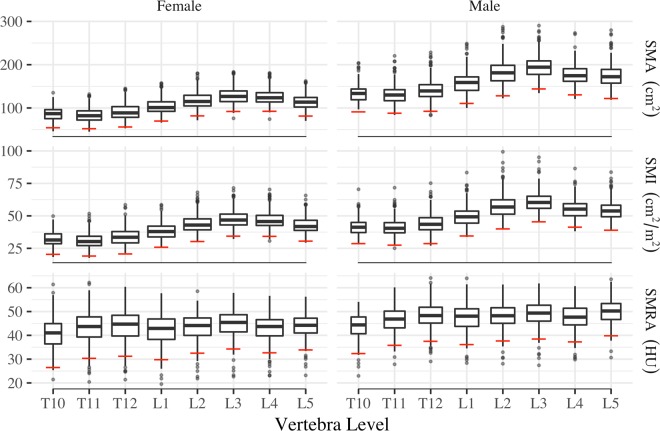
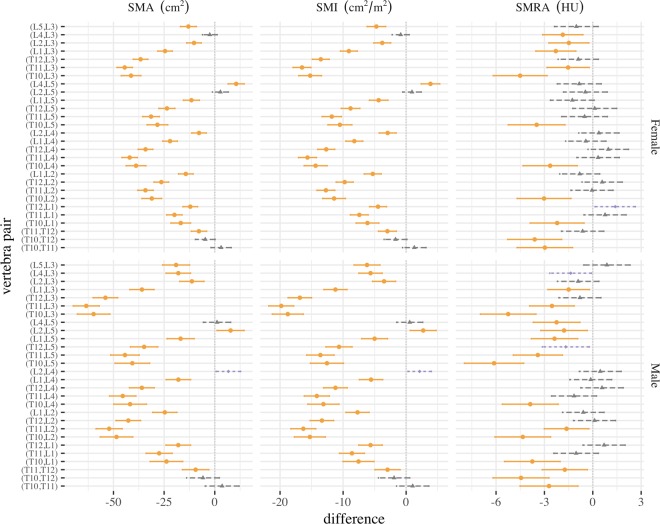
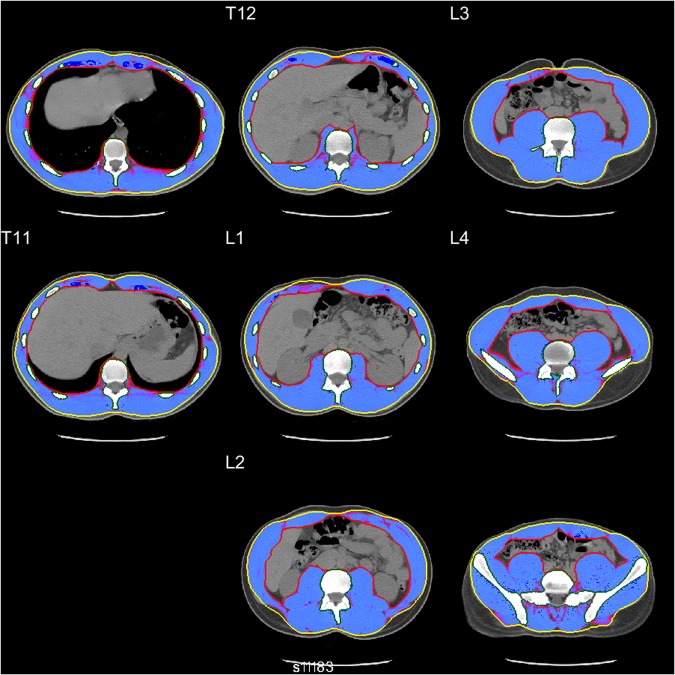
Measurements of skeletal muscle cross-sectional area, index, and radiation attenuation utilizing clinical computed tomography (CT) scans are used in assessments of sarcopenia, the loss of skeletal muscle mass and function associated with aging. To classify individuals as sarcopenic, sex-specific cutoffs for ‘low’ values are used. Conventionally, cutoffs for skeletal muscle measurements at the level of the third lumbar (L3) vertebra are used, however L3 is not included in several clinical CT protocols. Non-contrast-enhanced CT scans from healthy kidney donor candidates (age 18–40) at Michigan Medicine were utilized. Skeletal muscle area (SMA), index (SMI), and mean attenuation (SMRA) were measured at each vertebral level between the tenth thoracic (T10) and the fifth lumbar (L5) vertebra. Sex-specific means, standard deviations (s.d.), and sarcopenia cutoffs (mean-2 s.d.) at each vertebral level were computed. Associations between vertebral levels were assessed using Pearson correlations and Tukey’s difference test. Classification agreement between different vertebral level cutoffs was assessed using overall accuracy, specificity, and sensitivity. SMA, SMI, and SMRA L3 cutoffs for sarcopenia were 92.2 cm 2 , 34.4 cm 2 /m 2 , and 34.3 HU in females, and 144.3 cm 2 , 45.4 cm 2 /m 2 , and 38.5 HU in males, consistent with previously reported cutoffs. Correlations between all level pairs were statistically significant and high, ranging from 0.65 to 0.95 (SMA), 0.64 to 0.95 (SMI), and 0.63 to 0.95 (SMRA). SMA peaks at L3, supporting its use as the primary site for CT sarcopenia measurements. However, when L3 is not available alternative levels (in order of preference) are L2, L4, L5, L1, T12, T11, and T10. Healthy reference values reported here enable sarcopenia assessment and sex-specific standardization of SMA, SMI, and SMRA in clinical populations, including those whose CT protocols do not include L3.
Overview
The claims and statistics of this paper haven’t been checked yet.
Free: it reads the open-access text and checks the first 5 claims that cite a source we can check. Create a free account to check every claim.
Integrity signals
Registry
Cites
Statistics
Figures
Verification
Claims the paper makes
The claims and statistics of this paper haven’t been checked yet.
Free: it reads the open-access text and checks the first 5 claims that cite a source we can check. Create a free account to check every claim.
Claims other papers make about this one
Each is checked against this paper’s own text: does it say what the citing paper says it does?
The source backs part of the claim, not all of it — or backs it for a different population, condition or comparison.
In the citing paper
“the analysis of CT scan at L4 rather than L3 (although variation have been shown to be marginal 44 )”
From Muscle fat content is strongly associated with NASH: a longitudinal study in patients with morbid obesity (2021) · cites this paper as [44]
Experimental — accuracy not yet measuredIn the citing paper
“Cancer cachexia and Sc are frequently observed in lung cancer patients and are associated with increased postoperative complications, reduced tolerance to antineoplastic therapy, and decreased overall survival [7,13,25,26].”
From AI-Assistance Body Composition CT at T12 and T4 in Lung Cancer: Diagnosing Sarcopenia, and Its Correlation with Morphofunctional Assessment Techniques (2025) · cites this paper as [26]
In the citing paper
“Recent research has explored the feasibility of using thoracic levels, such as T12 or T4, for Sc assessment, demonstrating a strong correlation between thoracic levels and the established gold standard method at the L3 level, which is not included in routine studies performed on patients with LC [9,26,28,29,30].”
From AI-Assistance Body Composition CT at T12 and T4 in Lung Cancer: Diagnosing Sarcopenia, and Its Correlation with Morphofunctional Assessment Techniques (2025) · cites this paper as [26]
In the citing paper
“Cancer cachexia and Sc are frequently observed in lung cancer patients and are associated with increased postoperative complications, reduced tolerance to antineoplastic therapy, and decreased overall survival [7,13,25,26].”
From AI-Assistance Body Composition CT at T12 and T4 in Lung Cancer: Diagnosing Sarcopenia, and Its Correlation with Morphofunctional Assessment Techniques (2025) · cites this paper as [26]
In the citing paper
“Drestine et al. quantified reference values for Sc using lumbar and thoracic muscle CSA measures in a healthy US population, N = 604. SMA cutoffs for males/females, respectively, were 91.5/55.9 (T12), 141.7/91.2 (L3). SMI cutoffs for males/females, respectively, were 28.7/20.6 (T12) and 44.6/34.0 (L3) [26,41].”
From AI-Assistance Body Composition CT at T12 and T4 in Lung Cancer: Diagnosing Sarcopenia, and Its Correlation with Morphofunctional Assessment Techniques (2025) · cites this paper as [26]
Self-check
Percentages, sums and reported differences re-computed from the paper’s own numbers.
The self-check needs the paper’s full text.
Citations
Cites
ggplot2: Elegant Graphics for Data Analysis
Wickham, H. (2009) · doi:10.1007/978-0-387-98141-3 · Cited by 14,447
(2000) · PubMed · Cited by 13,173
Obesity : Preventing and managing the global epidemic
Akram, D. S., Astrup, A. V., Atinmo, T., Boissin, J.-L., Bray, G. A., Carroll, K. N., Chitson, P., Chen, C., Dietz, W. H., Hill, J. O., et al. (2000) · Research at the University of Copenhagen (University of Copenhagen) · Cited by 12,945
Sarcopenia: European consensus on definition and diagnosis
Cruz-Jentoft, A. J., Baeyens, J. P., Bauer, J. M., Boirie, Y., Cederholm, T., Landi, F., Martin, F. C., Michel, J.-P., Rolland, Y., Schneider, S. M., et al. (2010) · Age and Ageing · doi:10.1093/ageing/afq034 · Cited by 11,601
Prevalence of Overweight and Obesity in the United States, 1999-2004
Ogden, C. L., Carroll, M. D., Curtin, L. R., McDowell, M. A., Tabak, C. J., & Flegal, K. M. (2006) · JAMA · doi:10.1001/jama.295.13.1549 · Cited by 8,720
Sarcopenia in Asia: Consensus Report of the Asian Working Group for Sarcopenia
Chen, L.-K., Liu, L.-K., Woo, J., Assantachai, P., Auyeung, T.-W., Bahyah, K. S., Chou, M.-Y., Chen, L.-Y., Hsu, P.-S., Krairit, O., et al. (2014) · Journal of the American Medical Directors Association · doi:10.1016/j.jamda.2013.11.025 · Cited by 4,051
Fielding, R. A., Vellas, B., Evans, W. J., Bhasin, S., Morley, J. E., Newman, A. B., Abellan van Kan, G., Andrieu, S., Bauer, J., Breuille, D., et al. (2011) · Journal of the American Medical Directors Association · doi:10.1016/j.jamda.2011.01.003 · Cited by 3,256
Prado, C. M., Lieffers, J. R., McCargar, L. J., Reiman, T., Sawyer, M. B., Martin, L., & Baracos, V. E. (2008) · The Lancet Oncology · doi:10.1016/s1470-2045(08)70153-0 · Cited by 3,238
Janssen, I., Heymsfield, S. B., & Ross, R. (2002) · Journal of the American Geriatrics Society · doi:10.1046/j.1532-5415.2002.50216.x · Cited by 3,139
Martin, L., Birdsell, L., MacDonald, N., Reiman, T., Clandinin, M. T., McCargar, L. J., Murphy, R., Ghosh, S., Sawyer, M. B., & Baracos, V. E. (2013) · Journal of Clinical Oncology · doi:10.1200/jco.2012.45.2722 · Cited by 2,680
Studenski, S. A., Peters, K. W., Alley, D. E., Cawthon, P. M., McLean, R. R., Harris, T. B., Ferrucci, L., Guralnik, J. M., Fragala, M. S., Kenny, A. M., et al. (2014) · The Journals of Gerontology: Series A · doi:10.1093/gerona/glu010 · Cited by 2,545
Sarcopenia: origins and clinical relevance
Rosenberg, I. H. (1997) · The Journal of Nutrition · doi:10.1093/jn/127.5.990s · Cited by 2,399
Mourtzakis, M., Prado, C. M. M., Lieffers, J. R., Reiman, T., McCargar, L. J., & Baracos, V. E. (2008) · Applied Physiology, Nutrition, and Metabolism · doi:10.1139/h08-075 · Cited by 2,224
Shen, W., Punyanitya, M., Wang, Z., Gallagher, D., St.-Onge, M.-P., Albu, J., Heymsfield, S. B., & Heshka, S. (2004) · Journal of Applied Physiology · doi:10.1152/japplphysiol.00744.2004 · Cited by 1,692
Schuit, S. C. E., van der Klift, M., Weel, A. E. A. M., de Laet, C. E. D. H., Burger, H., Seeman, E., Hofman, A., Uitterlinden, A. G., van Leeuwen, J. P. T. M., & Pols, H. A. P. (2004) · Bone · doi:10.1016/j.bone.2003.10.001 · Cited by 1,651
Mitsiopoulos, N., Baumgartner, R. N., Heymsfield, S. B., Lyons, W., Gallagher, D., & Ross, R. (1998) · Journal of Applied Physiology · doi:10.1152/jappl.1998.85.1.115 · Cited by 1,522
Attenuation of skeletal muscle and strength in the elderly: the Health ABC Study
Goodpaster, B. H., Carlson, C. L., Visser, M., Kelley, D. E., Scherzinger, A., Harris, T. B., Stamm, E., & Newman, A. B. (2001) · Journal of Applied Physiology · doi:10.1152/jappl.2001.90.6.2157 · Cited by 1,226
Organization, W. H. (2025) · TIB Data Manager · doi:10.57702/o4rdcuwn · Cited by 1,158
Prado, C. M. M., Baracos, V. E., McCargar, L. J., Reiman, T., Mourtzakis, M., Tonkin, K., Mackey, J. R., Koski, S., Pituskin, E., & Sawyer, M. B. (2009) · Clinical Cancer Research · doi:10.1158/1078-0432.ccr-08-2242 · Cited by 1,104
Goodpaster, B. H., Kelley, D. E., Thaete, F. L., He, J., & Ross, R. (2000) · Journal of Applied Physiology · doi:10.1152/jappl.2000.89.1.104 · Cited by 947
Sarcopenia: origins and clinical relevance
Rosenberg, I. H. (2011) · Clinics in Geriatric Medicine · doi:10.1016/j.cger.2011.03.003 · Cited by 786
White, J. V., Guenter, P., Jensen, G., Malone, A., & Schofield, M. (2012) · Journal of the Academy of Nutrition and Dietetics · doi:10.1016/j.jand.2012.03.012 · Cited by 751
Stamler, J., Stamler, R., Neaton, J. D., Wentworth, D., Daviglus, M. L., Garside, D., Dyer, A. R., Liu, K., & Greenland, P. (1999) · JAMA · doi:10.1001/jama.282.21.2012 · Cited by 725
Measurement of skeletal muscle radiation attenuation and basis of its biological variation
Aubrey, J., Esfandiari, N., Baracos, V. E., Buteau, F. A., Frenette, J., Putman, C. T., & Mazurak, V. C. (2014) · Acta Physiologica · doi:10.1111/apha.12224 · Cited by 720
Lean Tissue Imaging: A New Era for Nutritional Assessment and Intervention
Prado, C. M. M., & Heymsfield, S. B. (2014) · Journal of Parenteral and Enteral Nutrition · doi:10.1177/0148607114550189 · Cited by 550
Hamaguchi, Y., Kaido, T., Okumura, S., Kobayashi, A., Hammad, A., Tamai, Y., Inagaki, N., & Uemoto, S. (2016) · Nutrition · doi:10.1016/j.nut.2016.04.003 · Cited by 536
How to Standardize Regression Coefficients
Bring, J. (1994) · The American Statistician · doi:10.1080/00031305.1994.10476059 · Cited by 519
Hanauer, D. A., Mei, Q., Law, J., Khanna, R., & Zheng, K. (2015) · Journal of Biomedical Informatics · doi:10.1016/j.jbi.2015.05.003 · Cited by 436
van Vugt, J. L. A., Levolger, S., de Bruin, R. W. F., van Rosmalen, J., Metselaar, H. J., & IJzermans, J. N. M. (2016) · American Journal of Transplantation · doi:10.1111/ajt.13732 · Cited by 361
van der Werf, A., Langius, J. A. E., de van der Schueren, M. A. E., Nurmohamed, S. A., van der Pant, K. A. M. I., Blauwhoff-Buskermolen, S., & Wierdsma, N. J. (2018) · European Journal of Clinical Nutrition · doi:10.1038/s41430-017-0034-5 · Cited by 295
Shachar, S. S., Deal, A. M., Weinberg, M., Nyrop, K. A., Williams, G. R., Nishijima, T. F., Benbow, J. M., & Muss, H. B. (2017) · Clinical Cancer Research · doi:10.1158/1078-0432.ccr-16-0940 · Cited by 288
Assessing skeletal muscle mass: historical overview and state of the art
Heymsfield, S. B., Adamek, M., Gonzalez, M. C., Jia, G., & Thomas, D. M. (2014) · Journal of Cachexia, Sarcopenia and Muscle · doi:10.1007/s13539-014-0130-5 · Cited by 212
Delineating the Age Ranges Used to Define Adolescents and Young Adults
Geiger, A. M., & Castellino, S. M. (2011) · Journal of Clinical Oncology · doi:10.1200/jco.2011.35.5602 · Cited by 140
Reisinger, K. W., Bosmans, J. W. A. M., Uittenbogaart, M., Alsoumali, A., Poeze, M., Sosef, M. N., & Derikx, J. P. M. (2015) · Annals of Surgical Oncology · doi:10.1245/s10434-015-4558-4 · Cited by 127
Boutin, R. D., Kaptuch, J. M., Bateni, C. P., Chalfant, J. S., & Yao, L. (2016) · American Journal of Roentgenology · doi:10.2214/ajr.16.16387 · Cited by 109
Skeletal muscle measures and physical function in older adults with cancer: sarcopenia or myopenia?
Williams, G. R., Deal, A. M., Muss, H. B., Weinberg, M. S., Sanoff, H. K., Nyrop, K. A., Pergolotti, M., & Shachar, S. S. (2017) · Oncotarget · doi:10.18632/oncotarget.16866 · Cited by 107
Scaling of body composition to height: relevance to height-normalized indexes
Heymsfield, S. B., Heo, M., Thomas, D. M., & Pietrobelli, A. (2011) · American Journal of Clinical Nutrition · doi:10.3945/ajcn.110.007161 · Cited by 102
Fuchs, G., Chretien, Y. R., Mario, J., Do, S., Eikermann, M., Liu, B., Yang, K., & Fintelmann, F. J. (2018) · European Radiology · doi:10.1007/s00330-017-5191-3 · Cited by 97
Prevalence of sarcopenia in older patients with colorectal cancer
Broughman, J. R., Williams, G. R., Deal, A. M., Yu, H., Nyrop, K. A., Alston, S. M., Gordon, B.-B. E., Sanoff, H. K., & Muss, H. B. (2015) · Journal of Geriatric Oncology · doi:10.1016/j.jgo.2015.08.005 · Cited by 90
Derstine, B. A., Holcombe, S. A., Goulson, R. L., Ross, B. E., Wang, N. C., Sullivan, J. A., Su, G. L., & Wang, S. C. (2018) · The Journal of nutrition, health and aging · doi:10.1007/s12603-017-0983-3 · Cited by 75
Self-citationvan der Werf, A., Dekker, I. M., Meijerink, M. R., Wierdsma, N. J., de van der Schueren, M. A. E., & Langius, J. A. E. (2018) · Clinical Physiology and Functional Imaging · doi:10.1111/cpf.12422 · Cited by 62
Hingson, R., Heeren, T., Edwards, E. M., & Saitz, R. (2011) · Journal of General Internal Medicine · doi:10.1007/s11606-011-1851-1 · Cited by 60
Krishnamurthy, V. N., Zhāng, P., Ethiraj, S., Enchakalody, B. E., Waljee, A. K., Wang, L., Wang, S. C., & Su, G. L. (2014) · Clinical Gastroenterology and Hepatology · doi:10.1016/j.cgh.2014.07.042 · Cited by 34
Self-citationvan der Werf, A., Langius, J. A. E., de van der Schueren, M. A. E., Nurmohamed, S. A., der Pant, K. A. M. I. V. D., Blauwhoff-Buskermolen, S., & Wierdsma, N. (2018) · Data Archiving and Networked Services (DANS) · Cited by 4
van der Werf, A., Dekker, I. M., Meijerink, M. R., Wierdsma, N., de van der Schueren, M. A. E., & Langius, J. A. E. (2018) · Data Archiving and Networked Services (DANS) · Cited by 3
Werf, A. V. D., Langius, J., Schueren, M. D. V. D., Nurmohamed, S., Pant, K. V. D., Blauwhoff-Buskermolen, S., & Wierdsma, N. (2017) · Clinical Nutrition · doi:10.1016/s0261-5614(17)30471-5
Research works printed but not linked: 1
- Rupert, G. Jr. et al. Simultaneous statistical inference (Springer Science & Business Media, 2012).
Cited by
Sarcopenia: revised European consensus on definition and diagnosis
Cruz-Jentoft, A. J., Bahat, G., Bauer, J., Boirie, Y., Bruyère, O., Cederholm, T., Cooper, C., Landi, F., Rolland, Y., Sayer, A. A., et al. (2019) · Age and Ageing · doi:10.1093/ageing/afy169 · Cited by 13,818
“…(CT) or MRI Lee (2004) [50] Lumbar muscle cross-sectional area by CT or MRI Lumbar muscle cross-sectional area by CT or MRI Van der Werf (2018) [51] Derstine (2018) [52] Muscle quality by mid-thigh or total body muscle quality by muscle biopsy, CT, MRI or Magnetic resonance Spectroscopy…”
MethodBossi, P., Delrio, P., Mascheroni, A., & Zanetti, M. (2021) · Nutrients · doi:10.3390/nu13061980 · Cited by 465
“• Evaluation of sarcopenia parameters [18]: muscle strength using a handgrip dynamometer [19] and chair stand test; muscle quantity using BIVA [20], DEXA and CT [21,22]; physical performance measures using tests as gait speed, short physical performance battery, timed-up-and-go test (TUG), and 400-m walk [23].”
MethodNutrition interventions to treat low muscle mass in cancer
Prado, C. M., Purcell, S. A., & Laviano, A. (2020) · Journal of Cachexia, Sarcopenia and Muscle · doi:10.1002/jcsm.12525 · Cited by 392
Barazzoni, R., Jensen, G. L., Correia, M. I. T. D., Gonzalez, M. C., Higashiguchi, T., Shi, H. P., Bischoff, S. C., Boirie, Y., Carrasco, F., Cruz-Jentoft, A., et al. (2022) · Clinical Nutrition · doi:10.1016/j.clnu.2022.02.001 · Cited by 406
Advances in muscle health and nutrition: A toolkit for healthcare professionals
Prado, C. M., Landi, F., Chew, S. T. H., Atherton, P. J., Molinger, J., Ruck, T., & Gonzalez, M. C. (2022) · Clinical Nutrition · doi:10.1016/j.clnu.2022.07.041 · Cited by 237
“Furthermore, skeletal muscle index reference values are being developed using data from healthy adults, which will improve comparison of prevalence and signi fi cance of low muscle mass across different populations [124 e 128].”
Method
Metadata
- Authors
- Derstine, B. A., Holcombe, S. A., Ross, B. E., Wang, N. C., Su, G. L., & Wang, S. C.
- Affiliations
- University of Michigan (US)
- Corresponding author
- Derstine, Brian A.
- Venue
- Scientific Reports
- Published
- 2018-07-27
- Volume
- 8
- Issue
- 1
- Pages
- 11369-11369
- ISSN
- 2045-2322 (ISSN-L)
- PMC
- PMC6063941
- OpenAlex
- W2883061070
- Cited by
- 507
- References
- 43
- Citations by year
- 2026: 63 · 2025: 83 · 2024: 68 · 2023: 74 · 2022: 77 · 2021: 71 · 2020: 35 · 2019: 31 · 2018: 3
- FWCI
- 24.07
- Type
- journal article
- Language
- en
- Open access
- gold
- doi.org
- Licence
- cc-by
- creativecommons.org/licenses/by/4.0 (tdm)
- creativecommons.org/licenses/by/4.0 (vor)
- Locations
- Scientific Reports (publishedVersion, cc-by)
- Europe PMC (PubMed Central) (publishedVersion, other-oa)
- PubMed Central (publishedVersion, cc-by)
- PubMed (publishedVersion)
- DOAJ (DOAJ: Directory of Open Access Journals) (submittedVersion, cc-by-sa)
- Topics
- Health Sciences › Medicine › Physiology (medical) › Nutrition and Health in Aging
- Health Sciences › Medicine › Physiology (medical) › Body Composition Measurement Techniques
- Life Sciences › Biochemistry, Genetics and Molecular Biology › Molecular Biology › Muscle Physiology and Disorders
- Keywords
- sarcopenia, skeletal muscle area, skeletal muscle index, CT-based sarcopenia assessment, reference values
- MeSH terms
- Adult, Female, Humans, Lumbar Vertebrae, Male, Reference Values, Sex Factors, Thoracic Vertebrae, Tomography, X-Ray Computed, United States, Muscle, Skeletal, Sarcopenia
About these checks
Registry, retraction, Cites and statistics results are computed, not judged, with one exception: a printed reference that no index lists is read once by a model before it counts as a citation error. Claims are extracted by a model and kept only when their quote appears verbatim in the text; each cited source is then checked, with a model’s help, for whether it says what the claim relies on. Those verdicts can be wrong — read the claim’s quote and the cited source before relying on one.
Statistics and arithmetic are recomputed, not judged.
Confidence bands are shown only for fields calibrated on our annotated test set. None is calibrated yet, so no band is shown.
What counts as a claim ›How we measure confidence ›How we check this ›
Are you an author, or do you see a problem with this page? Request a review
Data sources
Bibliographic data: Semantic Scholar, OpenAlex, Crossref.
Contains information from the Semantic Scholar Academic Graph Datasets, made available under the ODC Attribution License (ODC-BY 1.0).
Semantic Scholar’s data is described in: Kinney, R., et al. (2023). The Semantic Scholar Open Data Platform. arXiv:2301.10140.
