

A randomised, double-blind, placebo-controlled parallel trial of closed-loop infraslow brain training in food addiction
Open accessThe DOI matches its Crossref record; 46 of the 46 references it cites were found in a registry or an index.
Abstract
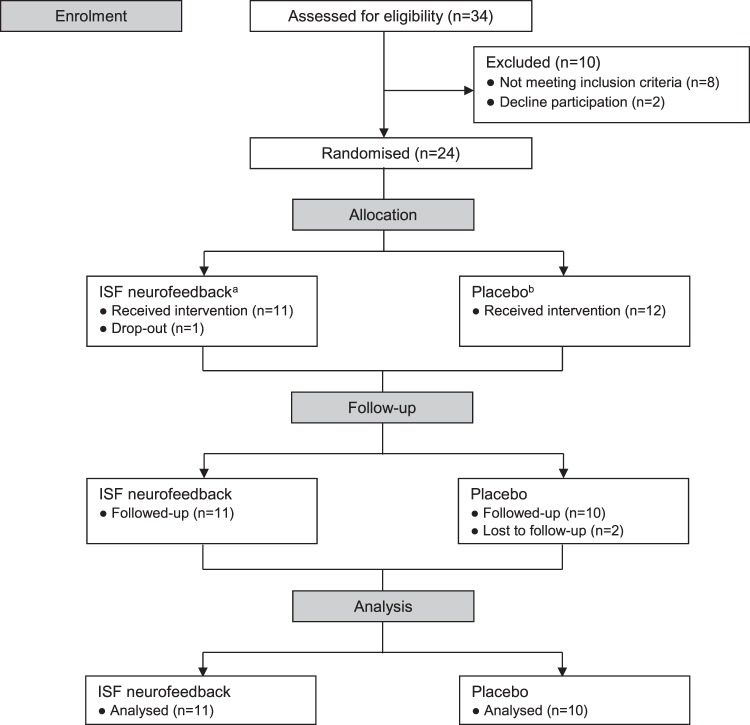
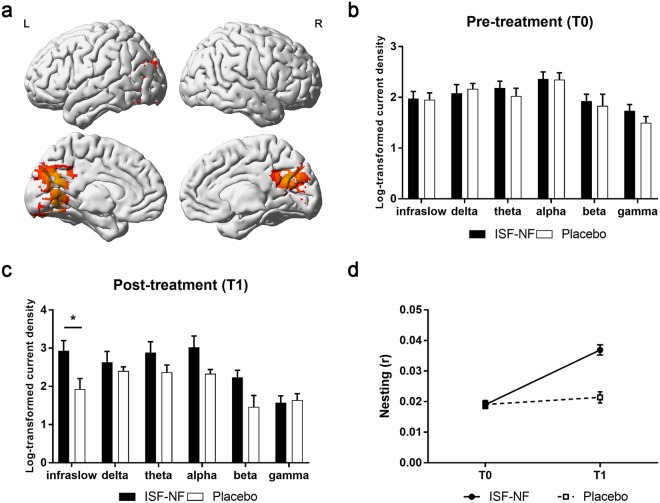
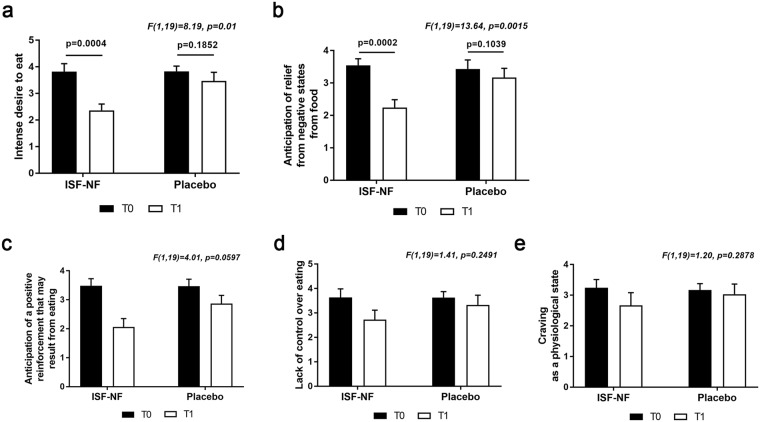
The posterior cingulate cortex (PCC) is involved in food craving in obese food addicted individuals. This randomised, double-blind, placebo-controlled parallel study explored the potential therapeutic effects of infraslow neurofeedback (ISF-NF) on food craving targeting the PCC in obese women with symptoms of food addiction. Participants received six sessions of either ISF-NF (n = 11) or placebo (n = 10) over a three-week period. There were no reported adverse effects. Electrophysiologically, there were significant increases in infraslow activity (p = 0.0002) and infraslow/beta nesting (p < 0.001) in the PCC in the ISF-NF group (mean r = 0.004 ± 0.002) compared to placebo (mean r = 0.02 ± 0.002) two days after the last intervention. Also, there was a significant decrease in different dimensions of state food craving compared to baseline and to placebo. Findings suggest that source localized IFS-NF results in electrophysiological changes and may be associated with reduced food craving. This trial is registered at www.anzctr.org.au, identifier, ACTRN12617000601336. This study was funded by the Otago Medical Research Grant: CT375.
Overview
The claims and statistics of this paper haven’t been checked yet.
Free: it reads the open-access text and checks the first 5 claims that cite a source we can check. Create a free account to check every claim.
Integrity signals
Registry
Cites
Statistics
Figures
Verification
Claims the paper makes
The claims and statistics of this paper haven’t been checked yet.
Free: it reads the open-access text and checks the first 5 claims that cite a source we can check. Create a free account to check every claim.
Claims other papers make about this one
Each is checked against this paper’s own text: does it say what the citing paper says it does?
The source backs part of the claim, not all of it — or backs it for a different population, condition or comparison.
In the citing paper
“Advanced source-localization (i.e. standardized LORETA, sLORETA [62]) combined with ISF-NFB is a novel introduction to the field that has been shown by our research group in a feasibility trial on obese females to improve sleep and wellbeing with minimal side-effects [159, 160].”
From Infraslow closed-loop brain training for anxiety and depression (ISAD): a protocol for a randomized, double-blind, sham-controlled pilot trial in adult females with internalizing disorders (2022) · cites this paper as [159]
Experimental — accuracy not yet measuredThe source backs part of the claim, not all of it — or backs it for a different population, condition or comparison.
In the citing paper
“Our group has previously carried out an sLORETA ISF-NFB trial in obese females [159]; however, this is a different population than the one in our trial and therefore not considered comparable for this study.”
From Infraslow closed-loop brain training for anxiety and depression (ISAD): a protocol for a randomized, double-blind, sham-controlled pilot trial in adult females with internalizing disorders (2022) · cites this paper as [159]
Experimental — accuracy not yet measuredThe cited source says what the claim attributes to it.
In the citing paper
“Based on our lab group’s prior feasibility study using ISF-NFB in an obese female population [159], discontinuation/loss-to-follow-up following randomization is expected to be 10-15%.”
Self-check
Percentages, sums and reported differences re-computed from the paper’s own numbers.
The self-check needs the paper’s full text.
Citations
Cites
The Brain's Default Network: Anatomy, Function, and Relevance to Disease
Buckner, R. L., Andrews‐Hanna, J. R., & Schacter, D. L. (2008) · Annals of the New York Academy of Sciences · doi:10.1196/annals.1440.011 · Cited by 9,761
Nonparametric permutation tests for functional neuroimaging: A primer with examples
Nichols, T. E., & Holmes, A. P. (2002) · Human Brain Mapping · doi:10.1002/hbm.1058 · Cited by 6,256
Reward, dopamine and the control of food intake: implications for obesity
Volkow, N. D., Wang, G.-J., & Baler, R. D. (2011) · Trends in Cognitive Sciences · doi:10.1016/j.tics.2010.11.001 · Cited by 1,400 · cited 3×
“Exclusion criteria included: (1) major weight gain or loss (>5 kgs) in the last 6 months; (2) recent significant head injuries; (3) females who are or intend to become pregnant; (4) co-morbidities associated with obesity (e.”
BackgroundMethodClosed-loop brain training: the science of neurofeedback
Sitaram, R., Ros, T., Stoeckel, L., Haller, S., Scharnowski, F., Lewis-Peacock, J., Weiskopf, N., Blefari, M. L., Rana, M., Oblak, E., et al. (2017) · Nature Reviews Neuroscience · doi:10.1038/nrn.2016.164 · Cited by 1,306
The functional neuroanatomy of autobiographical memory: a meta-analysis
Svoboda, E., McKinnon, M. C., & Levine, B. (2006) · Neuropsychologia · doi:10.1016/j.neuropsychologia.2006.05.023 · Cited by 1,274
Cortical oscillations and sensory predictions
Arnal, L. H., & Giraud, A.-L. (2012) · Trends in Cognitive Sciences · doi:10.1016/j.tics.2012.05.003 · Cited by 1,114
Cue-induced cocaine craving: neuroanatomical specificity for drug users and drug stimuli
Garavan, H., Pankiewicz, J., Bloom, A., Cho, J.-K., Sperry, L., Ross, T. J., Salmeron, B. J., Risinger, R., Kelley, D., & Stein, E. A. (2000) · American Journal of Psychiatry · doi:10.1176/appi.ajp.157.11.1789 · Cited by 931
Development of the Yale Food Addiction Scale Version 2.0
Gearhardt, A. N., Corbin, W. R., & Brownell, K. D. (2016) · Psychology of Addictive Behaviors · doi:10.1037/adb0000136 · Cited by 740 · cited 1×
“, diabetes, obstructive sleep apnoea); (5) centrally active medications; or (5) neurological or psychiatric disorders.”
BackgroundThe development and validation of the state and trait food-cravings questionnaires
Cepeda-Benito, A., Gleaves, D. H., Williams, T. L., & Erath, S. A. (2000) · Behavior Therapy · doi:10.1016/s0005-7894(00)80009-x · Cited by 489
Kühn, S., & Gallinat, J. (2011) · European Journal of Neuroscience · doi:10.1111/j.1460-9568.2010.07590.x · Cited by 472
Cited by
Godet, A., Fortier, A., Bannier, É., Coquery, N., & Val‐Laillet, D. (2022) · Reviews in Endocrine and Metabolic Disorders · doi:10.1007/s11154-021-09700-x · Cited by 84
Twenty Years of the Food Cravings Questionnaires: A Comprehensive Review
Meule, A. (2020) · Current Addiction Reports · doi:10.1007/s40429-020-00294-z · Cited by 62
Imperatori, C., Mancini, M., Della Marca, G., Valenti, E. M., & Farina, B. (2018) · Nutrients · doi:10.3390/nu10111806 · Cited by 43
“, simulation protocol) [65] or an alternative treatment [59] (i.”
InfluentialFood addiction: A transdiagnostic construct of increasing interest
Fernández‐Aranda, F., Karwautz, A. F. K., & Treasure, J. L. (2018) · European Eating Disorders Review · doi:10.1002/erv.2645 · Cited by 53
Unwin, J., Delon, C., Giæver, H., Kennedy, C., Painschab, M., Sandin, F., Poulsen, C. S., & Wiss, D. A. (2022) · Frontiers in Psychiatry · doi:10.3389/fpsyt.2022.1005523 · Cited by 46
“A range of possible interventions for FA symptoms have been proposed including medications (21), cognitive behavioral therapy (22), brain stimulation (23), psychoeducation (24), bariatric surgery (25), low-calorie diets (26), probiotics (27), and “infra slow” brain training (28).”
BackgroundLaboratory‐based interventions targeting food craving: A systematic review and meta‐analysis
Wolz, I., Nannt, J., & Svaldi, J. (2020) · Obesity Reviews · doi:10.1111/obr.12996 · Cited by 37
“(FCQ-S) from pre to post, which was not found in a placebo control condition.(123)”
Adhia, D. B., Mani, R., Mathew, J., O’Leary, F., Smith, M. L., Vanneste, S., & Ridder, D. D. (2023) · Scientific Reports · doi:10.1038/s41598-023-28344-2 · Cited by 29
Self-citationMathew, J., Adhia, D. B., Hall, M. J., Ridder, D. D., & Mani, R. (2023) · Journal of Pain · doi:10.1016/j.jpain.2023.11.012 · Cited by 20
Infra-Low Frequency Neurofeedback: A Systematic Mixed Studies Review
Bazzana, F., Finzi, S., Fini, G. D., & Veglia, F. (2022) · Frontiers in Human Neuroscience · doi:10.3389/fnhum.2022.920659 · Cited by 20
Mathew, J., Adhia, D. B., Smith, M. L., Ridder, D. D., & Mani, R. (2022) · Frontiers in Neuroscience · doi:10.3389/fnins.2022.899772 · Cited by 19
Self-citationBalt, K., Toit, P. D., Smith, M. L., & Rensburg, C. V. (2020) · NeuroRegulation · doi:10.15540/nr.7.2.64 · Cited by 17
“The centrality of the low regime in cortex is emphasized by recent evidence that suggests that these slow oscillations play a role in synchronizing faster activity and modulating cortical excitability (Hiltunen et al., 2014; Leong et al., 2018).”
BackgroundSelf-citationUnwin, J., Delon, C., Giæver, H., Kennedy, C., Painschab, M., Sandin, F., Poulsen, C. S., & Wiss, D. A. (2025) · Frontiers in Psychiatry · doi:10.3389/fpsyt.2025.1556988 · Cited by 15
Mathew, J., Adhia, D. B., Smith, M. L., Ridder, D. D., & Mani, R. (2020) · NeuroRegulation · doi:10.15540/nr.7.1.30 · Cited by 15
“received?’’ at the end of the third training session every week (Leong et al., 2018).”
BackgroundMethodInfluentialSelf-citationBiosensors and Biofeedback in Clinical Psychology
Mancuso, V., Stramba-Badiale, C., Cavedoni, S., & Cipresso, P. (2020) · Elsevier eBooks · doi:10.1016/b978-0-12-818697-8.00002-9 · Cited by 15
Schmidt, J., & Martin, A. (2020) · Applied Psychophysiology and Biofeedback · doi:10.1007/s10484-020-09486-9 · Cited by 12
Perez, T. M., Glue, P., Adhia, D. B., Navid, M. S., Zeng, J., Dillingham, P., Smith, M., Niazi, I. K., Young, C. K., & De Ridder, D. (2022) · Trials · doi:10.1186/s13063-022-06863-z · Cited by 8
“standardized LORETA, sLORETA [62]) combined with ISF-NFB is a novel introduction to the field that has been shown by our research group in a feasibility trial on obese females to improve sleep and wellbeing with minimal side-effects [159, 160].”
MethodResultSelf-citationFathi, M., Ebrahimi, M. N., Banazadeh, M., Shirvani, A., Kamalahmadi, N., Amiri, H., & Talaeı, A. (2025) · Psychiatry Research · doi:10.1016/j.psychres.2025.116474 · Cited by 8
Infralow neurofeedback in the treatment of substance use disorders: a randomized controlled trial
Gabrielsen, K. B., Clausen, T., Haugland, S. H., Hollup, S., & Vederhus, J. (2022) · Journal of Psychiatry and Neuroscience · doi:10.1503/jpn.210202 · Cited by 8
Bennett, E., Lycett, D., Whelan, M., Bellamy, E. L., Banks, S., & Patel, R. (2025) · Frontiers in Psychiatry · doi:10.3389/fpsyt.2025.1620372 · Cited by 7
Wimmer, J., Rösch, S. A., Schmidt, R., & Hilbert, A. (2023) · Frontiers in Human Neuroscience · doi:10.3389/fnhum.2023.1234085 · Cited by 6
Mathew, J., Adhia, D. B., Smith, M. L., Ridder, D. D., & Mani, R. (2024) · Clinical EEG and Neuroscience · doi:10.1177/15500594241264892 · Cited by 6
“130 – 133 eLORETA statistical contrast maps 67,134 : eLORETA was used to generate voxel-based brain contrast maps of the cortical brain sources and frequency bands that are signi fi - cantly different between the two groups using the highest threshold (Thresh) with P .05.”
InfluentialSelf-citationPostsession Dreaming in Neurofeedback as an Indication of Nondeclarative Learning
Yonah, R. (2020) · NeuroRegulation · doi:10.15540/nr.7.1.2 · Cited by 5
“A survey of existing literature reveals that increased dreaming occurred also with the alpha/theta protocol (Gruzelier, 2009; Johnson, 2011), with infra-slow neurofeedback (Leong et al., 2018a) and more.”
BackgroundThe Effect of Infra-Slow Fluctuation Neurofeedback Training on a Cohort of Insomnia Participants
Bekker, M., Balt, K., Bipath, P., Jordaan, J., & Toit, P. D. (2021) · NeuroRegulation · doi:10.15540/nr.8.3.137 · Cited by 8
Davranışsal Bağımlılıklara Yönelik Müdahalelere İlişkin Bir Derleme
KARAHAN, A. S. (2023) · Ayna Klinik Psikoloji Dergisi · doi:10.31682/ayna.1152083 · Cited by 6
Mathew, J., Galacgac, J., Smith, M. L., Du, P., & Çakmak, Y. Ö. (2025) · Neurogastroenterology & Motility · doi:10.1111/nmo.15009 · Cited by 7
“The software is widely used in EEG studies for blind source separation and artifact rejection [74, 76, 77, 82–84].”
Self-citationMeditation-type specific reduction in infra-slow activity of electroencephalogram
Sihn, D., Kim, J., & Kim, S.-P. (2024) · Biomedical Engineering Letters · doi:10.1007/s13534-024-00377-0 · Cited by 4
Theis, T., Bolduan, U., Seuß, S., Spallek, J., Wandernoth, B., & Mayer-Pelinski, R. (2025) · Frontiers in Human Neuroscience · doi:10.3389/fnhum.2025.1601187 · Cited by 3
Li, G., Hu, Y., Zhang, W., Wang, J., Sun, L., Yu, J., Manza, P., Volkow, N. D., Ji, G., Wang, G., et al. (2024) · JCI Insight · doi:10.1172/jci.insight.175967 · Cited by 8
“…neurofeedback study targeting the PCC showed that increased activity in PCC can result in suppression of food craving in individuals with overweight or obesity, suggesting that increased interoceptive awareness after neurofeedback may have improved processing of internal appetite signals (33).”
BackgroundMathew, J., Adhia, D. B., Smith, M. L., Ridder, D. J. M. K. D., & Mani, R. (2025) · Brain and Behavior · doi:10.1002/brb3.70541 · Cited by 3
Self-citationBialostocki, L. S., Adhia, D. B., Mudiyanselage, D. R., Smith, M. L., Çakmak, Y. Ö., Ridder, D. D., Mani, R., & Mathew, J. (2025) · JMIR Research Protocols · doi:10.2196/78806 · Cited by 3
“EEG-NF has been used successfully in several conditions, including chronic MSK pain, demonstrating clinical and EEG modulation [49-52].”
InfluentialSelf-citationSchmidt, C. (2024) · Journal of Psychiatric Research · doi:10.1016/j.jpsychires.2024.04.035 · Cited by 2
Eplerian Philosophy for a New Way of Life for Health, Vitality, and Happiness
Epler, G. (2020) · Open Journal of Philosophy · doi:10.4236/ojpp.2020.102013 · Cited by 2
“Brain science has shown many different independent brain regions (Hou et al., 2020; Kral et al., 2019; Le et al., 2019; Wang et al., 2019; Leong et al., 2018; Zhang et al., 2018; Oei et al., 2018) and people can only think from one brain region at a time.”
BackgroundMani, R., Adhia, D. B., Awatere, S., Gray, A. R., Mathew, J., Wilson, L. C., Still, A., Jackson, D., Hudson, B., Zeidan, F. Z., et al. (2024) · Frontiers in Pain Research · doi:10.3389/fpain.2023.1271839 · Cited by 5
Pryer, T. A., Mathew, J., Khwaounjoo, P., & Çakmak, Y. Ö. (2025) · Neuromodulation Technology at the Neural Interface · doi:10.1016/j.neurom.2025.08.411 · Cited by 2
Wu, Y., Deng, F., Bai, M., Zhang, G., Li, Z., Wen, M., Zhang, J., Li, R., Shi, Y., Lu, L., et al. (2026) · Nutrition & Metabolism · doi:10.1186/s12986-026-01081-9 · Cited by 1
Neuroeconomics: An overview and applications to agricultural and food economics
Palma, M. A. (2022) · Handbook of agricultural economics · doi:10.1016/bs.hesagr.2022.03.007 · Cited by 4
Karl, M., Göke, H. L., Kowalski, A., Dörrie, N., Skoda, E., Bäuerle, A., Teufel, M., & Schmidt, K. (2025) · Psychiatry International · doi:10.3390/psychiatryint6010028 · Cited by 1
“Although many studies suggest the efficacy of NFB, results should be viewed with caution since sample sizes were small [34,40] and many studies did not investigate con-trol groups [41,42] and long-term effects.”
Perez, T. M., Adhia, D. B., Glue, P., Zeng, J., Dillingham, P. W., Navid, M. S., Niazi, I. K., Young, C. K., Smith, M. L., & Ridder, D. J. M. K. D. (2025) · Cognitive Affective & Behavioral Neuroscience · doi:10.3758/s13415-025-01279-z · Cited by 4
“In addition, we found evidence that ISF-NFB may modulate frequencies above ISFs within the targeted ROIs (Sook Ling Leong et al., 2018a, 2018b).”
InfluentialSelf-citationNeuere Ansätze im Neurofeedbacktraining
Haus, K.-M., Held, C., Kowalski, A., Krombholz, A., Nowak, M., Schneider, E. M., Strauß, G., & Wiedemann, M. (2020) · Springer eBooks · doi:10.1007/978-3-662-59720-0_6 · Cited by 1
Smith, M. L. (2019) · Elsevier eBooks · doi:10.1016/b978-0-12-817659-7.00047-6
Self-citationProceedings of the 2021 ISNR Annual Conference (Virtual): Keynote and Plenary Presentations
International Society of NeuroRegulation and Research (2021) · NeuroRegulation · doi:10.15540/nr.8.4.198
Proceedings of the 2020 ISNR Annual Conference: Keynote and Plenary Sessions
International Society of Neurofeedback and Research (2020) · NeuroRegulation · doi:10.15540/nr.7.4.158 · Cited by 1
Collins, R. A., Skinner, J. A., Leary, M., & Burrows, T. L. (2024) · Journal of Human Nutrition and Dietetics · doi:10.1111/jhn.13300 · Cited by 1
Proceedings of the 2024 ISNR Annual Conference: Keynote and Plenary Presentations
International Society of Neuroregulation and Research (ISNR) (2024) · NeuroRegulation · doi:10.15540/nr.11.4.394
Chen, J. F., Changchien, T.-C., Fang, Y.-Y., Yeh, W., Tseng, P., Hsu, T.-W., & Liang, C.-S. (2026) · Psychiatry Research · doi:10.1016/j.psychres.2026.116979
EEG neurofeedback for children with overweight and obesity: A proof-of-concept study
Hahn, U., Hübner, C., Hilbert, A., & Schmidt, R. (2026) · Brain Research · doi:10.1016/j.brainres.2026.150554
Metadata
- Authors
- Leong, S. L., Vanneste, S., Lim, J., Smith, M., Manning, P., & De Ridder, D.
- Affiliations
- University of Otago (NZ)
- The University of Texas at Dallas (US)
- Corresponding author
- Leong, Sook Ling
- Venue
- Scientific Reports
- Published
- 2018-08-03
- Volume
- 8
- Issue
- 1
- Pages
- 11659-11659
- ISSN
- 2045-2322 (ISSN-L)
- PMC
- PMC6076277
- OpenAlex
- W2885442967
- Semantic Scholar
- f3235becdd7a1339f4cbd4ce18b2a2be18f68f9c
- Cited by
- 46
- References
- 46
- Citations by year
- 2026: 3 · 2025: 10 · 2024: 7 · 2023: 4 · 2022: 7 · 2021: 2 · 2020: 10 · 2019: 1 · 2018: 2
- FWCI
- 4.41
- Type
- journal article
- Language
- en
- Open access
- gold
- doi.org
- Licence
- cc-by
- creativecommons.org/licenses/by/4.0 (tdm)
- creativecommons.org/licenses/by/4.0 (vor)
- Locations
- Scientific Reports (publishedVersion, cc-by)
- Europe PMC (PubMed Central) (publishedVersion, other-oa)
- PubMed Central (publishedVersion, cc-by)
- PubMed (publishedVersion)
- DOAJ (DOAJ: Directory of Open Access Journals) (submittedVersion)
- Funders
- Otago Medical Research Foundation (CT375)
- Topics
- Social Sciences › Psychology › Clinical Psychology › Eating Disorders and Behaviors
- Life Sciences › Neuroscience › Cognitive Neuroscience › EEG and Brain-Computer Interfaces
- Life Sciences › Neuroscience › Cognitive Neuroscience › Neural and Behavioral Psychology Studies
- Keywords
- food addiction, food cravings, posterior cingulate cortex, obesity, closed-loop neurofeedback, source localization, women
- MeSH terms
- Food Addiction, Adolescent, Adult, Brain, Double-Blind Method, Female, Gyrus Cinguli, Humans, Male, Middle Aged, Placebos, Young Adult, Neurofeedback, Craving
About these checks
Registry, retraction, Cites and statistics results are computed, not judged, with one exception: a printed reference that no index lists is read once by a model before it counts as a citation error. Claims are extracted by a model and kept only when their quote appears verbatim in the text; each cited source is then checked, with a model’s help, for whether it says what the claim relies on. Those verdicts can be wrong — read the claim’s quote and the cited source before relying on one.
Statistics and arithmetic are recomputed, not judged.
Confidence bands are shown only for fields calibrated on our annotated test set. None is calibrated yet, so no band is shown.
What counts as a claim ›How we measure confidence ›How we check this ›
Are you an author, or do you see a problem with this page? Request a review
Data sources
Bibliographic data: Semantic Scholar, OpenAlex, Crossref.
Contains information from the Semantic Scholar Academic Graph Datasets, made available under the ODC Attribution License (ODC-BY 1.0).
Semantic Scholar’s data is described in: Kinney, R., et al. (2023). The Semantic Scholar Open Data Platform. arXiv:2301.10140.
