

A randomised, double-blind, placebo-controlled parallel trial of closed-loop infraslow brain training in food addiction
Open accessThe DOI matches its Crossref record; 46 of the 46 references it cites were found in a registry or an index.
Abstract
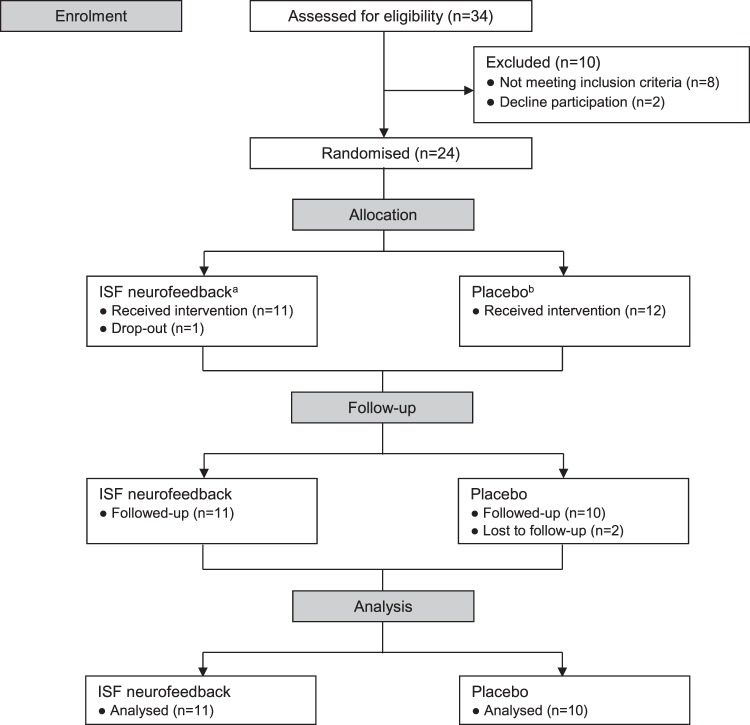
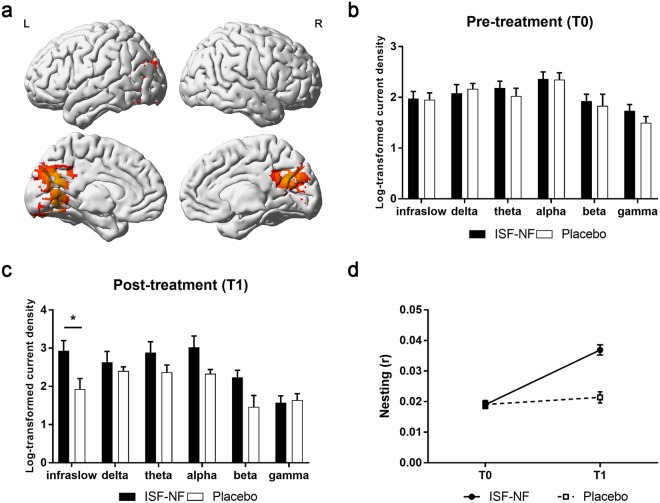
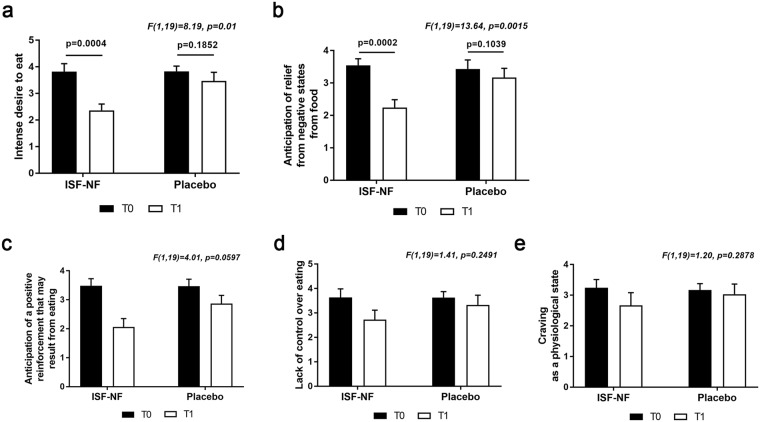
The posterior cingulate cortex (PCC) is involved in food craving in obese food addicted individuals. This randomised, double-blind, placebo-controlled parallel study explored the potential therapeutic effects of infraslow neurofeedback (ISF-NF) on food craving targeting the PCC in obese women with symptoms of food addiction. Participants received six sessions of either ISF-NF (n = 11) or placebo (n = 10) over a three-week period. There were no reported adverse effects. Electrophysiologically, there were significant increases in infraslow activity (p = 0.0002) and infraslow/beta nesting (p < 0.001) in the PCC in the ISF-NF group (mean r = 0.004 ± 0.002) compared to placebo (mean r = 0.02 ± 0.002) two days after the last intervention. Also, there was a significant decrease in different dimensions of state food craving compared to baseline and to placebo. Findings suggest that source localized IFS-NF results in electrophysiological changes and may be associated with reduced food craving. This trial is registered at www.anzctr.org.au, identifier, ACTRN12617000601336. This study was funded by the Otago Medical Research Grant: CT375.
Overview
The claims and statistics of this paper haven’t been checked yet.
Free: it reads the open-access text and checks the first 5 claims that cite a source we can check. Create a free account to check every claim.
Integrity signals
Registry
Cites
Statistics
Figures
Verification
Claims the paper makes
The claims and statistics of this paper haven’t been checked yet.
Free: it reads the open-access text and checks the first 5 claims that cite a source we can check. Create a free account to check every claim.
Claims other papers make about this one
Each is checked against this paper’s own text: does it say what the citing paper says it does?
The source backs part of the claim, not all of it — or backs it for a different population, condition or comparison.
In the citing paper
“Advanced source-localization (i.e. standardized LORETA, sLORETA [62]) combined with ISF-NFB is a novel introduction to the field that has been shown by our research group in a feasibility trial on obese females to improve sleep and wellbeing with minimal side-effects [159, 160].”
From Infraslow closed-loop brain training for anxiety and depression (ISAD): a protocol for a randomized, double-blind, sham-controlled pilot trial in adult females with internalizing disorders (2022) · cites this paper as [159]
Experimental — accuracy not yet measuredThe source backs part of the claim, not all of it — or backs it for a different population, condition or comparison.
In the citing paper
“Our group has previously carried out an sLORETA ISF-NFB trial in obese females [159]; however, this is a different population than the one in our trial and therefore not considered comparable for this study.”
From Infraslow closed-loop brain training for anxiety and depression (ISAD): a protocol for a randomized, double-blind, sham-controlled pilot trial in adult females with internalizing disorders (2022) · cites this paper as [159]
Experimental — accuracy not yet measuredThe cited source says what the claim attributes to it.
In the citing paper
“Based on our lab group’s prior feasibility study using ISF-NFB in an obese female population [159], discontinuation/loss-to-follow-up following randomization is expected to be 10-15%.”
Self-check
Percentages, sums and reported differences re-computed from the paper’s own numbers.
The self-check needs the paper’s full text.
Citations
Cites
The Brain's Default Network: Anatomy, Function, and Relevance to Disease
Buckner, R. L., Andrews‐Hanna, J. R., & Schacter, D. L. (2008) · Annals of the New York Academy of Sciences · doi:10.1196/annals.1440.011 · Cited by 9,761
Nonparametric permutation tests for functional neuroimaging: A primer with examples
Nichols, T. E., & Holmes, A. P. (2002) · Human Brain Mapping · doi:10.1002/hbm.1058 · Cited by 6,256
Reward, dopamine and the control of food intake: implications for obesity
Volkow, N. D., Wang, G.-J., & Baler, R. D. (2011) · Trends in Cognitive Sciences · doi:10.1016/j.tics.2010.11.001 · Cited by 1,400 · cited 3×
“Exclusion criteria included: (1) major weight gain or loss (>5 kgs) in the last 6 months; (2) recent significant head injuries; (3) females who are or intend to become pregnant; (4) co-morbidities associated with obesity (e.”
BackgroundMethodClosed-loop brain training: the science of neurofeedback
Sitaram, R., Ros, T., Stoeckel, L., Haller, S., Scharnowski, F., Lewis-Peacock, J., Weiskopf, N., Blefari, M. L., Rana, M., Oblak, E., et al. (2017) · Nature Reviews Neuroscience · doi:10.1038/nrn.2016.164 · Cited by 1,306
The functional neuroanatomy of autobiographical memory: a meta-analysis
Svoboda, E., McKinnon, M. C., & Levine, B. (2006) · Neuropsychologia · doi:10.1016/j.neuropsychologia.2006.05.023 · Cited by 1,274
Cortical oscillations and sensory predictions
Arnal, L. H., & Giraud, A.-L. (2012) · Trends in Cognitive Sciences · doi:10.1016/j.tics.2012.05.003 · Cited by 1,114
Cue-induced cocaine craving: neuroanatomical specificity for drug users and drug stimuli
Garavan, H., Pankiewicz, J., Bloom, A., Cho, J.-K., Sperry, L., Ross, T. J., Salmeron, B. J., Risinger, R., Kelley, D., & Stein, E. A. (2000) · American Journal of Psychiatry · doi:10.1176/appi.ajp.157.11.1789 · Cited by 931
Development of the Yale Food Addiction Scale Version 2.0
Gearhardt, A. N., Corbin, W. R., & Brownell, K. D. (2016) · Psychology of Addictive Behaviors · doi:10.1037/adb0000136 · Cited by 740 · cited 1×
“, diabetes, obstructive sleep apnoea); (5) centrally active medications; or (5) neurological or psychiatric disorders.”
BackgroundThe development and validation of the state and trait food-cravings questionnaires
Cepeda-Benito, A., Gleaves, D. H., Williams, T. L., & Erath, S. A. (2000) · Behavior Therapy · doi:10.1016/s0005-7894(00)80009-x · Cited by 489
Kühn, S., & Gallinat, J. (2011) · European Journal of Neuroscience · doi:10.1111/j.1460-9568.2010.07590.x · Cited by 472
Transitions in neural oscillations reflect prediction errors generated in audiovisual speech
Arnal, L. H., Wyart, V., & Giraud, A.-L. (2011) · Nature Neuroscience · doi:10.1038/nn.2810 · Cited by 353
Gender differences in brain functional connectivity density
Tomasi, D., & Volkow, N. D. (2012) · Human Brain Mapping · doi:10.1002/hbm.21252 · Cited by 282
Cepeda-Benito, A., Gleaves, D. H., Fernández, M. C., Vila, J., Williams, T. L., & Reynoso, J. (2000) · Behaviour Research and Therapy · doi:10.1016/s0005-7967(99)00141-2 · Cited by 280
Neurofeedback and Basic Learning Theory: Implications for Research and Practice
Sherlin, L. H., Arns, M., Lubar, J., Heinrich, H., Kerson, C., Strehl, U., & Sterman, M. B. (2011) · Journal of Neurotherapy · doi:10.1080/10874208.2011.623089 · Cited by 248
Infraslow LFP correlates to resting-state fMRI BOLD signals
Pan, W.-J., Thompson, G. J., Magnuson, M. E., Jaeger, D., & Keilholz, S. (2013) · NeuroImage · doi:10.1016/j.neuroimage.2013.02.035 · Cited by 231
Desire: The New Hot Spot in Self-Control Research
Hofmann, W., & Van Dillen, L. (2012) · Current Directions in Psychological Science · doi:10.1177/0963721412453587 · Cited by 197
Real-time fMRI brain computer interfaces: Self-regulation of single brain regions to networks
Ruiz, S., Buyukturkoglu, K., Rana, M., Birbaumer, N., & Sitaram, R. (2014) · Biological Psychology · doi:10.1016/j.biopsycho.2013.04.010 · Cited by 187
Vanneste, S., van de Heyning, P., & De Ridder, D. (2011) · European Journal of Neuroscience · doi:10.1111/j.1460-9568.2011.07793.x · Cited by 171
Self-citationFood addiction A common neurobiological mechanism with drug abuse
Wang, G.-J. (2018) · Frontiers in Bioscience · doi:10.2741/4618 · Cited by 163 · cited 3×
“Exclusion criteria included: (1) major weight gain or loss (>5 kgs) in the last 6 months; (2) recent significant head injuries; (3) females who are or intend to become pregnant; (4) co-morbidities associated with obesity (e.”
BackgroundMethodThompson, G. J., Pan, W.-J., Magnuson, M. E., Jaeger, D., & Keilholz, S. D. (2014) · NeuroImage · doi:10.1016/j.neuroimage.2013.09.029 · Cited by 158
Yokum, S., & Stice, E. (2013) · International Journal of Obesity · doi:10.1038/ijo.2013.39 · Cited by 149
The Distressed Brain: A Group Blind Source Separation Analysis on Tinnitus
De Ridder, D., Vanneste, S., & Congedo, M. (2011) · PLoS ONE · doi:10.1371/journal.pone.0024273 · Cited by 145
Self-citationLow-resolution electromagnetic tomography neurofeedback
Congedo, M., Lubar, J. F., & Joffe, D. (2004) · IEEE Transactions on Neural Systems and Rehabilitation Engineering · doi:10.1109/tnsre.2004.840492 · Cited by 139 · cited 4×
“A repeated measures ANOVA reveals significant main effects for two of the five FCQ-S subscales, a) intense desire to eat, F(1,19) = 23, p = 0.”
BackgroundMethodInfluentialThe neural correlates of the unified percept of alcohol-related craving: a fMRI and EEG study
Huang, Y., Mohan, A., De Ridder, D., Sunaert, S., & Vanneste, S. (2018) · Scientific Reports · doi:10.1038/s41598-017-18471-y · Cited by 91 · cited 1×
“Repeated measures MANOVA showed there was a significant main difference between ISF-NF and placebo on the different frequency bands over time, F(6, 14) = 3.”
MethodSelf-citationLattimore, P. J., Mead, B. R., Irwin, L., Grice, L., Carson, R., & Malinowski, P. (2016) · Psychiatry Research · doi:10.1016/j.psychres.2016.11.022 · Cited by 88
Cingulate cortex functional connectivity predicts future relapse in alcohol dependent individuals
Zakiniaeiz, Y., Scheinost, D., Seo, D., Sinha, R., & Constable, R. T. (2017) · NeuroImage: Clinical · doi:10.1016/j.nicl.2016.10.019 · Cited by 82
Cannon, R., Congedo, M., Lubar, J., & Hutchens, T. (2009) · International Journal of Neuroscience · doi:10.1080/00207450802480325 · Cited by 74
Infraslow Electroencephalographic and Dynamic Resting State Network Activity
Grooms, J. K., Thompson, G. J., Pan, W.-J., Billings, J., Schumacher, E. H., Epstein, C. M., & Keilholz, S. D. (2017) · Brain Connectivity · doi:10.1089/brain.2017.0492 · Cited by 74
Beyer, F., Kharabian Masouleh, S., Huntenburg, J. M., Lampe, L., Luck, T., Riedel‐Heller, S. G., Loeffler, M., Schroeter, M. L., Stumvoll, M., Villringer, A., et al. (2017) · Human Brain Mapping · doi:10.1002/hbm.23605 · Cited by 71
Estradiol, SHBG and leptin interplay with food craving and intake across the menstrual cycle
Krishnan, S., Tryon, R. R., Horn, W. F., Welch, L., & Keim, N. L. (2016) · Physiology & Behavior · doi:10.1016/j.physbeh.2016.08.010 · Cited by 60
The brain, obesity and addiction: an EEG neuroimaging study
De Ridder, D., Manning, P., Leong, S. L., Ross, S., Sutherland, W., Horwath, C., & Vanneste, S. (2016) · Scientific Reports · doi:10.1038/srep34122 · Cited by 60 · cited 1×
“Repeated measures MANOVA showed there was a significant main difference between ISF-NF and placebo on the different frequency bands over time, F(6, 14) = 3.”
MethodSelf-citationFunctional connectivity arises from a slow rhythmic mechanism
Li, J. M., Bentley, W. J., & Snyder, L. H. (2015) · Proceedings of the National Academy of Sciences · doi:10.1073/pnas.1419837112 · Cited by 53
Deco, G., van Hartevelt, T. J., Fernandes, H. M., Stevner, A. B. A., & Kringelbach, M. L. (2016) · NeuroImage · doi:10.1016/j.neuroimage.2016.10.047 · Cited by 50
Food Addiction and Neuroimaging
Zhang, Y., M. von Deneen, K., Tian, J., S. Gold, M., & Liu, Y. (2011) · Current Pharmaceutical Design · doi:10.2174/138161211795656855 · Cited by 46 · cited 4×
“Exclusion criteria included: (1) major weight gain or loss (>5 kgs) in the last 6 months; (2) recent significant head injuries; (3) females who are or intend to become pregnant; (4) co-morbidities associated with obesity (e.”
BackgroundMethodInfluentialVanneste, S., Joos, K., Ost, J., & De Ridder, D. (2018) · Neurobiology of Stress · doi:10.1016/j.ynstr.2016.11.003 · Cited by 45
Self-citationMeule, A., Teran, C. B., Berker, J., Gründel, T., Mayerhofer, M., & Platte, P. (2014) · Journal of Eating Disorders · doi:10.1186/s40337-014-0025-z · Cited by 42
EEG neurofeedback effects in the treatment of adolescent anorexia nervosa
Lackner, N., Unterrainer, H.-F., Skliris, D., Shaheen, S., Dunitz-Scheer, M., Wood, G., Scheer, P. J. Z., Wallner-Liebmann, S. J., & Neuper, C. (2016) · Eating Disorders · doi:10.1080/10640266.2016.1160705 · Cited by 38
Gade, H., Rosenvinge, J. H., Hjelmesaeth, J. S., & Friborg, O. (2014) · Obesity Facts · doi:10.1159/000362257 · Cited by 36
EEG Biofeedback for Addictive Disorders—The State of the Art in 2004
Trudeau, D. L. (2005) · Journal of Adult Development · doi:10.1007/s10804-005-7030-z · Cited by 34
Disruption of cigarette smoking addiction after posterior cingulate damage: Case report
Jarraya, B., Brugières, P., Tani, N., Hodel, J., Grandjacques, B., Fénelon, G., Decq, P., & Palfi, S. (2010) · Journal of Neurosurgery · doi:10.3171/2010.6.jns10346 · Cited by 33
Neural Circuitry of Impulsivity in a Cigarette Craving Paradigm
Bourque, J., Mendrek, A., Dinh-Williams, L., & Potvin, S. (2013) · Frontiers in Psychiatry · doi:10.3389/fpsyt.2013.00067 · Cited by 32
Imperatori, C., Valenti, E. M., Della Marca, G., Amoroso, N., Massullo, C., Carbone, G. A., Maestoso, G., Quintiliani, M. I., Contardi, A., & Farina, B. (2017) · International Journal of Psychophysiology · doi:10.1016/j.ijpsycho.2016.11.010 · Cited by 29
Infra-slow Fluctuation Training in Clinical Practice: A Technical History
Smith, M. L., Collura, T. F., Ferrera, J., & Vries, J. D. (2014) · NeuroRegulation · doi:10.15540/nr.1.2.187 · Cited by 24
Self-citationAllostasis in health and food addiction
Ridder, D. D., Manning, P. J., Leong, S. L., Ross, S., & Vanneste, S. (2016) · Scientific Reports · doi:10.1038/srep37126 · Cited by 22
Self-citationLeong, S. L., De Ridder, D., Vanneste, S., Sutherland, W., Ross, S., & Manning, P. (2018) · Appetite · doi:10.1016/j.appet.2017.10.034 · Cited by 22
Meule, A., Teran, C. B., Berker, J., Gründel, T., Mayerhofer, M., & Platte, P. (2014) · Journal of Eating Disorders · doi:10.1186/s40337-014-0033-z · Cited by 8
Cited by
Godet, A., Fortier, A., Bannier, É., Coquery, N., & Val‐Laillet, D. (2022) · Reviews in Endocrine and Metabolic Disorders · doi:10.1007/s11154-021-09700-x · Cited by 84
Twenty Years of the Food Cravings Questionnaires: A Comprehensive Review
Meule, A. (2020) · Current Addiction Reports · doi:10.1007/s40429-020-00294-z · Cited by 62
Imperatori, C., Mancini, M., Della Marca, G., Valenti, E. M., & Farina, B. (2018) · Nutrients · doi:10.3390/nu10111806 · Cited by 43
“, simulation protocol) [65] or an alternative treatment [59] (i.”
InfluentialFood addiction: A transdiagnostic construct of increasing interest
Fernández‐Aranda, F., Karwautz, A. F. K., & Treasure, J. L. (2018) · European Eating Disorders Review · doi:10.1002/erv.2645 · Cited by 53
Unwin, J., Delon, C., Giæver, H., Kennedy, C., Painschab, M., Sandin, F., Poulsen, C. S., & Wiss, D. A. (2022) · Frontiers in Psychiatry · doi:10.3389/fpsyt.2022.1005523 · Cited by 46
“A range of possible interventions for FA symptoms have been proposed including medications (21), cognitive behavioral therapy (22), brain stimulation (23), psychoeducation (24), bariatric surgery (25), low-calorie diets (26), probiotics (27), and “infra slow” brain training (28).”
Background
Metadata
- Authors
- Leong, S. L., Vanneste, S., Lim, J., Smith, M., Manning, P., & De Ridder, D.
- Affiliations
- University of Otago (NZ)
- The University of Texas at Dallas (US)
- Corresponding author
- Leong, Sook Ling
- Venue
- Scientific Reports
- Published
- 2018-08-03
- Volume
- 8
- Issue
- 1
- Pages
- 11659-11659
- ISSN
- 2045-2322 (ISSN-L)
- PMC
- PMC6076277
- OpenAlex
- W2885442967
- Semantic Scholar
- f3235becdd7a1339f4cbd4ce18b2a2be18f68f9c
- Cited by
- 46
- References
- 46
- Citations by year
- 2026: 3 · 2025: 10 · 2024: 7 · 2023: 4 · 2022: 7 · 2021: 2 · 2020: 10 · 2019: 1 · 2018: 2
- FWCI
- 4.41
- Type
- journal article
- Language
- en
- Open access
- gold
- doi.org
- Licence
- cc-by
- creativecommons.org/licenses/by/4.0 (tdm)
- creativecommons.org/licenses/by/4.0 (vor)
- Locations
- Scientific Reports (publishedVersion, cc-by)
- Europe PMC (PubMed Central) (publishedVersion, other-oa)
- PubMed Central (publishedVersion, cc-by)
- PubMed (publishedVersion)
- DOAJ (DOAJ: Directory of Open Access Journals) (submittedVersion)
- Funders
- Otago Medical Research Foundation (CT375)
- Topics
- Social Sciences › Psychology › Clinical Psychology › Eating Disorders and Behaviors
- Life Sciences › Neuroscience › Cognitive Neuroscience › EEG and Brain-Computer Interfaces
- Life Sciences › Neuroscience › Cognitive Neuroscience › Neural and Behavioral Psychology Studies
- Keywords
- food addiction, food cravings, posterior cingulate cortex, obesity, closed-loop neurofeedback, source localization, women
- MeSH terms
- Food Addiction, Adolescent, Adult, Brain, Double-Blind Method, Female, Gyrus Cinguli, Humans, Male, Middle Aged, Placebos, Young Adult, Neurofeedback, Craving
About these checks
Registry, retraction, Cites and statistics results are computed, not judged, with one exception: a printed reference that no index lists is read once by a model before it counts as a citation error. Claims are extracted by a model and kept only when their quote appears verbatim in the text; each cited source is then checked, with a model’s help, for whether it says what the claim relies on. Those verdicts can be wrong — read the claim’s quote and the cited source before relying on one.
Statistics and arithmetic are recomputed, not judged.
Confidence bands are shown only for fields calibrated on our annotated test set. None is calibrated yet, so no band is shown.
What counts as a claim ›How we measure confidence ›How we check this ›
Are you an author, or do you see a problem with this page? Request a review
Data sources
Bibliographic data: Semantic Scholar, OpenAlex, Crossref.
Contains information from the Semantic Scholar Academic Graph Datasets, made available under the ODC Attribution License (ODC-BY 1.0).
Semantic Scholar’s data is described in: Kinney, R., et al. (2023). The Semantic Scholar Open Data Platform. arXiv:2301.10140.
