

Klebsiella oxytoca expands in cancer cachexia and acts as a gut pathobiont contributing to intestinal dysfunction
Open accessThe DOI matches its Crossref record; 50 of the 50 references it cites were found in a registry or an index.
Abstract
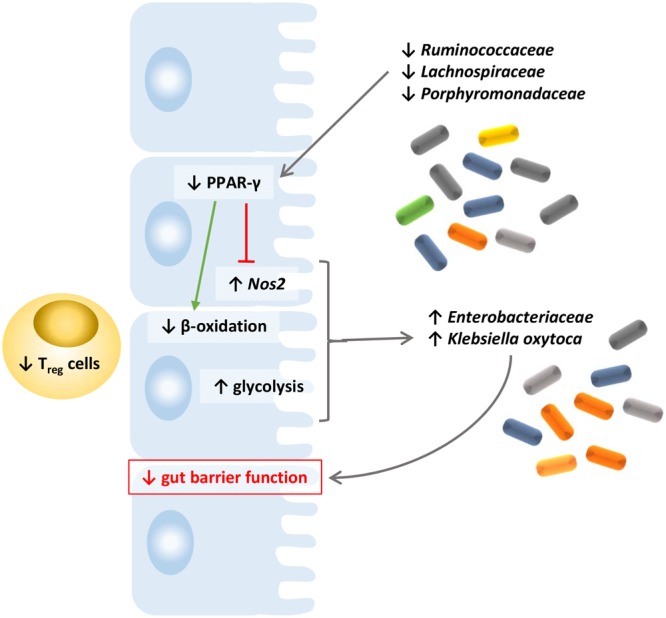
Cancer cachexia is a complex multi-organ syndrome characterized by body weight loss, weakness, muscle atrophy and fat depletion. With a prevalence of 1 million people in Europe and only limited therapeutic options, there is a high medical need for new approaches to treat cachexia. Our latest results highlighted microbial dysbiosis, characterized by a bloom in Enterobacteriaceae and altered gut barrier function in preclinical models of cancer cachexia. They also demonstrated the potential of targeting the gut microbial dysbiosis in this pathology. However, the exact mechanisms underlying the gut microbiota-host crosstalk in cancer cachexia remain elusive. In this set of studies, we identified Klebsiella oxytoca as one of the main Enterobacteriaceae species increased in cancer cachexia and we demonstrated that this bacteria acts as a gut pathobiont by altering gut barrier function in cachectic mice. Moreover, we propose a conceptual framework for the lower colonization resistance to K . oxytoca in cancer cachexia that involves altered host gut epithelial metabolism and host-derived nitrate boosting the growth of the gut pathobiont. This set of studies constitutes a strong progression in the field of gut microbiota in cancer cachexia, by dissecting the mechanism of emergence of one bacterium, K . oxytoca , and establishing its role as a gut pathobiont in this severe disease.
Overview
The claims and statistics of this paper haven’t been checked yet.
Free: it reads the open-access text and checks the first 5 claims that cite a source we can check. Create a free account to check every claim.
Integrity signals
Registry
Cites
Statistics
Figures
Verification
Claims the paper makes
The claims and statistics of this paper haven’t been checked yet.
Free: it reads the open-access text and checks the first 5 claims that cite a source we can check. Create a free account to check every claim.
Claims other papers make about this one
Each is checked against this paper’s own text: does it say what the citing paper says it does?
In the citing paper
“Murine models of cancer cachexia show a dysbiosis characterized by expansion of Enterobacteriaceae112 such as Klebsiella oxytoca, a gut pathobiont whose growth follows the depletion of butyrate-producing taxa.113”
From Gut dysbiosis in oncology: a risk factor for immunoresistance (2026) · doi:10.1038/s41422-025-01212-6 · cites this paper as [113]
Self-check
Percentages, sums and reported differences re-computed from the paper’s own numbers.
The self-check needs the paper’s full text.
Citations
Cites
Controlling the False Discovery Rate: A Practical and Powerful Approach to Multiple Testing
Benjamini, Y., & Hochberg, Y. (1995) · Journal of the Royal Statistical Society Series B: Statistical Methodology · doi:10.1111/j.2517-6161.1995.tb02031.x · Cited by 109,482
Cytoscape: A software Environment for integrated models of biomolecular interaction networks
Shannon, P., Markiel, A., Ozier, O., Baliga, N. S., Wang, J. T., Ramage, D., Amin, N., Schwikowski, B., & Ideker, T. (2003) · Genome Research · doi:10.1101/gr.1239303 · Cited by 51,888
Schloss, P. D., Westcott, S. L., Ryabin, T., Hall, J. R., Hartmann, M., Hollister, E. B., Lesniewski, R. A., Oakley, B. B., Parks, D. H., Robinson, C. J., et al. (2009) · Applied and Environmental Microbiology · doi:10.1128/aem.01541-09 · Cited by 19,549
UPARSE: highly accurate OTU sequences from microbial amplicon reads
Edgar, R. C. (2013) · Nature Methods · doi:10.1038/nmeth.2604 · Cited by 16,707
Definition and classification of cancer cachexia: an international consensus
Fearon, K., Strasser, F., Anker, S. D., Bosaeus, I., Bruera, E., Fainsinger, R. L., Jatoi, A., Loprinzi, C., MacDonald, N., Mantovani, G., et al. (2011) · The Lancet Oncology · doi:10.1016/s1470-2045(10)70218-7 · Cited by 5,767
Regulation of cancer cell metabolism
Cairns, R. A., Harris, I. S., & Mak, T. W. (2011) · Nature Reviews Cancer · doi:10.1038/nrc2981 · Cited by 4,744
Ribosomal Database Project: data and tools for high throughput rRNA analysis
Cole, J. R., Wang, Q., Fish, J. A., Chai, B., McGarrell, D. M., Sun, Y., Brown, C. T., Porras-Alfaro, A., Kuske, C. R., & Tiedje, J. M. (2014) · Nucleic Acids Research · doi:10.1093/nar/gkt1244 · Cited by 4,367
The peroxisome proliferator-activated receptor-γ is a negative regulator of macrophage activation
Ricote, M., Li, A. C., Willson, T. M., Kelly, C. J., & Glass, C. K. (1998) · Nature · doi:10.1038/34178 · Cited by 3,525
ESPEN guidelines on nutrition in cancer patients
Arends, J., Bachmann, P., Baracos, V., Barthelemy, N., Bertz, H., Bozzetti, F., Fearon, K., Hütterer, E., Isenring, E., Kaasa, S., et al. (2017) · Clinical Nutrition · doi:10.1016/j.clnu.2016.07.015 · Cited by 3,114
Diet–microbiota interactions as moderators of human metabolism
Sonnenburg, J. L., & Bäckhed, F. (2016) · Nature · doi:10.1038/nature18846 · Cited by 2,257
Cited by
Items 101–127 of 127
Wang, T., Yang, J., Jia, Z., An, C., Liu, Y., Li, J., Su, L., & Wang, Q. (2025) · Journal of Future Foods · doi:10.1016/j.jfutfo.2025.09.008 · Cited by 1
Research progress on the role of gut microbiota in skeletal muscle atrophy
Wen-Ya, G. U. O., XIANG, S.-J., ZHANG, X.-L., Yao, L., & Li, Y. (2026) · Shengming kexue · doi:10.3724/cbls.2026011 · Cited by 1
Li, X., Jing, Z., Zhao, W.-R., Tang, J.-Y., & Zhou, Z.-Y. (2026) · Biochimica et Biophysica Acta (BBA) - Reviews on Cancer · doi:10.1016/j.bbcan.2026.189598 · Cited by 1
Youn, H.-Y., Park, S., Min, H., Ngoc, N. B., Kim, Y. H., Cha, K.-H., Park, Y. T., Kwon, H. Y., Lee, C. J., & Kim, M. (2026) · Microbiome · doi:10.1186/s40168-026-02412-x · Cited by 1
“MCL reversed cachexia-associated dysbiosis [41, 42] by suppressing pathobionts ( E. faecalis , S. acidomin-imus ) and selectively enriching the SCFA-producing commensal P. vulgatus .”
The gut microbiota in cachexia: master regulator of neuro-immune-metabolic cross-talk
Gao, K., Xi, W., Lei, Y., Ni, J., Zhang, C., Feng, W., Ouyang, Y., An, Y., Li, X., Wu, B., et al. (2026) · Molecular Aspects of Medicine · doi:10.1016/j.mam.2026.101502 · Cited by 1
Kuehnast, T., Pototschnig, I., Träger, M., Diener, C., Habisch, H., Vogel, A., Wink, L., Mahnert, A., Madl, T., Weichhart, T., et al. (2024) · bioRxiv (Cold Spring Harbor Laboratory) · doi:10.1101/2024.09.13.612865 · Cited by 1
Molecular Mechanisms Governing Muscle Wasting in Cancer
Dasgupta, A. (2019) · DigitalCommons@UNMC
Eid, A. A., Njeim, R., Khuri, F. R., & Thomas, D. K. (2022) · Wiley eBooks · doi:10.1002/9781119000822.hfcm125.pub2
Strategies for improving hypertension management
(2023) · Frontiers research topics · doi:10.3389/978-2-83250-905-0
Structural basis of anaphylatoxin receptor activation and signaling bias
Yadav, R., Yadav, M. K., Maharana, J., Saha, S., Sarma, P., Banerjee, R., Shukla, A. K., & Gati, C. (2024) · Biophysical Journal · doi:10.1016/j.bpj.2023.11.240
Zhu, H., Deuser, J. T., Stern, T., & O’Shaughnessy, B. (2024) · Biophysical Journal · doi:10.1016/j.bpj.2023.11.3330
Vilà-Quintana, L. (2025) · DUGiDocs (Universitat de Girona)
Bray, M. B., Mishra, P., Solieva, S. O., Kelly, D. G., Woodward, C. H., Park, J., & Bowman, G. R. (2026) · Biophysical Journal · doi:10.1016/j.bpj.2025.11.368
Barbosa, D. A., de Maria, Y. N. L. F., Menegídio, F. B., de Oliveira, R. C., Jabes, D. L., & Nunes, L. R. (2026) · Archives of Virology · doi:10.1007/s00705-026-06522-7
Hillege, L. E., Stevens, M. A. M., de Vos‐Geelen, J., Iersel, L. V., van Kuijk, S. M. J., Rensen, S. S., Roeselers, G., van Helvoort, A., Penders, J., Smidt, M. L., et al. (2026) · Research Square · doi:10.21203/rs.3.rs-8436668/v1
Lien entre muscle et microbiote intestinal dans la cachexie cancereuse
Simonson, M. (2024) · theses.fr (ABES) · doi:10.70675/7cd50e31z01f8z40f3z953az7777c5c68fac
Bedeutung und Therapie der Tumorkachexie für die onkologische Chirurgie
Quarder, A., Puffert, R., Thoren, M., Önel, A., Feldbrügge, L., Schmelzle, M., & Köhler, F. (2026) · Zentralblatt für Chirurgie - Zeitschrift für Allgemeine Viszeral- Thorax- und Gefäßchirurgie · doi:10.1055/a-2723-0605
Rousseau, L., Demangeat, T., Salaün, C., Queguiner, C., Guerin, C., Bôle‐Feysot, C., Maiga, O., Tiffay, A., Léon, F., Cornaille, L., et al. (2026) · Journal of Neuroinflammation · doi:10.1186/s12974-026-03867-3
“…as follows: the V5-V6 region of the 16S rRNA gene was PCR-enriched using the primer pair V5F_Nextera (TCGTCGGCAGCGTCAGATGTGTATA-AGAGACAGRGGATTAGATACCC) and V6R_Nextera (GTCTCGTGGGCTCGGAGATGTGTATAAGAGA-CAGCGACRRCCATGCANCACCT) and then underwent a library tailing PCR as previously described [36].”
Investigating the gut microbiota in advanced heart failure and cardiac cachexia
Dulay, M. S., Chrysostomou, D., Campos, M., Storch, M., Roberts, L. A., Dev, D. S., Raza, N., Assaf, R., Tan, T., Marber, M. S., et al. (2026) · Gut Microbes Reports · doi:10.1080/29933935.2026.2670244
“24,25 Such changes may translate to overall reductions in levels of SCFA in cachexia; one study involving 107 patients with cachexia secondary to pancreatic malignancy demonstrated reductions in all major SCFA groups.”
Mixed acid fermentation products from Lachnospira eligens counteract myotube atrophyPreprint
Lecop, S., Piron, E., Neyrinck, A. M., Loriot, A. E., Pötgens, S. A., Helaers, R., Jacquet, A., Morigny, P., Scorletti, E., Bilson, J., et al. (2026) · bioRxiv (Cold Spring Harbor Laboratory) · doi:10.64898/2026.06.10.729780
Self-citationThe Association Between Gut Microbiome and Cachexia in Colorectal Cancer: A Systematic Review
Hachani, M., Gwenzi, T., Schöttker, B., Puschhof, J., Stein-Thöringer, C. K., Panagiotou, G., Brenner, H., & Hoffmeister, M. (2026) · Cancers · doi:10.3390/cancers18152387
Ringseis, R., Eder, K., & Geßner, D. K. (2026) · Animals · doi:10.3390/ani16162594
Microbial Dysbiosis Supports Inflammation and Pancreatic Ductal Adenocarcinoma Cancer Cell Survival
Attebury, H. (2026) · Deep Blue (University of Michigan) · doi:10.7302/dspace/30492
The impact of the gut microbiome on skeletal muscle in health and disease
Bongers, K. S. (2026) · The American Journal of the Medical Sciences · doi:10.1016/j.amjms.2026.11.009
Genton, L., Lazarevic, V., Stojanovic, O., Spiljar, M., Djaafar, S., Koessler, T., Dutoit, V., Gaïa, N., Mareschal, J., Macpherson, A. J., et al. (2021) · doi:10.3389/fcimb.2021.752889.s001
Metadata
- Authors
- Pötgens, S. A., Brossel, H., Sboarina, M., Catry, E., Cani, P. D., Neyrinck, A. M., Delzenne, N. M., & Bindels, L. B.
- Affiliations
- UCLouvain (BE)
- Walloon Excellence in Lifesciences and Biotechnology (BE)
- Corresponding author
- Bindels, Laure B.
- ORCID
- Venue
- Scientific Reports
- Published
- 2018-08-17
- Volume
- 8
- Issue
- 1
- Pages
- 12321-12321
- ISSN
- 2045-2322 (ISSN-L)
- PMC
- PMC6098145
- OpenAlex
- W2886815222
- Semantic Scholar
- 2faaa4014badfc91f9c68a8a81198bf2c4eab335
- Cited by
- 114
- References
- 50
- Citations by year
- 2026: 17 · 2025: 13 · 2024: 12 · 2023: 12 · 2022: 16 · 2021: 20 · 2020: 13 · 2019: 11
- FWCI
- 3.91
- Type
- journal article
- Language
- en
- Open access
- gold
- doi.org
- Licence
- cc-by
- creativecommons.org/licenses/by/4.0 (tdm)
- creativecommons.org/licenses/by/4.0 (vor)
- Locations
- Scientific Reports (publishedVersion, cc-by)
- Europe PMC (PubMed Central) (publishedVersion, cc-by)
- PubMed Central (publishedVersion, cc-by)
- PubMed (publishedVersion)
- Digital Access to Libraries (Université catholique de Louvain (UCL), l'Université de Namur (UNamur) and the Université Saint-Louis (USL-B)) (submittedVersion, other-oa)
- DIAL (Catholic University of Leuven) (submittedVersion)
- DOAJ (DOAJ: Directory of Open Access Journals) (submittedVersion)
- ORBi (University of Liège) (submittedVersion, other-oa)
- Funders
- University of Minnesota
- European Commission (613979)
- Fonds De La Recherche Scientifique - FNRS (WELBIO-CR-2017C-02)
- Vlaamse regering
- Walloon excellence in life sciences and biotechnology (WELBIO-CR-2017C-02)
- FP7 Ideas: European Research Council (336452)
- Topics
- Life Sciences › Biochemistry, Genetics and Molecular Biology › Molecular Biology › Gut microbiota and health
- Health Sciences › Medicine › Physiology (medical) › Nutrition and Health in Aging
- Health Sciences › Medicine › Gastroenterology › Gastrointestinal motility and disorders
- Keywords
- Klebsiella oxytoca, cancer cachexia, gut dysbiosis, Enterobacteriaceae, intestinal barrier, intestinal dysfunction, colonization resistance, nitrate, host-microbe crosstalk
- MeSH terms
- Gastrointestinal Microbiome, Animals, Cachexia, Intestinal Diseases, Male, Neoplasms, Klebsiella oxytoca, Gastrointestinal Tract, Cell Line, Tumor, Mice
About these checks
Registry, retraction, Cites and statistics results are computed, not judged, with one exception: a printed reference that no index lists is read once by a model before it counts as a citation error. Claims are extracted by a model and kept only when their quote appears verbatim in the text; each cited source is then checked, with a model’s help, for whether it says what the claim relies on. Those verdicts can be wrong — read the claim’s quote and the cited source before relying on one.
Statistics and arithmetic are recomputed, not judged.
Confidence bands are shown only for fields calibrated on our annotated test set. None is calibrated yet, so no band is shown.
What counts as a claim ›How we measure confidence ›How we check this ›
Are you an author, or do you see a problem with this page? Request a review
Data sources
Bibliographic data: Semantic Scholar, OpenAlex, Crossref.
Contains information from the Semantic Scholar Academic Graph Datasets, made available under the ODC Attribution License (ODC-BY 1.0).
Semantic Scholar’s data is described in: Kinney, R., et al. (2023). The Semantic Scholar Open Data Platform. arXiv:2301.10140.
