

Neural dynamics of verbal working memory in auditory description naming
Open accessThe DOI matches its Crossref record; 74 of the 74 references it cites were found in a registry or an index.
Abstract
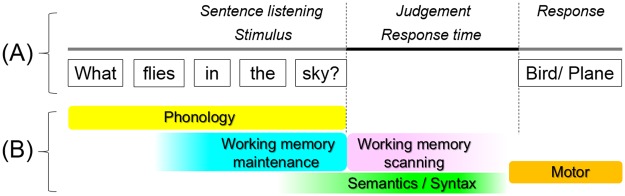
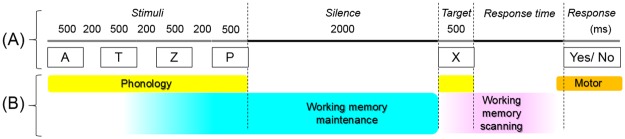
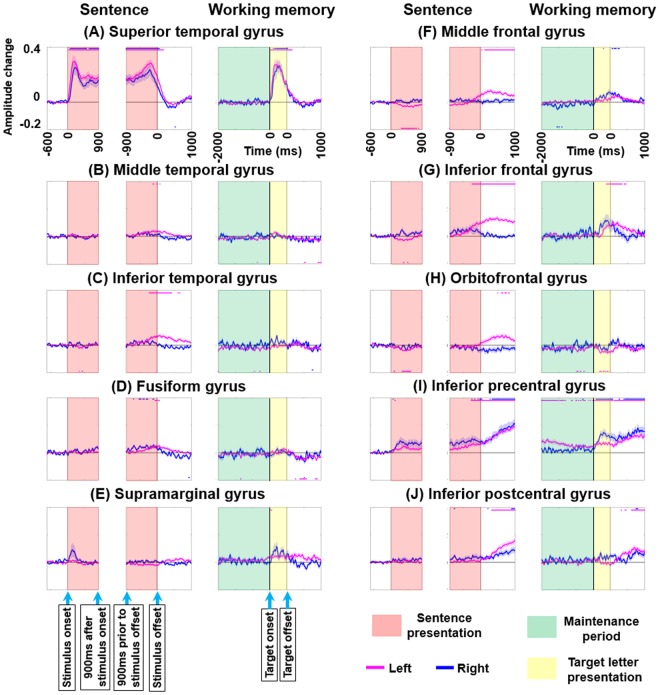
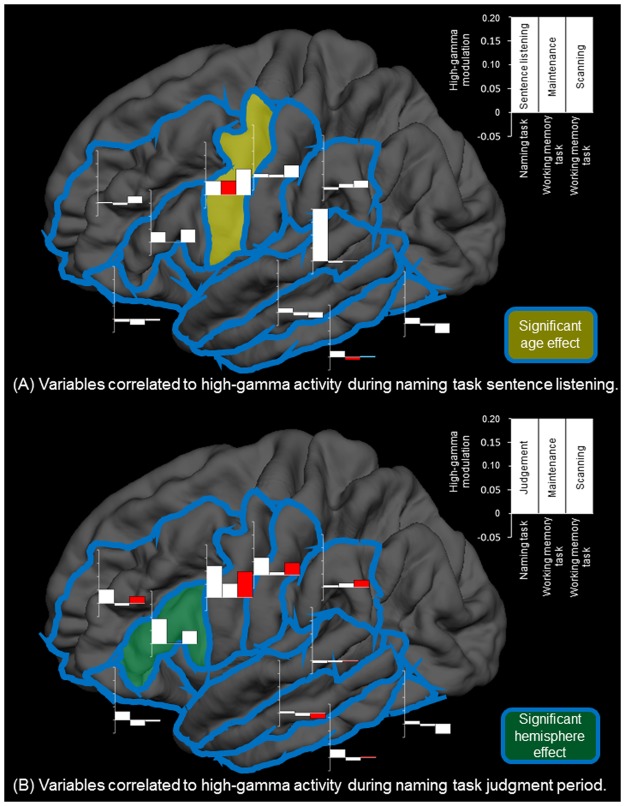
Auditory naming is suggested to require verbal working memory (WM) operations in addition to speech sound perception during the sentence listening period and semantic/syntactic processing during the subsequent judgement period. We attempted to dissect cortical activations attributable to verbal WM from those otherwise involved in answering auditory sentence questions. We studied 19 patients who underwent electrocorticography recordings and measured high-gamma activity during auditory naming and WM tasks. In the auditory naming task, inferior-precentral high-gamma activity was augmented during sentence listening, and the magnitude of augmentation was independently correlated to that during the WM task maintenance period as well as patient age. High-gamma augmentation during the WM task scanning period accounted for high-gamma variance during the naming task judgement period in some of the left frontal association neocortex regions (most significantly in the middle-frontal, less in the inferior-frontal, and least in the orbitofrontal gyrus). Inferior-frontal high-gamma augmentation was left-hemispheric dominant during naming task judgement but rather symmetric during WM scanning. Left orbitofrontal high-gamma augmentation was evident only during the naming task judgement period but minimal during the WM task scanning period. The inferior-precentral regions may exert WM maintenance during sentence listening, and such maintenance function may be gradually strengthened as the brain matures. The left frontal association neocortex may have a dorsal-to-ventral gradient in functional roles during naming task judgement. Namely, left middle-frontal activation may be well-attributable to WM scanning function, whereas left orbitofrontal activation may be attributable less to WM scanning but more largely to syntactic/semantic processing.
Overview
The claims and statistics of this paper haven’t been checked yet.
Free: it reads the open-access text and checks the first 5 claims that cite a source we can check. Create a free account to check every claim.
Integrity signals
Registry
Cites
Statistics
Figures
Verification
Claims the paper makes
The claims and statistics of this paper haven’t been checked yet.
Free: it reads the open-access text and checks the first 5 claims that cite a source we can check. Create a free account to check every claim.
Self-check
Percentages, sums and reported differences re-computed from the paper’s own numbers.
The self-check needs the paper’s full text.
Citations
Cites
Desikan, R. S., Ségonne, F., Fischl, B., Quinn, B. T., Dickerson, B. C., Blacker, D., Buckner, R. L., Dale, A. M., Maguire, R. P., Hyman, B. T., et al. (2006) · NeuroImage · doi:10.1016/j.neuroimage.2006.01.021 · Cited by 13,324
The episodic buffer: a new component of working memory?
Baddeley, A. (2000) · Trends in Cognitive Sciences · doi:10.1016/s1364-6613(00)01538-2 · Cited by 7,359
Bootstrap Methods and their Application
Davison, A. C., & Hinkley, D. V. (1997) · doi:10.1017/cbo9780511802843 · Cited by 7,350
Working memory: Looking back and looking forward
Baddeley, A. (2003) · Nature Reviews Neuroscience · doi:10.1038/nrn1201 · Cited by 5,200
A capacity theory of comprehension: individual differences in working memory
Just, M. A., & Carpenter, P. A. (1992) · Psychological Review · doi:10.1037/0033-295x.99.1.122 · Cited by 4,153
High-speed scanning in human memory
Sternberg, S. (1966) · Science · doi:10.1126/science.153.3736.652 · Cited by 3,576
The neural correlates of the verbal component of working memory
Paulesu, E., Frith, C. D., & Frackowiak, R. S. J. (1993) · Nature · doi:10.1038/362342a0 · Cited by 2,230
The spatial and temporal signatures of word production components
Indefrey, P., & Levelt, W. J. M. (2004) · Cognition · doi:10.1016/j.cognition.2002.06.001 · Cited by 2,144
Meta-analyzing left hemisphere language areas: phonology, semantics, and sentence processing.
Vigneau, M., Beaucousin, V., Hervé, P. Y., Duffau, H., Crivello, F., Houdé, O., Mazoyer, B., & Tzourio-Mazoyer, N. (2006) · NeuroImage · doi:10.1016/j.neuroimage.2005.11.002 · Cited by 1,851
The visual word form area: expertise for reading in the fusiform gyrus
McCandliss, B. D., Cohen, L., & Dehaene, S. (2003) · Trends in Cognitive Sciences · doi:10.1016/s1364-6613(03)00134-7 · Cited by 1,489
Cited by
Dynamic tractography: Integrating cortico-cortical evoked potentials and diffusion imaging
Silverstein, B. H., Asano, E., Sugiura, A., Sonoda, M., Lee, M., & Jeong, J. (2020) · NeuroImage · doi:10.1016/j.neuroimage.2020.116763 · Cited by 70
Self-citationFour‐dimensional functional cortical maps of visual and auditory language: Intracranial recording
Nakai, Y., Sugiura, A., Brown, E. C., Sonoda, M., Jeong, J., Rothermel, R., Luat, A. F., Sood, S., & Asano, E. (2019) · Epilepsia · doi:10.1111/epi.14648 · Cited by 57
“Our previous ECoG studies of auditory naming–related neural dynamics reported that older age was associated with a greater degree of inferior‐precentral high‐gamma augmentation during stimulus listening as well as a greater degree of left rostral middle‐frontal high‐gamma augmentation immediately following stimulus of…”
ResultSelf-citationDependence of Working Memory on Coordinated Activity Across Brain Areas
Rezayat, E., Clark, K., Dehaqani, M. A., & Noudoost, B. (2022) · Frontiers in Systems Neuroscience · doi:10.3389/fnsys.2021.787316 · Cited by 48
Ikegaya, N., Motoi, H., Iijima, K., Takayama, Y., Kambara, T., Sugiura, A., Silverstein, B. H., Iwasaki, M., & Asano, E. (2019) · Clinical Neurophysiology · doi:10.1016/j.clinph.2019.04.008 · Cited by 21
Self-citationMa, S., Li, Y., Liu, Y., Xu, C., Li, H., Yao, Q., Wang, Y., Yang, Z., Zuo, P., Yang, M., et al. (2020) · Frontiers in Neurology · doi:10.3389/fneur.2020.00691 · Cited by 14
A left-lateralized dorsolateral prefrontal network for naming
Yu, L., Dugan, P. C., Doyle, W., Devinsky, O., Friedman, D. J., & Flinker, A. (2025) · Cell Reports · doi:10.1016/j.celrep.2025.115677 · Cited by 18
“40 Taking these results together, our spatial dissociation between pre-articulatory and semantic networks (Figure 3) suggests that a frontal semantic node might be missing in current language models that argue for a multi-stream process.”
Liu, X., Horinouchi, H., Yang, Y., Yan, Y., Ando, M., Obinna, U. J., Namba, S., & Kambara, T. (2021) · Frontiers in Communication · doi:10.3389/fcomm.2021.605009 · Cited by 18
Self-citationPoor reading is characterized by a more connected network with wrong hubs
Mao, J., Liu, L., Perkins, K., & Cao, F. (2021) · Brain and Language · doi:10.1016/j.bandl.2021.104983 · Cited by 14
Speech recognition in noise task among children and young-adults: a pupillometry study
Trau-Margalit, A., Fostick, L., Harel-Arbeli, T., Gannot, R. N., & Taitelbaum‐Swead, R. (2023) · Frontiers in Psychology · doi:10.3389/fpsyg.2023.1188485 · Cited by 15
“The working memory capacity of school aged children is less developed in comparison to that of adults (Kambara et al., 2018).”
BackgroundChoiński, M., Stanczyk, M., & Szymaszek, A. (2023) · Scientific Reports · doi:10.1038/s41598-023-41045-0 · Cited by 12
“Both naming and verbal fluency require the engagement of working memory and, furthermore, verbal fluency is additionally based on processing speed and auditory attention 64–66 .”
BackgroundYan, Y., Yang, Y., Ando, M., Liu, X., & Kambara, T. (2021) · European Journal of Investigation in Health Psychology and Education · doi:10.3390/ejihpe11030074 · Cited by 8
“, [56,57]) and learning of novel linguistic forms and pictures [18].”
BackgroundSelf-citationNeural dynamics during the vocalization of ‘uh’ or ‘um’
Sugiura, A., Alqatan, Z., Nakai, Y., Kambara, T., Silverstein, B. H., & Asano, E. (2020) · Scientific Reports · doi:10.1038/s41598-020-68606-x · Cited by 12
Self-citationCulicetto, L., Latella, D., Buono, V. L., Orecchio, F., Murdaca, A. M., Quartarone, A., & Marino, S. (2025) · Journal of Personalized Medicine · doi:10.3390/jpm15030092 · Cited by 11
Frontal mechanisms underlying primate calls recognition by humans
Ceravolo, L., Debracque, C., Pool, E. R., Gruber, T., & Grandjean, D. (2023) · Cerebral Cortex Communications · doi:10.1093/texcom/tgad019 · Cited by 12
“Moreover, the functions of the 66 frontal lobe, often associated to problem solving, emotion processing and especially evaluative 67 judgment, communication and language or even motor and sexual behaviours (6, 20-25), as well as 68 their related brain structures are shared by most primate species.”
Expanded Exploration of the Auditory Naming Test in Patients with Dementia
Hirsch, J. A., Cuesta, G. M., Fonzetti, P., Comaty, J. E., Jordan, B. D., Cirio, R. T., Levin, L. K., Abrahams, A., & Fry, K. M. (2021) · Journal of Alzheimer s Disease · doi:10.3233/jad-210322 · Cited by 8
“…discrete (left temporal and frontal regions) and sensitive to disruptions in the left anterior temporal lobe; whereas, visual naming recruits more diffuse regions in both hemispheres (including visual cortices) and is more sensitive to disruption of left posterior temporal areas [31, 36–38 , 72 ].”
Yang, Y., Yan, Y., Ando, M., Liu, X., & Kambara, T. (2021) · European Journal of Investigation in Health Psychology and Education · doi:10.3390/ejihpe11020044 · Cited by 7
“In fact, the repetition of pseudowords or verbal sounds is associated with associative learning of word forms and perceptual features [17], or language comprehension [46,47].”
BackgroundSelf-citationVowel Length Expands Perceptual and Emotional Evaluations in Written Japanese Sound-Symbolic Words
Lin, Z., Wang, N., Yan, Y., & Kambara, T. (2021) · Behavioral Sciences · doi:10.3390/bs11060090 · Cited by 7
Self-citationAndo, M., & Kambara, T. (2023) · Cognitive Processing · doi:10.1007/s10339-023-01138-0 · Cited by 8
“This procedure would be associated with working memory processes for the maintenance and scanning of verbal stimuli (e.g., Kambara et al. 2017, 2018).”
MethodSelf-citationMesial-Temporal Epileptic Ripples Correlate With Verbal Memory Impairment
Bruder, J. C., Wagner, K., Piza, D. L., Klotz, K. A., Schulze‐Bonhage, A., & Jacobs, J. (2022) · Frontiers in Neurology · doi:10.3389/fneur.2022.876024 · Cited by 5
“the short-term maintenance of verbal memory occurs in left neocortical networks (left pre-central, supra-marginal, and inferior frontal gyri) (61).”
BackgroundDebracque, C., Ceravolo, L., Clay, Z., Grandjean, D., & Gruber, T. (2025) · Imaging Neuroscience · doi:10.1162/imag_a_00480 · Cited by 7
Mohan, V., Parekh, P., Lukose, A., Moirangthem, S., Saini, J. S., Schretlen, D. J., & John, J. P. (2023) · Clinical Psychopharmacology and Neuroscience · doi:10.9758/cpn.2023.21.2.340 · Cited by 4
“central gyrus has been shown to be important for short term retention of auditory stimuli before further processing and motor transformation [104,105].”
BackgroundAge-related reduction in anxiety and neural encoding of negative emotional memory
Chaudhary, S., Zhang, S., Chen, Y., Dominguez, J. C., Chao, H. H., & Li, C. R. (2024) · Frontiers in Aging Neuroscience · doi:10.3389/fnagi.2024.1375435 · Cited by 6
EEG Analysis of Working Memory Between Sober State and Intoxicated State
Deng, X., Yang, P., Lv, X., Liu, K., & Sun, K. (2021) · IEEE Access · doi:10.1109/access.2021.3123336 · Cited by 6
“The frontal involves in many verbal expression processes, including verbal WM [41], and the parietal mediates the brain functions such as spatial WM [42].”
BackgroundSuhendro, J. M., Wibawa, A. D., & Mas, A. (2023) · International Electronics Symposium (IES) · doi:10.1109/ies59143.2023.10242535 · Cited by 6
Get the Picture: Learning Referents in a Single-Day Context
Horinouchi, H., Liu, X., Kabir, R. S., Kobayashi, R., Haramaki, Y., & Kambara, T. (2024) · WORD · doi:10.1080/00437956.2023.2299070 · Cited by 4
“We revised a verbal working memory task used in prior studies (Kambara et al. 2017; Kambara et al. 2018), such that the participants judged whether the sixth word (a target unfamiliar word) was present among the previous fi ve words by pushing one of two keys associated with the right index…”
MethodSelf-citationLeft hemispheric α band cerebral oscillatory changes correlate with verbal memory
Araki, T., Watanabe, Y., & Hirata, M. (2020) · Scientific Reports · doi:10.1038/s41598-020-72087-3
Mohan, V., Parekh, P., Lukose, A., Moirangthem, S., Saini, J. S., Schretlen, D. J., & John, J. P. (2022) · medRxiv · doi:10.1101/2022.04.12.22273462
“The inferior precentral gyrus has been shown to be important for short term retention of auditory stimuli before further processing and motor transformation (Carpenter et al., 2018; Kambara et al., 2018; Nakai et al., 2017).”
BackgroundStereo‐ EEG mapping of visual working memory with task‐related high‐gamma modulations
Ervin, B., Buroker, J., Cummins, T. B., Byars, A. W., Scholle, C., Rozhkov, L., Horn, P. S., Tenney, J. R., Greiner, H. M., Leach, J. L., et al. (2026) · Epilepsia · doi:10.1002/epi.70241
Passive Language Mapping With High-Gamma Modulations
Ervin, B., Asano, E., & Crone, N. E. (2026) · Journal of Clinical Neurophysiology · doi:10.1097/wnp.0000000000001296
Self-citation
Metadata
- Authors
- Kambara, T., Brown, E. C., Silverstein, B. H., Nakai, Y., & Asano, E.
- Affiliations
- Hiroshima University (JP)
- Oregon Health & Science University (US)
- Wayne State University (US)
- Corresponding author
- Asano, Eishi
- Venue
- Scientific Reports
- Published
- 2018-10-26
- Volume
- 8
- Issue
- 1
- Pages
- 15868-15868
- ISSN
- 2045-2322 (ISSN-L)
- PMC
- PMC6203730
- OpenAlex
- W2896363922
- Cited by
- 29
- References
- 73
- Citations by year
- 2026: 2 · 2025: 3 · 2024: 2 · 2023: 6 · 2022: 3 · 2021: 7 · 2020: 4 · 2019: 2
- FWCI
- 1.94
- Type
- journal article
- Language
- en
- Open access
- gold
- doi.org
- Licence
- cc-by
- creativecommons.org/licenses/by/4.0 (tdm)
- creativecommons.org/licenses/by/4.0 (vor)
- Locations
- Scientific Reports (publishedVersion, cc-by)
- Europe PMC (PubMed Central) (publishedVersion, other-oa)
- PubMed Central (publishedVersion, cc-by)
- PubMed (publishedVersion)
- DOAJ (DOAJ: Directory of Open Access Journals) (submittedVersion)
- Funders
- Wayne State University
- Children's Hospital of Michigan
- National Institutes of Health
- Japan Society for the Promotion of Science (18H05599)
- National Institute of Neurological Disorders and Stroke (R01NS064033)
- Topics
- Life Sciences › Neuroscience › Cognitive Neuroscience › Neurobiology of Language and Bilingualism
- Life Sciences › Neuroscience › Cognitive Neuroscience › Neural dynamics and brain function
- Life Sciences › Neuroscience › Cognitive Neuroscience › Neuroscience and Music Perception
- Keywords
- verbal working memory, auditory sentence comprehension, high gamma activity, frontal association cortex, orbitofrontal cortex, middle frontal cortex, inferior frontal cortex, brain maturation, electrocorticography
- MeSH terms
- Electrocorticography, Adolescent, Adult, Auditory Perception, Brain, Brain Mapping, Child, Female, Humans, Magnetic Resonance Imaging, Male, Memory, Short-Term, Semantics, Young Adult
About these checks
Registry, retraction, Cites and statistics results are computed, not judged, with one exception: a printed reference that no index lists is read once by a model before it counts as a citation error. Claims are extracted by a model and kept only when their quote appears verbatim in the text; each cited source is then checked, with a model’s help, for whether it says what the claim relies on. Those verdicts can be wrong — read the claim’s quote and the cited source before relying on one.
Statistics and arithmetic are recomputed, not judged.
Confidence bands are shown only for fields calibrated on our annotated test set. None is calibrated yet, so no band is shown.
What counts as a claim ›How we measure confidence ›How we check this ›
Are you an author, or do you see a problem with this page? Request a review
Data sources
Bibliographic data: Semantic Scholar, OpenAlex, Crossref.
Contains information from the Semantic Scholar Academic Graph Datasets, made available under the ODC Attribution License (ODC-BY 1.0).
Semantic Scholar’s data is described in: Kinney, R., et al. (2023). The Semantic Scholar Open Data Platform. arXiv:2301.10140.
