

Towards reconstructing intelligible speech from the human auditory cortex
Open accessPublished version of a preprint
The DOI matches its Crossref record; 82 of the 84 references it cites were found in a registry or an index.
Abstract
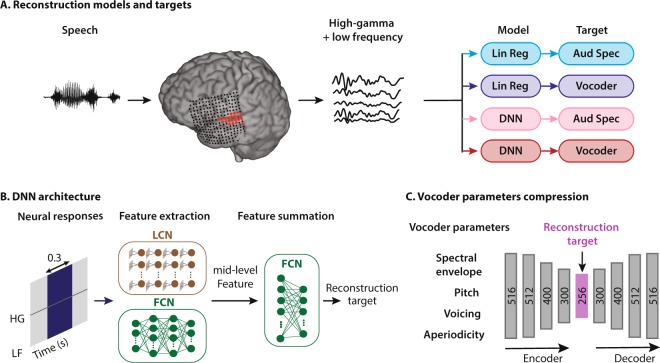
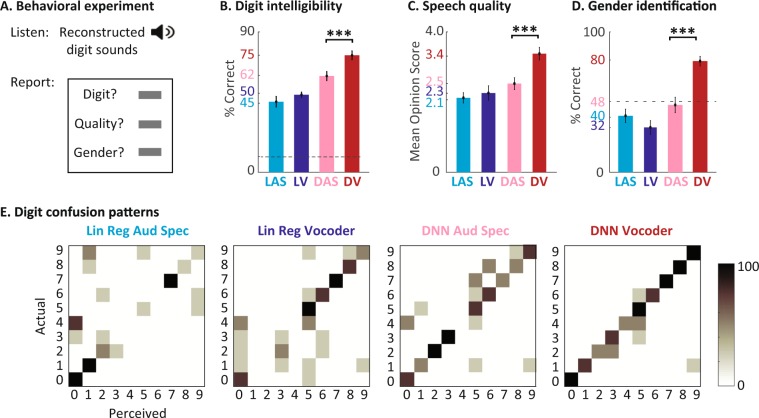
Auditory stimulus reconstruction is a technique that finds the best approximation of the acoustic stimulus from the population of evoked neural activity. Reconstructing speech from the human auditory cortex creates the possibility of a speech neuroprosthetic to establish a direct communication with the brain and has been shown to be possible in both overt and covert conditions. However, the low quality of the reconstructed speech has severely limited the utility of this method for brain-computer interface (BCI) applications. To advance the state-of-the-art in speech neuroprosthesis, we combined the recent advances in deep learning with the latest innovations in speech synthesis technologies to reconstruct closed-set intelligible speech from the human auditory cortex. We investigated the dependence of reconstruction accuracy on linear and nonlinear (deep neural network) regression methods and the acoustic representation that is used as the target of reconstruction, including auditory spectrogram and speech synthesis parameters. In addition, we compared the reconstruction accuracy from low and high neural frequency ranges. Our results show that a deep neural network model that directly estimates the parameters of a speech synthesizer from all neural frequencies achieves the highest subjective and objective scores on a digit recognition task, improving the intelligibility by 65% over the baseline method which used linear regression to reconstruct the auditory spectrogram. These results demonstrate the efficacy of deep learning and speech synthesis algorithms for designing the next generation of speech BCI systems, which not only can restore communications for paralyzed patients but also have the potential to transform human-computer interaction technologies.
Overview
The claims and statistics of this paper haven’t been checked yet.
Free: it reads the open-access text and checks the first 5 claims that cite a source we can check. Create a free account to check every claim.
Integrity signals
Registry
Cites
Statistics
Figures
Verification
Claims the paper makes
The claims and statistics of this paper haven’t been checked yet.
Free: it reads the open-access text and checks the first 5 claims that cite a source we can check. Create a free account to check every claim.
Claims other papers make about this one
Each is checked against this paper’s own text: does it say what the citing paper says it does?
The cited source says what the claim attributes to it.
In the citing paper
“Neural activity in the STG encodes acoustic features — for example, recurring speech sound patterns in the mel-spectrogram — during speech perception53,54 and may be used to reconstruct perceived speech55,56.”
From The speech neuroprosthesis (2024) · cites this paper as [55]
Self-check
Percentages, sums and reported differences re-computed from the paper’s own numbers.
The self-check needs the paper’s full text.
Citations
Cites
ImageNet classification with deep convolutional neural networks
Krizhevsky, A., Sutskever, I., & Hinton, G. E. (2017) · Communications of the ACM · doi:10.1145/3065386 · Cited by 112,155
LeCun, Y., Bengio, Y., & Hinton, G. (2015) · Nature · doi:10.1038/nature14539 · Cited by 84,126
(2014) · Cited by 33,419
Advances in neural information processing systems 7
Cios, K., & Shields, M. (1997) · Neurocomputing · doi:10.1016/s0925-2312(97)90018-7 · Cited by 22,059
Reducing the dimensionality of data with neural networks
Hinton, G. E., & Salakhutdinov, R. R. (2006) · Science · doi:10.1126/science.1127647 · Cited by 20,928
Delving Deep into Rectifiers: Surpassing Human-Level Performance on ImageNet Classification
He, K., Zhang, X., Ren, S., & Sun, J. (2015) · 2015 IEEE International Conference on Computer Vision (ICCV) · doi:10.1109/iccv.2015.123 · Cited by 19,741
A fast learning algorithm for deep belief nets
Hinton, G. E., Osindero, S., & Teh, Y.-W. (2006) · Neural Computation · doi:10.1162/neco.2006.18.7.1527 · Cited by 16,336
Batch Normalization: Accelerating Deep Network Training by Reducing Internal Covariate Shift
Ioffe, S. (2024) · arXiv (Cornell University) · doi:10.57702/o9raffed · Cited by 14,214
TensorFlow: A system for large-scale machine learning
Abadi, M., Barham, P., Chen, J., Chen, Z., Davis, A., Dean, J., Devin, M., Ghemawat, S., Irving, G., Isard, M., et al. (2016) · arXiv (Cornell University) · doi:10.48550/arxiv.1605.08695 · Cited by 11,822
Hinton, G., Deng, L., Yu, D., Dahl, G., Mohamed, A.-R., Jaitly, N., Senior, A., Vanhoucke, V., Nguyen, P., Sainath, T., et al. (2012) · IEEE Signal Processing Magazine · doi:10.1109/msp.2012.2205597 · Cited by 10,260
Research works printed but not linked: 3
- Salza PL Foti E Nebbia L Oreglia M MOS and pair comparison combined methods for quality evaluation of text-to-speech systems Acta Acust. united with Acust. 1996 82 650 656
- Maas AL Hannun AY Ng AY Rectifier nonlinearities improve neural network acoustic models In Proc. icml 2013 30 3
- Kingma, D. P. & Ba, J. Adam: A method for stochastic optimization. arXiv Prepr. arXiv1412.6980 (2014).
Cited by
Items 201–274 of 274
Human Intracranial Recordings for Language Research
Schuerman, W. L., & Leonard, M. K. (2023) · Neuromethods · doi:10.1007/978-1-0716-3263-5_9 · Cited by 1
Neural Signal-Based Speech Recognition: Leveraging EEG for Speech Detection
Bhutani, P., Madan, P., Mishra, U., Vishnoi, A., & Arya, P. K. (2024) · International Conference on Computational Intelligence and Network Systems (CINS) · doi:10.1109/cins63881.2024.10862994 · Cited by 1
The Affective Perceptual Model: Enhancing Communication Quality for Persons with PIMD
Tredup, J. (2019) · Digital Scholarship - UNLV (University of Nevada Reno) · doi:10.34917/15778564 · Cited by 1
A convolutional neural-network framework for modelling auditory sensory cells and synapsesPreprint
Drakopoulos, F., Baby, D., & Verhulst, S. (2020) · bioRxiv (Cold Spring Harbor Laboratory) · doi:10.1101/2020.11.25.388546 · Cited by 1
Multi-view Temporal Alignment for Non-parallel Articulatory-to-Acoustic Speech SynthesisPreprint
González, J. A., González-Atienza, M., Gomez-Alanis, A., Pérez-Córdoba, J. L., & Green, P. (2020) · arXiv (Cornell University) · doi:10.48550/arxiv.2012.15184 · Cited by 1
Graphene field-effect transistors as flexible neural interfaces for intracortical electrophysiology
Calia, A. B. (2021) · Tesis Doctorals en Xarxa (Consorci de Serveis Universitaris de Catalunya) · Cited by 1
Between Collection and Interpretation: Targeted Rights for Unpredictable Insights
Gavina, T., & Gutiérrez-Lafrentz, L. (2024) · AJOB Neuroscience · doi:10.1080/21507740.2024.2328243 · Cited by 1
Li, J., Guo, C., Zhang, C., Chang, E. F., & Li, Y. (2025) · eLife · doi:10.7554/elife.109400.1 · Cited by 1
Towards an objective and automatic measure of speech understanding
Vanthornhout, J. (2020) · Lirias (KU Leuven) · Cited by 1
Neuro-steered music source separation
Cantisani, G. (2021) · theses.fr (ABES) · doi:10.70675/0fd7a113zc08fz49bbza24dz94a0834ee136 · Cited by 1
Semantic-Aware Decoding of Covert Inner Speech: A Multimodal EEG–EMG–Audio FrameworkPreprint
Ahmadi, H., Santamaría-Vázquez, E., Mesin, L., & Hornero, R. (2026) · Research Square · doi:10.21203/rs.3.rs-9365678/v1 · Cited by 1
Lobo-Alonso, M., Martín-Fernández, I., García, I. O., Barra-Chicote, R., Kontaxakis, G., & San-Segundo, R. (2026) · Scientific Data · doi:10.1038/s41597-026-07745-8 · Cited by 1
Cortical encoding of probabilistic temporal predictions during speech perceptionPreprint
Deyna, L., Albouy, P., Trébuchon, A., Schön, D., Morillon, B., & Guilleminot, P. H. (2026) · bioRxiv (Cold Spring Harbor Laboratory) · doi:10.64898/2026.08.16.745095 · Cited by 1
Brain-to-Language Decoding: Paradigms, Signals, Methods, Evaluation, Practical Use and BeyondPreprint
Yang, Y., Duan, Y., Liu, C., Wang, Y., Zhou, X., Lin, C.-T., & Zhang, Y. (2026) · arXiv (Cornell University) · doi:10.48550/arxiv.2609.27650 · Cited by 1
Translating neural signals to text using a Brain-Machine InterfacePreprint
Sheth, J. K., Tankus, A., Tran, M., Pouratian, N., Fried, I., & Speier, W. F. (2019) · arXiv (Cornell University) · doi:10.48550/arxiv.1907.04265
Cortical encoding and decoding models of speech production
Chartier, J. (2019) · eScholarship (California Digital Library)
Investigating cortical encoding of auditory space & motion in humans using EEG
Bednar, A. (2020) · Arrow@dit (Dublin Institute of Technology)
Karkosz, S., & Jukiewicz, M. (2020) · Bio-Algorithms and Med-Systems · doi:10.1515/bams-2020-0013
Neural coding of overlapping speech and the effects of hearing loss
Smith, S. S. (2020) · Nottingham ePrints (University of Nottingham)
Decoding Speech from Dorsal Motor Cortex
Stavisky, S. D. (2021) · Springer briefs in electrical and computer engineering · doi:10.1007/978-3-030-60460-8_10
BrainTalk—An EEG Motor Imagery BCI for Giving Non-speaking People a Voice: A Position Paper
Talukdar, U., & Shougrakpam, D. (2021) · Lecture notes in networks and systems · doi:10.1007/978-981-33-4084-8_34
A Method To Map EEG Signals To Spoken Speech Using Gaussian Process Modeling
Wu, H., Pan, C., Li, M., & Chen, F. (2021) · European Signal Processing Conference (EUSIPCO) · doi:10.23919/eusipco54536.2021.9615959
Zeng, Q. (2022) · Scientific Programming · doi:10.1155/2022/7082043
Electronic assistive technology
(2020) · Elsevier eBooks · doi:10.1016/b978-0-08-102694-6.00027-9
Neural Code: Another breach in the wall?Preprint
Edeline, J., Huetz, C., Souffi, S., & Adenis, V. (2019) · PsyArXiv (OSF Preprints) · doi:10.31234/osf.io/y8jax
A protocol for Brain-Computer Interfaces based on Musical Notes Imagery
Montevilla, A., & Sahonero-Alvarez, G. (2021) · IEEE Latin American Conference on Computational Intelligence (LA-CCI) · doi:10.1109/la-cci48322.2021.9769845
Simon, A. (2023) · VBN Forskningsportal (Aalborg Universitet) · doi:10.54337/aau548864023
KI als Werkzeug in der Hirnforschung
Krauß, P. (2023) · Springer eBooks · doi:10.1007/978-3-662-67179-5_20
Weitere Werkzeuge der Künstlichen Intelligenz
Mockenhaupt, A., & Schlagenhauf, T. (2024) · Springer eBooks · doi:10.1007/978-3-658-41935-6_8
AI as a Tool in Brain Research
Krauß, P. (2024) · Springer eBooks · doi:10.1007/978-3-662-68980-6_20
Author response: Reconstructing Voice Identity from Noninvasive Auditory Cortex Recordings
Lamothe, C., Thoret, E., Trapeau, R., Giordano, B. L., Sein, J., Takerkart, S., Ayache, S., Artières, T., & Belin, P. (2024) · eLife · doi:10.7554/elife.98047.1.sa4
eLife Assessment: Reconstructing Voice Identity from Noninvasive Auditory Cortex Recordings
Martin, A. E. (2024) · eLife · doi:10.7554/elife.98047.1.sa3
Reconstructing Voice Identity from Noninvasive Auditory Cortex RecordingsPreprint
Lamothe, C., Thoret, E., Trapeau, R., Giordano, B. L., Sein, J., Takerkart, S., Ayache, S., Artières, T., & Belin, P. (2024) · eLife · doi:10.7554/elife.98047.1
Organoids: Revolutionising research and shaping the future of medicine
Alisha, A., Nety, S., Koley, K. M., Kumar, S., Kashif, M., & Mishra, P. (2024) · International Journal of Advanced Biochemistry Research · doi:10.33545/26174693.2024.v8.i7j.1610
Wu, Y., Li, C., Zhang, H., Chen, F., Chen, W., & Zhang, S. (2024) · International Conference on Biomedical Signal and Image Processing (ICBIP) · doi:10.1145/3691521.3691534
Li, J., Guo, C., Chang, E. F., & Li, Y. (2024) · bioRxiv (Cold Spring Harbor Laboratory) · doi:10.1101/2024.12.16.628596
Kathuria, A. (2025) · Journal of Information Systems Engineering & Management · doi:10.52783/jisem.v10i46s.8804
A Review of Multimodal Brain Language Decoding
Tang, Y. (2025) · Lecture Notes in Education Psychology and Public Media · doi:10.54254/2753-7048/2025.nd25514
Image-Based Brain Tumor Classification Using Deep Learning Techniques
Sathvika, K., Ahad, A., Akshaya, P., Sucharita, S., & Jabbar, M. A. (2025) · International Conference on Intelligent Communication Networks and Computational Techniques (ICICNCT) · doi:10.1109/icicnct66124.2025.11233069
Reconstructing Voice Identity from Noninvasive Auditory Cortex RecordingsPreprint
Lamothe, C., Thoret, E., Trapeau, R., Giordano, B. L., Sein, J., Takerkart, S., Ayache, S., Artières, T., & Belin, P. (2025) · eLife · doi:10.7554/elife.98047.2
Lee, H., Hwang, J., Kim, K., Lee, G., Chung, C. K., & Im, C. (2025) · Machine Learning with Applications · doi:10.1016/j.mlwa.2025.100805
Reflections on artificial intelligence, speech technology, brain imaging and phonetics
Lindblom, B. E. F. (2019) · Zenodo (CERN European Organization for Nuclear Research) · doi:10.5281/zenodo.3246028
Children: an inheritance from the Lord. Infanticide and the value of life
Hain, R. D. W. (2021) · Oxford University Research Archive (ORA) (University of Oxford) · doi:10.5287/ora-qo2p519yo · Cited by 1
Neutralización del acento local de un hispanohablante
González Martín, R. (2020) · Hispana
The use of artificial intelligence to identify thought messages via non-invasive EEG brain signals
Majumdar, S. (2024) · Nottingham Trent University's Institutional Repository (Nottingham Trent Repository)
Diepe neurale netwerken als model voor spraakperceptie
Accou, B. (2023) · Lirias
Decoding non-invasive brain activity with novel deep-learning approachesPreprint
Csáky, R. (2025) · arXiv (Cornell University) · doi:10.48550/arxiv.2510.24733
Speech Perception and Auditory Attention in Noisy and Multi-Talker Environments
Haro, S. (2023) · Digital Access to Scholarship at Harvard (DASH) (Harvard University)
Comparison of single-channel EEG decoding performance in imagined speech tasks
Ma, X., Ding, Y., Zhao, K., Zhang, P., Tang, Y., Shi, J., Chen, D., Wu, D., & Tang, Z. (2026) · Brain Hemorrhages · doi:10.1016/j.hest.2026.01.001
Li, J., Guo, C., Zhang, C., Chang, E. F., & Li, Y. (2026) · eLife · doi:10.7554/elife.109400.2
Li, J., Guo, C., Zhang, C., Chang, E. F., & Li, Y. (2026) · eLife · doi:10.7554/elife.109400.2.sa0
Attentional modulation of the auditory cortex activity in a sound discrimination task in mice
Bardin, C. (2021) · theses.fr (ABES) · doi:10.70675/be0d6f87zffc2z40bcz9551z7fef7c276b41
Le droit international et l'intelligence artificielle forte
Chen, Y. (2023) · theses.fr (ABES) · doi:10.70675/f5f60605z7c2ez46ecz86f7z2c7f5972244c
Reconstruction of overt speech from Electrocorticographic (ECoG) data using deep neural networks
Ticha, M. B. B. (2025) · theses.fr (ABES) · doi:10.70675/12c589a0z38bdz4a87zbe17zc60eac7a3e60
Spatiotemporal Dynamics in Prespeech Semantic Category Decoding: An Intracranial EEG Study
Park, Y. J., Kwon, J., Lee, G. H., Meng, K., & Chung, C. K. (2026) · eNeuro · doi:10.1523/eneuro.0254-25.2026
Hain, R. (2026) · Springer eBooks · doi:10.1007/978-3-032-12111-0_11
Solvitur Ambulando: Turning to the Evidence
Hain, R. (2026) · Springer eBooks · doi:10.1007/978-3-032-12111-0_8
Classification of image category based on spatially distributed, transient high-frequency eventsPreprint
Díaz, A., Tal, I., Markowitz, N., Grossman, S., Espinal, E., Tostaeva, G., schroeder, C., Mehta, A. D., Neymotin, S. A., & Bickel, S. (2026) · bioRxiv (Cold Spring Harbor Laboratory) · doi:10.64898/2026.05.15.725481
Self-citationA Lightweight LSTM-Based iEEG-to-Speech Decoder with Event-Level Unseen Neural Pattern Detection
Memon, S., & Al-Radhi, M. S. (2026) · Lecture notes in computer science · doi:10.1007/978-3-032-37870-5_13
Semantic-aware decoding of covert inner speech: A multimodal EEG–EMG–audio framework
Ahmadi, H., Santamaría-Vázquez, E., Mesin, L., & Hornero, R. (2026) · Biomedical Signal Processing and Control · doi:10.1016/j.bspc.2026.111527
Subject-Invariant Cross-Modal Decoding of Perceived Speech from Brain RecordingsPreprint
Zhang, A., & Chen, J. (2026) · arXiv (Cornell University) · doi:10.48550/arxiv.2609.30832
Integrating Language Models into Listened and Imagined Speech Decoding from MEGPreprint
Maghsoudi, M., Kankanala, S. S., Shamma, S., & Ganapathy, S. (2026) · arXiv (Cornell University) · doi:10.48550/arxiv.2609.31997
From Neurons to Conversation: Speech Brain-Computer InterfacesPreprint
Khajehnejad, M., Habibollahi, F., Boccato, T., Sousa, M., Olak, M., Sheiban, F. J., & Ferrante, M. (2026) · arXiv (Cornell University) · doi:10.48550/arxiv.2609.36736
Modeling Paralinguistic Features for Speech Neuroprostheses: A Systematic ReviewPreprint
Yenikapati, M. S., Deshpande, S., Desai, S., Santine, D. D., & Roghani, A. K. (2026) · bioRxiv (Cold Spring Harbor Laboratory) · doi:10.64898/2026.10.11.758333
Buragohain, R., Maheshwari, S., & Nathwani, K. (2026) · Interspeech (USB) · doi:10.21437/interspeech.2026-377
From Predefined Auditory Stimuli to Brain-Guided Generative Auditory Neuroscience
Li, Q., & He, J. (2026) · Biology · doi:10.3390/biology15212006
Wallner, J. J., Angrick, M., Luo, S., Candrea, D. N., Crone, N. E., & Krusienski, D. J. (2026) · Journal of Neural Engineering · doi:10.1088/1741-2552/aec049
Luo, C., Gao, Y., Fan, J., Liu, Y., Yu, Y., & Zhang, X. (2023) · doi:10.3389/fnhum.2023.1174720.s001
Metadata
- Authors
- Akbari, H., Khalighinejad, B., Herrero, J. L., Mehta, A. D., & Mesgarani, N.
- Affiliations
- Mortimer B. Zuckerman Mind Brain Behavior Institute (US)
- Feinstein Institute for Medical Research (US)
- Corresponding author
- Mesgarani, Nima
- Venue
- Scientific Reports
- Published
- 2019-01-29
- Volume
- 9
- Issue
- 1
- Pages
- 874-874
- ISSN
- 2045-2322 (ISSN-L)
- PMC
- PMC6351601
- OpenAlex
- W2913144232
- Cited by
- 221
- References
- 84
- Citations by year
- 2026: 11 · 2025: 25 · 2024: 33 · 2023: 28 · 2022: 28 · 2021: 35 · 2020: 29 · 2019: 32
- FWCI
- 18.01
- Type
- journal article
- Language
- en
- Open access
- gold
- doi.org
- Licence
- cc-by
- creativecommons.org/licenses/by/4.0 (tdm)
- creativecommons.org/licenses/by/4.0 (vor)
- Locations
- Scientific Reports (publishedVersion, cc-by)
- Europe PMC (PubMed Central) (publishedVersion, cc-by)
- PubMed Central (publishedVersion, cc-by)
- PubMed (publishedVersion)
- DOAJ (DOAJ: Directory of Open Access Journals) (submittedVersion)
- Funders
- U.S. Department of Health & Human Services | NIH | National Institute on Deafness and Other Communication Disorders (DC014279)
- Topics
- Life Sciences › Neuroscience › Cognitive Neuroscience › EEG and Brain-Computer Interfaces
- Physical Sciences › Computer Science › Artificial Intelligence › Speech Recognition and Synthesis
- Physical Sciences › Computer Science › Signal Processing › Speech and Audio Processing
- Keywords
- auditory cortex, speech reconstruction, brain-computer interface, deep neural network regression, speech intelligibility, digit recognition
- MeSH terms
- Deep Learning, Acoustic Stimulation, Algorithms, Auditory Cortex, Brain Mapping, Evoked Potentials, Auditory, Humans, Speech, Speech Intelligibility, Speech Perception, Neural Networks, Computer, Neural Prostheses
About these checks
Registry, retraction, Cites and statistics results are computed, not judged, with one exception: a printed reference that no index lists is read once by a model before it counts as a citation error. Claims are extracted by a model and kept only when their quote appears verbatim in the text; each cited source is then checked, with a model’s help, for whether it says what the claim relies on. Those verdicts can be wrong — read the claim’s quote and the cited source before relying on one.
Statistics and arithmetic are recomputed, not judged.
Confidence bands are shown only for fields calibrated on our annotated test set. None is calibrated yet, so no band is shown.
What counts as a claim ›How we measure confidence ›How we check this ›
Are you an author, or do you see a problem with this page? Request a review
Data sources
Bibliographic data: Semantic Scholar, OpenAlex, Crossref.
Contains information from the Semantic Scholar Academic Graph Datasets, made available under the ODC Attribution License (ODC-BY 1.0).
Semantic Scholar’s data is described in: Kinney, R., et al. (2023). The Semantic Scholar Open Data Platform. arXiv:2301.10140.
