

Towards reconstructing intelligible speech from the human auditory cortex
Open accessPublished version of a preprint
The DOI matches its Crossref record; 82 of the 84 references it cites were found in a registry or an index.
Abstract
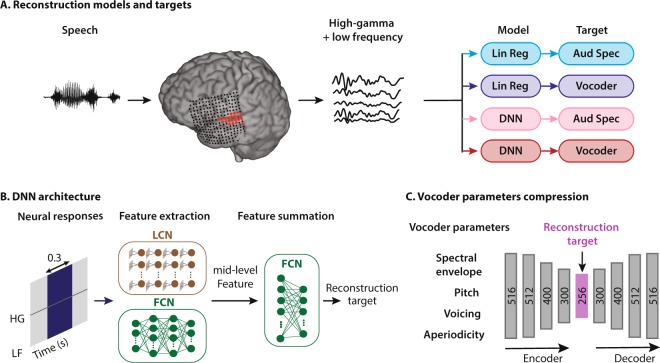
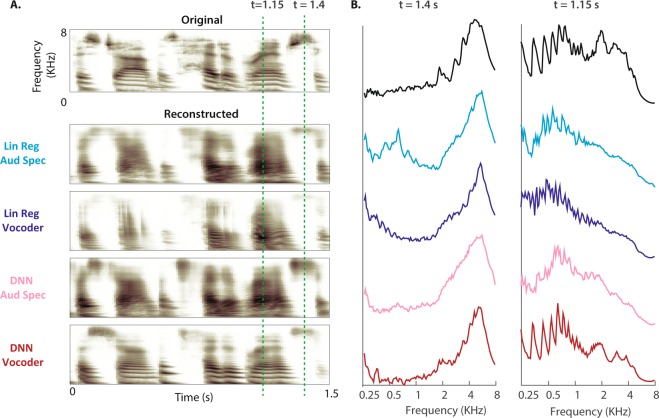
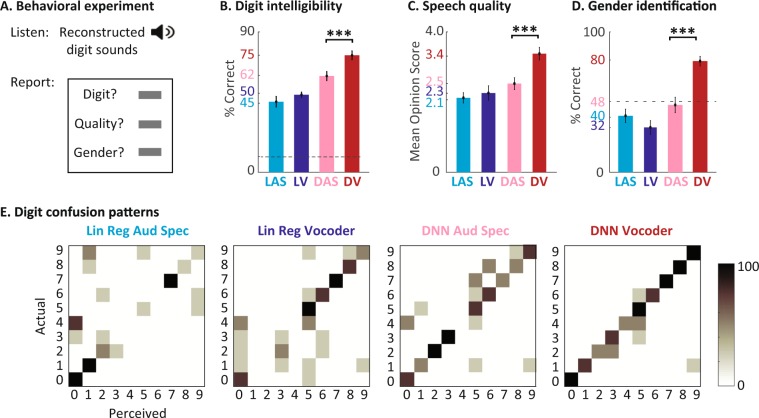
Auditory stimulus reconstruction is a technique that finds the best approximation of the acoustic stimulus from the population of evoked neural activity. Reconstructing speech from the human auditory cortex creates the possibility of a speech neuroprosthetic to establish a direct communication with the brain and has been shown to be possible in both overt and covert conditions. However, the low quality of the reconstructed speech has severely limited the utility of this method for brain-computer interface (BCI) applications. To advance the state-of-the-art in speech neuroprosthesis, we combined the recent advances in deep learning with the latest innovations in speech synthesis technologies to reconstruct closed-set intelligible speech from the human auditory cortex. We investigated the dependence of reconstruction accuracy on linear and nonlinear (deep neural network) regression methods and the acoustic representation that is used as the target of reconstruction, including auditory spectrogram and speech synthesis parameters. In addition, we compared the reconstruction accuracy from low and high neural frequency ranges. Our results show that a deep neural network model that directly estimates the parameters of a speech synthesizer from all neural frequencies achieves the highest subjective and objective scores on a digit recognition task, improving the intelligibility by 65% over the baseline method which used linear regression to reconstruct the auditory spectrogram. These results demonstrate the efficacy of deep learning and speech synthesis algorithms for designing the next generation of speech BCI systems, which not only can restore communications for paralyzed patients but also have the potential to transform human-computer interaction technologies.
Overview
The claims and statistics of this paper haven’t been checked yet.
Free: it reads the open-access text and checks the first 5 claims that cite a source we can check. Create a free account to check every claim.
Integrity signals
Registry
Cites
Statistics
Figures
Verification
Claims the paper makes
The claims and statistics of this paper haven’t been checked yet.
Free: it reads the open-access text and checks the first 5 claims that cite a source we can check. Create a free account to check every claim.
Claims other papers make about this one
Each is checked against this paper’s own text: does it say what the citing paper says it does?
The cited source says what the claim attributes to it.
In the citing paper
“Neural activity in the STG encodes acoustic features — for example, recurring speech sound patterns in the mel-spectrogram — during speech perception53,54 and may be used to reconstruct perceived speech55,56.”
From The speech neuroprosthesis (2024) · cites this paper as [55]
Self-check
Percentages, sums and reported differences re-computed from the paper’s own numbers.
The self-check needs the paper’s full text.
Citations
Cites
ImageNet classification with deep convolutional neural networks
Krizhevsky, A., Sutskever, I., & Hinton, G. E. (2017) · Communications of the ACM · doi:10.1145/3065386 · Cited by 112,155
LeCun, Y., Bengio, Y., & Hinton, G. (2015) · Nature · doi:10.1038/nature14539 · Cited by 84,126
(2014) · Cited by 33,419
Advances in neural information processing systems 7
Cios, K., & Shields, M. (1997) · Neurocomputing · doi:10.1016/s0925-2312(97)90018-7 · Cited by 22,059
Reducing the dimensionality of data with neural networks
Hinton, G. E., & Salakhutdinov, R. R. (2006) · Science · doi:10.1126/science.1127647 · Cited by 20,928
Delving Deep into Rectifiers: Surpassing Human-Level Performance on ImageNet Classification
He, K., Zhang, X., Ren, S., & Sun, J. (2015) · 2015 IEEE International Conference on Computer Vision (ICCV) · doi:10.1109/iccv.2015.123 · Cited by 19,741
A fast learning algorithm for deep belief nets
Hinton, G. E., Osindero, S., & Teh, Y.-W. (2006) · Neural Computation · doi:10.1162/neco.2006.18.7.1527 · Cited by 16,336
Batch Normalization: Accelerating Deep Network Training by Reducing Internal Covariate Shift
Ioffe, S. (2024) · arXiv (Cornell University) · doi:10.57702/o9raffed · Cited by 14,214
TensorFlow: A system for large-scale machine learning
Abadi, M., Barham, P., Chen, J., Chen, Z., Davis, A., Dean, J., Devin, M., Ghemawat, S., Irving, G., Isard, M., et al. (2016) · arXiv (Cornell University) · doi:10.48550/arxiv.1605.08695 · Cited by 11,822
Hinton, G., Deng, L., Yu, D., Dahl, G., Mohamed, A.-R., Jaitly, N., Senior, A., Vanhoucke, V., Nguyen, P., Sainath, T., et al. (2012) · IEEE Signal Processing Magazine · doi:10.1109/msp.2012.2205597 · Cited by 10,260
Fast and Accurate Deep Network Learning by Exponential Linear Units (ELUs)
Clevert, D.-A., Unterthiner, T., & Hochreiter, S. (2015) · arXiv · doi:10.48550/arxiv.1511.07289 · Cited by 4,513
Automatically Parcellating the Human Cerebral Cortex
Fischl, B. (2004) · Cerebral Cortex · doi:10.1093/cercor/bhg087 · Cited by 4,253
The origin of extracellular fields and currents — EEG, ECoG, LFP and spikes
Buzsáki, G., Anastassiou, C. A., & Koch, C. (2012) · Nature Reviews Neuroscience · doi:10.1038/nrn3241 · Cited by 4,225
(1989) · neural information processing systems · Cited by 3,736
Automatic parcellation of human cortical gyri and sulci using standard anatomical nomenclature
Destrieux, C., Fischl, B., Dale, A., & Halgren, E. (2010) · NeuroImage · doi:10.1016/j.neuroimage.2010.06.010 · Cited by 2,956
The functional role of cross-frequency coupling
Canolty, R. T., & Knight, R. T. (2010) · Trends in Cognitive Sciences · doi:10.1016/j.tics.2010.09.001 · Cited by 2,101
Kawahara, H., Masuda-Katsuse, I., & de Cheveigné, A. (1999) · Speech Communication · doi:10.1016/s0167-6393(98)00085-5 · Cited by 1,831
The design for the wall street journal-based CSR corpus
Paul, D. B., & Baker, J. M. (1992) · Proceedings of the workshop on Speech and Natural Language - HLT '91 · doi:10.3115/1075527.1075614 · Cited by 1,099
WORLD: A Vocoder-Based High-Quality Speech Synthesis System for Real-Time Applications
MORISE, M., YOKOMORI, F., & OZAWA, K. (2016) · IEICE Transactions on Information and Systems · doi:10.1587/transinf.2015edp7457 · Cited by 1,092
Different Origins of Gamma Rhythm and High-Gamma Activity in Macaque Visual Cortex
Ray, S., & Maunsell, J. H. R. (2011) · PLoS Biology · doi:10.1371/journal.pbio.1000610 · Cited by 1,012
Selective cortical representation of attended speaker in multi-talker speech perception
Mesgarani, N., & Chang, E. F. (2012) · Nature · doi:10.1038/nature11020 · Cited by 1,007
Self-citationPhase Patterns of Neuronal Responses Reliably Discriminate Speech in Human Auditory Cortex
Luo, H., & Poeppel, D. (2007) · Neuron · doi:10.1016/j.neuron.2007.06.004 · Cited by 995
Bialek, W., Rieke, F., de Ruyter van Steveninck, R. R., & Warland, D. (1991) · Science · doi:10.1126/science.2063199 · Cited by 992
NeuroGrid: recording action potentials from the surface of the brain
Khodagholy, D., Gelinas, J. N., Thesen, T., Doyle, W., Devinsky, O., Malliaras, G. G., & Buzsáki, G. (2015) · Nature Neuroscience · doi:10.1038/nn.3905 · Cited by 938
Emergence of neural encoding of auditory objects while listening to competing speakers
Ding, N., & Simon, J. Z. (2012) · Proceedings of the National Academy of Sciences · doi:10.1073/pnas.1205381109 · Cited by 835
Attentional Selection in a Cocktail Party Environment Can Be Decoded from Single-Trial EEG
O'Sullivan, J. A., Power, A. J., Mesgarani, N., Rajaram, S., Foxe, J. J., Shinn-Cunningham, B. G., Slaney, M., Shamma, S. A., & Lalor, E. C. (2015) · Cerebral Cortex · doi:10.1093/cercor/bht355 · Cited by 824
Self-citationPower-Law Scaling in the Brain Surface Electric Potential
Miller, K. J., Sorensen, L. B., Ojemann, J. G., & den Nijs, M. (2009) · PLoS Computational Biology · doi:10.1371/journal.pcbi.1000609 · Cited by 742
Multiresolution spectrotemporal analysis of complex sounds
Chi, T., Ru, P., & Shamma, S. A. (2005) · The Journal of the Acoustical Society of America · doi:10.1121/1.1945807 · Cited by 673
An Algorithm for Predicting the Intelligibility of Speech Masked by Modulated Noise Maskers
Jensen, J., & Taal, C. H. (2016) · IEEE/ACM Transactions on Audio, Speech, and Language Processing · doi:10.1109/taslp.2016.2585878 · Cited by 605
Reconstructing Speech from Human Auditory Cortex
Pasley, B. N., David, S. V., Mesgarani, N., Flinker, A., Shamma, S. A., Crone, N. E., Knight, R. T., & Chang, E. F. (2012) · PLoS Biology · doi:10.1371/journal.pbio.1001251 · Cited by 604
Self-citationLow-Frequency Cortical Entrainment to Speech Reflects Phoneme-Level Processing
Di Liberto, G. M., O’Sullivan, J. A., & Lalor, E. C. (2015) · Current Biology · doi:10.1016/j.cub.2015.08.030 · Cited by 578
The Efficiency of Logistic Regression Compared to Normal Discriminant Analysis
Efron, B. (1975) · Journal of the American Statistical Association · doi:10.1080/01621459.1975.10480319 · Cited by 567
Induced electrocorticographic gamma activity during auditory perception
Crone, N. E., Boatman, D., Gordon, B., & Hao, L. (2001) · Clinical Neurophysiology · doi:10.1016/s1388-2457(00)00545-9 · Cited by 494
The locked-in syndrome : what is it like to be conscious but paralyzed and voiceless?
Laureys, S., Pellas, F., Van Eeckhout, P., Ghorbel, S., Schnakers, C., Perrin, F., Berré, J., Faymonville, M.-E., Pantke, K.-H., Damas, F., et al. (2005) · Progress in Brain Research · doi:10.1016/s0079-6123(05)50034-7 · Cited by 477
Hearing in the Mind's Ear: A PET Investigation of Musical Imagery and Perception
Zatorre, R. J., Halpern, A. R., Perry, D. W., Meyer, E., & Evans, A. C. (1996) · Journal of Cognitive Neuroscience · doi:10.1162/jocn.1996.8.1.29 · Cited by 439
Towards adaptive classification for BCI
Shenoy, P., Krauledat, M., Blankertz, B., Rao, R. P. N., & Müller, K.-R. (2006) · Journal of Neural Engineering · doi:10.1088/1741-2560/3/1/r02 · Cited by 438
Deep attractor network for single-microphone speaker separation
Chen, Z., Luo, Y., & Mesgarani, N. (2017) · 2017 IEEE International Conference on Acoustics, Speech and Signal Processing (ICASSP) · doi:10.1109/icassp.2017.7952155 · Cited by 397
Self-citationAuditory representations of acoustic signals
Yang, X., Wang, K., & Shamma, S. A. (1992) · IEEE Transactions on Information Theory · doi:10.1109/18.119739 · Cited by 382
(1995) · Proceedings of the Royal Society of London. Series B: Biological Sciences · doi:10.1098/rspb.1995.0204 · Cited by 317
BioImage Suite: An integrated medical image analysis suite: An update
Papademetris, X., Jackowski, M., Rajeevan, N., DiStasio, M., Okuda, H., Constable, R. T., & Staib, L. (2006) · The Insight Journal · doi:10.54294/2g80r4 · Cited by 298
Brain-to-text: decoding spoken phrases from phone representations in the brain
Herff, C., Heger, D., de Pesters, A., Telaar, D., Brunner, P., Schalk, G., & Schultz, T. (2015) · Frontiers in Neuroscience · doi:10.3389/fnins.2015.00217 · Cited by 297
Statistical models for neural encoding, decoding, and optimal stimulus design
Paninski, L., Pillow, J., & Lewi, J. (2007) · Progress in Brain Research · doi:10.1016/s0079-6123(06)65031-0 · Cited by 280
Speaker-Independent Speech Separation With Deep Attractor Network
Luo, Y., Chen, Z., & Mesgarani, N. (2018) · IEEE/ACM Transactions on Audio, Speech, and Language Processing · doi:10.1109/taslp.2018.2795749 · Cited by 260
Self-citationMental imagery of speech and movement implicates the dynamics of internal forward models
Tian, X. (2010) · Frontiers in Psychology · doi:10.3389/fpsyg.2010.00166 · Cited by 259
Pinto, N., Doukhan, D., DiCarlo, J. J., & Cox, D. D. (2009) · PLoS Computational Biology · doi:10.1371/journal.pcbi.1000579 · Cited by 248
Groppe, D. M., Bickel, S., Dykstra, A. R., Wang, X., Mégevand, P., Mercier, M. R., Lado, F. A., Mehta, A. D., & Honey, C. J. (2017) · Journal of Neuroscience Methods · doi:10.1016/j.jneumeth.2017.01.022 · Cited by 245
Self-citationReconstruction of Natural Scenes from Ensemble Responses in the Lateral Geniculate Nucleus
Stanley, G. B., Li, F. F., & Dan, Y. (1999) · The Journal of Neuroscience · doi:10.1523/jneurosci.19-18-08036.1999 · Cited by 240
Pei, X., Barbour, D. L., Leuthardt, E. C., & Schalk, G. (2011) · Journal of Neural Engineering · doi:10.1088/1741-2560/8/4/046028 · Cited by 237
Decoding spoken words using local field potentials recorded from the cortical surface
Kellis, S., Miller, K., Thomson, K., Brown, R., House, P., & Greger, B. (2010) · Journal of Neural Engineering · doi:10.1088/1741-2560/7/5/056007 · Cited by 235
Discrimination of speech from nonspeech based on multiscale spectro-temporal Modulations
Mesgarani, N., Slaney, M., & Shamma, S. A. (2006) · IEEE Transactions on Audio, Speech and Language Processing · doi:10.1109/tsa.2005.858055 · Cited by 224
Self-citationEEG-based prediction of driver's cognitive performance by deep convolutional neural network
Hajinoroozi, M., Mao, Z., Jung, T.-P., Lin, C.-T., & Huang, Y. (2016) · Signal Processing: Image Communication · doi:10.1016/j.image.2016.05.018 · Cited by 210
Brain stimulation for epilepsy: can scheduled or responsive neurostimulation stop seizures?
Morrell, M. (2006) · Current Opinion in Neurology · doi:10.1097/01.wco.0000218233.60217.84 · Cited by 208
Machine-learning-based coadaptive calibration for brain-computer interfaces
Vidaurre, C., Sannelli, C., Müller, K.-R., & Blankertz, B. (2011) · Neural Computation · doi:10.1162/neco_a_00089 · Cited by 207
Decoding spectrotemporal features of overt and covert speech from the human cortex
Martin, S., Brunner, P., Holdgraf, C., Heinze, H.-J., Crone, N. E., Rieger, J., Schalk, G., Knight, R. T., & Pasley, B. N. (2014) · Frontiers in Neuroengineering · doi:10.3389/fneng.2014.00014 · Cited by 200
Mugler, E. M., Patton, J. L., Flint, R. D., Wright, Z. A., Schuele, S. U., Rosenow, J., Shih, J. J., Krusienski, D. J., & Slutzky, M. W. (2014) · Journal of Neural Engineering · doi:10.1088/1741-2560/11/3/035015 · Cited by 192
Scanning silence: Mental imagery of complex sounds
Bunzeck, N., Wuestenberg, T., Lutz, K., Heinze, H.-J., & Jancke, L. (2005) · NeuroImage · doi:10.1016/j.neuroimage.2005.03.013 · Cited by 171
Word pair classification during imagined speech using direct brain recordings
Martin, S., Brunner, P., Iturrate, I., Millán, J. D. R., Schalk, G., Knight, R. T., & Pasley, B. N. (2016) · Scientific Reports · doi:10.1038/srep25803 · Cited by 171
Mesgarani, N., David, S. V., Fritz, J. B., & Shamma, S. A. (2009) · Journal of Neurophysiology · doi:10.1152/jn.91128.2008 · Cited by 164
Self-citationComparison of brain–computer interface decoding algorithms in open-loop and closed-loop control
Koyama, S., Chase, S. M., Whitford, A. S., Velliste, M., Schwartz, A. B., & Kass, R. E. (2010) · Journal of Computational Neuroscience · doi:10.1007/s10827-009-0196-9 · Cited by 163
Using the electrocorticographic speech network to control a brain–computer interface in humans
Leuthardt, E. C., Gaona, C., Sharma, M., Szrama, N., Roland, J., Freudenberg, Z., Solis, J., Breshears, J., & Schalk, G. (2011) · Journal of Neural Engineering · doi:10.1088/1741-2560/8/3/036004 · Cited by 161
Mechanisms of noise robust representation of speech in primary auditory cortex
Mesgarani, N., David, S. V., Fritz, J. B., & Shamma, S. (2014) · Proceedings of the National Academy of Sciences · doi:10.1073/pnas.1318017111 · Cited by 156
Self-citationEdwards, E., Soltani, M., Kim, W., Dalal, S. S., Nagarajan, S. S., Berger, M. S., & Knight, R. T. (2009) · Journal of Neurophysiology · doi:10.1152/jn.90954.2008 · Cited by 153
David, S. V., Mesgarani, N., Fritz, J. B., & Shamma, S. A. (2009) · The Journal of Neuroscience · doi:10.1523/jneurosci.5249-08.2009 · Cited by 151
Self-citationNoninvasive brain-computer interface enables communication after brainstem stroke
Sellers, E. W., Ryan, D. B., & Hauser, C. K. (2014) · Science Translational Medicine · doi:10.1126/scitranslmed.3007801 · Cited by 140
Dynamic Encoding of Acoustic Features in Neural Responses to Continuous Speech
Khalighinejad, B., da Silva, G. C., & Mesgarani, N. (2017) · Journal of Neuroscience · doi:10.1523/jneurosci.2383-16.2017 · Cited by 138
Self-citationSelecting Receptive Fields in Deep Networks
Coates, A. (2024) · doi:10.57702/4h3zav33 · Cited by 132
Reconstructing the spectrotemporal modulations of real-life sounds from fMRI response patterns
Santoro, R., Moerel, M., De Martino, F., Valente, G., Ugurbil, K., Yacoub, E., & Formisano, E. (2017) · Proceedings of the National Academy of Sciences · doi:10.1073/pnas.1617622114 · Cited by 129
O’Sullivan, J., Chen, Z., Herrero, J., McKhann, G. M., Sheth, S. A., Mehta, A. D., & Mesgarani, N. (2017) · Journal of Neural Engineering · doi:10.1088/1741-2552/aa7ab4 · Cited by 123
Self-citationThe functional neuroanatomy of metrical stress evaluation of perceived and imagined spoken words
Aleman, A. (2004) · Cerebral Cortex · doi:10.1093/cercor/bhh124 · Cited by 119
Automatic Speech Recognition from Neural Signals: A Focused Review
Herff, C., & Schultz, T. (2016) · Frontiers in Neuroscience · doi:10.3389/fnins.2016.00429 · Cited by 117
Moses, D. A., Mesgarani, N., Leonard, M. K., & Chang, E. F. (2016) · Journal of Neural Engineering · doi:10.1088/1741-2560/13/5/056004 · Cited by 91
Self-citationBlakely, T., Miller, K. J., Rao, R. P. N., Holmes, M. D., & Ojemann, J. G. (2008) · 2008 30th Annual International Conference of the IEEE Engineering in Medicine and Biology Society · doi:10.1109/iembs.2008.4650328 · Cited by 89
Electrocorticographic representations of segmental features in continuous speech
Lotte, F., Brumberg, J. S., Brunner, P., Gunduz, A., Ritaccio, A. L., Guan, C., & Schalk, G. (2015) · Frontiers in Human Neuroscience · doi:10.3389/fnhum.2015.00097 · Cited by 86
Progress in speech decoding from the electrocorticogram
Chakrabarti, S., Sandberg, H. M., Brumberg, J. S., & Krusienski, D. J. (2015) · Biomedical Engineering Letters · doi:10.1007/s13534-015-0175-1 · Cited by 74
Spatial resolution dependence on spectral frequency in human speech cortex electrocorticography
Muller, L., Hamilton, L. S., Edwards, E., Bouchard, K. E., & Chang, E. F. (2016) · Journal of Neural Engineering · doi:10.1088/1741-2560/13/5/056013 · Cited by 64
Should the parameters of a BCI translation algorithm be continually adapted?
McFarland, D. J., Sarnacki, W. A., & Wolpaw, J. R. (2011) · Journal of Neuroscience Methods · doi:10.1016/j.jneumeth.2011.04.037 · Cited by 62
Neural Encoding of Auditory Features during Music Perception and Imagery
Martin, S., Mikutta, C., Leonard, M. K., Hungate, D., Koelsch, S., Shamma, S., Chang, E. F., Millán, J. D. R., Knight, R. T., & Pasley, B. N. (2018) · Cerebral Cortex · doi:10.1093/cercor/bhx277 · Cited by 61
Towards direct speech synthesis from ECoG: A pilot study
Herff, C., Johnson, G., Diener, L., Shih, J., Krusienski, D., & Schultz, T. (2016) · 2016 38th Annual International Conference of the IEEE Engineering in Medicine and Biology Society (EMBC) · doi:10.1109/embc.2016.7591004 · Cited by 41
Speech reconstruction from human auditory cortex with deep neural networks
Yang, M., Sheth, S. A., Schevon, C. A., McKhann, G. M., & Mesgarani, N. (2015) · Interspeech (USB) · doi:10.21437/interspeech.2015-294 · Cited by 38
Self-citationIljina, O., Derix, J., Schirrmeister, R. T., Schulze-Bonhage, A., Auer, P., Aertsen, A., & Ball, T. (2017) · Brain-Computer Interfaces · doi:10.1080/2326263x.2017.1330611 · Cited by 37
Ramirez, A. D., Ahmadian, Y., Schumacher, J. W., Schneider, D. M., Woolley, S. M. N., & Paninski, L. (2011) · Journal of Neuroscience · doi:10.1523/jneurosci.3256-10.2011 · Cited by 27
NAPLib: An open source toolbox for real-time and offline Neural Acoustic Processing
Khalighinejad, B., Nagamine, T., Mehta, A. D., & Mesgarani, N. (2017) · IEEE International Conference on Acoustics Speech and Signal Processing · doi:10.1109/icassp.2017.7952275 · Cited by 19
Self-citation
Research works printed but not linked: 3
- Salza PL Foti E Nebbia L Oreglia M MOS and pair comparison combined methods for quality evaluation of text-to-speech systems Acta Acust. united with Acust. 1996 82 650 656
- Maas AL Hannun AY Ng AY Rectifier nonlinearities improve neural network acoustic models In Proc. icml 2013 30 3
- Kingma, D. P. & Ba, J. Adam: A method for stochastic optimization. arXiv Prepr. arXiv1412.6980 (2014).
Cited by
Speech synthesis from neural decoding of spoken sentences
Anumanchipalli, G. K., Chartier, J., & Chang, E. F. (2019) · Nature · doi:10.1038/s41586-019-1119-1 · Cited by 883
“Meanwhile, decoding of auditory cortex responses has been more successful for speech sounds 30,31 in part because of the direct relationship between the auditory encoding of spectrotemporal information and the reconstructed spectrogram.”
BackgroundA Hybrid Deep Learning-Based Approach for Brain Tumor Classification
Raza, A., Ayub, H., Khan, J. A., Ahmad, I., S. Salama, A., Daradkeh, Y. I., Javeed, D., Ur Rehman, A., & Hamam, H. (2022) · Electronics · doi:10.3390/electronics11071146 · Cited by 354
Natural Language Processing for Smart Healthcare
Zhou, B., Yang, G., Shi, Z., & Ma, S. (2024) · IEEE Reviews in Biomedical Engineering · doi:10.1109/rbme.2022.3210270 · Cited by 230
Decoding speech perception from non-invasive brain recordings
Défossez, A., Caucheteux, C., Rapin, J., Kabeli, O., & King, J.-R. (2023) · Nature Machine Intelligence · doi:10.1038/s42256-023-00714-5 · Cited by 215
He, B., Yuan, H., Meng, J., & Gao, S. (2020) · Springer eBooks · doi:10.1007/978-3-030-43395-6_4 · Cited by 168
Metadata
- Authors
- Akbari, H., Khalighinejad, B., Herrero, J. L., Mehta, A. D., & Mesgarani, N.
- Affiliations
- Mortimer B. Zuckerman Mind Brain Behavior Institute (US)
- Feinstein Institute for Medical Research (US)
- Corresponding author
- Mesgarani, Nima
- Venue
- Scientific Reports
- Published
- 2019-01-29
- Volume
- 9
- Issue
- 1
- Pages
- 874-874
- ISSN
- 2045-2322 (ISSN-L)
- PMC
- PMC6351601
- OpenAlex
- W2913144232
- Cited by
- 221
- References
- 84
- Citations by year
- 2026: 11 · 2025: 25 · 2024: 33 · 2023: 28 · 2022: 28 · 2021: 35 · 2020: 29 · 2019: 32
- FWCI
- 18.01
- Type
- journal article
- Language
- en
- Open access
- gold
- doi.org
- Licence
- cc-by
- creativecommons.org/licenses/by/4.0 (tdm)
- creativecommons.org/licenses/by/4.0 (vor)
- Locations
- Scientific Reports (publishedVersion, cc-by)
- Europe PMC (PubMed Central) (publishedVersion, cc-by)
- PubMed Central (publishedVersion, cc-by)
- PubMed (publishedVersion)
- DOAJ (DOAJ: Directory of Open Access Journals) (submittedVersion)
- Funders
- U.S. Department of Health & Human Services | NIH | National Institute on Deafness and Other Communication Disorders (DC014279)
- Topics
- Life Sciences › Neuroscience › Cognitive Neuroscience › EEG and Brain-Computer Interfaces
- Physical Sciences › Computer Science › Artificial Intelligence › Speech Recognition and Synthesis
- Physical Sciences › Computer Science › Signal Processing › Speech and Audio Processing
- Keywords
- auditory cortex, speech reconstruction, brain-computer interface, deep neural network regression, speech intelligibility, digit recognition
- MeSH terms
- Deep Learning, Acoustic Stimulation, Algorithms, Auditory Cortex, Brain Mapping, Evoked Potentials, Auditory, Humans, Speech, Speech Intelligibility, Speech Perception, Neural Networks, Computer, Neural Prostheses
About these checks
Registry, retraction, Cites and statistics results are computed, not judged, with one exception: a printed reference that no index lists is read once by a model before it counts as a citation error. Claims are extracted by a model and kept only when their quote appears verbatim in the text; each cited source is then checked, with a model’s help, for whether it says what the claim relies on. Those verdicts can be wrong — read the claim’s quote and the cited source before relying on one.
Statistics and arithmetic are recomputed, not judged.
Confidence bands are shown only for fields calibrated on our annotated test set. None is calibrated yet, so no band is shown.
What counts as a claim ›How we measure confidence ›How we check this ›
Are you an author, or do you see a problem with this page? Request a review
Data sources
Bibliographic data: Semantic Scholar, OpenAlex, Crossref.
Contains information from the Semantic Scholar Academic Graph Datasets, made available under the ODC Attribution License (ODC-BY 1.0).
Semantic Scholar’s data is described in: Kinney, R., et al. (2023). The Semantic Scholar Open Data Platform. arXiv:2301.10140.
