

Towards reconstructing intelligible speech from the human auditory cortex
Open accessPublished version of a preprint
The DOI matches its Crossref record; 82 of the 84 references it cites were found in a registry or an index.
Abstract
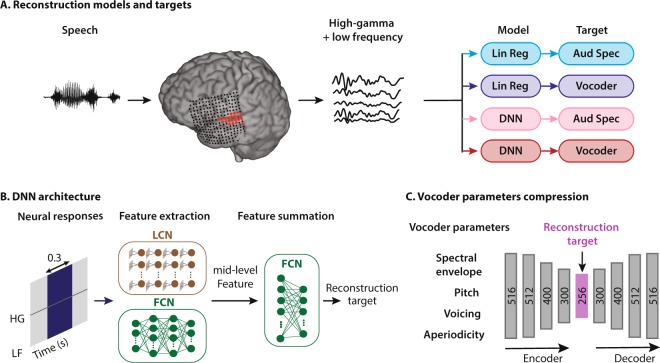
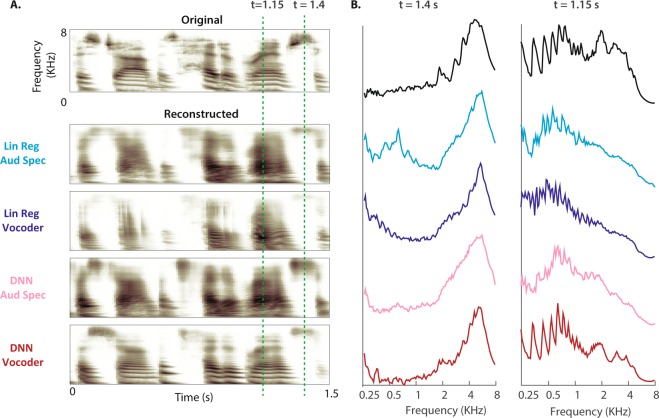
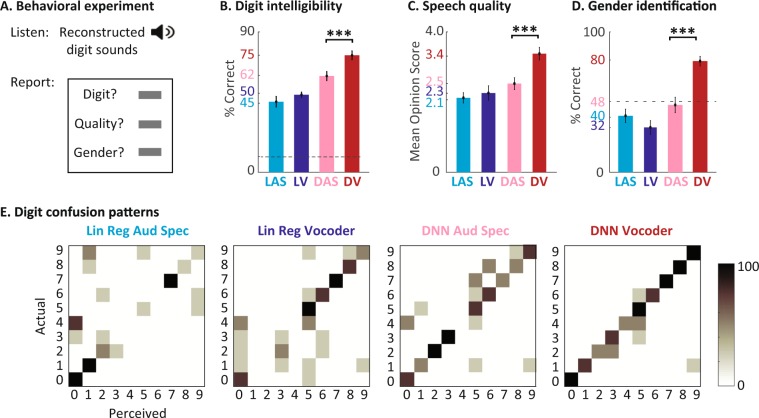
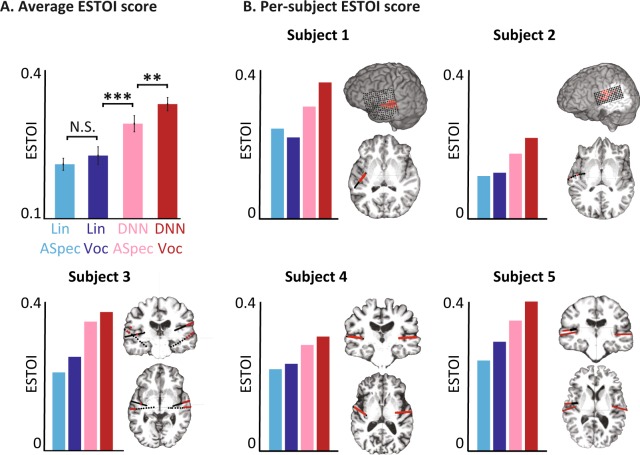
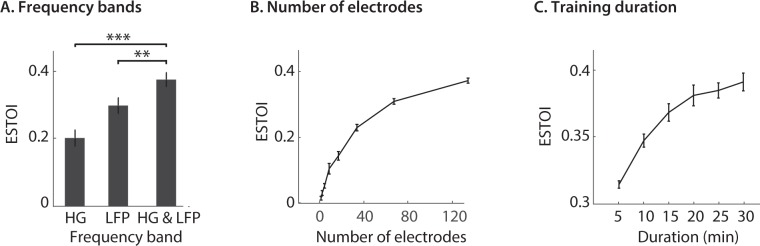
Auditory stimulus reconstruction is a technique that finds the best approximation of the acoustic stimulus from the population of evoked neural activity. Reconstructing speech from the human auditory cortex creates the possibility of a speech neuroprosthetic to establish a direct communication with the brain and has been shown to be possible in both overt and covert conditions. However, the low quality of the reconstructed speech has severely limited the utility of this method for brain-computer interface (BCI) applications. To advance the state-of-the-art in speech neuroprosthesis, we combined the recent advances in deep learning with the latest innovations in speech synthesis technologies to reconstruct closed-set intelligible speech from the human auditory cortex. We investigated the dependence of reconstruction accuracy on linear and nonlinear (deep neural network) regression methods and the acoustic representation that is used as the target of reconstruction, including auditory spectrogram and speech synthesis parameters. In addition, we compared the reconstruction accuracy from low and high neural frequency ranges. Our results show that a deep neural network model that directly estimates the parameters of a speech synthesizer from all neural frequencies achieves the highest subjective and objective scores on a digit recognition task, improving the intelligibility by 65% over the baseline method which used linear regression to reconstruct the auditory spectrogram. These results demonstrate the efficacy of deep learning and speech synthesis algorithms for designing the next generation of speech BCI systems, which not only can restore communications for paralyzed patients but also have the potential to transform human-computer interaction technologies.
Overview
The claims and statistics of this paper haven’t been checked yet.
Free: it reads the open-access text and checks the first 5 claims that cite a source we can check. Create a free account to check every claim.
Integrity signals
Registry
Cites
Statistics
Figures
Verification
Claims the paper makes
The claims and statistics of this paper haven’t been checked yet.
Free: it reads the open-access text and checks the first 5 claims that cite a source we can check. Create a free account to check every claim.
Claims other papers make about this one
Each is checked against this paper’s own text: does it say what the citing paper says it does?
The cited source says what the claim attributes to it.
In the citing paper
“Neural activity in the STG encodes acoustic features — for example, recurring speech sound patterns in the mel-spectrogram — during speech perception53,54 and may be used to reconstruct perceived speech55,56.”
From The speech neuroprosthesis (2024) · cites this paper as [55]
Self-check
Percentages, sums and reported differences re-computed from the paper’s own numbers.
The self-check needs the paper’s full text.
Citations
Cites
ImageNet classification with deep convolutional neural networks
Krizhevsky, A., Sutskever, I., & Hinton, G. E. (2017) · Communications of the ACM · doi:10.1145/3065386 · Cited by 112,155
LeCun, Y., Bengio, Y., & Hinton, G. (2015) · Nature · doi:10.1038/nature14539 · Cited by 84,126
(2014) · Cited by 33,419
Advances in neural information processing systems 7
Cios, K., & Shields, M. (1997) · Neurocomputing · doi:10.1016/s0925-2312(97)90018-7 · Cited by 22,059
Reducing the dimensionality of data with neural networks
Hinton, G. E., & Salakhutdinov, R. R. (2006) · Science · doi:10.1126/science.1127647 · Cited by 20,928
Delving Deep into Rectifiers: Surpassing Human-Level Performance on ImageNet Classification
He, K., Zhang, X., Ren, S., & Sun, J. (2015) · 2015 IEEE International Conference on Computer Vision (ICCV) · doi:10.1109/iccv.2015.123 · Cited by 19,741
A fast learning algorithm for deep belief nets
Hinton, G. E., Osindero, S., & Teh, Y.-W. (2006) · Neural Computation · doi:10.1162/neco.2006.18.7.1527 · Cited by 16,336
Batch Normalization: Accelerating Deep Network Training by Reducing Internal Covariate Shift
Ioffe, S. (2024) · arXiv (Cornell University) · doi:10.57702/o9raffed · Cited by 14,214
TensorFlow: A system for large-scale machine learning
Abadi, M., Barham, P., Chen, J., Chen, Z., Davis, A., Dean, J., Devin, M., Ghemawat, S., Irving, G., Isard, M., et al. (2016) · arXiv (Cornell University) · doi:10.48550/arxiv.1605.08695 · Cited by 11,822
Hinton, G., Deng, L., Yu, D., Dahl, G., Mohamed, A.-R., Jaitly, N., Senior, A., Vanhoucke, V., Nguyen, P., Sainath, T., et al. (2012) · IEEE Signal Processing Magazine · doi:10.1109/msp.2012.2205597 · Cited by 10,260
Research works printed but not linked: 3
- Salza PL Foti E Nebbia L Oreglia M MOS and pair comparison combined methods for quality evaluation of text-to-speech systems Acta Acust. united with Acust. 1996 82 650 656
- Maas AL Hannun AY Ng AY Rectifier nonlinearities improve neural network acoustic models In Proc. icml 2013 30 3
- Kingma, D. P. & Ba, J. Adam: A method for stochastic optimization. arXiv Prepr. arXiv1412.6980 (2014).
Cited by
Speech synthesis from neural decoding of spoken sentences
Anumanchipalli, G. K., Chartier, J., & Chang, E. F. (2019) · Nature · doi:10.1038/s41586-019-1119-1 · Cited by 883
“Meanwhile, decoding of auditory cortex responses has been more successful for speech sounds 30,31 in part because of the direct relationship between the auditory encoding of spectrotemporal information and the reconstructed spectrogram.”
BackgroundA Hybrid Deep Learning-Based Approach for Brain Tumor Classification
Raza, A., Ayub, H., Khan, J. A., Ahmad, I., S. Salama, A., Daradkeh, Y. I., Javeed, D., Ur Rehman, A., & Hamam, H. (2022) · Electronics · doi:10.3390/electronics11071146 · Cited by 354
Natural Language Processing for Smart Healthcare
Zhou, B., Yang, G., Shi, Z., & Ma, S. (2024) · IEEE Reviews in Biomedical Engineering · doi:10.1109/rbme.2022.3210270 · Cited by 230
“In addition, NLP techniques are also of great value for providing essential aids to people with various disabilities, e.g., speech impairments [122], [174]–[178], hearing loss [179], dyslexia [180], or neurological disorders [119]–[121].”
BackgroundDecoding speech perception from non-invasive brain recordings
Défossez, A., Caucheteux, C., Rapin, J., Kabeli, O., & King, J.-R. (2023) · Nature Machine Intelligence · doi:10.1038/s42256-023-00714-5 · Cited by 215
“Thus, it is common to train decoders in a supervised manner to predict a latent representation of speech known to be relevant to the brain [4, 6, 7, 54, 55].”
BackgroundHe, B., Yuan, H., Meng, J., & Gao, S. (2020) · Springer eBooks · doi:10.1007/978-3-030-43395-6_4 · Cited by 168
Evaluation of deep learning in non-coding RNA classification
Amin, N., McGrath, A., & Chen, Y. P. (2019) · Nature Machine Intelligence · doi:10.1038/s42256-019-0051-2 · Cited by 159
Decoding Imagined and Spoken Phrases From Non-invasive Neural (MEG) Signals
Dash, D., Ferrari, P., & Wang, J. (2020) · Frontiers in Neuroscience · doi:10.3389/fnins.2020.00290 · Cited by 124
Deep Learning in EEG: Advance of the Last Ten-Year Critical Period
Gong, S., Xing, K., Cichocki, A., & Li, J. (2021) · IEEE Transactions on Cognitive and Developmental Systems · doi:10.1109/tcds.2021.3079712 · Cited by 147
Herff, C., Krusienski, D. J., & Kubben, P. (2020) · Frontiers in Neuroscience · doi:10.3389/fnins.2020.00123 · Cited by 119
Hierarchical Encoding of Attended Auditory Objects in Multi-talker Speech Perception
O’Sullivan, J., Herrero, J. L., Smith, E. H., Schevon, C. A., McKhann, G. M., Sheth, S. A., Mehta, A. D., & Mesgarani, N. (2019) · Neuron · doi:10.1016/j.neuron.2019.09.007 · Cited by 130
Self-citationAngrick, M., Ottenhoff, M. C., Diener, L., Ivucic, D., Ivucic, G., Goulis, S., Saal, J., Colon, A. J., Wagner, L., Krusienski, D. J., et al. (2021) · Communications Biology · doi:10.1038/s42003-021-02578-0 · Cited by 125
A Tutorial on Auditory Attention Identification Methods
Aličković, E., Lunner, T., Gustafsson, F., & Ljung, L. (2019) · Frontiers in Neuroscience · doi:10.3389/fnins.2019.00153 · Cited by 123
Brain Tumor Classification and Detection Using Hybrid Deep Tumor Network
Amran, G. A., Alsharam, M. S., Blajam, A. O. A., Hasan, A. A., Alfaifi, M. Y., Amran, M., Gumaei, A., & Eldin, S. M. (2022) · Electronics · doi:10.3390/electronics11213457 · Cited by 123
The Potential for a Speech Brain–Computer Interface Using Chronic Electrocorticography
Rabbani, Q., Milsap, G., & Crone, N. E. (2019) · Neurotherapeutics · doi:10.1007/s13311-018-00692-2 · Cited by 126
Herff, C., Diener, L., Angrick, M., Mugler, E., Tate, M. C., Goldrick, M. A., Krusienski, D. J., Slutzky, M. W., & Schultz, T. (2019) · Frontiers in Neuroscience · doi:10.3389/fnins.2019.01267 · Cited by 118
“Comparing the results of Brain-To-Speech to recent deep neural network based approaches (Akbari et al., 2019; Angrick et al., 2019; Anumanchipalli et al., 2019), our approach yields slightly lower correlations and STOI values, but does not require the huge computational costs of deep neural…”
BackgroundResultAngrick, M., Luo, S., Rabbani, Q., Candrea, D. N., Shah, S., Milsap, G., Anderson, W. S., Gordon, C. R., Rosenblatt, K. R., Clawson, L., et al. (2024) · Scientific Reports · doi:10.1038/s41598-024-60277-2 · Cited by 120
Ceolini, E., Hjortkjær, J., Wong, D. D. E., O’Sullivan, J., Raghavan, V., Herrero, J. L., Mehta, A. D., Liu, S., & Mesgarani, N. (2020) · NeuroImage · doi:10.1016/j.neuroimage.2020.117282 · Cited by 109
Self-citationDecoding of the speech envelope from EEG using the VLAAI deep neural network
Accou, B., Vanthornhout, J., hamme, H. V., & Francart, T. (2023) · Scientific Reports · doi:10.1038/s41598-022-27332-2 · Cited by 109
Deep learning approaches for neural decoding across architectures and recording modalities
Livezey, J. A., & Glaser, J. I. (2020) · Briefings in Bioinformatics · doi:10.1093/bib/bbaa355 · Cited by 107
Brain-Computer Interface: Applications to Speech Decoding and Synthesis to Augment Communication
Luo, S., Rabbani, Q., & Crone, N. E. (2022) · Neurotherapeutics · doi:10.1007/s13311-022-01190-2 · Cited by 106
Speaker-independent auditory attention decoding without access to clean speech sources
Han, C., O’Sullivan, J., Luo, Y., Herrero, J. L., Mehta, A. D., & Mesgarani, N. (2019) · Science Advances · doi:10.1126/sciadv.aav6134 · Cited by 107
Self-citationNeural ensemble dynamics in dorsal motor cortex during speech in people with paralysis
Stavisky, S. D., Willett, F. R., Wilson, G. H., Murphy, B. A., Rezaii, P., Avansino, D. T., Memberg, W. D., Miller, J. P., Kirsch, R. F., Hochberg, L. R., et al. (2019) · eLife · doi:10.7554/elife.46015 · Cited by 105
Decoding spoken English from intracortical electrode arrays in dorsal precentral gyrus
Wilson, G. H., Stavisky, S. D., Willett, F. R., Avansino, D. T., Kelemen, J. N., Hochberg, L. R., Henderson, J. M., Druckmann, S., & Shenoy, K. V. (2020) · Journal of Neural Engineering · doi:10.1088/1741-2552/abbfef · Cited by 103
“…has also used neural networks to learn nonlinear mappings that transformneural signals into a variety of outputs such as acoustic speech features (Akbari et al 2019, Angrick et al 2019), including by way of intermediate articulatory kinematics (Anumanchipalli et al 2019), discrete targets such…”
BackgroundSilva, A. B., Littlejohn, K. T., Liu, J. R., Moses, D. A., & Chang, E. F. (2024) · Nature Reviews Neuroscience · doi:10.1038/s41583-024-00819-9 · Cited by 103
“Neural activity in the STG encodes acoustic features — for example, recurring speech sound patterns in the mel-spectrogram — during speech perception 53,54 and may be used to reconstruct perceived speech 55,56 .”
Angrick, M., Luo, S., Rabbani, Q., Candrea, D. N., Shah, S., Milsap, G. W., Anderson, W. S., Gordon, C. R., Rosenblatt, K. R., Clawson, L., et al. (2023) · doi:10.1101/2023.06.30.23291352 · Cited by 95
Towards Voice Reconstruction from EEG during Imagined Speech
Lee, Y.-E., Lee, S., Kim, S., & Lee, S. (2023) · Proceedings of the AAAI Conference on Artificial Intelligence · doi:10.1609/aaai.v37i5.25745 · Cited by 93
Music can be reconstructed from human auditory cortex activity using nonlinear decoding models
Bellier, L., Llorens, A., Marciano, D., Schalk, G., Brunner, P., Knight, R. T., & Pasley, B. N. (2023) · PLoS Biology · doi:10.1371/journal.pbio.3002176 · Cited by 93
Brain-computer interfaces for communication
Vansteensel, M. J., & Jarosiewicz, B. (2020) · Handbook of clinical neurology · doi:10.1016/b978-0-444-63934-9.00007-x · Cited by 85
Baby, D., Broucke, A. V. D., & Verhulst, S. (2021) · Nature Machine Intelligence · doi:10.1038/s42256-020-00286-8 · Cited by 78
Brain2Char: a deep architecture for decoding text from brain recordings
Sun, P., Anumanchipalli, G. K., & Chang, E. F. (2020) · Journal of Neural Engineering · doi:10.1088/1741-2552/abc742 · Cited by 77
High-resolution neural recordings improve the accuracy of speech decoding
Duraivel, S., Rahimpour, S., Chiang, C.-H., Trumpis, M., Wang, C., Barth, K., Harward, S. C., Lad, S. P., Friedman, A. H., Southwell, D. G., et al. (2023) · Nature Communications · doi:10.1038/s41467-023-42555-1 · Cited by 75
A Bimodal Deep Learning Architecture for EEG-fNIRS Decoding of Overt and Imagined Speech
Cooney, C., Folli, R., & Coyle, D. (2021) · IEEE Transactions on Biomedical Engineering · doi:10.1109/tbme.2021.3132861 · Cited by 70
Direct-Sense Brain–Computer Interfaces and Wearable Computers
Lin, C., & Do, T. (2020) · IEEE Transactions on Systems Man and Cybernetics Systems · doi:10.1109/tsmc.2020.3041382 · Cited by 71
Rainey, S., Martin, S., Christen, A., Mégevand, P., & Fourneret, E. (2020) · Science and Engineering Ethics · doi:10.1007/s11948-020-00218-0 · Cited by 65
Accou, B., Monesi, M. J., Montoya-Martínez, J., hamme, H. V., & Francart, T. (2020) · European Signal Processing Conference (EUSIPCO) · doi:10.23919/eusipco47968.2020.9287417 · Cited by 65
Neural decoding of music from the EEG
Daly, I. P. (2023) · Scientific Reports · doi:10.1038/s41598-022-27361-x · Cited by 64
Artificial Intelligence in Medicine and Healthcare: applications, availability and societal impact
Gómez-González, E., & Gutiérrez, E. G. (2020) · Deposito de Investigacion Universidad de Sevilla (University of Seville) · doi:10.2760/047666 · Cited by 65
Roussel, P., Godais, G. L., Bocquelet, F., Palma, M., Hongjie, J., Zhang, S., Giraud, A.-L., Mégevand, P., Miller, K., Gehrig, J., et al. (2020) · Journal of Neural Engineering · doi:10.1088/1741-2552/abb25e · Cited by 49
Flexible, high-resolution thin-film electrodes for human and animal neural research
Chiang, C.-H., Wang, C., Barth, K., Rahimpour, S., Trumpis, M., Duraivel, S., Rachinskiy, I., Dubey, A., Wingel, K. E., Wong, M., et al. (2021) · Journal of Neural Engineering · doi:10.1088/1741-2552/ac02dc · Cited by 49
Restoring Speech Using Brain–Computer Interfaces
Stavisky, S. D. (2025) · Annual Review of Biomedical Engineering · doi:10.1146/annurev-bioeng-110122-012818 · Cited by 52
Data-driven models in human neuroscience and neuroengineering
Brunton, B. W., & Beyeler, M. (2019) · Current Opinion in Neurobiology · doi:10.1016/j.conb.2019.06.008 · Cited by 51
LipSound2: Self-Supervised Pre-Training for Lip-to-Speech Reconstruction and Lip Reading
Qu, L., Weber, C., & Wermter, S. (2022) · IEEE Transactions on Neural Networks and Learning Systems · doi:10.1109/tnnls.2022.3191677 · Cited by 50
Heelan, C., Lee, J., O’Shea, R., Lynch, L., Brandman, D. M., Truccolo, W., & Nurmikko, A. V. (2019) · Communications Biology · doi:10.1038/s42003-019-0707-9 · Cited by 40
Chandrasekaran, S., Fifer, M. S., Bickel, S., Osborn, L. E., Herrero, J. L., Christie, B. P., Xu, J., Murphy, R. K. J., Singh, S., Glasser, M. F., et al. (2021) · Bioelectronic Medicine · doi:10.1186/s42234-021-00076-6 · Cited by 45
Self-citationA convolutional neural-network framework for modelling auditory sensory cells and synapses
Drakopoulos, F., Baby, D., & Verhulst, S. (2021) · Communications Biology · doi:10.1038/s42003-021-02341-5 · Cited by 44
Synthesizing Speech from Intracranial Depth Electrodes using an Encoder-Decoder Framework
Kohler, J., Ottenhoff, M. C., Goulis, S., Angrick, M., Colon, A. J., Wagner, L., Tousseyn, S., Kubben, P. L., & Herff, C. (2022) · Neurons, Behavior, Data analysis, and Theory · doi:10.51628/001c.57524 · Cited by 28
Direct speech reconstruction from sensorimotor brain activity with optimized deep learning models
Berezutskaya, J., Freudenburg, Z. V., Vansteensel, M. J., Aarnoutse, E. J., Ramsey, N. F., & van Gerven, M. A. J. (2023) · Journal of Neural Engineering · doi:10.1088/1741-2552/ace8be · Cited by 42
Direct Speech Reconstruction from Sensorimotor Brain Activity with Optimized Deep Learning Models
Berezutskaya, J., Freudenburg, Z. V., Vansteensel, M. J., Aarnoutse, E. J., Ramsey, N. F., & van Gerven, M. A. J. (2022) · doi:10.1101/2022.08.02.502503 · Cited by 42
The risks and challenges of neurotechnologies for human rights
M, S. N., & C, G. (2023) · UNESCO eBooks · doi:10.54678/pogs7778 · Cited by 44
UniCoRN: Unified Cognitive Signal ReconstructioN bridging cognitive signals and human language
Xi, N., Zhao, S., Wang, H., Liu, C., Qin, B., & Liu, T. (2023) · Proceedings of the conference - Association for Computational Linguistics. Meeting · doi:10.18653/v1/2023.acl-long.741 · Cited by 42
Lee, S., Lee, Y.-E., & Lee, S. (2022) · International Winter Conference on Brain-Computer Interface (BCI) · doi:10.1109/bci53720.2022.9734827 · Cited by 42
Free Will and Autonomy in the Age of Neurotechnologies
Lavazza, A. (2022) · Ethics of science and technology assessment/Wissenschaftsethik und Technikfolgenbeurteilung · doi:10.1007/978-3-030-94032-4_5 · Cited by 41
Auditory stimulus-response modeling with a match-mismatch task
de Cheveigné, A., Slaney, M., Fuglsang, S. A., & Hjortkjær, J. (2021) · Journal of Neural Engineering · doi:10.1088/1741-2552/abf771 · Cited by 40
Chandler, J. A., der Loos, K. I. V., Boehnke, S. E., Beaudry, J. S., Buchman, D. Z., & Illes, J. (2022) · Frontiers in Human Neuroscience · doi:10.3389/fnhum.2022.841035 · Cited by 37
Feasibility of decoding covert speech in ECoG with a Transformer trained on overt speech
Komeiji, S., Mitsuhashi, T., Iimura, Y., Suzuki, H., Sugano, H., Shinoda, K., & Tanaka, T. (2024) · Scientific Reports · doi:10.1038/s41598-024-62230-9 · Cited by 34
Including Measures of High Gamma Power Can Improve the Decoding of Natural Speech From EEG
Synigal, S. R., Teoh, E. S., & Lalor, E. C. (2020) · Frontiers in Human Neuroscience · doi:10.3389/fnhum.2020.00130 · Cited by 34
Predicting speech intelligibility from EEG in a non-linear classification paradigm *
Accou, B., Monesi, M. J., hamme, H. V., & Francart, T. (2021) · Journal of Neural Engineering · doi:10.1088/1741-2552/ac33e9 · Cited by 34
EEG-Based Decoding of Auditory Attention to a Target Instrument in Polyphonic Music
Cantisani, G., Essid, S., & Richard, G. (2019) · IEEE Workshop on Applications of Signal Processing to Audio and Acoustics (WASPAA) · doi:10.1109/waspaa.2019.8937219 · Cited by 33
Angrick, M., Herff, C., Johnson, G. D., Shih, J. J., Krusienski, D. J., & Schultz, T. (2019) · Neurocomputing · doi:10.1016/j.neucom.2018.10.080 · Cited by 31
NeuroSight : A Deep‐Learning Integrated Efficient Approach to Brain Tumor Detection
Mugdha, S. B. S., & Uddin, M. (2025) · Engineering Reports · doi:10.1002/eng2.13100 · Cited by 30
The business of brain–computer interfaces
Smalley, E. (2019) · Nature Biotechnology · doi:10.1038/s41587-019-0231-y · Cited by 31
Endovascular neuromodulation: safety profile and future directions
Raza, S. A., Opie, N. L., Morokoff, A., Sharma, R. P., Mitchell, P. J., & Oxley, T. J. (2020) · Frontiers in Neurology · doi:10.3389/fneur.2020.00351 · Cited by 29
Brain implants that let you speak your mind
Pandarinath, C., & Ali, Y. H. (2019) · Nature · doi:10.1038/d41586-019-01181-y · Cited by 29
Petrosyan, A., Voskoboinikov, A., Sukhinin, D., Makarova, A. V., Skalnaya, A. A., Arkhipova, N., Sinkin, M. V., & Ossadtchi, A. E. (2022) · Journal of Neural Engineering · doi:10.1088/1741-2552/aca1e1 · Cited by 28
Distributed feedforward and feedback cortical processing supports human speech production
Wang, R., Chen, X., Khalilian-Gourtani, A., Yu, L., Dugan, P. C., Friedman, D. J., Doyle, W., Devinsky, O., Wang, Y., & Flinker, A. (2023) · Proceedings of the National Academy of Sciences · doi:10.1073/pnas.2300255120 · Cited by 29
Wu, X., Wellington, S., Fu, Z., & Zhang, D. (2024) · Journal of Neural Engineering · doi:10.1088/1741-2552/ad593a · Cited by 28
Wu, X., Metcalfe, B., He, S., Tan, H., & Zhang, D. (2024) · IEEE Transactions on Neural Systems and Rehabilitation Engineering · doi:10.1109/tnsre.2024.3421551 · Cited by 27
A BCI based Smart Home System Combined with Event-related Potentials and Speech Imagery Task
Kim, H.-J., Lee, M.-H., & Lee, M. (2020) · International Winter Conference on Brain-Computer Interface (BCI) · doi:10.1109/bci48061.2020.9061634 · Cited by 27
Deep Neural Network Model of Hearing-Impaired Speech-in-Noise Perception
Haro, S., Smalt, C. J., Ciccarelli, G. A., & Quatieri, T. F. (2020) · Frontiers in Neuroscience · doi:10.3389/fnins.2020.588448 · Cited by 27
Beyond linear neural envelope tracking: a mutual information approach
Clercq, P. D., Vanthornhout, J., Vandermosten, M., & Francart, T. (2023) · Journal of Neural Engineering · doi:10.1088/1741-2552/acbe1d · Cited by 26
Generalizable EEG Encoding Models with Naturalistic Audiovisual Stimuli
Desai, M., Holder, J., Villarreal, C., Clark, N., Hoang, B., & Hamilton, L. S. (2021) · Journal of Neuroscience · doi:10.1523/jneurosci.2891-20.2021 · Cited by 26
Transformer-Based Estimation of Spoken Sentences Using Electrocorticography
Komeiji, S., Shigemi, K., Mitsuhashi, T., Iimura, Y., Suzuki, H., Sugano, H., Shinoda, K., & Tanaka, T. (2022) · IEEE International Conference on Acoustics Speech and Signal Processing · doi:10.1109/icassp43922.2022.9747443 · Cited by 26
de Borman, A., Wittevrongel, B., Dauwe, I., Carrette, E., Meurs, A., Roost, D. V., Boon, P., & Hulle, M. M. V. (2024) · Communications Biology · doi:10.1038/s42003-024-06518-6 · Cited by 24
Guo, Y., Liu, T., Zhang, X., Wang, A., & Wang, W. (2023) · Knowledge-Based Systems · doi:10.1016/j.knosys.2023.110837 · Cited by 23
Brain‐Controlled Augmented Hearing for Spatially Moving Conversations in Multi‐Talker Environments
Choudhari, V., Han, C., Bickel, S., Mehta, A. D., Schevon, C. A., McKhann, G. M., & Mesgarani, N. (2024) · Advanced Science · doi:10.1002/advs.202401379 · Cited by 23
Self-citationSingle-paradigm and hybrid brain computing interfaces and their use by disabled patients
de Neeling, M. G. J., & Hulle, M. M. V. (2019) · Journal of Neural Engineering · doi:10.1088/1741-2552/ab2706 · Cited by 23
Wu, X., Jiang, S., Li, G., Liu, S., Metcalfe, B., Chen, L., & Zhang, D. (2023) · IEEE Journal of Biomedical and Health Informatics · doi:10.1109/jbhi.2023.3242262 · Cited by 22
Lim, M. J. R., Lo, Y. T., Tan, Y. Y., Lin, H.-Y., Wang, Y., Tan, D., Wang, E., Ma, Y. Y. N., Ng, J. J. W., Jefree, R. A., et al. (2025) · Journal of Neural Engineering · doi:10.1088/1741-2552/adb88e · Cited by 21
Meng, K., Grayden, D. B., Cook, M. J., Vogrin, S. J., & Goodarzy, F. (2021) · International Winter Conference on Brain-Computer Interface (BCI) · doi:10.1109/bci51272.2021.9385355 · Cited by 20
Sufficient sampling for kriging prediction of cortical potential in rat, monkey, and human µECoG
Trumpis, M., Chiang, C., Orsborn, A. L., Bent, B., Li, J., Rogers, J. A., Pesaran, B., Cogan, G. B., & Viventi, J. (2021) · Journal of Neural Engineering · doi:10.1088/1741-2552/abd460 · Cited by 19
Cooney, C., Folli, R., & Coyle, D. (2022) · Neuroscience & Biobehavioral Reviews · doi:10.1016/j.neubiorev.2022.104783 · Cited by 19
ExGSense: Toward Facial Gesture Sensing with a Sparse Near-Eye Sensor Array
Chen, C., Sun, K., & Zhang, X. (2021) · ACM/IEEE International Conference on Information Processing in Sensor Networks (IPSN) · doi:10.1145/3412382.3458268 · Cited by 19
Towards Closed-Loop Speech Synthesis from Stereotactic EEG: A Unit Selection Approach
Angrick, M., Ottenhoff, M. C., Diener, L., Ivucic, D., Ivucic, G., Goulis, S., Colon, A., Wagner, L., Krusienski, D. J., Kubben, P., et al. (2022) · IEEE International Conference on Acoustics Speech and Signal Processing · doi:10.1109/icassp43922.2022.9747300 · Cited by 18
Two stages of speech envelope tracking in human auditory cortex modulated by speech intelligibility
Xu, N., Zhao, B., Luo, L., Zhang, K., Shao, X., Luan, G., Wang, Q., Hu, W., & Wang, Q. (2022) · Cerebral Cortex · doi:10.1093/cercor/bhac203 · Cited by 17
Majumdar, S., Al‐Habaibeh, A., Omurtag, A., Shakmak, B., & Asrar, M. (2023) · Neuroscience Informatics · doi:10.1016/j.neuri.2023.100126 · Cited by 17
Meng, K., Goodarzy, F., Kim, E., Park, Y. J., Kim, J. S., Cook, M. J., Chung, C. K., & Grayden, D. B. (2023) · Journal of Neural Engineering · doi:10.1088/1741-2552/ace7f6 · Cited by 17
Li, C., Liu, Y., Li, J., Miao, Y., Liu, J., & Song, L. (2024) · IEEE Transactions on Neural Systems and Rehabilitation Engineering · doi:10.1109/tnsre.2023.3348981 · Cited by 17
Angrick, M., Ottenhoff, M. C., Goulis, S., Colon, A., Wagner, L., Krusienski, D. J., Kubben, P., Schultz, T., & Herff, C. (2021) · Annual International Conference of the IEEE Engineering in Medicine and Biology Society (EMBC) · doi:10.1109/embc46164.2021.9629711 · Cited by 17
Therapeutic Effectiveness of Brain Computer Interfaces in Stroke Patients: A Systematic Review
Penev, Y. P., Beneke, A. A., Root, K. T., Meisel, E. P., Kwak, S., Diaz, M. J., Root, J., Hosseini, M. R., & Lucke-Wold, B. P. (2023) · Journal of Experimental Neurology · doi:10.33696/neurol.4.077 · Cited by 17
VocalMind: A Stereotactic EEG Dataset for Vocalized, Mimed, and Imagined Speech in Tonal Language
He, T., Wei, M., Wang, R., Wang, R., Du, S., Cai, S., Tao, W., & Li, H. (2025) · Scientific Data · doi:10.1038/s41597-025-04741-2 · Cited by 17
Human brain function and brain-computer interfaces
Ramsey, N. F. (2020) · Handbook of clinical neurology · doi:10.1016/b978-0-444-63934-9.00001-9 · Cited by 16
Dynamic time-locking mechanism in the cortical representation of spoken words
Nora, A., Faisal, A., Seol, J., Renvall, H., Formisano, E., & Salmelin, R. H. (2020) · eNeuro · doi:10.1523/eneuro.0475-19.2020 · Cited by 16
Bouton, C. E., Bhagat, N. A., Chandrasekaran, S., Herrero, J. L., Markowitz, N., Espinal, E., Kim, J.-W., Ramdeo, R., Xu, J., Glasser, M. F., et al. (2021) · Frontiers in Neuroscience · doi:10.3389/fnins.2021.699631 · Cited by 16
Self-citationA hybrid autoencoder framework of dimensionality reduction for brain-computer interface decoding
Ran, X., Chen, W., Yvert, B., & Zhang, S. (2022) · Computers in Biology and Medicine · doi:10.1016/j.compbiomed.2022.105871 · Cited by 16
Neural tracking of speech mental imagery during rhythmic inner counting
Lu, L., Wang, Q., Sheng, J., Liu, Z., Qin, L., Li, L., & Gao, J. (2019) · eLife · doi:10.7554/elife.48971 · Cited by 16
Decoding Silent Reading EEG Signals Using Adaptive Feature Graph Convolutional Network
Li, C., Fang, G., Liu, Y., Liu, J., & Song, L. (2023) · IEEE Signal Processing Letters · doi:10.1109/lsp.2023.3337727 · Cited by 15
Semantic Reconstruction of Continuous Language from Meg Signals
Wang, B., Xu, X., Zhang, L., Xiao, B., Wu, X. H., & Chen, J. (2024) · IEEE International Conference on Acoustics Speech and Signal Processing · doi:10.1109/icassp48485.2024.10448281 · Cited by 15
Reconstructing Covert Consciousness: Neural Decoding as a Novel Consciousness Assessment
Fischer, D. B., Edlow, B. L., Freeman, H. J., Alaiev, D., Wu, Q., Ware, J. B., Detre, J. A., & Aguirre, G. K. (2025) · Neurology · doi:10.1212/wnl.0000000000210208 · Cited by 15
Park, J.-Y., Tsukamoto, M., Tanaka, M., & Kamitani, Y. (2025) · PLoS Biology · doi:10.1371/journal.pbio.3003293 · Cited by 16
Progress, challenges and future of linguistic neural decoding with deep learning
Wang, Y., Liu, H., Wang, Y., Xuan, C., Hou, Y., Feng, S., Liu, H., Liao, Y., & Wang, Y. (2025) · Communications Biology · doi:10.1038/s42003-025-08511-z · Cited by 15
Metadata
- Authors
- Akbari, H., Khalighinejad, B., Herrero, J. L., Mehta, A. D., & Mesgarani, N.
- Affiliations
- Mortimer B. Zuckerman Mind Brain Behavior Institute (US)
- Feinstein Institute for Medical Research (US)
- Corresponding author
- Mesgarani, Nima
- Venue
- Scientific Reports
- Published
- 2019-01-29
- Volume
- 9
- Issue
- 1
- Pages
- 874-874
- ISSN
- 2045-2322 (ISSN-L)
- PMC
- PMC6351601
- OpenAlex
- W2913144232
- Semantic Scholar
- 5b6529603d1e4a2fb3c79489e3b8bdef196f5c16
- Cited by
- 221
- References
- 84
- Citations by year
- 2026: 11 · 2025: 25 · 2024: 33 · 2023: 28 · 2022: 28 · 2021: 35 · 2020: 29 · 2019: 32
- FWCI
- 18.01
- Type
- journal article
- Language
- en
- Open access
- gold
- doi.org
- Licence
- cc-by
- creativecommons.org/licenses/by/4.0 (tdm)
- creativecommons.org/licenses/by/4.0 (vor)
- Locations
- Scientific Reports (publishedVersion, cc-by)
- Europe PMC (PubMed Central) (publishedVersion, cc-by)
- PubMed Central (publishedVersion, cc-by)
- PubMed (publishedVersion)
- DOAJ (DOAJ: Directory of Open Access Journals) (submittedVersion)
- Funders
- U.S. Department of Health & Human Services | NIH | National Institute on Deafness and Other Communication Disorders (DC014279)
- Topics
- Life Sciences › Neuroscience › Cognitive Neuroscience › EEG and Brain-Computer Interfaces
- Physical Sciences › Computer Science › Artificial Intelligence › Speech Recognition and Synthesis
- Physical Sciences › Computer Science › Signal Processing › Speech and Audio Processing
- Keywords
- auditory cortex, speech reconstruction, brain-computer interface, deep neural network regression, speech intelligibility, digit recognition
- MeSH terms
- Deep Learning, Acoustic Stimulation, Algorithms, Auditory Cortex, Brain Mapping, Evoked Potentials, Auditory, Humans, Speech, Speech Intelligibility, Speech Perception, Neural Networks, Computer, Neural Prostheses
About these checks
Registry, retraction, Cites and statistics results are computed, not judged, with one exception: a printed reference that no index lists is read once by a model before it counts as a citation error. Claims are extracted by a model and kept only when their quote appears verbatim in the text; each cited source is then checked, with a model’s help, for whether it says what the claim relies on. Those verdicts can be wrong — read the claim’s quote and the cited source before relying on one.
Statistics and arithmetic are recomputed, not judged.
Confidence bands are shown only for fields calibrated on our annotated test set. None is calibrated yet, so no band is shown.
What counts as a claim ›How we measure confidence ›How we check this ›
Are you an author, or do you see a problem with this page? Request a review
Data sources
Bibliographic data: Semantic Scholar, OpenAlex, Crossref.
Contains information from the Semantic Scholar Academic Graph Datasets, made available under the ODC Attribution License (ODC-BY 1.0).
Semantic Scholar’s data is described in: Kinney, R., et al. (2023). The Semantic Scholar Open Data Platform. arXiv:2301.10140.
