

DeepSOFA: a continuous acuity score for critically ill patients using clinically interpretable deep learning.
Open accessThe DOI matches its Crossref record; 25 of the 25 references it cites were found in a registry or an index.
Abstract
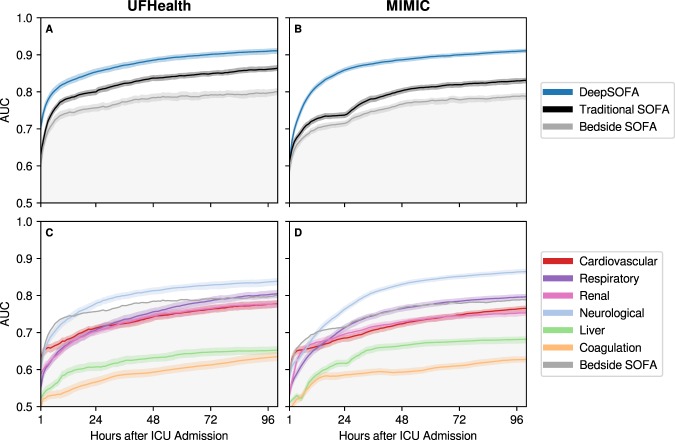
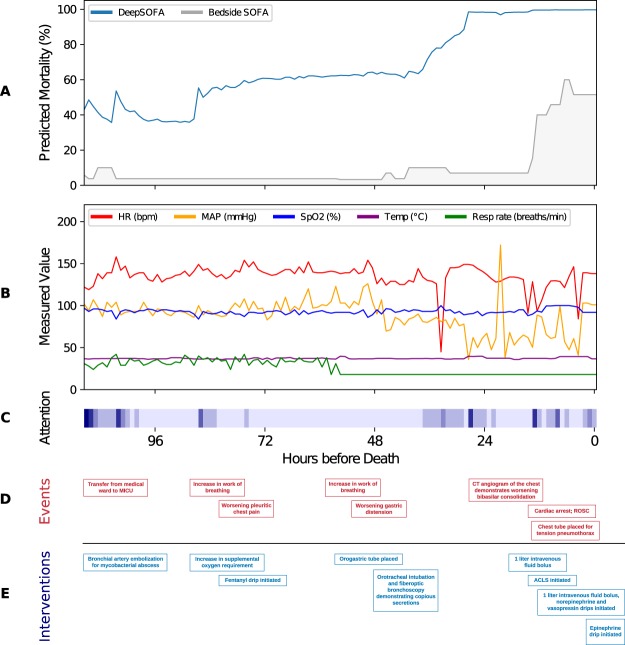
Traditional methods for assessing illness severity and predicting in-hospital mortality among critically ill patients require time-consuming, error-prone calculations using static variable thresholds. These methods do not capitalize on the emerging availability of streaming electronic health record data or capture time-sensitive individual physiological patterns, a critical task in the intensive care unit. We propose a novel acuity score framework (DeepSOFA) that leverages temporal measurements and interpretable deep learning models to assess illness severity at any point during an ICU stay. We compare DeepSOFA with SOFA (Sequential Organ Failure Assessment) baseline models using the same model inputs and find that at any point during an ICU admission, DeepSOFA yields significantly more accurate predictions of in-hospital mortality. A DeepSOFA model developed in a public database and validated in a single institutional cohort had a mean AUC for the entire ICU stay of 0.90 (95% CI 0.90–0.91) compared with baseline SOFA models with mean AUC 0.79 (95% CI 0.79–0.80) and 0.85 (95% CI 0.85–0.86). Deep models are well-suited to identify ICU patients in need of life-saving interventions prior to the occurrence of an unexpected adverse event and inform shared decision-making processes among patients, providers, and families regarding goals of care and optimal resource utilization.
Overview
The claims and statistics of this paper haven’t been checked yet.
Free: it reads the open-access text and checks the first 5 claims that cite a source we can check. Create a free account to check every claim.
Integrity signals
Registry
Cites
Statistics
Figures



Verification
Claims the paper makes
The claims and statistics of this paper haven’t been checked yet.
Free: it reads the open-access text and checks the first 5 claims that cite a source we can check. Create a free account to check every claim.
Claims other papers make about this one
Each is checked against this paper’s own text: does it say what the citing paper says it does?
The cited source doesn’t support the claim as written.
In the citing paper
“Additionally, because of their high sensitivity but low discriminatory ability, these scores identify a large number of patients as “at risk” when the actual number is far lower (38).”
From Accessing Artificial Intelligence for Clinical Decision-Making (2021) · cites this paper as [38]
Checked by a reasoning model — may be wrong.
Experimental — accuracy not yet measuredThe cited source says what the claim attributes to it.
In the citing paper
“When applied to the same variable set used to calculate SOFA scores, deep models outperform traditional SOFA modeling in predicting in-hospital mortality for ICU patients.42”
From Artificial Intelligence and Surgical Decision-making. (2020) · cites this paper as [42]
The cited source says what the claim attributes to it.
In the citing paper
“The EHR contains a large amount of data that may be useful to identify patients at the highest risk of decompensation if the data are evaluated over time (37, 38).”
From Accessing Artificial Intelligence for Clinical Decision-Making (2021) · cites this paper as [38]
The cited source says what the claim attributes to it.
In the citing paper
“AI-based algorithms using time series data from the EHR are in development with strong results.”
From Accessing Artificial Intelligence for Clinical Decision-Making (2021) · cites this paper as [38]
The cited source says what the claim attributes to it.
In the citing paper
“Its predictive ability performed well in identifying increased risk of mortality.”
From Accessing Artificial Intelligence for Clinical Decision-Making (2021) · cites this paper as [38]
2 more claims about this paper
Create a free account to see every claim other papers make about this one.
Self-check
Percentages, sums and reported differences re-computed from the paper’s own numbers.
The self-check needs the paper’s full text.
Citations
Cites
LeCun, Y., Bengio, Y., & Hinton, G. (2015) · Nature · doi:10.1038/nature14539 · Cited by 84,126
Learning Phrase Representations using RNN Encoder–Decoder for Statistical Machine Translation
Cho, K., van Merrienboer, B., Gulcehre, C., Bahdanau, D., Bougares, F., Schwenk, H., & Bengio, Y. (2014) · Proceedings of the 2014 Conference on Empirical Methods in Natural Language Processing (EMNLP) · doi:10.3115/v1/d14-1179 · Cited by 25,545
Dermatologist-level classification of skin cancer with deep neural networks
Esteva, A., Kuprel, B., Novoa, R. A., Ko, J., Swetter, S. M., Blau, H. M., & Thrun, S. (2017) · Nature · doi:10.1038/nature21056 · Cited by 14,362
Vincent, J. L., Moreno, R., Takala, J., Willatts, S., De Mendonça, A., Bruining, H., Reinhart, C. K., Suter, P. M., & Thijs, L. G. (1996) · Intensive Care Medicine · doi:10.1007/bf01709751 · Cited by 11,674
Empirical Evaluation of Gated Recurrent Neural Networks on Sequence Modeling
Chung, J., Gulcehre, C., Cho, K., & Bengio, Y. (2014) · arXiv · doi:10.48550/arxiv.1412.3555 · Cited by 11,008
MIMIC-III, a freely accessible critical care database
Johnson, A. E. W., Pollard, T. J., Shen, L., Lehman, L.-W. H., Feng, M., Ghassemi, M., Moody, B., Szolovits, P., Anthony Celi, L., & Mark, R. G. (2016) · Scientific Data · doi:10.1038/sdata.2016.35 · Cited by 8,141
Gulshan, V., Peng, L., Coram, M., Stumpe, M. C., Wu, D., Narayanaswamy, A., Venugopalan, S., Widner, K., Madams, T., Cuadros, J., et al. (2016) · JAMA · doi:10.1001/jama.2016.17216 · Cited by 7,697
Vincent, J.-L., de Mendonca, A., Cantraine, F., Moreno, R., Takala, J., Suter, P. M., Sprung, C. L., Colardyn, F., & Blecher, S. (1998) · Critical Care Medicine · doi:10.1097/00003246-199811000-00016 · Cited by 3,463
Serial Evaluation of the SOFA Score to Predict Outcome in Critically Ill Patients
Ferreira, F. L. (2001) · JAMA · doi:10.1001/jama.286.14.1754 · Cited by 2,862
Zimmerman, J. E., Kramer, A. A., McNair, D. S., & Malila, F. M. (2006) · Critical Care Medicine · doi:10.1097/01.ccm.0000215112.84523.f0 · Cited by 1,764
Research works printed but not linked: 1
- Goodfellow, I., Bengio, Y. & Courville, A. Deep Learning. (MIT Press, 2016).
Cited by
Yang, G., Ye, Q., & Xia, J. (2022) · Information Fusion · doi:10.1016/j.inffus.2021.07.016 · Cited by 717
Artificial Intelligence and Surgical Decision-making.
Loftus, T. J., Tighe, P. J., Filiberto, A. C., Efron, P. A., Brakenridge, S. C., Mohr, A. M., Rashidi, P., Upchurch, G. R., & Bihorac, A. (2020) · JAMA Surgery · doi:10.1001/jamasurg.2019.4917 · Cited by 650
“42 Preliminary data suggest that deep models are theoretically capable of accurately predicting risk for perioperative and postoperative complications and augmenting recommendations for operative management and the informed consent process.”
BackgroundSelf-citationExplainable AI for Healthcare 5.0: Opportunities and Challenges
Saraswat, D., Bhattacharya, P., Verma, A., Prasad, V. K., Tanwar, S., Sharma, G., Bokoro, P. N., & Sharma, R. (2022) · IEEE Access · doi:10.1109/access.2022.3197671 · Cited by 523
Lauritsen, S. M., Kristensen, M., Olsen, M. V., Larsen, M. S., Lauritsen, K. M., Jørgensen, M. J., Lange, J., & Thiesson, B. (2020) · Nature Communications · doi:10.1038/s41467-020-17431-x · Cited by 448
Accessing Artificial Intelligence for Clinical Decision-Making
Giordano, C., Brennan, M., Mohamed, B., Rashidi, P., Modave, F., & Tighe, P. (2021) · Frontiers in Digital Health · doi:10.3389/fdgth.2021.645232 · Cited by 326
“Multivariate regression-based models or AI-based early-warning systems have the potential to detect subtle trends in physiologic parameters over time to provide precision and reliability (38–41).”
InfluentialSelf-citation
Metadata
- Authors
- Shickel, B., Loftus, T. J., Adhikari, L., Ozrazgat-Baslanti, T., Bihorac, A., & Rashidi, P.
- Affiliations
- University of Florida (US)
- Corresponding author
- Bihorac, Azra
- Venue
- Scientific Reports
- Published
- 2019-02-12
- Volume
- 9
- Issue
- 1
- Pages
- 1879-1879
- ISSN
- 2045-2322 (ISSN-L)
- PMC
- PMC6372608
- OpenAlex
- W2889037799
- Cited by
- 165
- References
- 22
- Citations by year
- 2026: 12 · 2025: 22 · 2024: 16 · 2023: 26 · 2022: 28 · 2021: 29 · 2020: 23 · 2019: 9
- FWCI
- 10.15
- Type
- journal article
- Language
- en
- Open access
- gold
- doi.org
- Licence
- cc-by
- creativecommons.org/licenses/by/4.0 (tdm)
- creativecommons.org/licenses/by/4.0 (vor)
- Locations
- Scientific Reports (publishedVersion, cc-by)
- Europe PMC (PubMed Central) (publishedVersion, cc-by)
- PubMed Central (publishedVersion, cc-by)
- PubMed (publishedVersion)
- arXiv (Cornell University) (submittedVersion)
- DOAJ (DOAJ: Directory of Open Access Journals) (submittedVersion)
- arXiv (Cornell University)
- Funders
- Internal funds at J. Crayton Pruitt Family Department of Biomedical Engineering, University of Florida.
- U.S. Department of Health & Human Services | NIH | National Institute of General Medical Sciences (T32 GM-008721, R01 GM110240, P50 GM-111152)
- National Science Foundation (NSF-IIS 1750192)
- Topics
- Physical Sciences › Computer Science › Artificial Intelligence › Machine Learning in Healthcare
- Health Sciences › Medicine › Critical Care and Intensive Care Medicine › Sepsis Diagnosis and Treatment
- Health Sciences › Health Professions › Health Information Management › Artificial Intelligence in Healthcare
- Keywords
- in-hospital mortality prediction, critically ill patients, intensive care unit, explainable deep learning, SOFA score, electronic health record data, goals of care, shared decision-making
- MeSH terms
- Deep Learning, Adolescent, Adult, Aged, Critical Care, Decision Making, Female, Humans, Intensive Care Units, Length of Stay, Longitudinal Studies, Male, Middle Aged, Probability, Retrospective Studies, Severity of Illness Index, Databases, Factual, Critical Illness, Hospital Mortality, Area Under Curve, Young Adult, Organ Dysfunction Scores
About these checks
Registry, retraction, Cites and statistics results are computed, not judged, with one exception: a printed reference that no index lists is read once by a model before it counts as a citation error. Claims are extracted by a model and kept only when their quote appears verbatim in the text; each cited source is then checked, with a model’s help, for whether it says what the claim relies on. Those verdicts can be wrong — read the claim’s quote and the cited source before relying on one.
Statistics and arithmetic are recomputed, not judged.
Confidence bands are shown only for fields calibrated on our annotated test set. None is calibrated yet, so no band is shown.
What counts as a claim ›How we measure confidence ›How we check this ›
Are you an author, or do you see a problem with this page? Request a review
How to cite
Cite CoChat for the checks on this page, and the paper for its own findings.
- This page
- CoChat. (2026). Citation check: DeepSOFA: a continuous acuity score for critically ill patients using clinically interpretable deep learning. https://app.cochat.ai/papers/10.1038/s41598-019-38491-0
- The paper
- Shickel, B., Loftus, T. J., Adhikari, L., Ozrazgat-Baslanti, T., Bihorac, A., & Rashidi, P. (2019). DeepSOFA: a continuous acuity score for critically ill patients using clinically interpretable deep learning. Scientific Reports. https://doi.org/10.1038/s41598-019-38491-0
Data sources
Bibliographic data: Semantic Scholar, OpenAlex, Crossref.
Contains information from the Semantic Scholar Academic Graph Datasets, made available under the ODC Attribution License (ODC-BY 1.0).
Semantic Scholar’s data is described in: Kinney, R., et al. (2023). The Semantic Scholar Open Data Platform. arXiv:2301.10140.
