

DeepSOFA: a continuous acuity score for critically ill patients using clinically interpretable deep learning.
Open accessThe DOI matches its Crossref record; 25 of the 25 references it cites were found in a registry or an index.
Abstract
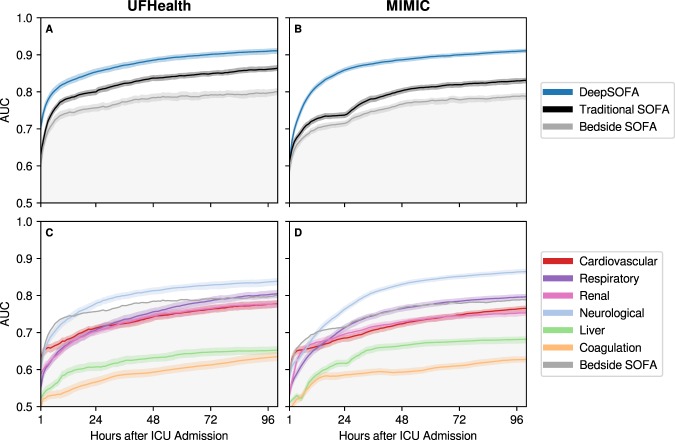
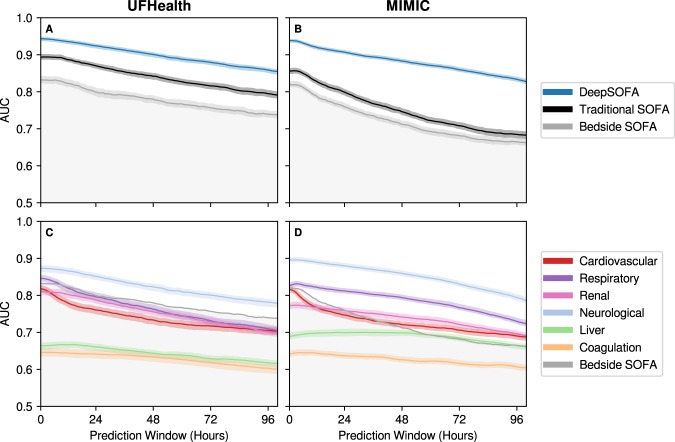
Traditional methods for assessing illness severity and predicting in-hospital mortality among critically ill patients require time-consuming, error-prone calculations using static variable thresholds. These methods do not capitalize on the emerging availability of streaming electronic health record data or capture time-sensitive individual physiological patterns, a critical task in the intensive care unit. We propose a novel acuity score framework (DeepSOFA) that leverages temporal measurements and interpretable deep learning models to assess illness severity at any point during an ICU stay. We compare DeepSOFA with SOFA (Sequential Organ Failure Assessment) baseline models using the same model inputs and find that at any point during an ICU admission, DeepSOFA yields significantly more accurate predictions of in-hospital mortality. A DeepSOFA model developed in a public database and validated in a single institutional cohort had a mean AUC for the entire ICU stay of 0.90 (95% CI 0.90–0.91) compared with baseline SOFA models with mean AUC 0.79 (95% CI 0.79–0.80) and 0.85 (95% CI 0.85–0.86). Deep models are well-suited to identify ICU patients in need of life-saving interventions prior to the occurrence of an unexpected adverse event and inform shared decision-making processes among patients, providers, and families regarding goals of care and optimal resource utilization.
Overview
The claims and statistics of this paper haven’t been checked yet.
Free: it reads the open-access text and checks the first 5 claims that cite a source we can check. Create a free account to check every claim.
Integrity signals
Registry
Cites
Statistics
Figures
Verification
Claims the paper makes
The claims and statistics of this paper haven’t been checked yet.
Free: it reads the open-access text and checks the first 5 claims that cite a source we can check. Create a free account to check every claim.
Claims other papers make about this one
Each is checked against this paper’s own text: does it say what the citing paper says it does?
The cited source doesn’t support the claim as written.
In the citing paper
“Additionally, because of their high sensitivity but low discriminatory ability, these scores identify a large number of patients as “at risk” when the actual number is far lower (38).”
From Accessing Artificial Intelligence for Clinical Decision-Making (2021) · cites this paper as [38]
Checked by a reasoning model — may be wrong.
Experimental — accuracy not yet measuredThe cited source says what the claim attributes to it.
In the citing paper
“When applied to the same variable set used to calculate SOFA scores, deep models outperform traditional SOFA modeling in predicting in-hospital mortality for ICU patients.42”
From Artificial Intelligence and Surgical Decision-making. (2020) · cites this paper as [42]
The cited source says what the claim attributes to it.
In the citing paper
“The EHR contains a large amount of data that may be useful to identify patients at the highest risk of decompensation if the data are evaluated over time (37, 38).”
From Accessing Artificial Intelligence for Clinical Decision-Making (2021) · cites this paper as [38]
The cited source says what the claim attributes to it.
In the citing paper
“AI-based algorithms using time series data from the EHR are in development with strong results.”
From Accessing Artificial Intelligence for Clinical Decision-Making (2021) · cites this paper as [38]
The cited source says what the claim attributes to it.
In the citing paper
“Its predictive ability performed well in identifying increased risk of mortality.”
From Accessing Artificial Intelligence for Clinical Decision-Making (2021) · cites this paper as [38]
2 more claims about this paper
Create a free account to see every claim other papers make about this one.
Self-check
Percentages, sums and reported differences re-computed from the paper’s own numbers.
The self-check needs the paper’s full text.
Citations
Cites
LeCun, Y., Bengio, Y., & Hinton, G. (2015) · Nature · doi:10.1038/nature14539 · Cited by 84,126
Learning Phrase Representations using RNN Encoder–Decoder for Statistical Machine Translation
Cho, K., van Merrienboer, B., Gulcehre, C., Bahdanau, D., Bougares, F., Schwenk, H., & Bengio, Y. (2014) · Proceedings of the 2014 Conference on Empirical Methods in Natural Language Processing (EMNLP) · doi:10.3115/v1/d14-1179 · Cited by 25,545
Dermatologist-level classification of skin cancer with deep neural networks
Esteva, A., Kuprel, B., Novoa, R. A., Ko, J., Swetter, S. M., Blau, H. M., & Thrun, S. (2017) · Nature · doi:10.1038/nature21056 · Cited by 14,362
Vincent, J. L., Moreno, R., Takala, J., Willatts, S., De Mendonça, A., Bruining, H., Reinhart, C. K., Suter, P. M., & Thijs, L. G. (1996) · Intensive Care Medicine · doi:10.1007/bf01709751 · Cited by 11,674
Empirical Evaluation of Gated Recurrent Neural Networks on Sequence Modeling
Chung, J., Gulcehre, C., Cho, K., & Bengio, Y. (2014) · arXiv · doi:10.48550/arxiv.1412.3555 · Cited by 11,008
MIMIC-III, a freely accessible critical care database
Johnson, A. E. W., Pollard, T. J., Shen, L., Lehman, L.-W. H., Feng, M., Ghassemi, M., Moody, B., Szolovits, P., Anthony Celi, L., & Mark, R. G. (2016) · Scientific Data · doi:10.1038/sdata.2016.35 · Cited by 8,141
Gulshan, V., Peng, L., Coram, M., Stumpe, M. C., Wu, D., Narayanaswamy, A., Venugopalan, S., Widner, K., Madams, T., Cuadros, J., et al. (2016) · JAMA · doi:10.1001/jama.2016.17216 · Cited by 7,697
Vincent, J.-L., de Mendonca, A., Cantraine, F., Moreno, R., Takala, J., Suter, P. M., Sprung, C. L., Colardyn, F., & Blecher, S. (1998) · Critical Care Medicine · doi:10.1097/00003246-199811000-00016 · Cited by 3,463
Serial Evaluation of the SOFA Score to Predict Outcome in Critically Ill Patients
Ferreira, F. L. (2001) · JAMA · doi:10.1001/jama.286.14.1754 · Cited by 2,862
Zimmerman, J. E., Kramer, A. A., McNair, D. S., & Malila, F. M. (2006) · Critical Care Medicine · doi:10.1097/01.ccm.0000215112.84523.f0 · Cited by 1,764
Research works printed but not linked: 1
- 11. Goodfellow, I., Bengio, Y. & Courville, A. Deep Learning. (MIT Press, 2016).
Cited by
Yang, G., Ye, Q., & Xia, J. (2022) · Information Fusion · doi:10.1016/j.inffus.2021.07.016 · Cited by 717
“Shickel et al. [81] presented an interpretable acuity score framework using deep learning and attention-based sequential organ failure assessment that can assess the severity of patients during an ICU stay.”
BackgroundArtificial Intelligence and Surgical Decision-making.
Loftus, T. J., Tighe, P. J., Filiberto, A. C., Efron, P. A., Brakenridge, S. C., Mohr, A. M., Rashidi, P., Upchurch, G. R., & Bihorac, A. (2020) · JAMA Surgery · doi:10.1001/jamasurg.2019.4917 · Cited by 650
“42 Preliminary data suggest that deep models are theoretically capable of accurately predicting risk for perioperative and postoperative complications and augmenting recommendations for operative management and the informed consent process.”
BackgroundSelf-citationExplainable AI for Healthcare 5.0: Opportunities and Challenges
Saraswat, D., Bhattacharya, P., Verma, A., Prasad, V. K., Tanwar, S., Sharma, G., Bokoro, P. N., & Sharma, R. (2022) · IEEE Access · doi:10.1109/access.2022.3197671 · Cited by 523
Lauritsen, S. M., Kristensen, M., Olsen, M. V., Larsen, M. S., Lauritsen, K. M., Jørgensen, M. J., Lange, J., & Thiesson, B. (2020) · Nature Communications · doi:10.1038/s41467-020-17431-x · Cited by 448
Accessing Artificial Intelligence for Clinical Decision-Making
Giordano, C., Brennan, M., Mohamed, B., Rashidi, P., Modave, F., & Tighe, P. (2021) · Frontiers in Digital Health · doi:10.3389/fdgth.2021.645232 · Cited by 326
“Multivariate regression-based models or AI-based early-warning systems have the potential to detect subtle trends in physiologic parameters over time to provide precision and reliability (38–41).”
InfluentialSelf-citationPayrovnaziri, S. N., Chen, Z., Rengifo-Moreno, P., Miller, T., Bian, J., Chen, J. H., Liu, X., & He, Z. (2020) · Journal of the American Medical Informatics Association · doi:10.1093/jamia/ocaa053 · Cited by 313
Machine learning in clinical decision making
Adlung, L., Cohen, Y., Mor, U., & Elinav, E. (2021) · Med · doi:10.1016/j.medj.2021.04.006 · Cited by 282
Time Series Prediction Using Deep Learning Methods in Healthcare
Morid, M. A., Sheng, O. R. L., & Dunbar, J. (2023) · ACM Transactions on Management Information Systems · doi:10.1145/3531326 · Cited by 231
“By far the most common DL interpretation method is to show visualized examples of selected patient records to highlight which visits and medical codes most influence the prediction task [2,13,22,41,47,49,54,57,60,66,67,69,75,82,95,97].”
MethodMachine Learning in Epidemiology and Health Outcomes Research
Wiemken, T. L., & Kelley, R. R. (2020) · Annual Review of Public Health · doi:10.1146/annurev-publhealth-040119-094437 · Cited by 222
“A 2019 example from Shickel and colleagues (56) used gated recurrent unit neural networks to identify individuals at risk of in-hospital mortality.”
BackgroundA Review on Explainable Artificial Intelligence for Healthcare: Why, How, and When?
Bharati, S., Mondal, M. R. H., & Podder, P. (2024) · IEEE Transactions on Artificial Intelligence · doi:10.1109/tai.2023.3266418 · Cited by 203
“[141]thatmakesuse ofattentionandDL-basedevaluationonsequentialorganfailure.”
Ding, W., Abdel-Basset, M., Hawash, H., & Ali, A. M. (2022) · Information Sciences · doi:10.1016/j.ins.2022.10.013 · Cited by 183
Ren, Y., Loftus, T. J., Datta, S., Ruppert, M. M., Guan, Z., Miao, S., Shickel, B., Feng, Z., Giordano, C., Upchurch, G. R., et al. (2022) · JAMA Network Open · doi:10.1001/jamanetworkopen.2022.11973 · Cited by 136
Self-citationSheu, R.-K., & Pardeshi, M. S. (2022) · Sensors · doi:10.3390/s22208068 · Cited by 129
Tomašev, N., Harris, N., Baur, S., Mottram, A., Glorot, X., Rae, J. W., Zielinski, M., Askham, H., Saraiva, A., Magliulo, V., et al. (2021) · Nature Protocols · doi:10.1038/s41596-021-00513-5 · Cited by 131
Mosavi, A. H., Ardabili, S., & Várkonyi-Kóczy, A. R. (2020) · Lecture notes in networks and systems · doi:10.1007/978-3-030-36841-8_20 · Cited by 125
Schwartz, J. M., Moy, A. J., Rossetti, S. C., Elhadad, N., & Cato, K. D. (2021) · Journal of the American Medical Informatics Association · doi:10.1093/jamia/ocaa296 · Cited by 83
Implementing Artificial Intelligence in Critical Care Medicine: a consensus of 22.
Cecconi, M., Greco, M., Shickel, B., Angus, D. C., Bailey, H., Bignami, E., Calandra, T., Celi, L. A., Einav, S., Elbers, P., et al. (2025) · Critical Care · doi:10.1186/s13054-025-05532-2 · Cited by 80
“The first step toward integration is to understand how clinicians interact with AI and to design systems that complement, rather than disrupt, clinical reasoning [32].”
Self-citationHong, N., Liu, C., Gao, J., Han, L., Chang, F., Gong, M., & Su, L. (2022) · JMIR Medical Informatics · doi:10.2196/28781 · Cited by 76
Eke, C. I., & Shuib, L. M. (2024) · Neural Computing and Applications · doi:10.1007/s00521-024-10868-x · Cited by 127
Uncertainty-aware deep learning in healthcare: A scoping review
Loftus, T. J., Shickel, B., Ruppert, M. M., Balch, J. A., Ozrazgat-Baslanti, T., Tighe, P. J., Efron, P. A., Hogan, W. R., Rashidi, P., Upchurch, G. R., et al. (2022) · PLOS Digital Health · doi:10.1371/journal.pdig.0000085 · Cited by 73
“Deep learning prediction models that leverage electronic health record data have outperformed other statistical and regressionbased methods [1,2].”
BackgroundSelf-citationMortality prediction models in the adult critically ill: A scoping review
Keuning, B. E., Kaufmann, T., Wiersema, R., Granholm, A., Pettilä, V., Møller, M. H., Christiansen, C. F., Forte, J. C., Snieder, H., Keus, F., et al. (2019) · Acta Anaesthesiologica Scandinavica · doi:10.1111/aas.13527 · Cited by 82
Temporal pointwise convolutional networks for length of stay prediction in the intensive care unit
Rocheteau, E., Liò, P., & Hyland, S. (2021) · Proceedings of the Conference on Health, Inference, and Learning · doi:10.1145/3450439.3451860 · Cited by 56
A deep learning approach for sepsis monitoring via severity score estimation
Aşuroğlu, T., & Oğul, H. (2020) · Computer Methods and Programs in Biomedicine · doi:10.1016/j.cmpb.2020.105816 · Cited by 78
Lim, L., Gim, U., Cho, K., Yoo, D., Ryu, H. G., & Lee, H. (2024) · Critical Care · doi:10.1186/s13054-024-04866-7 · Cited by 88
Li, Y., Wang, H., & Luo, Y. (2022) · Circulation: Heart Failure · doi:10.1161/circheartfailure.122.009473 · Cited by 64
Safaei, N., Safaei, B., Seyedekrami, S., Talafidaryani, M., Masoud, A., Wang, S., Li, Q., & Moqri, M. (2022) · PLoS ONE · doi:10.1371/journal.pone.0262895 · Cited by 85
Shickel, B., Loftus, T. J., Ruppert, M. M., Upchurch, G. R., Ozrazgat‐Baslanti, T., Rashidi, P., & Bihorac, A. (2023) · Scientific Reports · doi:10.1038/s41598-023-27418-5 · Cited by 83
Self-citationForte, J. C., Yeshmagambetova, G., van der Grinten, M. L., Hiemstra, B., Kaufmann, T., Eck, R. J., Keus, F., Epema, A. H., Wiering, M., & van der Horst, I. C. C. (2021) · Scientific Reports · doi:10.1038/s41598-021-91297-x · Cited by 69
Ideal algorithms in healthcare: Explainable, dynamic, precise, autonomous, fair, and reproducible
Loftus, T. J., Tighe, P. J., Ozrazgat-Baslanti, T., Davis, J. P., Ruppert, M. M., Ren, Y., Shickel, B., Kamaleswaran, R., Hogan, W. R., Moorman, J. R., et al. (2022) · PLOS Digital Health · doi:10.1371/journal.pdig.0000006 · Cited by 57
Self-citationA Multimodal Approach for Detection and Assessment of Depression Using Text, Audio and Video
Zhang, W., Mao, K., & Chen, J. (2024) · Phenomics · doi:10.1007/s43657-023-00152-8 · Cited by 71
Deasy, J., Liò, P., & Ercole, A. (2020) · Scientific Reports · doi:10.1038/s41598-020-79142-z · Cited by 52
Decision analysis and reinforcement learning in surgical decision-making
Loftus, T. J., Filiberto, A. C., Li, Y., Balch, J. A., Cook, A. C., Tighe, P. J., Efron, P. A., Upchurch, G. R., Rashidi, P., Li, X., et al. (2020) · Surgery · doi:10.1016/j.surg.2020.04.049 · Cited by 60
Self-citationMultilayer dynamic ensemble model for intensive care unit mortality prediction of neonate patients
Juraev, F., El–Sappagh, S., Abdukhamidov, E., Ali, F., & Abuhmed, T. (2022) · Journal of Biomedical Informatics · doi:10.1016/j.jbi.2022.104216 · Cited by 48
Data-driven ICU management: Using Big Data and algorithms to improve outcomes
Carra, G., Salluh, J. I., Ramos, F. J. D. S., & Meyfroidt, G. (2020) · Journal of Critical Care · doi:10.1016/j.jcrc.2020.09.002 · Cited by 55
An explainable knowledge distillation method with XGBoost for ICU mortality prediction
Liu, M., Guo, C., & Guo, S. (2022) · Computers in Biology and Medicine · doi:10.1016/j.compbiomed.2022.106466 · Cited by 51
Intelligent, Autonomous Machines in Surgery
Loftus, T. J., Filiberto, A. C., Balch, J. A., Ayzengart, A., Tighe, P. J., Rashidi, P., Bihorac, A., & Upchurch, G. R. (2020) · Journal of Surgical Research · doi:10.1016/j.jss.2020.03.046 · Cited by 51
Self-citationList of Deep Learning ModelsPreprint
Mosavi, A. H., Ardabili, S., & Várkonyi-Kóczy, A. R. (2020) · OSF Preprints (OSF Preprints) · doi:10.31219/osf.io/58f2a · Cited by 48
Moss, L., Corsar, D., Shaw, M., Piper, I., & Hawthorne, C. (2022) · Neurocritical Care · doi:10.1007/s12028-022-01504-4 · Cited by 49
Artificial intelligence to predict AKI: is it a breakthrough?
Kellum, J. A., & Bihorac, A. (2019) · Nature Reviews Nephrology · doi:10.1038/s41581-019-0203-y · Cited by 37
Self-citationA systematic survey of fuzzy deep learning for uncertain medical data
Zheng, Y., Xu, Z., Wu, T. Q., & Zhang, Y. (2024) · Artificial Intelligence Review · doi:10.1007/s10462-024-10871-7 · Cited by 52
Applying interpretable deep learning models to identify chronic cough patients using EHR data
Luo, X., Gandhi, P., Zhang, Z., Shao, W., Han, Z., Chandrasekaran, V., Turzhitsky, V. M., Bali, V., Roberts, A., Metzger, M., et al. (2021) · Computer Methods and Programs in Biomedicine · doi:10.1016/j.cmpb.2021.106395 · Cited by 48
Machine Learning Applications in Solid Organ Transplantation and Related Complications
Balch, J. A., Delitto, D., Tighe, P. J., Zarrinpar, A., Efron, P. A., Rashidi, P., Upchurch, G. R., Bihorac, A., & Loftus, T. J. (2021) · Frontiers in Immunology · doi:10.3389/fimmu.2021.739728 · Cited by 33
“(20)andLauristenetal.”
MethodSelf-citationUse of Artificial Intelligence to Represent Emergent Systems and Augment Surgical Decision-making
Loftus, T. J., Upchurch, G. R., & Bihorac, A. (2019) · JAMA Surgery · doi:10.1001/jamasurg.2019.1510 · Cited by 32
Self-citationList of Deep Learning ModelsPreprint
Mosavi, A. H., Ardabili, S., & Várkonyi-Kóczy, A. R. (2019) · Preprints.org · doi:10.20944/preprints201908.0152.v1 · Cited by 33
Advancements in Methods and Camera-Based Sensors for the Quantification of Respiration
Rehouma, H., Noumeir, R., Essouri, S., & Jouvet, P. A. (2020) · Sensors · doi:10.3390/s20247252 · Cited by 35
Patient similarity analytics for explainable clinical risk prediction
Fang, H. S. A., Tan, N. C., Tan, W. Y., Oei, R. W., Lee, M. L., & Hsu, W. (2021) · BMC Medical Informatics and Decision Making · doi:10.1186/s12911-021-01566-y · Cited by 39
Opportunities for machine learning to improve surgical ward safety
Loftus, T. J., Tighe, P. J., Filiberto, A. C., Balch, J. A., Upchurch, G. R., Rashidi, P., & Bihorac, A. (2020) · The American Journal of Surgery · doi:10.1016/j.amjsurg.2020.02.037 · Cited by 33
Self-citationConcept-based model explanations for electronic health records
Mincu, D., Loreaux, E., Hou, S., Baur, S., Protsyuk, I., Seneviratne, M. G., Mottram, A., Tomasev, N., Karthikesalingam, A., & Schrouff, J. (2021) · ACM Conference on Health, Inference, and Learning (CHIL) · doi:10.1145/3450439.3451858 · Cited by 38
Boussi Rahmouni, H., Hassine, N. B. E. H., Chouchen, M., Ceylan, H. İ., Muntean, R. I., Bragazzi, N. L., & Dergaa, I. (2025) · Healthcare · doi:10.3390/healthcare13202553 · Cited by 25
“DeepSOFA was established to yield a seamless mortality score [60], and SICULA was an ensemble for mortality risk forecasting [64]; however, neither included a feedback loop to healthcare providers.”
Satlin, M. J., Goyal, P., Magleby, R., Maldarelli, G. A., Pham, K., Kondo, M., Schenck, E. J., Rennert, H., Westblade, L. F., Choi, J. J., et al. (2020) · PLoS ONE · doi:10.1371/journal.pone.0236778 · Cited by 27
Predictive Modeling for Readmission to Intensive Care: A Systematic Review
Ruppert, M. M., Loftus, T. J., Small, C., Li, H., Ozrazgat-Baslanti, T., Balch, J., Holmes, R., Tighe, P. J., Upchurch, G. R., Efron, P. A., et al. (2023) · Critical Care Explorations · doi:10.1097/cce.0000000000000848 · Cited by 24
Self-citationShah, P., Ginestra, J. C., Ungar, L., Junker, P., Rohrbach, J. I., Fishman, N. O., & Weissman, G. E. (2021) · Critical Care Medicine · doi:10.1097/ccm.0000000000004966 · Cited by 29
Zheng, Z. Q., Luo, J., Zhu, Y., Du, L., Lan, L., Zhou, X., Yang, X., & Huang, S. (2025) · Journal of Medical Internet Research · doi:10.2196/69293 · Cited by 35
Liu, Y., Gao, K., Deng, H., Ling, T., Lin, J., Yu, X., Bo, X., Zhou, J., Gao, L., Wang, P., et al. (2022) · International Journal of Medical Informatics · doi:10.1016/j.ijmedinf.2022.104776 · Cited by 24
Loftus, T. J., Ruppert, M. M., Shickel, B., Ozrazgat‐Baslanti, T., Balch, J. A., Hu, D., Javed, A., Madbak, F., Skarupa, D. J., Guirgis, F. W., et al. (2022) · Journal of the American College of Surgeons · doi:10.1097/xcs.0000000000000471 · Cited by 21
Self-citationPatton, M. J., & Liu, V. X. (2023) · Critical Care Clinics · doi:10.1016/j.ccc.2023.02.001 · Cited by 26
Deep Multi-Modal Transfer Learning for Augmented Patient Acuity Assessment in the Intelligent ICU
Shickel, B., Davoudi, A., Ozrazgat-Baslanti, T., Ruppert, M., Bihorac, A., & Rashidi, P. (2021) · Frontiers in Digital Health · doi:10.3389/fdgth.2021.640685 · Cited by 21
Self-citationArtificial Intelligence-Based Models for Prediction of Mortality in ICU Patients: A Scoping Review
Olang, O., Mohseni, S., Shahabinezhad, A., Hamidianshirazi, Y., Goli, A. N., Abolghasemian, M., Shafiee, M. A., Aarabi, M., Alavinia, M., & Shaker, P. (2024) · Journal of Intensive Care Medicine · doi:10.1177/08850666241277134 · Cited by 30
Park, C., Han, C., Jang, S. K., Kim, H., Kim, S., Kang, B. H., Jung, K., & Yoon, D. (2025) · Journal of Medical Internet Research · doi:10.2196/59520 · Cited by 23
Vagliano, I., Dormosh, N., Rios, M., Luik, T. T., Buonocore, T. M., Elbers, P., Dongelmans, D. A., Schut, M. C., & Abu–Hanna, A. (2023) · Journal of Biomedical Informatics · doi:10.1016/j.jbi.2023.104504 · Cited by 22
AI‐Based Emotion Detection System in Healthcare for Patient
Jain, A., & Jain, A. (2025) · Wiley eBooks · doi:10.1002/9781394280735.ch23 · Cited by 23
Kim, H. B., Nguyen, H. T., Jin, Q., Tamby, S., Gelaf Romer, T., Sung, E., Liu, R., Greenstein, J. L., Suarez, J. I., Storm, C., et al. (2022) · Anaesthesia Critical Care & Pain Medicine · doi:10.1016/j.accpm.2021.101015 · Cited by 18
“The attention layer has been widely used on medical data such as healthcare image data for lesion detection and PTS data [27,28].”
MethodExplainable Artificial Intelligence in Genomic Sequence for Healthcare Systems Prediction
Awotunde, J. B., Adeniyi, A. E., Ajamu, G. J., Balogun, G. B., & Taofeek-Ibrahim, F. A. (2022) · Studies in computational intelligence · doi:10.1007/978-3-030-97929-4_19 · Cited by 24
Shickel, B., Silva, B., Ozrazgat‐Baslanti, T., Ren, Y., Khezeli, K., Guan, Z., Tighe, P. J., Bihorac, A., & Rashidi, P. (2022) · Frontiers in Digital Health · doi:10.3389/fdgth.2022.1029191 · Cited by 33
Self-citationAn overview of clinical machine learning applications in neurology
Smith, C. M., Weathers, A. L., & Lewis, S. L. (2023) · Journal of the Neurological Sciences · doi:10.1016/j.jns.2023.122799 · Cited by 23
Roy, S., Mincu, D., Loreaux, E., Mottram, A., Protsyuk, I., Harris, N., Xue, Y., Schrouff, J., Montgomery, H., Connell, A., et al. (2021) · Journal of the American Medical Informatics Association · doi:10.1093/jamia/ocab101 · Cited by 28
On Missingness Features in Machine Learning Models for Critical Care: Observational Study
Singh, J., Sato, M., & Ohkuma, T. (2021) · JMIR Medical Informatics · doi:10.2196/25022 · Cited by 17
Responsible application of artificial intelligence in health care
Obasa, A. E., & Palk, A. C. (2023) · South African Journal of Science · doi:10.17159/sajs.2023/14889 · Cited by 26
Sun, Y., Kaur, R., Gupta, S., Paul, R., Das, R., Cho, S. J., Anand, S., Boutilier, J. J., Saria, S., Palma, J. P., et al. (2021) · JAMIA Open · doi:10.1093/jamiaopen/ooab004 · Cited by 19
Primer on machine learning: utilization of large data set analyses to individualize pain management
Rashidi, P., Edwards, D. A., & Tighe, P. J. (2019) · Current Opinion in Anaesthesiology · doi:10.1097/aco.0000000000000779 · Cited by 18
Self-citationMysteries, Epistemological Modesty, and Artificial Intelligence in Surgery
Loftus, T. J., Upchurch, G. R., Delitto, D., Rashidi, P., & Bihorac, A. (2020) · Frontiers in Artificial Intelligence · doi:10.3389/frai.2019.00032 · Cited by 15
Self-citationAligning Patient Acuity With Resource Intensity After Major Surgery: A Scoping Review
Loftus, T. J., Balch, J. A., Ruppert, M. M., Tighe, P. J., Hogan, W. R., Rashidi, P., Upchurch, G. R., & Bihorac, A. (2021) · Annals of Surgery · doi:10.1097/sla.0000000000005079 · Cited by 20
Self-citationMueller, N., Anderle, R. V. R., Brachowicz, N., Graziadei, H., Lloyd, S. J., Morais, G. A. D. S., Sironi, A., Gibert, K., Tonne, C. C., Nieuwenhuijsen, M. J., et al. (2023) · International Journal of Health Policy and Management · doi:10.34172/ijhpm.2023.7103 · Cited by 22
Mutchmore, A., Lamontagne, F., Chassé, M., Moore, L., & Mayette, M. (2023) · Journal of Clinical Monitoring and Computing · doi:10.1007/s10877-023-01010-8 · Cited by 21
Yang, G. Z., Ye, Q., & Xia, J. (2021) · arXiv (Cornell University) · doi:10.48550/arxiv.2102.01998 · Cited by 13
Schenck, E. J., Hoffman, K. L., Oromendia, C., Sánchez, E., Finkelsztein, E. J., Hong, K. S., Kabariti, J., Torres, L. K., Harrington, J. S., Siempos, I. Ι., et al. (2021) · Annals of the American Thoracic Society · doi:10.1513/annalsats.202004-399oc · Cited by 17
Pungitore, S. A., & Subbian, V. (2023) · Journal of Healthcare Informatics Research · doi:10.1007/s41666-023-00143-4 · Cited by 27
Wearable sensors in patient acuity assessment in critical care
Sena, J., Mostafiz, M. T., Zhang, J., Davidson, A., Bandyopadhyay, S., Nerella, S., Ren, Y., Ozrazgat‐Baslanti, T., Shickel, B., Loftus, T. J., et al. (2024) · Frontiers in Neurology · doi:10.3389/fneur.2024.1386728 · Cited by 15
Self-citationBlack-Box AI and Patient Autonomy
Prince, S., & Lim, J. (2025) · Minds and Machines · doi:10.1007/s11023-025-09729-w · Cited by 14
Temporal-Spatial Correlation Attention Network for Clinical Data Analysis in Intensive Care Unit
Nie, W., Yu, Y., Zhang, C., Song, D., Zhao, L., & Bai, Y. (2023) · IEEE Transactions on Biomedical Engineering · doi:10.1109/tbme.2023.3309956 · Cited by 21
Shickel, B., & Rashidi, P. (2020) · arXiv (Cornell University) · doi:10.48550/arxiv.2004.12524 · Cited by 28
Self-citationBritsch, S., Britsch, M., Lindner, S., Hahn, L., Schneider‐Lindner, V., Helbing, T., Thiel, M., Duerschmied, D., & Becher, T. (2025) · Communications Medicine · doi:10.1038/s43856-025-01192-z · Cited by 18
Improving the quality of care for patients requiring continuous renal replacement therapy
Neyra, J. A., & KASHANI, K. B. (2021) · Seminars in Dialysis · doi:10.1111/sdi.12968 · Cited by 11
Contreras, M., Silva, B., Shickel, B., Bandyopadhyay, S., Guan, Z., Ren, Y., Ozrazgat‐Baslanti, T., Khezeli, K., Bihorac, A., & Rashidi, P. (2023) · IEEE-EMBS International Conference on Biomedical and Health Informatics (BHI ...) · doi:10.1109/bhi58575.2023.10313445 · Cited by 11
Self-citationThe application of artificial intelligence in upper gastrointestinal cancers
Huang, X., Qin, M., Fang, M., Wang, Z., Hu, C., Zhao, T., Qin, Z., Zhu, H., Wu, L., Yu, G., et al. (2024) · Journal of the National Cancer Center · doi:10.1016/j.jncc.2024.12.006 · Cited by 16
Zeng, G., Zhuang, J., Huang, H., Tian, M., Gao, Y., Liu, Y., & Yu, X. (2023) · Tsinghua Science & Technology · doi:10.26599/tst.2022.9010027 · Cited by 9
Ozrazgat‐Baslanti, T., Motaei, A., Islam, R., Hashemighouchani, H., Ruppert, M. M., Madushani, R. W. M. A., Segal, M. S., Lipori, G. P., Bihorac, A., & Hobson, C. (2019) · arXiv (Cornell University) · doi:10.48550/arxiv.1903.03149 · Cited by 18
Self-citationExplainable text-tabular models for predicting mortality risk in companion animals
Burton, J., Farrell, S., Noble, P. M., & Moubayed, N. A. (2024) · Scientific Reports · doi:10.1038/s41598-024-64551-1 · Cited by 12
Cheungpasitporn, W., Thongprayoon, C., & KASHANI, K. B. (2025) · Kidney360 · doi:10.34067/kid.0000001037 · Cited by 13
Yoo, K. D., Noh, J., Bae, W., An, J. N., Oh, H. J., Rhee, H., Seong, E. Y., Baek, S. H., Ahn, S. Y., Cho, J., et al. (2023) · Scientific Reports · doi:10.1038/s41598-023-30074-4 · Cited by 11
Shen, J.-H., Zhang, J., Li, Q., Wang, L., Zhu, B., Li, J., Ying, L., & Jian-Rong, C. (2021) · Medicine · doi:10.1097/md.0000000000026444 · Cited by 8
When is black-box AI justifiable to use in healthcare?
Prince, S., & Savulescu, J. (2025) · Big Data & Society · doi:10.1177/20539517251386037 · Cited by 10
Building an automated, machine learning-enabled platform for predicting post-operative complications
Balch, J. A., Ruppert, M. M., Shickel, B., Ozrazgat‐Baslanti, T., Tighe, P. J., Efron, P. A., Upchurch, G. R., Rashidi, P., Bihorac, A., & Loftus, T. J. (2023) · Physiological Measurement · doi:10.1088/1361-6579/acb4db · Cited by 11
Self-citationWinston, L., McCann, M., & Onofrei, G. (2022) · JMIR Formative Research · doi:10.2196/35114 · Cited by 15
Children are small adults (when properly normalized): Transferrable/generalizable sepsis prediction
Marassi, C., Socia, D., Larie, D., An, G. C., & Cockrell, R. C. (2023) · Surgery Open Science · doi:10.1016/j.sopen.2023.09.013 · Cited by 8
Jiang, H., Su, L., Wang, H., Li, D., Zhao, C., Hong, N., Long, Y., & Zhu, W. (2021) · JMIR Medical Informatics · doi:10.2196/23888 · Cited by 9
He, Y., Luo, Q., Wang, H., Zheng, Z., Luo, H., & Ooi, O. C. (2024) · Health Information Science and Systems · doi:10.1007/s13755-024-00331-5 · Cited by 7
Ren, Y., Li, Y., Loftus, T. J., Balch, J. A., Abbott, K. L., Ruppert, M. M., Guan, Z., Shickel, B., Rashidi, P., Ozrazgat‐Baslanti, T., et al. (2024) · Scientific Reports · doi:10.1038/s41598-024-59047-x · Cited by 8
Self-citationPhysiologic signatures within six hours of hospitalization identify acute illness phenotypes
Ren, Y., Loftus, T. J., Li, Y., Guan, Z., Ruppert, M. M., Datta, S., Upchurch, G. R., Tighe, P. J., Rashidi, P., Shickel, B., et al. (2022) · PLOS Digital Health · doi:10.1371/journal.pdig.0000110 · Cited by 6
“For each admission we extracted demographics, 19 clinical biomarkers routinely measured at hospital admission (S2 Table), Sequential Organ Dysfunction Assessment (SOFA) and Modified Early Warning Score (MEWS) acuity scores, and patient outcomes [19,20].”
MethodSelf-citationReview of Time Domain Electronic Medical Record Taxonomies in the Application of Machine Learning
Ali, H., Niazi, I. K., Russell, B. K., Crofts, C. A. P., Madanian, S., & White, D. E. (2023) · Electronics · doi:10.3390/electronics12030554 · Cited by 10
Metadata
- Authors
- Shickel, B., Loftus, T. J., Adhikari, L., Ozrazgat-Baslanti, T., Bihorac, A., & Rashidi, P.
- Affiliations
- University of Florida (US)
- Corresponding author
- Bihorac, Azra
- Venue
- Scientific Reports
- Published
- 2019-02-12
- Volume
- 9
- Issue
- 1
- Pages
- 1879-1879
- ISSN
- 2045-2322 (ISSN-L)
- PMC
- PMC6372608
- OpenAlex
- W2889037799
- Cited by
- 165
- References
- 22
- Citations by year
- 2026: 12 · 2025: 22 · 2024: 16 · 2023: 26 · 2022: 28 · 2021: 29 · 2020: 23 · 2019: 9
- FWCI
- 10.15
- Type
- journal article
- Language
- en
- Open access
- gold
- doi.org
- Licence
- cc-by
- creativecommons.org/licenses/by/4.0 (tdm)
- creativecommons.org/licenses/by/4.0 (vor)
- Locations
- Scientific Reports (publishedVersion, cc-by)
- Europe PMC (PubMed Central) (publishedVersion, cc-by)
- PubMed Central (publishedVersion, cc-by)
- PubMed (publishedVersion)
- arXiv (Cornell University) (submittedVersion)
- DOAJ (DOAJ: Directory of Open Access Journals) (submittedVersion)
- arXiv (Cornell University)
- Funders
- Internal funds at J. Crayton Pruitt Family Department of Biomedical Engineering, University of Florida.
- U.S. Department of Health & Human Services | NIH | National Institute of General Medical Sciences (T32 GM-008721, R01 GM110240, P50 GM-111152)
- National Science Foundation (NSF-IIS 1750192)
- Topics
- Physical Sciences › Computer Science › Artificial Intelligence › Machine Learning in Healthcare
- Health Sciences › Medicine › Critical Care and Intensive Care Medicine › Sepsis Diagnosis and Treatment
- Health Sciences › Health Professions › Health Information Management › Artificial Intelligence in Healthcare
- Keywords
- in-hospital mortality prediction, critically ill patients, intensive care unit, explainable deep learning, SOFA score, electronic health record data, goals of care, shared decision-making
- MeSH terms
- Deep Learning, Adolescent, Adult, Aged, Critical Care, Decision Making, Female, Humans, Intensive Care Units, Length of Stay, Longitudinal Studies, Male, Middle Aged, Probability, Retrospective Studies, Severity of Illness Index, Databases, Factual, Critical Illness, Hospital Mortality, Area Under Curve, Young Adult, Organ Dysfunction Scores
About these checks
Registry, retraction, Cites and statistics results are computed, not judged, with one exception: a printed reference that no index lists is read once by a model before it counts as a citation error. Claims are extracted by a model and kept only when their quote appears verbatim in the text; each cited source is then checked, with a model’s help, for whether it says what the claim relies on. Those verdicts can be wrong — read the claim’s quote and the cited source before relying on one.
Statistics and arithmetic are recomputed, not judged.
Confidence bands are shown only for fields calibrated on our annotated test set. None is calibrated yet, so no band is shown.
What counts as a claim ›How we measure confidence ›How we check this ›
Are you an author, or do you see a problem with this page? Request a review
Data sources
Bibliographic data: Semantic Scholar, OpenAlex, Crossref.
Contains information from the Semantic Scholar Academic Graph Datasets, made available under the ODC Attribution License (ODC-BY 1.0).
Semantic Scholar’s data is described in: Kinney, R., et al. (2023). The Semantic Scholar Open Data Platform. arXiv:2301.10140.
