

DeepSOFA: a continuous acuity score for critically ill patients using clinically interpretable deep learning.
Open accessThe DOI matches its Crossref record; 25 of the 25 references it cites were found in a registry or an index.
Abstract
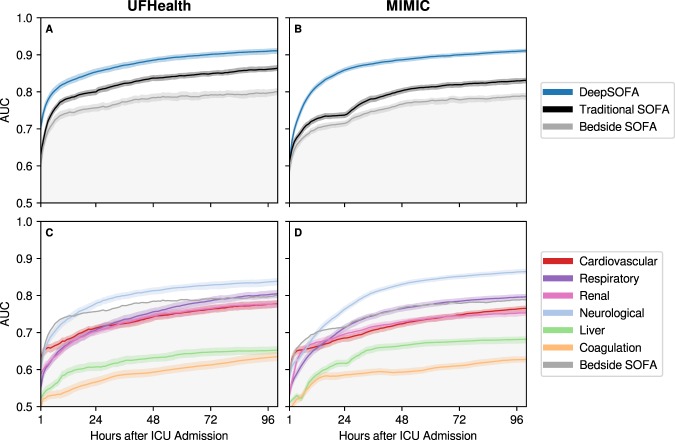
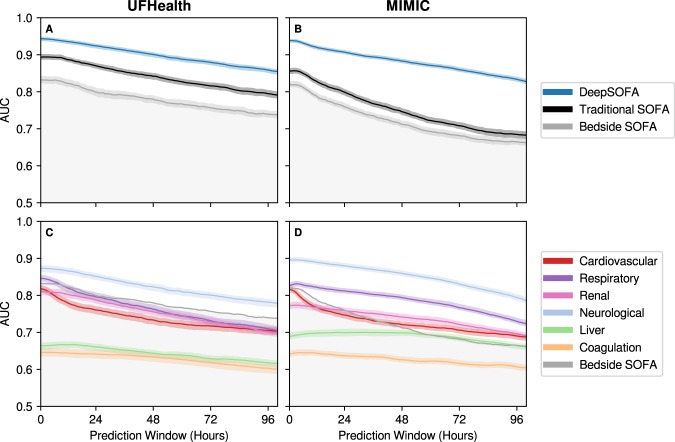
Traditional methods for assessing illness severity and predicting in-hospital mortality among critically ill patients require time-consuming, error-prone calculations using static variable thresholds. These methods do not capitalize on the emerging availability of streaming electronic health record data or capture time-sensitive individual physiological patterns, a critical task in the intensive care unit. We propose a novel acuity score framework (DeepSOFA) that leverages temporal measurements and interpretable deep learning models to assess illness severity at any point during an ICU stay. We compare DeepSOFA with SOFA (Sequential Organ Failure Assessment) baseline models using the same model inputs and find that at any point during an ICU admission, DeepSOFA yields significantly more accurate predictions of in-hospital mortality. A DeepSOFA model developed in a public database and validated in a single institutional cohort had a mean AUC for the entire ICU stay of 0.90 (95% CI 0.90–0.91) compared with baseline SOFA models with mean AUC 0.79 (95% CI 0.79–0.80) and 0.85 (95% CI 0.85–0.86). Deep models are well-suited to identify ICU patients in need of life-saving interventions prior to the occurrence of an unexpected adverse event and inform shared decision-making processes among patients, providers, and families regarding goals of care and optimal resource utilization.
Overview
The claims and statistics of this paper haven’t been checked yet.
Free: it reads the open-access text and checks the first 5 claims that cite a source we can check. Create a free account to check every claim.
Integrity signals
Registry
Cites
Statistics
Figures
Verification
Claims the paper makes
The claims and statistics of this paper haven’t been checked yet.
Free: it reads the open-access text and checks the first 5 claims that cite a source we can check. Create a free account to check every claim.
Claims other papers make about this one
Each is checked against this paper’s own text: does it say what the citing paper says it does?
The cited source doesn’t support the claim as written.
In the citing paper
“Additionally, because of their high sensitivity but low discriminatory ability, these scores identify a large number of patients as “at risk” when the actual number is far lower (38).”
From Accessing Artificial Intelligence for Clinical Decision-Making (2021) · cites this paper as [38]
Checked by a reasoning model — may be wrong.
Experimental — accuracy not yet measuredThe cited source says what the claim attributes to it.
In the citing paper
“When applied to the same variable set used to calculate SOFA scores, deep models outperform traditional SOFA modeling in predicting in-hospital mortality for ICU patients.42”
From Artificial Intelligence and Surgical Decision-making. (2020) · cites this paper as [42]
The cited source says what the claim attributes to it.
In the citing paper
“The EHR contains a large amount of data that may be useful to identify patients at the highest risk of decompensation if the data are evaluated over time (37, 38).”
From Accessing Artificial Intelligence for Clinical Decision-Making (2021) · cites this paper as [38]
The cited source says what the claim attributes to it.
In the citing paper
“AI-based algorithms using time series data from the EHR are in development with strong results.”
From Accessing Artificial Intelligence for Clinical Decision-Making (2021) · cites this paper as [38]
The cited source says what the claim attributes to it.
In the citing paper
“Its predictive ability performed well in identifying increased risk of mortality.”
From Accessing Artificial Intelligence for Clinical Decision-Making (2021) · cites this paper as [38]
2 more claims about this paper
Create a free account to see every claim other papers make about this one.
Self-check
Percentages, sums and reported differences re-computed from the paper’s own numbers.
The self-check needs the paper’s full text.
Citations
Cites
LeCun, Y., Bengio, Y., & Hinton, G. (2015) · Nature · doi:10.1038/nature14539 · Cited by 84,126
Learning Phrase Representations using RNN Encoder–Decoder for Statistical Machine Translation
Cho, K., van Merrienboer, B., Gulcehre, C., Bahdanau, D., Bougares, F., Schwenk, H., & Bengio, Y. (2014) · Proceedings of the 2014 Conference on Empirical Methods in Natural Language Processing (EMNLP) · doi:10.3115/v1/d14-1179 · Cited by 25,545
Dermatologist-level classification of skin cancer with deep neural networks
Esteva, A., Kuprel, B., Novoa, R. A., Ko, J., Swetter, S. M., Blau, H. M., & Thrun, S. (2017) · Nature · doi:10.1038/nature21056 · Cited by 14,362
Vincent, J. L., Moreno, R., Takala, J., Willatts, S., De Mendonça, A., Bruining, H., Reinhart, C. K., Suter, P. M., & Thijs, L. G. (1996) · Intensive Care Medicine · doi:10.1007/bf01709751 · Cited by 11,674
Empirical Evaluation of Gated Recurrent Neural Networks on Sequence Modeling
Chung, J., Gulcehre, C., Cho, K., & Bengio, Y. (2014) · arXiv · doi:10.48550/arxiv.1412.3555 · Cited by 11,008
MIMIC-III, a freely accessible critical care database
Johnson, A. E. W., Pollard, T. J., Shen, L., Lehman, L.-W. H., Feng, M., Ghassemi, M., Moody, B., Szolovits, P., Anthony Celi, L., & Mark, R. G. (2016) · Scientific Data · doi:10.1038/sdata.2016.35 · Cited by 8,141
Gulshan, V., Peng, L., Coram, M., Stumpe, M. C., Wu, D., Narayanaswamy, A., Venugopalan, S., Widner, K., Madams, T., Cuadros, J., et al. (2016) · JAMA · doi:10.1001/jama.2016.17216 · Cited by 7,697
Vincent, J.-L., de Mendonca, A., Cantraine, F., Moreno, R., Takala, J., Suter, P. M., Sprung, C. L., Colardyn, F., & Blecher, S. (1998) · Critical Care Medicine · doi:10.1097/00003246-199811000-00016 · Cited by 3,463
Serial Evaluation of the SOFA Score to Predict Outcome in Critically Ill Patients
Ferreira, F. L. (2001) · JAMA · doi:10.1001/jama.286.14.1754 · Cited by 2,862
Zimmerman, J. E., Kramer, A. A., McNair, D. S., & Malila, F. M. (2006) · Critical Care Medicine · doi:10.1097/01.ccm.0000215112.84523.f0 · Cited by 1,764
Research works printed but not linked: 1
- 11. Goodfellow, I., Bengio, Y. & Courville, A. Deep Learning. (MIT Press, 2016).
Cited by
Items 101–165 of 165
Artificial Intelligence in Surgical Research: Accomplishments and Future Directions
Rogers, M. P., Janjua, H. M., Walczak, S., Baker, M. S., Read, M. D., Cios, K. J., Velanovich, V., Pietrobon, R. S., & Kuo, P. C. (2023) · The American Journal of Surgery · doi:10.1016/j.amjsurg.2023.10.045 · Cited by 7
Smit, J. M., Krijthe, J. H., Endeman, H., Tintu, A. N., de Rijke, Y. B., Gommers, D. A. M. P. J., Cremer, O. L., Bosman, R. J., Rigter, S., Wils, E., et al. (2022) · Intelligence-Based Medicine · doi:10.1016/j.ibmed.2022.100071 · Cited by 8
Mortality Prediction in the ICU: The Daunting Task of Predicting the Unpredictable
Ak, A. K. (2022) · Indian Journal of Critical Care Medicine · doi:10.5005/jp-journals-10071-24063 · Cited by 8
Risk Factors and Strategies for Failure to Rescue Following Hepatectomy: A Review
Kimura, J., Takagi, K., Fuji, T., Yasui, K., Nishiyama, T., & Fujiwara, T. (2025) · Journal of Hepato-Biliary-Pancreatic Sciences · doi:10.1002/jhbp.70014 · Cited by 7
Association Between Glycemic Gap and Mortality in Critically Ill Patients with Diabetes
Lou, R., Jiang, L., Wang, M., Zhu, B., Jiang, Q., & Wang, P. (2022) · Journal of Intensive Care Medicine · doi:10.1177/08850666221101856 · Cited by 6
Quantitative methods for optimizing patient outcomes in liver transplantation
Al‐Bahou, R., Bruner, J., Moore, H. A., & Zarrinpar, A. (2023) · Liver Transplantation · doi:10.1097/lvt.0000000000000325 · Cited by 5
Deep Learning Systems: Algorithms, Compilers, and Processors for Large-Scale Production
Rodríguez, A. (2020) · Synthesis lectures on computer architecture · doi:10.2200/s01046ed1v01y202009cac053 · Cited by 8
Are AI models explainable, interpretable, and understandable?
Jung, J., & Park, D. (2022) · Elsevier eBooks · doi:10.1016/b978-0-323-85648-5.00003-7 · Cited by 6
Liu, X., Hu, P., Mao, Z., Kuo, P., Li, P., Liu, C., Hu, J., Li, D., Cao, D., Mark, R. G., et al. (2020) · arXiv (Cornell University) · doi:10.48550/arxiv.2001.10977 · Cited by 9
Contreras, M., Silva, B., Shickel, B., Davidson, A., Ozrazgat‐Baslanti, T., Ren, Y., Guan, Z., Balch, J. A., Zhang, J., Bandyopadhyay, S., et al. (2025) · Nature Communications · doi:10.1038/s41467-025-62121-1 · Cited by 20
Self-citationUnlocking the Potential of Artificial Intelligence (AI) for Healthcare
Kaur, P., Mack, A. A., Patel, N., Pal, A., Singh, R., Michaud, A., & Mulflur, M. (2023) · Artificial intelligence · doi:10.5772/intechopen.111489 · Cited by 8
Lauritsen, S. M., Thiesson, B., Jørgensen, M. J., Riis, A. H., Espelund, U. S., Weile, J. B., & Lange, J. (2021) · arXiv (Cornell University) · doi:10.48550/arxiv.2101.10790 · Cited by 4
Generalisability of AI-based scoring systems in the ICU: a systematic review and meta-analysisPreprint
Rockenschaub, P., Akay, E. M., Carlisle, B., Hilbert, A., Meyer-Eschenbach, F., NaÌher, A.-F., Frey, D., & Madai, V. I. (2023) · medRxiv · doi:10.1101/2023.10.11.23296733 · Cited by 5
Zhu, Y., Sui, D., Wang, Z., Hu, X., Gu, L., Qi, Y., Wu, T., Wang, L., Wei, Y., Tang, W., et al. (2026) · Proceedings of the 2026 CHI Conference on Human Factors in Computing Systems · doi:10.1145/3772318.3791458 · Cited by 3
“With the advent of machine learning, these systems evolved to offer predictive analytics, such as risk scores for patient deterioration or disease onset [55], with prominent examples like the Epic Sepsis Model providing a single risk score to alert clinicians [73].”
Explainable multimodal deep learning models for variable-length sequences in critically ill patients
Martin, J., Afshar, M., Afshar, A. S., Caskey, J., Dligach, D., Gao, Y., Gao, J., Chen, G., Mayampurath, A. M., & Churpek, M. M. (2026) · Journal of Biomedical Informatics · doi:10.1016/j.jbi.2026.105001 · Cited by 6
Current Perspectives on the Artificial Intelligence in Critical Care Medicine
Lee, J., & Yoon, J. H. (2025) · Anesthesiology Clinics · doi:10.1016/j.anclin.2025.05.005 · Cited by 5
Use of artificial intelligence in the surgical field: advantages and implications
Menezes, C. A. G. P., Krubniki, Y. S., Fonseca, M. B., Viltrakis, L. N., Correa, R. P., Colares, J. V. T., Pantoja, J. V. S., Ghersberg, S. G., & Betarelli, R. P. (2024) · International Journal of Research Publication and Reviews · doi:10.55248/gengpi.5.0124.0337 · Cited by 3
Hybrid Text Feature Modeling for Disease Group Prediction Using Unstructured Physician Notes
Krishnan, G. S., & Kamath, S. S. (2020) · Lecture notes in computer science · doi:10.1007/978-3-030-50423-6_24 · Cited by 3
Machine learning for early prediction of circulatory failure in the intensive care unitPreprint
Hyland, S. L., Faltys, M., Hüser, M., Lyu, X., Gumbsch, T., Esteban, C., Bock, C., Horn, M., Moor, M., Rieck, B., et al. (2019) · arXiv (Cornell University) · doi:10.48550/arxiv.1904.07990 · Cited by 3
Predicting Length of Stay in the Intensive Care Unit with Temporal Pointwise Convolutional NetworksPreprint
Rocheteau, E., Lió, P., & Hyland, S. L. (2020) · arXiv (Cornell University) · doi:10.48550/arxiv.2006.16109 · Cited by 3
Aseri, Z. A. A., Cote, M., Baharoon, S. A., Alabdulaali, M. K., Altamimi, S. N., & Arntfield, R. T. (2025) · Journal of Taibah University Medical Sciences · doi:10.1016/j.jtumed.2025.05.007 · Cited by 6
Liang, B., Ma, C., & Lei, M. (2025) · Frontiers in Physiology · doi:10.3389/fphys.2025.1612900 · Cited by 5
Goals of Care Transition after Postoperative Undertriage
Loftus, T. J., Ruppert, M. M., Hu, D., Nolan, V., Balch, J. A., Ozrazgat‐Baslanti, T., Madbak, F., Shickel, B., Bihorac, A., & Upchurch, G. R. (2026) · Journal of the American College of Surgeons · doi:10.1097/xcs.0000000000001763 · Cited by 2
Self-citationTrustworthy Artificial Intelligence in Medical Applications: A Mini Survey
Onari, M. A., Grau, I., Nobile, M. S., & Zhang, Y. (2023) · IEEE Conference on Computational Intelligence in Bioinformatics and Computational Biology (CIBCB) · doi:10.1109/cibcb56990.2023.10264883 · Cited by 6
Tella, A. K., & Balasundaram, S. R. (2025) · Engineering Technology & Applied Science Research · doi:10.48084/etasr.8994 · Cited by 6
Artificial Intelligence in the Intensive Care Unit: Present and Future
Auza-Santiváñez, J. C., Remón, A. S., Bautista-Vanegas, F. E., Cabezas-Soliz, I. N., Gallego, I. V., Apaza-Huanca, B., Márquez-Molina, J., & Vallejos-Rejas, D. R. E. (2025) · Seminars in Medical Writing and Education · doi:10.56294/mw2025464 · Cited by 2
Kramer, A. A. (2021) · Informatics in Medicine Unlocked · doi:10.1016/j.imu.2021.100754 · Cited by 2
Dynamic Outcomes-Based Clustering of Disease Trajectory in Mechanically Ventilated Patients
Rocheteau, E., Bica, I., Lió, P., & Ercole, A. (2023) · Studies in computational intelligence · doi:10.1007/978-3-031-36938-4_6 · Cited by 2
Patient Similarity Analytics for Explainable Clinical Risk PredictionPreprint
Fang, H. S. A., Tan, N. C., Tan, W. Y., Oei, R. W., Lee, M. L., & Hsu, W. (2021) · Research Square · doi:10.21203/rs.3.rs-147408/v1 · Cited by 4
Rashidi, P., Contreras, M., Silva, B., Shickel, B., Davidson, A., Ozrazgat‐Baslanti, T., Ren, Y., Guan, Z., Balch, J. A., Zhang, J., et al. (2024) · Research Square · doi:10.21203/rs.3.rs-4790824/v1 · Cited by 9
Self-citationAkabane, S., Asamoto, M., Azuma, S., Otsuji, M., & Uchida, K. (2024) · Scientific Reports · doi:10.1038/s41598-024-74890-8 · Cited by 1
Future Trends in Artificial Intelligence for Medical Applications
Chaudhuri, T., & Ghosh, J. (2025) · Advances in medical diagnosis, treatment, and care (AMDTC) book series · doi:10.4018/979-8-3693-9816-6.ch020 · Cited by 1
Improving Acute Care Surgery with Artificial Intelligence: A Practical Review
Rice, W. M., Morris, R., & Haines, K. (2025) · Clinics in Colon and Rectal Surgery · doi:10.1055/a-2769-0955 · Cited by 1
Moheb, M. E., Bitar, E. R., Putman, K., Lain, W., Weber, M., Noona, S. W. W., Young, S., Kern, J., Beller, J., Teman, N. R., et al. (2026) · Journal of Thoracic and Cardiovascular Surgery · doi:10.1016/j.jtcvs.2026.08.015 · Cited by 1
Insights Into Incorporating Trustworthiness and Ethics in AI Systems With Explainable AI
Kshirsagar, M., Gupt, K. K., Vaidya, G., Ryan, C., Sullivan, J., & Kshirsagar, V. (2022) · International Journal of Natural Computing Research · doi:10.4018/ijncr.310006 · Cited by 2
Scoring for Hemorrhage Severity in Traumatic Injury
Shickel, B., Balch, J. A., Aggas, J. R., Loftus, T. J., Kotanen, C. N., Rashidi, P., & Guiseppi‐Elie, A. (2022) · Biomarkers in disease · doi:10.1007/978-3-030-87302-8_58-1 · Cited by 1
Self-citationKramer, A. A., Krinsley, J. F., & Lissauer, M. E. (2023) · Critical Care Medicine · doi:10.1097/ccm.0000000000005931 · Cited by 3
MS-LSTMEA: Predicting Clinical Events for Hypertension Using Multi-Sources LSTM Explainable ApproachPreprint
Zehraoui, F., Sendi, N., & Abchiche-Mimouni, N. (2022) · SSRN Electronic Journal · doi:10.2139/ssrn.4123459 · Cited by 2
Interpretable Multi-Task Deep Neural Networks for Dynamic Predictions of Postoperative ComplicationsPreprint
Shickel, B., Loftus, T. J., Datta, S., Ozrazgat‐Baslanti, T., Bihorac, A., & Rashidi, P. (2020) · arXiv (Cornell University)
Self-citationSchuler, A., Bhardwaj, A., & Liu, V. X. (2020) · arXiv (Cornell University) · doi:10.48550/arxiv.2006.01752 · Cited by 1
Forte, J. C., Yeshmagambetova, G., van der Grinten, M. L., Hiemstra, B., Kaufmann, T., Eck, R. J., Keus, F., Epema, A. H., Wiering, M., & van der Horst, I. C. C. (2020) · Research Square · doi:10.21203/rs.3.rs-129367/v1
Liu, M., Guo, C., & Cui, S. (2021) · Research Square · doi:10.21203/rs.3.rs-1027700/v1
Winston, L., McCann, M., & Onofrei, G. (2021) · doi:10.2196/preprints.35114
Q3: An ICU Acuity Score for Exploring the Effects of Changing Acuity Throughout the StayPreprint
Brossette, S. E., Zheng, N., Wong, D. Y., & Hymel, P. A. (2022) · medRxiv · doi:10.1101/2022.03.05.22271962
Deep Learning Models: An Understandable Interpretable Approach
Batra, R., & Mahajan, M. (2021) · Signals and communication technology · doi:10.1007/978-981-16-6186-0_10
Duguet, A. (2022) · Presses de l'Université Toulouse Capitole eBooks · doi:10.4000/books.putc.15470 · Cited by 1
Scoring for Hemorrhage Severity in Traumatic Injury
Shickel, B., Balch, J. A., Aggas, J. R., Loftus, T. J., Kotanen, C. N., Rashidi, P., & Guiseppi‐Elie, A. (2023) · Biomarkers in disease · doi:10.1007/978-3-031-07395-3_58 · Cited by 1
Self-citationUse of Artificial Intelligence in Early Warning Score in Critical ill Patients: Scoping Review
Ismail, S., Wardah, Z., & Wibowo, A. (2023) · JURNAL INFO KESEHATAN · doi:10.31965/infokes.vol21.iss4.1105 · Cited by 1
Zhuang, J., Xie, L., Peng, C., Zeng, G., Wu, M., & Yu, X. (2024) · Lecture notes in computer science · doi:10.1007/978-981-97-5128-0_40
Hamad, F., Ali, M., Kindawi, M., Mustafa, R., Saeed, A. N. O., Abdelfadeel, W. H. K., & Ibrahim, E. I. H. (2025) · Cureus · doi:10.7759/cureus.86773
Rouaf, H. A. (2024) · International Journal of Multidisciplinary Sciences and Arts · doi:10.47709/ijmdsa.v3i4.5206
Sundaravadivel, P., Augustian Isaac, R., Elangovan, D., & Kumaran, U. (2025) · Research Square · doi:10.21203/rs.3.rs-7493640/v1
Khanal, S., & Bista, R. (2025) · Health Leadership and Quality of Life · doi:10.56294/hl2025918
Multimorbidity measurement strategies for predicting hospital visits
Neves, B. D., Moreira, J. M., Gonçalves, S., Cerejo, J., Mota, I., Silva, N. A., Leite, F., & Silva, M. J. (2025) · BMC Health Services Research · doi:10.1186/s12913-025-13817-z
Lim, L., Gim, U., Cho, K., Yoo, D., Ryu, H. G., & Lee, H.-C. (2024) · Figshare · doi:10.6084/m9.figshare.25414823
Additional file 1 of Patient similarity analytics for explainable clinical risk prediction
Fang, H. S. A., Tan, N. C., Tan, W. Y., Oei, R. W., Lee, M. L., & Hsu, W. (2021) · Figshare · doi:10.6084/m9.figshare.14897350
Guiding the Development of AI in Healthcare Through Ethical Considerations and Effective Governance
Jain, R., & Chaudhary, G. (2026) · Studies in computational intelligence · doi:10.1007/978-3-032-03985-9_10
Fairness in AI – how to design ‘unbiased’ algorithms?
Hammer, B. (2026) · De Gruyter eBooks · doi:10.1515/9783111586458-014 · Cited by 1
Regionalization of Critical Care in Community Settings
Leung, S., & Semczuk, P. P. (2026) · Critical Care Clinics · doi:10.1016/j.ccc.2025.12.001
Transparent approach based on deep learning and multiagent argumentation for hypertension management
Sendi, N. (2020) · theses.fr (ABES) · doi:10.70675/287e3bf5z984az4b7azbffaz0e578f463977
Artificial intelligence for oncology sepsis risk and mortality prediction
Rashid, A., Hafez, W., Zaki, S., & Hashmi, S. (2026) · Elsevier eBooks · doi:10.1016/b978-0-443-45004-4.00016-5
Ferretti, F., Garetto, R., Masi, M. D., & Battineni, G. (2026) · Springer eBooks · doi:10.1007/978-981-95-9027-8_10 · Cited by 1
Zarrinpar, A., & Orinion, A. F. (2026) · Frontiers in Transplantation · doi:10.3389/frtra.2026.1879684
Jeong, S.-J., & Kim, S. (2026) · CIN Computers Informatics Nursing · doi:10.1097/cin.0000000000001592
Yeo, Y. H., Que, L., Zhang, M., Zu, J., Wu, Y., Chiang, D. J., Chen, T., Shi, Y., He, Y., Wu, F., et al. (2026) · eGastroenterology · doi:10.1136/egastro-2026-100463 · Cited by 1
Metadata
- Authors
- Shickel, B., Loftus, T. J., Adhikari, L., Ozrazgat-Baslanti, T., Bihorac, A., & Rashidi, P.
- Affiliations
- University of Florida (US)
- Corresponding author
- Bihorac, Azra
- Venue
- Scientific Reports
- Published
- 2019-02-12
- Volume
- 9
- Issue
- 1
- Pages
- 1879-1879
- ISSN
- 2045-2322 (ISSN-L)
- PMC
- PMC6372608
- OpenAlex
- W2889037799
- Cited by
- 165
- References
- 22
- Citations by year
- 2026: 12 · 2025: 22 · 2024: 16 · 2023: 26 · 2022: 28 · 2021: 29 · 2020: 23 · 2019: 9
- FWCI
- 10.15
- Type
- journal article
- Language
- en
- Open access
- gold
- doi.org
- Licence
- cc-by
- creativecommons.org/licenses/by/4.0 (tdm)
- creativecommons.org/licenses/by/4.0 (vor)
- Locations
- Scientific Reports (publishedVersion, cc-by)
- Europe PMC (PubMed Central) (publishedVersion, cc-by)
- PubMed Central (publishedVersion, cc-by)
- PubMed (publishedVersion)
- arXiv (Cornell University) (submittedVersion)
- DOAJ (DOAJ: Directory of Open Access Journals) (submittedVersion)
- arXiv (Cornell University)
- Funders
- Internal funds at J. Crayton Pruitt Family Department of Biomedical Engineering, University of Florida.
- U.S. Department of Health & Human Services | NIH | National Institute of General Medical Sciences (T32 GM-008721, R01 GM110240, P50 GM-111152)
- National Science Foundation (NSF-IIS 1750192)
- Topics
- Physical Sciences › Computer Science › Artificial Intelligence › Machine Learning in Healthcare
- Health Sciences › Medicine › Critical Care and Intensive Care Medicine › Sepsis Diagnosis and Treatment
- Health Sciences › Health Professions › Health Information Management › Artificial Intelligence in Healthcare
- Keywords
- in-hospital mortality prediction, critically ill patients, intensive care unit, explainable deep learning, SOFA score, electronic health record data, goals of care, shared decision-making
- MeSH terms
- Deep Learning, Adolescent, Adult, Aged, Critical Care, Decision Making, Female, Humans, Intensive Care Units, Length of Stay, Longitudinal Studies, Male, Middle Aged, Probability, Retrospective Studies, Severity of Illness Index, Databases, Factual, Critical Illness, Hospital Mortality, Area Under Curve, Young Adult, Organ Dysfunction Scores
About these checks
Registry, retraction, Cites and statistics results are computed, not judged, with one exception: a printed reference that no index lists is read once by a model before it counts as a citation error. Claims are extracted by a model and kept only when their quote appears verbatim in the text; each cited source is then checked, with a model’s help, for whether it says what the claim relies on. Those verdicts can be wrong — read the claim’s quote and the cited source before relying on one.
Statistics and arithmetic are recomputed, not judged.
Confidence bands are shown only for fields calibrated on our annotated test set. None is calibrated yet, so no band is shown.
What counts as a claim ›How we measure confidence ›How we check this ›
Are you an author, or do you see a problem with this page? Request a review
Data sources
Bibliographic data: Semantic Scholar, OpenAlex, Crossref.
Contains information from the Semantic Scholar Academic Graph Datasets, made available under the ODC Attribution License (ODC-BY 1.0).
Semantic Scholar’s data is described in: Kinney, R., et al. (2023). The Semantic Scholar Open Data Platform. arXiv:2301.10140.
