

The DOI matches its Crossref record; 55 of the 55 references it cites were found in a registry or an index.
Rare Pathogenic Variants Predispose to Hepatocellular Carcinoma in Nonalcoholic Fatty Liver Disease
Open accessAbstract
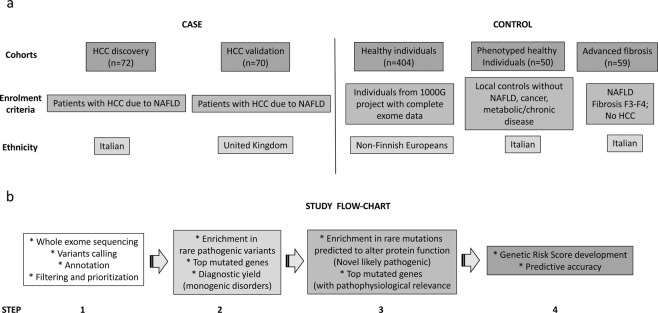
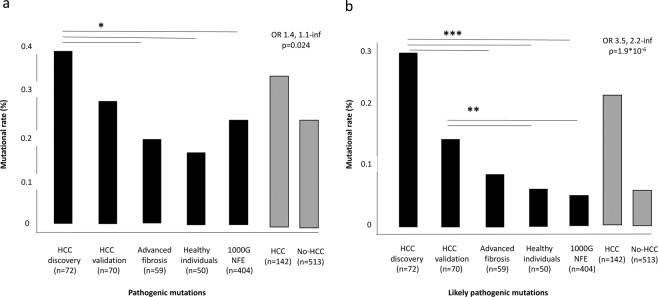
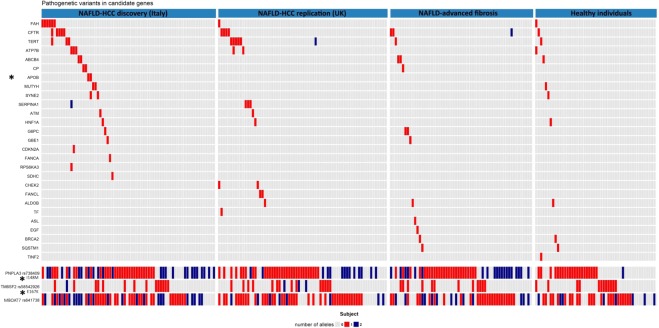
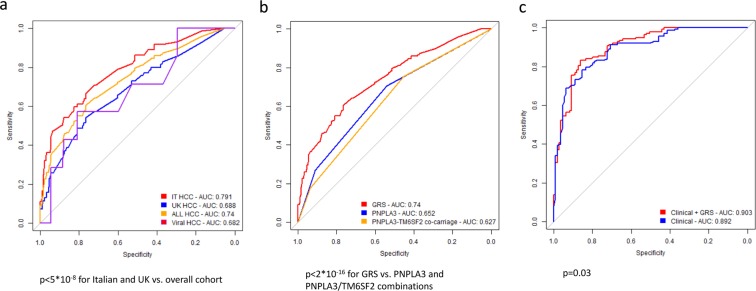
Abstract Nonalcoholic fatty liver disease (NAFLD) is a rising cause of hepatocellular carcinoma (HCC). We examined whether inherited pathogenic variants in candidate genes (n = 181) were enriched in patients with NAFLD-HCC. To this end, we resequenced peripheral blood DNA of 142 NAFLD-HCC, 59 NAFLD with advanced fibrosis, and 50 controls, and considered 404 healthy individuals from 1000 G. Pathogenic variants were defined according to ClinVar, likely pathogenic as rare variants predicted to alter protein activity. In NAFLD-HCC patients, we detected an enrichment in pathogenic (p = 0.024), and likely pathogenic variants (p = 1.9*10 −6 ), particularly in APOB (p = 0.047). APOB variants were associated with lower circulating triglycerides and higher HDL cholesterol (p < 0.01). A genetic risk score predicted NAFLD-HCC (OR 4.96, 3.29–7.55; p = 5.1*10 −16 ), outperforming the diagnostic accuracy of common genetic risk variants, and of clinical risk factors (p < 0.05). In conclusion, rare pathogenic variants in genes involved in liver disease and cancer predisposition are associated with NAFLD-HCC development.
Overview
The claims and statistics of this paper haven’t been checked yet.
Run the check — free, no account needed. It reads the open-access text and checks the sources it cites.
Integrity signals
Registry
Cites
Statistics
Figures
Verification
Claims the paper makes
The claims and statistics of this paper haven’t been checked yet.
Run the check — free, no account needed. It reads the open-access text and checks the sources it cites.
Claims other papers make about this one
Each is checked against this paper’s own text: does it say what the citing paper says it does?
The source backs part of the claim, not all of it — or backs it for a different population, condition or comparison.
In the citing paper
“Comprehensive polygenic risk scores are superior to PNPLA3 and TM6SF2 alone for risk prediction of progressive MASLD, especially in individuals with metabolic triggers, and the bene fi ts of their use over clinical risk factors alone becomes more evident for long-term prediction. 196,206,207”
From EASL-EASD-EASO Clinical Practice Guidelines on the management of metabolic dysfunction-associated steatotic liver disease (MASLD). (2024) · cites this paper as [196]
Experimental — accuracy not yet measuredThe source backs part of the claim, not all of it — or backs it for a different population, condition or comparison.
In the citing paper
“Overall evidence suggests that the PNPLA3 p.I148M and TM6SF2 p.E167K variants are major risk factors for progressive MASLD, and genotyping helps to noninvasively predict progressive MASH, cirrhosis and HCC when considered alongside clinical factors, 194 -196 but accuracy is suboptimal for prediction of liver disease severity and progression at the individual level.”
From EASL-EASD-EASO Clinical Practice Guidelines on the management of metabolic dysfunction-associated steatotic liver disease (MASLD). (2024) · cites this paper as [196]
Experimental — accuracy not yet measured
Self-check
Percentages, sums and reported differences re-computed from the paper’s own numbers.
The self-check needs the paper’s full text.
Citations
Cites
The Sequence Alignment/Map format and SAMtools
Li, H., Handsaker, B., Wysoker, A., Fennell, T., Ruan, J., Homer, N., Marth, G., Abecasis, G., Durbin, R., & 1000 Genome Project Data Processing Subgroup (2009) · Bioinformatics · doi:10.1093/bioinformatics/btp352 · Cited by 62,041
Fast and accurate short read alignment with Burrows-Wheeler transform
Li, H., & Durbin, R. (2009) · Bioinformatics · doi:10.1093/bioinformatics/btp324 · Cited by 58,607
The Genome Analysis Toolkit: A MapReduce framework for analyzing next-generation DNA sequencing data
McKenna, A., Hanna, M., Banks, E., Sivachenko, A., Cibulskis, K., Kernytsky, A., Garimella, K., Altshuler, D., Gabriel, S., Daly, M., et al. (2010) · Genome Research · doi:10.1101/gr.107524.110 · Cited by 27,895
BEDTools: a flexible suite of utilities for comparing genomic features
Quinlan, A. R., & Hall, I. M. (2010) · Bioinformatics · doi:10.1093/bioinformatics/btq033 · Cited by 27,437
A global reference for human genetic variation
The 1000 Genomes Project Consortium, authors, C., Auton, A., Abecasis, G. R., Steering committee, Altshuler, D. M., Durbin, R. M., Abecasis, G. R., Bentley, D. R., Chakravarti, A., et al. (2015) · Nature · doi:10.1038/nature15393 · Cited by 18,247
The variant call format and VCFtools
Danecek, P., Auton, A., Abecasis, G. R., Albers, C. A., Banks, E., DePristo, M. A., Handsaker, R. E., Lunter, G. A., Marth, G., Sherry, S. T., et al. (2011) · Bioinformatics · doi:10.1093/bioinformatics/btr330 · Cited by 16,450
Repertoires of Autophagy in the Pathogenesis of Ocular Diseases
Li, Y., Jiang, Q. L., Cao, G.-F., Yao, J., & Yan, B. (2015) · Cellular Physiology and Biochemistry · doi:10.1159/000373980 · Cited by 16,351
ANNOVAR: functional annotation of genetic variants from high-throughput sequencing data
Wang, K., Li, M., & Hakonarson, H. H. (2010) · Nucleic Acids Research · doi:10.1093/nar/gkq603 · Cited by 14,724
Fast and accurate long-read alignment with Burrows-Wheeler transform.
Li, H., & Durbin, R. (2010) · Bioinformatics · doi:10.1093/bioinformatics/btp698 · Cited by 12,063
EASL Clinical Practice Guidelines: Management of hepatocellular carcinoma
Galle, P. R., Forner, A., Llovet, J. M., Mazzaferro, V., Piscaglia, F., Raoul, J.-L., Schirmacher, P., & Vilgrain, V. (2018) · Journal of Hepatology · doi:10.1016/j.jhep.2018.03.019 · Cited by 11,406
Cited by
Sorted by citations
MAFLD: a consensus-driven proposed nomenclature for metabolic associated fatty liver disease
Eslam, M., Sanyal, A. J., George, J., Sanyal, A., Neuschwander-Tetri, B., Tiribelli, C., Kleiner, D. E., Brunt, E., Bugianesi, E., Yki-Järvinen, H., et al. (2020) · Gastroenterology · doi:10.1053/j.gastro.2019.11.312 · Cited by 3,286
Self-citationTacke, F., Horn, P., Wai-Sun Wong, V., Ratziu, V., Bugianesi, E., Francque, S., Zelber-Sagi, S., Valenti, L., Roden, M., Schick, F., et al. (2024) · Journal of Hepatology · doi:10.1016/j.jhep.2024.04.031 · Cited by 2,210
Self-citation(2024) · Obesity Facts · doi:10.1159/000539371 · Cited by 545
Update on NAFLD genetics: From new variants to the clinic
Trépo, E., & Valenti, L. (2020) · Journal of Hepatology · doi:10.1016/j.jhep.2020.02.020 · Cited by 393
Self-citationBianco, C., Jamialahmadi, O., Pelusi, S., Baselli, G., Dongiovanni, P., Zanoni, I., Santoro, L., Maier, S., Liguori, A., Meroni, M., et al. (2021) · Journal of Hepatology · doi:10.1016/j.jhep.2020.11.024 · Cited by 385
Self-citation
Metadata
- Authors
- Pelusi, S., Baselli, G., Pietrelli, A., Dongiovanni, P., Donati, B., McCain, M. V., Meroni, M., Fracanzani, A. L., Romagnoli, R., Petta, S., Grieco, A., Miele, L., Soardo, G., Bugianesi, E., Fargion, S., Aghemo, A., D’Ambrosio, R., Xing, C., Romeo, S., De Francesco, R., Reeves, H. L., & Valenti, L. V. C.
- Affiliations
- University of Milan (IT)
- Fondazione IRCCS Ca' Granda Ospedale Maggiore Policlinico (IT)
- Newcastle University (GB)
- University of Turin (IT)
- University of Palermo (IT)
- Agostino Gemelli University Polyclinic (IT)
- University of Udine (IT)
- Humanitas University (IT)
- The University of Texas Southwestern Medical Center (US)
- Magna Graecia University (IT)
- Newcastle upon Tyne Hospitals NHS Foundation Trust (GB)
- Corresponding author
- Valenti, Luca Vittorio Carlo
- ORCID
- Pelusi, Serena
- Baselli, Guido
- Pietrelli, Alessandro
- Dongiovanni, Paola
- Donati, Benedetta
- McCain, Misti Vanette
- Meroni, Marica
- Fracanzani, Anna Ludovica
- Romagnoli, Renato
- Petta, Salvatore
- Grieco, Antonio
- Miele, Luca
- Soardo, Giorgio
- Bugianesi, Elisabetta
- Fargion, Silvia
- Aghemo, Alessio
- D’Ambrosio, Roberta
- Xing, Chao
- Romeo, Stefano
- Reeves, Helen Louise
- Valenti, Luca Vittorio Carlo
- Venue
- Scientific Reports
- Published
- 2019-03-06
- Volume
- 9
- Issue
- 1
- Pages
- 3682-3682
- ISSN
- 2045-2322 (ISSN-L)
- PMC
- PMC6403344
- OpenAlex
- W2919587539
- Cited by
- 125
- References
- 55
- Citations by year
- 2026: 11 · 2025: 10 · 2024: 16 · 2023: 15 · 2022: 23 · 2021: 28 · 2020: 17 · 2019: 4
- FWCI
- 13.70
- Type
- journal article
- Language
- en
- Open access
- gold
- doi.org
- Locations
- Scientific Reports (publishedVersion, cc-by)
- Europe PMC (PubMed Central) (publishedVersion, other-oa)
- PubMed Central (publishedVersion, cc-by)
- PubMed (publishedVersion)
- Archivio Istituzionale della Ricerca (Universita Degli Studi Di Milano) (submittedVersion, cc-by)
- Institutional Research Information System University of Turin (University of Turin) (submittedVersion, other-oa)
- Institutional Research Information System (University of Udine) (submittedVersion, cc-by)
- DOAJ (DOAJ: Directory of Open Access Journals) (submittedVersion)
- Nova Science Publishers (Nova Science Publishers, Inc.) (submittedVersion, other-oa)
- PubliCatt (Università Cattolica del Sacro Cuore) (submittedVersion, other-oa)
- Newcastle University ePrints (Newcastle Univesity) (cc-by)
- Funders
- European Commission (HEALTH-F2-2009-241762)
- Associazione Italiana per la Ricerca sul Cancro (MFAG-16888)
- Ministry of Health, Italy | Agenzia Italiana del Farmaco, Ministero della Salute (RF-2016-02364358)
- Topics
- Health Sciences › Medicine › Hepatology › Liver Disease Diagnosis and Treatment
- Life Sciences › Biochemistry, Genetics and Molecular Biology › Genetics › Genetic Associations and Epidemiology
- Health Sciences › Medicine › Hepatology › Hepatocellular Carcinoma Treatment and Prognosis
- Keywords
- hepatocellular carcinoma, non-alcoholic fatty liver disease, rare pathogenic variants, apolipoprotein B, genetic susceptibility, polygenic risk score, HDL cholesterol, liver fibrosis, cancer susceptibility genes
- MeSH terms
- Sequestosome-1 Protein, Aged, Female, Carcinoma, Hepatocellular, Humans, Cholesterol, HDL, Liver Neoplasms, Male, Middle Aged, Risk Factors, Reproducibility of Results, Case-Control Studies, Genetic Predisposition to Disease, Glial Cell Line-Derived Neurotrophic Factor Receptors, Apolipoprotein B-100, Non-alcoholic Fatty Liver Disease
About these checks
Registry, retraction, Cites and statistics results are computed, not judged, with one exception: a printed reference that no index lists is read once by a model before it counts as a citation error. Claims are extracted by a model and kept only when their quote appears verbatim in the text; each cited source is then checked, with a model’s help, for whether it says what the claim relies on. Those verdicts can be wrong — read the claim’s quote and the cited source before relying on one.
Statistics and arithmetic are recomputed, not judged.
Confidence bands are shown only for fields calibrated on our annotated test set. None is calibrated yet, so no band is shown.
What counts as a claim ›How we measure confidence ›How we check this ›
Are you an author, or do you see a problem with this page? Request a review
