

Reversal of established liver fibrosis by IC-2-engineered mesenchymal stem cell sheets
Open accessThe DOI matches its Crossref record; 52 of the 54 references it cites were found in a registry or an index.
Abstract
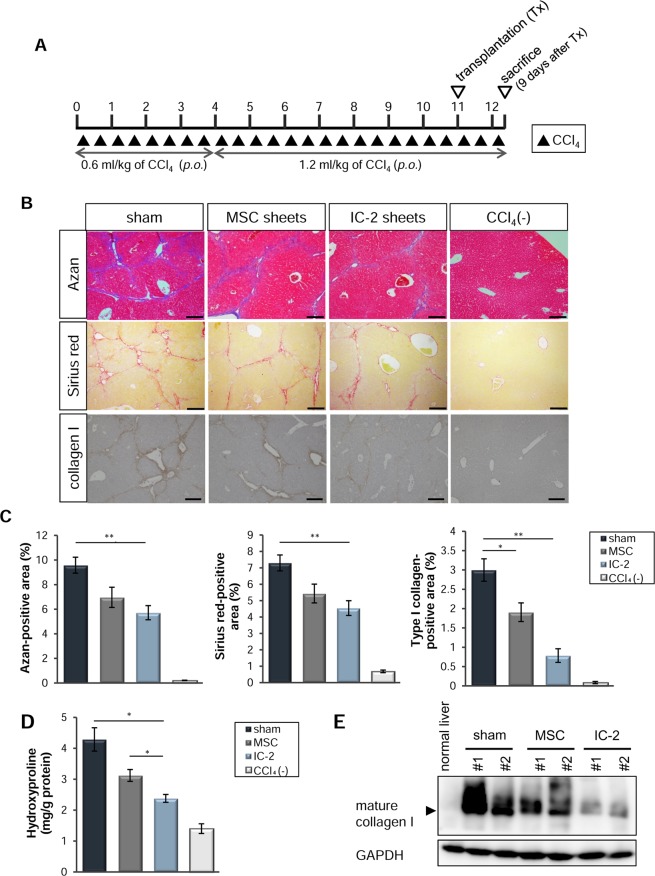
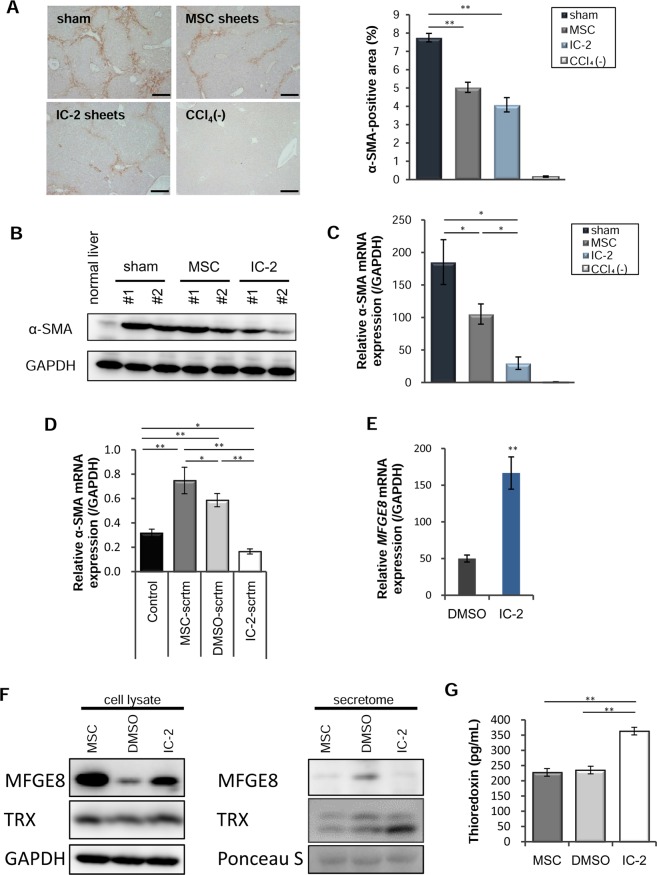
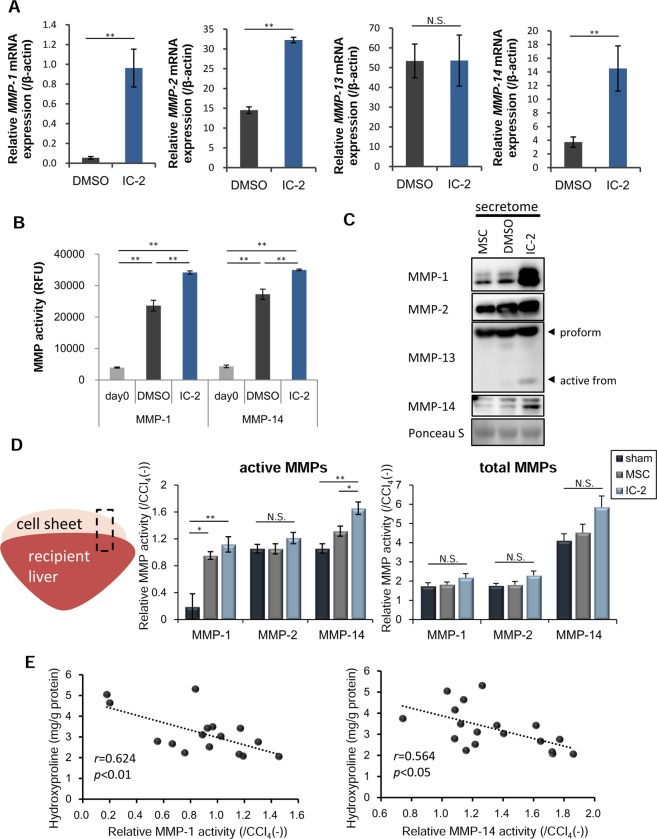
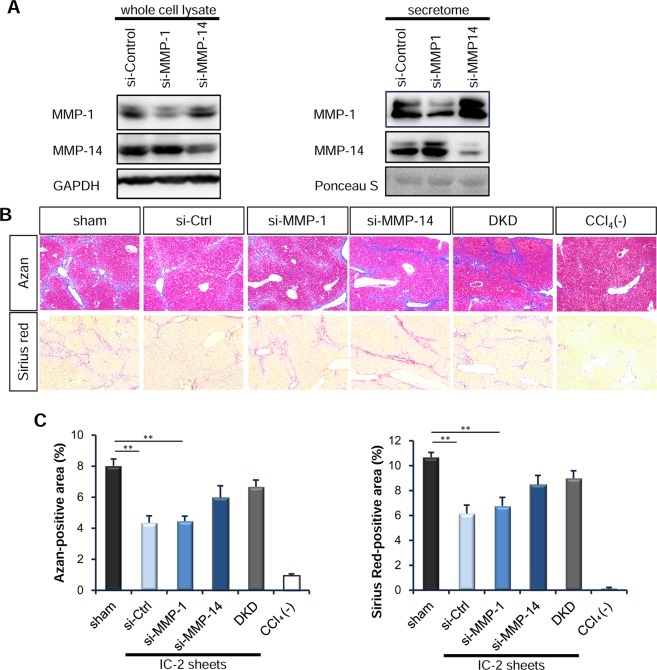
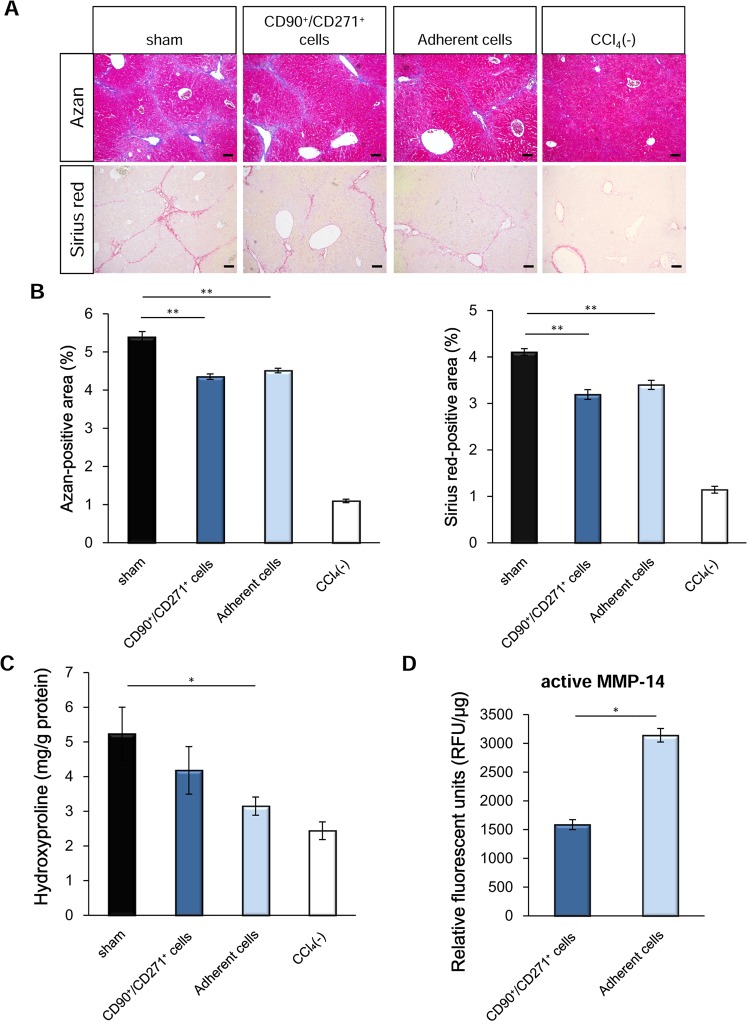
Chronic hepatitis viral infection, alcoholic intoxication, and obesity cause liver fibrosis, which progresses to decompensated liver cirrhosis, a disease for which medical demands cannot be met. Since there are currently no approved anti-fibrotic therapies for established liver fibrosis, the development of novel modalities is required to improve patient prognosis. In this study, we clarified the anti-fibrotic effects of cell sheets produced from human bone marrow-derived mesenchymal stem cells (MSCs) incubated on a temperature-sensitive culture dish with the chemical compound IC-2. Orthotopic transplantation of IC-2-engineered MSC sheets (IC-2 sheets) remarkably reduced liver fibrosis induced by chronic CCl 4 administration. Further, the marked production of fibrolytic enzymes such as matrix metalloproteinase (MMP)-1 and MMP-14, as well as thioredoxin, which suppresses hepatic stellate cell activation, was observed in IC-2 sheets. Moreover, the anti-fibrotic effect of IC-2 sheets was much better than that of MSC sheets. Finally, knockdown experiments revealed that MMP-14 was primarily responsible for the reduction of liver fibrosis. Here, we show that IC-2 sheets could be a promising therapeutic option for established liver fibrosis.
Overview
The claims and statistics of this paper haven’t been checked yet.
Free: it reads the open-access text and checks the first 5 claims that cite a source we can check. Create a free account to check every claim.
Integrity signals
Registry
Cites
Statistics
Figures
Verification
Claims the paper makes
The claims and statistics of this paper haven’t been checked yet.
Free: it reads the open-access text and checks the first 5 claims that cite a source we can check. Create a free account to check every claim.
Claims other papers make about this one
Each is checked against this paper’s own text: does it say what the citing paper says it does?
The source backs part of the claim, not all of it — or backs it for a different population, condition or comparison.
In the citing paper
“MSCs can increase the expression of MMP-1, -2, -9, -13, and -14 [190–192] and reduce the secretion of TIMP-1 and TIMP-2 [193, 194], rescuing deposited ECM and established fibrosis.”
From Mechanisms, efficacy, and future perspectives of cellular-based therapies for liver fibrosis/cirrhosis: focusing on mesenchymal stromal cells (2025) · cites this paper as [191]
Experimental — accuracy not yet measuredThe cited source says what the claim attributes to it.
In the citing paper
“IC-2-engineered MSC sheets remarkably reduced CCl4-induced liver fibrosis by increasing the expression and activities of MMP-1 and MMP-14, especially MMP-14, which can activate MMP-2 and MMP-13 and contribute to the degradation of type I collagen [191].”
From Mechanisms, efficacy, and future perspectives of cellular-based therapies for liver fibrosis/cirrhosis: focusing on mesenchymal stromal cells (2025) · cites this paper as [191]
Self-check
Percentages, sums and reported differences re-computed from the paper’s own numbers.
The self-check needs the paper’s full text.
Citations
Cites
Mechanisms of hepatic stellate cell activation
Tsuchida, T., & Friedman, S. L. (2017) · Nature Reviews Gastroenterology & Hepatology · doi:10.1038/nrgastro.2017.38 · Cited by 2,909
Extracellular Matrix Degradation and Remodeling in Development and Disease
Lu, P., Takai, K., Weaver, V. M., & Werb, Z. (2011) · Cold Spring Harbor Perspectives in Biology · doi:10.1101/cshperspect.a005058 · Cited by 2,265
The Cellular Basis of Hepatic Fibrosis -- Mechanisms and Treatment Strategies
Flier, J. S., Underhill, L. H., & Friedman, S. L. (1993) · New England Journal of Medicine · doi:10.1056/nejm199306243282508 · Cited by 1,432
Matrix Metalloproteinase-2 Is an Interstitial Collagenase
Aimes, R. T., & Quigley, J. P. (1995) · Journal of Biological Chemistry · doi:10.1074/jbc.270.11.5872 · Cited by 944
Ohuchi, E., Imai, K., Fujii, Y., Sato, H., Seiki, M., & Okada, Y. (1997) · Journal of Biological Chemistry · doi:10.1074/jbc.272.4.2446 · Cited by 938
Hepatic fibrosis: concept to treatment
Trautwein, C., Friedman, S. L., Schuppan, D., & Pinzani, M. (2015) · Journal of Hepatology · doi:10.1016/j.jhep.2015.02.039 · Cited by 677
Will, H., Atkinson, S. J., Butler, G. S., Smith, B., & Murphy, G. (1996) · Journal of Biological Chemistry · doi:10.1074/jbc.271.29.17119 · Cited by 569
Engineering functional two- and three-dimensional liver systems in vivo using hepatic tissue sheets
Ohashi, K., Yokoyama, T., Yamato, M., Kuge, H., Kanehiro, H., Tsutsumi, M., Amanuma, T., Iwata, H., Yang, J., Okano, T., et al. (2007) · Nature Medicine · doi:10.1038/nm1576 · Cited by 507
Kuo, T. K., Hung, S., Chuang, C., Chen, C., Shih, Y. V., Fang, S. Y., Yang, V. W., & Lee, O. K. (2008) · Gastroenterology · doi:10.1053/j.gastro.2008.03.015 · Cited by 466
Fibrosis-dependent mechanisms of hepatocarcinogenesis
Zhang, D. Y., & Friedman, S. L. (2012) · Hepatology · doi:10.1002/hep.25670 · Cited by 444
Cited by
Matrix Metalloproteinases as Potential Biomarkers and Therapeutic Targets in Liver Diseases
Geervliet, E., & Bansal, R. (2020) · Cells · doi:10.3390/cells9051212 · Cited by 176
Liver fibrosis resolution: from molecular mechanisms to therapeutic opportunities
Pei, Q., Yi, Q., & Tang, L. (2023) · International Journal of Molecular Sciences · doi:10.3390/ijms24119671 · Cited by 121
“Currently, the only effective treatment for advanced liver disease is liver transplantation [15,18], but it has its limitations.”
BackgroundMesenchymal stromal cells in hepatic fibrosis/cirrhosis: from pathogenesis to treatment
Yang, X., Li, Q., Liu, W., Zong, C., Wei, L., Shi, Y., & Han, Z. (2023) · Cellular & Molecular Immunology · doi:10.1038/s41423-023-00983-5 · Cited by 120
Stem cells for treatment of liver fibrosis/cirrhosis: clinical progress and therapeutic potential
Liu, P., Mao, Y., Xie, Y., Wei, J., & Yao, J. (2022) · Stem Cell Research & Therapy · doi:10.1186/s13287-022-03041-5 · Cited by 82
Geervliet, E., Moreno, S., Baiamonte, L., Booijink, R., Boye, S., Wang, P., Voit, B., Lederer, A., Appelhans, D., & Bansal, R. (2021) · Journal of Controlled Release · doi:10.1016/j.jconrel.2021.03.016 · Cited by 63
Liu, X., Wang, L., Tan, S., Chen, Z., Wu, B., & Wu, X. (2022) · Frontiers in Pharmacology · doi:10.3389/fphar.2022.814871 · Cited by 54
Cell mediated ECM-degradation as an emerging tool for anti-fibrotic strategy
Zhao, P., Sun, T., Lyu, C., Liang, K., & Du, Y. (2023) · Cell Regeneration · doi:10.1186/s13619-023-00172-9 · Cited by 48
Zhu, M., Hua, T., Ouyang, T., Qian, H., & Yu, B. (2021) · Stem Cells International · doi:10.1155/2021/6546780 · Cited by 43
Review of the potential of mesenchymal stem cells for the treatment of infectious diseases
Sharma, A., Chakraborty, A., & Jaganathan, B. G. (2021) · World Journal of Stem Cells · doi:10.4252/wjsc.v13.i6.568 · Cited by 39
Wang, E. Y., Zhao, Y., Okhovatian, S., Smith, J. B., & Radisic, M. (2022) · Frontiers in Bioengineering and Biotechnology · doi:10.3389/fbioe.2022.1005051 · Cited by 15
Tailoring cell sheets for biomedical applications
Chen, W., Nie, M., Gan, J., Xia, N., Wang, D., & Sun, L. (2024) · Smart Medicine · doi:10.1002/smmd.20230038 · Cited by 12
Czekaj, P., Król, M., Limanówka, Ł., Michalik, M., Lorek, K., & Gramignoli, R. (2019) · European Journal of Pharmacology · doi:10.1016/j.ejphar.2019.172597 · Cited by 12
Fukushima, K., Itaba, N., Kono, Y., Okazaki, S., Enokida, S., Kuranobu, N., Murakami, J., Enokida, M., Nagashima, H., Kanzaki, S., et al. (2021) · Regenerative Therapy · doi:10.1016/j.reth.2021.08.004 · Cited by 11
Self-citationCell Sheets Restore Secretory Function in Wounded Mouse Submandibular Glands
dos Santos, H. T., Kim, K.-S., Okano, T., Camden, J. M., Weisman, G. A., Baker, O. J., & Nam, K. (2020) · Cells · doi:10.3390/cells9122645 · Cited by 11
McKee, C. C., & Wong, J. Y. (2026) · Nature Reviews Bioengineering · doi:10.1038/s44222-026-00437-3 · Cited by 7
Mykytenko, A. О., Akimov, O. Y., Yeroshenko, G. А., & Neporada, K. N. (2023) · Regulatory Mechanisms in Biosystems · doi:10.15421/022341 · Cited by 5
Identification of a Novel Deactivating Small-Molecule Compound for Fibrogenic Hepatic Stellate Cells
Sakaguchi, T., Kono, Y., Itaba, N., Morimoto, M., Isomoto, H., & Shiota, G. (2020) · Yonago acta medica · doi:10.33160/yam.2020.02.013 · Cited by 5
Self-citationHatakeyama, D., Itaba, N., Shimizu, H., Morimoto, M., & Shiota, G. (2025) · Yonago acta medica · doi:10.33160/yam.2025.05.009 · Cited by 4
Self-citationIslam, M. A., Mawya, J., Salma, U., Kasim, N. H. A., & Haque, N. (2025) · World Journal of Stem Cells · doi:10.4252/wjsc.v17.i11.111090 · Cited by 5
Matrix metalloproteinases: the role in evolution of liver diseases
Koroy, P., Dudov, T. R., Yagoda, A., & Sarithala, V. J. (2023) · Medical news of the North Caucasus · doi:10.14300/mnnc.2023.18052 · Cited by 4
Salem, B. A.-A., Elkaliny, H. H., El-Hafez, A. A. A. A., & Sarhan, N. I. (2022) · Journal of Microscopy and Ultrastructure · doi:10.4103/jmau.jmau_62_21 · Cited by 4
Pan, X., Gao, T., & Wang, B. (2025) · Cell & Bioscience · doi:10.1186/s13578-025-01520-9 · Cited by 2
“IC-2-engineered MSC sheets remarkably reduced CCl 4 -induced liver fibrosis by increasing the expression and activities of MMP-1 and MMP-14, especially MMP-14, which can activate MMP-2 and MMP-13 and contribute to the degradation of type I collagen [191].”
Stem cell signaling molecules and pathways in liver regeneration
Chawla, S., & Das, A. (2023) · Elsevier eBooks · doi:10.1016/b978-0-443-18800-8.00014-9 · Cited by 1
Cell Sheet Technology as a Platform for Functional Regeneration
Shiota, G., & Itaba, N. (2026) · International Journal of Molecular Sciences · doi:10.3390/ijms27198695
Self-citationPathogenic and therapeutic roles of mesenchymal stem cells in liver fibrosis
Онищенко, Н. А., Shagidulin, M. Y., Vaniukova, A. A., Kuzmina, A. V., Nikolskaya, A. O., Volkova, E. A., Kostysheva, A., Lychagin, I. A., Kazantseva, K. A., Ibragimova, M. R., et al. (2026) · Russian Journal of Transplantology and Artificial Organs · doi:10.15825/1995-1191-2025-4-110-124
Itaba, N., Abe, K.-I., Kono, Y., Shimizu, H., Oka, H., Morimoto, M., Nanba, D., & Shiota, G. (2026) · International Journal of Molecular Sciences · doi:10.3390/ijms27219522
Self-citationDrugs to Modify Liver Fibrosis Progression and Regression
Vilaseca, M., & Gracia‐Sancho, J. (2022) · Springer eBooks · doi:10.1007/978-3-031-08552-9_18
Stem cells for hepatic regeneration: Evaluating mechanisms, sources, and clinical outcomes
Dastmalchi, N., Rahbarghazi, R., Barzegari, A., Safaralizadeh, R., Mansoori, B., Khojasteh, S. M. B., & Hajiasgharzadeh, K. (2026) · Biochemistry and Biophysics Reports · doi:10.1016/j.bbrep.2026.102858
Fukushima, T., 40216, Fukushima, K., & 40217 (2022) · Institutional Repositories DataBase (IRDB)
Reconceptualizing Mesenchymal Stromal Cell Sheets: From Delivery Tool to Models of Morphogenesis
Alexandrushkina, N., Glazieva, V. S., Vodopetova, M. A., Eremichev, R. Y., Hu, Y.-C., & Макаревич, П. И. (2026) · Tissue Engineering Part B Reviews · doi:10.1177/19373368261448752
Metadata
- Authors
- Itaba, N., Kono, Y., Watanabe, K., Yokobata, T., Oka, H., Osaki, M., Kakuta, H., Morimoto, M., & Shiota, G.
- Affiliations
- Tottori University (JP)
- KanonCure Inc. (Japan) (JP)
- Okayama University (JP)
- Corresponding author
- Shiota, Goshi
- ORCID
- Venue
- Scientific Reports
- Published
- 2019-05-02
- Volume
- 9
- Issue
- 1
- Pages
- 6841-6841
- ISSN
- 2045-2322 (ISSN-L)
- PMC
- PMC6497888
- OpenAlex
- W2943631274
- Cited by
- 29
- References
- 53
- Citations by year
- 2026: 6 · 2025: 3 · 2024: 1 · 2023: 6 · 2022: 5 · 2021: 4 · 2020: 3 · 2019: 1
- FWCI
- 1.79
- Type
- journal article
- Language
- en
- Open access
- gold
- doi.org
- Licence
- cc-by
- creativecommons.org/licenses/by/4.0 (tdm)
- creativecommons.org/licenses/by/4.0 (vor)
- Locations
- Scientific Reports (publishedVersion, cc-by)
- Europe PMC (PubMed Central) (publishedVersion, cc-by)
- PubMed Central (publishedVersion, cc-by)
- PubMed (publishedVersion)
- Tokyo Tech Research Repository (Tokyo Institute of Technology) (submittedVersion)
- Funders
- Ministry of Education, Culture, Sports, Science and Technology
- Topics
- Life Sciences › Biochemistry, Genetics and Molecular Biology › Cell Biology › Mesenchymal stem cell research
- Health Sciences › Medicine › Hepatology › Liver physiology and pathology
- Health Sciences › Medicine › Surgery › Tissue Engineering and Regenerative Medicine
- Keywords
- liver fibrosis, mesenchymal stem cells, cell sheets, orthotopic transplantation, antifibrotic therapy, hepatic stellate cells, MMP-14, MMP-1, thioredoxin, CCl4-induced liver fibrosis, bone marrow-derived stem cells
- MeSH terms
- Animals, Bridged Bicyclo Compounds, Bone Marrow Cells, Enzyme Inhibitors, Hexachlorophene, Humans, Immunohistochemistry, Liver Cirrhosis, Mice, Inbred BALB C, Temperature, Matrix Metalloproteinase 1, Collagen Type I, Mice, Matrix Metalloproteinase 14, Chemical and Drug Induced Liver Injury, Mesenchymal Stem Cells
About these checks
Registry, retraction, Cites and statistics results are computed, not judged, with one exception: a printed reference that no index lists is read once by a model before it counts as a citation error. Claims are extracted by a model and kept only when their quote appears verbatim in the text; each cited source is then checked, with a model’s help, for whether it says what the claim relies on. Those verdicts can be wrong — read the claim’s quote and the cited source before relying on one.
Statistics and arithmetic are recomputed, not judged.
Confidence bands are shown only for fields calibrated on our annotated test set. None is calibrated yet, so no band is shown.
What counts as a claim ›How we measure confidence ›How we check this ›
Are you an author, or do you see a problem with this page? Request a review
Data sources
Bibliographic data: Semantic Scholar, OpenAlex, Crossref.
Contains information from the Semantic Scholar Academic Graph Datasets, made available under the ODC Attribution License (ODC-BY 1.0).
Semantic Scholar’s data is described in: Kinney, R., et al. (2023). The Semantic Scholar Open Data Platform. arXiv:2301.10140.
