

The DOI matches its Crossref record; 47 of the 47 references it cites were found in a registry or an index.
Audio-Tactile Skinny Buttons for Touch User Interfaces
Open accessAbstract
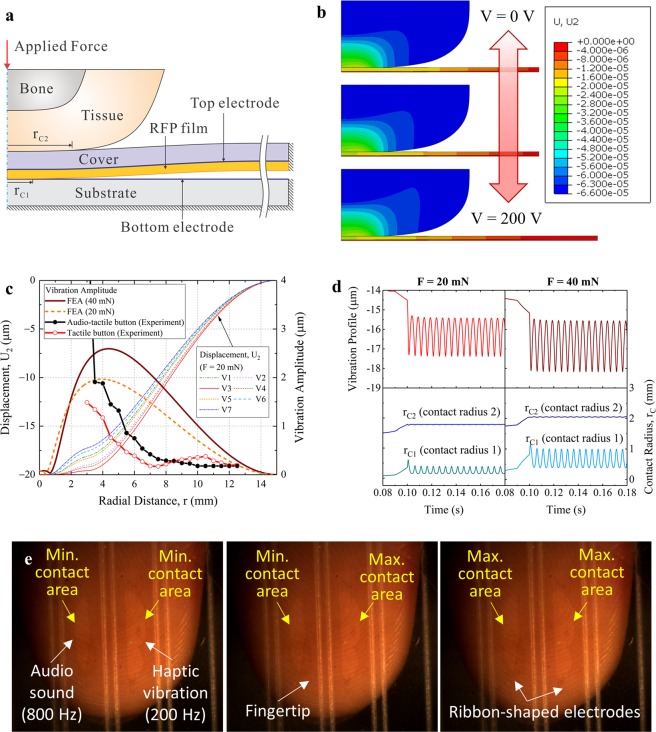
This study proposes a novel skinny button with multimodal audio and haptic feedback to enhance the touch user interface of electronic devices. The active material in the film-type actuator is relaxor ferroelectric polymer (RFP) poly(vinylidene fluoride-trifluoroethylene-chlorofluoroethylene) [P(VDF-TrFE-CFE)] blended with poly(vinylidene fluoride-trifluoroethylene) [P(VDF-TrFE)], which produces mechanical vibrations via the fretting vibration phenomenon. Normal pressure applied by a human fingertip on the film-type skinny button mechanically activates the locally concentrated electric field under the contact area, thereby producing a large electrostrictive strain in the blended RFP film. Multimodal audio and haptic feedback is obtained by simultaneously applying various electric signals to the pairs of ribbon-shaped top and bottom electrodes. The fretting vibration provides tactile feedback at frequencies of 50–300 Hz and audible sounds at higher frequencies of 500 Hz to 1 kHz through a simple on-off mechanism. The advantage of the proposed audio-tactile skinny button is that it restores the “click” sensation to the popular virtual touch buttons employed in contemporary electronic devices.
Overview
The claims and statistics of this paper haven’t been checked yet.
Free: it reads the open-access text and checks the first 5 claims that cite a source we can check. Create a free account to check every claim.
Integrity signals
Registry
Cites
Statistics
Figures



Verification
Claims the paper makes
The claims and statistics of this paper haven’t been checked yet.
Free: it reads the open-access text and checks the first 5 claims that cite a source we can check. Create a free account to check every claim.
Claims other papers make about this one
Each is checked against this paper’s own text: does it say what the citing paper says it does?
The check wasn’t confident either way, so it gives no verdict — never disputed.
In the citing paper
“To solve the issue of insufficient stimulation force, multi-layer stacking structure,[592] or hydraulic pressure to amplify the force have been proposed.[63,593,594]”
From Flexible Electronics and Devices as Human–Machine Interfaces for Medical Robotics (2022) · cites this paper as [593]
Experimental — accuracy not yet measured
Self-check
Percentages, sums and reported differences re-computed from the paper’s own numbers.
The self-check needs the paper’s full text.
Citations
Cites
Use of piezoelectric actuators as elements of intelligent structures
Crawley, E. F., & de Luis, J. (1987) · AIAA Journal · doi:10.2514/3.9792 · Cited by 2,602
Pursuing prosthetic electronic skin
Chortos, A., Liu, J., & Bao, Z. (2016) · Nature Materials · doi:10.1038/nmat4671 · Cited by 2,396
Abraira, V. E., & Ginty, D. D. (2013) · Neuron · doi:10.1016/j.neuron.2013.07.051 · Cited by 1,648
Talbot, W. H., Darian-Smith, I., Kornhuber, H. H., & Mountcastle, V. B. (1968) · Journal of Neurophysiology · doi:10.1152/jn.1968.31.2.301 · Cited by 990
Four channels mediate the mechanical aspects of touch
Bolanowski, S. J., Gescheider, G. A., Verrillo, R. T., & Checkosky, C. M. (1988) · The Journal of the Acoustical Society of America · doi:10.1121/1.397184 · Cited by 937
(1984) · PubMed · Cited by 908
TeslaTouch: electrovibration for touch surfaces
Bau, O., Poupyrev, I., Israr, A., & Harrison, C. (2010) · Proceedings of the 23nd annual ACM symposium on User interface software and technology · doi:10.1145/1866029.1866074 · Cited by 664
Modeling piezoelectric actuators
Adriaens, H. J. M. T. S., De Koning, W. L., & Banning, R. (2000) · IEEE/ASME Transactions on Mechatronics · doi:10.1109/3516.891044 · Cited by 601
Psychophysical Dimensions of Tactile Perception of Textures
Okamoto, S., Nagano, H., & Yamada, Y. (2013) · IEEE Transactions on Haptics · doi:10.1109/toh.2012.32 · Cited by 482
Piezoelectric Actuators for Distributed Vibration Excitation of Thin Plates
Dimitriadis, E. K., Fuller, C. R., & Rogers, C. A. (1991) · Journal of Vibration and Acoustics · doi:10.1115/1.2930143 · Cited by 462
Research works printed but not linked: 2
- Di Jasio, L. Simplifying Capacitive Touch Sensing. Electronics World 122, 10–13 (2016).
- Pyo, D. et al. In Haptics: Perception, Devices, Mobility, and Communication (eds Isokoski, P. & Springare, J.) 133–138 (Springer Berlin Heidelberg, Berlin, Heidelberg, 2012).
Cited by
Flexible Electronics and Devices as Human–Machine Interfaces for Medical Robotics
Heng, W., Solomon, S., & Gao, W. (2022) · Advanced Materials · doi:10.1002/adma.202107902 · Cited by 609
Yang, T., Kim, J. R., Jin, H., Gil, H., Koo, J., & Kim, H. J. (2021) · Advanced Functional Materials · doi:10.1002/adfm.202008831 · Cited by 178
Highly pixelated, untethered tactile interfaces for an ultra-flexible on-skin telehaptic system
Jin, H., Kim, Y., Youm, W., Min, Y., Seo, S., Lim, C., Hong, C., Kwon, S., Park, G., Park, S., et al. (2022) · npj Flexible Electronics · doi:10.1038/s41528-022-00216-1 · Cited by 91
Soft Actuator Materials for Electrically Driven Haptic Interfaces
Ankit, A., Ho, T. Y. K., Nirmal, A., Kulkarni, M. R., Accoto, D., & Mathews, N. (2021) · Advanced Intelligent Systems · doi:10.1002/aisy.202100061 · Cited by 82
Towards high performance and durable soft tactile actuators
Tan, M., Wang, H., Gao, D., Huang, P.-W., & Lee, P. S. (2024) · Chemical Society Reviews · doi:10.1039/d3cs01017a · Cited by 73
Metadata
- Authors
- Van Duong, Q., Nguyen, V. P., Luu, A. T., & Choi, S. T.
- Affiliations
- Chung-Ang University (KR)
- Corresponding author
- Choi, Seung Tae
- Venue
- Scientific Reports
- Published
- 2019-09-16
- Volume
- 9
- Issue
- 1
- Pages
- 13290-13290
- ISSN
- 2045-2322 (ISSN-L)
- PMC
- PMC6746798
- OpenAlex
- W2972340928
- Cited by
- 21
- References
- 47
- Citations by year
- 2026: 1 · 2025: 3 · 2024: 1 · 2023: 4 · 2022: 5 · 2021: 5 · 2020: 1 · 2019: 1
- FWCI
- 1.74
- Type
- journal article
- Language
- en
- Open access
- gold
- doi.org
- Licence
- cc-by
- creativecommons.org/licenses/by/4.0 (tdm)
- creativecommons.org/licenses/by/4.0 (vor)
- Locations
- Scientific Reports (publishedVersion, cc-by)
- PubMed Central (publishedVersion, cc-by)
- PubMed (publishedVersion)
- DOAJ (DOAJ: Directory of Open Access Journals) (submittedVersion)
- Funders
- National Research Foundation
- National Research Foundation of Korea (NRF-2016M3A7B4910531, NRF-2017R1A2B4012081)
- Ministry of Science and ICT, South Korea
- Topics
- Life Sciences › Neuroscience › Cognitive Neuroscience › Tactile and Sensory Interactions
- Physical Sciences › Materials Science › Electronic, Optical and Magnetic Materials › Dielectric materials and actuators
- Physical Sciences › Engineering › Biomedical Engineering › Advanced Sensor and Energy Harvesting Materials
- Keywords
- relaxor ferroelectric polymers, P(VDF-TrFE-CFE), P(VDF-TrFE), electrostrictive strain, haptic feedback, multimodal feedback
About these checks
Registry, retraction, Cites and statistics results are computed, not judged, with one exception: a printed reference that no index lists is read once by a model before it counts as a citation error. Claims are extracted by a model and kept only when their quote appears verbatim in the text; each cited source is then checked, with a model’s help, for whether it says what the claim relies on. Those verdicts can be wrong — read the claim’s quote and the cited source before relying on one.
Statistics and arithmetic are recomputed, not judged.
Confidence bands are shown only for fields calibrated on our annotated test set. None is calibrated yet, so no band is shown.
What counts as a claim ›How we measure confidence ›How we check this ›
Are you an author, or do you see a problem with this page? Request a review
How to cite
Cite CoChat for the checks on this page, and the paper for its own findings.
- This page
- CoChat. (2026). Citation check: Audio-Tactile Skinny Buttons for Touch User Interfaces. https://app.cochat.ai/papers/10.1038/s41598-019-49640-w
- The paper
- Van Duong, Q., Nguyen, V. P., Luu, A. T., & Choi, S. T. (2019). Audio-Tactile Skinny Buttons for Touch User Interfaces. Scientific Reports. https://doi.org/10.1038/s41598-019-49640-w
Data sources
Bibliographic data: Semantic Scholar, OpenAlex, Crossref.
Contains information from the Semantic Scholar Academic Graph Datasets, made available under the ODC Attribution License (ODC-BY 1.0).
Semantic Scholar’s data is described in: Kinney, R., et al. (2023). The Semantic Scholar Open Data Platform. arXiv:2301.10140.
