

Audio-Tactile Skinny Buttons for Touch User Interfaces
Open accessThe DOI matches its Crossref record; 47 of the 47 references it cites were found in a registry or an index.
Abstract
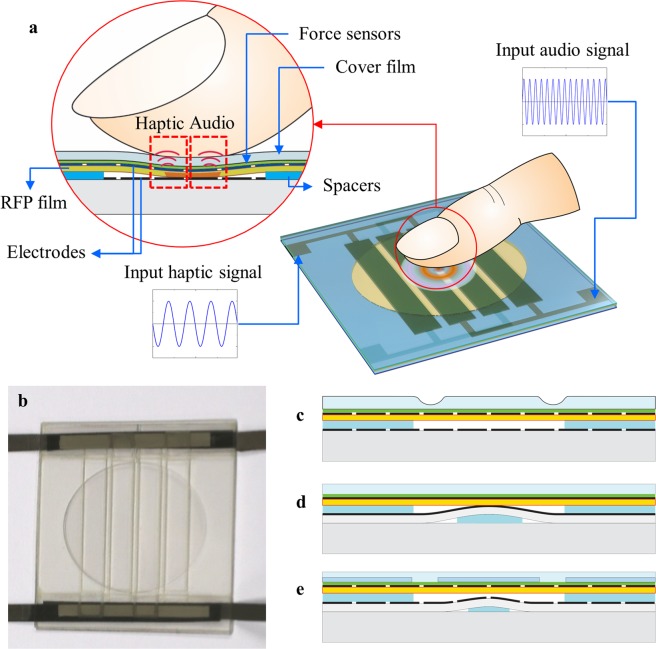
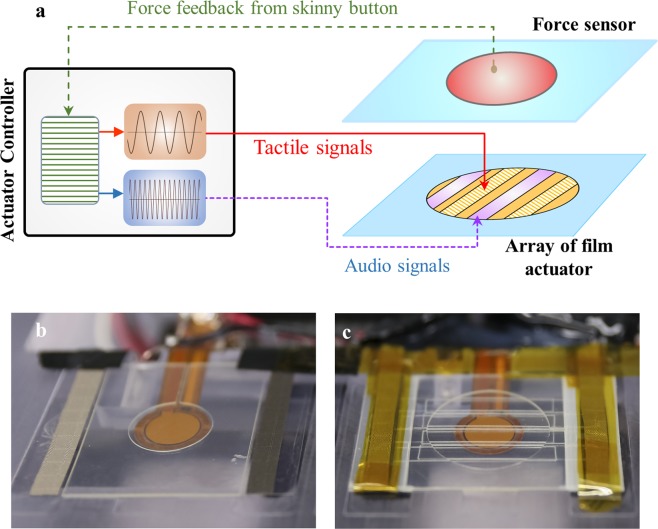
This study proposes a novel skinny button with multimodal audio and haptic feedback to enhance the touch user interface of electronic devices. The active material in the film-type actuator is relaxor ferroelectric polymer (RFP) poly(vinylidene fluoride-trifluoroethylene-chlorofluoroethylene) [P(VDF-TrFE-CFE)] blended with poly(vinylidene fluoride-trifluoroethylene) [P(VDF-TrFE)], which produces mechanical vibrations via the fretting vibration phenomenon. Normal pressure applied by a human fingertip on the film-type skinny button mechanically activates the locally concentrated electric field under the contact area, thereby producing a large electrostrictive strain in the blended RFP film. Multimodal audio and haptic feedback is obtained by simultaneously applying various electric signals to the pairs of ribbon-shaped top and bottom electrodes. The fretting vibration provides tactile feedback at frequencies of 50–300 Hz and audible sounds at higher frequencies of 500 Hz to 1 kHz through a simple on-off mechanism. The advantage of the proposed audio-tactile skinny button is that it restores the “click” sensation to the popular virtual touch buttons employed in contemporary electronic devices.
Overview
The claims and statistics of this paper haven’t been checked yet.
Free: it reads the open-access text and checks the first 5 claims that cite a source we can check. Create a free account to check every claim.
Integrity signals
Registry
Cites
Statistics
Figures
Verification
Claims the paper makes
The claims and statistics of this paper haven’t been checked yet.
Free: it reads the open-access text and checks the first 5 claims that cite a source we can check. Create a free account to check every claim.
Claims other papers make about this one
Each is checked against this paper’s own text: does it say what the citing paper says it does?
The check wasn’t confident either way, so it gives no verdict — never disputed.
In the citing paper
“To solve the issue of insufficient stimulation force, multi-layer stacking structure,[592] or hydraulic pressure to amplify the force have been proposed.[63,593,594]”
From Flexible Electronics and Devices as Human–Machine Interfaces for Medical Robotics (2022) · cites this paper as [593]
Experimental — accuracy not yet measured
Self-check
Percentages, sums and reported differences re-computed from the paper’s own numbers.
The self-check needs the paper’s full text.
Citations
Cites
Use of piezoelectric actuators as elements of intelligent structures
Crawley, E. F., & de Luis, J. (1987) · AIAA Journal · doi:10.2514/3.9792 · Cited by 2,602
Pursuing prosthetic electronic skin
Chortos, A., Liu, J., & Bao, Z. (2016) · Nature Materials · doi:10.1038/nmat4671 · Cited by 2,396
Abraira, V. E., & Ginty, D. D. (2013) · Neuron · doi:10.1016/j.neuron.2013.07.051 · Cited by 1,648
Talbot, W. H., Darian-Smith, I., Kornhuber, H. H., & Mountcastle, V. B. (1968) · Journal of Neurophysiology · doi:10.1152/jn.1968.31.2.301 · Cited by 990
Four channels mediate the mechanical aspects of touch
Bolanowski, S. J., Gescheider, G. A., Verrillo, R. T., & Checkosky, C. M. (1988) · The Journal of the Acoustical Society of America · doi:10.1121/1.397184 · Cited by 937
(1984) · PubMed · Cited by 908
TeslaTouch: electrovibration for touch surfaces
Bau, O., Poupyrev, I., Israr, A., & Harrison, C. (2010) · Proceedings of the 23nd annual ACM symposium on User interface software and technology · doi:10.1145/1866029.1866074 · Cited by 664
Modeling piezoelectric actuators
Adriaens, H. J. M. T. S., De Koning, W. L., & Banning, R. (2000) · IEEE/ASME Transactions on Mechatronics · doi:10.1109/3516.891044 · Cited by 601
Psychophysical Dimensions of Tactile Perception of Textures
Okamoto, S., Nagano, H., & Yamada, Y. (2013) · IEEE Transactions on Haptics · doi:10.1109/toh.2012.32 · Cited by 482
Piezoelectric Actuators for Distributed Vibration Excitation of Thin Plates
Dimitriadis, E. K., Fuller, C. R., & Rogers, C. A. (1991) · Journal of Vibration and Acoustics · doi:10.1115/1.2930143 · Cited by 462
Johansson, R. S., & Vallbo, A. B. (1979) · The Journal of Physiology · doi:10.1113/jphysiol.1979.sp013048 · Cited by 300
Visualization: Theory and Practice in Science Education
(2008) · Springer eBooks · doi:10.1007/978-1-4020-5267-5 · Cited by 288
Feeling small: exploring the tactile perception limits
Skedung, L., Arvidsson, M., Chung, J. Y., Stafford, C. M., Berglund, B., & Rutland, M. W. (2013) · Scientific Reports · doi:10.1038/srep02617 · Cited by 285
Stimulus—response functions of rapidly adapting mechanoreceptors in the human glabrous skin area
Knibestöl, M. (1973) · The Journal of Physiology · doi:10.1113/jphysiol.1973.sp010279 · Cited by 258
Gescheider, G. A., Bolanowski, S. J., Pope, J. V., & Verrillo, R. T. (2002) · Somatosensory & Motor Research · doi:10.1080/08990220220131505 · Cited by 203
ACTIVITY OF MOTOR UNITS DURING CONCENTRIC AND ECCENTRIC CONTRACTIONS
MORITANI, T., MURAMATSU, S., & MURO, M. (1988) · American Journal of Physical Medicine & Rehabilitation · doi:10.1097/00002060-198812000-00003 · Cited by 178
Effect of Waveform on Tactile Perception by Electrovibration Displayed on Touch Screens
Vardar, Y., Guclu, B., & Basdogan, C. (2017) · IEEE Transactions on Haptics · doi:10.1109/toh.2017.2704603 · Cited by 130
The Psychophysics of Tactile Perception and its Peripheral Physiological Basis
Greenspan, J. D., & Bolanowski, S. J. (1996) · Elsevier eBooks · doi:10.1016/b978-012426910-1/50004-2 · Cited by 129
Tactile detection of a dot on a smooth surface: peripheral neural events
LaMotte, R. H., & Whitehouse, J. (1986) · Journal of Neurophysiology · doi:10.1152/jn.1986.56.4.1109 · Cited by 117
Vibrotacile masking of Pacinian and non-Pacinian channels
Hamer, R. D., Verrillo, R. T., & Zwislocki, J. J. (1983) · The Journal of the Acoustical Society of America · doi:10.1121/1.389278 · Cited by 113
Polarity Effect in Electrovibration for Tactile Display
Kaczmarek, K. A., Nammi, K., Agarwal, A. K., Tyler, M. E., Haase, S. J., & Beebe, D. J. (2006) · IEEE Transactions on Biomedical Engineering · doi:10.1109/tbme.2006.881804 · Cited by 108
Review on the properties of the ferrorelaxor polymers and some new recent developments
Bauer, F. (2012) · Applied Physics A · doi:10.1007/s00339-012-6831-8 · Cited by 88
Ahn, M. H., Cho, E., & Kwon, S. J. (2011) · Applied Surface Science · doi:10.1016/j.apsusc.2011.09.081 · Cited by 81
Zhang, S., Klein, R. J., Ren, K., Chu, B., Zhang, X., Runt, J. P., & Zhang, Q. (2006) · Journal of Materials Science · doi:10.1007/s10853-006-6081-2 · Cited by 62
Choi, S. T., Kwon, J. O., & Bauer, F. (2013) · Sensors and Actuators A Physical · doi:10.1016/j.sna.2013.08.049 · Cited by 59
Self-citationFrauman, P., Burakov, A., & Arkkio, A. (2007) · IEEE Transactions on Magnetics · doi:10.1109/tmag.2007.899470 · Cited by 56
Vezzoli, E., Messaoud, W. B., Amberg, M., Giraud, F., Lemaire-Semail, B., & Bueno, M.-A. (2015) · IEEE Transactions on Haptics · doi:10.1109/toh.2015.2430353 · Cited by 53
Tactile perception of fabrics with an artificial finger compared to human sensing
Chen, S., Ge, S., Tang, W., Zhang, J., & Chen, N. (2015) · Textile Research Journal · doi:10.1177/0040517515586164 · Cited by 46
Method for Providing Electrovibration with Uniform Intensity
Kim, H., Kang, J., Kim, K.-D., Lim, K.-M., & Ryu, J. (2015) · IEEE Transactions on Haptics · doi:10.1109/toh.2015.2476810 · Cited by 37
Zhang, S., Klein, R. J., Ren, K., Chu, B., Zhang, X., Runt, J. P., & Zhang, Q. (2007) · Springer eBooks · doi:10.1007/978-0-387-38039-1_24 · Cited by 36
Seeing Through Touch: The Role of Haptic Information in Visualization
Reiner, M. (2007) · Springer eBooks · doi:10.1007/978-1-4020-5267-5_4 · Cited by 30
Amplitude Control Method of Linear Resonant Actuator by Load Estimation From the Back-EMF
Asai, Y., Hirata, K., & Ota, T. (2013) · IEEE Transactions on Magnetics · doi:10.1109/tmag.2013.2243419 · Cited by 29
Localized Fretting-Vibrotactile Sensations for Large-Area Displays
Duong, Q. V., Nguyen, V. P., Santos, F. D. D., & Choi, S. T. (2019) · ACS Applied Materials & Interfaces · doi:10.1021/acsami.9b09691 · Cited by 26
Self-citationAn inductive telemetric measurement system for humidity sensing
Marioli, D., Sardini, E., & Serpelloni, M. (2008) · Measurement Science and Technology · doi:10.1088/0957-0233/19/11/115204 · Cited by 24
Development of a Fully Flexible Sheet-Type Tactile Display Based on Electrovibration Stimulus
Ishizuka, H., Hatada, R., Cortes, C., & Miki, N. (2018) · Micromachines · doi:10.3390/mi9050230 · Cited by 24
Honrado, C., & Dong, T. (2014) · Sensors · doi:10.3390/s140813851 · Cited by 23
Žuk, S., Pietriková, A., & Vehec, I. (2018) · Microelectronics International · doi:10.1108/mi-12-2017-0071 · Cited by 23
2005 12th International Symposium on Electrets
(2005) · doi:10.1109/ieeeconf9859.2005 · Cited by 21
Analysis of Electrical Resonance Distortion for Inductive Sensing Applications
Hughes, R. R., & Dixon, S. (2018) · IEEE Sensors Journal · doi:10.1109/jsen.2018.2841506 · Cited by 20
Ferroelectric copolymers and terpolymers for electrostrictors: synthesis and properties
Bauer, F., Fousson, É., Zhang, Q., & Lee, L. M. (2003) · International Symposium on Electrets · doi:10.1109/ise.2002.1043017 · Cited by 13
Kajimoto, H., Saga, S., & Konyo, M. (2016) · Springer eBooks · doi:10.1007/978-4-431-55772-2 · Cited by 13
A Virtual Button with Tactile Feedback Using Ultrasonic Vibration
Tashiro, K., Shiokawa, Y., Aono, T., & Maéno, T. (2009) · Lecture notes in computer science · doi:10.1007/978-3-642-02771-0_43 · Cited by 9
Jiang, C., Quan, Y., & Lin, X. (2016) · Applied Optics · doi:10.1364/ao.55.002331 · Cited by 6
Capacitive sensor pixel circuit with single transistor for touch‐fingerprint recognition sensor
Kang, I. H., Hong, M. T., & Bae, B. S. (2018) · Electronics Letters · doi:10.1049/el.2018.5189 · Cited by 6
Low cost resistive based touch sensor
Bertetto, A. M., & Ruggiu, M. (2003) · Mechanics Research Communications · doi:10.1016/s0093-6413(02)00362-2 · Cited by 4
Capacitive sensor supporting multiple touch switches using a resistor string
Seong, K.-S. (2015) · TURKISH JOURNAL OF ELECTRICAL ENGINEERING & COMPUTER SCIENCES · doi:10.3906/elk-1304-149 · Cited by 2
Arun, A., Gaston, B., Kwiat, D. A., Imamura-Ching, J., Fechter, R., Chen, S., Jiang, H., Harrison, M. R., & Roy, S. (2016) · Journal of Medical Devices · doi:10.1115/1.4032615 · Cited by 2
Research works printed but not linked: 2
- Di Jasio L Simplifying Capacitive Touch Sensing Electronics World 2016 122 10 13
- Pyo, D. et al. In Haptics: Perception, Devices, Mobility, and Communication (eds Isokoski, P. & Springare, J.) 133–138 (Springer Berlin Heidelberg, Berlin, Heidelberg, 2012).
Cited by
Flexible Electronics and Devices as Human–Machine Interfaces for Medical Robotics
Heng, W., Solomon, S., & Gao, W. (2022) · Advanced Materials · doi:10.1002/adma.202107902 · Cited by 609
Yang, T., Kim, J. R., Jin, H., Gil, H., Koo, J., & Kim, H. J. (2021) · Advanced Functional Materials · doi:10.1002/adfm.202008831 · Cited by 178
Highly pixelated, untethered tactile interfaces for an ultra-flexible on-skin telehaptic system
Jin, H., Kim, Y., Youm, W., Min, Y., Seo, S., Lim, C., Hong, C., Kwon, S., Park, G., Park, S., et al. (2022) · npj Flexible Electronics · doi:10.1038/s41528-022-00216-1 · Cited by 91
Soft Actuator Materials for Electrically Driven Haptic Interfaces
Ankit, A., Ho, T. Y. K., Nirmal, A., Kulkarni, M. R., Accoto, D., & Mathews, N. (2021) · Advanced Intelligent Systems · doi:10.1002/aisy.202100061 · Cited by 82
Towards high performance and durable soft tactile actuators
Tan, M., Wang, H., Gao, D., Huang, P.-W., & Lee, P. S. (2024) · Chemical Society Reviews · doi:10.1039/d3cs01017a · Cited by 73
Metadata
- Authors
- Van Duong, Q., Nguyen, V. P., Luu, A. T., & Choi, S. T.
- Affiliations
- Chung-Ang University (KR)
- Corresponding author
- Choi, Seung Tae
- Venue
- Scientific Reports
- Published
- 2019-09-16
- Volume
- 9
- Issue
- 1
- Pages
- 13290-13290
- ISSN
- 2045-2322 (ISSN-L)
- PMC
- PMC6746798
- OpenAlex
- W2972340928
- Cited by
- 21
- References
- 47
- Citations by year
- 2026: 1 · 2025: 3 · 2024: 1 · 2023: 4 · 2022: 5 · 2021: 5 · 2020: 1 · 2019: 1
- FWCI
- 1.74
- Type
- journal article
- Language
- en
- Open access
- gold
- doi.org
- Licence
- cc-by
- creativecommons.org/licenses/by/4.0 (tdm)
- creativecommons.org/licenses/by/4.0 (vor)
- Locations
- Scientific Reports (publishedVersion, cc-by)
- PubMed Central (publishedVersion, cc-by)
- PubMed (publishedVersion)
- DOAJ (DOAJ: Directory of Open Access Journals) (submittedVersion)
- Funders
- National Research Foundation
- National Research Foundation of Korea (NRF-2016M3A7B4910531, NRF-2017R1A2B4012081)
- Ministry of Science and ICT, South Korea
- Topics
- Life Sciences › Neuroscience › Cognitive Neuroscience › Tactile and Sensory Interactions
- Physical Sciences › Materials Science › Electronic, Optical and Magnetic Materials › Dielectric materials and actuators
- Physical Sciences › Engineering › Biomedical Engineering › Advanced Sensor and Energy Harvesting Materials
- Keywords
- relaxor ferroelectric polymers, P(VDF-TrFE-CFE), P(VDF-TrFE), electrostrictive strain, haptic feedback, multimodal feedback
About these checks
Registry, retraction, Cites and statistics results are computed, not judged, with one exception: a printed reference that no index lists is read once by a model before it counts as a citation error. Claims are extracted by a model and kept only when their quote appears verbatim in the text; each cited source is then checked, with a model’s help, for whether it says what the claim relies on. Those verdicts can be wrong — read the claim’s quote and the cited source before relying on one.
Statistics and arithmetic are recomputed, not judged.
Confidence bands are shown only for fields calibrated on our annotated test set. None is calibrated yet, so no band is shown.
What counts as a claim ›How we measure confidence ›How we check this ›
Are you an author, or do you see a problem with this page? Request a review
Data sources
Bibliographic data: Semantic Scholar, OpenAlex, Crossref.
Contains information from the Semantic Scholar Academic Graph Datasets, made available under the ODC Attribution License (ODC-BY 1.0).
Semantic Scholar’s data is described in: Kinney, R., et al. (2023). The Semantic Scholar Open Data Platform. arXiv:2301.10140.
