

The DOI matches its Crossref record; 67 of the 67 references it cites were found in a registry or an index.
Sleep stage classification from heart-rate variability using long short-term memory neural networks
Open accessAbstract
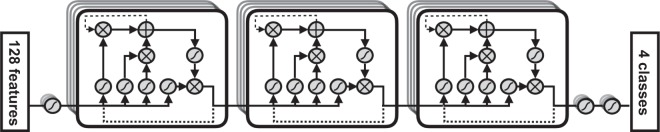
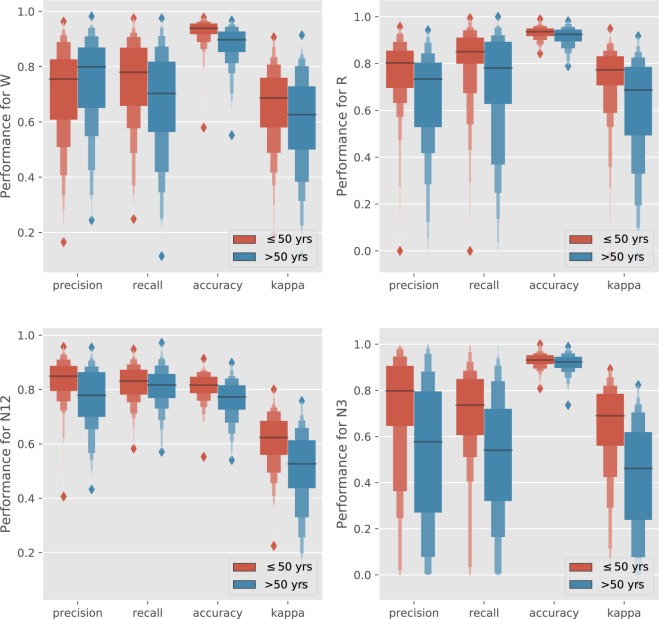
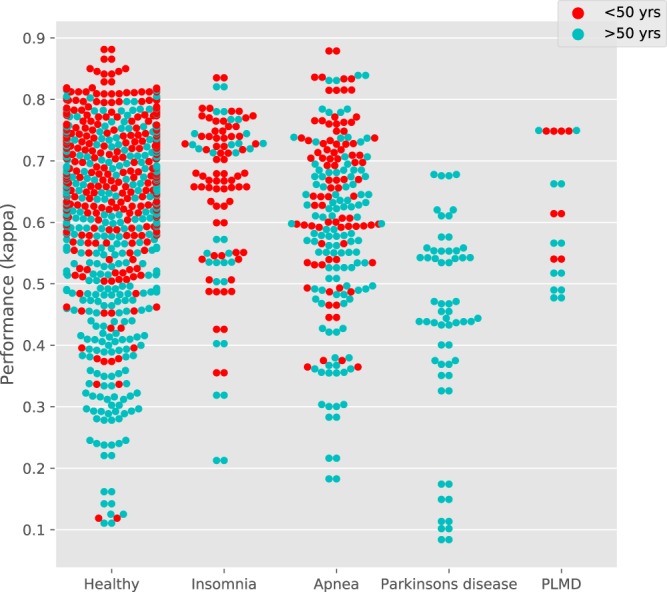
Automated sleep stage classification using heart rate variability (HRV) may provide an ergonomic and low-cost alternative to gold standard polysomnography, creating possibilities for unobtrusive home-based sleep monitoring. Current methods however are limited in their ability to take into account long-term sleep architectural patterns. A long short-term memory (LSTM) network is proposed as a solution to model long-term cardiac sleep architecture information and validated on a comprehensive data set (292 participants, 584 nights, 541.214 annotated 30 s sleep segments) comprising a wide range of ages and pathological profiles, annotated according to the Rechtschaffen and Kales (R&K) annotation standard. It is shown that the model outperforms state-of-the-art approaches which were often limited to non-temporal or short-term recurrent classifiers. The model achieves a Cohen’s k of 0.61 ± 0.15 and accuracy of 77.00 ± 8.90% across the entire database. Further analysis revealed that the performance for individuals aged 50 years and older may decline. These results demonstrate the merit of deep temporal modelling using a diverse data set and advance the state-of-the-art for HRV-based sleep stage classification. Further research is warranted into individuals over the age of 50 as performance tends to worsen in this sub-population.
Overview
The claims and statistics of this paper haven’t been checked yet.
Free: it reads the open-access text and checks the first 5 claims that cite a source we can check. Create a free account to check every claim.
Integrity signals
Registry
Cites
Statistics
Figures

Verification
Claims the paper makes
The claims and statistics of this paper haven’t been checked yet.
Free: it reads the open-access text and checks the first 5 claims that cite a source we can check. Create a free account to check every claim.
Claims other papers make about this one
Each is checked against this paper’s own text: does it say what the citing paper says it does?
The check wasn’t confident either way, so it gives no verdict — never disputed.
In the citing paper
“Such complementary fusion protocols have been shown to significantly improve the classification performance of sleep stages79,80.”
From The future of sleep health: a data-driven revolution in sleep science and medicine (2020) · cites this paper as [80]
Experimental — accuracy not yet measured
Self-check
Percentages, sums and reported differences re-computed from the paper’s own numbers.
The self-check needs the paper’s full text.
Citations
Cites
1 retracted
Uçar, M. K., Bozkurt, M. R., Bilgin, C., & Polat, K. (2018) · Neural Computing and Applications · doi:10.1007/s00521-016-2365-x · Cited by 106
RetractedHochreiter, S., & Schmidhuber, J. (1997) · Neural Computation · doi:10.1162/neco.1997.9.8.1735 · Cited by 102,318 · cited 2×
“A detailed description and equations of LSTM cells are given in the original paper 34 .”
BackgroundMethod(2014) · Cited by 33,419
Huang, N. E., Shen, Z., Long, S. R., Wu, M. C., Shih, H. H., Zheng, Q., Yen, N.-C., Tung, C. C., & Liu, H. H. (1998) · Proceedings of the Royal Society of London. Series A: Mathematical, Physical and Engineering Sciences · doi:10.1098/rspa.1998.0193 · Cited by 23,564
Heart Rate Variability: Standards of Measurement, Physiological Interpretation, and Clinical Use
Electrophysiology, T. F. O. T. E. S. O. C. T. N. A. (1996) · Circulation · doi:10.1161/01.cir.93.5.1043 · Cited by 17,159
Heart rate variability: Standards of measurement, physiological interpretation, and clinical use
Malik, M., Bigger, J. T., Camm, A. J., Kleiger, R. E., Malliani, A., Moss, A. J., & Schwartz, P. J. (1996) · European Heart Journal · doi:10.1093/oxfordjournals.eurheartj.a014868 · Cited by 15,289
Rechtschaffen, A. (1968) · Medical Entomology and Zoology · Cited by 12,638
Physiological time-series analysis using approximate entropy and sample entropy
Richman, J. S., & Moorman, J. R. (2000) · American Journal of Physiology-Heart and Circulatory Physiology · doi:10.1152/ajpheart.2000.278.6.h2039 · Cited by 7,880
(2007) · Cited by 6,530
ADADELTA: An Adaptive Learning Rate Method
Zeiler, M. D. (2012) · arXiv · doi:10.48550/arxiv.1212.5701 · Cited by 5,322
Research works printed but not linked: 3
- Stephansen, J. B. et al. The use of neural networks in the analysis of sleep stages and the diagnosis of narcolepsy. arXiv preprint arXiv:1710.02094 (2017). · arXiv
- Zhao, M., Yue, S., Katabi, D., Jaakkola, T. S. & Bianchi, M. T. Learning sleep stages from radio signals: a conditional adversarial architecture. In International Conference on Machine Learning, 4100–4109 (2017).
- Tieleman, T. & Hinton, G. Lecture 6.5-rmsprop: Divide the gradient by a running average of its recent magnitude. COURSERA: Neural Networks for Machine Learning 4, 26–31 (2012).
Cited by
The future of sleep health: a data-driven revolution in sleep science and medicine
Perez-Pozuelo, I., Zhai, B., Palotti, J., Mall, R., Aupetit, M., Garcia-Gomez, J. M., Taheri, S., Guan, Y., & Fernandez-Luque, L. (2020) · npj Digital Medicine · doi:10.1038/s41746-020-0244-4 · Cited by 311
Deep learning for automated sleep staging using instantaneous heart rate
Sridhar, N., Shoeb, A. H., Stephens, P., Kharbouch, A. A., Shimol, D. B., Burkart, J., Ghoreyshi, A., & Myers, L. J. (2020) · npj Digital Medicine · doi:10.1038/s41746-020-0291-x · Cited by 170
Loh, H. W., Ooi, C. P., Vicnesh, J., Oh, S. L., Faust, O., Gertych, A., & Acharya, U. R. (2020) · Applied Sciences · doi:10.3390/app10248963 · Cited by 152
“[62] published the only study that was based on ECG signals from a private dataset that was collected as part of the European Union SIESTA project [100] as shown in Table 5.”
BackgroundA deep transfer learning approach for wearable sleep stage classification with photoplethysmography
Radha, M., Fonseca, P. M., Moreau, A., Ross, M., Cerny, A., Anderer, P., Long, X., & Aarts, R. M. (2021) · npj Digital Medicine · doi:10.1038/s41746-021-00510-8 · Cited by 154
Self-citationPapini, G. B., Fonseca, P., van Gilst, M. M., Bergmans, J. W. M., Vullings, R., & Overeem, S. (2020) · Scientific Reports · doi:10.1038/s41598-020-69935-7 · Cited by 90
Self-citation
Metadata
- Authors
- Radha, M., Fonseca, P., Moreau, A., Ross, M., Cerny, A., Anderer, P., Long, X., & Aarts, R. M.
- Affiliations
- Philips (Netherlands) (NL)
- Corresponding author
- Radha, Mustafa
- ORCID
- Venue
- Scientific Reports
- Published
- 2019-10-02
- Volume
- 9
- Issue
- 1
- Pages
- 14149-14149
- ISSN
- 2045-2322 (ISSN-L)
- PMC
- PMC6775145
- OpenAlex
- W2977759318
- Semantic Scholar
- d257cfb03ce52116657f8ef51272a9b8e76cd62e
- Cited by
- 186
- References
- 67
- Citations by year
- 2026: 19 · 2025: 29 · 2024: 21 · 2023: 38 · 2022: 29 · 2021: 32 · 2020: 18
- FWCI
- 14.27
- Type
- journal article
- Language
- en
- Open access
- gold
- doi.org
- Licence
- cc-by
- creativecommons.org/licenses/by/4.0 (tdm)
- creativecommons.org/licenses/by/4.0 (vor)
- Locations
- Scientific Reports (publishedVersion, cc-by)
- Europe PMC (PubMed Central) (publishedVersion, cc-by)
- PubMed Central (publishedVersion, cc-by)
- PubMed (publishedVersion)
- TU/e Research Portal (publishedVersion, other-oa)
- TU/e Research Portal (submittedVersion)
- DOAJ (DOAJ: Directory of Open Access Journals) (submittedVersion)
- TU/e Research Portal (submittedVersion, other-oa)
- Funders
- Royal Philips
- Topics
- Health Sciences › Medicine › Cardiology and Cardiovascular Medicine › Heart Rate Variability and Autonomic Control
- Physical Sciences › Engineering › Biomedical Engineering › Non-Invasive Vital Sign Monitoring
- Life Sciences › Neuroscience › Cognitive Neuroscience › EEG and Brain-Computer Interfaces
- Keywords
- sleep stage classification, heart rate variability, long short-term memory networks, home sleep monitoring, sleep architecture, aging and sleep, polysomnography alternative, unobtrusive sleep monitoring
- MeSH terms
- Adult, Aged, Female, Heart Rate, Humans, Male, Middle Aged, Models, Neurological, Sleep Stages, Neural Networks, Computer
About these checks
Registry, retraction, Cites and statistics results are computed, not judged, with one exception: a printed reference that no index lists is read once by a model before it counts as a citation error. Claims are extracted by a model and kept only when their quote appears verbatim in the text; each cited source is then checked, with a model’s help, for whether it says what the claim relies on. Those verdicts can be wrong — read the claim’s quote and the cited source before relying on one.
Statistics and arithmetic are recomputed, not judged.
Confidence bands are shown only for fields calibrated on our annotated test set. None is calibrated yet, so no band is shown.
What counts as a claim ›How we measure confidence ›How we check this ›
Are you an author, or do you see a problem with this page? Request a review
How to cite
Cite CoChat for the checks on this page, and the paper for its own findings.
- This page
- CoChat. (2026). Citation check: Sleep stage classification from heart-rate variability using long short-term memory neural networks. https://app.cochat.ai/papers/10.1038/s41598-019-49703-y
- The paper
- Radha, M., Fonseca, P., Moreau, A., Ross, M., Cerny, A., Anderer, P., Long, X., & Aarts, R. M. (2019). Sleep stage classification from heart-rate variability using long short-term memory neural networks. Scientific Reports. https://doi.org/10.1038/s41598-019-49703-y
Data sources
Bibliographic data: Semantic Scholar, OpenAlex, Crossref.
Contains information from the Semantic Scholar Academic Graph Datasets, made available under the ODC Attribution License (ODC-BY 1.0).
Semantic Scholar’s data is described in: Kinney, R., et al. (2023). The Semantic Scholar Open Data Platform. arXiv:2301.10140.
