

Novel mitochondrial complex I-inhibiting peptides restrain NADH dehydrogenase activity
Open accessThe DOI matches its Crossref record; 49 of the 49 references it cites were found in a registry or an index.
Abstract
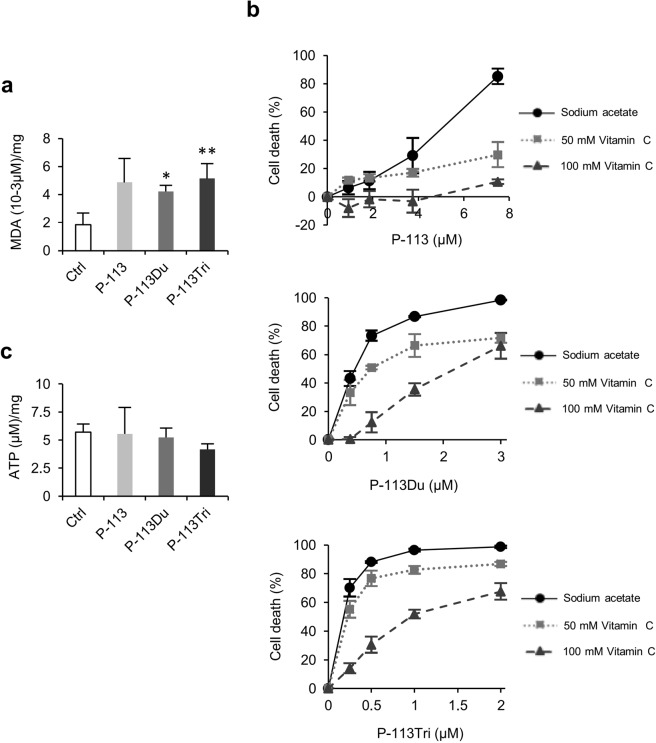
The emergence of drug-resistant fungal pathogens is becoming increasingly serious due to overuse of antifungals. Antimicrobial peptides have potent activity against a broad spectrum of pathogens, including fungi, and are considered a potential new class of antifungals. In this study, we examined the activities of the newly designed peptides P-113Du and P-113Tri, together with their parental peptide P-113, against the human fungal pathogen Candida albicans. The results showed that these peptides inhibit mitochondrial complex I, specifically NADH dehydrogenase, of the electron transport chain. Moreover, P-113Du and P-113Tri also block alternative NADH dehydrogenases. Currently, most inhibitors of the mitochondrial complex I are small molecules or artificially-designed antibodies. Here, we demonstrated novel functions of antimicrobial peptides in inhibiting the mitochondrial complex I of C. albican s, providing insight in the development of new antifungal agents.
Overview
The claims and statistics of this paper haven’t been checked yet.
Free: it reads the open-access text and checks the first 5 claims that cite a source we can check. Create a free account to check every claim.
Integrity signals
Registry
Cites
Statistics
Figures
Verification
Claims the paper makes
The claims and statistics of this paper haven’t been checked yet.
Free: it reads the open-access text and checks the first 5 claims that cite a source we can check. Create a free account to check every claim.
Claims other papers make about this one
Each is checked against this paper’s own text: does it say what the citing paper says it does?
The source backs part of the claim, not all of it — or backs it for a different population, condition or comparison.
In the citing paper
“The fungal ETC includes five respiratory complexes (complexes I to V [CI to CV]), of which NADH-ubiquinone oxidoreductase (CI), ubiquinol-cytochrome c oxidoreductase (CIII), and cytochrome c oxidase (CIV) are responsible for generating proton gradients.”
From Recent Progress in Research on Mitochondrion-Targeted Antifungal Drugs: a Review (2023) · cites this paper as [11]
Experimental — accuracy not yet measuredThe source backs part of the claim, not all of it — or backs it for a different population, condition or comparison.
In the citing paper
“Once the proton gradients are established, the F1F0 ATP synthase (CV) can produce ATP by binding free ADP to free phosphate.”
From Recent Progress in Research on Mitochondrion-Targeted Antifungal Drugs: a Review (2023) · cites this paper as [11]
Experimental — accuracy not yet measuredThe cited source says what the claim attributes to it.
In the citing paper
“The mitochondrion is the powerhouse of cell metabolism and produces energy through oxidative phosphorylation (OXPHOS), which involves the ETC (11).”
From Recent Progress in Research on Mitochondrion-Targeted Antifungal Drugs: a Review (2023) · cites this paper as [11]
The cited source says what the claim attributes to it.
In the citing paper
“The latest mechanistic findings uncovered that P-113, P-113Du, and P-113Tri exert antifungal effects by inhibiting the NADH dehydrogenase activity of mitochondrial CI in ETC (11).”
From Recent Progress in Research on Mitochondrion-Targeted Antifungal Drugs: a Review (2023) · cites this paper as [11]
The cited source says what the claim attributes to it.
In the citing paper
“P-113Du and P-113Tri even blocked a fungus-specific alternative NADH dehydrogenase, which is rarely observed for CI-specific inhibitors (11).”
From Recent Progress in Research on Mitochondrion-Targeted Antifungal Drugs: a Review (2023) · cites this paper as [11]
Self-check
Percentages, sums and reported differences re-computed from the paper’s own numbers.
The self-check needs the paper’s full text.
Citations
Cites
How mitochondria produce reactive oxygen species
Murphy, M. P. (2009) · Biochemical Journal · doi:10.1042/bj20081386 · Cited by 8,207
Free radicals, natural antioxidants, and their reaction mechanisms
Nimse, S. B., & Pal, D. (2015) · RSC Advances · doi:10.1039/c4ra13315c · Cited by 2,077
Bahar, A., & Ren, D. (2013) · Pharmaceuticals · doi:10.3390/ph6121543 · Cited by 1,351
Lipid peroxidation—DNA damage by malondialdehyde
Marnett, L. J. (1999) · Mutation Research - Fundamental and Molecular Mechanisms of Mutagenesis · doi:10.1016/s0027-5107(99)00010-x · Cited by 1,304
Energy Converting NADH: Quinone Oxidoreductase (Complex I)
Brandt, U. (2006) · Annual Review of Biochemistry · doi:10.1146/annurev.biochem.75.103004.142539 · Cited by 814
Hirst, J. (2013) · Annual Review of Biochemistry · doi:10.1146/annurev-biochem-070511-103700 · Cited by 744
Noble, S. M., French, S., Kohn, L. A., Chen, V., & Johnson, A. D. (2010) · Nature Genetics · doi:10.1038/ng.605 · Cited by 678
Development and regulation of single- and multi-species Candida albicans biofilms
Lohse, M. B., Gulati, M., Johnson, A. D., & Nobile, C. J. (2018) · Nature Reviews Microbiology · doi:10.1038/nrmicro.2017.107 · Cited by 643
Inhibitors of NADH–ubiquinone reductase: an overview
Degli Esposti, M. (1998) · Biochimica et Biophysica Acta (BBA) - Bioenergetics · doi:10.1016/s0005-2728(98)00029-2 · Cited by 528
Human Antimicrobial Peptides and Proteins
Wang, G. (2014) · Pharmaceuticals · doi:10.3390/ph7050545 · Cited by 528
Luttik, M. A. H., Overkamp, K. M., Kötter, P., de Vries, S., van Dijken, J. P., & Pronk, J. T. (1998) · Journal of Biological Chemistry · doi:10.1074/jbc.273.38.24529 · Cited by 311
Okun, J. G., Lümmen, P., & Brandt, U. (1999) · Journal of Biological Chemistry · doi:10.1074/jbc.274.5.2625 · Cited by 308
The Cellular Target of Histatin 5 on Candida albicans Is the Energized Mitochondrion
Helmerhorst, E. J., Breeuwer, P., van 't Hof, W., Walgreen-Weterings, E., Oomen, L. C. J. M., Veerman, E. C. I., Amerongen, A. V. N., & Abee, T. (1999) · Journal of Biological Chemistry · doi:10.1074/jbc.274.11.7286 · Cited by 283
In vivo and in organello assessment of OXPHOS activities
Barrientos, A. (2002) · Methods · doi:10.1016/s1046-2023(02)00036-1 · Cited by 266
Metabolism impacts upon Candida immunogenicity and pathogenicity at multiple levels
Brown, A. J. P., Brown, G. D., Netea, M. G., & Gow, N. A. R. (2014) · Trends in Microbiology · doi:10.1016/j.tim.2014.07.001 · Cited by 258
Helmerhorst, E. J., Troxler, R. F., & Oppenheim, F. G. (2001) · Proceedings of the National Academy of Sciences · doi:10.1073/pnas.141366998 · Cited by 251
Höfs, S., Mogavero, S., & Hube, B. (2016) · Journal of Microbiology · doi:10.1007/s12275-016-5514-0 · Cited by 238
Shingu-Vazquez, M., & Traven, A. (2011) · Eukaryotic Cell · doi:10.1128/ec.05184-11 · Cited by 209
Diversity and origin of alternative NADH:ubiquinone oxidoreductases
Kerscher, S. J. (2000) · Biochimica et Biophysica Acta (BBA) - Bioenergetics · doi:10.1016/s0005-2728(00)00162-6 · Cited by 188
Anticandida Activity Is Retained in P-113, a 12-Amino-Acid Fragment of Histatin 5
Rothstein, D. M., Spacciapoli, P., Tran, L. T., Xu, T., Roberts, F. D., Dalla Serra, M., Buxton, D. K., Oppenheim, F. G., & Friden, P. (2001) · Antimicrobial Agents and Chemotherapy · doi:10.1128/aac.45.5.1367-1373.2001 · Cited by 188
Studies on the Respiratory Chain-linked Reduced Nicotinamide Adenine Dinucleotide Dehydrogenase
Horgan, D. J., Singer, T. P., & Casida, J. E. (1968) · Journal of Biological Chemistry · doi:10.1016/s0021-9258(19)81741-6 · Cited by 186
How Does It Kill?: Understanding the Candidacidal Mechanism of Salivary Histatin 5
Puri, S., & Edgerton, M. (2014) · Eukaryotic Cell · doi:10.1128/ec.00095-14 · Cited by 186
Synthetic histatin analogues with broad-spectrum antimicrobial activity
HELMERHORST, E. J., HOF, W. V. '., VEERMAN, E. C. I., SIMOONS-SMIT, I., & AMERONGEN, A. V. N. (1997) · Biochemical Journal · doi:10.1042/bj3260039 · Cited by 183
Natural Antimicrobial Peptides as Inspiration for Design of a New Generation Antifungal Compounds
Bondaryk, M., Staniszewska, M., Zielińska, P., & Urbańczyk-Lipkowska, Z. (2017) · Journal of Fungi · doi:10.3390/jof3030046 · Cited by 145
System-level impact of mitochondria on fungal virulence: to metabolism and beyond
Calderone, R., Li, D., & Traven, A. (2015) · FEMS Yeast Research · doi:10.1093/femsyr/fov027 · Cited by 101
Characterization of the mitochondrial respiratory pathways in Candida albicans
Helmerhorst, E. J., Murphy, M. P., Troxler, R. F., & Oppenheim, F. G. (2002) · Biochimica et Biophysica Acta (BBA) - Bioenergetics · doi:10.1016/s0005-2728(02)00308-0 · Cited by 95
Bambach, A., Fernandes, M. P., Ghosh, A., Kruppa, M., Alex, D., Li, D., Fonzi, W. A., Chauhan, N., Sun, N., Agrellos, O. A., et al. (2009) · Eukaryotic Cell · doi:10.1128/ec.00066-09 · Cited by 95
Sun, N., Fonzi, W., Chen, H., She, X., Zhang, L., Zhang, L., & Calderone, R. (2013) · Antimicrobial Agents and Chemotherapy · doi:10.1128/aac.01520-12 · Cited by 94
Gyurko, C., Lendenmann, U., Troxler, R. F., & Oppenheim, F. G. (2000) · Antimicrobial Agents and Chemotherapy · doi:10.1128/aac.44.2.348-354.2000 · Cited by 92
Li, D., Chen, H., Florentino, A., Alex, D., Sikorski, P., Fonzi, W. A., & Calderone, R. (2011) · Eukaryotic Cell · doi:10.1128/ec.00303-10 · Cited by 91
Cyanide-resistant respiration, a very frequent metabolic pathway in yeasts
VEIGA, A., ARRABACA, J., & LOUREIRODIAS, M. (2003) · FEMS Yeast Research · doi:10.1016/s1567-1356(03)00036-9 · Cited by 90
Jang, W. S., Li, X. S., Sun, J. N., & Edgerton, M. (2008) · Antimicrobial Agents and Chemotherapy · doi:10.1128/aac.01199-07 · Cited by 83
Zharova, T. V., & Vinogradov, A. D. (1997) · Biochimica et Biophysica Acta (BBA) - Bioenergetics · doi:10.1016/s0005-2728(97)00029-7 · Cited by 76
Studies on the Respiratory Chain-linked Nicotinamide Adenine Dinucleotide Dehydrogenase
Kean, E. A., Gutman, M., & Singer, T. P. (1971) · Journal of Biological Chemistry · doi:10.1016/s0021-9258(18)62299-9 · Cited by 68
Exploiting mitochondria as targets for the development of new antifungals
Li, D., & Calderone, R. (2017) · Virulence · doi:10.1080/21505594.2016.1188235 · Cited by 67
Mickels, N., McManus, C., Massaro, J. M., Friden, P. M., Braman, V. M., D’Agostino, R. B., Oppenheim, F. G., Warbington, M. L., Dibart, S., & Dyke, T. E. V. (2001) · Journal Of Clinical Periodontology · doi:10.1034/j.1600-051x.2001.028005404.x · Cited by 57
She, X., Khamooshi, K., Gao, Y., Shen, Y., Lv, Y., Calderone, R., Fonzi, W., Liu, W., & Li, D. (2015) · Cellular Microbiology · doi:10.1111/cmi.12438 · Cited by 51
Inhibiting mitochondrial phosphate transport as an unexploited antifungal strategy
McLellan, C. A., Vincent, B. M., Solis, N. V., Lancaster, A. K., Sullivan, L. B., Hartland, C. L., Youngsaye, W., Filler, S. G., Whitesell, L., & Lindquist, S. (2018) · Nature Chemical Biology · doi:10.1038/nchembio.2534 · Cited by 49
A novel strong competitive inhibitor of complex I
Kotlyar, A. B., Karliner, J. S., & Cecchini, G. (2005) · FEBS Letters · doi:10.1016/j.febslet.2005.07.076 · Cited by 35
Driscoll, J. J., Duan, C., Zuo, Y., Xu, T., Troxler, R. F., & Oppenheim, F. G. (1996) · Gene · doi:10.1016/0378-1119(96)00265-x · Cited by 30
Ansari, M. A., Fatima, Z., & Hameed, S. (2016) · The Open Microbiology Journal · doi:10.2174/1874285801610010012 · Cited by 30
Functional diversity of complex I subunits in Candida albicans mitochondria
Li, D., She, X., & Calderone, R. (2016) · Current Genetics · doi:10.1007/s00294-015-0518-6 · Cited by 27
A mitochondrial proteomics view of complex I deficiency in Candida albicans
She, X., Zhang, P., Gao, Y., Zhang, L., Wang, Q., Chen, H., Calderone, R., Liu, W., & Li, D. (2018) · Mitochondrion · doi:10.1016/j.mito.2017.08.003 · Cited by 26
Li, S.-X., Song, Y.-J., Zhang, Y.-S., Wu, H.-T., Guo, H., Zhu, K.-J., Li, D.-M., & Zhang, H. (2017) · Frontiers in Microbiology · doi:10.3389/fmicb.2017.00285 · Cited by 25
Ng, S. M. S., Yap, Y. Y. A., Cheong, J. W. D., Ng, F. M., Lau, Q. Y., Barkham, T., Teo, J. W. P., Hill, J., & Chia, C. S. B. (2017) · Journal of Peptide Science · doi:10.1002/psc.2970 · Cited by 24
Respiratory inhibition of isolated mammalian mitochondria by salivary antifungal peptide histatin-5
Petruzzelli, R., Clementi, M. E., Marini, S., Coletta, M., Stasio, E. D., Giardina, B., & Misiti, F. (2003) · Biochemical and Biophysical Research Communications · doi:10.1016/j.bbrc.2003.10.104 · Cited by 19
Characterization of glycolytic metabolism and ion transport of Candida albicans
Calahorra, M., Sánchez, N. S., & Peña, A. (2012) · Yeast · doi:10.1002/yea.2915 · Cited by 15
The Antimicrobial Peptides P-113Du and P-113Tri Function against Candida albicans
Lin, G.-Y., Chen, H.-F., Xue, Y.-P., Yeh, Y.-C., Chen, C.-L., Liu, M.-S., Cheng, W.-C., & Lan, C.-Y. (2016) · Antimicrobial Agents and Chemotherapy · doi:10.1128/aac.00699-16 · Cited by 14
Self-citationKang, P. T., Yun, J. S., Kaumaya, P. T. P., & Chen, Y. (2010) · Biopolymers · doi:10.1002/bip.21457 · Cited by 10
Cited by
LC3A-mediated autophagy regulates lung cancer cell plasticity
Miao, C., Hwang, W., Chu, L.-Y., Yang, L., Ha, C.-T., Chen, P., Kuo, M.-H., Lin, S., Yang, Y., Chuang, S., et al. (2021) · Autophagy · doi:10.1080/15548627.2021.1964224 · Cited by 65
“Mitochondria were isolated as previously described [53] with some modifications.”
MethodSelf-citationInnate Inspiration: Antifungal Peptides and Other Immunotherapeutics From the Host Immune Response
Mercer, D. K., & O'Neil, D. A. (2020) · Frontiers in Immunology · doi:10.3389/fimmu.2020.02177 · Cited by 50
“The rapid killing by P113, dimer and trimer mostly occurs via ROS generation, rather than depletion of energy (188).”
BackgroundRecent Progress in Research on Mitochondrion-Targeted Antifungal Drugs: a Review
Qin, Y., Wang, J., Lv, Q., & Han, B. (2023) · Antimicrobial Agents and Chemotherapy · doi:10.1128/aac.00003-23 · Cited by 38
“All these mitochondrial proteins in mitochondrial ETC are potential targets for antifungal agents in the future, since their de fi ciency will result in disastrous damage to cell vitality.”
BackgroundInfluentialAntimicrobial Activity of the Peptide LfcinB15 against Candida albicans
Chang, C.-K., Kao, M., & Lan, C. (2021) · Journal of Fungi · doi:10.3390/jof7070519 · Cited by 41
“Measurement of Intracellular ROS Intracellular ROS levels were measured using dihydroethidium (DHE), 2′,7′dichlorodihydrofluorescein diacetate (H2DCFDA), and MitoSOX red (Invitrogen), as previously described [29].”
MethodSelf-citationRodríguez-Castaño, G. P., Rosenau, F., Ständker, L., & Firacative, C. (2023) · Pharmaceutics · doi:10.3390/pharmaceutics15030789 · Cited by 38
“It also has membrane-lytic activity [90,91].”
Metadata
- Authors
- Xue, Y.-P., Kao, M.-C., & Lan, C.-Y.
- Affiliations
- National Tsing Hua University (TW)
- Corresponding author
- Kao, Mou-Chieh
- Lan, Chung-Yu
- Venue
- Scientific Reports
- Published
- 2019-09-23
- Volume
- 9
- Issue
- 1
- Pages
- 13694-13694
- ISSN
- 2045-2322 (ISSN-L)
- PMC
- PMC6757105
- OpenAlex
- W2974423455
- Cited by
- 25
- References
- 49
- Citations by year
- 2026: 2 · 2025: 5 · 2024: 5 · 2023: 5 · 2022: 1 · 2021: 4 · 2020: 3
- FWCI
- 1.47
- Type
- journal article
- Language
- en
- Open access
- gold
- doi.org
- Licence
- cc-by
- creativecommons.org/licenses/by/4.0 (tdm)
- creativecommons.org/licenses/by/4.0 (vor)
- Locations
- Scientific Reports (publishedVersion, cc-by)
- PubMed Central (publishedVersion, cc-by)
- PubMed (publishedVersion)
- DOAJ (DOAJ: Directory of Open Access Journals) (submittedVersion)
- Funders
- Ministry of Science and Technology, Taiwan (MOST 107-2313-B-007-002-MY3, MOST105-2311-B-007-007-MY3)
- Topics
- Life Sciences › Immunology and Microbiology › Microbiology › Antimicrobial Peptides and Activities
- Health Sciences › Medicine › Infectious Diseases › Antifungal resistance and susceptibility
- Life Sciences › Immunology and Microbiology › Applied Microbiology and Biotechnology › Microbial Natural Products and Biosynthesis
- Keywords
- antimicrobial peptides, mitochondrial complex I inhibition, NADH dehydrogenase, Candida albicans, antifungal agents, electron transport chain, drug-resistant fungi, peptide design
- MeSH terms
- Antifungal Agents, Candida albicans, Microbial Sensitivity Tests, Mitochondria, NADH Dehydrogenase, Reactive Oxygen Species, Electron Transport Complex I, Histatins
About these checks
Registry, retraction, Cites and statistics results are computed, not judged, with one exception: a printed reference that no index lists is read once by a model before it counts as a citation error. Claims are extracted by a model and kept only when their quote appears verbatim in the text; each cited source is then checked, with a model’s help, for whether it says what the claim relies on. Those verdicts can be wrong — read the claim’s quote and the cited source before relying on one.
Statistics and arithmetic are recomputed, not judged.
Confidence bands are shown only for fields calibrated on our annotated test set. None is calibrated yet, so no band is shown.
What counts as a claim ›How we measure confidence ›How we check this ›
Are you an author, or do you see a problem with this page? Request a review
Data sources
Bibliographic data: Semantic Scholar, OpenAlex, Crossref.
Contains information from the Semantic Scholar Academic Graph Datasets, made available under the ODC Attribution License (ODC-BY 1.0).
Semantic Scholar’s data is described in: Kinney, R., et al. (2023). The Semantic Scholar Open Data Platform. arXiv:2301.10140.
