

Negativity-bias in forming beliefs about own abilities
Open accessThe DOI matches its Crossref record; 73 of the 73 references it cites were found in a registry or an index.
Abstract
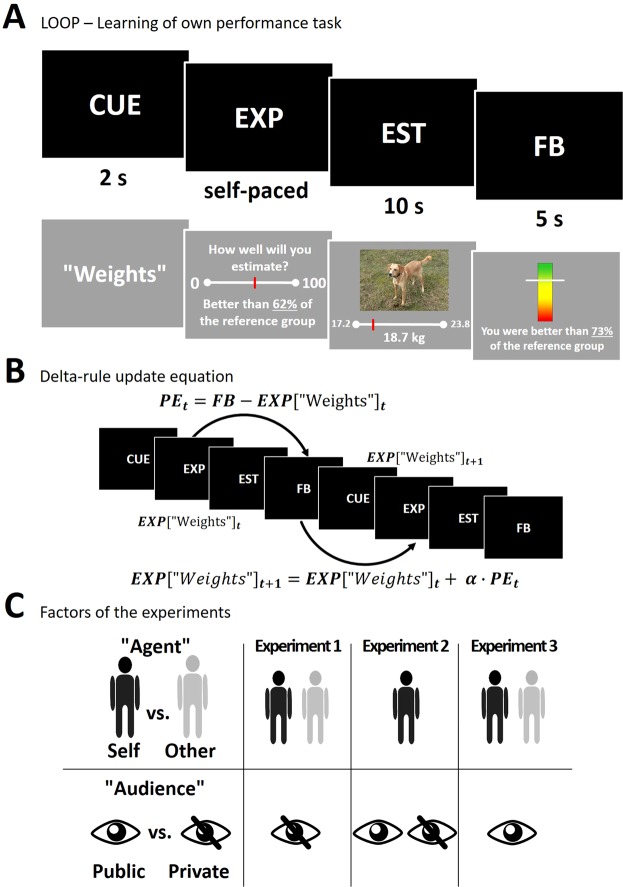
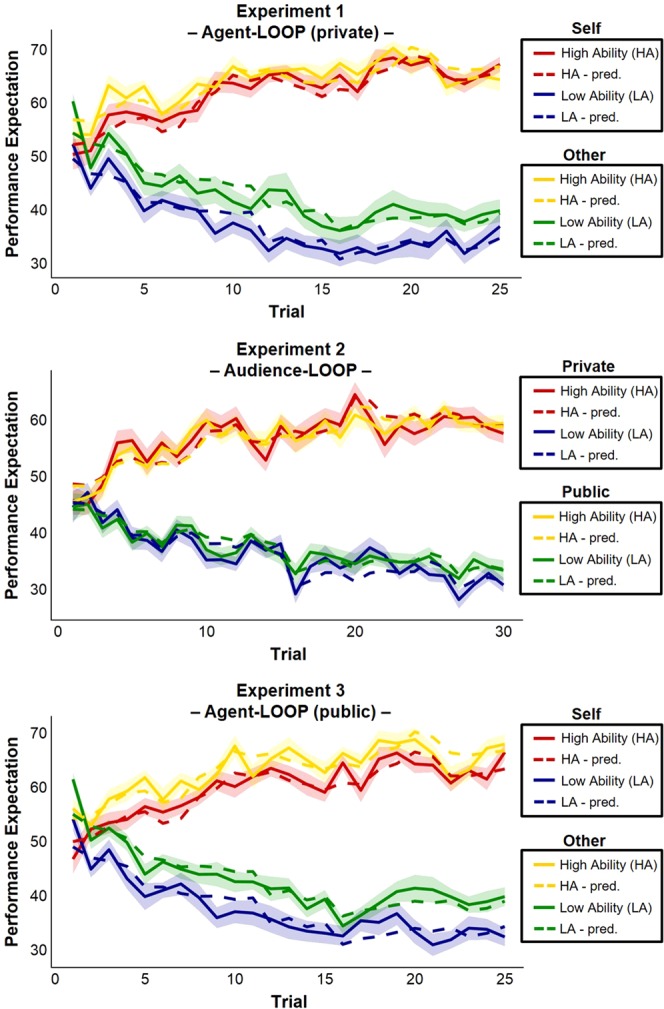
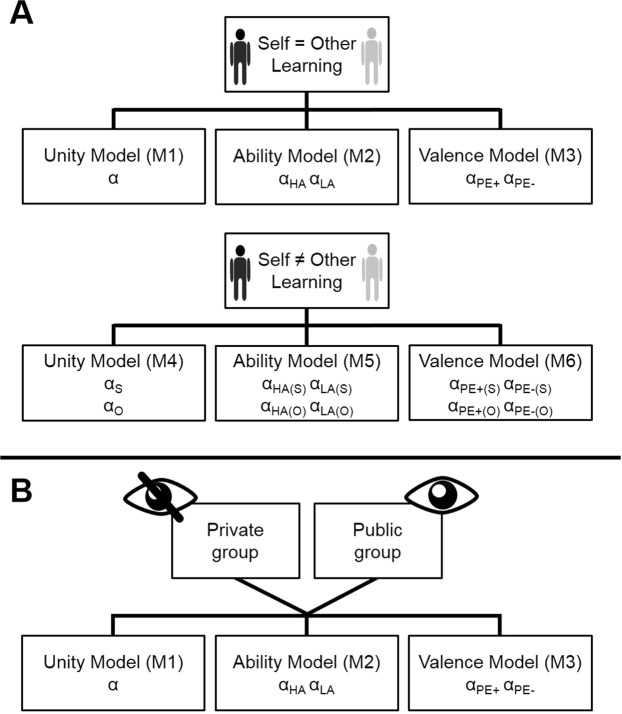
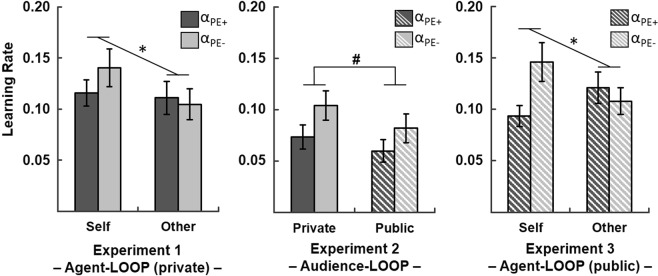
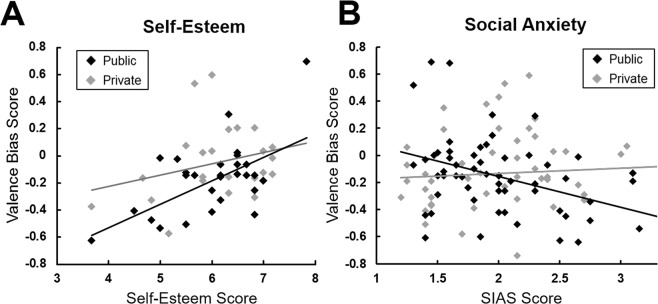
During everyday interactions people constantly receive feedback on their behavior, which shapes their beliefs about themselves. While classic studies in the field of social learning suggest that people have a tendency to learn better from good news (positivity bias) when they perceive little opportunities to immediately improve their own performance, we show updating is biased towards negative information when participants perceive the opportunity to adapt their performance during learning. In three consecutive experiments we applied a computational modeling approach on the subjects’ learning behavior and reveal the negativity bias was specific for learning about own compared to others’ performances and was modulated by prior beliefs about the self, i.e. stronger negativity bias in individuals lower in self-esteem. Social anxiety affected self-related negativity biases only when individuals were exposed to a judging audience thereby potentially explaining the persistence of negative self-images in socially anxious individuals which commonly surfaces in social settings. Self-related belief formation is therefore surprisingly negatively biased in situations suggesting opportunities to improve and this bias is shaped by trait differences in self-esteem and social anxiety.
Overview
The claims and statistics of this paper haven’t been checked yet.
Free: it reads the open-access text and checks the first 5 claims that cite a source we can check. Create a free account to check every claim.
Integrity signals
Registry
Cites
Statistics
Figures
Verification
Claims the paper makes
The claims and statistics of this paper haven’t been checked yet.
Free: it reads the open-access text and checks the first 5 claims that cite a source we can check. Create a free account to check every claim.
Claims other papers make about this one
Each is checked against this paper’s own text: does it say what the citing paper says it does?
The source backs part of the claim, not all of it — or backs it for a different population, condition or comparison.
In the citing paper
“Furthermore, negative information may be more ‘sticky’ in our brains; people weigh negative information more heavily than positive information, when learning about themselves, learning about others and making decisions28–30.”
From Negativity drives online news consumption (2023) · cites this paper as [28]
Experimental — accuracy not yet measured
Self-check
Percentages, sums and reported differences re-computed from the paper’s own numbers.
The self-check needs the paper’s full text.
Citations
Cites
Brainard, D. H. (1997) · Spatial Vision · doi:10.1163/156856897x00357 · Cited by 19,702
Inference from iterative simulation using multiple sequences
Gelman, A., & Rubin, D. B. (1992) · Statistical Science · doi:10.1214/ss/1177011136 · Cited by 16,627
Social Cognitive Theory: An Agentic Perspective
Bandura, A. (2001) · Annual Review of Psychology · doi:10.1146/annurev.psych.52.1.1 · Cited by 15,510
Becoming a Self-Regulated Learner: An Overview
Zimmerman, B. J. (2002) · Theory Into Practice · doi:10.1207/s15430421tip4102_2 · Cited by 10,197
Illusion and well‐being: A social psychological perspective on mental health
Taylor, S. E., & Brown, J. D. (1988) · Psychological Bulletin · doi:10.1037/0033-2909.103.2.193 · Cited by 7,814
Kluger, A. N., & DeNisi, A. (1996) · Psychological Bulletin · doi:10.1037/0033-2909.119.2.254 · Cited by 5,882
(2015) · doi:10.1007/s11222-016-9696-4 · Cited by 5,611
Baumeister, R. F., Campbell, J. D., Krueger, J. I., & Vohs, K. D. (2003) · Psychological Science in the Public Interest · doi:10.1111/1529-1006.01431 · Cited by 3,893
Self-Regulated Learning and Academic Achievement: An Overview
Zimmerman, B. J. (1990) · Educational Psychologist · doi:10.1207/s15326985ep2501_2 · Cited by 3,687
Mattick, R. P., & Clarke, J. C. (1998) · Behaviour Research and Therapy · doi:10.1016/s0005-7967(97)10031-6 · Cited by 3,367
Research works printed but not linked: 1
- Leary, M. R. & Kowalski, R. M. Social anxiety. (The Guilford Press, 1995).
Cited by
Negativity drives online news consumption
Robertson, C. E., Pröllochs, N., Schwarzenegger, K., Pärnamets, P., Van Bavel, J. J., & Feuerriegel, S. (2023) · Nature Human Behaviour · doi:10.1038/s41562-023-01538-4 · Cited by 333
“Furthermore, negative information may be more ‘sticky’ in our brains; people weigh negative information more heavily than positive information, when learning about themselves, learning about others and making decisions 28–30 .”
What Is the Function of Confirmation Bias?
Peters, U. (2022) · Erkenntnis · doi:10.1007/s10670-020-00252-1 · Cited by 236
Embracing informed learner self-assessment during debriefing: the art of plus-delta
Cheng, A., Eppich, W., Epps, C. A., Kolbe, M., Meguerdichian, M. J., & Grant, V. J. (2021) · Advances in Simulation · doi:10.1186/s41077-021-00173-1 · Cited by 161
The neuroscience of social feelings: mechanisms of adaptive social functioning
Eslinger, P. J., Anders, S., Ballarini, T., Boutros, S., Krach, S., Mayer, A. V., Moll, J., Newton, T. L., Schroeter, M. L., de Oliveira-Souza, R., et al. (2021) · Neuroscience & Biobehavioral Reviews · doi:10.1016/j.neubiorev.2021.05.028 · Cited by 130
Self-citationCognitive Load Management: An Invaluable Tool for Safe and Effective Surgical Training
Howie, E. E., Dharanikota, H., Gunn, E., Ambler, O., DIAS, R. D., Wigmore, S. J., Skipworth, R. J. E., & Yule, S. (2023) · Journal of surgical education · doi:10.1016/j.jsurg.2022.12.010 · Cited by 104
Stolz, D. S., Müller‐Pinzler, L., Krach, S., & Paulus, F. M. (2020) · Nature Communications · doi:10.1038/s41467-020-14800-4 · Cited by 59
Self-citationElder, J., Davis, T. H., & Hughes, B. (2022) · Psychological Science · doi:10.1177/09567976211045934 · Cited by 48
“Specifically, research demonstrates that positivity biases (Lefebvre et al., 2017), self-relevant biases (Koban et al., 2017; Müller-Pinzler et al., 2019), and associations between feedback (Vaidya & Badre, 2020) can shape how people modify their behavior from feedback.”
BackgroundThe (un)learning of social functions and its significance for mental health
Flechsenhar, A., Kanske, P., Krach, S., Korn, C. W., & Bertsch, K. (2022) · Clinical Psychology Review · doi:10.1016/j.cpr.2022.102204 · Cited by 35
Self-citationNeurocomputational mechanisms of affected beliefs
Müller‐Pinzler, L., Czekalla, N., Mayer, A. V., Schröder, A., Stolz, D. S., Paulus, F. M., & Krach, S. (2022) · Communications Biology · doi:10.1038/s42003-022-04165-3 · Cited by 28
Self-citationBrain mediators of biased social learning of self-perception in social anxiety disorder
Koban, L., Andrews‐Hanna, J. R., Ives, L. T., Wager, T. D., & Arch, J. J. (2023) · Translational Psychiatry · doi:10.1038/s41398-023-02587-z · Cited by 33
Self-beneficial belief updating as a coping mechanism for stress-induced negative affect
Czekalla, N., Stierand, J., Stolz, D. S., Mayer, A. V., Voges, J. F., Rademacher, L., Paulus, F. M., Krach, S., & Müller‐Pinzler, L. (2021) · Scientific Reports · doi:10.1038/s41598-021-96264-0 · Cited by 28
Self-citationMoradi, M., Akbari, M., & Alavi, M. (2022) · Perspectives In Psychiatric Care · doi:10.1111/ppc.13125 · Cited by 32
Lee, H., & Chung, D. (2022) · Frontiers in Psychiatry · doi:10.3389/fpsyt.2022.846535 · Cited by 27
“Even in learning directly from experience, highly anxious individuals showed a negative bias (i.e., learning better from bad news) when social others were observing (70).”
BackgroundA newly detected bias in self-evaluation
Deffuant, G., Roubin, T., Nugier, A., & Guimond, S. (2024) · PLoS ONE · doi:10.1371/journal.pone.0296383 · Cited by 17
“In this respect, the experiment reported in [18] is an important example for this paper because our own experiment shares several features of its design.”
BackgroundMethodResultInfluentialFolz, J., Akdağ, R., Nikolić, M., van Steenbergen, H., & Kret, M. E. (2023) · Scientific Reports · doi:10.1038/s41598-023-35773-6 · Cited by 18
Czekalla, N., Schröder, A., Mayer, A. V., Stierand, J., Stolz, D. S., Κube, T., Korn, C. W., Wilhelm, I., Klein, J. P., Paulus, F. M., et al. (2024) · bioRxiv (Cold Spring Harbor Laboratory) · doi:10.1101/2024.05.09.593087 · Cited by 10
Self-citationInitial Expectations and Confidence Affect the Formation of Novel Self-Beliefs and Their Revision
Schröder, A., Czekalla, N., Mayer, A. V., Zhang, L., Stolz, D. S., Korn, C. W., Diekelmann, S., Luebber, F., Paulus, F. M., Müller‐Pinzler, L., et al. (2025) · Open Mind · doi:10.1162/opmi.a.36 · Cited by 12
Self-citationNegative mood and optimism bias: An experimental investigation of sadness and belief updating
Karnick, A. T., Bauer, B. W., & Capron, D. W. (2023) · Journal of Behavior Therapy and Experimental Psychiatry · doi:10.1016/j.jbtep.2023.101910 · Cited by 14
Threat induction biases processing of emotional expressions
Flechsenhar, A., Levine, S. M., & Bertsch, K. (2022) · Frontiers in Psychology · doi:10.3389/fpsyg.2022.967800 · Cited by 14
“Recent studies investigating self-updating (Müller-Pinzler et al., 2019; Czekalla et al., 2021) and integration of social feedback (Korn et al.”
BackgroundZamfir, E., & Dayan, P. (2022) · PLoS Computational Biology · doi:10.1371/journal.pcbi.1009920 · Cited by 10
“Our result replicates that of [56] who, in a learning context somewhat similar to ours, found higher learning rates for negative than for positive feedback, for self but not for other.”
BackgroundResultExploring Asymmetries in Self-Concept Change After Discrepant Feedback
Brotzeller, F., & Gollwitzer, M. (2024) · Personality and Social Psychology Bulletin · doi:10.1177/01461672241232738 · Cited by 10
“…is triggered in particular when a person perceives that they can overcome is-ought discrepancies (e.g., by practicing or rehearsing), self-enhancement should be triggered when a person perceives it as impossible to improve on the self-concept aspect in question (Müller-Pinzler et al., 2019).”
InfluentialA corticostriatal pathway mediating self-efficacy enhancement
Shany, O., Gurevitch, G., Gilam, G., Dunsky, N., Balter, S. R., Greental, A., Nutkevitch, N., Eldar, E., & Hendler, T. (2022) · npj Mental Health Research · doi:10.1038/s44184-022-00006-7 · Cited by 14
Kirchner, L., Κube, T., D’Astolfo, L., Strahler, J., Herbstreit, R., & Rief, W. (2023) · Journal of Behavior Therapy and Experimental Psychiatry · doi:10.1016/j.jbtep.2023.101859 · Cited by 9
Valsecchi, W. M., Delfino, J. M., Santos, J., & Faraj, S. E. (2024) · Chemistry Education Research and Practice · doi:10.1039/d3rp00053b · Cited by 21
Beyond Belief Updating: A Framework for Self-Belief FormationPreprint
Krach, S., Müller‐Pinzler, L., Czekalla, N., Schröder, A., Wilhelm, I., Luebber, F., Rademacher, L., Stolz, D. S., Paulus, F. M., & Mayer, A. V. (2024) · PsyArXiv (OSF Preprints) · doi:10.31234/osf.io/2y5tv · Cited by 7
Self-citationImpostor Phenomenon and Microaggressions in Gastroenterology: Exposing the Tip of the Iceberg
Farha, N., Bhama, A. R., Tizzano, A. P., Asfaw, S. H., Kim, M. K., & Burke, C. A. (2023) · Clinical Gastroenterology and Hepatology · doi:10.1016/j.cgh.2023.10.001 · Cited by 7
Elder, J., Davis, T. H., & Hughes, B. (2021) · doi:10.31234/osf.io/etz56 · Cited by 7
Differential effects of social feedback valence and self-relevance on brain responses and behaviour
Helming, H., Peters, A., Arkun, S., Bruchmann, M., Moeck, R., Straube, T., & Schindler, S. (2025) · Social Cognitive and Affective Neuroscience · doi:10.1093/scan/nsaf062 · Cited by 7
Κube, T., & Eggers, I. W. T. (2025) · Journal of Affective Disorders · doi:10.1016/j.jad.2025.03.167 · Cited by 6
Fujisaki, I., Honda, H., & Ueda, K. (2022) · Scientific Reports · doi:10.1038/s41598-022-16584-7 · Cited by 6
Navigating negative emotions: The role of negativity bias in digital activism
Lee, S. J., Hwang, E., Yuk, H., & de Villiers, R. (2025) · International Journal of Market Research · doi:10.1177/14707853251350548 · Cited by 5
“Müller-Pinzler et al. (2019) fi nd that negativity bias towards self-perception is modulated by prior beliefs and self-esteem, suggesting that individual differences in processing negative information could in fl uence engagement with digital activism content.”
The Origins of Emerging Adults’ Work–Family Balance Self-Efficacy: A Dyadic Study
Cho, E. (2024) · Journal of Career Development · doi:10.1177/08948453241228853 · Cited by 4
“Previous research found that individuals are more sensitive to negative performance feedback when updating their beliefs about their own abilities (e.g., Müller-Pinzler et al., 2019).”
BackgroundI Think, Therefore I Change: Reflection Leads to Self-Concept Change After Discrepant Feedback
Brotzeller, F., Spägele, G. L., & Gollwitzer, M. (2025) · Personality and Social Psychology Bulletin · doi:10.1177/01461672251333466 · Cited by 4
“Yet , external information that is discrepant from their self-concept can some-times lead to self-concept change (Brotzeller & Gollwitzer, 2024; Elder et al., 2022; Müller-Pinzler et al., 2019).”
Impostor Phenomenon and Microaggressions in Gastroenterology: Exposing the Tip of the Iceberg
Farha, N., Bhama, A. R., Tizzano, A. P., Asfaw, S. H., Kim, M. K., & Burke, C. A. (2023) · Gastroenterology · doi:10.1053/j.gastro.2023.11.015 · Cited by 3
The Contributions of Attentional Bias and Expectancy Bias to Fluctuations in State Anxiety
Tough, J., Grafton, B., MacLeod, C., & Bockstaele, B. V. (2024) · Cognitive Therapy and Research · doi:10.1007/s10608-024-10535-4 · Cited by 5
“Previous research has suggested that negative information carries greater emotional weight positive information, which may impact decision making (Muller-Pinzler et al., 2019).”
Folz, J., Akdağ, R., Nikolić, M., van Steenbergen, H., & Kret, M. E. (2022) · doi:10.31234/osf.io/e7w6k · Cited by 3
The role of the body in altered facial emotion perception in autism and social anxiety
Folz, J., Nikić, K., Nikolić, M., Janowicz, V., Koelkebeck, K., & Kret, M. E. (2025) · Behaviour Research and Therapy · doi:10.1016/j.brat.2025.104819 · Cited by 3
Causal attributions shape the formation of novel ability self-beliefs
Mayer, A. V., Schröder, A., Stolz, D. S., Czekalla, N., Paulus, F. M., Krach, S., Κube, T., & Müller‐Pinzler, L. (2026) · Communications Psychology · doi:10.1038/s44271-026-00479-8 · Cited by 3
“Notably, while both biases are likely tied to self-referential processing 18,21,33,47,48 , the computational mechanism captured by our model – reduced updating from outcomes perceived as externally caused – may re fl ect a more general learning principle that is not limited to self-related contexts.”
InfluentialSelf-citationΚube, T., Rief, W., & Seewald, A. (2025) · Behaviour Research and Therapy · doi:10.1016/j.brat.2025.104768 · Cited by 2
Rewards bias self-evaluations of ability
Luo, J., Mende‐Siedlecki, P., & Hackel, L. M. (2025) · Communications Psychology · doi:10.1038/s44271-025-00286-7 · Cited by 2
“In this way, participants could learn based on feedback about their performance in a task that did not clearly map onto pre-existing abilities, similar to prior paradigms used to study self-beliefs 11,26 – 28 .”
Depression impairs metacognitive biases, but not learningPreprint
Sax, A.-L., Baddeley, R., & Costa, R. P. (2023) · PsyArXiv (OSF Preprints) · doi:10.31234/osf.io/9a7y8 · Cited by 6
The Gratitude Campaign: A Multihospital Evidence-Based Practice Project
Kelly, L. A., Miller, B. A., Graber, A., Tran, A., & Collins, J. N. (2023) · JONA The Journal of Nursing Administration · doi:10.1097/nna.0000000000001347 · Cited by 1
“31 Negativity bias acknowledges that individuals give more mental weight or thought to a thought when things go wrong than when things go right.”
BackgroundAging and Interpersonal Strain: The Role of Self-Efficacy and Social Drivers of Inclusive Workplaces
Sommovigo, V., Rosa, V., Alfano, V., Laudadio, A., & Боргогни, Л. (2025) · Social Sciences · doi:10.3390/socsci14050258 · Cited by 2
Κube, T. (2025) · Cognitive Therapy and Research · doi:10.1007/s10608-025-10657-3 · Cited by 1
Scholten, S., Gegner, L., Stoverock, M., & Κube, T. (2025) · Behaviour Research and Therapy · doi:10.1016/j.brat.2025.104860 · Cited by 1
Time-of-day related fluctuations of self-belief formationPreprint
Mayer, A. V., Schröder, A., Czekalla, N., Müller‐Pinzler, L., Rosenbusch, L., Paulus, F. M., Oster, H., Sayk, C., Kammerer, M. K., Wilhelm, I., et al. (2024) · bioRxiv (Cold Spring Harbor Laboratory) · doi:10.1101/2024.12.05.627011 · Cited by 1
Self-citationAbsence of Systematic Effects of Internalizing Psychopathology on Learning Under UncertaintyPreprint
Satti, M. H., Wille, K., Nassar, M. R., Cichy, R. M., Schuck, N. W., Dayan, P., & Bruckner, R. (2025) · bioRxiv (Cold Spring Harbor Laboratory) · doi:10.1101/2025.05.12.653409 · Cited by 2
Absence of Systematic Effects of Internalizing Psychopathology on Learning Under UncertaintyPreprint
Satti, M. H., Wille, K., Nassar, M. R., Cichy, R. M., Schuck, N. W., Dayan, P., & Bruckner, R. (2025) · eLife · doi:10.7554/elife.107611.1 · Cited by 3
Commentary on Cropp et al. (2025): Interpersonal Dynamics
Czekalla, N., & Krach, S. (2025) · Zeitschrift für Klinische Psychologie und Psychotherapie · doi:10.1026/1616-3443/a000822 · Cited by 1
Self-citationSelf-compassion is linked to positive affect and buffers declines in self-esteem in low performersPreprint
Weis, J. F., Krach, S., Paulus, F. M., & Stolz, D. S. (2025) · bioRxiv (Cold Spring Harbor Laboratory) · doi:10.1101/2025.11.11.687618 · Cited by 1
Self-citationZamfir, E., & Dayan, P. (2022) · doi:10.31234/osf.io/gtd4h
Fujisaki, I., Honda, H., & Ueda, K. (2022) · Research Square · doi:10.21203/rs.3.rs-1497903/v1
Response to (Stress and cataract surgery: A nationwide study evaluating surgeon burnout)
Jesudason, D., Macri, C. Z., Bacchi, S., & Chan, W. O. (2024) · European Journal of Ophthalmology · doi:10.1177/11206721241297020
Li, Y., An, P., & He, J. (2025) · Social Influence · doi:10.1080/15534510.2025.2468226
“…decision-making processes (Kanouse, 1984), attributions (Lewicka et al., 1992), evaluations (T. A. Ito et al., 1998), capability development (Müller-Pinzler et al., 2019), and physiological activations (Soroka et al., 2019), etc. Research by Correa et al. (2015) demonstrated that content on…”
Brain Diffusion Transformer for Personalized Neuroscience and PsychiatryPreprint
Zhai, R., Hu, Y., Zheng, L., Xiang, S., Xie, C., Peng, L., Banaschewski, T., Barker, G. J., Bokde, A. L. W., Brühl, R., et al. (2025) · bioRxiv (Cold Spring Harbor Laboratory) · doi:10.1101/2025.04.12.648506
“Such a shift could be a maladaptive outcome of self-management for negative bias ( 29 ).”
Tang, A., Kim, T., & Yoon, L. (2025) · SSRN Electronic Journal · doi:10.2139/ssrn.5235803
Zhang, G.-L., Zhang, J., Li, H., Liu, W., & Zhang, X. (2025) · BMC Psychology · doi:10.1186/s40359-025-03089-x
“This finding aligns with research across various domains showing that individuals with low self-esteem tend to hold more negative self-evaluations [3, 44, 58], a pattern that is thought to stem from their internalized negative self-beliefs [41, 45].”
Absence of Systematic Effects of Internalizing Psychopathology on Learning Under UncertaintyPreprint
Satti, M. H., Wille, K., Nassar, M. R., Cichy, R. M., Schuck, N. W., Dayan, P., & Bruckner, R. (2025) · eLife · doi:10.7554/elife.107611
Self-esteem modulates beneficial causal attributions in the formation of novel self-beliefsPreprint
Mayer, A. V., Schröder, A., Stolz, D. S., Czekalla, N., Paulus, F. M., Müller‐Pinzler, L., Krach, S., & Κube, T. (2025) · bioRxiv (Cold Spring Harbor Laboratory) · doi:10.1101/2025.10.27.684784
“…positive experiences in people with elevated levels of depression (Korn et al., 2014; Kube & Eggers, 2025; Kube et al., 2019), we expected that participants with higher levels of depression would show a more negative bias in to a more negative bias, as shown (Müller-Pinzler et al., 2022, 2019).”
InfluentialSelf-citationMeyerhöfer, S., Ottenstein, C., Kirchner, L., Müller‐Pinzler, L., Krach, S., & Κube, T. (2025) · Clinical Psychological Science · doi:10.1177/21677026251375886 · Cited by 2
Self-citationRosbergen, I. C. M., van der Feen, A., van Houtert, W. F. C., de Jonge, E. A., Meesters, J. J. L., van der Sluis, G., Vennik, N., de Jong, B., & Siemonsma, P. C. (2026) · Disability and Rehabilitation · doi:10.1080/09638288.2026.2624504
“People aspire rewards while avoiding failure as negativity can lower self-belief and reduce motivation [37].”
Interoceptive NeuroEmpowerment Scale: a trauma-informed measure of adaptive state ownership
Truitt, K., Walsh, M., & Dalton, M. R. (2026) · Frontiers in Human Neuroscience · doi:10.3389/fnhum.2026.1748573
The neurocomputational mechanisms underlying the impact of social comparison on effort investment
Dong, J., Rong, Y., Ma, S., Xu, Y., & Wei, P. (2026) · Communications Biology · doi:10.1038/s42003-026-10229-5
“Neurocomputational evidence likewise suggests that self-related belief updating is sensitive to social feedback 7,21,22 , and that favorable social feedback can strengthen self-related beliefs 23,24 , in line with Bandura ’ s self-ef fi cacy framework.”
Yuan, G., Cheng, Z., Gui, J., Zhang, Y., Haoran, Z., & Li, Y. (2026) · Acta Psychologica · doi:10.1016/j.actpsy.2026.107212
Sommovigo, V., Montani, F., Hobfoll, S. E., & Alessandri, G. (2026) · European Journal of Work and Organizational Psychology · doi:10.1080/1359432x.2026.2692454
Czekalla, N., Schröder, A., Mayer, A. V., Stierand, J., Stolz, D. S., Κube, T., Korn, C. W., Wilhelm, I., Klein, J. P., Paulus, F. M., et al. (2026) · Translational Psychiatry · doi:10.1038/s41398-026-04341-7 · Cited by 4
“To understand the computational mechanisms underlying maladaptive self-belief formation [15, 33], we assessed individuals with depression and matched healthy controls in a functional magnetic resonance imaging (fMRI) study.”
InfluentialSelf-citation3D Printing as a Teaching Tool in Veterinary Medicine: Feline Ocular Model for Ultrasound Training
Lima, C. A. C., Filipe, A. I., & Mestrinho, L. A. (2026) · Journal of Veterinary Medical Education · doi:10.3138/jvme-2026-0028
Sohail, A., Magda, A., Said, M., Phillips, L., Lu, Y., Reynolds, G., Comer-Fenn, A., Russell, J., Lü, H., Sims, T., et al. (2026) · Psychological Medicine · doi:10.1017/s0033291726106217
Metadata
- Authors
- Müller-Pinzler, L., Czekalla, N., Mayer, A. V., Stolz, D. S., Gazzola, V., Keysers, C., Paulus, F. M., & Krach, S.
- Affiliations
- Social Neuroscience Lab (DE)
- Netherlands Institute for Neuroscience (NL)
- ORCID
- Venue
- Scientific Reports
- Published
- 2019-10-08
- Volume
- 9
- Issue
- 1
- Pages
- 14416-14416
- ISSN
- 2045-2322 (ISSN-L)
- PMC
- PMC6783436
- OpenAlex
- W2979463710
- Cited by
- 68
- References
- 72
- Citations by year
- 2026: 9 · 2025: 22 · 2024: 8 · 2023: 11 · 2022: 12 · 2021: 4 · 2020: 2
- FWCI
- 5.31
- Type
- journal article
- Language
- en
- Open access
- gold
- doi.org
- Licence
- cc-by
- creativecommons.org/licenses/by/4.0 (tdm)
- creativecommons.org/licenses/by/4.0 (vor)
- Locations
- Scientific Reports (publishedVersion, cc-by)
- Europe PMC (PubMed Central) (publishedVersion, cc-by)
- PubMed Central (publishedVersion, cc-by)
- PubMed (publishedVersion)
- KNAW research portal (Royal Academy of Art and Sciences (KNAW)) (publishedVersion, other-oa)
- UvA-DARE (University of Amsterdam) (submittedVersion, cc-by)
- Data Archiving and Networked Services (DANS) (submittedVersion, other-oa)
- DOAJ (DOAJ: Directory of Open Access Journals) (submittedVersion)
- KNAW Research Portal (The Royal Netherlands Academy of Arts and Sciences) (submittedVersion, other-oa)
- Funders
- European Commission (312511)
- Deutsche Forschungsgemeinschaft (MU4373/1-1)
- Nederlandse Organisatie voor Wetenschappelijk Onderzoek (453-15-009, 452-14-015)
- Universität zu Lübeck (J21-2018)
- Topics
- Social Sciences › Psychology › Experimental and Cognitive Psychology › Anxiety, Depression, Psychometrics, Treatment, Cognitive Processes
- Social Sciences › Sociology and Political Science › Social and Intergroup Psychology
- Social Sciences › Decision Sciences › General Decision Sciences › Decision-Making and Behavioral Economics
- Keywords
- negativity bias, self-assessment, belief updating, feedback learning, self-esteem, social anxiety, positivity bias, computational models of learning, negative self-concept
- MeSH terms
- Adult, Anxiety, Attention, Fear, Female, Humans, Learning, Male, Surveys and Questionnaires, Self Concept, Social Behavior, Bias, Young Adult
About these checks
Registry, retraction, Cites and statistics results are computed, not judged, with one exception: a printed reference that no index lists is read once by a model before it counts as a citation error. Claims are extracted by a model and kept only when their quote appears verbatim in the text; each cited source is then checked, with a model’s help, for whether it says what the claim relies on. Those verdicts can be wrong — read the claim’s quote and the cited source before relying on one.
Statistics and arithmetic are recomputed, not judged.
Confidence bands are shown only for fields calibrated on our annotated test set. None is calibrated yet, so no band is shown.
What counts as a claim ›How we measure confidence ›How we check this ›
Are you an author, or do you see a problem with this page? Request a review
Data sources
Bibliographic data: Semantic Scholar, OpenAlex, Crossref.
Contains information from the Semantic Scholar Academic Graph Datasets, made available under the ODC Attribution License (ODC-BY 1.0).
Semantic Scholar’s data is described in: Kinney, R., et al. (2023). The Semantic Scholar Open Data Platform. arXiv:2301.10140.
