

Negativity-bias in forming beliefs about own abilities
Open accessThe DOI matches its Crossref record; 73 of the 73 references it cites were found in a registry or an index.
Abstract
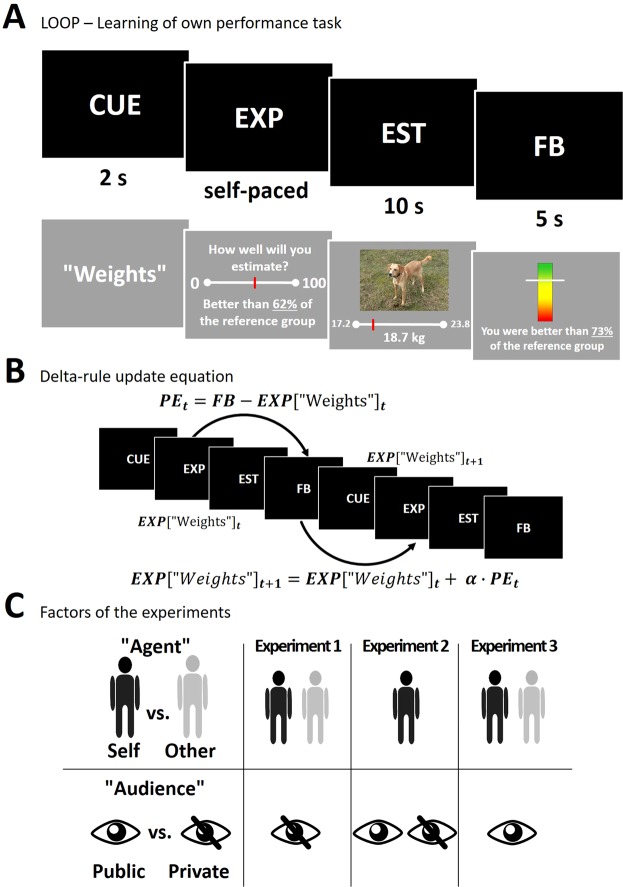
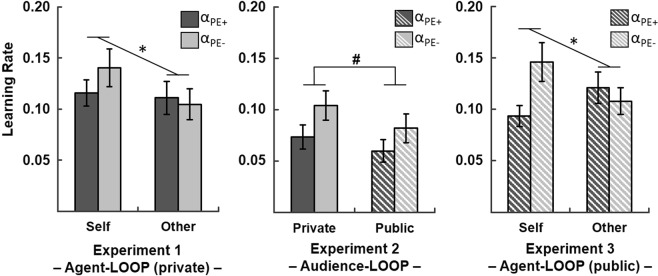
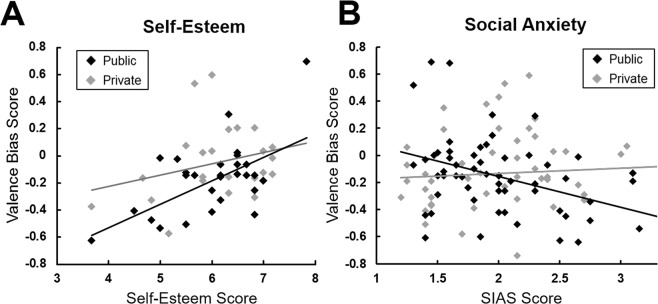
During everyday interactions people constantly receive feedback on their behavior, which shapes their beliefs about themselves. While classic studies in the field of social learning suggest that people have a tendency to learn better from good news (positivity bias) when they perceive little opportunities to immediately improve their own performance, we show updating is biased towards negative information when participants perceive the opportunity to adapt their performance during learning. In three consecutive experiments we applied a computational modeling approach on the subjects’ learning behavior and reveal the negativity bias was specific for learning about own compared to others’ performances and was modulated by prior beliefs about the self, i.e. stronger negativity bias in individuals lower in self-esteem. Social anxiety affected self-related negativity biases only when individuals were exposed to a judging audience thereby potentially explaining the persistence of negative self-images in socially anxious individuals which commonly surfaces in social settings. Self-related belief formation is therefore surprisingly negatively biased in situations suggesting opportunities to improve and this bias is shaped by trait differences in self-esteem and social anxiety.
Overview
The claims and statistics of this paper haven’t been checked yet.
Free: it reads the open-access text and checks the first 5 claims that cite a source we can check. Create a free account to check every claim.
Integrity signals
Registry
Cites
Statistics
Figures
Verification
Claims the paper makes
The claims and statistics of this paper haven’t been checked yet.
Free: it reads the open-access text and checks the first 5 claims that cite a source we can check. Create a free account to check every claim.
Claims other papers make about this one
Each is checked against this paper’s own text: does it say what the citing paper says it does?
The source backs part of the claim, not all of it — or backs it for a different population, condition or comparison.
In the citing paper
“Furthermore, negative information may be more ‘sticky’ in our brains; people weigh negative information more heavily than positive information, when learning about themselves, learning about others and making decisions28–30.”
From Negativity drives online news consumption (2023) · cites this paper as [28]
Experimental — accuracy not yet measured
Self-check
Percentages, sums and reported differences re-computed from the paper’s own numbers.
The self-check needs the paper’s full text.
Citations
Cites
Brainard, D. H. (1997) · Spatial Vision · doi:10.1163/156856897x00357 · Cited by 19,702
Inference from iterative simulation using multiple sequences
Gelman, A., & Rubin, D. B. (1992) · Statistical Science · doi:10.1214/ss/1177011136 · Cited by 16,627
Social Cognitive Theory: An Agentic Perspective
Bandura, A. (2001) · Annual Review of Psychology · doi:10.1146/annurev.psych.52.1.1 · Cited by 15,510
Becoming a Self-Regulated Learner: An Overview
Zimmerman, B. J. (2002) · Theory Into Practice · doi:10.1207/s15430421tip4102_2 · Cited by 10,197
Illusion and well‐being: A social psychological perspective on mental health
Taylor, S. E., & Brown, J. D. (1988) · Psychological Bulletin · doi:10.1037/0033-2909.103.2.193 · Cited by 7,814
Kluger, A. N., & DeNisi, A. (1996) · Psychological Bulletin · doi:10.1037/0033-2909.119.2.254 · Cited by 5,882
(2015) · doi:10.1007/s11222-016-9696-4 · Cited by 5,611
Baumeister, R. F., Campbell, J. D., Krueger, J. I., & Vohs, K. D. (2003) · Psychological Science in the Public Interest · doi:10.1111/1529-1006.01431 · Cited by 3,893
Self-Regulated Learning and Academic Achievement: An Overview
Zimmerman, B. J. (1990) · Educational Psychologist · doi:10.1207/s15326985ep2501_2 · Cited by 3,687
Mattick, R. P., & Clarke, J. C. (1998) · Behaviour Research and Therapy · doi:10.1016/s0005-7967(97)10031-6 · Cited by 3,367
The Dynamic Self-Concept: A Social Psychological Perspective
Markus, H., & Wurf, E. (1987) · Annual Review of Psychology · doi:10.1146/annurev.ps.38.020187.001503 · Cited by 3,089
Negative Self-Efficacy and Goal Effects Revisited
Bandura, A., & Locke, E. A. (2003) · Journal of Applied Psychology · doi:10.1037/0021-9010.88.1.87 · Cited by 2,813
Learned helplessness: Theory and evidence
Maier, S. F., & Seligman, M. E. (1976) · Journal of Experimental Psychology: General · doi:10.1037/0096-3445.105.1.3 · Cited by 2,494
Social cognitive theory of gender development and differentiation.
Bussey, K., & Bandura, A. (1999) · Psychological Review · doi:10.1037/0033-295x.106.4.676 · Cited by 2,476
Self-Efficacy Beliefs as Shapers of Children's Aspirations and Career Trajectories
Bandura, A., Barbaranelli, C., Caprara, G. V., & Pastorelli, C. (2001) · Child Development · doi:10.1111/1467-8624.00273 · Cited by 2,129
Understanding predictive information criteria for Bayesian models
Gelman, A., Hwang, J., & Vehtari, A. (2014) · Statistics and Computing · doi:10.1007/s11222-013-9416-2 · Cited by 2,104
Social anxiety and self-presentation: A conceptualization model.
Schlenker, B. R., & Leary, M. R. (1982) · Psychological Bulletin · doi:10.1037/0033-2909.92.3.641 · Cited by 1,590
Self-presentation: Impression Management And Interpersonal Behavior
Leary, M. R. (1994) · Cited by 1,228
JEFFREYS, H. (1922) · Nature · doi:10.1038/109132a0 · Cited by 1,217
The Dynamogenic Factors in Pacemaking and Competition
Triplett, N. (1898) · The American Journal of Psychology · doi:10.2307/1412188 · Cited by 1,164
Krueger, N. F., & Dickson, P. R. (1994) · Decision Sciences · doi:10.1111/j.1540-5915.1994.tb00810.x · Cited by 975
Self-Enhancement: Food for Thought
Sedikides, C., & Gregg, A. P. (2008) · Perspectives on Psychological Science · doi:10.1111/j.1745-6916.2008.00068.x · Cited by 880
Evaluations of Self and Others: Self-Enhancement Biases in Social Judgments
Brown, J. D. (1986) · Social Cognition · doi:10.1521/soco.1986.4.4.353 · Cited by 855
Motivational and emotional aspects of the self
Leary, M. R. (2007) · Annual Review of Psychology · doi:10.1146/annurev.psych.58.110405.085658 · Cited by 838
How unrealistic optimism is maintained in the face of reality
Sharot, T., Korn, C. W., & Dolan, R. J. (2011) · Nature Neuroscience · doi:10.1038/nn.2949 · Cited by 729
MARSH, H. W., & O'NEILL, R. (1984) · Journal of Educational Measurement · doi:10.1111/j.1745-3984.1984.tb00227.x · Cited by 685
Bayesian model selection for group studies — Revisited
Rigoux, L., Stephan, K. E., Friston, K. J., & Daunizeau, J. (2014) · NeuroImage · doi:10.1016/j.neuroimage.2013.08.065 · Cited by 666
The Good News-Bad News Effect: Asymmetric Processing of Objective Information about Yourself
Eil, D., & Rao, J. M. (2011) · American Economic Journal: Microeconomics · doi:10.1257/mic.3.2.114 · Cited by 657
Krueger, N. F., & Dickson, P. R. (1994) · Decision Sciences · doi:10.1111/j.1540-5915.1994.tb01849.x · Cited by 632
An experimental analysis of self-persuasion
Bem, D. J. (1965) · Journal of Experimental Social Psychology · doi:10.1016/0022-1031(65)90026-0 · Cited by 619
Water associated zero maze: a novel rat test for long term traumatic re-experiencing
Ritov, G., & Richter-Levin, G. (2014) · Frontiers in Behavioral Neuroscience · doi:10.3389/fnbeh.2014.00001 · Cited by 579
Cognitive and Interpersonal Features of Intellectual Humility
Leary, M. R., Diebels, K. J., Davisson, E. K., Jongman-Sereno, K. P., Isherwood, J. C., Raimi, K. T., Deffler, S. A., & Hoyle, R. H. (2017) · Personality and Social Psychology Bulletin · doi:10.1177/0146167217697695 · Cited by 539
Nolen-Hoeksema, S., Girgus, J. S., & Seligman, M. E. (1986) · Journal of Personality and Social Psychology · doi:10.1037//0022-3514.51.2.435 · Cited by 526
Social Anxiety and Social Anxiety Disorder
Morrison, A. S., & Heimberg, R. G. (2013) · Annual Review of Clinical Psychology · doi:10.1146/annurev-clinpsy-050212-185631 · Cited by 480
A Cognitive Behavioral Model of Social Anxiety Disorder
Heimberg, R. G., Brozovich, F. A., & Rapee, R. M. (2010) · Social Anxiety · doi:10.1016/b978-0-12-375096-9.00015-8 · Cited by 407 · cited 2×
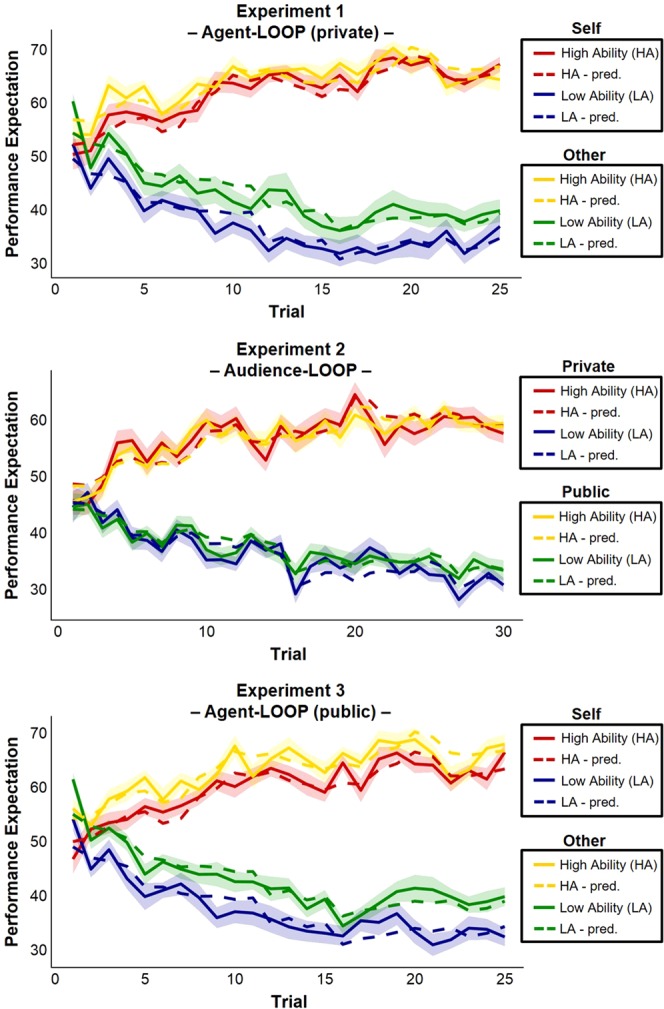
“001) and interaction of Trial × Ability condition (F(29,1653) = 39.”
BackgroundHilbert, M. (2012) · Psychological Bulletin · doi:10.1037/a0025940 · Cited by 391
Negative interpretation bias in social phobia
Amin, N., Foa, E. B., & Coles, M. E. (1998) · Behaviour Research and Therapy · doi:10.1016/s0005-7967(98)00060-6 · Cited by 386
Neural prediction errors reveal a risk-sensitive reinforcement-learning process in the human brain
Niv, Y., Edlund, J. A., Dayan, P., & O'Doherty, J. P. (2012) · The Journal of Neuroscience · doi:10.1523/jneurosci.5498-10.2012 · Cited by 356
Forming beliefs: Why valence matters
Sharot, T., & Garrett, N. (2016) · Trends in Cognitive Sciences · doi:10.1016/j.tics.2015.11.002 · Cited by 345
Korn, C. W., Sharot, T., Walter, H., Heekeren, H. R., & Dolan, R. J. (2014) · Psychological Medicine · doi:10.1017/s0033291713001074 · Cited by 334
Neural mechanisms of cognitive reappraisal of negative self-beliefs in social anxiety disorder.
Goldin, P. R., Manber-Ball, T., Werner, K., Heimberg, R., & Gross, J. J. (2009) · Biological Psychiatry · doi:10.1016/j.biopsych.2009.07.014 · Cited by 305
Self-Enhancement and Learning from Performance Feedback
Jordan, A. H., & Audia, P. G. (2012) · Academy of Management Review · doi:10.5465/amr.2010.0108 · Cited by 296
Depressive realism: a meta-analytic review
Moore, M. T., & Fresco, D. M. (2012) · Clinical Psychology Review · doi:10.1016/j.cpr.2012.05.004 · Cited by 291
Taylor, S. E., Neter, E., & Wayment, H. A. (1995) · Personality and Social Psychology Bulletin · doi:10.1177/01461672952112005 · Cited by 288
Social facilitation of dominant and subordinate responses
Zajonc, R. B., & Sales, S. M. (1966) · Journal of Experimental Social Psychology · doi:10.1016/0022-1031(66)90077-1 · Cited by 283
Impaired positive inferential bias in social phobia
Hirsch, C. R., & Mathews, A. (2000) · Journal of Abnormal Psychology · doi:10.1037/0021-843x.109.4.705 · Cited by 267
McFarlin, D. B., & Blascovich, J. (1981) · Journal of Personality and Social Psychology · doi:10.1037//0022-3514.40.3.521 · Cited by 240
Confirmation bias in human reinforcement learning: Evidence from counterfactual feedback processing
Palminteri, S., Lefebvre, G., Kilford, E. J., & Blakemore, S.-J. (2017) · PLOS Computational Biology · doi:10.1371/journal.pcbi.1005684 · Cited by 236
Understanding the Better Than Average Effect: Motives (Still) Matter
Brown, J. D. (2012) · Personality and Social Psychology Bulletin · doi:10.1177/0146167211432763 · Cited by 234
Positively Biased Processing of Self-Relevant Social Feedback
Korn, C. W., Prehn, K., Park, S. Q., Walter, H., & Heekeren, H. R. (2012) · The Journal of Neuroscience · doi:10.1523/jneurosci.3016-12.2012 · Cited by 200
Bringing Young Women to Math and Science
Eccles, J. S. (1989) · Springer eBooks · doi:10.1007/978-1-4612-3588-0_3 · Cited by 192
Ertaç, S. (2011) · Journal of Economic Behavior & Organization · doi:10.1016/j.jebo.2011.05.012 · Cited by 187
Social anxiety and the interpretation of positive social events
Alden, L. E., Taylor, C. T., Mellings, T. M. J. B., & Laposa, J. M. (2008) · Journal of Anxiety Disorders · doi:10.1016/j.janxdis.2007.05.007 · Cited by 177
Self-esteem and the effects of success and failure feedback on performance1
Shrauger, J. S., & Rosenberg, S. E. (1970) · Journal of Personality · doi:10.1111/j.1467-6494.1970.tb00018.x · Cited by 175
Overconfidence in Forecasts of Own Performance: An Experimental Study
Clark, J., & Friesen, L. (2008) · The Economic Journal · doi:10.1111/j.1468-0297.2008.02211.x · Cited by 156
The importance of stupidity in scientific research
Schwartz, M. A. (2008) · Journal of Cell Science · doi:10.1242/jcs.033340 · Cited by 149
Self-Efficacy, Social Anxiety, and Inhibition in Interpersonal Encounters
Leary, M. R., & Atherton, S. C. (1986) · Journal of Social and Clinical Psychology · doi:10.1521/jscp.1986.4.3.256 · Cited by 118
Acerbi, L., Dokka, K., Angelaki, D. E., & Ma, W. J. (2018) · PLOS Computational Biology · doi:10.1371/journal.pcbi.1006110 · Cited by 111
Sedikides, C., & Hepper, E. G. D. (2009) · Social and Personality Psychology Compass · doi:10.1111/j.1751-9004.2009.00231.x · Cited by 108
Neural sensitivity to social reward and punishment anticipation in social anxiety disorder
Cremers, H. R., Veer, I. M., Spinhoven, P., Rombouts, S. A. R. B., & Roelofs, K. (2015) · Frontiers in Behavioral Neuroscience · doi:10.3389/fnbeh.2014.00439 · Cited by 106
Social anxiety is characterized by biased learning about performance and the self.
Koban, L., Schneider, R., Ashar, Y. K., Andrews-Hanna, J. R., Landy, L., Moscovitch, D. A., Wager, T. D., & Arch, J. J. (2017) · Emotion · doi:10.1037/emo0000296 · Cited by 105
The role of the neural reward circuitry in self-referential optimistic belief updates
Kuzmanovic, B., Jefferson, A., & Vogeley, K. (2016) · NeuroImage · doi:10.1016/j.neuroimage.2016.02.014 · Cited by 95
Neural pathways of embarrassment and their modulation by social anxiety
Müller-Pinzler, L., Gazzola, V., Keysers, C., Sommer, J., Jansen, A., Frässle, S., Einhäuser, W., Paulus, F. M., & Krach, S. (2015) · NeuroImage · doi:10.1016/j.neuroimage.2015.06.036 · Cited by 85
Self-citationLack of a benign interpretation bias in social anxiety disorder
Amir, N., Prouvost, C., & Kuckertz, J. M. (2012) · Cognitive Behaviour Therapy · doi:10.1080/16506073.2012.662655 · Cited by 79
The Pleasures and Pains of Information
Loewenstein, G. (2006) · Science · doi:10.1126/science.1128388 · Cited by 74
Fear-relevant selective associations and social anxiety: Absence of a positive bias
Garner, M. J., Mogg, K., & Bradley, B. P. (2005) · Behaviour Research and Therapy · doi:10.1016/j.brat.2004.12.007 · Cited by 64
Button, K. S., Kounali, D., Stapinski, L., Rapee, R. M., Lewis, G., & Munafò, M. R. (2015) · PLOS ONE · doi:10.1371/journal.pone.0119456 · Cited by 57
Self-Evaluative Biases in Social Anxiety
Ashbaugh, A. R., Antony, M. M., McCabe, R. E., Schmidt, L. A., & Swinson, R. P. (2005) · Cognitive Therapy and Research · doi:10.1007/s10608-005-2413-9 · Cited by 52
Being observed magnifies action.
Steinmetz, J., Xu, Q., Fishbach, A., & Zhang, Y. (2016) · Journal of Personality and Social Psychology · doi:10.1037/pspi0000065 · Cited by 42
Depressive symptoms are associated with blunted reward learning in social contexts
Safra, L., Chevallier, C., & Palminteri, S. (2019) · PLOS Computational Biology · doi:10.1371/journal.pcbi.1007224 · Cited by 40
Possible Association of APOE Genotype with Working Memory in Young Adults
Sinclair, L. I., Button, K. S., Munafo, M. R., Day, I. N. M., & Lewis, G. (2015) · PLoS ONE · doi:10.1371/journal.pone.0135894 · Cited by 29
Deductive Reasoning and Social Anxiety: Evidence for a Fear-confirming Belief Bias
Vroling, M. S., & de Jong, P. J. (2008) · Cognitive Therapy and Research · doi:10.1007/s10608-008-9220-z · Cited by 28
THE IMPORTANCE OF STUPIDITY IN SCIENTIFIC RESEARCH
Schwartz, M. A. (2011) · Seismological Research Letters · doi:10.1785/gssrl.82.1.3 · Cited by 8
Research works printed but not linked: 1
- Leary, M. R. & Kowalski, R. M. Social anxiety. (The Guilford Press, 1995).
Cited by
Negativity drives online news consumption
Robertson, C. E., Pröllochs, N., Schwarzenegger, K., Pärnamets, P., Van Bavel, J. J., & Feuerriegel, S. (2023) · Nature Human Behaviour · doi:10.1038/s41562-023-01538-4 · Cited by 333
“Furthermore, negative information may be more ‘sticky’ in our brains; people weigh negative information more heavily than positive information, when learning about themselves, learning about others and making decisions 28–30 .”
What Is the Function of Confirmation Bias?
Peters, U. (2022) · Erkenntnis · doi:10.1007/s10670-020-00252-1 · Cited by 236
Embracing informed learner self-assessment during debriefing: the art of plus-delta
Cheng, A., Eppich, W., Epps, C. A., Kolbe, M., Meguerdichian, M. J., & Grant, V. J. (2021) · Advances in Simulation · doi:10.1186/s41077-021-00173-1 · Cited by 161
The neuroscience of social feelings: mechanisms of adaptive social functioning
Eslinger, P. J., Anders, S., Ballarini, T., Boutros, S., Krach, S., Mayer, A. V., Moll, J., Newton, T. L., Schroeter, M. L., de Oliveira-Souza, R., et al. (2021) · Neuroscience & Biobehavioral Reviews · doi:10.1016/j.neubiorev.2021.05.028 · Cited by 130
Self-citationCognitive Load Management: An Invaluable Tool for Safe and Effective Surgical Training
Howie, E. E., Dharanikota, H., Gunn, E., Ambler, O., DIAS, R. D., Wigmore, S. J., Skipworth, R. J. E., & Yule, S. (2023) · Journal of surgical education · doi:10.1016/j.jsurg.2022.12.010 · Cited by 104
Metadata
- Authors
- Müller-Pinzler, L., Czekalla, N., Mayer, A. V., Stolz, D. S., Gazzola, V., Keysers, C., Paulus, F. M., & Krach, S.
- Affiliations
- Social Neuroscience Lab (DE)
- Netherlands Institute for Neuroscience (NL)
- ORCID
- Venue
- Scientific Reports
- Published
- 2019-10-08
- Volume
- 9
- Issue
- 1
- Pages
- 14416-14416
- ISSN
- 2045-2322 (ISSN-L)
- PMC
- PMC6783436
- OpenAlex
- W2979463710
- Cited by
- 68
- References
- 72
- Citations by year
- 2026: 9 · 2025: 22 · 2024: 8 · 2023: 11 · 2022: 12 · 2021: 4 · 2020: 2
- FWCI
- 5.31
- Type
- journal article
- Language
- en
- Open access
- gold
- doi.org
- Licence
- cc-by
- creativecommons.org/licenses/by/4.0 (tdm)
- creativecommons.org/licenses/by/4.0 (vor)
- Locations
- Scientific Reports (publishedVersion, cc-by)
- Europe PMC (PubMed Central) (publishedVersion, cc-by)
- PubMed Central (publishedVersion, cc-by)
- PubMed (publishedVersion)
- KNAW research portal (Royal Academy of Art and Sciences (KNAW)) (publishedVersion, other-oa)
- UvA-DARE (University of Amsterdam) (submittedVersion, cc-by)
- Data Archiving and Networked Services (DANS) (submittedVersion, other-oa)
- DOAJ (DOAJ: Directory of Open Access Journals) (submittedVersion)
- KNAW Research Portal (The Royal Netherlands Academy of Arts and Sciences) (submittedVersion, other-oa)
- Funders
- European Commission (312511)
- Deutsche Forschungsgemeinschaft (MU4373/1-1)
- Nederlandse Organisatie voor Wetenschappelijk Onderzoek (453-15-009, 452-14-015)
- Universität zu Lübeck (J21-2018)
- Topics
- Social Sciences › Psychology › Experimental and Cognitive Psychology › Anxiety, Depression, Psychometrics, Treatment, Cognitive Processes
- Social Sciences › Sociology and Political Science › Social and Intergroup Psychology
- Social Sciences › Decision Sciences › General Decision Sciences › Decision-Making and Behavioral Economics
- Keywords
- negativity bias, self-assessment, belief updating, feedback learning, self-esteem, social anxiety, positivity bias, computational models of learning, negative self-concept
- MeSH terms
- Adult, Anxiety, Attention, Fear, Female, Humans, Learning, Male, Surveys and Questionnaires, Self Concept, Social Behavior, Bias, Young Adult
About these checks
Registry, retraction, Cites and statistics results are computed, not judged, with one exception: a printed reference that no index lists is read once by a model before it counts as a citation error. Claims are extracted by a model and kept only when their quote appears verbatim in the text; each cited source is then checked, with a model’s help, for whether it says what the claim relies on. Those verdicts can be wrong — read the claim’s quote and the cited source before relying on one.
Statistics and arithmetic are recomputed, not judged.
Confidence bands are shown only for fields calibrated on our annotated test set. None is calibrated yet, so no band is shown.
What counts as a claim ›How we measure confidence ›How we check this ›
Are you an author, or do you see a problem with this page? Request a review
Data sources
Bibliographic data: Semantic Scholar, OpenAlex, Crossref.
Contains information from the Semantic Scholar Academic Graph Datasets, made available under the ODC Attribution License (ODC-BY 1.0).
Semantic Scholar’s data is described in: Kinney, R., et al. (2023). The Semantic Scholar Open Data Platform. arXiv:2301.10140.
