

Using artificial intelligence to read chest radiographs for tuberculosis detection: A multi-site evaluation of the diagnostic accuracy of three deep learning systems
Open accessThe DOI matches its Crossref record; 34 of the 34 references it cites were found in a registry or an index.
Abstract
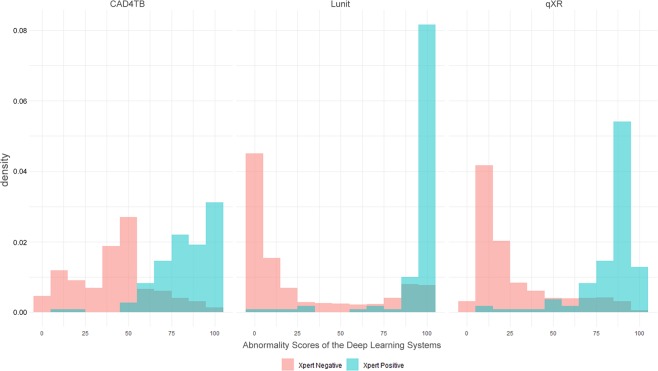
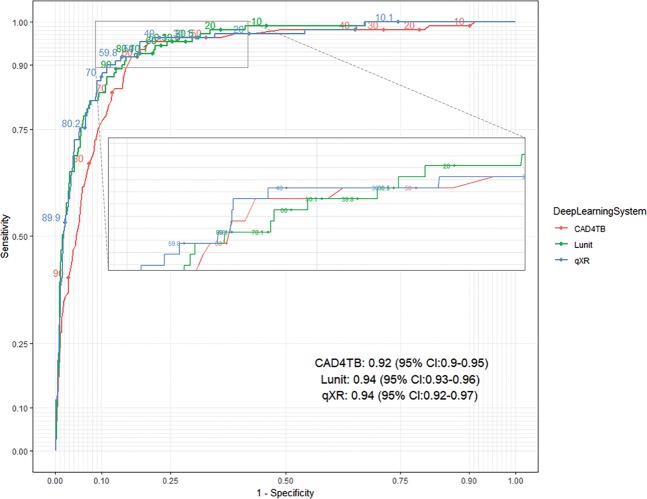
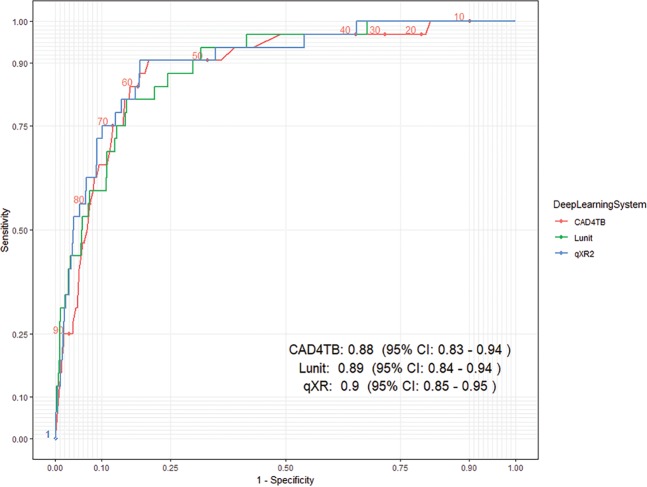
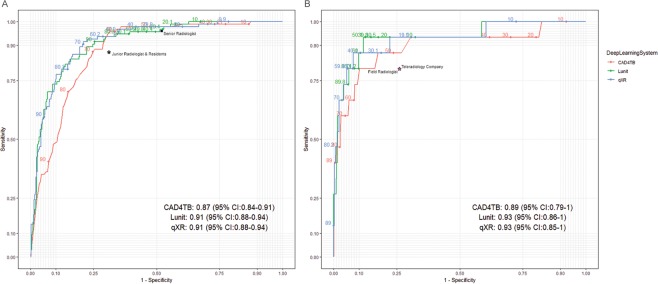
Deep learning (DL) neural networks have only recently been employed to interpret chest radiography (CXR) to screen and triage people for pulmonary tuberculosis (TB). No published studies have compared multiple DL systems and populations. We conducted a retrospective evaluation of three DL systems (CAD4TB, Lunit INSIGHT, and qXR) for detecting TB-associated abnormalities in chest radiographs from outpatients in Nepal and Cameroon. All 1196 individuals received a Xpert MTB/RIF assay and a CXR read by two groups of radiologists and the DL systems. Xpert was used as the reference standard. The area under the curve of the three systems was similar: Lunit (0.94, 95% CI: 0.93–0.96), qXR (0.94, 95% CI: 0.92–0.97) and CAD4TB (0.92, 95% CI: 0.90–0.95). When matching the sensitivity of the radiologists, the specificities of the DL systems were significantly higher except for one. Using DL systems to read CXRs could reduce the number of Xpert MTB/RIF tests needed by 66% while maintaining sensitivity at 95% or better. Using a universal cutoff score resulted different performance in each site, highlighting the need to select scores based on the population screened. These DL systems should be considered by TB programs where human resources are constrained, and automated technology is available.
Overview
The claims and statistics of this paper haven’t been checked yet.
Free: it reads the open-access text and checks the first 5 claims that cite a source we can check. Create a free account to check every claim.
Integrity signals
Registry
Cites
Statistics
Figures
Verification
Claims the paper makes
The claims and statistics of this paper haven’t been checked yet.
Free: it reads the open-access text and checks the first 5 claims that cite a source we can check. Create a free account to check every claim.
Claims other papers make about this one
Each is checked against this paper’s own text: does it say what the citing paper says it does?
The source backs part of the claim, not all of it — or backs it for a different population, condition or comparison.
In the citing paper
“Some developers recommend a threshold score for universal use, above which an individual would be classified as having abnormalities suggestive of tuberculosis [6, 7]. Other developers, such as CAD4TB (Delft Imaging Systems, Netherlands), recommend scores tailored to each setting due to variation in CAD abnormality scores between different software and populations [5, 6, 8–13]”
From Computer-aided detection thresholds for digital chest radiography interpretation in tuberculosis diagnostic algorithms. (2024) · cites this paper as [10]
Experimental — accuracy not yet measuredThe cited source says what the claim attributes to it.
In the citing paper
“Twenty-one54,63–67,70,72,76–88 studies compared algorithm performance against healthcare professionals.”
From Diagnostic accuracy of deep learning in medical imaging: a systematic review and meta-analysis (2021) · cites this paper as [70]
The cited source says what the claim attributes to it.
In the citing paper
“13 (refs. 63–75) studies validated algorithms on external data”
From Diagnostic accuracy of deep learning in medical imaging: a systematic review and meta-analysis (2021) · cites this paper as [70]
In the citing paper
“Only eight studies in ophthalmology imaging14,21,32,33,43,55,108,109, ten studies in respiratory imaging64,66,70,72,75,79,82,87,89,110 and six studies in breast imaging62,91,97,104,106,111 mentioned adherence to the STARD-2015 guidelines or had a STARD flow diagram in the manuscript.”
From Diagnostic accuracy of deep learning in medical imaging: a systematic review and meta-analysis (2021) · cites this paper as [70]
Self-check
Percentages, sums and reported differences re-computed from the paper’s own numbers.
The self-check needs the paper’s full text.
Citations
Cites
Deep learning in neural networks: an overview
Schmidhuber, J. (2015) · Neural Networks · doi:10.1016/j.neunet.2014.09.003 · Cited by 18,570
(2016) · Cited by 11,679
Towards complete and accurate reporting of studies of diagnostic accuracy: The STARD Initiative.
Bossuyt, P. M., Reitsma, J. B., Bruns, D. E., Gatsonis, C. A., Glasziou, P. P., Irwig, L. M., Lijmer, J. G., Moher, D., Rennie, D., de Vet, H. C. W., et al. (2003) · Annals of Internal Medicine · doi:10.7326/0003-4819-138-1-200301070-00010 · Cited by 3,219
Towards complete and accurate reporting of studies of diagnostic accuracy: the STARD initiative
Bossuyt, P. M., Reitsma, J. B., Bruns, D. E., Gatsonis, C. A., Glasziou, P. P., Irwig, L. M., Lijmer, J. G., Moher, D., Rennie, D., & de Vet, H. C. W. (2003) · BMJ · doi:10.1136/bmj.326.7379.41 · Cited by 3,215
Towards Complete and Accurate Reporting of Studies of Diagnostic Accuracy: The STARD Initiative
Bossuyt, P. M., Reitsma, J. B., Bruns, D. E., Gatsonis, C. A., Glasziou, P. P., Irwig, L. M., Lijmer, J. G., Moher, D., Rennie, D., & de Vet, H. C. W. (2003) · Radiology · doi:10.1148/radiol.2261021292 · Cited by 3,215
The International Journal of Tuberculosis and Lung Disease
Brown III, J. W. (1998) · JAMA: The Journal of the American Medical Association · doi:10.1001/jama.280.13.1200-a · Cited by 1,414
Sample size estimation in diagnostic test studies of biomedical informatics
Hajian-Tilaki, K. (2014) · Journal of Biomedical Informatics · doi:10.1016/j.jbi.2014.02.013 · Cited by 995 · cited 1×
“The areas under the curve (AUCs) were calculated as the primary index of accuracy of DL systems 22 .”
MethodMarušić, M., & Marušić, A. (2014) · Palgrave Macmillan UK eBooks · doi:10.1057/9781137351197_12 · Cited by 507
MaruÅ¡iÄ, M., & MaruÅ¡iÄ, A. (2014) · The Semiperiphery of Academic Writing · doi:10.1057/9781137351197.0020 · Cited by 498
Albert, H., Nathavitharana, R. R., Isaacs, C., Pai, M., Denkinger, C. M., & Boehme, C. C. (2016) · European Respiratory Journal · doi:10.1183/13993003.00543-2016 · Cited by 300 · cited 1×
“Implementers considering using DL systems for CXR reading should take into account other factors including service, ease of use, maintenance and price - all important considerations in any new technology implementation 26 .”
Method
Research works printed but not linked: 1
- 2. Krizhevsky, A., Sutskever, I. & Hinton, G. E. In Advances in neural information processing systems. 1097-1105.
Cited by
Items 201–300 of 346
Codlin, A. J., Vo, L. N. Q., Dao, T. P., Forse, R., Dang, H. T. M., Nguyen, L. H., Nguyen, H. B., Dinh, L. V., Annerstedt, K. S., Lundin, J. E., et al. (2025) · PLOS Digital Health · doi:10.1371/journal.pdig.0000813 · Cited by 4
Self-citationSim, J. Z. T., Lin, J. L. L., Fong, Q. W., Soon, A. Y. Q., Khin, L. W., Balakrishnan, S., Lin, T., Wong, S., & Tan, C. H. (2026) · BMJ Open · doi:10.1136/bmjopen-2025-111127 · Cited by 4
“9 15–17 Vendor-recommended default operating thresholds for CXR AI models are typically optimised for general diagnostic performance and may not be suitable for use as a co-triage tool.”
No Need for Ad-hoc Substitutes: The Expected Cost is a Principled All-purpose Classification Metric
Ferrer, L. (2025) · JAIIO, Jornadas Argentinas de Informática · Cited by 4
Das, A., Arora, D., Deswal, G., Grewal, A. S., & Bansal, S. (2026) · Journal of the National Medical Association · doi:10.1016/j.jnma.2026.02.007 · Cited by 5
Sharmila, V. C., Remya, K. R., & Sam Praveen, P. (2025) · Procedia Computer Science · doi:10.1016/j.procs.2025.04.583 · Cited by 4
Defining Replicability of Prediction Rules
Parmigiani, G. (2023) · Statistical Science · doi:10.1214/23-sts891 · Cited by 4
Closing the gaps in childhood TB detection
Creswell, J., & Colvin, C. E. (2025) · IJTLD OPEN · doi:10.5588/ijtldopen.24.0494 · Cited by 5
Self-citationDatabase System for Storing Tuberculosis Sputum Sample Images as an AI Training Dataset
Muljo, H. H., Perbangsa, A. S., Cenggoro, T. W., Purwandari, K., Sudigyo, D., & Pardamean, B. (2022) · International Journal of Online and Biomedical Engineering (iJOE) · doi:10.3991/ijoe.v18i15.28245 · Cited by 4
Afriyie, Y., Weyori, B. A., & Opoku, A. A. (2023) · Journal of Experimental & Theoretical Artificial Intelligence · doi:10.1080/0952813x.2023.2165721 · Cited by 4
Rajpurkar, P., Joshi, A., Pareek, A., Irvin, J., Ng, A. Y., & Lungren, M. P. (2020) · arXiv (Cornell University) · doi:10.48550/arxiv.2011.06129 · Cited by 4
Kvak, D., Chromcová, A., Ovesná, P., Dandár, J., Biros, M., Hrubý, R., Dufek, D., & Pajdaković, M. (2023) · arXiv (Cornell University) · doi:10.48550/arxiv.2305.10116 · Cited by 4
“Qin et al. 2019 [19] evaluated tuberculosis detection in the context of identifying TB-related abnormalities and comparing the performance of three different deep learning-based CAD systems.”
BackgroundArtificial Intelligence in healthcare: Embracing the future
Dabhadkar, S. (2024) · Bharati Vidyapeeth Medical Journal · doi:10.56136/bvmj/2024_00288 · Cited by 3
Cao, X., Feng, B., Zhang, B., Wang, D., Du, J., He, Y., Guo, T., Pan, S., Liu, Z., Yan, J., et al. (2025) · Chronic Diseases and Translational Medicine · doi:10.1002/cdt3.70001 · Cited by 3
Codlin, A. J., Dao, T. P., Nguyen, B. H., Vo, L. N. Q., Forse, R., Dang, H. T. M., Nguyen, L. H., Nguyen, H. B., Dinh, L. V., Annerstedt, K. S., et al. (2026) · BMC Global and Public Health · doi:10.1186/s44263-025-00237-8 · Cited by 3
“Most published CAD software evaluations have used a bacteriological reference standard, meaning they only evaluate software performance among the subset of participants who were tested during initial TB screening [9, 11, 12, 37, 38].”
Self-citationWei, X. B., Norsuddin, N. M., Azmi, M., & Hamid, H. A. (2026) · Radiography · doi:10.1016/j.radi.2026.103348 · Cited by 3
Batani, J., Nkomo, W., & Mokhosi, R. (2026) · Informatics and Health · doi:10.1016/j.infoh.2026.02.001 · Cited by 3
Nguyen, H. T. T., Le, V. Q., Dinh‐Xuan, A. T., & Nguyen, L. N. (2026) · Diagnostics · doi:10.3390/diagnostics16081127 · Cited by 3
“Evidence synthesized for WHO policy development indicates that contemporary CAD-CXR products can be configured to achieve sensitivity levels comparable to those of human readers when used for adult TB screening [3,5].”
Orthonormal Bayesian Convolutional Neural Network for Detection of the Novel Coronavirus-19
Jariwala, R. C., & Nalluri, M. R. (2021) · Lecture notes in electrical engineering · doi:10.1007/978-981-16-0749-3_63 · Cited by 3
Utilization of artificial intelligence for tuberculosis screening in Nepal
Adhikari, D. R., Kang, Y. A., Gautam, S., & Dahal, P. K. (2022) · Indian Journal of Tuberculosis · doi:10.1016/j.ijtb.2022.08.002 · Cited by 3
AI-assisted Analysis to Facilitate Detection of Humeral Lesions on Chest Radiographs
Kim, H., Kim, K., Oh, S. J., Lee, S., Woo, J. H., Kim, J. H., Ki, Y., Kim, K., & Chung, M. J. (2024) · Radiology Artificial Intelligence · doi:10.1148/ryai.230094 · Cited by 3
Shrestha, R. M., Paudel, R. C., Adhikari, P., Ghimire, R. H., Gurung, K., & Shrestha, R. (2024) · Journal of Nepal Health Research Council · doi:10.33314/jnhrc.v22i03.4637 · Cited by 3
Hybrid Approach of Deep Convolution Neural Network and Transfer Learning for Tuberculosis Prediction
Singh, R., Malviya, J., Sabita, Singh, R. B., & Garg, D. (2025) · International Conference on Cognitive Computing in Engineering, Communications, Sciences and Biomedical Health Informatics (IC3ECSBHI) · doi:10.1109/ic3ecsbhi63591.2025.10990849 · Cited by 3
“A cross-facility study examining the diagnostic efficacy of a trio of machine learning models for TB identification using chest radiographs (CXRs) is provided in research study by van Hesteren et al. (2019) [13].”
Ramadevi, P., Das, R., Lakshmi, M., Manohar, B. M., & Sharma, S. (2025) · Elsevier eBooks · doi:10.1016/b978-0-443-26765-9.00006-8 · Cited by 3
Hazra, A. (2021) · International Journal of Multimedia Information Retrieval · doi:10.1007/s13735-021-00205-6 · Cited by 3
“There are various purposes one should take care of, but the relevant two are the volume of the new dataset and similarity between old and new datasets [116].”
BackgroundFlores, G. P., Tamayo, R. L. J., Leong, R. N. F., Biglaen, C. S. M., Uy, K. N., Maglente, R. R. O., Nuguid, M. J. M., & Alacapa, J. (2024) · Acta Medica Philippina · doi:10.47895/amp.vi0.8950 · Cited by 3
Fehr, J., & Wong, E. B. (2022) · medRxiv · doi:10.1101/2022.04.29.22274472 · Cited by 3
“Previous work 9,12 and the developer 17 suggest conducting a population-specific pilot study to finding triage thresholds that optimally serve the goals of each screening exercise.”
BackgroundTB or not TB: does AI have an answer for children?
Creswell, J., Byrne, R. L., & Garg, T. (2024) · European Respiratory Journal · doi:10.1183/13993003.01709-2024 · Cited by 3
“Since 2017, several studies have documented good performance of multiple AI solutions for the interpretation of CXRs in the screening or triage of TB [10 – 13], with newer versions continuing to improve [14, 15].”
Self-citationSelf-Aware AI-Enabled Medical System
Vadsaria, A. S., Raza, A., Hammad, M. Y., & Shahid, M. F. (2023) · International Bhurban Conference on Applied Sciences and Technology (IBCAST) · doi:10.1109/ibcast59916.2023.10712990 · Cited by 2
“Some examples of AI’s ability include diagnose of pneumonia and tuberculosis based on chest X-ray, diagnosis of malaria using retinal images, and identification of skin cancer using computer vision [24, 25].”
MethodHashmi, M. F., Patil, R. B., Kene, J. D., & Waje, M. G. (2024) · Traitement du signal · doi:10.18280/ts.410616 · Cited by 2
“Qin et al. [38] compared different deep learning based systems like CAD4TB [20], LunitINSIGHT [39], and qXR [40] for tuberculosis classification.”
A Hybrid Approach for Tuberculosis Detection using Convolutional Attention Networks and XGBoost
Abdulrafay, Kehkashan, T., Zaman, M., Akbar, F., Hussain, A., & Munir, K. (2024) · International Conference on Innovative Computing (ICIC) · doi:10.1109/icic63915.2024.11116387 · Cited by 2
“Studies have demonstrated the potential of deep learning models, such as CNNs, in achieving high accuracy for TB classification [2, 3].”
Zhong, M., Li, S., Wang, Y., Ma, Y., Mao, S., Huang, Z., Xiao, H., Wang, Y., & Zhang, T. (2025) · Journal of Thoracic Disease · doi:10.21037/jtd-2025-1246 · Cited by 2
Artificial intelligence driven innovation in tuberculosis drug discovery
Rath, N., & Arora, V. K. (2026) · Indian Journal of Tuberculosis · doi:10.1016/j.ijtb.2026.04.004 · Cited by 2
Farquhar, H. (2026) · Tropical Medicine & International Health · doi:10.1111/tmi.70170 · Cited by 2
An Emerging Artificial Intelligence Tool for the Advancement of Modern Health Care in Tuberculosis
Palanivel, J., Manikkam, R., Sounderrajan, V., Jayaraj, S., Rao, S. S., Thangam, T., & Parthasarathy, K. (2024) · Springer eBooks · doi:10.1007/978-981-97-1777-4_8 · Cited by 2
A new pulmonary disease diagnosis system based on EfficientNet and transfer learning
Lu, S., Zhang, X., & Zhang, Y. (2021) · IEEE/ACM International Conference on Utility and Cloud Computing Companion (UCC Companion) · doi:10.1145/3492323.3495568 · Cited by 2
“Qin, Sander [11] compared the performance of three different TB detection methods based on deep learning models.”
BackgroundSemantic segmentation of TB in chest x-rays: a new dataset and generalization evaluation
Kantipudi, K., Bui, V., Yu, H., Lure, Y. M. F., Jaeger, S., & Yaniv, Z. (2025) · SPIE Medical Imaging: Computer-Aided Diagnosis · doi:10.1117/12.3047222 · Cited by 2
Wei, X., Liang, D., Zhang, Z., Thorpe, K. E., Zhou, L., Zhao, J., Qin, H., Liang, X., Cui, Z., Huang, Y. Q., et al. (2025) · PLoS ONE · doi:10.1371/journal.pone.0316073 · Cited by 2
“%) as a screening tool to reduce 66% of cases needed for laboratory tests [8].”
มหัสฉริยพงษ์, พ. (2021) · Journal of Primary Care and Family Medicine (PCFM) · Cited by 2
Ullah, A. N. Z., Rahman, H., Allayear, S. M., Khan, M. L. A., Faysal, S. M., Chowdhury, A. A., Uddin, M. N., & Khan, H. T. A. (2022) · International Journal of Biomedicine · doi:10.21103/article12(3)_oa21 · Cited by 2
Burke, R. M., Nyirenda, S., Twabi, H. H., Nliwasa, M., Joekes, E. C., Walker, N. F., Nyirenda, R. K., Gupta‐Wright, A., Fielding, K., MacPherson, P., et al. (2022) · PLoS ONE · doi:10.1371/journal.pone.0261877 · Cited by 2
“Sensitivity and specificity compared to sputum Xpert or culture reference standard are similar that that of expert radiologists [8].”
MethodResultInfluentialDesign of Computer-Aided-Diagnosis (CAD) for Self- Assessment Tuberculosis in Indonesia
Asadi, F., Trinugroho, J. P., & Pardamean, B. (2023) · E3S Web of Conferences · doi:10.1051/e3sconf/202338802004 · Cited by 2
“Previous research shows that most methods are used for the CXR images extraction and the result classification [40, 50].”
BackgroundMethodIdentification of Tuberculosis and Coronavirus Patients Using Hybrid Deep Learning Models
Ghamdi, M. A. A. (2023) · Computers, materials & continua/Computers, materials & continua (Print) · doi:10.32604/cmc.2023.037826 · Cited by 2
Interpreting Chest X-rays Like a Radiologist: A Benchmark with Clinical ReasoningPreprint
Guan, J., Chen, Q., Liang, L., Liu, Y., Phan, V. M. H., To, M., Chen, J., & Xie, Y. (2025) · arXiv (Cornell University) · doi:10.48550/arxiv.2505.23143 · Cited by 2
“With the rapid advancement of deep learning techniques, numerous CXR-based interpretation methods have emerged, significantly furthering research in tasks such as abnormality detection, disease identification, and report generation [3–5].”
Mungai, B., Ong‘angò, J., Ku, C.-C., Henrion, M., Morton, B., Joekes, E., Onyango, E., Kiplimo, R., Kirathe, D., Masini, E., et al. (2021) · medRxiv · doi:10.1101/2021.10.21.21265321 · Cited by 2
“(11, 12, 14) CAD software that provides a probabilistic score for TB offers a potential solution to these limitations.(6, 7, 15, 16) Previous evaluations of CAD software have been mostly conducted in triage testing use situations, with very little data available to evaluate accuracy in community-based TB screening int…”
Jiang, F., Wang, Y., Xu, C., & Xu, Q. (2022) · Radiology of Infectious Diseases · doi:10.4103/rid.rid_39_22 · Cited by 1
Ứng dụng bước đầu trí tuệ nhân tạo Qure.AI X-quang lồng ngực trong chẩn đoán lao phổi
Hoàn, L., Thủy, N. T. T., & Hằng, L. M. (2023) · Tạp chí Nghiên cứu Y học · doi:10.52852/tcncyh.v171i10.2066 · Cited by 1
Adhikari, L. M. (2025) · NPRC Journal of Multidisciplinary Research. · doi:10.3126/nprcjmr.v2i1.74654 · Cited by 1
Self-citationA Novel Deep Learning Framework for the Detection of Tuberculosis using Chest X-ray Images
Shastri, S., Sambyal, S., Kumar, S., & Mansotra, V. (2024) · International Journal of Computer Sciences and Engineering · doi:10.26438/ijcse/v12i6.1320 · Cited by 1
Desita, Z. T., Tadesse, T., Bohlbro, A. S., Sifna, A., Fekadu, H., Bizuneh, S., Sridhar, S., Robert, D., Tadepalli, M., Wejse, C. M., et al. (2026) · Mayo Clinic Proceedings Digital Health · doi:10.1016/j.mcpdig.2026.100338 · Cited by 1
“This finding has been shown in previous studies assessing the qXR. 12,14,33 The present study included 498 individual CXRs from patients seeking help for TB indicative symptoms, 58 (12”
InfluentialUpdates on tuberculosis imaging
Lawal, I. O., Ankrah, A. O., Abubakar, S., Ndlovu, H., Ismaila, A., & Sathekge, M. M. (2026) · Seminars in Nuclear Medicine · doi:10.1053/j.semnuclmed.2026.04.005 · Cited by 1
Imaging and AI Techniques in Intrapulmonary Tuberculosis Diagnosis and Management
Nwaiwu, V. C. (2026) · Infectious diseases · doi:10.5772/intechopen.1014716 · Cited by 1
Chaoui, I., Koulali, M. A., mbulayi, O., Djungu, S.-J., Aketi, L. P., Zouré, A. A., Bourkadi, J. E., Tayalati, Y., & Mzibri, M. E. (2026) · Frontiers in Public Health · doi:10.3389/fpubh.2026.1816634 · Cited by 1
“These are examples of AI and machine learning initiatives in TB management across different regions: 1 Deep learning for chest radiography in Cameroon, which offers a scalable adjunct to conventional TB screening, especially in low-resource, high-burden settings (19).”
Cayabyab, M. A. S., Rejollo, M. R. A., Rayco, R. C. M., Laping, I. P., Tan, J. A., Castañares, L. D. W., Castro, A. M. L., & Melford, C. M. (2026) · International Journal of Research and Innovation in Social Science · doi:10.47772/ijriss.2026.100600430 · Cited by 1
Tanomkiat, W., Timsina, S. R., Ingviya, T., Chaichulee, S., Yutchawit, P., Thuncharoenkanka, C., Pannuan, W., Chantharat, C., Kerdmeesup, U., Kiranantawat, N., et al. (2026) · Insights into Imaging · doi:10.1186/s13244-026-02334-0 · Cited by 1
Carnimeo, V., Phillips, E. L. Y., Galvan, D. K., Camélique, O., Roxas, M. R., Duka, M., Pardilla, G. F., Recidoro, M. J. C., Castro, R. H., Hossain, F., et al. (2026) · PLOS Global Public Health · doi:10.1371/journal.pgph.0006908 · Cited by 1
“Other studies of CAD systems have also highlighted that the sensitivity and specificity at a set threshold may differ according to factors such as age, gender, and history of previous TB [5,9,15–17].”
Bhagawati, H., Devanath, B., Shakya, A., Ghosh, S. K., Singh, U. P., & Bhat, H. R. (2026) · Letters in Drug Design & Discovery · doi:10.1016/j.lddd.2026.100572 · Cited by 1
Dzokoto, S. K., Marrah, S. A., Computer, S. T. R., Arhin, K. M., Dzokoto, F. K., Nawaz, S., & Arisiya, E. (2026) · Journal of Scientific Reports · doi:10.58970/jsr.1238 · Cited by 1
Neoteric advancements in TB diagnostics and its future frame
Kajal, Sharma, D., & Rai, R. (2020) · Indian Journal of Tuberculosis · doi:10.1016/j.ijtb.2020.10.004 · Cited by 1
Deep Learning-Based Software Tools for Tuberculosis Detection in Chest X-Ray Images
Puttagunta, M. K., & Ravi, S. (2021) · Advances in intelligent systems and computing · doi:10.1007/978-981-16-0171-2_21 · Cited by 1
Das, N., Topalovic, M., & Janssens, W. (2022) · Springer eBooks · doi:10.1007/978-3-030-64573-1_178 · Cited by 1
Multi-Label Classification for Diagnosis of Tuberculosis from Chest X-Ray Images
Navish Vardanaa, S., Devi, N. B., Murale, M., Prasanth, R. K., & Nilesh, D. (2022) · International Conference on Advances in Computing, Communication and Applied Informatics (ACCAI) · doi:10.1109/accai53970.2022.9752472 · Cited by 1
European Respiratory Society International Congress 2021: highlights from best-abstract awardees
Ramakrishnan, S., Beaufils, F., Brandt, J. D., Viney, K. A., Bradley, C., Cottin, V., Hassan, M., & Cruz, J. (2022) · Breathe · doi:10.1183/20734735.0176-2021 · Cited by 1
Innovation and Evidence for Achieving TB Elimination in the Asia–Pacific Region
du Cros, P., Hussain, H., & Viney, K. A. (2022) · MDPI eBooks · doi:10.3390/books978-3-0365-2550-1 · Cited by 1
TB Diagnostics: Existing Platform and Future Dir
Twabi, H. H. (2022) · American Journal of Biomedical Science & Research · doi:10.34297/ajbsr.2022.15.002169 · Cited by 1
Training AI to detect Tuberculosis in chest X-rays
Agarwal, K. (2024) · American journal of student research. · doi:10.70251/hyjr2348.24175182 · Cited by 1
Artificial Intelligence for Public Health
Adirim, T. A. (2025) · Springer eBooks · doi:10.1007/978-3-031-83526-1_9 · Cited by 1
Tanomkiat, W., Chaichulee, S., Ingviya, T., & Thawillarp, S. (2025) · The ASEAN Journal of Radiology · doi:10.46475/asean-jr.v26i3.988 · Cited by 1
Mapping respiratory health digital interventions in South and Southeast Asia: a scoping review
Evans, L., Evans, J., Abdullah, A. B., Ahmed, Z., & The RESPIRE Group (2025) · Journal of Global Health · doi:10.7189/jogh.15.04310 · Cited by 1
Advances in medical imaging and implementation challenges in Africa
Musisi, A., Kisembo, H. N., Mohammed, A. A., CHAPHUKA, C. D., Tuturu, A., Okoko, E. O., Kebede, E., Nkonde, K. A., Malumba, R., Pokoo‐Aikins, M., et al. (2025) · doi:10.51168/xe8zj007 · Cited by 1
Endoscopic ultrasound-guided biopsy for TB lymphadenopathy: role of PCR and Gene X-pert
Okasha, H., Ahmed, R. M., Abdellatef, A. A., Wassef, M., Shaaban, H. E., & Matar, R. A. (2025) · The Egyptian Journal of Internal Medicine · doi:10.1186/s43162-025-00514-w · Cited by 1
“AI-based tools can assist in image interpretation, pattern recognition, and clinical decision support, particularly in radiology and digital pathology, thereby improving early detection and reducing diagnostic delays [40].”
Manguerra, M. V., Cabatuan, M. K., & Culaba, A. B. (2020) · Innovative Technology and Management Journal · doi:10.70954/artad978
Das, N., Topalovic, M., & Janssens, W. (2021) · Springer eBooks · doi:10.1007/978-3-030-58080-3_178-1
Priority Areas for Research on Tuberculosis Diagnosis
Rühwald, M. (2021) · Springer eBooks · doi:10.1007/978-3-030-66703-0_44
Artificial Intelligence to Read Chest X-rays for Deduction of TB
Abdul Hasif., H., Vijaya Ganapathi., B., Suriya, B., & Ganesan, M. (2020) · International Journal of Engineering and Advanced Technology · doi:10.35940/ijeat.d7783.069520
Yadav, S. L., Dhaiya, R., & Bhatia, S. (2021) · Elsevier eBooks · doi:10.1016/b978-0-323-90959-4.00006-7
Emergent Advancements in M.tb Detection: An Artificial Intelligence Approach (Preprint)Preprint
Kaur, J., Kapoor, S., Singh, M., Kohli, P. S., Singh, U., Chana, I., & Singh, H. (2021) · doi:10.2196/preprints.29050
Tuberculosis Diagnostics, a journey from the past Experiences to the Future Directions, Review
Moorthy, S., Bhaskar, E. M., Shivakumar, S., & Silambanan, S. (2022) · Arab Gulf Journal of Scientific Research · doi:10.51758/agjsr-02-2021-0012
AI and TB: A New Insight in Digital Chest Radiography
Dolma, K. G., Paul, A. K., Rahmatullah, M., Pereira, M. D. L., Wiart, C., Shankarishan, P., Nissapatorn, V., & Khandelwal, B. (2022) · Lecture notes in computational vision and biomechanics · doi:10.1007/978-981-19-0151-5_37
DETECTION OF COVID-19 WITH CHEST X-RAY
Yadav, G., Jain, S., Singh, S., & Shanna, S. (2022) · IJRDO -Journal of Computer Science Engineering · doi:10.53555/cse.v8i11.5443
Role Data Scientist in Biopharmaceutical Industries
Kumar, A. (2022) · International Journal of convergence in healthcare · doi:10.55487/ijcih.v2i2.71
Detecting Pulmonary Lesions in Low-Prevalence Real-World Settings Using Deep Learning
Kvak, D., Chromcová, A., Ovesná, P., Dandár, J., Biros, M., Hrubý, R., Dufek, D., & Pajdaković, M. (2024) · Lecture notes in electrical engineering · doi:10.1007/978-981-97-1335-6_1
Role of Artificial Intelligence in Diagnosis of Tuberculosis: An Investigation
Ito-Fujita, A., & Katz, S. (2023) · International Journal of Advanced Nursing Education and Research · doi:10.21742/ijaner.2023.8.2.01
“Correspondingly, Rajpurkar attempted to improve precision by expanding the number of layers in their employment, which is not a foolproof method [15].”
BackgroundA Study on the Data Science in the Age of Covid
Deo, J. S., & Jaiswal, S. (2023) · International Journal of Advance Research and Innovation · doi:10.51976/ijari.1112308
Validation Protocol of Vaccine Vials for Quality Storage Temperature under Laboratory Conditions
Kumar, A. (2024) · International Journal of convergence in healthcare · doi:10.55487/nr3vh544
Yang, X., Man, D., Yun, K., Zhang, S., & Han, X. (2024) · doi:10.2196/preprints.63803
Estimation of Infected Area and its Severity in Chest X-ray Images of Tuberculosis Patients
Ng, W. (2024) · Annals of Advanced Biomedical Sciences · doi:10.23880/aabsc-16000228
Hằng, T. T. T., & Thủy, N. T. T. (2024) · Tạp chí Y Dược Thái Bình · doi:10.62685/tbjmp.2024.3.16
Koehlmoos, T. P., Korona-Bailey, J., Elzey, J., Marshall, B. H., & Shanley, L. (2024) · BMC Proceedings · doi:10.1186/s12919-024-00308-y
“For example, algorithms to test for tuberculosis in x-rays performed just as well as trained radiologists and could have potential use cases when resources are constrained [13, 14].”
MethodDeep Learning for Clinical Practice.
Sogancioglu, E. (2024) · Radboud University Press eBooks · doi:10.54195/9789493296770
Nadesh, R. K., Mohanraj, G., & Arivuselvan, K. (2024) · Studies in computational intelligence · doi:10.1007/978-981-97-7494-4_10
Emilov, B., Sorokin, A. A., Zhakypov, M. A., Keresbekova, A. B., Салибаев, О. А., & Chubakov, T. C. (2024) · Ulyanovsk Medico-biological Journal · doi:10.34014/2227-1848-2024-4-82-98
Pardasani, S., & Gosar, P. (2025) · Preprints.org · doi:10.20944/preprints202503.0882.v1
Current trends in tuberculosis diagnosis: Advancements and challenges
Baqir, M., Singh, K., Singh, S., & Sharma, T. (2025) · International Journal of Allied Medical Sciences and Clinical Research · doi:10.61096/ijamscr.v13.iss2.2025.137-141
DIRBTINIO INTELEKTO TAIKYMAS RADIOLOGIJOJE
Chomičius, B., & Černel, V. (2025) · Health Sciences · doi:10.35988/sm-hs.2025.178
How AI can transform healthcare in emerging economies
Morris, R. J. T. (2025) · Elsevier eBooks · doi:10.1016/b978-0-443-28969-9.00003-0
Exploring Deep Learning Architectures in Clinical PracticePreprint
Kim, M., Park, J., Lee, S., Choi, H., Kang, S., Han, Y., Shin, D., & Jung, G. (2025) · doi:10.36227/techrxiv.175606171.14396791/v1
ARTIFICIAL INTELLIGENCE AND MACHINE LEARNING IN MICROBIAL DIAGNOSTICS
Umedum, C. U. (2025) · Iterative International Publishers eBooks · doi:10.58532/nbennurndmcsw9
Computer-aided detection to strengthen tuberculosis screening and diagnosis in Pakistan
Sajid, H., Aslam, H. G., Irshad, N., & Imran, S. B. (2025) · Annals of Medicine and Surgery · doi:10.1097/ms9.0000000000003922
Ahmad, C. W. I. C. W., Lukman, K. A., Jeffree, M. S., Omar, R. M. R., Avoi, R., Hijazi, M. H. A., Muien, M. Z. A., Kieu, S. T. H., & Ibrahim, M. Y. (2025) · IEEE International Conference on Artificial Intelligence in Engineering and Technology (IICAIET) · doi:10.1109/iicaiet67254.2025.11265054
“Several prospective studies conducted in sub-Saharan Africa, South Asia, and Eastern Europe demonstrated that these systems had comparable performance to trained radiologists in detecting bacteriologically confirmed TB cases [10], [11], [12].”
Metadata
- Authors
- Qin, Z. Z., Sander, M. S., Rai, B., Titahong, C. N., Sudrungrot, S., Laah, S. N., Adhikari, L. M., Carter, E. J., Puri, L., Codlin, A. J., & Creswell, J.
- Affiliations
- University of Bamenda (CM)
- International Organization for Migration (CH)
- Brown University (US)
- Corresponding author
- Creswell, Jacob
- Venue
- Scientific Reports
- Published
- 2019-10-18
- Volume
- 9
- Issue
- 1
- Pages
- 15000-15000
- ISSN
- 2045-2322 (ISSN-L)
- PMC
- PMC6802077
- OpenAlex
- W2980965120
- Semantic Scholar
- 0cee6d78628c0824b6d6646ae80051fcab36379c
- Cited by
- 289
- References
- 31
- Citations by year
- 2026: 31 · 2025: 35 · 2024: 42 · 2023: 47 · 2022: 41 · 2021: 60 · 2020: 33
- FWCI
- 22.12
- Type
- journal article
- Language
- en
- Open access
- gold
- doi.org
- Licence
- cc-by
- creativecommons.org/licenses/by/4.0 (tdm)
- creativecommons.org/licenses/by/4.0 (vor)
- Locations
- Scientific Reports (publishedVersion, cc-by)
- Europe PMC (PubMed Central) (publishedVersion, cc-by)
- PubMed Central (publishedVersion, cc-by)
- PubMed (publishedVersion)
- DOAJ (DOAJ: Directory of Open Access Journals) (submittedVersion)
- Funders
- United States Agency for International Development
- Bill and Melinda Gates Foundation
- National Philanthropic Trust
- Government of Canada
- Topics
- Health Sciences › Medicine › Radiology, Nuclear Medicine and Imaging › COVID-19 diagnosis using AI
- Health Sciences › Medicine › Infectious Diseases › Tuberculosis Research and Epidemiology
- Health Sciences › Medicine › Health Informatics › Artificial Intelligence in Healthcare and Education
- Keywords
- pulmonary tuberculosis, chest X-ray interpretation, deep learning, computer-aided diagnosis, tuberculosis screening, diagnostic accuracy, CAD4TB, Xpert MTB/RIF, radiologist comparison, automated radiology, resource-limited settings, Nepal, Cameroon
- MeSH terms
- Data Accuracy, Deep Learning, Adult, Cameroon, DNA, Bacterial, Female, Humans, Male, Mass Screening, Middle Aged, Mycobacterium tuberculosis, Nepal, Retrospective Studies, Sensitivity and Specificity, Radiography, Thoracic, Triage, Tuberculosis, Pulmonary, Area Under Curve, Nucleic Acid Amplification Techniques
About these checks
Registry, retraction, Cites and statistics results are computed, not judged, with one exception: a printed reference that no index lists is read once by a model before it counts as a citation error. Claims are extracted by a model and kept only when their quote appears verbatim in the text; each cited source is then checked, with a model’s help, for whether it says what the claim relies on. Those verdicts can be wrong — read the claim’s quote and the cited source before relying on one.
Statistics and arithmetic are recomputed, not judged.
Confidence bands are shown only for fields calibrated on our annotated test set. None is calibrated yet, so no band is shown.
What counts as a claim ›How we measure confidence ›How we check this ›
Are you an author, or do you see a problem with this page? Request a review
Data sources
Bibliographic data: Semantic Scholar, OpenAlex, Crossref.
Contains information from the Semantic Scholar Academic Graph Datasets, made available under the ODC Attribution License (ODC-BY 1.0).
Semantic Scholar’s data is described in: Kinney, R., et al. (2023). The Semantic Scholar Open Data Platform. arXiv:2301.10140.
