

The relationship between mindfulness and objective measures of body awareness: A meta-analysis
Open accessThe DOI matches its Crossref record; 93 of the 93 references it cites were found in a registry or an index.
Abstract
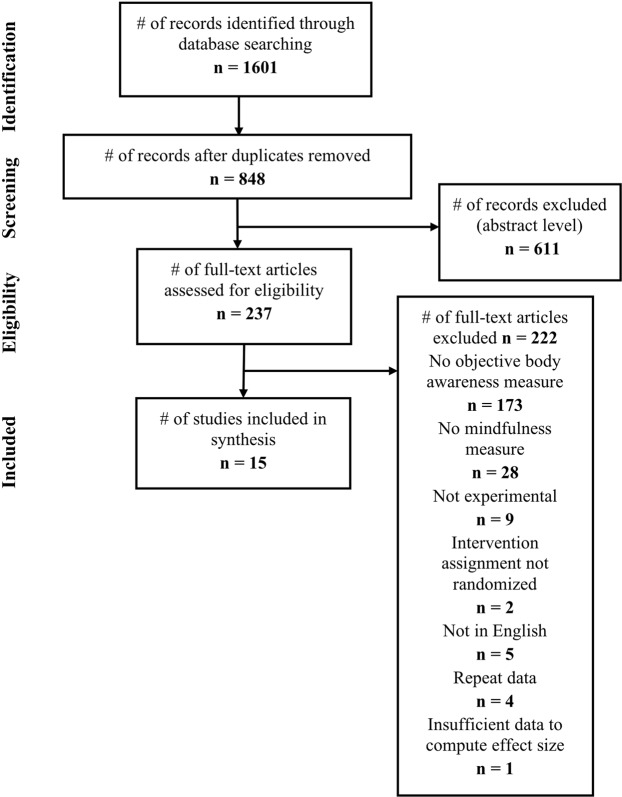
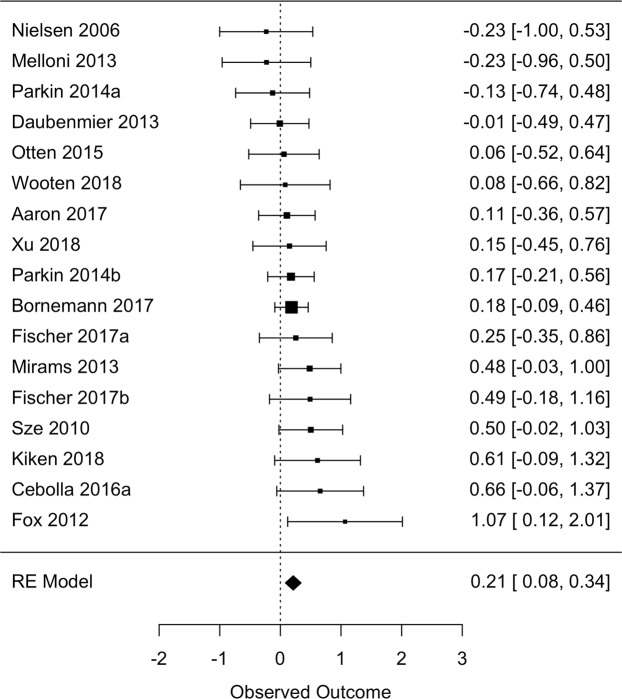
Although awareness of bodily sensations is a common mindfulness meditation technique, studies assessing the relationship between mindfulness and body awareness have provided mixed results. The current study sought to meta-analytically examine the relationship between mindfulness operationalized as a dispositional trait or a construct trained through short- (i.e., randomized controlled trials [RCTs]) or long-term mindfulness meditation practice with objective measures of body awareness accuracy. PubMed, Web of Science, PsycINFO, and Scopus were searched. Studies were eligible if they reported the association between mindfulness and body awareness, were published in English, and included adults. Across 15 studies (17 independent samples), a small effect was found linking mindfulness with greater body awareness accuracy ( g = 0.21 [0.08, 0.34], N = 879). When separated by study design, only RCTs continued to show a significant relationship ( g = 0.20, [0.02, 0.38], k = 7, n = 505). Heterogeneity of effects was low ( I 2 < 25%), although with wide confidence intervals. Effects were not moderated by study quality. Low fail-safe N estimates reduce confidence in the observed effects. Results suggest a small but potentially detectable relationship between mindfulness and body awareness accuracy. Future investigations could examine individual differences in body awareness as a mechanism within mindfulness interventions.
Overview
The claims and statistics of this paper haven’t been checked yet.
Free: it reads the open-access text and checks the first 5 claims that cite a source we can check. Create a free account to check every claim.
Integrity signals
Registry
Cites
Statistics
Figures
Verification
Claims the paper makes
The claims and statistics of this paper haven’t been checked yet.
Free: it reads the open-access text and checks the first 5 claims that cite a source we can check. Create a free account to check every claim.
Claims other papers make about this one
Each is checked against this paper’s own text: does it say what the citing paper says it does?
The cited source says what the claim attributes to it.
In the citing paper
“A meta-analysis of the effects of mindfulness training on body awareness has found a small, but significant, positive relationship between mindfulness and body awareness.”
From Brief structured respiration practices enhance mood and reduce physiological arousal (2023) · cites this paper as [48]
The cited source says what the claim attributes to it.
In the citing paper
“Numerous biological and behavioral mechanisms have been assessed for in-person MBIs (eg, changes in attention, body awareness, stress physiology) [126-128] and may be operant within mHealth MBIs.”
From Testing the efficacy of a multicomponent, self-guided, smartphone-based meditation app: Three-armed randomized controlled trial (2020) · cites this paper as [128]
In the citing paper
“Evidence for behavioral effects (for example, effects of MBIs on measures of attention91,92 and interoception93) is less robust (that is, the effects are smaller and less consistently statistically significant).”
From A common factors perspective on mindfulness-based interventions (2022) · cites this paper as [92]
Self-check
Percentages, sums and reported differences re-computed from the paper’s own numbers.
The self-check needs the paper’s full text.
Citations
Cites
Preferred Reporting Items for Systematic Reviews and Meta-Analyses: the PRISMA statement
Moher, D., Liberati, A., Tetzlaff, J., Altman, D. G., & for the PRISMA Group (2009) · BMJ · doi:10.1136/bmj.b2535 · Cited by 83,823
Measuring inconsistency in meta-analyses
Higgins, J. P. T., Thompson, S. G., Deeks, J. J., & Altman, D. G. (2003) · BMJ · doi:10.1136/bmj.327.7414.557 · Cited by 63,139
Preferred reporting items for systematic reviews and meta-analyses: the PRISMA Statement.
(2009) · PubMed Central · Cited by 44,859
Preferred reporting items for systematic reviews and meta-analyses: The PRISMA statement
Moher, D., Liberati, A., Tetzlaff, J., Altman, D. G., & the PRISMA Group* (2009) · Annals of Internal Medicine · doi:10.7326/0003-4819-151-4-200908180-00135 · Cited by 37,554
Assessing the quality of reports of randomized clinical trials: Is blinding necessary?
Jadad, A. R., Moore, R. A., Carroll, D., Jenkinson, C., Reynolds, D. J. M., Gavaghan, D. J., & McQuay, H. J. (1996) · Controlled Clinical Trials · doi:10.1016/0197-2456(95)00134-4 · Cited by 17,582
Borenstein, M., Hedges, L. V., Higgins, J. P. T., & Rothstein, H. R. (2009) · doi:10.1002/9780470743386 · Cited by 14,225
The benefits of being present: Mindfulness and its role in psychological well-being
Brown, K. W., & Ryan, R. M. (2003) · Journal of Personality and Social Psychology · doi:10.1037/0022-3514.84.4.822 · Cited by 13,448
The file drawer problem and tolerance for null results.
Rosenthal, R. (1979) · Psychological Bulletin · doi:10.1037/0033-2909.86.3.638 · Cited by 9,068
A new scale of social desirability independent of psychopathology.
Crowne, D. P., & Marlowe, D. (1960) · Journal of Consulting Psychology · doi:10.1037/h0047358 · Cited by 8,686
(2008) · Medical Entomology and Zoology · Cited by 7,477
Cited by
Items 101–116 of 116
Lyon, A. (2023) · Oxford University Press eBooks · doi:10.1093/oso/9780198843757.003.0003
Effects of mind-body exercises in a patient with mood disorders: a case report
Moraes, E., Pereira, K., & Moraes, H. (2024) · Jornal Brasileiro de Psiquiatria · doi:10.1590/0047-2085-2023-0041
Kayatekin, A. Z. Y., Bodur, F., Babaoğlu, E., & Özer, C. M. (2024) · Turkish Journal of Diabetes and Obesity · doi:10.25048/tudod.1473938
Defining and Measuring Crewmember Operational State for Spaceflight Operations
Zero, M., Klaus, D. M., Arquilla, K. S., & Fanchiang, C. (2024) · Aerospace Medicine and Human Performance · doi:10.3357/amhp.6405.2024
Lifestyle interventions for treatment-resistant depression
Toups, M. S. P. (2022) · Elsevier eBooks · doi:10.1016/b978-0-12-824067-0.00038-4
Douaihy, A. B., Boness, C. L., Gold, M. A., Brandon, F., & Myklebust, L. K. (2025) · Oxford University Press eBooks · doi:10.1093/med/9780197631010.003.0003
Handbook of Mindfulness and Self-Regulation: Introduction to the Volume
Robinson, M. D., Ostafin, B. D., & Meier, B. P. (2025) · Springer eBooks · doi:10.1007/978-3-031-91451-5_1
Chen, L., Berner, N., Hagel, L., Heukamp, N. J., Moliadze, V., & Nees, F. (2025) · PAIN Reports · doi:10.1097/pr9.0000000000001333 · Cited by 1
Longaretti, Y., Cheron, G. A., & Zarka, D. (2025) · The Journal of Psychology · doi:10.1080/00223980.2025.2575309
Mindfulness and the Addictive Process: Psychological Models and Neurobiological Mechanisms
Brewer, J. A., Houlihan, S. D., Yetter, K. M., & Davis, J. H. (2025) · Springer eBooks · doi:10.1007/978-3-031-91451-5_17 · Cited by 1
Hugh, J., & Nacif, A. P. (2025) · International Coaching Psychology Review · doi:10.53841/bpsicpr.2025.20.2.26
Mesure de la conscience du corps et de l'impact sur la cognition de l'information corporelle
Verdonk, C. (2021) · theses.fr (ABES) · doi:10.70675/abc55e86zddc9z4a4ezaba1z2cc93cac3fb9 · Cited by 1
The imaginary intervention: a conceptual framework for applied imagination in public health
Pressman, C. S., Fischer, A., Wylie, R., & Finn, E. (2026) · Critical Public Health · doi:10.1080/09581596.2026.2674214
From Stability to Flexibility: Neural Network Dynamics Associated with Trait Mindfulness
Liu, X., Zheng, Y., Cai, B., Huang, H., Li, J., Guo, Q., Wang, K., Luo, J., & Qing, F. A. N. (2026) · Mindfulness · doi:10.1007/s12671-026-02960-1
Foley, J. D., Hart, K., Yeh, G. Y., Batchelder, A., & O’Cleirigh, C. M. (2026) · Global Advances in Integrative Medicine and Health · doi:10.1177/27536130261500467
Metadata
- Authors
- Treves, I. N., Tello, L. Y., Davidson, R. J., & Goldberg, S. B.
- Affiliations
- Massachusetts Institute of Technology (US)
- University of California, Berkeley (US)
- University of Wisconsin–Madison (US)
- Corresponding author
- Goldberg, Simon B.
- Venue
- Scientific Reports
- Published
- 2019-11-22
- Volume
- 9
- Issue
- 1
- Pages
- 17386-17386
- ISSN
- 2045-2322 (ISSN-L)
- PMC
- PMC6874545
- OpenAlex
- W2990338100
- Semantic Scholar
- 0d24cb1060d8be90f0c0c308120596c3d78b7431
- Cited by
- 114
- References
- 93
- Citations by year
- 2026: 6 · 2025: 22 · 2024: 21 · 2023: 28 · 2022: 19 · 2021: 11 · 2020: 7
- FWCI
- 1.46
- Type
- journal article
- Language
- en
- Open access
- gold
- doi.org
- Licence
- cc-by
- creativecommons.org/licenses/by/4.0 (tdm)
- creativecommons.org/licenses/by/4.0 (vor)
- Locations
- Scientific Reports (publishedVersion, cc-by)
- PubMed Central (publishedVersion, cc-by)
- PubMed (publishedVersion)
- DOAJ (DOAJ: Directory of Open Access Journals) (submittedVersion)
- Funders
- U.S. Department of Health & Human Services | NIH | National Center for Complementary and Integrative Health (P01AT004952)
- Topics
- Social Sciences › Psychology › Clinical Psychology › Mindfulness and Compassion Interventions
- Health Sciences › Medicine › Psychiatry and Mental health › Psychosomatic Disorders and Their Treatments
- Life Sciences › Neuroscience › Cognitive Neuroscience › Embodied and Extended Cognition
- Keywords
- mindfulness, body awareness, mindfulness meditation, trait mindfulness, mindfulness-based interventions, individual differences
- MeSH terms
- Adult, Awareness, Body Image, Humans, Middle Aged, Self Concept, Meditation, Young Adult, Mindfulness
About these checks
Registry, retraction, Cites and statistics results are computed, not judged, with one exception: a printed reference that no index lists is read once by a model before it counts as a citation error. Claims are extracted by a model and kept only when their quote appears verbatim in the text; each cited source is then checked, with a model’s help, for whether it says what the claim relies on. Those verdicts can be wrong — read the claim’s quote and the cited source before relying on one.
Statistics and arithmetic are recomputed, not judged.
Confidence bands are shown only for fields calibrated on our annotated test set. None is calibrated yet, so no band is shown.
What counts as a claim ›How we measure confidence ›How we check this ›
Are you an author, or do you see a problem with this page? Request a review
Data sources
Bibliographic data: Semantic Scholar, OpenAlex, Crossref.
Contains information from the Semantic Scholar Academic Graph Datasets, made available under the ODC Attribution License (ODC-BY 1.0).
Semantic Scholar’s data is described in: Kinney, R., et al. (2023). The Semantic Scholar Open Data Platform. arXiv:2301.10140.
