

The relationship between mindfulness and objective measures of body awareness: A meta-analysis
Open accessThe DOI matches its Crossref record; 93 of the 93 references it cites were found in a registry or an index.
Abstract
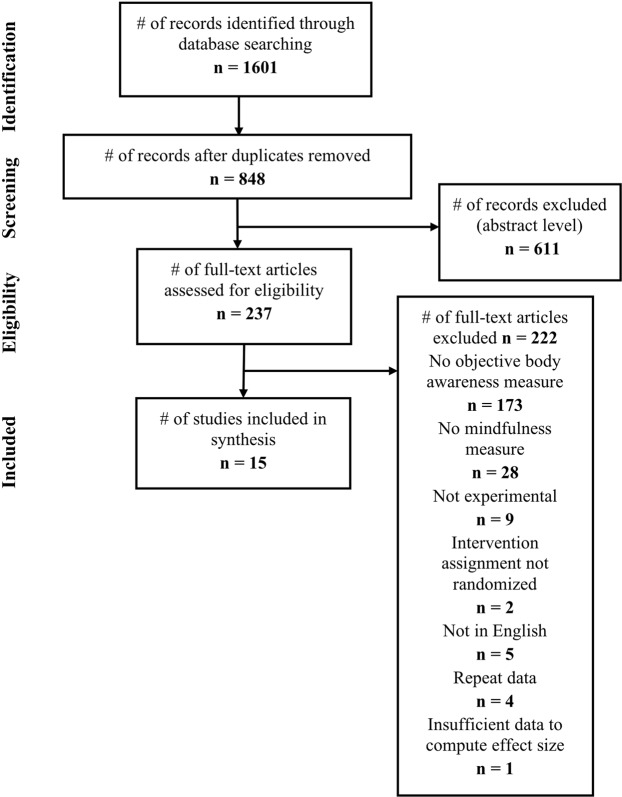
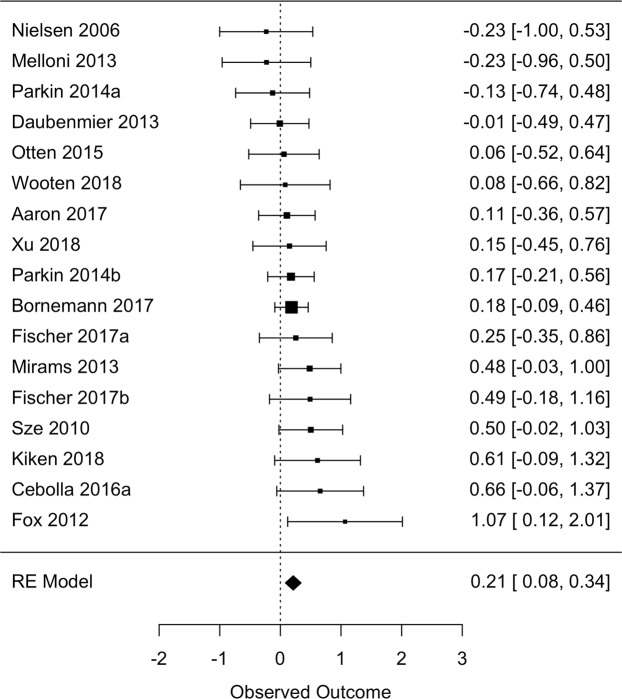
Although awareness of bodily sensations is a common mindfulness meditation technique, studies assessing the relationship between mindfulness and body awareness have provided mixed results. The current study sought to meta-analytically examine the relationship between mindfulness operationalized as a dispositional trait or a construct trained through short- (i.e., randomized controlled trials [RCTs]) or long-term mindfulness meditation practice with objective measures of body awareness accuracy. PubMed, Web of Science, PsycINFO, and Scopus were searched. Studies were eligible if they reported the association between mindfulness and body awareness, were published in English, and included adults. Across 15 studies (17 independent samples), a small effect was found linking mindfulness with greater body awareness accuracy ( g = 0.21 [0.08, 0.34], N = 879). When separated by study design, only RCTs continued to show a significant relationship ( g = 0.20, [0.02, 0.38], k = 7, n = 505). Heterogeneity of effects was low ( I 2 < 25%), although with wide confidence intervals. Effects were not moderated by study quality. Low fail-safe N estimates reduce confidence in the observed effects. Results suggest a small but potentially detectable relationship between mindfulness and body awareness accuracy. Future investigations could examine individual differences in body awareness as a mechanism within mindfulness interventions.
Overview
The claims and statistics of this paper haven’t been checked yet.
Free: it reads the open-access text and checks the first 5 claims that cite a source we can check. Create a free account to check every claim.
Integrity signals
Registry
Cites
Statistics
Figures
Verification
Claims the paper makes
The claims and statistics of this paper haven’t been checked yet.
Free: it reads the open-access text and checks the first 5 claims that cite a source we can check. Create a free account to check every claim.
Claims other papers make about this one
Each is checked against this paper’s own text: does it say what the citing paper says it does?
The cited source says what the claim attributes to it.
In the citing paper
“A meta-analysis of the effects of mindfulness training on body awareness has found a small, but significant, positive relationship between mindfulness and body awareness.”
From Brief structured respiration practices enhance mood and reduce physiological arousal (2023) · cites this paper as [48]
The cited source says what the claim attributes to it.
In the citing paper
“Numerous biological and behavioral mechanisms have been assessed for in-person MBIs (eg, changes in attention, body awareness, stress physiology) [126-128] and may be operant within mHealth MBIs.”
From Testing the efficacy of a multicomponent, self-guided, smartphone-based meditation app: Three-armed randomized controlled trial (2020) · cites this paper as [128]
In the citing paper
“Evidence for behavioral effects (for example, effects of MBIs on measures of attention91,92 and interoception93) is less robust (that is, the effects are smaller and less consistently statistically significant).”
From A common factors perspective on mindfulness-based interventions (2022) · cites this paper as [92]
Self-check
Percentages, sums and reported differences re-computed from the paper’s own numbers.
The self-check needs the paper’s full text.
Citations
Cites
Preferred Reporting Items for Systematic Reviews and Meta-Analyses: the PRISMA statement
Moher, D., Liberati, A., Tetzlaff, J., Altman, D. G., & for the PRISMA Group (2009) · BMJ · doi:10.1136/bmj.b2535 · Cited by 83,823
Measuring inconsistency in meta-analyses
Higgins, J. P. T., Thompson, S. G., Deeks, J. J., & Altman, D. G. (2003) · BMJ · doi:10.1136/bmj.327.7414.557 · Cited by 63,139
Preferred reporting items for systematic reviews and meta-analyses: the PRISMA Statement.
(2009) · PubMed Central · Cited by 44,859
Preferred reporting items for systematic reviews and meta-analyses: The PRISMA statement
Moher, D., Liberati, A., Tetzlaff, J., Altman, D. G., & the PRISMA Group* (2009) · Annals of Internal Medicine · doi:10.7326/0003-4819-151-4-200908180-00135 · Cited by 37,554
Assessing the quality of reports of randomized clinical trials: Is blinding necessary?
Jadad, A. R., Moore, R. A., Carroll, D., Jenkinson, C., Reynolds, D. J. M., Gavaghan, D. J., & McQuay, H. J. (1996) · Controlled Clinical Trials · doi:10.1016/0197-2456(95)00134-4 · Cited by 17,582
Borenstein, M., Hedges, L. V., Higgins, J. P. T., & Rothstein, H. R. (2009) · doi:10.1002/9780470743386 · Cited by 14,225
The benefits of being present: Mindfulness and its role in psychological well-being
Brown, K. W., & Ryan, R. M. (2003) · Journal of Personality and Social Psychology · doi:10.1037/0022-3514.84.4.822 · Cited by 13,448
The file drawer problem and tolerance for null results.
Rosenthal, R. (1979) · Psychological Bulletin · doi:10.1037/0033-2909.86.3.638 · Cited by 9,068
A new scale of social desirability independent of psychopathology.
Crowne, D. P., & Marlowe, D. (1960) · Journal of Consulting Psychology · doi:10.1037/h0047358 · Cited by 8,686
(2008) · Medical Entomology and Zoology · Cited by 7,477
Cited by
Goldberg, S. B., Riordan, K. M., Sun, S., & Davidson, R. J. (2022) · Perspectives on Psychological Science · doi:10.1177/1745691620968771 · Cited by 520
Self-citationBrief structured respiration practices enhance mood and reduce physiological arousal
Balban, M. Y., Neri, E., Kogon, M. M., Weed, L., Nouriani, B., Jo, B., Holl, G., Zeitzer, J. M., Spiegel, D., & Huberman, A. D. (2023) · Cell Reports Medicine · doi:10.1016/j.xcrm.2022.100895 · Cited by 284
“Including interoceptive measures in future studies can furthermore help discern what populations can most benefit from different breathing techniques.(48) Our study monitored subjects daily and collected daily physiological data remotely, a capability that was forced by the COVID restrictions but was enabled by the we…”
BackgroundThe Hitchhiker’s Guide to Neurophenomenology – The Case of Studying Self Boundaries With Meditators
Berkovich-Ohana, A., Dor-Ziderman, Y., Trautwein, F.-M., Schweitzer, Y., Nave, O., Fulder, S., & Ataria, Y. (2020) · Frontiers in Psychology · doi:10.3389/fpsyg.2020.01680 · Cited by 100
Goldberg, S. B., Imhoff-Smith, T., Bolt, D. M., Wilson-Mendenhall, C. D., Dahl, C. J., Davidson, R. J., & Rosenkranz, M. A. (2020) · JMIR Mental Health · doi:10.2196/23825 · Cited by 97
“Numerous biological and behavioral mechanisms have been assessed for in-person MBIs (eg, changes in attention, body awareness, stress physiology) [126-128] and may be operant within mHealth MBIs.”
BackgroundSelf-citationGoldberg, S. B., Imhoff-Smith, T., Bolt, D. M., Wilson-Mendenhall, C. D., Dahl, C. J., Davidson, R. J., & Rosenkranz, M. A. (2020) · doi:10.2196/preprints.23825 · Cited by 97
Self-citationDefining Mindfulness: A Review of Existing Definitions and Suggested Refinements
Chems-Maarif, R., Cavanagh, K., Baer, R. A., Gu, J., & Strauss, C. (2025) · Mindfulness · doi:10.1007/s12671-024-02507-2 · Cited by 154
Britton, W. B., Desbordes, G., Acabchuk, R., Peters, S., Lindahl, J. R., Canby, N. K., Vago, D. R., Dumais, T., Lipsky, J., Kimmel, H., et al. (2021) · Frontiers in Psychology · doi:10.3389/fpsyg.2021.730972 · Cited by 80
A common factors perspective on mindfulness-based interventions
Goldberg, S. B. (2022) · Nature Reviews Psychology · doi:10.1038/s44159-022-00090-8 · Cited by 75
Self-citationPsychobiological mechanisms underlying the mood benefits of meditation: A narrative review
Pascoe, M. C., de Manincor, M., Tseberja, J., Hallgren, M. Å., Baldwin, P. A., & Parker, A. G. (2021) · Comprehensive Psychoneuroendocrinology · doi:10.1016/j.cpnec.2021.100037 · Cited by 90
Exploring the Multidimensional Assessment of Interoceptive Awareness in youth aged 7–17 years
Jones, A., Silas, J., Todd, J., Stewart, A. L., Acree, M. C., Coulson, M., & Mehling, W. E. (2020) · Journal of Clinical Psychology · doi:10.1002/jclp.23067 · Cited by 72
Interoceptive Interaction: An Embodied Metaphor Inspired Approach to Designing for Meditation
Roquet, C. D., & Sas, C. (2021) · CHI Conference on Human Factors in Computing Systems · doi:10.1145/3411764.3445137 · Cited by 82
Schulte‐Frankenfeld, P. M., & Trautwein, F. (2022) · Applied Psychology: Health and Well-Being · doi:10.1111/aphw.12328 · Cited by 51
Rogowska, A. M., & Татаруч, Р. (2024) · BMC Sports Science Medicine and Rehabilitation · doi:10.1186/s13102-024-00863-z · Cited by 89
Mindfulness-Based Interventions and Body Awareness
Pérez-Peña, M., Notermans, J., Desmedt, O., der Gucht, K. V., & Philippot, P. (2022) · Brain Sciences · doi:10.3390/brainsci12020285 · Cited by 61
Attention to cardiac sensations enhances the heartbeat-evoked potential during exhalation
Zaccaro, A., della Penna, F., Mussini, E., Parrotta, E., Perrucci, M. G., Costantini, M., & Ferri, F. (2024) · iScience · doi:10.1016/j.isci.2024.109586 · Cited by 47
Silva, L. D. C., Belrose, C., Trousselard, M., Rea, B., Seery, E., Verdonk, C. G., Duffaud, A. M., & Verdonk, C. (2022) · Frontiers in Psychology · doi:10.3389/fpsyg.2022.946271 · Cited by 44
Jiménez, R. M. R., Carmona, M., García-Merino, S., Díaz-Rivas, B., & Thuissard, I. J. (2022) · PLoS ONE · doi:10.1371/journal.pone.0278372 · Cited by 53
Morriss, J. (2025) · Neuroscience & Biobehavioral Reviews · doi:10.1016/j.neubiorev.2025.106138 · Cited by 28
Desmedt, O., Heeren, A., Corneille, O., & Luminet, O. (2021) · doi:10.31234/osf.io/8mpz9 · Cited by 24
Qü, P., Zhu, X., Zhou, H., Kang, Z., Li, R., Wen, J., Pan, F., Liu, Y. S., Zhu, T., Cao, Q., et al. (2024) · Frontiers in Psychology · doi:10.3389/fpsyg.2024.1381009 · Cited by 25
Hadash, Y., Ruimi, L., & Bernstein, A. (2023) · Psychological Assessment · doi:10.1037/pas0001194 · Cited by 23
Toward a Refined Mindfulness Model Related to Consciousness and Based on Event-Related Potentials
Verdonk, C., Trousselard, M., Canini, F., Vialatte, F., & Ramdani, C. (2020) · Perspectives on Psychological Science · doi:10.1177/1745691620906444 · Cited by 35
Mindfulness, Interoception, and the Body
Todd, J., & Aspell, J. E. (2022) · Brain Sciences · doi:10.3390/brainsci12060696 · Cited by 36
Hadash, Y., Ruimi, L., & Bernstein, A. (2021) · doi:10.31231/osf.io/dwzcj · Cited by 23
Luo, L., Xiao, M., Luo, Y., Yi, H., Dong, D., Liu, Y., Chen, X., Li, W., & Chen, H. (2022) · Journal of Affective Disorders · doi:10.1016/j.jad.2022.07.051 · Cited by 24
Masumeh, N., Ghazanfarpour, M., Ahmadi, A., Mirzaee, M., & Alidousti, K. (2022) · Reproductive Health · doi:10.1186/s12978-022-01543-2 · Cited by 28
Mindfulness, Interoception, and Olfaction: A Network Approach
Lefranc, B., Martin‐Krumm, C., Aufauvre-Poupon, C., Berthail, B., & Trousselard, M. (2020) · Brain Sciences · doi:10.3390/brainsci10120921 · Cited by 24
Mindfulness supports emotional resilience in children during the COVID-19 pandemic
Treves, I. N., Li, C. E., Wang, K. L., Ozernov-Palchik, O., Olson, H. A., & Gabrieli, J. D. E. (2023) · PLoS ONE · doi:10.1371/journal.pone.0278501 · Cited by 19
“These practices may support more accurate appraisals of bodily sensations and diminish anxiety [22, 52, 53].”
BackgroundSelf-citationAdvanced and long-term meditation and the autonomic nervous system: A review and synthesis
Sezer, I., & Sacchet, M. D. (2024) · Neuroscience & Biobehavioral Reviews · doi:10.1016/j.neubiorev.2025.106141 · Cited by 28
Verdonk, C., Trousselard, M., Luft, C. D. B., Medani, T., Billaud, J., Ramdani, C., Canini, F., Claverie, D., Jaumard‐Hakoun, A., & Vialatte, F. (2021) · Psychophysiology · doi:10.1111/psyp.13891 · Cited by 21
Consciousness Beyond Neural Fields: Expanding the Possibilities of What Has Not Yet Happened
Dresp, B. (2022) · Frontiers in Psychology · doi:10.3389/fpsyg.2021.762349 · Cited by 20
Liebherr, M., Brandtner, A., Brand, M., & Tang, Y. (2024) · Annals of the New York Academy of Sciences · doi:10.1111/nyas.15095 · Cited by 34
Mindfulness, cognition, and long-term meditators: Toward a science of advanced meditation
Ehmann, S., Sezer, I., Treves, I. N., Gabrieli, J. D. E., & Sacchet, M. D. (2025) · Imaging Neuroscience · doi:10.1162/imag.a.82 · Cited by 35
Self-citationSieder, K., Thiedmann, P., Voracek, M., & Tran, U. S. (2024) · Applied Psychology: Health and Well-Being · doi:10.1111/aphw.12550 · Cited by 16
Mindfulness-based neurofeedback: A systematic review of EEG and fMRI studies
Treves, I. N., Greene, K. D., Bajwa, Z., Wool, E., Kim, N., Bauer, C. C. C., Bloom, P. A., Pagliaccio, D., Zhang, J., Whitfield, S., et al. (2024) · Imaging Neuroscience · doi:10.1162/imag_a_00396 · Cited by 26
Self-citationPsychedelic Experience: Revealing the Mind
Lyon, A. (2023) · doi:10.1093/oso/9780198843757.001.0001 · Cited by 29
Scattolin, M., Panasiti, M. S., & Aglioti, S. M. (2022) · Royal Society Open Science · doi:10.1098/rsos.220061 · Cited by 15
A meta-analysis of the effects of mindfulness meditation training on self-reported interoception
Treves, I. N., Chen, Y., Wilson, C. L., Verdonk, C., Qinaʻau, J., Pustejovsky, J. E., Goldberg, S. B., Mehling, W. E., Schuman‐Olivier, Z., & Khalsa, S. S. (2025) · Scientific Reports · doi:10.1038/s41598-025-22661-4 · Cited by 37
Self-citationSchmidt, C., Soler, J., Vega, D., Nicolaou, S., Arias, L., & Pascual, J. C. (2024) · Borderline Personality Disorder and Emotion Dysregulation · doi:10.1186/s40479-024-00265-0 · Cited by 19
Consumer-Grade Neurofeedback With Mindfulness Meditation: Meta-Analysis
Treves, I. N., Bajwa, Z., Greene, K. D., Bloom, P. A., Kim, N., Wool, E., Goldberg, S. B., Whitfield, S., & Auerbach, R. P. (2025) · Journal of Medical Internet Research · doi:10.2196/68204 · Cited by 19
Self-citationMeriç, I. A., & Sönmez, M. B. (2021) · Cognitive Neuropsychiatry · doi:10.1080/13546805.2021.2011183 · Cited by 13
Bonde, E. H., Mikkelsen, E. G., Fjorback, L. O., & Juul, L. (2022) · Frontiers in Psychology · doi:10.3389/fpsyg.2022.1020454 · Cited by 20
Matiz, A., Guzzon, D., Crescentini, C., Paschetto, A., & Fabbro, F. (2020) · European Journal of Integrative Medicine · doi:10.1016/j.eujim.2020.101168 · Cited by 11
Disrupted profiles of interoception and mental health in youths: a systematic review
Mayer-Benarous, H., Benarous, X., & Robin, M. (2025) · European Child and Adolescent Psychiatry · doi:10.1007/s00787-025-02705-w · Cited by 12
Guthrie, T., Matthews, J., Chambers, R., Windt, J., & Hohwy, J. (2022) · Mindfulness · doi:10.1007/s12671-022-01869-9 · Cited by 17
Hadash, Y., Dar, O., Amir, I., Braver, T. S., & Bernstein, A. (2026) · Annual Review of Psychology · doi:10.1146/annurev-psych-012925-030843 · Cited by 10
Contemporary Mindfulness and Transreligious Learning Paths of Mental Health Professionals
Husgafvel, V., & Utriainen, T. (2023) · Religions · doi:10.3390/rel14060807 · Cited by 15
Morris, A. (2021) · PsyArXiv (OSF Preprints) · doi:10.31234/osf.io/4nf5c · Cited by 13
Selfless minds, unlimited bodies? Homeostatic bodily self-regulation in meditative experiences
Ciaunica, A. (2024) · Journal of Consciousness Studies · doi:10.53765/20512201.31.5.104 · Cited by 9
Weiniger, S., & Schilaty, N. D. (2024) · Frontiers in Neuroscience · doi:10.3389/fnins.2024.1359594 · Cited by 11
Jacques, C., Quiquempoix, M., Sauvet, F., Quyen, M. L. V., Gomez-Mérino, D., & Chennaoui, M. (2024) · Frontiers in Psychology · doi:10.3389/fpsyg.2024.1412289 · Cited by 12
Multidimensional schizotypy and embodied emotions
Torregrossa, L., Blain, S. D., Snodgress, M. A., & Park, S. (2023) · Frontiers in Psychology · doi:10.3389/fpsyg.2023.1141799 · Cited by 8
Electroencephalography microstates highlight specific mindfulness traits
Zarka, D., Cevallos, C., Ruiz, P., Petieau, M., Cebolla, A. M., Bengoetxea, A., & Cheron, G. A. (2024) · European Journal of Neuroscience · doi:10.1111/ejn.16247 · Cited by 11
Verdonk, C., Trousselard, M., Medani, T., Vialatte, F., & Dreyfus, G. (2022) · Frontiers in Physiology · doi:10.3389/fphys.2022.915134 · Cited by 7
Dispositional mindfulness and its relationship to exercise motivation and experience
Lynn, S., Satyal, M. K., Smith, A. J., Tasnim, N., Gyamfi, D., English, D. F., SUZUKI, W. A., & Basso, J. C. (2022) · Frontiers in Sports and Active Living · doi:10.3389/fspor.2022.934657 · Cited by 12
Lindahl, J. R., Britton, W. B., & Cooper, D. J. (2022) · Journal of Cognitive Historiography · doi:10.1558/jch.22807 · Cited by 7
Borghi, O., Voracek, M., & Tran, U. S. (2024) · Frontiers in Psychology · doi:10.3389/fpsyg.2024.1272720 · Cited by 10
The Impact of a Short Body–Focused Meditation on Body Ownership and Interoceptive Abilities
Schroter, F. A., Siebertz, M., & Jansen, P. (2022) · Mindfulness · doi:10.1007/s12671-022-02039-7 · Cited by 14
Mylius, M., Guendelman, S., Iliopoulos, F., Gallese, V., & Kaltwasser, L. (2024) · Psychophysiology · doi:10.1111/psyp.14712 · Cited by 6
Limited Validity of Breath‐Counting as a Measure of Mindfulness in Ruminative Adolescents
Treves, I. N., Tierney, A. O., Goldberg, S. B., Rouleau, N., Carson, N. J., Schuman‐Olivier, Z., & Webb, C. A. (2025) · Psychophysiology · doi:10.1111/psyp.70071 · Cited by 6
Self-citationLopez-Sierra, Y., Trapero‐Asenjo, S., Rodríguez‐Costa, I., Granero‐Heredia, G., Pérez-Martín, Y., & Núñez-Nagy, S. (2024) · Healthcare · doi:10.3390/healthcare12202095 · Cited by 7
Bodily awareness: Religious culture’s associations with interoceptive sensibility
Cappellen, P. V., & Drummond, T. M. L. (2024) · PLoS ONE · doi:10.1371/journal.pone.0309216 · Cited by 9
Schwartz, K., Ganster, F. M., Voracek, M., & Tran, U. S. (2025) · Psychosomatic Medicine · doi:10.1097/psy.0000000000001381 · Cited by 8
Masoudi, A., Chemane, N., Magida, N., Useh, U., & Bello, B. (2025) · South African Journal of Sports Medicine · doi:10.17159/2078-516x/2025/v37i1a18648 · Cited by 5
Sönmez, M. B., Meriç, I. A., Sübay, B., & Görgülü, Y. (2022) · Journal of Psychophysiology · doi:10.1027/0269-8803/a000300 · Cited by 7
From Confound to Clinical Tool: Mindfulness and the Observer Effect in Research and Therapy
Bauer, C. C. C., Atad, D. A., Farb, N. A. S., & Brewer, J. A. (2025) · Biological Psychiatry Cognitive Neuroscience and Neuroimaging · doi:10.1016/j.bpsc.2025.01.012 · Cited by 7
Haruki, Y., Yang, Y., Suzuki, K., Imamizu, H., & Ogawa, K. (2025) · Imaging Neuroscience · doi:10.1162/imag.a.142 · Cited by 4
Verdonk, C., Mellier, C., Charlot, K., Jouvion, A.-X., Trousselard, M., Sagui, E., Malgoyre, A., & Tardo‐Dino, P. (2025) · Physiological Reports · doi:10.14814/phy2.70529 · Cited by 4
Thielmann, B., Zavgorodnii, I., & Böckelmann, I. (2021) · Psychiatrische Praxis · doi:10.1055/a-1360-9207 · Cited by 2
Zhu, L., Xie, Y.-H., Tan, H., Wang, L., Zhou, R.-Y., Xiao, Y.-N., Liu, C. X., Peng, L.-J., Yang, X.-L., Qu, Y.-J., et al. (2023) · Behaviour Research and Therapy · doi:10.1016/j.brat.2023.104418 · Cited by 4
Sánchez-Sánchez, L. C., Klysing, A., Stålbrand, I. S., & Lundberg, T. (2025) · Healthcare · doi:10.3390/healthcare13060628 · Cited by 4
The Role of Counselor Trainees' Co-Regulated Mindfulness: A Cluster-Randomized Controlled Study
Warwick, L. (2023) · University of North Texas Digital Library (University of North Texas) · doi:10.12794/metadc2137602 · Cited by 3
Lyon, A. (2023) · Oxford University Press eBooks · doi:10.1093/oso/9780198843757.003.0009 · Cited by 1
Peters, E. K., Sim, S. S.-H., Reb, J. M., Young, J. H., & Young, M. E. (2025) · Mindfulness · doi:10.1007/s12671-025-02581-0 · Cited by 1
Physical Activity Decreases Somatic Symptom Distress in the Affect and Symptom Paradigm
Petzke, T. M., Köteles, F. G., den Bergh, O. V., & Witthöft, M. (2025) · Psychosomatic Medicine · doi:10.1097/psy.0000000000001425 · Cited by 2
Self-awareness, Mindfulness, and Social Work Practice
Maddock, A., Althobity, T. S. M., & McGuigan, K. (2026) · Clinical Social Work Journal · doi:10.1007/s10615-026-01028-w · Cited by 2
Becattini, V., Lifshitz, M., & Miller, M. M. (2026) · Neuroscience of Consciousness · doi:10.1093/nc/niag001 · Cited by 4
Interoception in self-harm and suicide: a scoping review and meta-analysis
Liu, B., Wu, Z. W., Xue, M., Guo, J., Liu, S., Tong, Y., Liu, J., Qu, D., Wen, X., Lei, C., et al. (2026) · Nature Human Behaviour · doi:10.1038/s41562-026-02490-9 · Cited by 2
Embodied empathy and abstract concepts' concreteness: Evidence from contemplative practices
Marson, F., Paoletti, P., Naor‐Ziv, R., Carducci, F., & Ben‐Soussan, T. D. (2023) · Progress in brain research · doi:10.1016/bs.pbr.2022.12.005 · Cited by 4
Çırak, Y., Tütüneken, Y. E., Yelvar, G. D. Y., SEYRAN, Z., Köçe, K., Işıkcı, B., & Elbaşı, N. D. (2023) · Kocaeli Üniversitesi Sağlık Bilimleri Dergisi · doi:10.30934/kusbed.1194205 · Cited by 1
Lyon, A. (2023) · Oxford University Press eBooks · doi:10.1093/oso/9780198843757.003.0001 · Cited by 1
Lyon, A. (2023) · Oxford University Press eBooks · doi:10.1093/oso/9780198843757.003.0005 · Cited by 1
Tabatabaeian, A., Hosseinian, S., Taheri, A., & Leavitt, C. E. (2024) · Journal of Sex & Marital Therapy · doi:10.1080/0092623x.2024.2309965 · Cited by 2
Ankaç, B., Eren, H. C., & Sülün, E. (2024) · Psychology of Music · doi:10.1177/03057356241239876 · Cited by 2
Towards a refined mindfulness model related to consciousness and based on ERPPreprint
Verdonk, C., Trousselard, M., Canini, F., Vialatte, F., & Ramdani, C. (2020) · PsyArXiv (OSF Preprints) · doi:10.31234/osf.io/d5s7w · Cited by 1
Hayes, G. A. (2022) · Journal of Cognitive Historiography · doi:10.1558/jch.23124
Le neurofeedback au service de la maîtrise du stress
Verdonk, C. (2023) · Revue Défense Nationale · doi:10.3917/rdna.hs10.0129 · Cited by 1
Hadash, Y., Dar, O., Amir, I., & Bernstein, A. (2023) · PsyArXiv (OSF Preprints) · doi:10.31234/osf.io/s34nh
Mylius, M., Guendelman, S., Iliopoulos, F., D, V. G. M., & Kaltwasser, L. (2023) · doi:10.22541/au.169445202.28516536/v1
Lyon, A. (2023) · Oxford University Press eBooks · doi:10.1093/oso/9780198843757.003.0010
Lyon, A. (2023) · Oxford University Press eBooks · doi:10.1093/oso/9780198843757.003.0011
Lyon, A. (2023) · Oxford University Press eBooks · doi:10.1093/oso/9780198843757.003.0008
Lyon, A. (2023) · Oxford University Press eBooks · doi:10.1093/oso/9780198843757.003.0006
Lyon, A. (2023) · Oxford University Press eBooks · doi:10.1093/oso/9780198843757.003.0012
(2023) · Oxford University Press eBooks · doi:10.1093/oso/9780198843757.002.0006
Lyon, A. (2023) · Oxford University Press eBooks · doi:10.1093/oso/9780198843757.003.0007
(2023) · Oxford University Press eBooks · doi:10.1093/oso/9780198843757.002.0003
Lyon, A. (2023) · Oxford University Press eBooks · doi:10.1093/oso/9780198843757.003.0004
What Is Psychedelic Experience?
Lyon, A. (2023) · Oxford University Press eBooks · doi:10.1093/oso/9780198843757.003.0002
(2023) · Oxford University Press eBooks · doi:10.1093/oso/9780198843757.002.0005
Metadata
- Authors
- Treves, I. N., Tello, L. Y., Davidson, R. J., & Goldberg, S. B.
- Affiliations
- Massachusetts Institute of Technology (US)
- University of California, Berkeley (US)
- University of Wisconsin–Madison (US)
- Corresponding author
- Goldberg, Simon B.
- Venue
- Scientific Reports
- Published
- 2019-11-22
- Volume
- 9
- Issue
- 1
- Pages
- 17386-17386
- ISSN
- 2045-2322 (ISSN-L)
- PMC
- PMC6874545
- OpenAlex
- W2990338100
- Cited by
- 114
- References
- 93
- Citations by year
- 2026: 6 · 2025: 22 · 2024: 21 · 2023: 28 · 2022: 19 · 2021: 11 · 2020: 7
- FWCI
- 1.46
- Type
- journal article
- Language
- en
- Open access
- gold
- doi.org
- Licence
- cc-by
- creativecommons.org/licenses/by/4.0 (tdm)
- creativecommons.org/licenses/by/4.0 (vor)
- Locations
- Scientific Reports (publishedVersion, cc-by)
- PubMed Central (publishedVersion, cc-by)
- PubMed (publishedVersion)
- DOAJ (DOAJ: Directory of Open Access Journals) (submittedVersion)
- Funders
- U.S. Department of Health & Human Services | NIH | National Center for Complementary and Integrative Health (P01AT004952)
- Topics
- Social Sciences › Psychology › Clinical Psychology › Mindfulness and Compassion Interventions
- Health Sciences › Medicine › Psychiatry and Mental health › Psychosomatic Disorders and Their Treatments
- Life Sciences › Neuroscience › Cognitive Neuroscience › Embodied and Extended Cognition
- Keywords
- mindfulness, body awareness, mindfulness meditation, trait mindfulness, mindfulness-based interventions, individual differences
- MeSH terms
- Adult, Awareness, Body Image, Humans, Middle Aged, Self Concept, Meditation, Young Adult, Mindfulness
About these checks
Registry, retraction, Cites and statistics results are computed, not judged, with one exception: a printed reference that no index lists is read once by a model before it counts as a citation error. Claims are extracted by a model and kept only when their quote appears verbatim in the text; each cited source is then checked, with a model’s help, for whether it says what the claim relies on. Those verdicts can be wrong — read the claim’s quote and the cited source before relying on one.
Statistics and arithmetic are recomputed, not judged.
Confidence bands are shown only for fields calibrated on our annotated test set. None is calibrated yet, so no band is shown.
What counts as a claim ›How we measure confidence ›How we check this ›
Are you an author, or do you see a problem with this page? Request a review
Data sources
Bibliographic data: Semantic Scholar, OpenAlex, Crossref.
Contains information from the Semantic Scholar Academic Graph Datasets, made available under the ODC Attribution License (ODC-BY 1.0).
Semantic Scholar’s data is described in: Kinney, R., et al. (2023). The Semantic Scholar Open Data Platform. arXiv:2301.10140.
