

Association of glomerular DNA damage and DNA methylation with one-year eGFR decline in IgA nephropathy
Open accessThe DOI matches its Crossref record; 34 of the 34 references it cites were found in a registry or an index.
Abstract
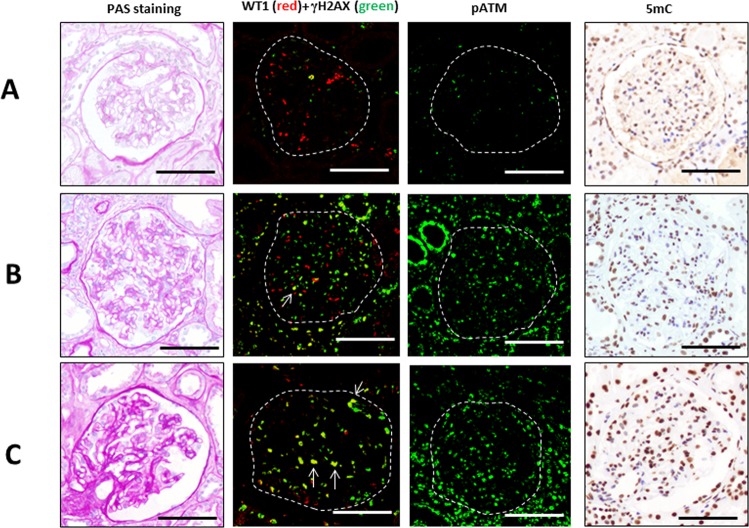
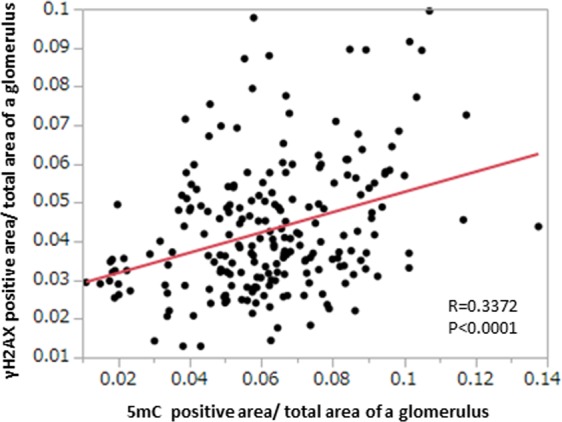
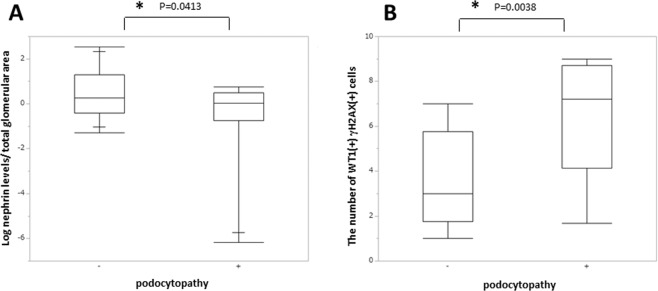
Accumulation of DNA double-strand breaks (DSBs) is linked to aging and age-related diseases. We recently reported the possible association of DNA DSBs with altered DNA methylation in murine models of kidney disease. However, DSBs and DNA methylation in human kidneys was not adequately investigated. This study was a cross-sectional observational study to evaluate the glomerular DNA DSB marker γH2AX and phosphorylated Ataxia Telangiectasia Mutated (pATM), and the DNA methylation marker 5-methyl cytosine (5mC) by immunostaining, and investigated the association with pathological features and clinical parameters in 29 patients with IgA nephropathy. To evaluate podocyte DSBs, quantitative long-distance PCR of the nephrin gene using laser-microdissected glomerular samples and immunofluorescent double-staining with WT1 and γH2AX were performed. Glomerular γH2AX level was associated with glomerular DNA methylation level in IgA nephropathy. Podocytopathic features were associated with increased number of WT1(+)γH2AX(+) cells and reduced amount of PCR product of the nephrin gene, which indicate podocyte DNA DSBs. Glomerular γH2AX and 5mC levels were significantly associated with the slope of eGFR decline over one year in IgA nephropathy patients using multiple regression analysis adjusted for age, baseline eGFR, amount of proteinuria at biopsy and immunosuppressive therapy after biopsy. Glomerular γH2AX level was associated with DNA methylation level, both of which may be a good predictor of renal outcome in IgA nephropathy.
Overview
The claims and statistics of this paper haven’t been checked yet.
Free: it reads the open-access text and checks the first 5 claims that cite a source we can check. Create a free account to check every claim.
Integrity signals
Registry
Cites
Statistics
Figures
Verification
Claims the paper makes
The claims and statistics of this paper haven’t been checked yet.
Free: it reads the open-access text and checks the first 5 claims that cite a source we can check. Create a free account to check every claim.
Claims other papers make about this one
Each is checked against this paper’s own text: does it say what the citing paper says it does?
The cited source says what the claim attributes to it.
In the citing paper
“Increased levels of γH2AX and phosphorylated ATM in glomeruli are associated with clinicopathological parameters in patients with IgA nephropathy”
From Telomere dysfunction in ageing and age-related diseases (2022) · cites this paper as [138]
Self-check
Percentages, sums and reported differences re-computed from the paper’s own numbers.
The self-check needs the paper’s full text.
Citations
Cites
1 retracted
RETRACTED: DNA Damage, Homology-Directed Repair, and DNA Methylation
Cuozzo, C., Porcellini, A., Angrisano, T., Morano, A., Lee, B., Pardo, A. D., Messina, S., Iuliano, R., Fusco, A., Santillo, M. R., et al. (2007) · PLoS Genetics · doi:10.1371/journal.pgen.0030110 · Cited by 191
RetractedDiagnosis and Classification of Diabetes Mellitus
American Diabetes Association (2011) · Diabetes Care · doi:10.2337/dc11-s062 · Cited by 13,988
Revised Equations for Estimated GFR From Serum Creatinine in Japan
Matsuo, S., Imai, E., Horio, M., Yasuda, Y., Tomita, K., Nitta, K., Yamagata, K., Tomino, Y., Yokoyama, H., & Hishida, A. (2009) · American Journal of Kidney Diseases · doi:10.1053/j.ajkd.2008.12.034 · Cited by 6,422
Diagnosis and classification of diabetes mellitus
American Diabetes Association (2010) · Diabetes Care · doi:10.2337/dc10-s062 · Cited by 5,491
The mechanism of double-strand DNA break repair by the nonhomologous DNA end-joining pathway
Lieber, M. R. (2010) · Annual Review of Biochemistry · doi:10.1146/annurev.biochem.052308.093131 · Cited by 2,882
-H2AX in recognition and signaling of DNA double-strand breaks in the context of chromatin
Kinner, A., Wu, W., Staudt, C., & Iliakis, G. (2008) · Nucleic Acids Research · doi:10.1093/nar/gkn550 · Cited by 1,256
A Working Group of the International IgA Nephropathy Network and the Renal Pathology Society, Cattran, D. C., Coppo, R., Cook, H. T., Feehally, J., Roberts, I. S. D., Troyanov, S., Alpers, C. E., Amore, A., Barratt, J., et al. (2009) · Kidney International · doi:10.1038/ki.2009.243 · Cited by 1,235
Trimarchi, H., Barratt, J., Cattran, D. C., Cook, H. T., Coppo, R., Haas, M., Liu, Z.-H., Roberts, I. S. D., Yuzawa, Y., Zhang, H., et al. (2017) · Kidney International · doi:10.1016/j.kint.2017.02.003 · Cited by 1,192
Roles of ATM and NBS1 in chromatin structure modulation and DNA double-strand break repair
Berkovich, E., Monnat, R. J., & Kastan, M. B. (2007) · Nature Cell Biology · doi:10.1038/ncb1599 · Cited by 477
O'Hagan, H. M., Mohammad, H. P., & Baylin, S. B. (2008) · PLoS Genetics · doi:10.1371/journal.pgen.1000155 · Cited by 386
Cited by
Telomere dysfunction in ageing and age-related diseases
Rossiello, F., Jurk, D., Passos, J. F., & d’Adda di Fagagna, F. (2022) · Nature Cell Biology · doi:10.1038/s41556-022-00842-x · Cited by 754
Gluck, C. A., Qiu, C., Han, S. Y., Palmer, M., Park, J., Ko, Y.-A., Guan, Y., Sheng, X., Hanson, R. L., Huang, J. Y., et al. (2019) · Nature Communications · doi:10.1038/s41467-019-10378-8 · Cited by 92
The relationship between telomere length and aging-related diseases
Huang, X., Huang, L., Lu, J., Cheng, L., Wu, D. A., Li, L., Zhang, S., Lai, X., & Xu, L. (2025) · Clinical and Experimental Medicine · doi:10.1007/s10238-025-01608-z · Cited by 65
“In CKD, increased DNA damage has been observed, as evidenced by elevated DDR markers such as γH2AX in kidney tissues [105].”
Fan, Y., Cheng, J., Yang, Q., Feng, J., Hu, J., Ren, Z., Yang, H., Yang, D., & Ding, G. (2021) · Food & Function · doi:10.1039/d0fo03467c · Cited by 46
Epigenetic Alterations in Podocytes in Diabetic Nephropathy
Sugita, E., Hayashi, K., Hishikawa, A., & Itoh, H. (2021) · Frontiers in Pharmacology · doi:10.3389/fphar.2021.759299 · Cited by 40
Self-citationSignificance of podocyte DNA damage and glomerular DNA methylation in CKD patients with proteinuria
Yoshimoto, N., Hayashi, K., Hishikawa, A., Hashiguchi, A., Nakamichi, R., Sugita-Nishimura, E., Hama, E. Y., Azegami, T., Nakayama, T., & Itoh, H. (2023) · Hypertension Research · doi:10.1038/s41440-023-01169-2 · Cited by 31
“The paraffin sections were stained with periodic acid-Schiff (PAS) stain or anti-γH2AX (NB100384, Novus Biologicals, Colorado, USA) and anti-5methylcytosine antibodies (sc-56615, Santa Cruz Biotechnology, Texas, USA), after which they were incubated with a peroxidase-conjugated secondary antibody and stained with 3,3-…”
BackgroundMethodSelf-citationPathological consequences of DNA damage in the kidney
Garaycoechea, J. I., Quinlan, C., & Luijsterburg, M. S. (2023) · Nature Reviews Nephrology · doi:10.1038/s41581-022-00671-z · Cited by 33
DNA-damaged podocyte-CD8 T cell crosstalk exacerbates kidney injury by altering DNA methylation
Nakamichi, R., Hishikawa, A., Chikuma, S., Yoshimura, A., Sasaki, T., Hashiguchi, A., Abe, T., Tokuhara, T., Yoshimoto, N., Nishimura, E. S., et al. (2023) · Cell Reports · doi:10.1016/j.celrep.2023.112302 · Cited by 16
Self-citationUnraveling the epigenetic landscape of glomerular cells in kidney disease
Pereira, B. M. V., Katakia, Y. T., Majumder, S., & Thieme, K. (2021) · Journal of Molecular Medicine · doi:10.1007/s00109-021-02066-2 · Cited by 13
Cellular senescence in kidney diseases
Wang, X., Li, Y., Chu, Q., Lv, H., Li, J., & Yi, F. (2025) · Chinese Medical Journal · doi:10.1097/cm9.0000000000003746 · Cited by 13
“[6,10] Similarly, elevated levels of γ H2AX are observed in glomeruli from patients with IgA nephropathy.”
Wei, M., Meng, S., Shi, S., Liu, L., Zhou, X., Lv, J., Zhu, L., & Zhang, H. (2020) · Kidney Diseases · doi:10.1159/000512169 · Cited by 11
Altered DNA methylation in kidney disease: useful markers and therapeutic targets
Hayashi, K. (2022) · Clinical and Experimental Nephrology · doi:10.1007/s10157-022-02181-5 · Cited by 11
“We have previously reported the association of glomerular DNA methylation with glomerular DNA DSB levels in IgA nephropathy, which is correlated with eGFR decline per year [43].”
BackgroundSelf-citationNishimura, E. S., Hishikawa, A., Nakamichi, R., Akashio, R., Chikuma, S., Hashiguchi, A., Yoshimoto, N., Hama, E. Y., Maruki, T., Ito, W., et al. (2025) · Nature Communications · doi:10.1038/s41467-025-59297-x · Cited by 14
Self-citationDNA methylation in chronic kidney disease
Cheng, Y., Liu, P., Xie, G., Li, W., Jing, H., Chen, Y., Chen, H., Fan, Y., & Zhou, J. (2025) · BMC Nephrology · doi:10.1186/s12882-024-03916-0 · Cited by 8
“Extensive DNA methylation studies have been carried out in other CKDs, such as ADPKD [108], lupus nephritis [109], IgA nephropathy (IgAN) [110], and Balkan endemic nephropathy (BEN) [111].”
Loss of genome maintenance is linked to mTOR complex 1 signaling and accelerates podocyte damage
Braun, F., Mandel, A. M., Blomberg, L., Wong, M. N., Chatzinikolaou, G., Meyer, D. H., Reinelt, A., Nair, V., Akbar-Haase, R., McCown, P. J., et al. (2025) · JCI Insight · doi:10.1172/jci.insight.172370 · Cited by 13
“Likewise, glomerular DNA damage was found to be associated with declining kidney function (15), and cells isolated from the urine of patients with diabetes and hypertension showed increased levels of DNA strand breaks (16).”
NAT10-mediated acetylation of NIK mRNA in B cells promotes IgA production
Jiang, W.-J., Mao, X.-T., Li, W., Jin, N., Wang, Y., Guan, G., Jin, J., & Li, Y. (2025) · EMBO Reports · doi:10.1038/s44319-025-00509-2 · Cited by 7
“Epigenetic modi fi cations, including DNA methylation and histone modi fi cations, play a signi fi cant role in the regulation of IgA CSR (Casali et al, 2021; Hayashi et al, 2020; Sugino et al, 2021).”
Podocyte Ercc1 is indispensable for glomerular integrity
Hama, E. Y., Nakamichi, R., Hishikawa, A., Kihara, M., Abe, T., Yoshimoto, N., Nishimura, E. S., Itoh, H., & Hayashi, K. (2024) · Biochemical and Biophysical Research Communications · doi:10.1016/j.bbrc.2024.149713 · Cited by 7
Self-citationRen, L., Pushpakumar, S. B., Almarshood, H., Das, S. K., & Sen, U. (2024) · International Journal of Molecular Sciences · doi:10.3390/ijms252111599 · Cited by 7
“However, they recognized that these candidate markers have not been adequately investigated in other glomerular diseases [101].”
BackgroundTargeting DNA Methylation in Podocytes to Overcome Chronic Kidney Disease
Hayashi, K. (2023) · The Keio Journal of Medicine · doi:10.2302/kjm.2022-0017-ir · Cited by 6
Self-citationHishikawa, A., Nishimura, E. S., Yoshimoto, N., Nakamichi, R., Hama, E. Y., Ito, W., Maruki, T., Nagashima, K., Shimizu‐Hirota, R., Takaishi, H., et al. (2024) · Scientific Reports · doi:10.1038/s41598-024-62405-4 · Cited by 5
Self-citationThe Zebrafish Model to Understand Epigenetics in Renal Diseases
Sopel, N., & Müller‐Deile, J. (2021) · International Journal of Molecular Sciences · doi:10.3390/ijms22179152 · Cited by 5
“γH2AX immunostaining is a marker of DNA double-strand breaks [25], while 5-methyl cytosine immunostaining is a marker of DNA methylation [26].”
BackgroundWatanabe, M., Kakutani, M., Nakano, K., Okamura, T., & Sasaki, N. (2025) · FEBS Journal · doi:10.1111/febs.70333 · Cited by 5
“For example, studies in IgA nephropathy and diabetic kidney disease have shown that c H2AX-positive podocytes correlate with decreased eGFR and faster disease progression [75,76].”
Loss of genome maintenance accelerates podocyte damage and agingPreprint
Braun, F., Mandel, A. M., Blomberg, L., Wong, M. N., Chatzinikolaou, G., Nair, V., Akbar-Haase, R., Puelles, V. G., Meyer, D. H., McCown, P. J., et al. (2020) · bioRxiv (Cold Spring Harbor Laboratory) · doi:10.1101/2020.09.13.295303 · Cited by 3
“Itoh and co-workers linked proteinuric kidney disease present in patients 530 with hypertension and diabetes to DNA double-strand breaks and methylation in the promotor 531 region of the slit diaphragm protein nephrin, and established an association to DNA double-strand 532 breaks in glomeruli of patients suffering fr…”
BackgroundInfluentialWang, K.-C., Wang, W. H., Huang, C.-Y., Lee, S.-Y., Sn, C., Tsai, C.-F., Chen, C. Y., Chen, Y.-T., & Chou, Y. (2026) · Human Genomics · doi:10.1186/s40246-026-00944-9 · Cited by 1
“Protein-bound uremic toxins, such as indoxyl sulfate and p-cresyl sulfate, have been shown to induce reactive oxygen species generation, activate DNA damage response pathways including γH2AX signaling, and upregulate pro-inflammatory transcriptional programs in multiple cell types [30–32].”
Sato, N., Mori, K. P., Sakai, K., Miyata, H., Yamamoto, S., Kobayashi, T., Haga, H., Yanagita, M., & Okuno, Y. (2023) · PLoS ONE · doi:10.1371/journal.pone.0282534 · Cited by 1
“One of the possible reasons is that some other studies reported staining of γH2AX in other kidney diseases, and the severity of the disease could affect the result [48].”
Result
Metadata
- Authors
- Hayashi, K., Hishikawa, A., Hashiguchi, A., Azegami, T., Yoshimoto, N., Nakamichi, R., Tokuyama, H., & Itoh, H.
- Affiliations
- Keio University (JP)
- Corresponding author
- Hayashi, Kaori
- ORCID
- Venue
- Scientific Reports
- Published
- 2020-01-14
- Volume
- 10
- Issue
- 1
- Pages
- 237-237
- ISSN
- 2045-2322 (ISSN-L)
- PMC
- PMC6959244
- OpenAlex
- W2999641303
- Cited by
- 25
- References
- 34
- Citations by year
- 2026: 1 · 2025: 7 · 2024: 3 · 2023: 5 · 2022: 2 · 2021: 4 · 2020: 2
- FWCI
- 2.04
- Type
- journal article
- Language
- en
- Open access
- gold
- doi.org
- Licence
- cc-by
- creativecommons.org/licenses/by/4.0 (tdm)
- creativecommons.org/licenses/by/4.0 (vor)
- Locations
- Scientific Reports (publishedVersion, cc-by)
- PubMed Central (publishedVersion, cc-by)
- PubMed (publishedVersion)
- DOAJ (DOAJ: Directory of Open Access Journals) (submittedVersion)
- Funders
- Ministry of Education, Culture, Sports, Science and Technology (19K08688)
- Japan Society for the Promotion of Science (18J13428, 19K08688, 20H00535)
- Topics
- Health Sciences › Medicine › Nephrology › Renal Diseases and Glomerulopathies
- Health Sciences › Medicine › Nephrology › Chronic Kidney Disease and Diabetes
- Health Sciences › Medicine › Rheumatology › Systemic Lupus Erythematosus Research
- Keywords
- IgA nephropathy, γH2AX, DNA methylation, 5-methylcytosine, estimated glomerular filtration rate decline, podocytes, nephrin, WT1, renal outcome prediction, DNA damage
- MeSH terms
- Adult, DNA Damage, Female, Glomerular Filtration Rate, Glomerulonephritis, IGA, Humans, Kidney Glomerulus, Male, Middle Aged, DNA Methylation
About these checks
Registry, retraction, Cites and statistics results are computed, not judged, with one exception: a printed reference that no index lists is read once by a model before it counts as a citation error. Claims are extracted by a model and kept only when their quote appears verbatim in the text; each cited source is then checked, with a model’s help, for whether it says what the claim relies on. Those verdicts can be wrong — read the claim’s quote and the cited source before relying on one.
Statistics and arithmetic are recomputed, not judged.
Confidence bands are shown only for fields calibrated on our annotated test set. None is calibrated yet, so no band is shown.
What counts as a claim ›How we measure confidence ›How we check this ›
Are you an author, or do you see a problem with this page? Request a review
Data sources
Bibliographic data: Semantic Scholar, OpenAlex, Crossref.
Contains information from the Semantic Scholar Academic Graph Datasets, made available under the ODC Attribution License (ODC-BY 1.0).
Semantic Scholar’s data is described in: Kinney, R., et al. (2023). The Semantic Scholar Open Data Platform. arXiv:2301.10140.
