

The DOI matches its Crossref record; 3 of the 3 references it cites were found in a registry or an index.
Quantum-inspired cascaded discrete-time quantum walks with induced chaotic dynamics and cryptographic applications
Open accessAbstract
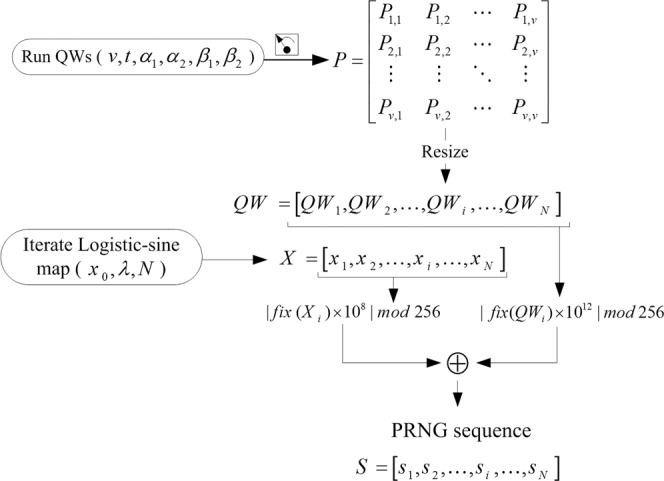
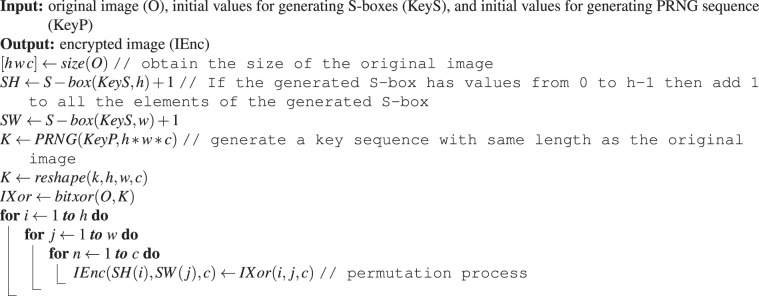
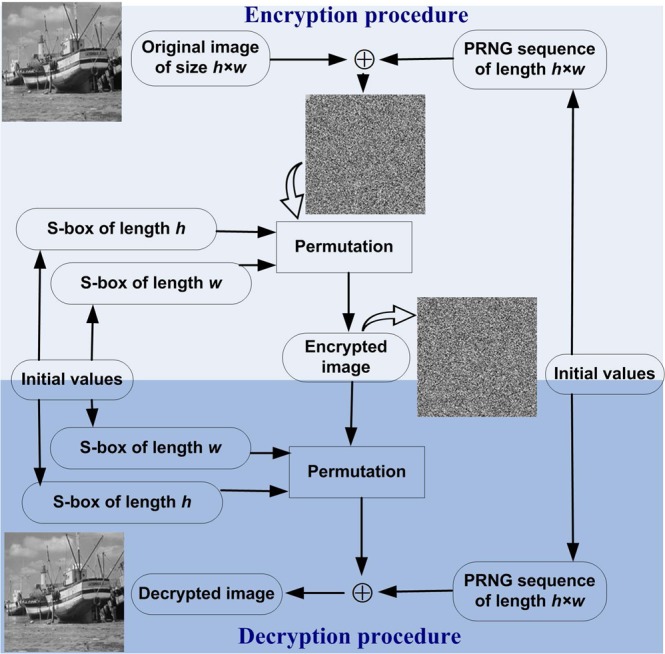
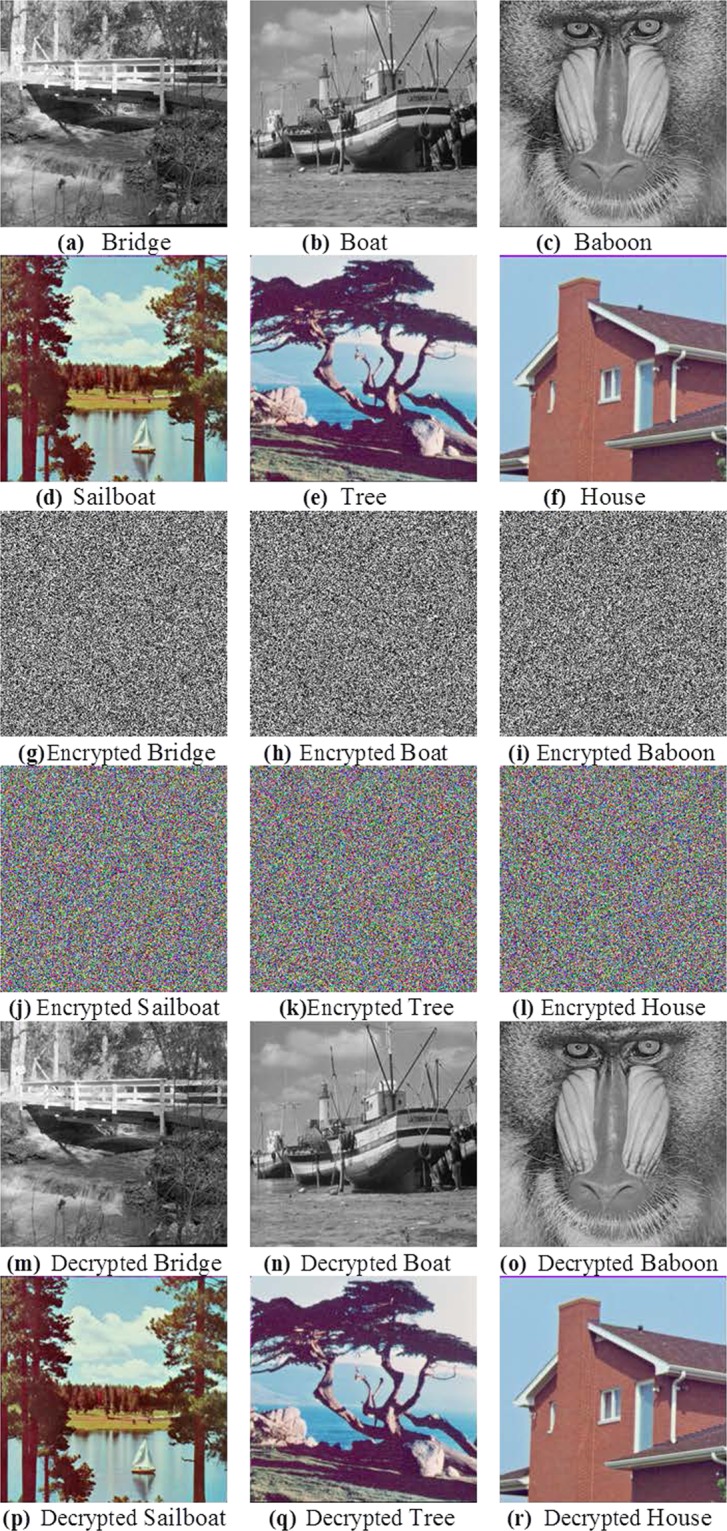
Designing efficient and secure cryptosystems has been a preoccupation for many scientists and engineers for a long time wherein they use chaotic systems to design new cryptosystems. While one dimensional (1-D) chaotic maps possess powerful properties compared to higher dimension ones, they are vulnerable to various attacks due to their small key space, chaotic discontinuous ranges, and degradation in chaotic dynamical behaviours. Moreover, when simulated on a computer, every such chaotic system produces a periodic cycle. Meanwhile, quantum random walks exhibit the potential for deployment in efficient cryptosystem design, which makes it an excellent solution for this problem. In this context, we present a new method for constructing substitution boxes (S-boxes) based on cascaded quantum-inspired quantum walks and chaos inducement. The performance of the proposed S-box scheme is investigated via established S-box evaluation criterion and outcomes suggest that the constructed S-box has significant qualities for viable applications information security. Further, we present an efficient scheme for pseudo-random numbers generation (PRNG) whose sustainability over long periods remedies the periodicity problem associated with traditional cryptographic applications. Furthermore, by combining the two mechanisms, an atypical image encryption scheme is introduced. Simulation results and analysis validate that the proposed image encryption algorithm will offer gains in many cryptographic applications.
Overview
The claims and statistics of this paper haven’t been checked yet.
Run the check — free, no account needed. It reads the open-access text and checks the sources it cites.
Integrity signals
Registry
Cites
Statistics
Figures
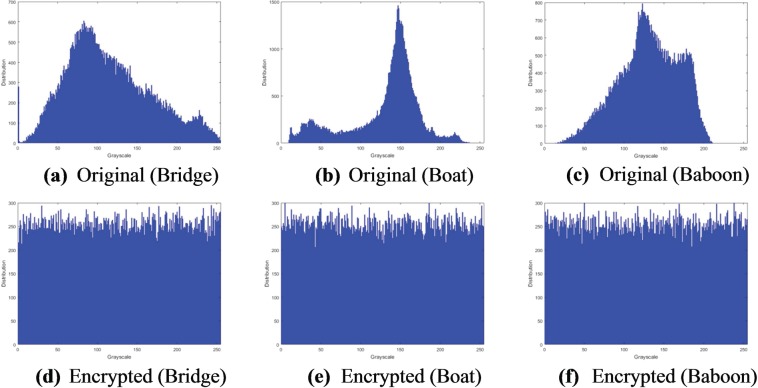
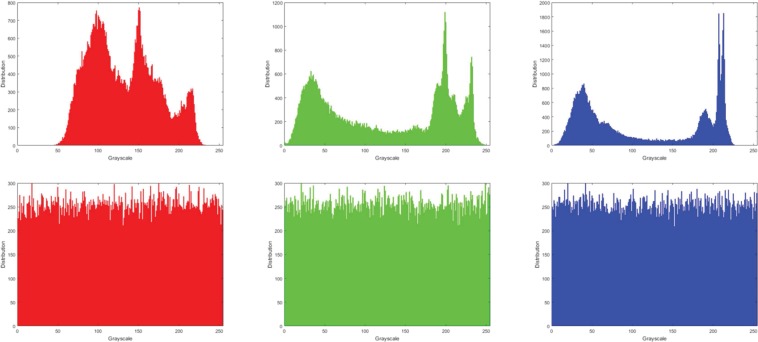
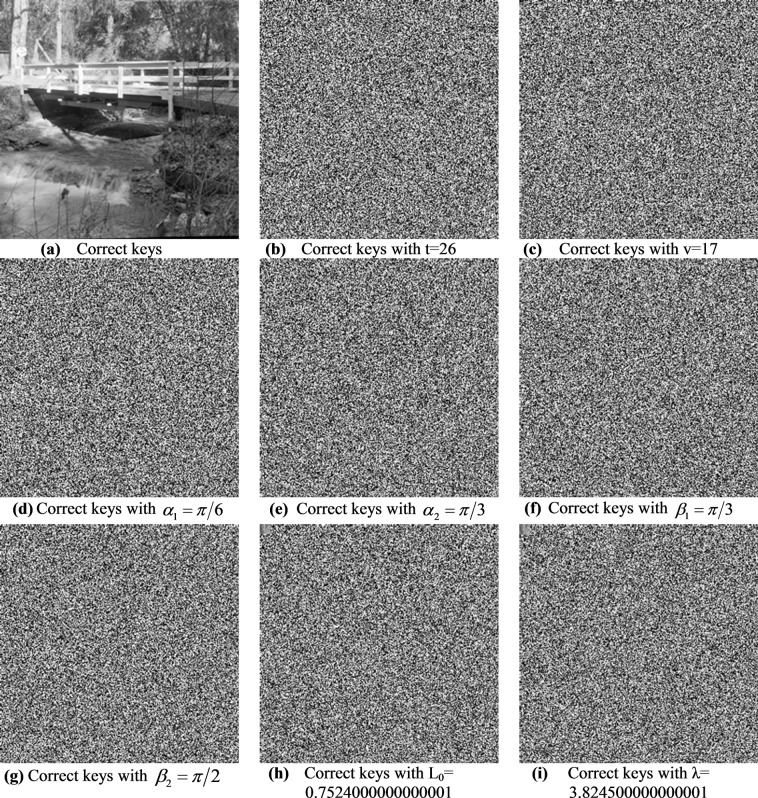
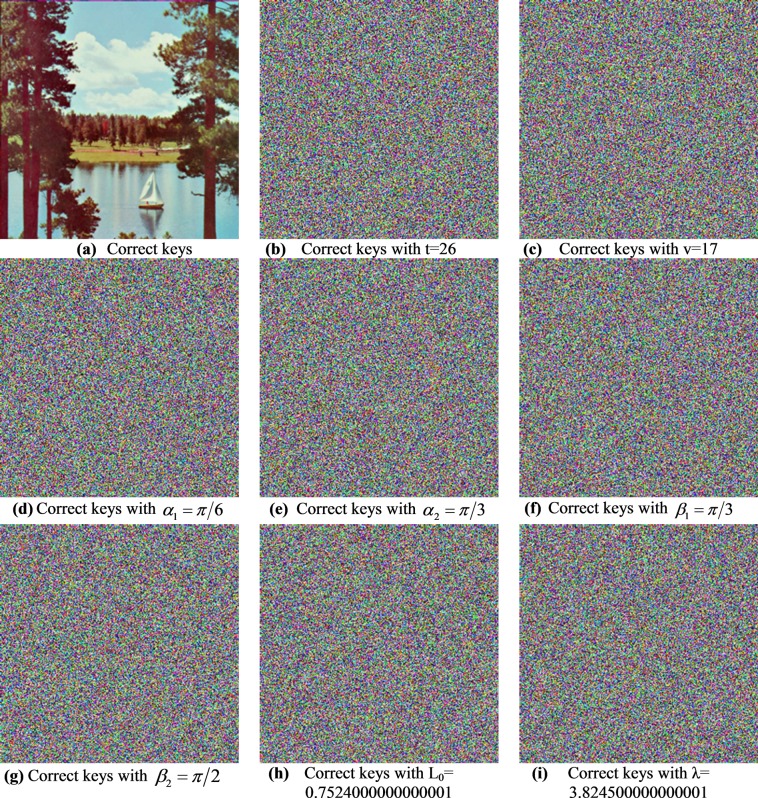
Verification
Claims the paper makes
The claims and statistics of this paper haven’t been checked yet.
Run the check — free, no account needed. It reads the open-access text and checks the sources it cites.
Claims other papers make about this one
Each is checked against this paper’s own text: does it say what the citing paper says it does?
The source backs part of the claim, not all of it — or backs it for a different population, condition or comparison.
In the citing paper
“The LAP value of 0.125 is lower and thus better than S-boxes investigated in [61] [64], [68] [72], [75], [76], [82], [83].”
From Bijective S-Boxes Method Using Improved Chaotic Map-Based Heuristic Search and Algebraic Group Structures (2020) · cites this paper as [82]
Experimental — accuracy not yet measured
Self-check
Percentages, sums and reported differences re-computed from the paper’s own numbers.
The self-check needs the paper’s full text.
Citations
Cites
SOME BASIC CRYPTOGRAPHIC REQUIREMENTS FOR CHAOS-BASED CRYPTOSYSTEMS
ALVAREZ, G., & LI, S. (2006) · International Journal of Bifurcation and Chaos · doi:10.1142/s0218127406015970 · Cited by 2,119
Kiktenko, E. O., Pozhar, N. O., Anufriev, M. N., Trushechkin, A. S., Yunusov, R. R., Kurochkin, Y. V., Lvovsky, A. I., & Fedorov, A. K. (2018) · Quantum Science and Technology · doi:10.1088/2058-9565/aabc6b · Cited by 264
Experimental realization of a delayed-choice quantum walk
Jeong, Y.-C., Di Franco, C., Lim, H.-T., Kim, M. S., & Kim, Y.-H. (2013) · Nature Communications · doi:10.1038/ncomms3471 · Cited by 76
Research works printed but not linked: 61
- Li, C., Feng, B., Li, S., Kurths, J. & Chen, G. Dynamic analysis of digital chaotic maps via state-mapping networks. IEEE Trans. Circuits Syst. I: Regul. Pap. 66, 2322–2335 (2019). · DOI · Paper page
- Matthews, R. On the derivation of a âchaoticâ encryption algorithm. Cryptologia 13, 29–42 (1989). · DOI · Paper page
- Kocarev, L. & Lian, S. Chaos-based cryptography: Theory, algorithms and applications, vol. 354 (Springer Science & Business Media, 2011). · DOI
- Jallouli, O., El Assad, S., Chetto, M. & Lozi, R. Design and analysis of two stream ciphers based on chaotic coupling and multiplexing techniques. Multimed. tools Appl. 77, 13391–13417 (2018). · DOI
- Li, C., Lin, D., Lü, J. & Hao, F. Cryptanalyzing an image encryption algorithm based on autoblocking and electrocardiography. IEEE Multimed. 25, 46–56 (2018). · DOI · Paper page
- Li, C., Lin, D., Feng, B., Lü, J. & Hao, F. Cryptanalysis of a chaotic image encryption algorithm based on information entropy. IEEE Access. 6, 75834–75842 (2018). · DOI · Paper page
- Zhou, Y., Hua, Z., Pun, C.-M. & Chen, C. P. Cascade chaotic system with applications. IEEE Trans. Cybern. 45, 2001–2012 (2014). · DOI
- Lv, X., Liao, X. & Yang, B. A novel pseudo-random number generator from coupled map lattice with time-varying delay. Nonlinear Dyn. 94, 325–341 (2018). · DOI
- Murillo-Escobar, M., Cruz-Hernández, C., Cardoza-Avendaño, L. & Méndez-Ramrez, R. A novel pseudorandom number generator based on pseudorandomly enhanced logistic map. Nonlinear Dyn. 87, 407–425 (2017). · DOI
- Sahari, M. L. & Boukemara, I. A pseudo-random numbers generator based on a novel 3d chaotic map with an application to color image encryption. Nonlinear Dyn. 94, 723–744 (2018). · DOI
- Lambić, D. Security analysis and improvement of the pseudo-random number generator based on quantum chaotic map. Nonlinear Dyn. 94, 1117–1126 (2018). · DOI
- El-Latif, A. A. A., Li, L., Wang, N., Han, Q. & Niu, X. A new approach to chaotic image encryption based on quantum chaotic system, exploiting color spaces. Signal. Process. 93, 2986–3000 (2013). · DOI
- Belazi, A., El-Latif, A. A. A. & Belghith, S. A novel image encryption scheme based on substitution-permutation network and chaos. Signal. Process. 128, 155–170 (2016). · DOI
- Li, L., Abd-El-Atty, B., El-Latif, A. A. A. & Ghoneim, A. Quantum color image encryption based on multiple discrete chaotic systems. In 2017 Federated Conference on Computer Science and Information Systems (FedCSIS), 555–559 (IEEE, 2017). · DOI
- Luo, Y., Zhou, R., Liu, J., Cao, Y. & Ding, X. A parallel image encryption algorithm based on the piecewise linear chaotic map and hyper-chaotic map. Nonlinear Dyn. 93, 1165–1181 (2018). · DOI · Paper page
- El-Latif, A. A. A., Abd-El-Atty, B. & Talha, M. Robust encryption of quantum medical images. IEEE Access. 6, 1073–1081 (2017). · DOI
- EL-Latif, A. A. A., Abd-El-Atty, B., Venegas-Andraca, S. E. & Mazurczyk, W. Efficient quantum-based security protocols for information sharing and data protection in 5g networks. Future Gener. Computer Syst. 100, 893–906 (2019). · DOI
- Li, D. et al. Discrete-time interacting quantum walks and quantum hash schemes. Quantum Inf. Process. 12, 1501–1513 (2013). · DOI
- Venegas-Andraca, S. E. Quantum walks: a comprehensive review. Quantum Inf. Process. 11, 1015–1106 (2012). · DOI · Paper page
- Melnikov, A. A., Fedichkin, L. E. & Alodjants, A. Detecting quantum speedup by quantum walk with convolutional neural networks. arXiv preprint arXiv:1901.10632 (2019). · DOI
- Zhang, G. Quantum-inspired evolutionary algorithms: a survey and empirical study. J. Heuristics 17, 303–351 (2011). · DOI
- Arrazola, J. M., Delgado, A., Bardhan, B. R. & Lloyd, S. Quantum-inspired algorithms in practice. arXiv preprint arXiv:1905.10415 (2019). · DOI
- Montiel, O., Rubio, Y., Olvera, C. & Rivera, A. Quantum-inspired acromyrmex evolutionary algorithm. Sci. Rep. 9, 1–10 (2019). · DOI
- Yang, Y.-G., Pan, Q.-X., Sun, S.-J. & Xu, P. Novel image encryption based on quantum walks. Sci. Rep. 5, 7784 (2015). · DOI
- Yang, Y.-G., Xu, P., Yang, R., Zhou, Y.-H. & Shi, W.-M. Quantum hash function and its application to privacy amplification in quantum key distribution, pseudo-random number generation and image encryption. Sci. Rep. 6, 19788 (2016). · DOI
- Abd-El-Atty, B., EL-Latif, A. A. A. & Venegas-Andraca, S. E. An encryption protocol for NEQR images based on one-particle quantum walks on a circle. Quantum Inf. Process. 18, 272 (2019). · DOI
- EL-Latif, A. A. A., Abd-El-Atty, B., Abou-Nassar, E. M. & Venegas-Andraca, S. E. Controlled alternate quantum walks based privacy preserving healthcare images in internet of things. Optics & Laser Technology 105942 (2019). · DOI
- EL-Latif, A. A. A., Abd-El-Atty, B. & Venegas-Andraca, S. E. Controlled alternate quantum walk-based pseudo-random number generator and its application to quantum color image encryption. Physica A: Statistical Mechanics and its Applications (2019). · DOI
- EL-Latif, A. A. A., Abd-El-Atty, B. & Venegas-Andraca, S. E. A novel image steganography technique based on quantum substitution boxes. Opt. Laser Technol. 116, 92–102 (2019). · DOI
- Zeng, M. & Yong, E. H. Discrete-time quantum walk with phase disorder: localization and entanglement entropy. Sci. Rep. 7, 12024 (2017). · DOI
- Souza, A. & Andrade, R. Coin state properties in quantum walks. Sci. Rep. 3, 1976 (2013). · DOI
- Wang, J. & Manouchehri, K. Physical implementation of quantum walks (Springer, 2013). · DOI
- Du, J. et al. Experimental implementation of the quantum random-walk algorithm. Phys. Rev. A 67, 042316 (2003). · DOI
- Douglas, B. & Wang, J. Efficient quantum circuit implementation of quantum walks. Phys. Rev. A 79, 052335 (2009). · DOI
- Goyal, S. K., Roux, F. S., Forbes, A. & Konrad, T. Implementation of multidimensional quantum walks using linear optics and classical light. Phys. Rev. A 92, 040302 (2015). · DOI
- Qiang, X. et al. Efficient quantum walk on a quantum processor. Nat. Commun. 7, 11511 (2016). · DOI · Paper page
- Qi, F., Wang, Y., Ma, Q. & Zheng, W. Experimentally simulating quantum walks with self-collimated light. Sci. Rep. 6, 28610 (2016). · DOI
- Lai, X. & Massey, J. L. A proposal for a new block encryption standard. In Workshop on the Theory and Application of of Cryptographic Techniques, 389–404 (Springer, 1990). · DOI
- Zhang, W. & Pasalic, E. Highly nonlinear balanced s-boxes with good differential properties. IEEE Trans. Inf. Theory 60, 7970–7979 (2014). · DOI
- Blondeau, C. & Nyberg, K. Perfect nonlinear functions and cryptography. Finite fields their Appl. 32, 120–147 (2015). · DOI
- Yang, Y.-G. & Zhao, Q.-Q. Novel pseudo-random number generator based on quantum random walks. Sci. Rep. 6, 20362 (2016). · DOI
- Zhou, Y., Cao, W. & Chen, C. P. Image encryption using binary bitplane. Signal. Process. 100, 197–207 (2014). · DOI
- Tsafack, N. et al. Design and implementation of a simple dynamical 4-d chaotic circuit with applications in image encryption. Inf. Sci. 515, 191–217 (2020). · DOI
- Nestor, T. et al. A multidimensional hyperjerk oscillator: Dynamics analysis, analogue and embedded systems implementation, and its application as a cryptosystem. Sens. 20, 83 (2020). · DOI
- Chiang, C.-F., Nagaj, D. & Wocjan, P. Efficient circuits for quantum walks. arXiv preprint arXiv:0903.3465 (2009). · arXiv
- Genske, M. et al. Electric quantum walks with individual atoms. Phys. Rev. Lett. 110, 190601 (2013). · DOI
- Melnikov, A. A. & Fedichkin, L. E. Quantum walks of interacting fermions on a cycle graph. Sci. Rep. 6, 34226 (2016). · DOI
- Li, D., Yang, Y.-G., Bi, J.-L., Yuan, J.-B. & Xu, J. Controlled alternate quantum walks based quantum hash function. Sci. Rep. 8, 225 (2018). · DOI
- Yang, Y.-G., Bi, J.-L., Li, D., Zhou, Y.-H. & Shi, W.-M. Hash function based on quantum walks. Int. J. Theor. Phys. 58, 1861–1873 (2019). · DOI
- Yang, Y.-G. et al. Simple hash function using discrete-time quantum walks. Quantum Inf. Process. 17, 189 (2018). · DOI
- Cao, W.-F. et al. Constructing quantum hash functions based on quantum walks on johnson graphs. Quantum Inf. Process. 17, 156 (2018). · DOI
- El-Latif, A. A. A. et al. Secret images transfer in cloud system based on investigating quantum walks in steganography approaches. Physica A: Statistical Mechanics and its Applications 123687 (2019). · DOI
- Li, D., Zhang, J., Ma, X.-W., Zhang, W.-W. & Wen, Q.-Y. Analysis of the two-particle controlled interacting quantum walks. Quantum Inf. Process. 12, 2167–2176 (2013). · DOI
- Zhou, Y., Bao, L. & Chen, C. P. A new 1d chaotic system for image encryption. Signal. Process. 97, 172–182 (2014). · DOI · Paper page
- Belazi, A. & El-Latif, A. A. A. A simple yet efficient s-box method based on chaotic sine map. Opt. 130, 1438–1444 (2017).
- Khan, M. & Asghar, Z. A novel construction of substitution box for image encryption applications with gingerbreadman chaotic map and s 8 permutation. Neural Comput. Appl. 29, 993–999 (2018). · DOI
- Wang, Y., Wong, K.-W., Li, C. & Li, Y. A novel method to design s-box based on chaotic map and genetic algorithm. Phys. Lett. A 376, 827–833 (2012). · DOI
- Tang, G., Liao, X. & Chen, Y. A novel method for designing s-boxes based on chaotic maps. Chaos, Solitons Fractals 23, 413–419 (2005). · DOI
- Özkaynak, F., Çelik, V. & Özer, A. B. A new s-box construction method based on the fractional-order chaotic chen system. Signal, Image Video Process. 11, 659–664 (2017). · DOI
- Belazi, A., Khan, M., El-Latif, A. A. A. & Belghith, S. Efficient cryptosystem approaches: S-boxes and permutation–substitution-based encryption. Nonlinear Dyn. 87, 337–361 (2017). · DOI
- Hussain, I., Shah, T. & Gondal, M. A. A novel approach for designing substitution-boxes based on nonlinear chaotic algorithm. Nonlinear Dyn. 70, 1791–1794 (2012). · DOI
Cited by
Sorted by citations
Providing End-to-End Security Using Quantum Walks in IoT Networks
El-Latif, A. A. A., Abd-El-Atty, B., Venegas-Andraca, S. E., Elwahsh, H., Piran, M. J., Bashir, A. K., Song, O.-Y., & Mazurczyk, W. (2020) · IEEE Access · doi:10.1109/access.2020.2992820 · Cited by 89
“However, the implementation of two-walker QW requires more physical resources than the realization of one-walker QW [41], that is why consequently Abd-El-Atty et al [36] designed a quantum encryption approach based on controlled one-walker QW. Finally, El-Latif et al [37] presented an image encryption approach using c…”
BackgroundSelf-citationAhmad, M., Al-Solami, E., Alghamdi, A. M., & Yousaf, M. A. (2020) · IEEE Access · doi:10.1109/access.2020.3001868 · Cited by 71
“For our S-box, the imbalance on the input/output EX-OR distribution is calculated as differential probability whose maximum value is 0.04687 which is capable to resist the differential cryptanalysis in better as compared to the S-boxes found in [22], [74], [82] and comparable to other findings.”
BackgroundResultInfluential
Metadata
- Authors
- Abd El-Latif, A. A., Abd-El-Atty, B., Amin, M., & Iliyasu, A. M.
- Affiliations
- Menoufia University (EG)
- Changchun University of Science and Technology (CN)
- Corresponding author
- Abd-El-Atty, Bassem
- Iliyasu, Abdullah M.
- Venue
- Scientific Reports
- Published
- 2020-02-06
- Volume
- 10
- Issue
- 1
- Pages
- 1930-1930
- ISSN
- 2045-2322 (ISSN-L)
- PMC
- PMC7005306
- OpenAlex
- W3005238411
- Cited by
- 155
- References
- 3
- Citations by year
- 2026: 4 · 2025: 19 · 2024: 24 · 2023: 23 · 2022: 36 · 2021: 36 · 2020: 13
- FWCI
- 10.50
- Type
- journal article
- Language
- en
- Open access
- gold
- doi.org
- Locations
- Scientific Reports (publishedVersion, cc-by)
- Europe PMC (PubMed Central) (publishedVersion, cc-by)
- PubMed Central (publishedVersion, cc-by)
- PubMed (publishedVersion)
- DOAJ (DOAJ: Directory of Open Access Journals) (submittedVersion)
- Greater South Information System
- Funders
- Prince Sattam bin Abdulaziz University (2019/01/9862)
- Menofia University
- Topics
- Physical Sciences › Computer Science › Computer Vision and Pattern Recognition › Chaos-based Image/Signal Encryption
- Physical Sciences › Physics and Astronomy › Atomic and Molecular Physics, and Optics › Quantum Information and Cryptography
- Physical Sciences › Computer Science › Computational Theory and Mathematics › Cellular Automata and Applications
- Keywords
- discrete-time quantum walks, chaotic maps, substitution boxes, S-box design, pseudorandom number generation, image encryption, quantum cryptography, chaotic dynamics
About these checks
Registry, retraction, Cites and statistics results are computed, not judged, with one exception: a printed reference that no index lists is read once by a model before it counts as a citation error. Claims are extracted by a model and kept only when their quote appears verbatim in the text; each cited source is then checked, with a model’s help, for whether it says what the claim relies on. Those verdicts can be wrong — read the claim’s quote and the cited source before relying on one.
Statistics and arithmetic are recomputed, not judged.
Confidence bands are shown only for fields calibrated on our annotated test set. None is calibrated yet, so no band is shown.
What counts as a claim ›How we measure confidence ›How we check this ›
Are you an author, or do you see a problem with this page? Request a review
