

The DOI matches its Crossref record; 1 of the 1 references it cites were found in a registry or an index.
Low vision and the risk of dementia: a nationwide population-based cohort study
Open accessAbstract
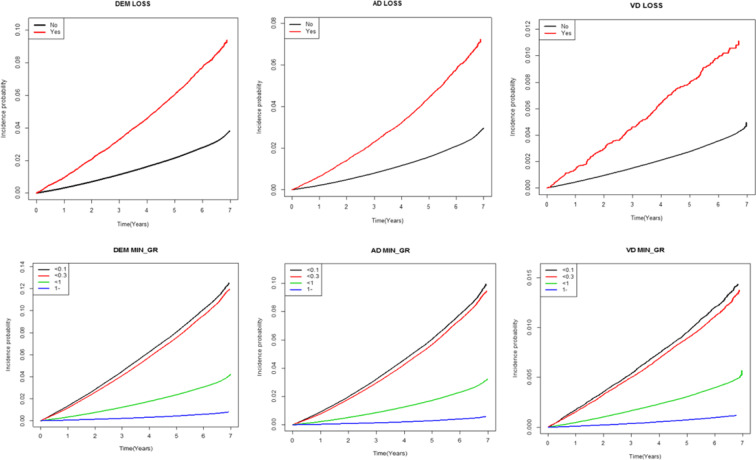
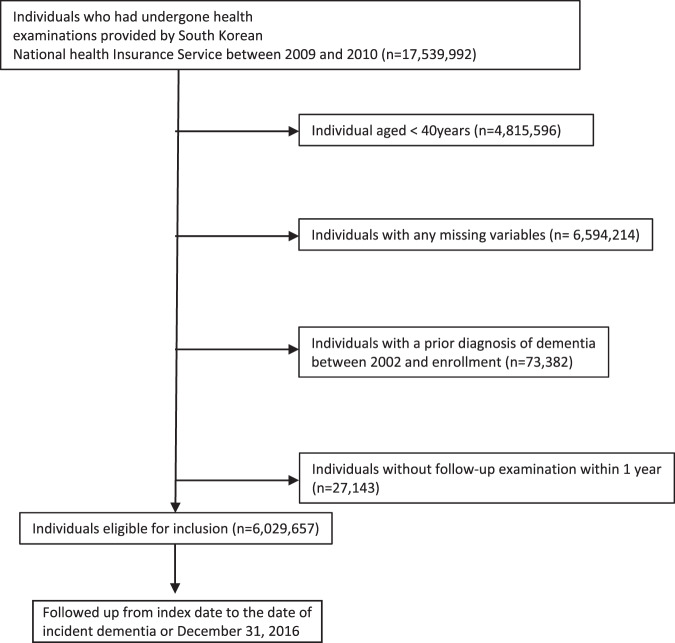
Recent studies suggested that an association exists between vision loss and cognitive impairment, although it is still vague whether there are causal relationships or direct association between low vision and dementia. We were to investigate the association between low vision and dementia in the Korean population using the National Health Insurance Service (NHIS) database. We analyzed the data of 6,029,657 subjects aged ≥40 years, drawn from Korea National Health Insurance Service. The hazard ratio (HRs) and 95% confidence interval (CIs) of dementia, Alzheimer’s disease (AD), and Vascular dementia (VD) were estimated using multivariable Cox proportional hazards regression models. Statistical analysis showed that subjects with more severe visual impairments have a higher risk of dementia, AD, and VD after adjusting for compounding variables. The HRs of dementia increased significantly as visual acuity worsened (HRs 1.444 [95% CIs 1.415–1.473] for visual acuity (VA) < 1.0, 1.734 [1.693–1.777] for VA < 0.3, 1.727 [1.686–1.770] for VA < 0.1 and 1.991[1.902–2.085] for visual loss). Baseline visual loss and visual impairment were positively associated with the risk of dementia, AD, and VD. From the results of this nationwide population-based cohort study, we suggest that there is a significant increase in the incidence of dementia in subjects with low vision.
Overview
The claims and statistics of this paper haven’t been checked yet.
Run the check — free, no account needed. It reads the open-access text and checks the sources it cites.
Integrity signals
Registry
Cites
Statistics
Figures
Verification
Claims the paper makes
The claims and statistics of this paper haven’t been checked yet.
Run the check — free, no account needed. It reads the open-access text and checks the sources it cites.
Claims other papers make about this one
Each is checked against this paper’s own text: does it say what the citing paper says it does?
The cited source says what the claim attributes to it.
In the citing paper
“supporting the hypothesis that vision loss in itself may be causal or that there is a dose-response effect to a shared aetiological factor.(257)”
From Dementia prevention, intervention, and care: 2024 report of the Lancet standing Commission (2024) · cites this paper as [257]
The cited source says what the claim attributes to it.
In the citing paper
“A Korean longitudinal health insurance database study of 6,029,657 people, found that dementia risk increased with visual impairment severity”
From Dementia prevention, intervention, and care: 2024 report of the Lancet standing Commission (2024) · cites this paper as [257]
Self-check
Percentages, sums and reported differences re-computed from the paper’s own numbers.
The self-check needs the paper’s full text.
Citations
Cites
Incidence and Risk of Dementia: The Rotterdam study
Ott, A., Breteler, M. M. B., Harskamp, F. V., Stijnen, T., & Hofman, A. (1998) · American Journal of Epidemiology · doi:10.1093/oxfordjournals.aje.a009489 · Cited by 455
Research works printed but not linked: 36
- Bowen, M. et al. The Prevalence of Visual Impairment in People with Dementia (the PrOVIDe study): a cross-sectional study of people aged 60–89 years with dementia and qualitative exploration of individual, carer and professional perspectives in Health Services and Delivery Research (NIHR Journals Library, 2016). · DOI
- Lane, C. A., Hardy, J. & Schott, J. M. Alzheimer’s disease. Eur. J. Neurol. 25, 59–70 (2018). · DOI · Paper page
- Scheltens, P. et al. Alzheimer’s disease. Lancet 388, 505–517 (2016). · DOI · Paper page
- Wortmann, M. Dementia: a global health priority - highlights from an ADI and World Health Organization report. Alzheimers Res. Ther. 4, 40 (2012). · DOI
- O’Brien, J. T. & Thomas, A. Vascular dementia. Lancet 386, 1698–1706 (2015). · DOI · Paper page
- Hebert, L. E., Scherr, P. A., Bienias, J. L., Bennett, D. A. & Evans, D. A. Alzheimer disease in the US population: prevalence estimates using the 2000 census. Arch. Neurol. 60, 1119–1122 (2003). · DOI · Paper page
- Wu, Y. T. et al. The changing prevalence and incidence of dementia over time - current evidence. Nat. Rev. Neurol. 13, 327–339 (2017).
- Wu, Y. T. et al. Dementia in western Europe: epidemiological evidence and implications for policy making. Lancet Neurol. 15, 116–124 (2016). · DOI
- Alzheimer’s Association. 2016 Alzheimer’s disease facts and figures. Alzheimers Dement 12, 459–509 (2016). · DOI · Paper page
- Stefanacci, R. G. The costs of Alzheimer’s disease and the value of effective therapies. Am. J. Manag. Care 17(Suppl 13), S356–362 (2011).
- Stephan, B. C. M. et al. Secular Trends in Dementia Prevalence and Incidence Worldwide: A Systematic Review. J. Alzheimers Dis. 66, 653–680 (2018). · DOI
- Clemons, T. E., Rankin, M. W. & McBee, W. L. Cognitive impairment in the Age-Related Eye Disease Study: AREDS report no. 16. Arch. Ophthalmol. 124, 537–543 (2006). · DOI · Paper page
- Ong, S. Y. et al. Visual impairment, age-related eye diseases, and cognitive function: the Singapore Malay Eye study. Arch. Ophthalmol. 130, 895–900 (2012).
- Lee, C. S. et al. Associations between recent and established ophthalmic conditions and risk of Alzheimer’s disease. Alzheimers Dement 15, 34–41 (2019). · DOI
- Chen, S. P., Bhattacharya, J. & Pershing, S. Association of Vision Loss With Cognition in Older Adults. JAMA Ophthalmol 135, 963–970 (2017). · DOI
- Pye, A., Charalambous, A. P., Leroi, I., Thodi, C. & Dawes, P. Screening tools for the identification of dementia for adults with age-related acquired hearing or vision impairment: a scoping review. Int. Psychogeriatr. 29, 1771–1784 (2017). · DOI
- Flaxman, S. R. et al. Global causes of blindness and distance vision impairment 1990-2020: a systematic review and meta-analysis. Lancet Glob Health 5, e1221–e1234 (2017). · DOI · Paper page
- Kang, J. H. et al. Contribution of the Nurses’ Health Study to the Epidemiology of Cataract, Age-Related Macular Degeneration, and Glaucoma. Am. J. Public Health 106, 1684–1689 (2016). · DOI
- Bourne, R. R. A. et al. Magnitude, temporal trends, and projections of the global prevalence of blindness and distance and near vision impairment: a systematic review and meta-analysis. Lancet Glob Health 5, e888–e897 (2017). · DOI · Paper page
- Evans, J. R. et al. Prevalence of visual impairment in people aged 75 years and older in Britain: results from the MRC trial of assessment and management of older people in the community. Br. J. Ophthalmol. 86, 795–800 (2002). · DOI
- Stevens, G. A. et al. Global prevalence of vision impairment and blindness: magnitude and temporal trends, 1990-2010. Ophthalmology 120, 2377–2384 (2013). · DOI
- Varma, R. et al. Visual Impairment and Blindness in Adults in the United States: Demographic and Geographic Variations From 2015 to 2050. JAMA Ophthalmol 134, 802–809 (2016). · DOI
- Schakel, W. et al. The Economic Burden of Visual Impairment and Comorbid Fatigue: A Cost-of-Illness Study (From a Societal Perspective). Invest. Ophthalmol. Vis. Sci. 59, 1916–1923 (2018). · DOI
- van Nispen, R. M., Vreeken, H. L., Comijs, H. C., Deeg, D. J. & van Rens, G. H. Role of vision loss, functional limitations and the supporting network in depression in a general population. Acta Ophthalmol 94, 76–82 (2016). · DOI
- Park, S. J., Ahn, S., Woo, S. J. & Park, K. H. Extent of Exacerbation of Chronic Health Conditions by Visual Impairment in Terms of Health-Related Quality of Life. JAMA Ophthalmol. 133, 1267–1275 (2015). · DOI
- Lee, J. Y. et al. Risk of Incident Dementia According to Metabolic Health and Obesity Status in Late Life: A Population-Based Cohort Study. J. Clin. Endocrinol. Metab. 104, 2942–2952 (2019). · DOI
- Hasnain, M. & Vieweg, W. V. Possible role of vascular risk factors in Alzheimer’s disease and vascular dementia. Curr. Pharm. Des. 20, 6007–6013 (2014). · DOI
- Lee, S. H. et al. Variability in metabolic parameters and risk of dementia: a nationwide population-based study. Alzheimers Res. Ther. 10, 110 (2018). · DOI
- Tariq, S. & Barber, P. A. Dementia risk and prevention by targeting modifiable vascular risk factors. J. Neurochem. 144, 565–581 (2018). · DOI
- Ratnayaka, J. A., Serpell, L. C. & Lotery, A. J. Dementia of the eye: the role of amyloid beta in retinal degeneration. Eye (Lond.) 29, 1013–1026 (2015). · DOI
- Zhao, Y. et al. Beta-Amyloid Precursor Protein (betaAPP) Processing in Alzheimer's Disease (AD) and Age-Related Macular Degeneration (AMD). Mol. Neurobiol. 52, 533–544 (2015). · DOI
- Livingston, G. et al. Dementia prevention, intervention, and care. Lancet. 390, 2673–2734 (2017). · DOI · Paper page
- Shin, D. W., Cho, B. & Guallar, E. Korean National Health Insurance Database. JAMA Intern. Med. 176, 138 (2016). · DOI
- Song, S. J. et al. Trends in diabetic retinopathy and related medical practices among type 2 diabetes patients: Results from the National Insurance Service Survey 2006-2013. J. Diabetes Investig. 9, 173–178 (2018). · DOI
- Cho, J. H., Suh, J. D., Han, K. D., Jung, J. H. & Lee, H. M. Uvulopalatopharyngoplasty May Reduce the Incidence of Dementia Caused by Obstructive Sleep Apnea: National Insurance Service Survey 2007–2014. J. Clin. Sleep Med. 14, 1749–1755 (2018). · DOI
- Kay, R. Proportional hazard regression models and the analysis of censored survival data. J. R. Stat. Soc. Ser. C (Applied Stat). 57, 289–300 (1995).
Cited by
Sorted by citations
Dementia prevention, intervention, and care: 2024 report of the Lancet standing Commission
Livingston, G., Huntley, J., Liu, K. Y., Costafreda, S. G., Selbæk, G., Alladi, S., Ames, D., Banerjee, S., Burns, A., Brayne, C., et al. (2024) · The Lancet · doi:10.1016/s0140-6736(24)01296-0 · Cited by 3,860
Visual impairment, eye diseases, and dementia risk: a systematic review and meta-analysis
Kuźma, E., Littlejohns, T. J., Khawaja, A. P., Llewellyn, D. J., Ukoumunne, O. C., & Thiem, U. (2021) · Journal of Alzheimer's Disease · doi:10.3233/jad-210250 · Cited by 83
Ehrlich, J. R., Goldstein, J., Swenor, B. K., Whitson, H., Langa, K. M., & Veliz, P. (2022) · JAMA Neurology · doi:10.1001/jamaneurol.2022.0723 · Cited by 69
Metadata
- Authors
- Paik, J.-S., Ha, M., Jung, Y. H., Kim, G.-H., Han, K.-D., Kim, H.-S., Lim, D. H., & Na, K.-S.
- Affiliations
- Catholic University of Korea (KR)
- Soongsil University (KR)
- Samsung Medical Center (KR)
- Corresponding author
- Lim, Dong Hui
- Na, Kyung-Sun
- Venue
- Scientific Reports
- Published
- 2020-06-04
- Volume
- 10
- Issue
- 1
- Pages
- 9109-9109
- ISSN
- 2045-2322 (ISSN-L)
- PMC
- PMC7272467
- OpenAlex
- W3033542549
- Cited by
- 54
- References
- 1
- Citations by year
- 2026: 3 · 2025: 10 · 2024: 12 · 2023: 3 · 2022: 11 · 2021: 14 · 2020: 1
- FWCI
- 5.29
- Type
- journal article
- Language
- en
- Open access
- gold
- doi.org
- Locations
- Scientific Reports (publishedVersion, cc-by)
- PubMed Central (publishedVersion, cc-by)
- PubMed (publishedVersion)
- Funders
- National Research Foundation (2016R1D1A1B03930886)
- National Research Foundation of Korea (2019R1F1A1061421, 2016R1A6A1A03010528)
- Topics
- Health Sciences › Medicine › Psychiatry and Mental health › Dementia and Cognitive Impairment Research
- Health Sciences › Medicine › Ophthalmology › Ophthalmology and Visual Impairment Studies
- Health Sciences › Medicine › Ophthalmology › Retinal Diseases and Treatments
- Keywords
- low vision, visual impairment, dementia, Alzheimer's disease, vascular dementia, visual acuity, vision loss, cognitive impairment, Korean population
- MeSH terms
- Adult, Aged, Aged, 80 and over, Alzheimer Disease, Dementia, Female, Humans, Male, Middle Aged, Risk, Severity of Illness Index, Visual Acuity, Dementia, Vascular, Cohort Studies, Vision, Low, Incidence, Databases, Factual, Republic of Korea
About these checks
Registry, retraction, Cites and statistics results are computed, not judged, with one exception: a printed reference that no index lists is read once by a model before it counts as a citation error. Claims are extracted by a model and kept only when their quote appears verbatim in the text; each cited source is then checked, with a model’s help, for whether it says what the claim relies on. Those verdicts can be wrong — read the claim’s quote and the cited source before relying on one.
Statistics and arithmetic are recomputed, not judged.
Confidence bands are shown only for fields calibrated on our annotated test set. None is calibrated yet, so no band is shown.
What counts as a claim ›How we measure confidence ›How we check this ›
Are you an author, or do you see a problem with this page? Request a review
