

Machine learning based identification of relevant parameters for functional voice disorders derived from endoscopic high-speed recordings
Open accessThe DOI matches its Crossref record; 63 of the 63 references it cites were found in a registry or an index.
Abstract
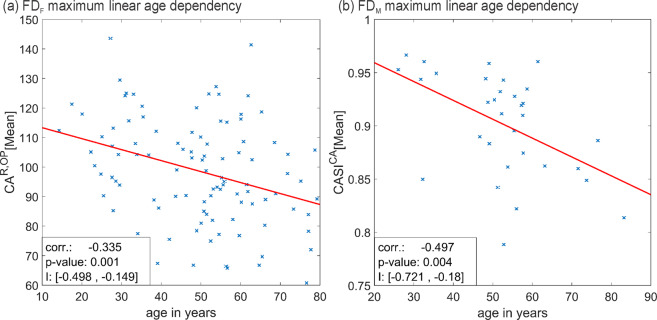
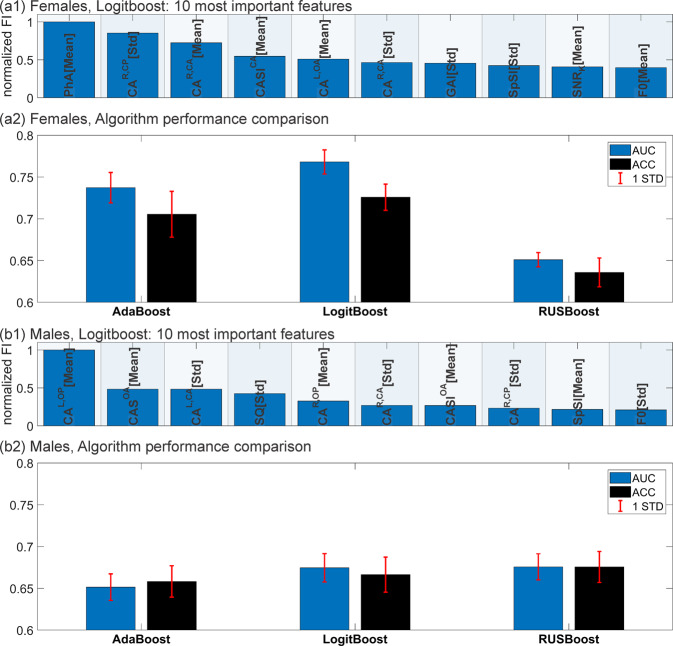
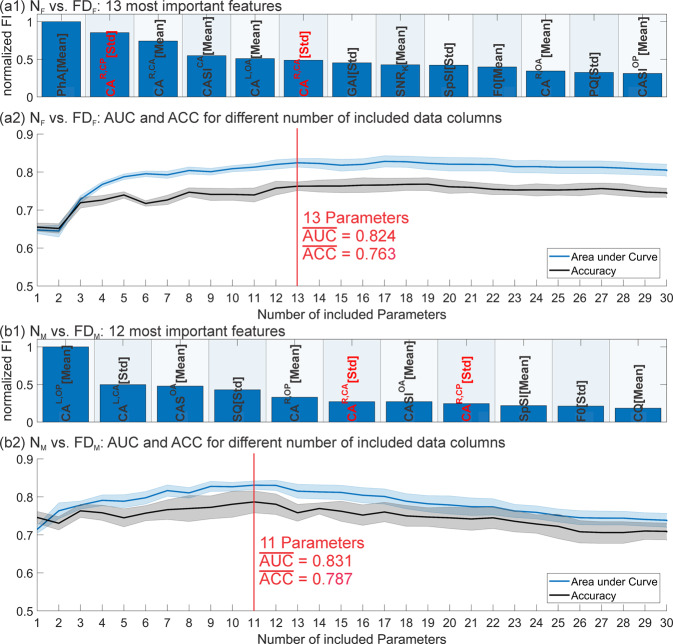
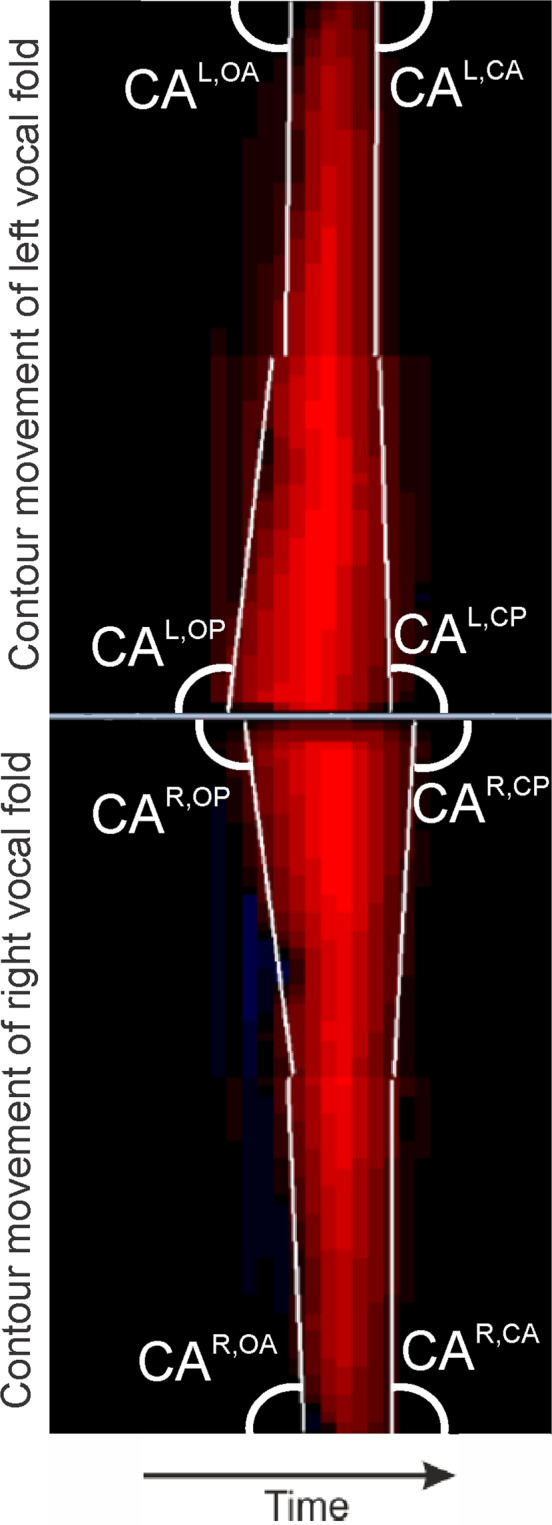
In voice research and clinical assessment, many objective parameters are in use. However, there is no commonly used set of parameters that reflect certain voice disorders, such as functional dysphonia (FD); i.e. disorders with no visible anatomical changes. Hence, 358 high-speed videoendoscopy (HSV) recordings (159 normal females (N F), 101 FD females (FD F), 66 normal males (N M), 32 FD males (FD M)) were analyzed. We investigated 91 quantitative HSV parameters towards their significance. First, 25 highly correlated parameters were discarded. Second, further 54 parameters were discarded by using a LogitBoost decision stumps approach. This yielded a subset of 12 parameters sufficient to reflect functional dysphonia. These parameters separated groups N F vs. FD F and N M vs. FD M with fair accuracy of 0.745 or 0.768, respectively. Parameters solely computed from the changing glottal area waveform (1D-function called GAW) between the vocal folds were less important than parameters describing the oscillation characteristics along the vocal folds (2D-function called Phonovibrogram). Regularity of GAW phases and peak shape, harmonic structure and Phonovibrogram-based vocal fold open and closing angles were mainly important. This study showed the high degree of redundancy of HSV-voice-parameters but also affirms the need of multidimensional based assessment of clinical data.
Overview
The claims and statistics of this paper haven’t been checked yet.
Free: it reads the open-access text and checks the first 5 claims that cite a source we can check. Create a free account to check every claim.
Integrity signals
Registry
Cites
Statistics
Figures
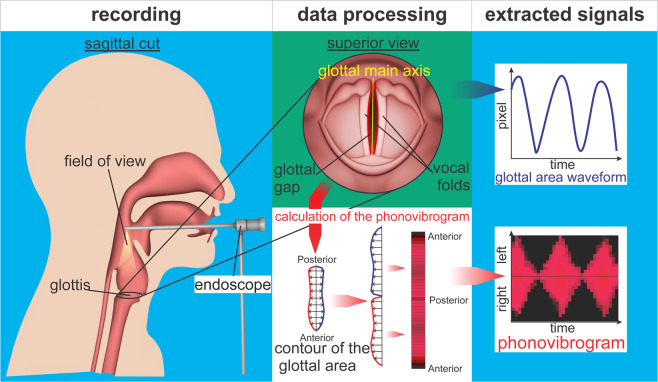
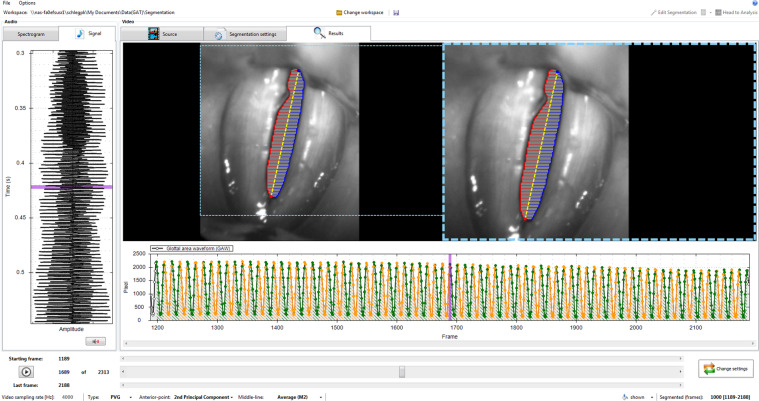
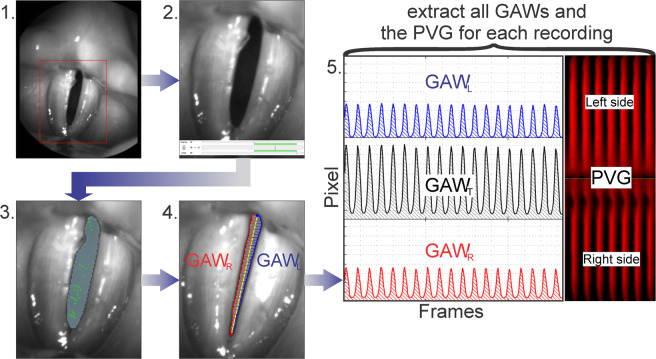
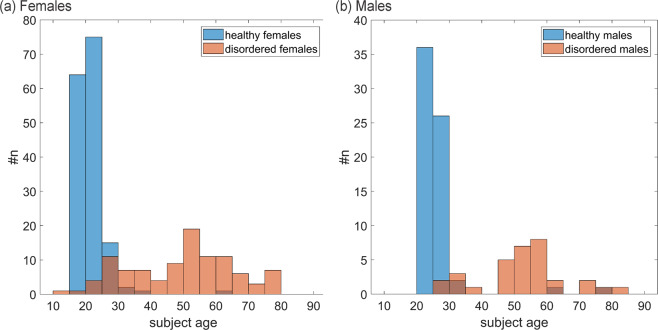
Verification
Claims the paper makes
The claims and statistics of this paper haven’t been checked yet.
Free: it reads the open-access text and checks the first 5 claims that cite a source we can check. Create a free account to check every claim.
Claims other papers make about this one
Each is checked against this paper’s own text: does it say what the citing paper says it does?
The source backs part of the claim, not all of it — or backs it for a different population, condition or comparison.
In the citing paper
“Laryngeal imaging—including videolaryngoscopy, stroboscopy, and high-speed videoendoscopy—represents the reference standard for laryngeal evaluation [9,16,17,18]; however, access depends on practitioner expertise, equipment availability, and cost, while neuromuscular disorders may present without visible structural lesions, complicating diagnosis [19].”
From Diagnostic Accuracy of Artificial Intelligence in Laryngeal Disorders: An Integrative Review (2026) · cites this paper as [17]
Experimental — accuracy not yet measured
Self-check
Percentages, sums and reported differences re-computed from the paper’s own numbers.
The self-check needs the paper’s full text.
Citations
Cites
Statistics corner: A guide to appropriate use of correlation coefficient in medical research.
(2012) · Europe PMC (PubMed Central) · Cited by 4,239
An empirical comparison of supervised learning algorithms
Caruana, R., & Niculescu-Mizil, A. (2006) · Proceedings of the 23rd international conference on Machine learning - ICML '06 · doi:10.1145/1143844.1143865 · Cited by 2,780
Géron, A. (2017) · Cited by 1,443
Acoustic Correlates of Breathy Vocal Quality
Hillenbrand, J., Cleveland, R. A., & Erickson, R. L. (1994) · Journal of Speech, Language, and Hearing Research · doi:10.1044/jshr.3704.769 · Cited by 747
Holmberg, E. B., Hillman, R. E., & Perkell, J. S. (1988) · The Journal of the Acoustical Society of America · doi:10.1121/1.396829 · Cited by 642
Harmonics-to-noise ratio as an index of the degree of hoarseness
Yumoto, E., Gould, W. J., & Baer, T. (1982) · The Journal of the Acoustical Society of America · doi:10.1121/1.387808 · Cited by 559
Stevens, K. N. (1999) · The MIT Press eBooks · doi:10.7551/mitpress/1072.001.0001 · Cited by 515
Induction of One-Level Decision Trees
Iba, W., & Langley, P. (1992) · Machine Learning Proceedings 1992 · doi:10.1016/b978-1-55860-247-2.50035-8 · Cited by 349
Laryngoscopic and Voice Characteristics of Aged Persons
Honjo, I., & Isshiki, N. (1980) · Archives of Otolaryngology - Head and Neck Surgery · doi:10.1001/archotol.1980.00790270013003 · Cited by 288
Normalized noise energy as an acoustic measure to evaluate pathologic voice
Kasuya, H., Ogawa, S., Mashima, K., & Ebihara, S. (1986) · The Journal of the Acoustical Society of America · doi:10.1121/1.394384 · Cited by 256
Research works printed but not linked: 6
- Titze, I. R. Principles of voice production (2nd ed.) (National Center for Voice and Speech, 2000).
- Wendler, J., Seidner, W. & Eysholdt, U. Lehrbuch der Phoniatrie und Pädaudiologie (4th ed.) 139-189 (Georg Thieme, 2005). · DOI
- Stemple, J. C. & Fry, L. B. Laryngeal Evaluation. 110–119 (Georg Thieme, 2010).
- Deliyski, D. Laryngeal evaluation., 245–270 (Georg Thieme, 2010).
- Géron, A. Hands-on machine learning with Scikit-Learn & TensorFlow (vol. 1) 183-205 (Media, Inc., 2017).
- Géron, A. Hands-on machine learning with Scikit-Learn & TensorFlow (vol. 1) 81-106 (Media, Inc., 2017).
Cited by
A Novel Approach for Classification of Speech Emotions Based on Deep and Acoustic Features
Er, M. B. (2020) · IEEE Access · doi:10.1109/access.2020.3043201 · Cited by 177
Ur Rehman, M., Shafique, A., Azhar, Q.-U.-A., Jamal, S. S., Gheraibia, Y., & Usman, A. B. (2024) · Engineering Applications of Artificial Intelligence · doi:10.1016/j.engappai.2024.108047 · Cited by 73
Nobel, S. M. N., Swapno, S. M. M. R., Islam, M. R., Safran, M., Alfarhood, S., & Mridha, M. F. (2024) · Scientific Reports · doi:10.1038/s41598-024-64987-5 · Cited by 79
OpenHSV: an open platform for laryngeal high-speed videoendoscopy
Kist, A. M., Dürr, S., Schützenberger, A., & Döllinger, M. (2021) · Scientific Reports · doi:10.1038/s41598-021-93149-0 · Cited by 48
Self-citationArtificial intelligence in clinical endoscopy: Insights in the field of videomics
Paderno, A., Gennarini, F., Sordi, A., Montenegro, C., Lancini, D., Villani, F. P., Moccia, S., & Piazza, C. (2022) · Frontiers in Surgery · doi:10.3389/fsurg.2022.933297 · Cited by 34
Metadata
- Authors
- Schlegel, P., Kniesburges, S., Dürr, S., Schützenberger, A., & Döllinger, M.
- Affiliations
- Friedrich-Alexander-Universität Erlangen-Nürnberg (DE)
- Corresponding author
- Schlegel, Patrick
- Venue
- Scientific Reports
- Published
- 2020-06-29
- Volume
- 10
- Issue
- 1
- Pages
- 10517-10517
- ISSN
- 2045-2322 (ISSN-L)
- PMC
- PMC7324600
- OpenAlex
- W3040522169
- Cited by
- 43
- References
- 63
- Citations by year
- 2026: 4 · 2025: 5 · 2024: 11 · 2023: 9 · 2022: 6 · 2021: 6 · 2020: 2
- FWCI
- 3.46
- Type
- journal article
- Language
- en
- Open access
- gold
- doi.org
- Licence
- cc-by
- creativecommons.org/licenses/by/4.0 (tdm)
- creativecommons.org/licenses/by/4.0 (vor)
- Locations
- Scientific Reports (publishedVersion, cc-by)
- PubMed Central (publishedVersion, cc-by)
- PubMed (publishedVersion)
- OPUS FAU (Kooperativer Bibliotheksverbund Berlin-Brandenburg (KOBV), on behalf of the Universitätsbibliothek Erlangen-Nürnberg) (submittedVersion, cc-by)
- Funders
- Deutsche Forschungsgemeinschaft (BO4399/2‐1, DO1247/8-1, 323308998)
- Topics
- Health Sciences › Health Professions › Speech and Hearing › Voice and Speech Disorders
- Social Sciences › Psychology › Experimental and Cognitive Psychology › Phonetics and Phonology Research
- Health Sciences › Medicine › Pulmonary and Respiratory Medicine › Respiratory and Cough-Related Research
- Keywords
- functional dysphonia, high-speed videoendoscopy, voice disorders, parameter selection, LogitBoost, glottal area waveform, vocal fold vibration, parameter redundancy
- MeSH terms
- Machine Learning, Age Factors, Endoscopy, Female, Humans, Laryngoscopy, Male, Voice Disorders, Voice Quality
About these checks
Registry, retraction, Cites and statistics results are computed, not judged, with one exception: a printed reference that no index lists is read once by a model before it counts as a citation error. Claims are extracted by a model and kept only when their quote appears verbatim in the text; each cited source is then checked, with a model’s help, for whether it says what the claim relies on. Those verdicts can be wrong — read the claim’s quote and the cited source before relying on one.
Statistics and arithmetic are recomputed, not judged.
Confidence bands are shown only for fields calibrated on our annotated test set. None is calibrated yet, so no band is shown.
What counts as a claim ›How we measure confidence ›How we check this ›
Are you an author, or do you see a problem with this page? Request a review
How to cite
Cite CoChat for the checks on this page, and the paper for its own findings.
- This page
- CoChat. (2026). Citation check: Machine learning based identification of relevant parameters for functional voice disorders derived from endoscopic high-speed recordings. https://app.cochat.ai/papers/10.1038/s41598-020-66405-y
- The paper
- Schlegel, P., Kniesburges, S., Dürr, S., Schützenberger, A., & Döllinger, M. (2020). Machine learning based identification of relevant parameters for functional voice disorders derived from endoscopic high-speed recordings. Scientific Reports. https://doi.org/10.1038/s41598-020-66405-y
Data sources
Bibliographic data: Semantic Scholar, OpenAlex, Crossref.
Contains information from the Semantic Scholar Academic Graph Datasets, made available under the ODC Attribution License (ODC-BY 1.0).
Semantic Scholar’s data is described in: Kinney, R., et al. (2023). The Semantic Scholar Open Data Platform. arXiv:2301.10140.
