

An Incremental Voltage Difference Based Technique for Online State of Health Estimation of Li-ion Batteries
Open accessThe DOI matches its Crossref record; 38 of the 38 references it cites were found in a registry or an index.
Abstract
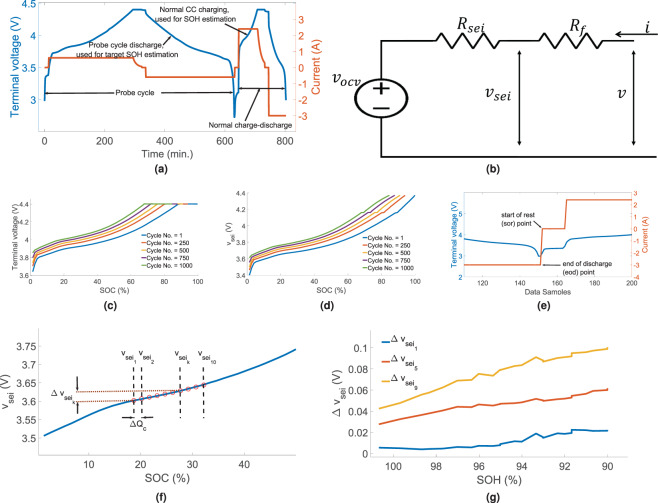
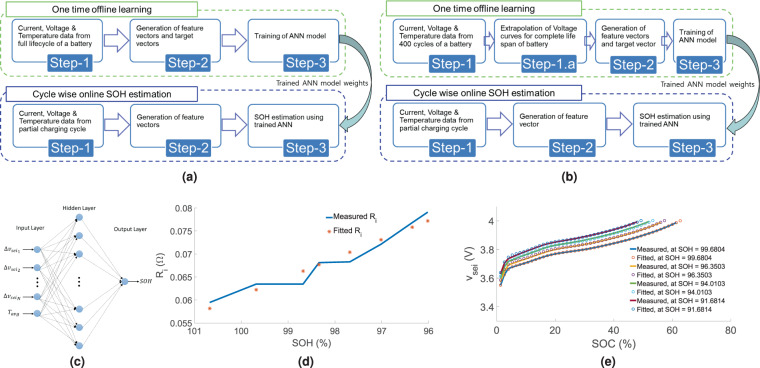
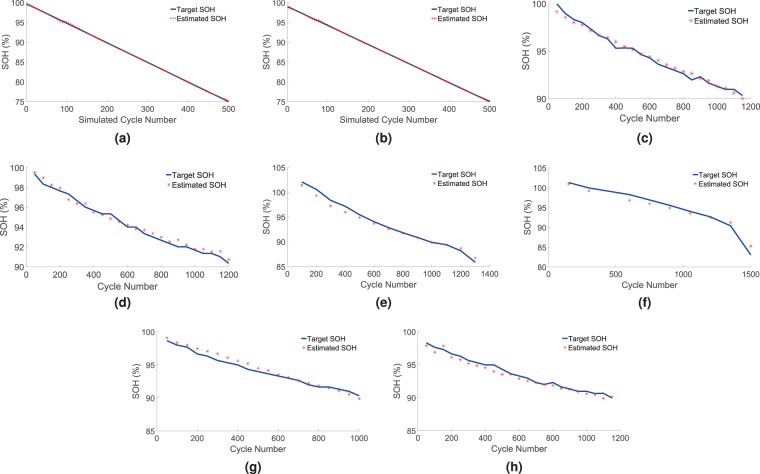
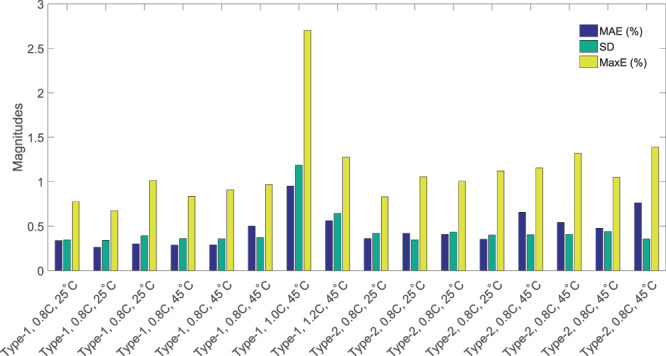
Accurate state of health (SOH) estimation of rechargeable batteries is important for the safe and reliable operation of electric vehicles (EVs), smart phones, and other battery operated systems. We propose a novel method for accurate SOH estimation which does not necessarily need full charging data. Using only partial charging data during normal usage, 10 derived voltage values ([Formula: see text]) are collected. The initial [Formula: see text] point is fixed and then for every 1.5% increase in the Coulomb counting, other points are selected. The difference between the [Formula: see text] values ([Formula: see text]) and the average temperature during the charging form the feature vector at different SOH levels. The training data set is prepared by extrapolating the charging voltage curves for the complete SOH range using initial 400 cycles of data. The trained artificial neural network (ANN) based on the feature vector and SOH values can be used in any battery management system (BMS) with a time complexity of only [Formula: see text]. Less than 1% mean absolute error (MAE) for the test cases has been achieved. The proposed method has a moderate training data requirement and does not need any knowledge of previous SOH, state of charge (SOC) vs. OCV relationship, and absolute SOC value.
Overview
The claims and statistics of this paper haven’t been checked yet.
Free: it reads the open-access text and checks the first 5 claims that cite a source we can check. Create a free account to check every claim.
Integrity signals
Registry
Cites
Statistics
Figures
Verification
Claims the paper makes
The claims and statistics of this paper haven’t been checked yet.
Free: it reads the open-access text and checks the first 5 claims that cite a source we can check. Create a free account to check every claim.
Claims other papers make about this one
Each is checked against this paper’s own text: does it say what the citing paper says it does?
The source backs part of the claim, not all of it — or backs it for a different population, condition or comparison.
In the citing paper
“The experimental results showed that the error between the extrapolated prediction curve and that measured is less than 1%.”
From A Review of Lithium-Ion Battery State of Health Estimation and Prediction Methods (2021) · cites this paper as [97]
Experimental — accuracy not yet measuredIn the citing paper
“The proposed algorithm in this paper greatly improved accuracy and did not need the past SOH, SOC, OCV curves, and other information, which indicates that it has strong applicability.”
From A Review of Lithium-Ion Battery State of Health Estimation and Prediction Methods (2021) · cites this paper as [97]
Self-check
Percentages, sums and reported differences re-computed from the paper’s own numbers.
The self-check needs the paper’s full text.
Citations
Cites
IEEE Transactions on Vehicular Technology
(2023) · IEEE Transactions on Vehicular Technology · doi:10.1109/tvt.25 · Cited by 1,174
Modeling of Lithium-Ion Battery Degradation for Cell Life Assessment
Xu, B., Oudalov, A., Ulbig, A., Andersson, G., & Kirschen, D. S. (2018) · IEEE Transactions on Smart Grid · doi:10.1109/tsg.2016.2578950 · Cited by 1,162
Lipu, M. S. H., Hannan, M. A., Hussain, A., Hoque, M. M., Ker, P. J., Saad, M. H. M., & Ayob, A. (2018) · Journal of Cleaner Production · doi:10.1016/j.jclepro.2018.09.065 · Cited by 755
State of Charge and State of Health Estimation for Lithium Batteries Using Recurrent Neural Networks
Chaoui, H., & Ibe-Ekeocha, C. C. (2017) · IEEE Transactions on Vehicular Technology · doi:10.1109/tvt.2017.2715333 · Cited by 555 · cited 1×
“Simplified analytical expressions are provided in35 for capacity loss (QLoss (10)) and the resistance of the SEI layer (Rsei (11)).”
BackgroundShen, P., Ouyang, M., Lu, L., Li, J., & Feng, X. (2018) · IEEE Transactions on Vehicular Technology · doi:10.1109/tvt.2017.2751613 · Cited by 534 · cited 1×
“∆ = ∆ ∆ ∆ Q Q Q Q [ (50,0) (100,0) (400,0)] (20) Loss Loss Loss T Loss”
Hu, X., Yuan, H., Zou, C., Li, Z., & Zhang, L. (2018) · IEEE Transactions on Vehicular Technology · doi:10.1109/tvt.2018.2865664 · Cited by 532 · cited 1×
“∆ = ∆ ∆ ∆ R R R R [ (50,0) (100,0) (400,0)] (21) sei sei sei T sei”
Li, Y., Abdel-Monem, M., Gopalakrishnan, R., Berecibar, M., Nanini-Maury, E., Omar, N., van den Bossche, P., & Van Mierlo, J. (2018) · Journal of Power Sources · doi:10.1016/j.jpowsour.2017.10.092 · Cited by 531 · cited 3×
“The summation in (4) is taken for the complete discharge period.”
BackgroundMethodLi, X., Yuan, C., Li, X., & Wang, Z. (2020) · Energy · doi:10.1016/j.energy.2019.116467 · Cited by 482
Xiong, R., Zhang, Y., Wang, J., He, H., Peng, S., & Pecht, M. (2019) · IEEE Transactions on Vehicular Technology · doi:10.1109/tvt.2018.2864688 · Cited by 449 · cited 3×
“The descriptions of the symbols used in (10)-(12) are provided in Table 4.”
BackgroundMethodWeng, C., Sun, J., & Peng, H. (2014) · Journal of Power Sources · doi:10.1016/j.jpowsour.2014.02.026 · Cited by 375 · cited 2×
“= × SOH n capacity n C ( ) ( ) 100% (5) max”
Method
Cited by
Review on state-of-health of lithium-ion batteries: Characterizations, estimations and applications
Yang, S., Zhang, C., Jiang, J., Zhang, W., Zhang, L., & Wang, Y. (2021) · Journal of Cleaner Production · doi:10.1016/j.jclepro.2021.128015 · Cited by 435
Sui, X., He, S., Vilsen, S. B., Meng, J., Teodorescu, R., & Stroe, D.-I. (2021) · Applied Energy · doi:10.1016/j.apenergy.2021.117346 · Cited by 409
Lu, J., Xiong, R., Tian, J., Wang, C., & Sun, F. (2023) · Nature Communications · doi:10.1038/s41467-023-38458-w · Cited by 403
“Speci fi cally, charging capacity sequences within a voltage sampling window (so-called partial charging curves) are taken as the input of each DNN, as demonstrated by previous studies 25,34 – 37 .”
Applications of artificial neural network based battery management systems: A literature review
Kurucan, M., Özbaltan, M., Yetgin, Z., & Alkaya, A. (2024) · Renewable and Sustainable Energy Reviews · doi:10.1016/j.rser.2023.114262 · Cited by 256
Multi-modal framework for battery state of health evaluation using open-source electric vehicle data
Liu, H., Li, C., Hu, X., Li, J., Zhang, K., Xie, Y., Wu, R., & Song, Z. (2025) · Nature Communications · doi:10.1038/s41467-025-56485-7 · Cited by 209
“Although effective features 45 , such as IC curves 46 and incremental voltage difference 47 , can be extracted during the charging process, as displayed in Fig.”
Metadata
- Authors
- Naha, A., Han, S., Agarwal, S., Guha, A., Khandelwal, A., Tagade, P., Hariharan, K. S., Kolake, S. M., Yoon, J., & Oh, B.
- Affiliations
- Samsung (India) (IN)
- Samsung (South Korea) (KR)
- Corresponding author
- Agarwal, Samarth
- Venue
- Scientific Reports
- Published
- 2020-06-12
- Volume
- 10
- Issue
- 1
- Pages
- 9526-9526
- ISSN
- 2045-2322 (ISSN-L)
- PMC
- PMC7293255
- OpenAlex
- W3035578270
- Cited by
- 81
- References
- 38
- Citations by year
- 2026: 12 · 2025: 13 · 2024: 9 · 2023: 13 · 2022: 19 · 2021: 14 · 2020: 1
- FWCI
- 4.35
- Type
- journal article
- Language
- en
- Open access
- gold
- doi.org
- Licence
- cc-by
- creativecommons.org/licenses/by/4.0 (tdm)
- creativecommons.org/licenses/by/4.0 (vor)
- Locations
- Scientific Reports (publishedVersion, cc-by)
- PubMed Central (publishedVersion, cc-by)
- PubMed (publishedVersion)
- Topics
- Physical Sciences › Engineering › Automotive Engineering › Battery Modeling and Management
- Physical Sciences › Engineering › Electrical and Electronic Engineering › Advancements in Battery Materials
- Physical Sciences › Engineering › Automotive Engineering › Electric and Hybrid Vehicle Technologies
- Keywords
- state of health estimation, lithium-ion batteries, Coulomb counting, artificial neural networks, battery management systems, electric vehicles
About these checks
Registry, retraction, Cites and statistics results are computed, not judged, with one exception: a printed reference that no index lists is read once by a model before it counts as a citation error. Claims are extracted by a model and kept only when their quote appears verbatim in the text; each cited source is then checked, with a model’s help, for whether it says what the claim relies on. Those verdicts can be wrong — read the claim’s quote and the cited source before relying on one.
Statistics and arithmetic are recomputed, not judged.
Confidence bands are shown only for fields calibrated on our annotated test set. None is calibrated yet, so no band is shown.
What counts as a claim ›How we measure confidence ›How we check this ›
Are you an author, or do you see a problem with this page? Request a review
How to cite
Cite CoChat for the checks on this page, and the paper for its own findings.
- This page
- CoChat. (2026). Citation check: An Incremental Voltage Difference Based Technique for Online State of Health Estimation of Li-ion Batteries. https://app.cochat.ai/papers/10.1038/s41598-020-66424-9
- The paper
- Naha, A., Han, S., Agarwal, S., Guha, A., Khandelwal, A., Tagade, P., Hariharan, K. S., Kolake, S. M., Yoon, J., & Oh, B. (2020). An Incremental Voltage Difference Based Technique for Online State of Health Estimation of Li-ion Batteries. Scientific Reports. https://doi.org/10.1038/s41598-020-66424-9
Data sources
Bibliographic data: Semantic Scholar, OpenAlex, Crossref.
Contains information from the Semantic Scholar Academic Graph Datasets, made available under the ODC Attribution License (ODC-BY 1.0).
Semantic Scholar’s data is described in: Kinney, R., et al. (2023). The Semantic Scholar Open Data Platform. arXiv:2301.10140.
