

Broadband slow-wave modulation in posterior and anterior cortex tracks distinct states of propofol-induced unconsciousness
Open accessPublished version of a preprint
The DOI matches its Crossref record; 34 of the 35 references it cites were found in a registry or an index.
Abstract
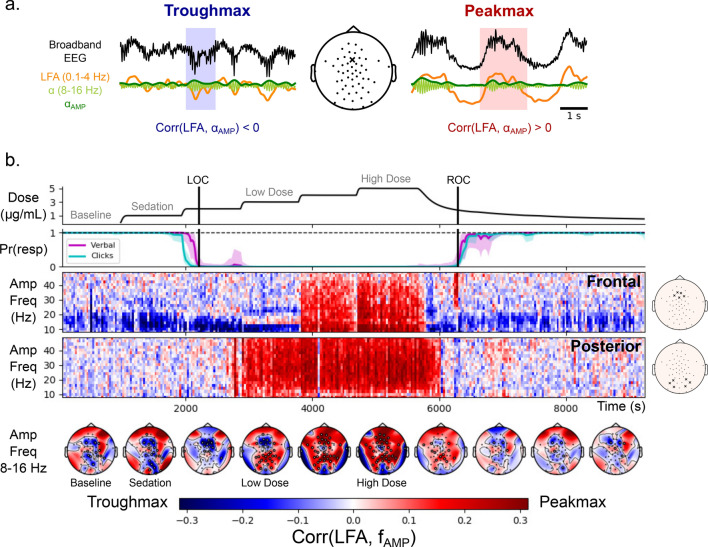
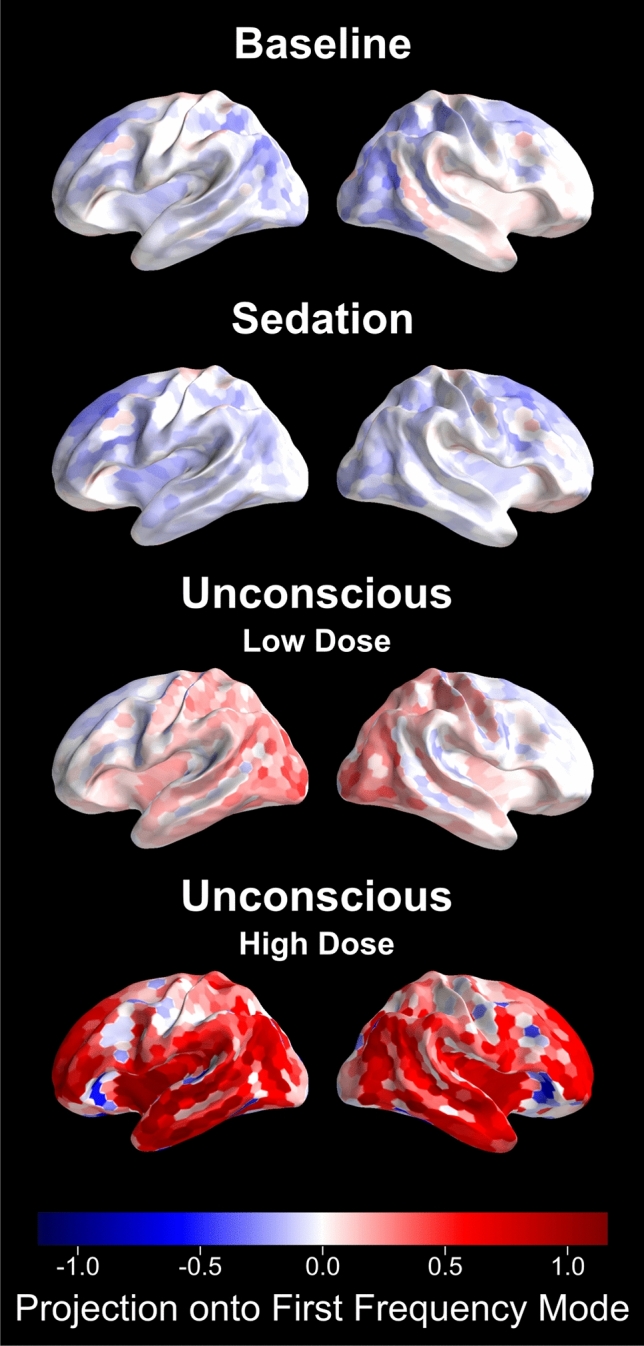
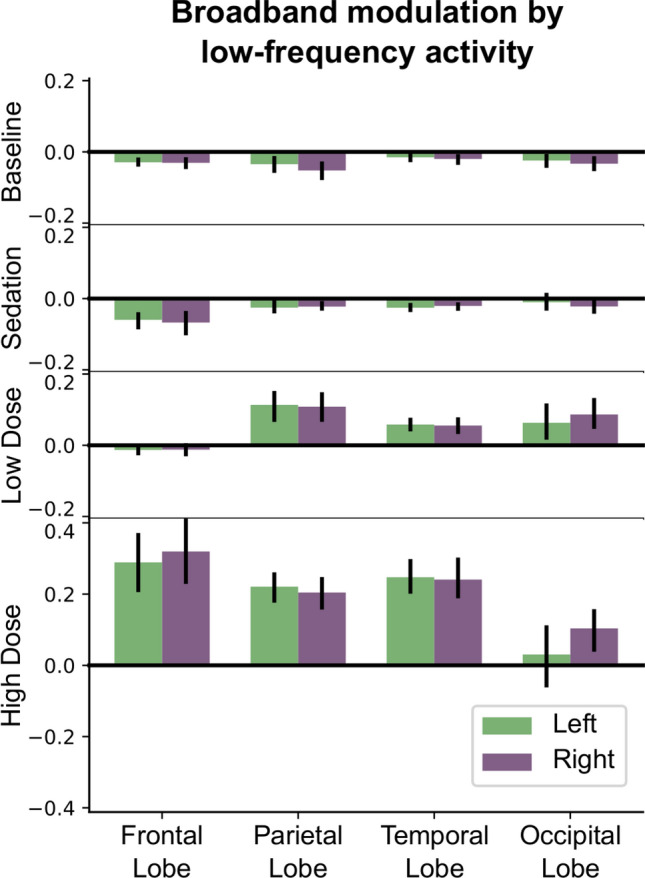
A controversy has developed in recent years over the roles of frontal and posterior cortices in mediating consciousness and unconsciousness. Disruption of posterior cortex during sleep appears to suppress the contents of dreaming, yet activation of frontal cortex appears necessary for perception and can reverse unconsciousness under anesthesia. We used anesthesia to study how regional cortical disruption, mediated by slow wave modulation of broadband activity, changes during unconsciousness in humans. We found that broadband slow-wave modulation enveloped posterior cortex when subjects initially became unconscious, but later encompassed both frontal and posterior cortex when subjects were more deeply anesthetized and likely unarousable. Our results suggest that unconsciousness under anesthesia comprises several distinct shifts in brain state that disrupt the contents of consciousness distinct from arousal and awareness of those contents.
Overview
The claims and statistics of this paper haven’t been checked yet.
Free: it reads the open-access text and checks the first 5 claims that cite a source we can check. Create a free account to check every claim.
Integrity signals
Registry
Cites
Statistics
Figures
Verification
Claims the paper makes
The claims and statistics of this paper haven’t been checked yet.
Free: it reads the open-access text and checks the first 5 claims that cite a source we can check. Create a free account to check every claim.
Claims other papers make about this one
Each is checked against this paper’s own text: does it say what the citing paper says it does?
The source backs part of the claim, not all of it — or backs it for a different population, condition or comparison.
In the citing paper
“the degree of bistability can be estimated by the features of sleep slow waves126–128.”
From Consciousness and sleep (2024) · cites this paper as [126]
Experimental — accuracy not yet measured
Self-check
Percentages, sums and reported differences re-computed from the paper’s own numbers.
The self-check needs the paper’s full text.
Citations
Cites
Jolliffe, I. (2005) · Encyclopedia of Statistics in Behavioral Science · doi:10.1002/0470013192.bsa501 · Cited by 14,310
Cortical Surface-Based Analysis
Dale, A. M., Fischl, B., & Sereno, M. I. (1999) · NeuroImage · doi:10.1006/nimg.1998.0395 · Cited by 10,910
Jolliffe, I. T. (1986) · Springer Series in Statistics · doi:10.1007/978-1-4757-1904-8 · Cited by 8,273
Hämäläinen, M., Hari, R., Ilmoniemi, R. J., Knuutila, J., & Lounasmaa, O. V. (1993) · Reviews of Modern Physics · doi:10.1103/revmodphys.65.413 · Cited by 4,684
MEG and EEG data analysis with MNE-Python
Gramfort, A. (2013) · Frontiers in Neuroscience · doi:10.3389/fnins.2013.00267 · Cited by 3,784
Nunez, P. L., & Srinivasan, R. (2006) · doi:10.1093/acprof:oso/9780195050387.001.0001 · Cited by 2,531
Electric Fields of the Brain: The Neurophysics of EEG
Nunez, P. L., & Harth, E. (1982) · Physics Today · doi:10.1063/1.2915137 · Cited by 2,232 · cited 1×
“We chose the upper limit of the higher bands, 50 Hz, in order to avoid line noise and capture the frequencies with the largest EEG power 27 .”
Steriade, M., Nunez, A., & Amzica, F. (1993) · The Journal of Neuroscience · doi:10.1523/jneurosci.13-08-03252.1993 · Cited by 1,903
Neural correlates of consciousness: progress and problems
Koch, C., Massimini, M., Boly, M., & Tononi, G. (2016) · Nature Reviews Neuroscience · doi:10.1038/nrn.2016.22 · Cited by 1,600
Measuring Phase-Amplitude Coupling Between Neuronal Oscillations of Different Frequencies
Tort, A. B. L., Komorowski, R., Eichenbaum, H., & Kopell, N. (2010) · Journal of Neurophysiology · doi:10.1152/jn.00106.2010 · Cited by 1,363
Research works printed but not linked: 1
- 21. Berlucchi, G. Giuseppe Moruzzi's midpontine pretrigeminal preparation and its continuing importance for neuroscience. Arch. Ital. Biol.149, 124–130 (2011). 10.4449/aib.v149i4%20Suppl.1404 · DOI
Cited by
Consciousness among delta waves: a paradox?
Frohlich, J., Toker, D., & Monti, M. M. (2021) · Brain · doi:10.1093/brain/awab095 · Cited by 195
Distributed harmonic patterns of structure-function dependence orchestrate human consciousness
Luppi, A. I., Vohryzek, J., Kringelbach, M. L., Mediano, P. A. M., Craig, M. M., Ram, A., Carhart-Harris, R. L., Roseman, L., Pappas, I., Peattie, A. R. D., et al. (2023) · Communications Biology · doi:10.1038/s42003-023-04474-1 · Cited by 128
Tononi, G., Boly, M., & Cirelli, C. (2024) · Neuron · doi:10.1016/j.neuron.2024.04.011 · Cited by 70
Differential cortical network engagement during states of un/consciousness in humans
Zelmann, R., Paulk, A. C., Tian, F., Balanza, G. A., Peralta, J. D., Crocker, B., Cosgrove, G. R., Richardson, R. M., Williams, Z. M., Dougherty, D. D., et al. (2023) · Neuron · doi:10.1016/j.neuron.2023.08.007 · Cited by 57
Self-citationModulatory dynamics mark the transition between anesthetic states of unconsciousness
Adam, E. M., Kwon, O., Montejo, K. A., & Brown, E. N. (2023) · Proceedings of the National Academy of Sciences · doi:10.1073/pnas.2300058120 · Cited by 34
Self-citationCasey, C. P., Tanabe, S., Farahbakhsh, Z. Z., Parker, M., Bo, A. Y., White, M., Ballweg, T., Mcintosh, A., Filbey, W., Banks, M. I., et al. (2023) · British Journal of Anaesthesia · doi:10.1016/j.bja.2023.09.031 · Cited by 25
Kurniawan, J. F., Tjhia, B., Wu, V. M., Shin, A. J., Sit, N. L. J., Pham, T. V., Nguyen, A., Li, C., Kumar, R., Aguilar‐Rivera, M., et al. (2021) · Advanced Materials Technologies · doi:10.1002/admt.202001229 · Cited by 23
Soplata, A. E., Adam, E. M., Brown, E. N., Purdon, P. L., McCarthy, M. M., & Kopell, N. (2023) · Journal of Neurophysiology · doi:10.1152/jn.00068.2022 · Cited by 16
Self-citationFrom macro to micro: slow-wave sleep and its pivotal health implications
Ishii, T., Taweesedt, P. T., Chick, C. F., O'Hara, R. M., & Kawai, M. (2024) · Frontiers in Sleep · doi:10.3389/frsle.2024.1322995 · Cited by 19
Matus, H., Kvolik, S., Rakipović-Stojanović, A., & Borzan, V. (2021) · Medicina · doi:10.3390/medicina58010062 · Cited by 10
“Stefan and colleagues found that broadband slow-wave modulation initially enveloped the posterior cortex when subjects became unconscious but later, when subjects were more deeply anesthetized, encompassed both the frontal and posterior cortices [20].”
BackgroundIncidence of dreaming during ciprofol anesthesia for painless gastroscopy
Cao, X., Zhou, J., Xu, M., Wang, B., Yang, C., XIONG, J., & Hui, K. (2024) · Minerva Anestesiologica · doi:10.23736/s0375-9393.24.17845-5 · Cited by 7
Neural correlates of pure presence
Boly, M., Smith, R., Borrego, G. V., Pozuelos, J. P., Alauddin, T., Malinowski, P., & Tononi, G. (2024) · doi:10.1101/2024.04.18.590081 · Cited by 7
Bloniasz, P. F., Oyama, S., & Stephen, E. P. (2025) · Journal of Neural Engineering · doi:10.1088/1741-2552/ade28b · Cited by 6
Self-citationLi, X., Liu, D., Li, Z., Wang, R., Li, X., & Zhou, T. (2025) · NeuroImage · doi:10.1016/j.neuroimage.2025.121084 · Cited by 7
Sun, F., Wang, S., Wang, Y., Sun, J., Li, Y., Li, Y., Xu, Y., & Wang, X. (2023) · Epilepsy & Behavior · doi:10.1016/j.yebeh.2023.109440 · Cited by 5
A precision-mapping approach to physical exercise interventions targeting cognitive function
Moreau, D., & Wiebels, K. (2024) · Progress in brain research · doi:10.1016/bs.pbr.2023.12.001 · Cited by 5
Anaesthesia selectively decouples signal propagation from responsivity in the fronto-parietal loopPreprint
Dwarakanath, A., Khalili‐Ardali, M., Gay, M., Raghuram, H. V., Roustan, M., Jarraya, B., & Panagiotaropoulos, T. I. (2025) · bioRxiv (Cold Spring Harbor Laboratory) · doi:10.1101/2025.04.15.648923 · Cited by 5
Switching Functional Network Models of Oscillatory Brain Dynamics
Hsin, W.-C., Eden, U. T., & Stephen, E. P. (2022) · Asilomar Conference on Signals, Systems and Computers (ACSSC) · doi:10.1109/ieeeconf56349.2022.10052077 · Cited by 4
“In particular, general anesthesia induces a slow oscillation at frequencies less than 1 Hz that entrains activity in cortex, and frontal versus posterior regions become entrained to the slow wave at different doses of the drug [8].”
BackgroundSelf-citationConsciousness in the Brain: An Integrative Review of Contemporary Theories
Arachchige, A. S. P. M., Svet, A., & Svet, M. (2026) · Brain Sciences · doi:10.3390/brainsci16070745 · Cited by 5
“Consequently, lesion evidence does not straightforwardly adjudicate between competing theories but instead constrains their explanatory scope [37–41].”
Onoda, K., Miyauchi, S., Kan, S., & Akama, H. (2025) · Neuroscience of Consciousness · doi:10.1093/nc/niaf024 · Cited by 2
“In addition, a study examining the cross-coupling of alpha and delta waves has reported that the posterior cortex is first affected by loss of consciousness caused by propofol and that the effect extends to the anterior cortex as anesthesia deepens (Stephen et al. 2020).”
Biophysical Model: A Promising Method in the Study of the Mechanism of Propofol: A Narrative Review
Li, Z., Liu, J., & Liang, H. (2022) · Computational Intelligence and Neuroscience · doi:10.1155/2022/8202869 · Cited by 4
“Although we have learned much about the molecular mechanism of propofol, little is known about the neural mechanism of inhibiting auditory signal transduction [32].”
BackgroundCan We Prevent Recall During Anesthesia?
Bowdle, A. T. (2022) · Elsevier eBooks · doi:10.1016/b978-0-323-77846-6.00036-7 · Cited by 1
Akzidentelle Wachheit während Allgemeinanästhesie
Hachenberg, T., & Scheller, B. (2023) · AINS - Anästhesiologie · Intensivmedizin · Notfallmedizin · Schmerztherapie · doi:10.1055/a-1768-5161 · Cited by 1
“[46] Stephen EP, Hotan GC, Pierce ET et al.”
BackgroundSlow-wave modulation analysis during states of unconsciousness using the novel tau-modulation method
Xie, T., Wu, Z., Foutz, T. J., Sheng, X., Zhu, X., Leuthardt, E. C., Willie, J. T., Chen, L., & Brunner, P. (2023) · Journal of Neural Engineering · doi:10.1088/1741-2552/ace5db · Cited by 2
Biomimetic model of corticostriatal micro-assemblies discovers new neural codePreprint
Pathak, A., Brincat, S. L., Organtzidis, H., Strey, H. H., Senneff, S., Antzoulatos, E. G., Mujica-Parodi, L. R., Miller, E. K., & Granger, R. (2023) · bioRxiv (Cold Spring Harbor Laboratory) · doi:10.1101/2023.11.06.565902 · Cited by 1
The meaning of EEG indicators of loss of consciousness during anaesthesia and coma.Preprint
Vakalopoulos, C. (2021) · PsyArXiv (OSF Preprints) · doi:10.31234/osf.io/u2cg7
Density spectral array emergence pattern during TIVA: Neurophysiological and clinical implications
Avendaño, C. F., Saxena, S., & Berger‐Estilita, J. (2026) · Trends in Anaesthesia and Critical Care · doi:10.1016/j.tacc.2026.101633
Fan, L., Wen, X., Lu, F., Wang, D., Chang, Y., Zhao, G., Shu, W., Yu, T., & Liang, Z. (2026) · NeuroImage · doi:10.1016/j.neuroimage.2026.122235
Metadata
- Authors
- Stephen, E. P., Hotan, G. C., Pierce, E. T., Harrell, P. G., Walsh, J. L., Brown, E. N., & Purdon, P. L.
- Affiliations
- Massachusetts Institute of Technology (US)
- Harvard University (US)
- Corresponding author
- Purdon, Patrick L.
- Venue
- Scientific Reports
- Published
- 2020-08-13
- Volume
- 10
- Issue
- 1
- Pages
- 13701-13701
- ISSN
- 2045-2322 (ISSN-L)
- PMC
- PMC7426927
- OpenAlex
- W3048920141
- Cited by
- 27
- References
- 35
- Citations by year
- 2026: 3 · 2025: 4 · 2024: 4 · 2023: 9 · 2022: 3 · 2021: 4
- FWCI
- 2.15
- Type
- journal article
- Language
- en
- Update notices
- correction (2024-08-15)
- Open access
- gold
- doi.org
- Licence
- cc-by
- creativecommons.org/licenses/by/4.0 (tdm)
- creativecommons.org/licenses/by/4.0 (vor)
- Locations
- Scientific Reports (publishedVersion, cc-by)
- bioRxiv (Cold Spring Harbor Laboratory) (acceptedVersion)
- PubMed Central (publishedVersion, cc-by)
- PubMed (publishedVersion)
- OpenBU (Boston University) (publishedVersion, cc-by)
- DSpace@MIT (Massachusetts Institute of Technology) (submittedVersion, cc-by-nc)
- Funders
- Massachusetts General Hospital
- Massachusetts Institute of Technology
- National Institutes of Health
- National Institute on Aging (R01AG056015, R01AG054081)
- National Institute on Drug Abuse (R21DA048323)
- National Institute of General Medical Sciences (P01GM118269)
- Topics
- Life Sciences › Neuroscience › Cognitive Neuroscience › Neural dynamics and brain function
- Health Sciences › Medicine › Anesthesiology and Pain Medicine › Anesthesia and Sedative Agents
- Life Sciences › Neuroscience › Cognitive Neuroscience › Sleep and Wakefulness Research
- Keywords
- propofol anesthesia, loss of consciousness, posterior cortex, frontal cortex, brain states, consciousness, arousal
- MeSH terms
- Adult, Brain, Consciousness, Electroencephalography, Humans, Unconsciousness, Propofol, Anesthetics, Intravenous, Young Adult
About these checks
Registry, retraction, Cites and statistics results are computed, not judged, with one exception: a printed reference that no index lists is read once by a model before it counts as a citation error. Claims are extracted by a model and kept only when their quote appears verbatim in the text; each cited source is then checked, with a model’s help, for whether it says what the claim relies on. Those verdicts can be wrong — read the claim’s quote and the cited source before relying on one.
Statistics and arithmetic are recomputed, not judged.
Confidence bands are shown only for fields calibrated on our annotated test set. None is calibrated yet, so no band is shown.
What counts as a claim ›How we measure confidence ›How we check this ›
Are you an author, or do you see a problem with this page? Request a review
Data sources
Bibliographic data: Semantic Scholar, OpenAlex, Crossref.
Contains information from the Semantic Scholar Academic Graph Datasets, made available under the ODC Attribution License (ODC-BY 1.0).
Semantic Scholar’s data is described in: Kinney, R., et al. (2023). The Semantic Scholar Open Data Platform. arXiv:2301.10140.
