

The DOI matches its Crossref record; 2 of the 2 references it cites were found in a registry or an index.
Multiscale consensus habitat modeling for landscape level conservation prioritization
Open accessAbstract
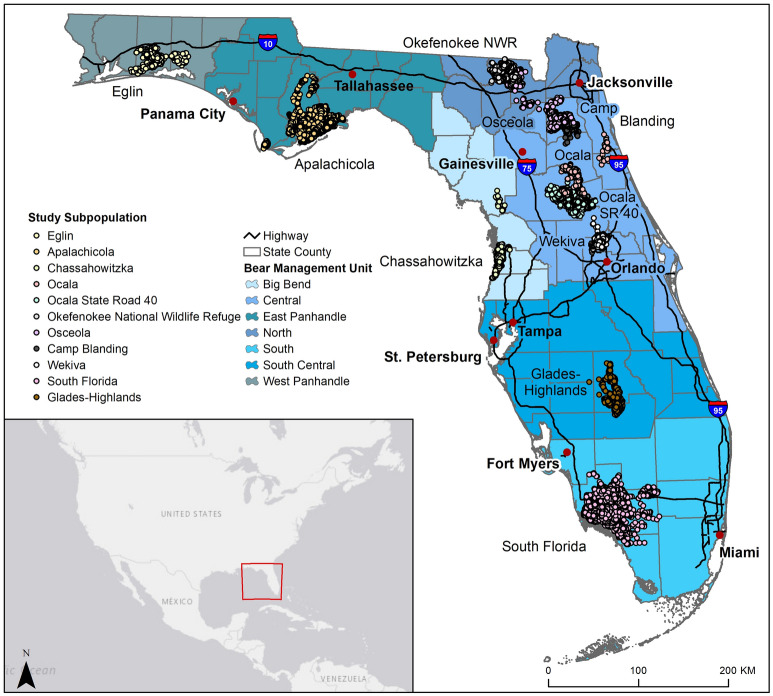
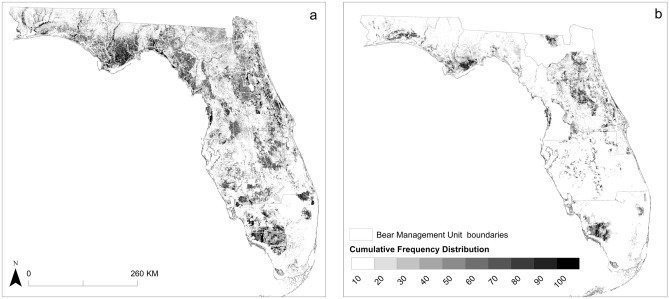
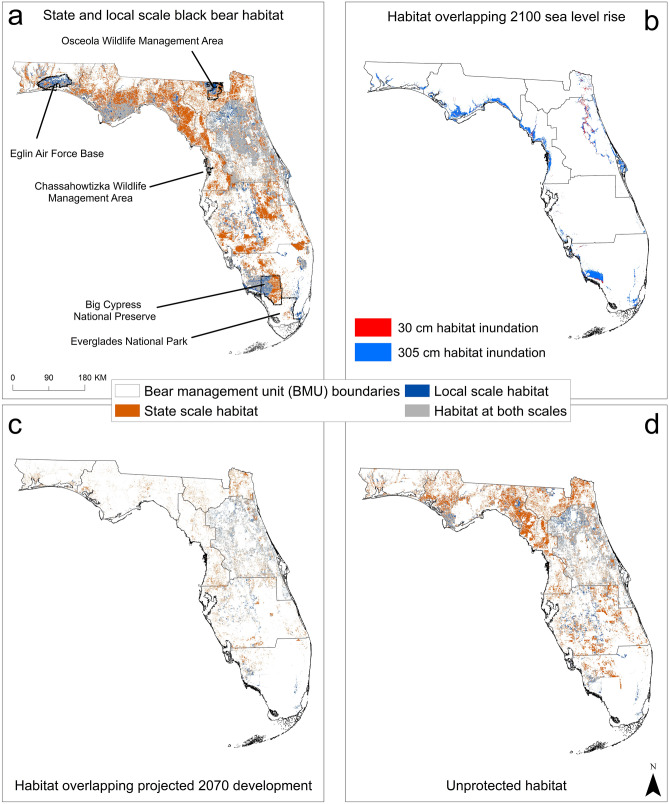
Globally, wide-ranging carnivore populations are imperiled due to human-caused habitat fragmentation. Where populations are fragmented, habitat quantification is often the first step in conservation. Presence-only species distribution models can provide robust results when proper scales and data are considered. We aimed to identify habitat for a fragmented carnivore population at two scales and aid conservation prioritization by identifying potential future habitat fragmentation. We used location data and environmental variables to develop a consensus model using Maxent and Mahalanobis distance to identify black bear (Ursus americanus floridanus) habitat across Florida, USA. We compared areas of habitat to areas of predicted sea level rise, development, and protected areas. Local-scale models performed better than state-scale models. We identified 23,798 km 2 of habitat at the local-scale and 45,703 km 2 at the state-scale. Approximately 10% of state- and 14% of local-scale habitat may be inundated by 2100, 16% of state- and 7% of local-scale habitat may be developed, and 54% of state- and 15% of local-scale habitat is unprotected. Results suggest habitat is at risk of fragmentation. Lack of focused conservation and connectivity among bear subpopulations could further fragmentation, and ultimately threaten population stability as seen in other fragmented carnivore populations globally.
Overview
The claims and statistics of this paper haven’t been checked yet.
Run the check — free, no account needed. It reads the open-access text and checks the sources it cites.
Integrity signals
Registry
Cites
Statistics
Figures
Verification
Claims the paper makes
The claims and statistics of this paper haven’t been checked yet.
Run the check — free, no account needed. It reads the open-access text and checks the sources it cites.
Self-check
Percentages, sums and reported differences re-computed from the paper’s own numbers.
The self-check needs the paper’s full text.
Citations
Cites
The biodiversity of species and their rates of extinction, distribution, and protection
Pimm, S. L., Jenkins, C. N., Abell, R., Brooks, T. M., Gittleman, J. L., Joppa, L. N., Raven, P. H., Roberts, C. M., & Sexton, J. O. (2014) · Science · doi:10.1126/science.1246752 · Cited by 3,542
The Predictive Performance and Stability of Six Species Distribution Models
Duan, R.-Y., Kong, X.-Q., Huang, M.-Y., Fan, W.-Y., & Wang, Z.-G. (2014) · PLoS ONE · doi:10.1371/journal.pone.0112764 · Cited by 259
Research works printed but not linked: 104
- Smeraldo, S. et al. Modelling risks posed by wind turbines and power lines to soaring birds: the black stork (Ciconia nigra) in Italy as a case study. Biodivers. Conserv. 29, 1959–1976 (2020). · DOI
- Gutierrez, B. L. et al. An island of wildlife in a human-dominated landscape: the last fragment of primary forest on the Osa Peninsula’s Golfo Dulce coastline Costa Rica. PLoS ONE 14, e0214390 (2019). · DOI
- Padalia, H. et al. Assessment of historical forest cover loss and fragmentation in Asian elephant ranges in India. Environ. Monit. Assess. 191, 802 (2019). · DOI
- Sodhi, N. S., Lee, T. M., Koh, L. P. & Brook, B. W. A meta-analysis of the impact of anthropogenic forest disturbance on Southeast Asia’s biotas. Biotropica 41, 103–109 (2009). · DOI
- Beier, P. Determining minimum habitat areas and habitat corridors for cougars. Conserv. Biol. 7, 94–108 (1993). · DOI · Paper page
- MacNally, R. & Bennett, A. F. Species-specific prediction of the impact of habitat fragmentation: local extinction of birds in the box-ironbark forests of central Victoria Australia. Biol. Conserv. 82, 147–155 (1997). · DOI
- Hanski, I. Habitat connectivity, habitat continuity, and metapopulations in dynamic landscapes. Oikos 8, 209–219 (1999). · DOI
- Weaver, J. L., Paquet, P. C. & Ruggerio, L. F. Resilience and conservation of large carnivores in the Rocky Mountains. Conserv. Biol. 10, 964–976 (1996). · DOI
- Smith, J. B., Nielsen, C. K. & Hellgren, E. C. Suitable habitat for recolonizing large carnivores in the midwestern USA. Oryx 50, 555–564 (2016). · DOI
- Morehouse, A. T., Hughes, C., Manners, N., Bectell, J. & Bruder, T. Carnivores and communities: a case study of human-carnivore conflict mitigation in southwestern Alberta. Front. Ecol. Evol. 8, 2 (2020). · DOI
- Williamson, D. F. In the Black: Status, Management, and Trade of the American Black Bear (Ursus americanus) in North America (TRAFFIC North America. World Wildlife Fund, Washington, DC, 2002).
- Hristienko, H. & McDonald, J. E. Jr. Going into the 21st century: a perspective on trends and controversies in the management of the American black bear. Ursus 18, 72–88 (2007). · DOI
- Scheick, B. K. & McCown, W. Geographic distribution of American black bears in North America. Ursus 25, 24–33 (2014). · DOI
- Wright, S. Evolution and the genetics of populations (The University of Chicago Press, Chicago, 1984).
- Wooding, J. B. & Hardisky, T. S. Home range, habitat use, and mortality of black bears in north-central Florida. Int. Conf. Bear Res. Manag. 9, 349–356 (1994).
- Florida Game and Fresh Water Fish Commission. Management of the Black Bear in Florida: A Staff Report to the Commissioners (Florida Game and Fresh Water Fish Commission, Tallahassee, 1993).
- Florida Fish and Wildlife Conservation Commission. Florida Black Bear Management Plan (Florida Game and Fresh Water Fish Commission, Tallahassee, 2019).
- Dixon, J. D. Genetic consequences of habitat fragmentation and loss: the case of the Florida black bear (Ursus americanus floridanus). Conserv. Genet. 8, 455–464 (2007). · DOI
- Brown, J. H. Challenges in Estimating Size and Conservation of Black Bear in West-Central Florida. Thesis, University of Kentucky (2004)
- Humm, J. M., McCown, J. W., Scheick, B. K. & Clark, J. D. Spatially explicit population estimates for black bears based on cluster sampling. J. Wildl. Manag. 81, 1187–1201 (2017). · DOI
- Florida Fish and Wildlife Conservation Commission. Florida Black Bear Management Plan (Florida Game and Fresh Water Fish Commission, Tallahassee, 2012).
- Carr, M. H. & Zwick, P. D. Technical Report Florida 2070: Mapping Florida’s Future—Alternative Patterns of Development in 2070 (Geoplan Center at the University of Florida, Gainesville, 2016).
- Noss, R. E., Quiqley, H. B., Hornocker, M. G., Merrill, T. & Paquet, P. C. Conservation biology and carnivore conservation in the Rocky Mountains. Conserv. Biol. 10, 94–96 (1996).
- Breitenmoser, U. Large predators in the Alps: the fall and rise of man’s competitors. Biol. Conserv. 83, 279–289 (1998). · DOI
- Waser, P. M. Patterns and consequences of dispersal in gregarious carnivores. In Carnivore Behavior, Ecology, and Evolution (ed. Gittleman, J. L.) 267–295 (Cornell University Press, Ithaca, 1996).
- Guisan, A. & Thuiller, W. Predicting species distribution: offering more than simple habitat models. Ecol. Lett. 8, 993–1009 (2005). · DOI
- Allouche, O., Tsoar, A. & Kadmon, R. Assessing the accuracy of species distribution models: prevalence, kappa and the true skill statistic (TSS). J. Appl. Ecol. 43, 1223–1232 (2006). · DOI · Paper page
- Yackulic, C. B. et al. Presence-only modelling using MAXENT: When can we trust the inferences?. Methods Ecol. Evol. 4, 236–243 (2013). · DOI
- Araújo, M. B. & New, M. Ensemble forecasting of species distributions. Trends Ecol. Evol. 22, 42–47 (2007). · DOI · Paper page
- De Oliveira Moreira, D. et al. The distributional ecology of the maned sloth: Environmental influences on its distribution and gaps in knowledge. PLoS ONE. 9, 1–12 (2014).
- Martin, J. et al. Brown bear habitat suitability in the Pyrenees: transferability across sites and linking scales to make the most of scarce data. J. Appl. Ecol. 49, 621–631 (2012). · DOI
- Khosravi, R., Hemami, R. K. M. & Cushman, S. A. Multi-scale niche modeling of three sympatric felids of conservation importance in central Iran. Landsc. Ecol. 34, 2451–2467 (2019). · DOI
- Maehr, D. S., McCown, J. W., Land, E. D. & Roof, J. C. Southwest Florida Black Bear Habitat Use, Distribution, Movements, and Conservation Strategy (Florida Game and Fresh Water Fish Commission, Gainesville, 1992).
- McCown, W., Kublis, P., Eason, T. & Scheick, B. Black Bear Movements and Habitat Use Relative to Roads in Ocala National Forest (Florida Fish and Wildlife Commission, Gainesville, 2004).
- Dobey, S. Ecology of Florida black bears in the Okefenokee-Osceola ecosystem. Wildl. Monogr. 158, 1–41 (2005). · DOI
- Ulrey, W. A. Home Range, Habitat Use, and Food Habits of the Black Bear in South-Central Florida. Thesis, University of Kentucky (2008)
- Karelus, D. L., McCown, J. W., Scheick, B. K., van de Kerk, M. & Oli, M. K. Home ranges and habitat selection by black bears in a newly colonized population in Florida. Southeast Nat. 15, 346–364 (2016). · DOI
- Karelus, D. L., McCown, J. W., Scheick, B. K. & Oli, M. K. Microhabitat features influencing habitat use by Florida black bears. Glob. Ecol. Conserv. 13, e00367 (2018). · DOI
- Olson, D. M. & Dinerstein, E. The Global 200: Priority ecoregions for global conservation. Ann. MO Bot. Gard. 89, 125–126 (2002). · DOI
- Burby, R. & May, P. Making Governments Plan (John Hopkins University Press, Baltimore, 1997). · DOI
- Boarnet, M. G., McLaughlin, R. B. & Carruthers, J. I. Does state growth management change the pattern of urban growth? Evidence from Florida. Reg. Sci. Urban Econ. 41, 236–252 (2011). · DOI
- Seibert, S. G. Status and Management of Black Bears in Apalachicola National Forest (Florida Game and Fresh Water Fish Commission, Gainesville, 2013).
- Land, E. D. Southwest Florida Black Bear Habitat Use, Distribution, Movements, and Conservation Strategy (Florida Game and Fresh Water Fish Commission, Tallahassee, 1994).
- McCown, W., Eason, T. H. & Cunningham, M. W. Black Bear Movements and Habitat Use Relative to Roads in Ocala National Forest (Florida Fish and Wildlife Conservation Commission, Gainesville, 2001).
- Stratman, M. R., Alden, C. D., Pelton, M. R. & Sunquist, M. E. Habitat use by American black bears in the sandhills of Florida. Ursus 12, 109–114 (2001).
- Maehr, D. W. et al. Spatial characteristics of an isolated Florida black bear population. Southeast Nat. 2, 433–446 (2003). · DOI
- Orlando, M. A. The Ecology and Behavior of an Isolated Black Bear Population in West Central Florida. Thesis, University of Kentucky (2003)
- Annis, K. M. The Impact of Translocation on Nuisance Florida Black Bears. Thesis, University of Florida (2007). · DOI
- Neils, A. M. Florida Black Bear (Ursus americanus floridanus) at the Urban-Wildlife Interface: Are They Different? Thesis, University of Florida (2011).
- Guthrie, J. M. Modeling Movement Behavior and Road Crossing the Black Bear of South Central Florida. Thesis, University of Kentucky (2012).
- Baruch-Mordo, S. et al. Stochasticity in natural forage production affects use of urban areas by black bears: implications to management of human-bear conflicts. PLoS ONE 9, e85122 (2014). · DOI
- Lewis, J. S., Rachlow, J. L., Garton, E. O. & Vierling, L. A. Effects of habitat on GPS collar performance: using data screening to reduce location error. J. Appl. Ecol. 44, 663–671 (2007). · DOI
- Clark, J. D., Laufenberg, J. S., Davidson, M. & Murrow, J. L. Connectivity among subpopulations of Louisiana black bears as estimated by a step selection function. J. Wildl. Manage. 79, 1347–1360 (2015). · DOI
- Beumer, L. T., van Beest, F. M., Stelvig, M. & Schmidt, N. M. Spatiotemproal dynamics in habitat suitability of a large Arctic herbivore: environmental heterogeneity is key to a sedentary lifestyle. Glob. Ecol. Conserv. 18, e00647 (2019). · DOI
- Hinton, J. W. et al. Space use and habitat selection by resident and transient red wolves (Canis rufus). PLoS ONE 11, e0167603 (2016). · DOI
- Fourcade, Y., Engler, J. O., Rodder, D. & Secondi, J. Mapping species distributions with MAXENT using a geographically biased sample of presence data: a performance assessment of methods for correcting sampling bias. PLoS ONE 9, e97122 (2014). · DOI · Paper page
- Pellerin, M., Said, S. & Gaillard, J.-M. Roe deer Capreolus capreolus home-range sizes estimated from VHF and GPS data. Wildl. Biol. 14, 101–110 (2009). · DOI
- Signer, J., Fieberg, J. & Avgar, T. Animal movement tools (amt): R package for managing tracking data and conducting habitat selection analyses. Ecol. Evol. 9, 880–890 (2019). · DOI
- Maehr, D. S. & Brady, J. R. Food habits of Florida black bears. J. Wildl. Manag. 48, 230–235 (1984). · DOI
- Hellgren, E. C., Vaughan, M. R. & Stauffer, D. F. Macrohabitat use by black bears in a southeastern wetland. J Wildl. Manag. 55, 442–448 (1991). · DOI
- Karelus, D. L. et al. Effects of environmental factors and landscape features on movement patterns of Florida black bears. J. Mammal. 98, 1463–1478 (2017). · DOI
- Riley, S. J., DeGloria, S. D. & Elliot, R. A terrain ruggedness index that quantifies topographic heterogeneity. Intermt. J. Sci. 5, 1–4 (1999).
- Clark, J. D., Dunn, J. E. & Smith, K. G. A multivariate model of female black bear habitat use for a geographic information system. J. Wildl. Manag. 57, 519–526 (1993). · DOI
- Ditmer, M. A., Noyce, K. V., Fieberg, J. R. & Garshelisa, D. L Delineating the ecological and geographic edge of an opportunist: The American black bear exploiting an agricultural landscape. Ecol. Model. 387, 205–219 (2018). · DOI
- Hostetler, J. A. et al. Demographic consequences of anthropogenic influences: Florida black bears in north-central Florida. Biol. Conserv. 142, 2456–2463 (2009). · DOI
- Brody, A. J. & Pelton, M. R. Effects of roads on black bears in western North Carolina. Wildl. Soc. B 17, 5–10 (1989).
- Elith, J. et al. Novel methods improve prediction of species’ distributions from occurrence data. Ecography 29, 129–151 (2006). · DOI · Paper page
- Phillips, S. J., Anderson, R. P. & Schapire, R. E. Maximum entropy modeling of species geographic distributions. Ecol. Model. 190, 231–259 (2006). · DOI · Paper page
- Calenge, C. The package adehabitat for the R software: a tool for the analysis of space and habitat use by animals. Ecol. Model. 197, 516–519 (2016). · DOI
- Elith, J. et al. A statistical explanation of MaxEnt for ecologists. Divers. Distrib. 17, 43–57 (2011). · DOI · Paper page
- Phillips, S. J., Dudik, M., & Schapire, R. E. A maximum entropy approach to species distribution modeling in Proceedings of the twenty-first international conference on machine learning (technical coordinators Greiner, R. & Schuurmans, D.) 655–662 (ACM Press, 2004). · DOI
- Hernandez, P. A. et al. Predicting species distributions in poorly-studied landscapes. Biodivers. Conserv. 17, 1353–1366 (2008). · DOI
- Poor, E. E., Loucks, C., Jakes, A. & Urban, D. L. Comparing habitat suitability and connectivity modeling methods for conserving pronghorn migrations. PLoS ONE 7, e49390 (2012). · DOI · Paper page
- Zhang, J. et al. MaxEnt modeling for predicting the spatial distribution of three raptors in the Sanjiangyuan National Park China. Ecol. Evol. 9, 6643–6654 (2019). · DOI
- Bertolino, S. et al. Spatially-explicit models as tools for implementing effective management strategies for invasive alien mammals. Mammal. Rev. 50, 87–199 (2020).
- Alsamadisi, A. G., Tran, L. T. & Papes, M. Employing inferences across scales: integrating spatial data with different resolutions to enhance Maxent models. Ecol. Model. 415, 108857 (2020). · DOI
- Peralvo, M. F., Cuesta, F. & van Manen, F. Delineating priority habitat areas for the conservation of Andean bears in northern Ecuador. Ursus 16, 222–233 (2005). · DOI
- Mahalanobis, P. C. On the generalized distance in statistics. Proc. Natl. Aacd. Sci. India 2, 49–55 (1936).
- Browning, D. M., Beaupre, S. J. & Duncan, L. Using partitioned Mahalanobis D2 (K) to formulate a GIS-based model of timber rattlesnake hibernacula. J. Wildl. Manag. 69, 33–44 (2005). · DOI
- Griffin, S. C., Taper, M. L., Hoffman, R. & Mills, L. S. Ranking Mahalanobis Distance models for predictions of occupancy from presence-only data. J. Wildl. Manag. 74, 1112–1121 (2010). · DOI
- Phillips, S. J. et al. Sample selection bias and presence-only distribution models: implications for background and pseudo-absence data. Ecol. Appl. 19, 181–197 (2009). · DOI · Paper page
- Fielding, A. H. & Bell, J. F. A review of methods for the assessment of prediction errors in conservation presence/absence models. Environ. Conserv. 24, 38–49 (1997). · DOI · Paper page
- Boyce, M. S., Vernier, P. R., Nielsen, S. E. & Schmiegelow, F. K. A. Evaluating resource selection functions. Ecol. Model. 157, 281–300 (2002). · DOI
- Hirzel, A. H., Le Lay, G., Helfer, V., Randin, C. & Guisan, A. Evaluating the ability of habitat suitability models to predict species presences. Ecol. Model. 199, 142–152 (2006). · DOI
- Murrow, J. L. & Clark, J. D. Effects of hurricanes Katrina and Rita on Louisiana black bear habitat. Ursus 23, 192–205 (2012). · DOI
- Sing, T., Sander, O., Beerenwinkel, N. & Lengauer, T. ROCR: visualizing classifier performance in R. Bioinformatics 21, 7881 (2005). · DOI
- Liu, C., White, M. & Newell, G. Selecting thresholds for the prediction of species occurrence with presence-only data. J. Biogeogr. 40, 778–789 (2013). · DOI
- Hellgren, E. C., Bales, S. L., Gregory, M. S., Leslie, D. M. Jr. & Clark, J. D. Testing a Mahalanobis Distance model of black bear habitat use in the Ouichita Mountains of Oklahoma. J. Wildl. Manag. 71, 924–928 (2007). · DOI
- Murrow, J. L., Thatcher, C. A., van Manen, F. T. & Clark, J. A data-based conservation planning tool for Florida Panthers. Environ. Model. Assess. 18, 159–170 (2013). · DOI
- Pelton, M. R. 2003. Black bear. In Wild Mammals of North America: Biology, Management, and Conservation (eds Feldhamer, J. A. et al.) 547–555 (Johns Hopkins University, Baltimore, 2003).
- Thuiller, W., Brotons, L., Araujo, M. B. & Lavorel, S. Effects of restricting environmental range of data to project current and future species distributions. Ecography 27, 165–172 (2004). · DOI
- Liu, C., Berry, P. M., Dawson, T. P. & Pearson, R. G. Selecting thresholds of occurrence in the prediction of species distributions. Ecography 28, 385–393 (2005). · DOI · Paper page
- Kopp, R. E. et al. Probalistic 21st and 22nd century sea-level projections at a global network of tide-gauge sites. Earth’s Future 2, 383–406 (2014). · DOI
- Xiao, H. & Tang, Y. Assess the “superposed” effects of storm surge from a Category 3 hurricane. and continuous sea-level rise on saltwater intrusion into the surficial aquifer in coastal east-central Florida (USA). Environ. Sci. Pollut Res. 26, 21882–21889 (2019). · DOI
- Laurance, W. F. et al. A global strategy for road building. Nature 513, 229–234 (2014). · DOI
- Mukul, S. A. et al. Combined effects of climate change and sea-level rise project dramatic habitat loss of the globally endangered Bengal tiger in the Bangladesh Sundarbans. Sci. Total Environ. 663, 830–840 (2019). · DOI
- Poor, E. E., Shao, Y. & Kelly, M. J. Mapping and predicting forest loss in a Sumatran tiger landscape from 2002 to 2050. J. Environ. Manag. 231, 397–404 (2019). · DOI
- Durner, G. M. et al. Predicting 21st-century polar bear habitat distribution from global climate models. Ecol. Monogr. 79, 25–58 (2009). · DOI
- Yovovich, V., Allen, M. L., Macaulay, L. T. & Wilmers, C. C. Using spatial characteristics of apex carnivore communication and reproductive behaviors to predict responses to future human development. Biodivers. Conserv. 29, 2589–2603 (2020). · DOI
- Muhly, T. B. et al. Functional response of wolves to human development across boreal North America. Ecol. Evol. 9, 10801–10815 (2019). · DOI
- Zeller, K. A., Wattles, D. W., Conlee, L. & Destefano, S. Response of female black bears to a high-density road network and identification of long-term road mitigation sites. Anim. Conserv. https://doi.org/10.1111/acv.12621 (2020). · DOI
- Morales-González, A., Ruiz-Villar, H., Ordiz, A. & Penteriani, V. Large carnivores living alongside humans: Brown bears in human-modified landscapes. Glob. Ecol. Conserv. 22, 1–13 (2020).
- Maletzke, B. et al. Cougar response to a gradient of human development. Ecosphere 8, 1–14 (2017). · DOI
- Barrington-Leigh, C. & Millard-Ball, A. A century of sprawl in the United States. PNAS https://doi.org/10.1073/pnas.1504033112 (2015). · DOI
Metadata
- Authors
- Poor, E. E., Scheick, B. K., & Mullinax, J. M.
- Affiliations
- University of Maryland, College Park (US)
- Florida Fish and Wildlife Conservation Commission (US)
- Corresponding author
- Mullinax, Jennifer M.
- Venue
- Scientific Reports
- Published
- 2020-10-20
- Volume
- 10
- Issue
- 1
- Pages
- 17783-17783
- ISSN
- 2045-2322 (ISSN-L)
- PMC
- PMC7576151
- OpenAlex
- W3094055716
- Cited by
- 27
- References
- 2
- Citations by year
- 2026: 3 · 2025: 6 · 2024: 3 · 2023: 5 · 2022: 6 · 2021: 4
- FWCI
- 6.71
- Type
- journal article
- Language
- en
- Open access
- gold
- doi.org
- Locations
- Scientific Reports (publishedVersion, cc-by)
- PubMed Central (publishedVersion, cc-by)
- PubMed (publishedVersion)
- Funders
- University of Kentucky
- University of Florida
- Topics
- Physical Sciences › Environmental Science › Ecological Modeling › Species Distribution and Climate Change
- Physical Sciences › Environmental Science › Ecology › Wildlife Ecology and Conservation
- Physical Sciences › Environmental Science › Ecology › Wildlife-Road Interactions and Conservation
- Keywords
- Ursus americanus, habitat modeling, habitat fragmentation, conservation prioritization, multiscale analysis, sea level rise, development pressure, protected areas, carnivore conservation, habitat connectivity, species distribution modeling, Florida
- MeSH terms
- Animals, Ursidae, Computer Simulation, Conservation of Natural Resources, Humans, Population Dynamics, United States, Ecosystem, Animal Distribution
About these checks
Registry, retraction, Cites and statistics results are computed, not judged, with one exception: a printed reference that no index lists is read once by a model before it counts as a citation error. Claims are extracted by a model and kept only when their quote appears verbatim in the text; each cited source is then checked, with a model’s help, for whether it says what the claim relies on. Those verdicts can be wrong — read the claim’s quote and the cited source before relying on one.
Statistics and arithmetic are recomputed, not judged.
Confidence bands are shown only for fields calibrated on our annotated test set. None is calibrated yet, so no band is shown.
What counts as a claim ›How we measure confidence ›How we check this ›
Are you an author, or do you see a problem with this page? Request a review
