

The DOI matches its Crossref record; 71 of the 71 references it cites were found in a registry or an index.
SkipGNN: predicting molecular interactions with skip-graph networks
Open accessAbstract
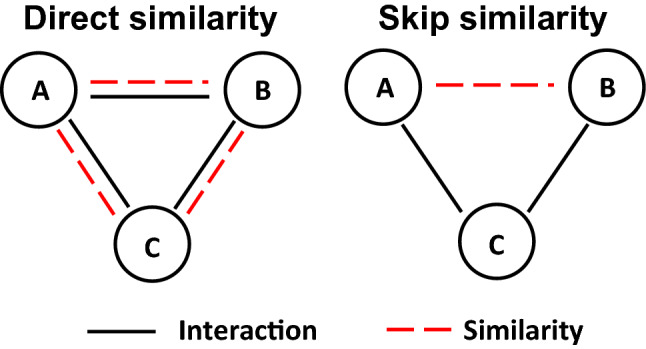
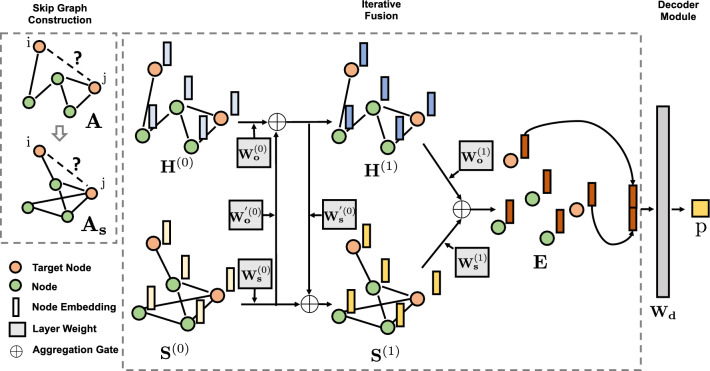
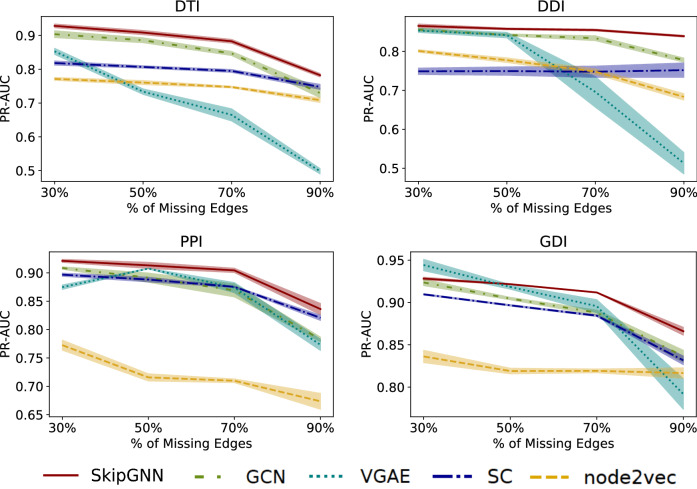
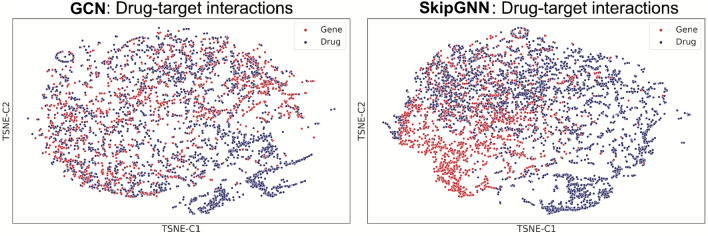
Molecular interaction networks are powerful resources for molecular discovery. They are increasingly used with machine learning methods to predict biologically meaningful interactions. While deep learning on graphs has dramatically advanced the prediction prowess, current graph neural network (GNN) methods are mainly optimized for prediction on the basis of direct similarity between interacting nodes. In biological networks, however, similarity between nodes that do not directly interact has proved incredibly useful in the last decade across a variety of interaction networks. Here, we present SkipGNN, a graph neural network approach for the prediction of molecular interactions. SkipGNN predicts molecular interactions by not only aggregating information from direct interactions but also from second-order interactions, which we call skip similarity. In contrast to existing GNNs, SkipGNN receives neural messages from two-hop neighbors as well as immediate neighbors in the interaction network and non-linearly transforms the messages to obtain useful information for prediction. To inject skip similarity into a GNN, we construct a modified version of the original network, called the skip graph. We then develop an iterative fusion scheme that optimizes a GNN using both the skip graph and the original graph. Experiments on four interaction networks, including drug–drug, drug–target, protein–protein, and gene–disease interactions, show that SkipGNN achieves superior and robust performance. Furthermore, we show that unlike popular GNNs, SkipGNN learns biologically meaningful embeddings and performs especially well on noisy, incomplete interaction networks.
Overview
The claims and statistics of this paper haven’t been checked yet.
Run the check — free, no account needed. It reads the open-access text and checks the sources it cites.
Integrity signals
Registry
Cites
Statistics
Figures
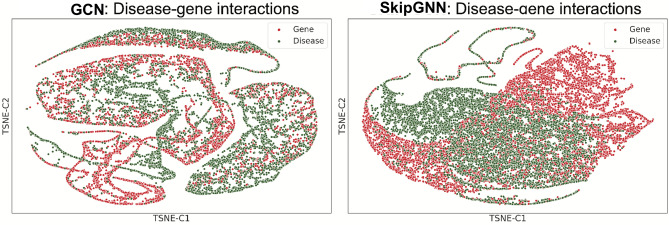
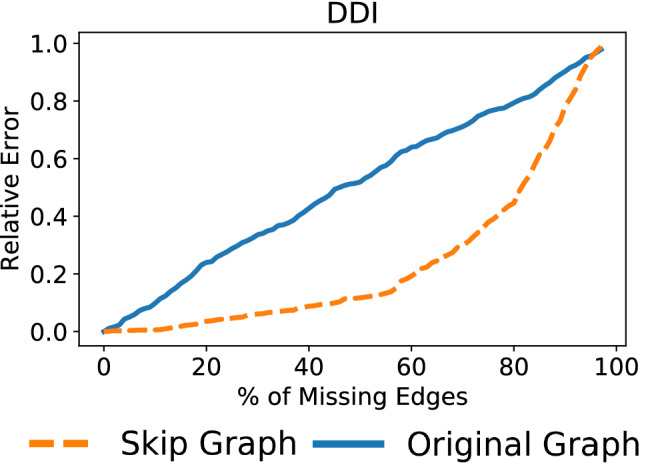
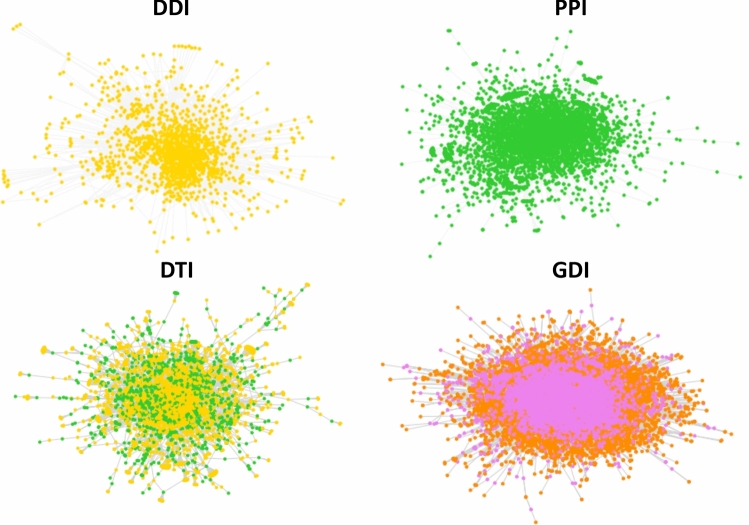
Verification
Claims the paper makes
The claims and statistics of this paper haven’t been checked yet.
Run the check — free, no account needed. It reads the open-access text and checks the sources it cites.
Claims other papers make about this one
Each is checked against this paper’s own text: does it say what the citing paper says it does?
In the citing paper
“Specifically, the inductive ability of graph convolution neural networks to generalize to data points unseen during model training (Section 2.2) and even generate new data points from scratch by decoding latent representation from the embedding space (Section 2.3) has enabled the discovery of new molecules, interactions, and functions [101, 108, 109].”
From Graph representation learning in biomedicine and healthcare (2022) · cites this paper as [101]
In the citing paper
“Unlike machine learning approaches designed to analyze data modalities like medical images and biological sequences, graph representation learning methods are uniquely able to leverage structural information in multimodal datasets [101].”
From Graph representation learning in biomedicine and healthcare (2022) · cites this paper as [101]
Self-check
Percentages, sums and reported differences re-computed from the paper’s own numbers.
The self-check needs the paper’s full text.
Citations
Cites
Adam: A Method for Stochastic Optimization
Kingma, D. P., & Ba, J. (2014) · arXiv · doi:10.48550/arxiv.1412.6980 · Cited by 98,946
Emergence of Scaling in Random Networks
Barabási, A.-L., & Albert, R. (1999) · Science · doi:10.1126/science.286.5439.509 · Cited by 36,135
(2008) · Journal of Machine Learning Research · Cited by 33,051
Semi-supervised classification with graph convolutional networks
Kipf, T. N., & Welling, M. (2016) · arXiv · doi:10.48550/arxiv.1609.02907 · Cited by 24,853
Graph Attention NetworksPreprint
Veličković, P., Casanova, A., Liò, P., Cucurull, G., Romero, A., & Bengio, Y. (2017) · arXiv (Cornell University) · doi:10.17863/cam.48429 · Cited by 19,745
Birds of a Feather: Homophily in Social Networks
McPherson, M., Smith-Lovin, L., & Cook, J. M. (2001) · Annual Review of Sociology · doi:10.1146/annurev.soc.27.1.415 · Cited by 18,567
Veličković, P., Cucurull, G., Casanova, A., Romero, A., Liò, P., & Bengio, Y. (2017) · arXiv · doi:10.48550/arxiv.1710.10903 · Cited by 12,107
A Comprehensive Survey on Graph Neural Networks
Wu, Z., Pan, S., Chen, F., Long, G., Zhang, C., & Yu, P. S. (2021) · IEEE Transactions on Neural Networks and Learning Systems · doi:10.1109/tnnls.2020.2978386 · Cited by 11,000
node2vec: Scalable Feature Learning for Networks
Grover, A., & Leskovec, J. (2016) · Proceedings of the 22nd ACM SIGKDD International Conference on Knowledge Discovery and Data Mining · doi:10.1145/2939672.2939754 · Cited by 10,926
Inductive Representation Learning on Large Graphs
Hamilton, W. L., Ying, R., & Leskovec, J. (2017) · arXiv · doi:10.48550/arxiv.1706.02216 · Cited by 10,639
Research works printed but not linked: 6
- Ribeiro, L. F., Saverese, P. H. & Figueiredo, D. R. struc2vec: Learning node representations from structural identity. In KDD 385–394 (2017).
- Xu, K., Hu, W., Leskovec, J. & Jegelka, S. How powerful are graph neural networks? In ICLR (2018).
- DuPont, P. Product Information. Coumadin (Warfarin). (DuPont Pharmaceuticals, Wilmington, 2000).
- Merck, C. I. Product Information. Belsomra (Suvorexant). (Merck & Company Inc., Whitehouse Station, 2014).
- Ligand, P. Product Information. Targretin (Bexarotene). (Ligand Pharmaceuticals, San Diego, 1999).
- Novartis, P. Product Information. Clozaril (Clozapine). (Novartis Pharmaceuticals, East Hanover, 1989).
Cited by
Sorted by citations
Graph representation learning in biomedicine and healthcare
Li, M. M., Huang, K., & Zitnik, M. (2022) · Nature Biomedical Engineering · doi:10.1038/s41551-022-00942-x · Cited by 294
Self-citationSumGNN: multi-typed drug interaction prediction via efficient knowledge graph summarization
Yu, Y., Huang, K., Zhang, C., Glass, L. M., Sun, J., & Xiao, C. (2021) · Bioinformatics · doi:10.1093/bioinformatics/btab207 · Cited by 207
Self-citationGraph neural network approaches for drug-target interactions
Zhang, Z., Chen, L., Zhong, F., Wang, D., Jiang, J., Zhang, S., Jiang, H., Zheng, M., & Li, X. (2022) · Current Opinion in Structural Biology · doi:10.1016/j.sbi.2021.102327 · Cited by 190
A geometric deep learning framework for drug repositioning over heterogeneous information networks
Zhao, B.-W., Su, X., Hu, P., Ma, Y.-P., Zhou, X., & Hu, L. (2022) · Briefings in Bioinformatics · doi:10.1093/bib/bbac384 · Cited by 164
Current and future directions in network biology
Žitnik, M., Li, M. M., Wells, A., Glass, K., Gysi, D. M., Krishnan, A., Murali, T. M., Predrag Radivojac, A., Roy, S., Baudot, A., et al. (2024) · Bioinformatics Advances · doi:10.1093/bioadv/vbae099 · Cited by 128
Metadata
- Authors
- Huang, K., Xiao, C., Glass, L. M., Zitnik, M., & Sun, J.
- Affiliations
- Harvard University (US)
- IQVIA (United States) (US)
- University of Illinois Urbana-Champaign (US)
- Corresponding author
- Sun, Jimeng
- Venue
- Scientific Reports
- Published
- 2020-12-03
- Volume
- 10
- Issue
- 1
- Pages
- 21092-21092
- ISSN
- 2045-2322 (ISSN-L)
- PMC
- PMC7713130
- OpenAlex
- W3108458441
- Cited by
- 133
- References
- 65
- Citations by year
- 2026: 14 · 2025: 28 · 2024: 34 · 2023: 18 · 2022: 24 · 2021: 12 · 2020: 3
- FWCI
- 4.62
- Type
- journal article
- Language
- en
- Open access
- gold
- doi.org
- Locations
- Scientific Reports (publishedVersion, cc-by)
- arXiv (Cornell University) (publishedVersion)
- PubMed Central (publishedVersion, cc-by)
- PubMed (publishedVersion)
- arXiv (Cornell University) (cc-by)
- Topics
- Life Sciences › Biochemistry, Genetics and Molecular Biology › Molecular Biology › Bioinformatics and Genomic Networks
- Life Sciences › Pharmacology, Toxicology and Pharmaceutics › Drug Discovery › Computational Drug Discovery Methods
- Physical Sciences › Computer Science › Artificial Intelligence › Advanced Graph Neural Networks
- Keywords
- graph neural networks, molecular interaction prediction, second-order interactions, skip graphs, drug-drug interactions, drug-target interactions, protein-protein interaction, gene-disease interaction, node embeddings
About these checks
Registry, retraction, Cites and statistics results are computed, not judged, with one exception: a printed reference that no index lists is read once by a model before it counts as a citation error. Claims are extracted by a model and kept only when their quote appears verbatim in the text; each cited source is then checked, with a model’s help, for whether it says what the claim relies on. Those verdicts can be wrong — read the claim’s quote and the cited source before relying on one.
Statistics and arithmetic are recomputed, not judged.
Confidence bands are shown only for fields calibrated on our annotated test set. None is calibrated yet, so no band is shown.
What counts as a claim ›How we measure confidence ›How we check this ›
Are you an author, or do you see a problem with this page? Request a review
