

A computational model of language functions in flexible goal-directed behaviour
Open accessThe DOI matches its Crossref record; 70 of the 71 references it cites were found in a registry or an index.
Abstract
The function of language in high-order goal-directed human cognition is an important topic at the centre of current debates. Experimental evidence shows that inner speech, representing a self-directed form of language, empowers cognitive processes such as working memory, perception, categorization, and executive functions. Here we study the relations between inner speech and processes like feedback processing and cognitive flexibility. To this aim we propose a computational model that controls an artificial agent who uses inner speech to internally manipulate its representations. The agent is able to reproduce human behavioural data collected during the solution of the Wisconsin Card Sorting test, a neuropsychological test measuring cognitive flexibility, both in the basic condition and when a verbal shadowing protocol is used. The components of the model were systematically lesioned to clarify the specific impact of inner speech on the agent’s behaviour. The results indicate that inner speech improves the efficiency of internal representation manipulation. Specifically, it makes the representations linked to specific visual features more disentangled, thus improving the agent’s capacity to engage/disengage attention on stimulus features after positive/negative action outcomes. Overall, the model shows how inner speech could improve goal-directed internal manipulation of representations and enhance behavioural flexibility.
Overview
The claims and statistics of this paper haven’t been checked yet.
Free: it reads the open-access text and checks the first 5 claims that cite a source we can check. Create a free account to check every claim.
Integrity signals
Registry
Cites
Statistics
Figures
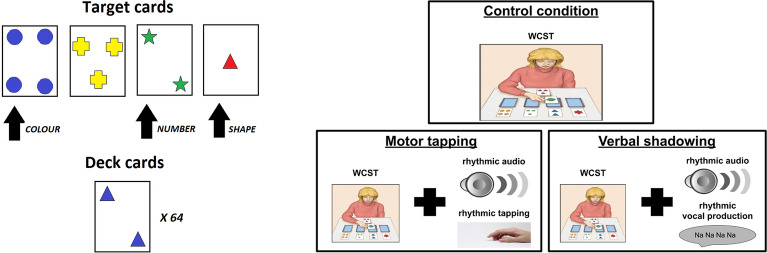
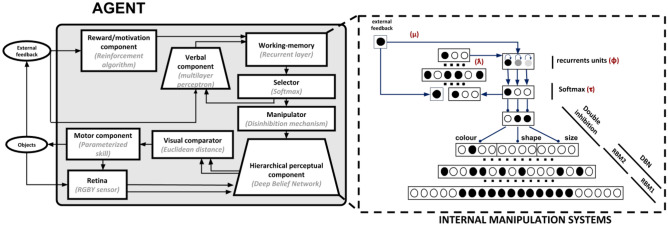
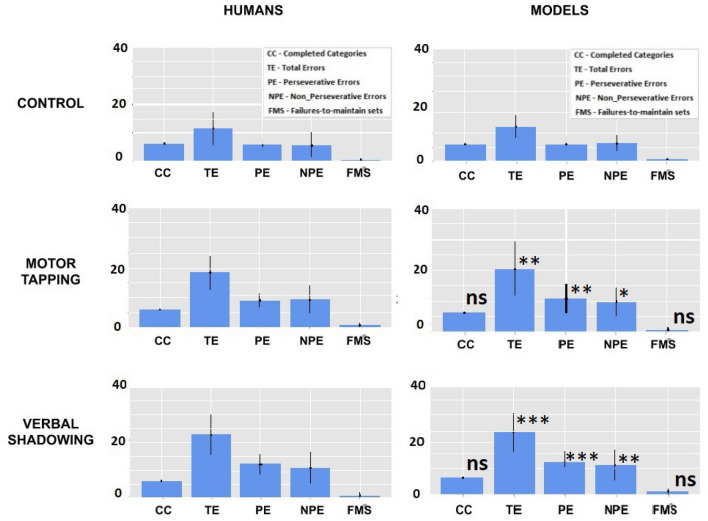
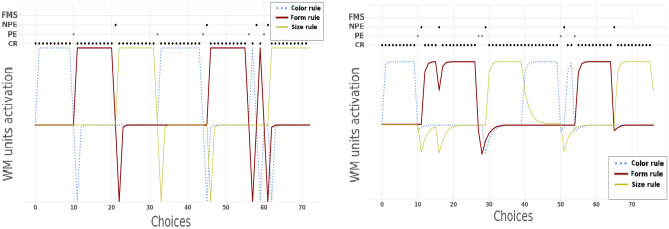
Verification
Claims the paper makes
The claims and statistics of this paper haven’t been checked yet.
Free: it reads the open-access text and checks the first 5 claims that cite a source we can check. Create a free account to check every claim.
Claims other papers make about this one
Each is checked against this paper’s own text: does it say what the citing paper says it does?
The cited source says what the claim attributes to it.
In the citing paper
“A recent computational model [58] replicated human data on the Wisconsin Card Sorting Test (WCST), a neuropsychological test of task-switching ability.”
From Inner speech as language process and cognitive tool (2023) · cites this paper as [58]
The cited source says what the claim attributes to it.
In the citing paper
“In the example of the computational model described above [58], systematic lesioning showed that IS enhanced the cognitive flexibility of an agent when tested on the WCST.”
From Inner speech as language process and cognitive tool (2023) · cites this paper as [58]
The check wasn’t confident either way, so it gives no verdict — never disputed.
In the citing paper
“Using distanced self-talk is also associated with more abstract self-representations.”
From Inner speech as language process and cognitive tool (2023) · cites this paper as [57]
Experimental — accuracy not yet measuredThe check wasn’t confident either way, so it gives no verdict — never disputed.
In the citing paper
“Self-distance provided a more detached perspective than social-distance: self-distancing participants produced more abstract person characterizations and used more abstract statements [57].”
From Inner speech as language process and cognitive tool (2023) · cites this paper as [57]
Experimental — accuracy not yet measured
Self-check
Percentages, sums and reported differences re-computed from the paper’s own numbers.
The self-check needs the paper’s full text.
Citations
Cites
Vygotsky, L. S. (1964) · Bulletin of the Orton Society · doi:10.1007/bf02928399 · Cited by 20,704
A fast learning algorithm for deep belief nets
Hinton, G. E., Osindero, S., & Teh, Y.-W. (2006) · Neural Computation · doi:10.1162/neco.2006.18.7.1527 · Cited by 16,336
Diamond, A. (2013) · Annual Review of Psychology · doi:10.1146/annurev-psych-113011-143750 · Cited by 13,268
(2016) · Cited by 11,679
Barsalou, L. W. (2008) · Annual Review of Psychology · doi:10.1146/annurev.psych.59.103006.093639 · Cited by 5,936
Baddeley, A. (1992) · Science · doi:10.1126/science.1736359 · Cited by 5,258
A Practical Guide to Training Restricted Boltzmann Machines
Hinton, G. E. (2012) · Lecture Notes in Computer Science · doi:10.1007/978-3-642-35289-8_32 · Cited by 2,852
Language, Thought, and Reality: Selected Writings of Benjamin Lee Whorf
Miller, G. A., & Carroll, J. B. (1957) · The American Journal of Psychology · doi:10.2307/1419256 · Cited by 2,743
(2009) · Philosophical Investigations · doi:10.1111/(issn)1467-9205 · Cited by 2,366
Working memory and language: an overview
Baddeley, A. (2003) · Journal of Communication Disorders · doi:10.1016/s0021-9924(03)00019-4 · Cited by 2,309
Research works printed but not linked: 2
- Heaton R Chelune G Talley J Kay G Curtiss G di Hardoy M WCST: Wisconsin Card Sorting Test: forma completa revisionata: manuale 2000 Firenze O.S.
- Kosslyn SM Image and Brain 1999 4 Cambridge, MA The MIT Press
Cited by
Inner speech as language process and cognitive tool
Fernyhough, C., & Borghi, A. M. (2023) · Trends in Cognitive Sciences · doi:10.1016/j.tics.2023.08.014 · Cited by 101
“In the example of the computational model described above [58], systematic lesioning showed that IS enhanced the cognitive flexibility of an agent when tested on the WCST.”
MethodSelf-citationFrom Affordances to Abstract Words: The Flexibility of Sensorimotor Grounding
Mazzuca, C., Fini, C., Michalland, A. H., Falcinelli, I., Rold, F. D., Tummolini, L., & Borghi, A. M. (2021) · Brain Sciences · doi:10.3390/brainsci11101304 · Cited by 53
“For example, recent computational work with a model reproducing the effects of the Wisconsin Card Sorting test showed that inner speech strongly enhanced cognitive flexibility [173].”
ResultSelf-citationConcepts, abstractness and inner speech
Borghi, A. M., & Fernyhough, C. (2023) · Philosophical Transactions of the Royal Society B · doi:10.1098/rstb.2021.0371 · Cited by 45
Self-citationInner speech and “pure” Thought – do we think in language?
Kompa, N. A. (2024) · Review of Philosophy and Psychology · doi:10.1007/s13164-023-00678-w · Cited by 21
“Also, it has been said to be implicated in cognitive control mechanisms (Granato, Borghi and Baldassare 2020; Miyake et al. 2004), and to play a role in the processing of abstract concepts (Fini et al. 2022).”
Intrinsically motivated humans and agents in open-world exploration
Lidayan, A., Du, Y., Kosoy, E., Rufova, M., Abbeel, P., & Gopnik, A. (2026) · Proceedings of the National Academy of Sciences · doi:10.1073/pnas.2612366123 · Cited by 20
The developing impact of verbal labels on visual memories in children.
Overkott, C. S. R., Souza, A. S., & Morey, C. C. (2022) · Journal of Experimental Psychology General · doi:10.1037/xge0001305 · Cited by 13
“Verbal labeling may also serve to direct thought toward one representation and consequently away from others (e.g., Granato et al., 2020).”
BackgroundGranato, G., & Baldassarre, G. (2024) · Neural Networks · doi:10.1016/j.neunet.2024.106292 · Cited by 12
Self-citationPitti, A., Quoy, M., Lavandier, C., Boucenna, S., Swaileh, W., & Weidmann, C. (2022) · IEEE Transactions on Cognitive and Developmental Systems · doi:10.1109/tcds.2022.3168046 · Cited by 10
“(b) Gated networks are a variant of them as they have special signals to gate, maintain or forget signals with respect to the current task [7], [30]–[32].”
BackgroundMethodGranato, G., Cartoni, E., Rold, F. D., Mattera, A., & Baldassarre, G. (2022) · PLoS ONE · doi:10.1371/journal.pone.0267838 · Cited by 12
Self-citationA computational model of inner speech supporting flexible goal-directed behaviour in autism
Granato, G., Borghi, A. M., Mattera, A., & Baldassarre, G. (2022) · Scientific Reports · doi:10.1038/s41598-022-18445-9 · Cited by 8
“Importantly, this component can assume a compensating role with respect to a high working-memory decay and a weak motivational component functioning 7 .”
InfluentialSelf-citationGranato, G., Costanzo, R., Borghi, A. M., Mattera, A., Carruthers, S. P., Rossell, S. L., & Baldassarre, G. (2025) · Scientific Reports · doi:10.1038/s41598-025-89555-3 · Cited by 9
Self-citationAssessment of cognition in aphasia: Perspectives from clinicians and researchers
Tessaro, B., Brownsett, S. L. E., Hameau, S., Simić, T., Nickels, L., Gilmore, N., Peñaloza, C., Robson, H., & Salis, C. (2025) · Neuropsychological Rehabilitation · doi:10.1080/09602011.2025.2506598 · Cited by 8
“However, language has also been shown to impact cognitive functioning (see for example, Alderson-Day & Fernyhough, 2015; Baldo et al., 2005; Granato et al., 2020).”
Granato, G., Manzi, G., Giulio, J. D., Puzzo, C., Mattera, A., Adriani, W., Baldassarre, G., & Capobianco, M. (2025) · Frontiers in Behavioral Neuroscience · doi:10.3389/fnbeh.2025.1655310 · Cited by 7
“…scoring, modeling), whose theoretical-computational proposals are validated with several human populations in healthy, neurodivergent, and clinical conditions (Granato et al., 2020; Granato and Baldassarre, 2021; Granato et al., 2022; Granato and Baldassarre, 2024; Granato et al., 2025a,b).”
Self-citationConceptual development from the perspective of a brain-inspired robotic architecture
Giorgi, I., Golosio, B., Esposito, M., Cangelosi, A., & Masala, G. L. (2023) · Cognitive Systems Research · doi:10.1016/j.cogsys.2023.101151 · Cited by 6
“Similarly([27]), it draws on cognition-enabled models, specifically, the multicompartment working memory (WM) principles, by exploiting one of the few architectures that instantiate the theories of Baddeley([30]) and Cowan([31]).”
BackgroundGranato, G., Mattera, A., Cartoni, E., & Baldassarre, G. (2026) · Scientific Reports · doi:10.1038/s41598-026-37612-w · Cited by 4
Self-citationParvizi, G.-R., Tavakoli, M., Amiryousefi, M., & Rezazadeh, M. (2023) · Education and Information Technologies · doi:10.1007/s10639-023-11825-2 · Cited by 4
Moderate Empiricism and Machine Learning
Buckner, C. J. (2023) · Oxford University Press eBooks · doi:10.1093/oso/9780197653302.003.0001 · Cited by 2
Camminga, T. F., Hermans, D., van der Ven, S. H. G., Segers, E., & Vissers, C. (2025) · Journal of Cognitive Psychology · doi:10.1080/20445911.2025.2478887 · Cited by 2
“Interestingly, studies in other domains suggest that categorisation may indeed be a function of inner speech (Granato et al., 2020; Lupyan, 2009).”
Granato, G., Giulio, J. D., Manzi, G., Puzzo, C., Mattera, A., Giocondo, F., Adriani, W., Capobianco, M., & Baldassarre, G. (2026) · Scientific Reports · doi:10.1038/s41598-026-75754-z · Cited by 1
“In particular, different versions of the model reproduced experimental data from different task conditions (control, motor tapping, and verbal shadowing; 17 ) and populations, including individuals with frontal lesions or Parkinson’s disease 16 , Fig.”
Self-citationMechanistic explanation and the integration between language and action
Borghi, A. M. (2024) · Cognitive Neuroscience · doi:10.1080/17588928.2024.2403337 · Cited by 1
“Models endowing robots with inner speech and computational models of inner speech (e.g., Chella & Pipitone, 2020; Granato et al., 2020) allow testing predictions derived from the empirical literature and suggest explanations of the phenomenon.”
Self-citationGranato, G., Costanzo, R., Borghi, A. M., Mattera, A., Carruthers, S. P., Rossell, S. L., & Baldassarre, G. (2023) · PsyArXiv (OSF Preprints) · doi:10.31234/osf.io/n68yr · Cited by 2
Self-citationNote on Abbreviated Citations to Historical Works
Buckner, C. J. (2023) · Oxford University Press eBooks · doi:10.1093/oso/9780197653302.002.0008
Buckner, C. J. (2023) · Oxford University Press eBooks · doi:10.1093/oso/9780197653302.003.0008
Buckner, C. J. (2023) · Oxford University Press eBooks · doi:10.1093/oso/9780197653302.003.0005
Buckner, C. J. (2023) · Oxford University Press eBooks · doi:10.1093/oso/9780197653302.003.0004
Buckner, C. J. (2023) · Oxford University Press eBooks · doi:10.1093/oso/9780197653302.002.0007
Buckner, C. J. (2023) · Oxford University Press eBooks · doi:10.1093/oso/9780197653302.003.0006
Buckner, C. J. (2023) · Oxford University Press eBooks · doi:10.1093/oso/9780197653302.003.0003
Buckner, C. J. (2023) · Oxford University Press eBooks · doi:10.1093/oso/9780197653302.002.0003
Buckner, C. J. (2023) · Oxford University Press eBooks · doi:10.1093/oso/9780197653302.003.0007 · Cited by 1
What Is Deep Learning, and How Should We Evaluate Its Potential?
Buckner, C. J. (2023) · Oxford University Press eBooks · doi:10.1093/oso/9780197653302.003.0002
Buckner, C. J. (2023) · Oxford University Press eBooks · doi:10.1093/oso/9780197653302.002.0004
Rethinking Inner Speech through Linguistic Active InferencePreprint
Yao, B. (2025) · PsyArXiv (OSF Preprints) · doi:10.31234/osf.io/b5ykj_v2
Working Memory and Self-Directed Inner Speech Enhance Multitask Generalization in Active Inference
Queißer, J. F., & Tani, J. (2025) · Neural Computation · doi:10.1162/neco.a.36
NEUROLINGUISTICS AND THE EVOLUTION OF LANGUAGE
Kh.A.Bakhodirova (2025) · Modern American Journal of Linguistics, Education, and Pedagogy
INNER SPEECH SEBAGAI MEKANISME REFLEKTIF DALAM KOGNISI MANUSIA: SEBUAH NARRATIVE REVIEW
Puspitasati, A. Y., Imanuel, D., & Evanytha, E. (2026) · PAEDAGOGY Jurnal Ilmu Pendidikan dan Psikologi · doi:10.51878/paedagogy.v6i4.16270
“Kajian Chella dan Pipitone (2020) menghubungkan inner speech dengan working memory , phonological loop , dan fungsi eksekutif, sedangkan Granato et al. (2020) membahas peran bahasa dalam manipulasi representasi internal.”
Metadata
- Authors
- Granato, G., Borghi, A. M., & Baldassarre, G.
- Affiliations
- National Research Council (IT)
- Corresponding author
- Baldassarre, Gianluca
- Venue
- Scientific Reports
- Published
- 2020-12-10
- Volume
- 10
- Issue
- 1
- Pages
- 21623-21623
- ISSN
- 2045-2322 (ISSN-L)
- PMC
- PMC7729881
- OpenAlex
- W3112311942
- Semantic Scholar
- 6a4149de8adaf19cfcf64f16f6c5bd2dc5512436
- Cited by
- 34
- References
- 71
- Citations by year
- 2026: 1 · 2025: 5 · 2024: 2 · 2023: 19 · 2022: 5 · 2021: 2
- FWCI
- 7.11
- Type
- journal article
- Language
- en
- Open access
- gold
- doi.org
- Licence
- cc-by
- creativecommons.org/licenses/by/4.0 (tdm)
- creativecommons.org/licenses/by/4.0 (vor)
- Locations
- Scientific Reports (publishedVersion, cc-by)
- PubMed Central (publishedVersion, cc-by)
- PubMed (publishedVersion)
- IRIS Research product catalog (Sapienza University of Rome) (submittedVersion, cc-by)
- DOAJ (DOAJ: Directory of Open Access Journals) (submittedVersion, cc-by-sa)
- PsyArXiv (OSF Preprints) (submittedVersion, cc-by)
- PsyArXiv (OSF Preprints) (submittedVersion)
- Topics
- Social Sciences › Psychology › Social Psychology › Social Representations and Identity
- Life Sciences › Neuroscience › Cognitive Neuroscience › Neurobiology of Language and Bilingualism
- Life Sciences › Neuroscience › Cognitive Neuroscience › Neural and Behavioral Psychology Studies
- Keywords
- inner speech, language functions, goal-directed behavior, cognitive flexibility, Wisconsin Card Sorting Test, feedback processing, attentional disengagement, lesion analysis, executive function
- MeSH terms
- Wisconsin Card Sorting Test, Cognition, Computer Simulation, Female, Humans, Language, Male, Young Adult
About these checks
Registry, retraction, Cites and statistics results are computed, not judged, with one exception: a printed reference that no index lists is read once by a model before it counts as a citation error. Claims are extracted by a model and kept only when their quote appears verbatim in the text; each cited source is then checked, with a model’s help, for whether it says what the claim relies on. Those verdicts can be wrong — read the claim’s quote and the cited source before relying on one.
Statistics and arithmetic are recomputed, not judged.
Confidence bands are shown only for fields calibrated on our annotated test set. None is calibrated yet, so no band is shown.
What counts as a claim ›How we measure confidence ›How we check this ›
Are you an author, or do you see a problem with this page? Request a review
Data sources
Bibliographic data: Semantic Scholar, OpenAlex, Crossref.
Contains information from the Semantic Scholar Academic Graph Datasets, made available under the ODC Attribution License (ODC-BY 1.0).
Semantic Scholar’s data is described in: Kinney, R., et al. (2023). The Semantic Scholar Open Data Platform. arXiv:2301.10140.
