

Multimodal fusion with deep neural networks for leveraging CT imaging and electronic health record: a case-study in pulmonary embolism detection
Open accessThe DOI matches its Crossref record; 35 of the 38 references it cites were found in a registry or an index.
Abstract
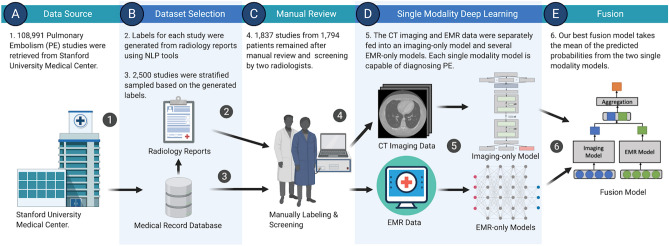
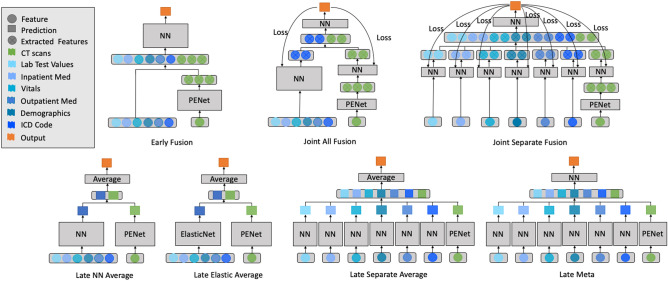
Recent advancements in deep learning have led to a resurgence of medical imaging and Electronic Medical Record (EMR) models for a variety of applications, including clinical decision support, automated workflow triage, clinical prediction and more. However, very few models have been developed to integrate both clinical and imaging data, despite that in routine practice clinicians rely on EMR to provide context in medical imaging interpretation. In this study, we developed and compared different multimodal fusion model architectures that are capable of utilizing both pixel data from volumetric Computed Tomography Pulmonary Angiography scans and clinical patient data from the EMR to automatically classify Pulmonary Embolism (PE) cases. The best performing multimodality model is a late fusion model that achieves an AUROC of 0.947 [95% CI: 0.946–0.948] on the entire held-out test set, outperforming imaging-only and EMR-only single modality models.
Overview
The claims and statistics of this paper haven’t been checked yet.
Free: it reads the open-access text and checks the first 5 claims that cite a source we can check. Create a free account to check every claim.
Integrity signals
Registry
Cites
Statistics
Figures
Verification
Claims the paper makes
The claims and statistics of this paper haven’t been checked yet.
Free: it reads the open-access text and checks the first 5 claims that cite a source we can check. Create a free account to check every claim.
Claims other papers make about this one
Each is checked against this paper’s own text: does it say what the citing paper says it does?
The source backs part of the claim, not all of it — or backs it for a different population, condition or comparison.
In the citing paper
“Huang et al. [83] found that averaging-based late fusion with regularized DNNs as sub-models outperforms early, intermediate and other late fusion strategies on the prediction of pulmonary embolism detection utilizing CT scans and EHR data.”
From Multimodal deep learning for biomedical data fusion: a review (2022) · cites this paper as [83]
Experimental — accuracy not yet measuredThe cited source says what the claim attributes to it.
In the citing paper
“Huang et al. created seven different fusion architectures. These included, early, joint, and late fusion. The architecture that performed the best was the late elastic average fusion for the diagnosis of pulmonary embolism using computed tomography and EHR data159.”
From Multimodal machine learning in precision health: A scoping review (2022) · cites this paper as [159]
The cited source says what the claim attributes to it.
In the citing paper
“Imaging and EHR-based data have been fused to improve detection of pulmonary embolism, outperforming single-modality models 99”
From Multimodal biomedical AI (2022) · cites this paper as [99]
The cited source says what the claim attributes to it.
In the citing paper
“Huang et al. [83] applied an FCNN for fusing sub-model predictions”
From Multimodal deep learning for biomedical data fusion: a review (2022) · cites this paper as [83]
The cited source says what the claim attributes to it.
In the citing paper
“recent work has demonstrated that the combination of imaging and EHR data outperforms each of these modalities alone to identify pulmonary embolism 99”
From Multimodal biomedical AI (2022) · cites this paper as [99]
Self-check
Percentages, sums and reported differences re-computed from the paper’s own numbers.
The self-check needs the paper’s full text.
Citations
Cites
Focal Loss for Dense Object Detection
Lin, T.-Y., Goyal, P., Girshick, R., He, K., & Dollar, P. (2017) · 2017 IEEE International Conference on Computer Vision (ICCV) · doi:10.1109/iccv.2017.324 · Cited by 30,581
Regularization and Variable Selection Via the Elastic Net
Zou, H., & Hastie, T. (2005) · Journal of the Royal Statistical Society Series B: Statistical Methodology · doi:10.1111/j.1467-9868.2005.00503.x · Cited by 20,957
CheXNet: Radiologist-Level Pneumonia Detection on Chest X-Rays with Deep Learning
Rajpurkar, P., Irvin, J., Zhu, K., Yang, B., Mehta, H., Duan, T., Ding, D. Y., Bagul, A., Langlotz, C. P., Shpanskaya, K. S., et al. (2017) · arXiv (Cornell University) · doi:10.48550/arxiv.1711.05225 · Cited by 1,219
Self-citationA Deep Learning Mammography-based Model for Improved Breast Cancer Risk Prediction
Yala, A., Lehman, C., Schuster, T., Portnoi, T., & Barzilay, R. (2019) · Radiology · doi:10.1148/radiol.2019182716 · Cited by 758
Bien, N., Rajpurkar, P., Ball, R. L., Irvin, J., Park, A., Jones, E., Bereket, M., Patel, B. N., Yeom, K. W., Shpanskaya, K., et al. (2018) · PLOS Medicine · doi:10.1371/journal.pmed.1002699 · Cited by 734
Self-citationHorlander, K. T., Mannino, D. M., & Leeper, K. V. (2003) · Archives of Internal Medicine · doi:10.1001/archinte.163.14.1711 · Cited by 657
Seven-point checklist and skin lesion classification using multitask multimodal neural nets
Kawahara, J., Daneshvar, S., Argenziano, G., & Hamarneh, G. (2019) · IEEE Journal of Biomedical and Health Informatics · doi:10.1109/jbhi.2018.2824327 · Cited by 584
CheXpert: A Large Chest Radiograph Dataset with Uncertainty Labels and Expert Comparison
Irvin, J., Rajpurkar, P., Ko, M., Yu, Y., Ciurea-Ilcus, S., Chute, C., Marklund, H., Haghgoo, B., Ball, R., Shpanskaya, K., et al. (2019) · Proceedings of the AAAI Conference on Artificial Intelligence · doi:10.1609/aaai.v33i01.3301590 · Cited by 392
Self-citationCheXpert: A Large Chest Radiograph Dataset with Uncertainty Labels and Expert Comparison
Irvin, J., Rajpurkar, P., Ko, M., Yu, Y., Ciurea-Ilcus, S., Chute, C., Marklund, H., Haghgoo, B., Ball, R., Shpanskaya, K., et al. (2019) · arXiv · doi:10.48550/arxiv.1901.07031 · Cited by 392
Self-citationMultimodal skin lesion classification using deep learning
Yap, J., Yolland, W., & Tschandl, P. (2018) · Experimental Dermatology · doi:10.1111/exd.13777 · Cited by 326
Research works printed but not linked: 1
- Rajan D Beymer D Abedin S Dehghan E Pi-PE: A pipeline for pulmonary embolism detection using sparsely annotated 3D CT images Mach. Learn. Health NeurIPS Workshop 2020 116 220 232
Cited by
Items 201–263 of 263
May, M. S., & Muttke, A. (2022) · Medical radiology · doi:10.1007/978-3-030-96285-2_11 · Cited by 1
Aydın, N., Cihan, Ç., Çelik, Ö., Aslan, A. F., Odabaş, A., Alataş, F., & Yıldırım, H. (2022) · Research Square · doi:10.21203/rs.3.rs-1694060/v2 · Cited by 1
NUMERICAL SIMULATION OF TURBULENT COUETTE FLOW.
Léonard, A., & Sicilian, J. M. (1972) · Transactions of the American Nuclear Society
Aydın, N., Cihan, Ç., Çelik, Ö., Aslan, A. F., Odabaş, A., Alataş, F., & Yıldırım, H. (2022) · Research Square · doi:10.21203/rs.3.rs-1694060/v1
AI applications in routine clinical imaging: detection, segmentation, diagnosis, and prognosis
Vaidyanathan, A. (2023) · Research Publications (Maastricht University) · doi:10.26481/dis.20230228av · Cited by 1
Feldman, J. D. (2023) · arXiv (Cornell University) · doi:10.48550/arxiv.2307.06775
“Moreover, by fusing two models, one can combine state-of-the-art models from CV and NLP far more easily (Boulahia et al., 2021; Huang et al., 2020).”
MethodBinary Classification of Drug Sensitivity Prediction Using Multimodal Deep LearningPreprint
Aqeeli, N., & Alzaid, E. (2023) · Research Square · doi:10.21203/rs.3.rs-3490258/v1
Pulmonary Embolism Detection Using Machine and Deep Learning Techniques
Vadhera, R., Sharma, M., & Vashisht, P. (2023) · Wiley eBooks · doi:10.1002/9781119792406.ch11
Deep learning and traditional-based CAD schemes for the pulmonary embolism diagnosis: A surveyPreprint
Hosseini, S. H., Taherinia, A. H., & Saadatmand‐Tarzjan, M. (2023) · arXiv (Cornell University) · doi:10.48550/arxiv.2312.01351
“Huang et al. [33] have developed and compared a multimodal fusion deep learning model that uses information from CT and EMR images to automatically detect pulmonary embolism.”
BackgroundMultimodality Fusion Method Based on Multiview Subspace Clustering for Pulmonary Embolism Diagnosis
Hu, P., Qi, Q., Zhao, Y., Fu, M., & Li, J. (2024) · Studies in health technology and informatics · doi:10.3233/shti231098
Yan, Z., Jiang, X., Chen, Y., Zhang, T., Huang, W., Gao, C., Chen, Q., & Liu, H. (2023) · IEEE Smart World Congress (SWC) · doi:10.1109/swc57546.2023.10448852
“In the work of [4], CT and electronic medical records (EMR) are used to diagnose pulmonary embolisms.”
MethodSCALED SIAMESE CNN-BASED AUTOMATIC CLASSIFICATION ALGORITHM FOR DETECTING PULMONARY EMBOLISM
Sekhar, A., & Suresh, L. P. (2024) · Biomedical Engineering Applications Basis and Communications · doi:10.4015/s1016237224500285
[Cross-modal hash retrieval of medical images based on Transformer semantic alignment].
Wu, Q., Tang, L., Liu, Q., Xu, L., & Chen, Q. (2025) · Europe PMC (PubMed Central) · doi:10.7507/1001-5515.202407034
Hierarchical attention fusion of EUS-doppler features for GISTs risk assessment
Wei, Q., Gao, Y., Liang, S., Chen, K., Wang, Y., & Guo, Y. (2025) · Computerized Medical Imaging and Graphics · doi:10.1016/j.compmedimag.2025.102584
Deep Learning for Diabetic Retinopathy Detection: A Review of Multimodal Data Fusion ApproachesPreprint
Wardhani, K. D. K., Kasim, S. B., hassan, R. B., Hidayat, R. S., & Sujon, K. M. (2025) · Research Square · doi:10.21203/rs.3.rs-7196434/v1 · Cited by 3
Amudha, T. K., & Sunitha, R. (2025) · International Conference on Emerging Technologies in Engineering Applications (ICETEA) · doi:10.1109/icetea64585.2025.11099778 · Cited by 3
Zhao, H., Xu, Z., & Ren, T. (2025) · IEEE International Conference on Pattern Recognition, Machine Vision and Artificial Intelligence (PRMVAI) · doi:10.1109/prmvai65741.2025.11108454
“Furthermore, it is labor-intensive and demands high-level expertise, consuming significant medical resources [2].”
Nabipoorashrafi, S. A., Seyedi, A., Bahri, R. A., Yadegar, A., Shomalzadeh, M., Mohammadi, F., Afshari, S. A., Firoozeh, N., Noroozzadeh, N., Khosravi, F., et al. (2025) · Journal of Imaging Informatics in Medicine · doi:10.1007/s10278-025-01645-w
Chen, S., Chen, X., Huang, X., Fang, Z., Wang, J., Huo, X., Chen, X., & Chen, J. (2025) · IEEE International Conference on Nano/Micro Engineered and Molecular Systems · doi:10.1109/nems67320.2025.11170105
“Bimodal fusion in deep learning (e.g., data-level direct modeling [7], feature-level joint fusion [8] and decision-level meta-learning [9]) have been developed to merge raw data, features or preliminary decisions of two modalities.”
The Sound and Sight of Confidence: An Audiovisual ML Approach
Jyothsna, A. N., Eric, P. V., & Rao, M. S. S. (2025) · International Journal of Computing · doi:10.47839/ijc.24.3.4191
Xue, K., Gong, T., Chang, Y., Liu, J., Wang, W., Li, M., Han, P., Xu, H., Wei, X., Dai, H., et al. (2025) · Research Square · doi:10.21203/rs.3.rs-7891003/v1
Explainable AI for Lung Disease Classification: Looking Inside the Black Box
Truong, T.-D., & Do, T. (2025) · Communications in computer and information science · doi:10.1007/978-981-95-4724-1_3
Qi, B., Zeng, S., Kwok, W. C., Chan, R. W., & Lee, P. T. Y. (2025) · Annual International Conference of the IEEE Engineering in Medicine and Biology Society (EMBC) · doi:10.1109/embc58623.2025.11254394
Wang, S., He, X., Jian, Z., Li, J., Xu, C., Chen, Y., Liu, Y., Chen, H., Huang, C., Hu, J., et al. (2024) · Figshare · doi:10.6084/m9.figshare.27140944
Wang, S., He, X., Jian, Z., Li, J., Xu, C., Chen, Y., Liu, Y., Chen, H., Huang, C., Hu, J., et al. (2024) · Figshare · doi:10.6084/m9.figshare.27140935
Tehrani, S. S. M., Zarvani, M., Amiri, P., Ghods, Z., Raoufi, M., Safavi-Naini, S. A. A., Soheili, A., Gharib, M., & Abbasi, H. (2023) · Figshare · doi:10.6084/m9.figshare.24586002
Wang, S., He, X., Jian, Z., Li, J., Xu, C., Chen, Y., Liu, Y., Chen, H., Huang, C., Hu, J., et al. (2024) · Figshare · doi:10.6084/m9.figshare.27140938
Towards the Automatic Diagnosis of Amyotrophic Lateral Sclerosis from Speech
Cebola, R. (2022) · Portuguese National Funding Agency for Science, Research and Technology (RCAAP Project by FCT)
Multimodal Artificial Intelligence Model for Wound Care
Pörhö, B. (2025) · UTUPub (University of Turku)
He, J., Huang, G., Yuan, X., Pun, C., Zhong, G., Yang, Q., Guo, L., Zhu, S., Lei, B., & Li, H. (2026) · Medical Image Analysis · doi:10.1016/j.media.2026.103958
Near-instantaneous Cardiovascular Event Prediction Using Multimodal Deep Learning
Al-Hasooni, M., Abdzaid, A., Hadi, N., & Fakhruldeen, H. (2026) · Electronics ETF · doi:10.53314/els2630003a
Xu, H., Zhang, J., Yu, L., & Xia, J. (2026) · International Conference on Big Data, Computational Intelligence, and Applications (BDCIA) · doi:10.1117/12.3104543
“However, single mode data often has limitations and is difficult to comprehensively and accurately describe the real health status of patients [6].”
Priya, N., Bilal, N., Tiwari, N., Bhat, M. H., & Bharadwaj, V. K. (2026) · International Conference on Intelligent and Innovative Technologies in Computing, Electrical and Electronics (IITCEE) · doi:10.1109/iitcee67948.2026.11394654
Multimodale Datenfusion zur Klassifikation von Angriffsphasen in Advanced Persistent Threat Attacken
Mellert, S. (2026) · elib (German Aerospace Center)
Hybrid Multi-View MRI Fusion for csPCa Diagnosis via Intra- and Inter-View Transformers
Zhao, Y., Li, D., Zhang, T., Wang, X., Xu, J., & Xuan, K. (2026) · IEEE Journal of Biomedical and Health Informatics · doi:10.1109/jbhi.2026.3672887
“In contrast, late fusion [15], [16], [17], [18], [19] processes each view independently and merges features only at later stages.”
Kumar, S., Singh, J., Bansal, A., & Unhelkar, B. (2025) · International Conference on IoT, Communication and Automation Technology (ICICAT) · doi:10.1109/icicat68430.2025.11414510
“Huang et al. [15] [16] introduced dual-stream designs which incorporated both CT and MRI for brain tumour classification and achieved significantly higher performance than single-modality approaches.”
Applications of Artificial Intelligence in Quantitative Imaging
Estépar, R. S. J., Curiale, A. H., & Nardelli, P. (2026) · Springer eBooks · doi:10.1007/978-3-032-14103-3_27
Farah, L. (2024) · theses.fr (ABES) · doi:10.70675/2826eff9z5f56z4a53za618z7d4afbe7e069
Sun, S., Cai, C. X., Ruochong, F. A. N., You, S., Tran, D., Rao, P. K., Suchard, M. A., Wang, Y., Lee, C. S., Lee, A., et al. (2026) · medRxiv · doi:10.64898/2026.04.23.26351616
The Rise of Multimodal AI in Healthcare: A New Frontier
Venkatesh, U., Santhosh, V. N., & Mittal, M. (2026) · Springer eBooks · doi:10.1007/978-981-95-9027-8_1
Yin, Z., Shu, Y., Shen, D., Gao, H., Zhang, Y., Yang, Z., Gong, W., Chen, T., & Liu, Y. (2026) · BMC Cancer · doi:10.1186/s12885-026-16116-w · Cited by 1
“Late fusion performs fusion at the decision-making level [10, 11].”
Li, B., Gong, Y., Du, B., Ye, J., & Xu, L. (2026) · Lecture notes in computer science · doi:10.1007/978-981-95-7141-3_26
PET and S-PET: A Two-Stage Pipeline for Pulmonary Embolism Detection From CTPA Scans
Raghu, A., & Boicu, M. (2025) · IEEE MIT Undergraduate Research Technology Conference (URTC) · doi:10.1109/urtc68753.2025.11533084
“In the RadFusion dataset, three labels were made for each patient by board certified radiologists: The presence or absence of PE, the type of PE and the slices were PE was present for cases with positive PE [7] [22].”
Magwenzi, S. (2026) · Journal of Precision Medicine and Artificial Intelligence · doi:10.64949/kap5fa07
“3,13 In interventional cardiology, a trimodal framework integrating coronary angiography videos, procedural text reports, and structured clinical features demonstrated superior performance in predicting five-year all-cause mortality after percutaneous coronary intervention (PCI).”
Deep learning in the early diagnosis of acute aortic dissection
Eggleton, S., Ryan, J., & Gallego, B. (2026) · Frontiers in Cardiovascular Medicine · doi:10.3389/fcvm.2026.1828870
“Whilst it cannot learn inter-modal relationships, late fusion has outperformed unimodal models (41) and early and intermediate fused models in classification tasks (42).”
Multimodal data fusion in deep learning for diabetic retinopathy detection: A systematic review
Wardhani, K. D. K., Kasim, S. B., hassan, R. B., Hidayat, R., Sujon, K. M., & Samad, M. A. (2026) · ICT Express · doi:10.1016/j.icte.2026.06.001 · Cited by 1
Multimodal Motion Tracking: A Review
Aidoo, E., Custance, O., Tenagyei, E. K., Dai, C., Chen, M., & Xu, Z. (2026) · IEEE Sensors Journal · doi:10.1109/jsen.2026.3701620
“Early fusion has been applied in contexts such as multisensor integration for patient monitoring and combining physiological signals with demographic features for risk prediction [123], [140], [238], [239], [240], [241].”
Advancing ICU decision making through multimodal data fusion in predicting cardiovascular disorders
Krones, F., Papastylianou, T., Qian, G., Parsons, G., Shukla, B., Papież, B. W., & Mahdi, A. (2026) · Information Fusion · doi:10.1016/j.inffus.2026.104573 · Cited by 2
Multimodal clinical data integration for prognosis of pulmonary embolism: A comparative study
Paolo, D., Soda, P., Tortora, M., Bria, A., & Sicilia, R. (2026) · Computerized Medical Imaging and Graphics · doi:10.1016/j.compmedimag.2026.102794
Jiang, C., Jiang, Z., Teng, Y., Lai, R., Zhou, Y., Zhang, Z., Huang, H., Liu, Y., Xie, Z., Jiang, M., et al. (2026) · European Journal of Nuclear Medicine and Molecular Imaging · doi:10.1007/s00259-026-08061-4
“Multimodal integration remains an important direction [28–30].”
Jiao, J., Duan, Z., Liu, G., Chen, Y., Wang, W., Ni, G., & Wu, Q. (2026) · Lecture notes in computer science · doi:10.1007/978-981-92-3495-0_20
Aşık, S., Yazıcı, A. T., Aşçı, M., & Okumuser, I. (2026) · Journal of Clinical Medicine · doi:10.3390/jcm15145525
Reddy, N. M., & Krishnan, G. H. (2026) · Radiation Physics and Chemistry · doi:10.1016/j.radphyschem.2026.114242
Liu, B., & Xie, M. (2026) · Rare Disease and Orphan Drugs Journal · doi:10.20517/rdodj.2025.88
Fundamentals of Multimodal AI for Clinical Use
Dinç, R., & Ardıç, N. (2026) · Springer eBooks · doi:10.1007/978-3-032-26723-8_3
Liu, L., Luo, C., Duan, C., Hu, J., Yang, M., Wang, X., Bian, X., & Lou, X. (2026) · Quantitative Imaging in Medicine and Surgery · doi:10.21037/qims-2026-1-0293
“Models integrating CTPA features with clinical data or electronic medical record variables have reported improved discriminatory performance compared with single-modality approaches in retrospective settings (40,41).”
Rodriguez-Idiazabal, L., Quintana, J. M., Ser, J. D., Echevarria‐Uraga, J. J., Legarreta, M. J., Larrea, N., García-García, F., & Barrio, I. (2026) · Expert Systems · doi:10.1111/exsy.70440
Strategies for recycled plastics content verification
Zabihi, O., Brüll, R., Pfaendner, R., Malz, F., Dagley, I., & Naebe, M. (2026) · Advanced Industrial and Engineering Polymer Research · doi:10.1016/j.aiepr.2026.100284
Ge, R., Wang, Z., Xiao, D., Jia, G., Xing, Z., Wan, X., Wang, C., & Elazab, A. (2026) · Pattern Recognition · doi:10.1016/j.patcog.2026.115118
Multimodal deep learning for wound healing prediction
Rojalin, T., Kröger, A., Koivunotko, E., Pörhö, B., Laaksonen, T., Partanen, J., Pridgeon, C., Madetoja, M., Airola, A., Akmal, J. S., et al. (2026) · European Journal of Pharmaceutical Sciences · doi:10.1016/j.ejps.2026.107693
Ameri, A., & Salmanizadeh, F. (2026) · Journal of Health and Biomedical Informatics · doi:10.34172/jhbmi.2026.07
Research on multimodal medical data fusion and application based on large-scale models
Zhao, N., Li, Y.-Q., & Liu, H. (2026) · Journal of Chinese Integrative Medicine · doi:10.1016/j.joim.2026.11.002
Metadata
- Authors
- Huang, S.-C., Pareek, A., Zamanian, R., Banerjee, I., & Lungren, M. P.
- Affiliations
- Stanford University (US)
- Stanford Medicine (US)
- Emory University (US)
- Corresponding author
- Huang, Shih-Cheng
- Venue
- Scientific Reports
- Published
- 2020-12-17
- Volume
- 10
- Issue
- 1
- Pages
- 22147-22147
- ISSN
- 2045-2322 (ISSN-L)
- PMC
- PMC7746687
- OpenAlex
- W3112990870
- Semantic Scholar
- 95a702faa61532ddca0a593404c6e60817be66a5
- Cited by
- 246
- References
- 38
- Citations by year
- 2026: 38 · 2025: 56 · 2024: 62 · 2023: 49 · 2022: 31 · 2021: 9
- FWCI
- 8.75
- Type
- journal article
- Language
- en
- Open access
- gold
- doi.org
- Licence
- cc-by
- creativecommons.org/licenses/by/4.0 (tdm)
- creativecommons.org/licenses/by/4.0 (vor)
- Locations
- Scientific Reports (publishedVersion, cc-by)
- PubMed Central (publishedVersion, cc-by)
- PubMed (publishedVersion)
- DOAJ (DOAJ: Directory of Open Access Journals) (submittedVersion, cc-by-sa)
- Funders
- U.S. National Library of Medicine (R01LM012966)
- Topics
- Physical Sciences › Computer Science › Artificial Intelligence › Machine Learning in Healthcare
- Health Sciences › Medicine › Radiology, Nuclear Medicine and Imaging › Radiomics and Machine Learning in Medical Imaging
- Physical Sciences › Computer Science › Computer Vision and Pattern Recognition › Multimodal Machine Learning Applications
- Keywords
- multimodal fusion, pulmonary embolism detection, CT pulmonary angiography, electronic health records, decision fusion, automated diagnosis, deep neural network
- MeSH terms
- Clinical Decision-Making, Machine Learning, Humans, Image Interpretation, Computer-Assisted, Image Processing, Computer-Assisted, Pulmonary Embolism, Sensitivity and Specificity, Tomography, X-Ray Computed, Neural Networks, Computer, Disease Management, Workflow, Electronic Health Records
About these checks
Registry, retraction, Cites and statistics results are computed, not judged, with one exception: a printed reference that no index lists is read once by a model before it counts as a citation error. Claims are extracted by a model and kept only when their quote appears verbatim in the text; each cited source is then checked, with a model’s help, for whether it says what the claim relies on. Those verdicts can be wrong — read the claim’s quote and the cited source before relying on one.
Statistics and arithmetic are recomputed, not judged.
Confidence bands are shown only for fields calibrated on our annotated test set. None is calibrated yet, so no band is shown.
What counts as a claim ›How we measure confidence ›How we check this ›
Are you an author, or do you see a problem with this page? Request a review
Data sources
Bibliographic data: Semantic Scholar, OpenAlex, Crossref.
Contains information from the Semantic Scholar Academic Graph Datasets, made available under the ODC Attribution License (ODC-BY 1.0).
Semantic Scholar’s data is described in: Kinney, R., et al. (2023). The Semantic Scholar Open Data Platform. arXiv:2301.10140.
