

The DOI matches its Crossref record; 102 of the 103 references it cites were found in a registry or an index.
Defining skin aging and its risk factors: a systematic review and meta-analysis
Open accessAbstract
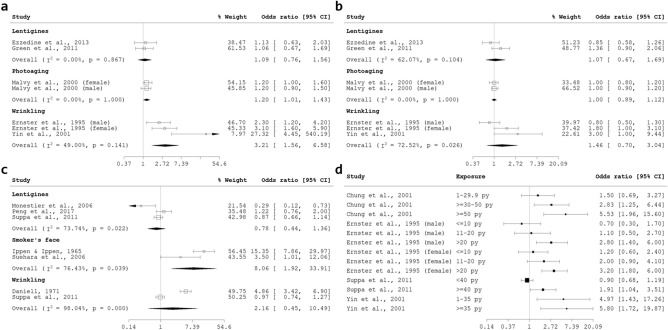
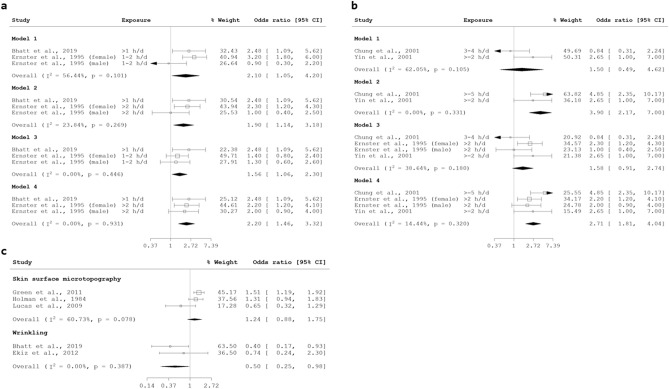
Skin aging has been defined to encompass both intrinsic and extrinsic aging, with extrinsic aging effected by environmental influences and overlaying the effects of chronological aging. The risk factors of skin aging have been studied previously, using methods of quantifying skin aging. However, these studies have yet to be reviewed. To better understand skin aging risk factors and collate the available data, we aimed to conduct a systematic review and meta-analysis. We conducted our systematic review in compliance with Preferred Reporting Item for Systematic Review and Meta-Analyses (PRISMA) guidelines. Embase, PubMed and Web of Science databases were searched in October 2020 using specific search strategies. Where odds ratios were reported, meta-analyses were conducted using the random effects model. Otherwise, significant factors were reported in this review. We identified seven notable risk factors for various skin aging phenotypes: age, gender, ethnicity, air pollution, nutrition, smoking, sun exposure. This review's results will guide future works, such as those aiming to examine the interaction between genetic and environmental influences.
Overview
The claims and statistics of this paper haven’t been checked yet.
Run the check — free, no account needed. It reads the open-access text and checks the sources it cites.
Integrity signals
Registry
Cites
Statistics
Figures
Verification
Claims the paper makes
The claims and statistics of this paper haven’t been checked yet.
Run the check — free, no account needed. It reads the open-access text and checks the sources it cites.
Claims other papers make about this one
Each is checked against this paper’s own text: does it say what the citing paper says it does?
The source backs part of the claim, not all of it — or backs it for a different population, condition or comparison.
In the citing paper
“Skin aging is a multifactorial biological process characterized by progressive alterations in skin structure, function, and appearance, including wrinkle formation, reduced hydration, impaired barrier integrity, and loss of elasticity [1,2].”
From A Randomized, Double-Blind, Placebo-Controlled Trial Assessing the Effects of Oral Centella asiatica Extract on Skin Aging-Related Parameters in Middle-Aged Korean Women. (2026) · cites this paper as [2]
Experimental — accuracy not yet measured
Self-check
Percentages, sums and reported differences re-computed from the paper’s own numbers.
The self-check needs the paper’s full text.
Citations
Cites
Preferred Reporting Items for Systematic Reviews and Meta-Analyses: the PRISMA statement
Moher, D., Liberati, A., Tetzlaff, J., Altman, D. G., & for the PRISMA Group (2009) · BMJ · doi:10.1136/bmj.b2535 · Cited by 83,823
Preferred reporting items for systematic reviews and meta-analyses: the PRISMA Statement.
(2009) · PubMed Central · Cited by 44,859
Meta-analysis in clinical trials
DerSimonian, R., & Laird, N. (1986) · Controlled Clinical Trials · doi:10.1016/0197-2456(86)90046-2 · Cited by 39,552
Conducting Meta-Analyses in R with the metafor Package
Viechtbauer, W. (2010) · Journal of Statistical Software · doi:10.18637/jss.v036.i03 · Cited by 20,464
Molecular Mechanisms of Stress-Responsive Changes in Collagen and Elastin Networks in Skin
Aziz, J., Shezali, H., Radzi, Z., Yahya, N. A., Abu Kassim, N. H., Czernuszka, J., & Rahman, M. T. (2016) · Skin Pharmacology and Physiology · doi:10.1159/000447017 · Cited by 7,323
JBI Manual for Evidence Synthesis
(2020) · JBI eBooks · doi:10.46658/jbimes-20-01 · Cited by 4,165
Meta-analysis of risk factors for cutaneous melanoma: II. Sun exposure
Gandini, S., Sera, F., Cattaruzza, M. S., Pasquini, P., Picconi, O., Boyle, P., & Melchi, C. F. (2005) · European Journal of Cancer · doi:10.1016/j.ejca.2004.10.016 · Cited by 1,266
Meta-analysis of risk factors for cutaneous melanoma: I. Common and atypical naevi
Gandini, S., Sera, F., Cattaruzza, M. S., Pasquini, P., ABENI, D. D., Boyle, P., & Melchi, C. F. (2004) · European Journal of Cancer · doi:10.1016/j.ejca.2004.10.015 · Cited by 879
Gandini, S., Sera, F., Cattaruzza, M. S., Pasquini, P., Zanetti, R., Masini, C., Boyle, P., & Melchi, C. F. (2005) · European Journal of Cancer · doi:10.1016/j.ejca.2005.03.034 · Cited by 829
Krutmann, J., Bouloc, A., Sore, G., Bernard, B. A., & Passeron, T. (2017) · Journal of Dermatological Science · doi:10.1016/j.jdermsci.2016.09.015 · Cited by 768
Research works printed but not linked: 2
- Ippen, M. & Ippen, H. Approaches to a prophylaxis of skin aging. J. Soc. Cosmet. Chem. 16, 305–308 (1965).
- Beagley, J. & Gibson, I. Changes in Skin Condition in Relation to Degree of Exposure to Ultraviolet Light 1–45 (School of Biology, Western Australian Institute of Technology, 1980).
Cited by
Sorted by citations
Aging Hallmarks and Progression and Age-Related Diseases: A Landscape View of Research Advancement
Tenchov, R., Sasso, J. M., Wang, X., & Zhou, Q. A. (2024) · ACS Chemical Neuroscience · doi:10.1021/acschemneuro.3c00531 · Cited by 276
Agrawal, R., Hu, A., & Bollag, W. B. (2023) · Biology · doi:10.3390/biology12111396 · Cited by 123
Skin ageing and topical rejuvenation strategies
Griffiths, T. W., Watson, R. E. B., & Langton, A. K. (2023) · British Journal of Dermatology · doi:10.1093/bjd/ljad282 · Cited by 108
Effects of Air Pollution on Cellular Senescence and Skin Aging
Martic, I., Jansen-Dürr, P., & Cavinato, M. (2022) · Cells · doi:10.3390/cells11142220 · Cited by 95
Macrophages: Subtypes, Distribution, Polarization, Immunomodulatory Functions, and Therapeutics
Peng, M., Li, N., Wang, H., Li, Y., Liu, H., Luo, Y., Lang, B., Zhang, W., Li, S., Tian, L., et al. (2025) · MedComm · doi:10.1002/mco2.70304 · Cited by 98
Metadata
- Authors
- Wong, Q. Y. A., & Chew, F. T.
- Affiliations
- National University of Singapore (SG)
- Corresponding author
- Chew, Fook Tim
- Venue
- Scientific Reports
- Published
- 2021-11-11
- Volume
- 11
- Issue
- 1
- Pages
- 22075-22075
- ISSN
- 2045-2322 (ISSN-L)
- PMC
- PMC8586245
- OpenAlex
- W3213583402
- Cited by
- 250
- References
- 103
- Citations by year
- 2026: 60 · 2025: 75 · 2024: 61 · 2023: 40 · 2022: 14
- FWCI
- 5.13
- Type
- journal article
- Language
- en
- Open access
- gold
- doi.org
- Locations
- Scientific Reports (publishedVersion, cc-by)
- PubMed Central (publishedVersion, cc-by)
- PubMed (publishedVersion)
- National University of Singapore (submittedVersion)
- DOAJ (DOAJ: Directory of Open Access Journals) (submittedVersion, cc-by-sa)
- Funders
- Faculty of Science, National University of Singapore (N-154-000-038-001)
- Ministry of Education - Singapore (R-154-000-191-112)
- Biomedical Research Council (BMRC/01/1/21/18/077)
- Singapore Immunology Network (SIgN-06-006)
- National Medical Research Council (NMRC/1150/2008)
- Agency for Science, Technology and Research (H17/01/a0/008)
- Topics
- Health Sciences › Medicine › Dermatology › Skin Protection and Aging
- Life Sciences › Biochemistry, Genetics and Molecular Biology › Cell Biology › melanin and skin pigmentation
- Health Sciences › Medicine › Dermatology › Dermatology and Skin Diseases
- Keywords
- skin aging, intrinsic aging, extrinsic aging, chronological aging, risk factors, air pollution, nutrition, smoking, sun exposure, gender differences, ethnicity, age
- MeSH terms
- Age Factors, Air Pollutants, Air Pollution, Humans, Risk Factors, Sex Factors, Skin, Smoking, Ultraviolet Rays, Skin Aging
About these checks
Registry, retraction, Cites and statistics results are computed, not judged, with one exception: a printed reference that no index lists is read once by a model before it counts as a citation error. Claims are extracted by a model and kept only when their quote appears verbatim in the text; each cited source is then checked, with a model’s help, for whether it says what the claim relies on. Those verdicts can be wrong — read the claim’s quote and the cited source before relying on one.
Statistics and arithmetic are recomputed, not judged.
Confidence bands are shown only for fields calibrated on our annotated test set. None is calibrated yet, so no band is shown.
What counts as a claim ›How we measure confidence ›How we check this ›
Are you an author, or do you see a problem with this page? Request a review
