

Emotions explain differences in the diffusion of true vs. false social media rumors
Open accessThe DOI matches its Crossref record; 67 of the 67 references it cites were found in a registry or an index.
Abstract
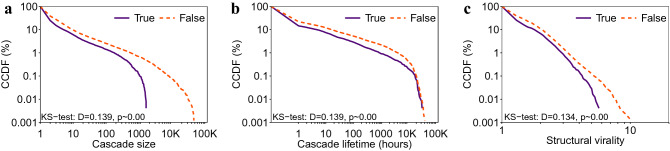
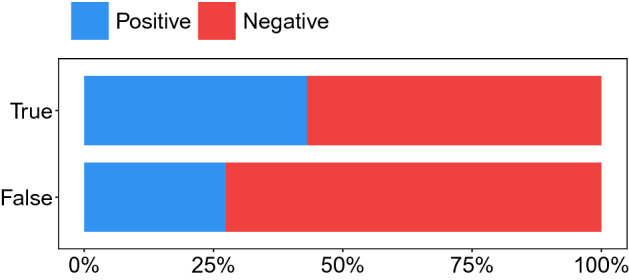
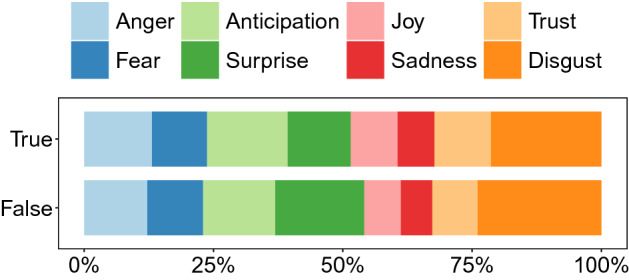
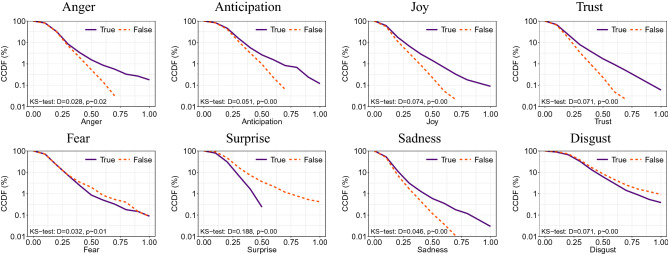
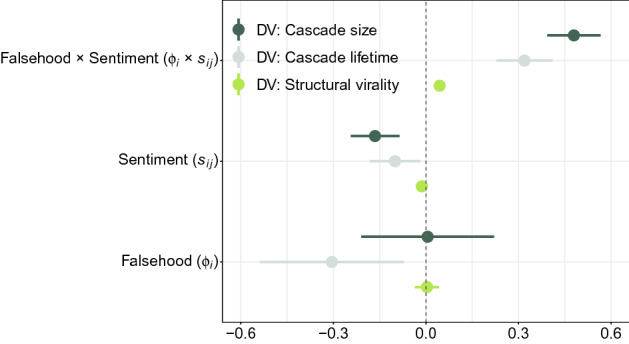
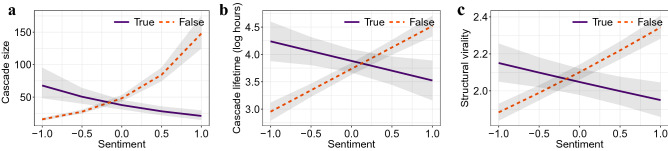
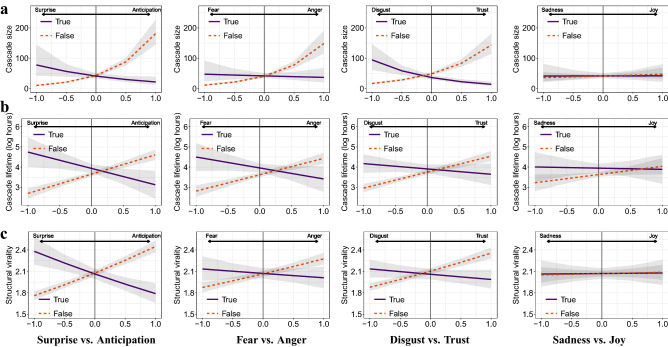
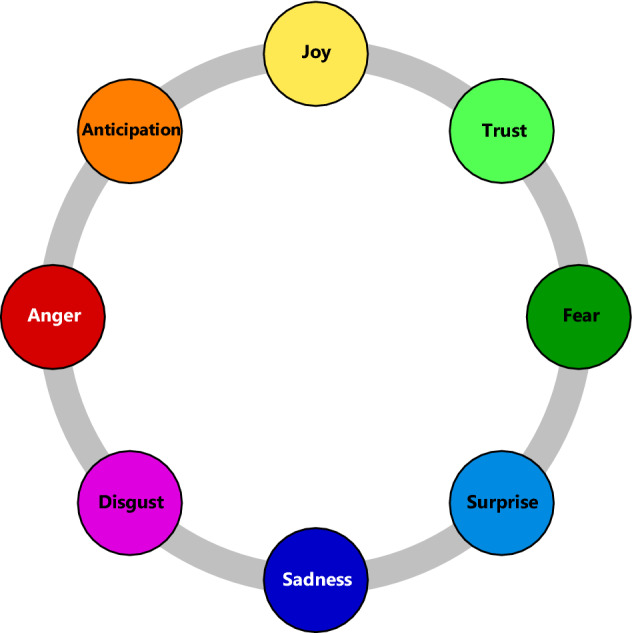
False rumors (often termed “fake news”) on social media pose a significant threat to modern societies. However, potential reasons for the widespread diffusion of false rumors have been underexplored. In this work, we analyze whether sentiment words, as well as different emotional words, in social media content explain differences in the spread of true vs. false rumors. For this purpose, we collected $${\varvec{N}} =126{,}301$$ N = 126 , 301 rumor cascades from Twitter, comprising more than 4.5 million retweets that have been fact-checked for veracity. We then categorized the language in social media content to (1) sentiment (i.e., positive vs. negative) and (2) eight basic emotions (i. e., anger, anticipation, disgust, fear, joy, trust, sadness, and surprise). We find that sentiment and basic emotions explain differences in the structural properties of true vs. false rumor cascades. False rumors (as compared to true rumors) are more likely to go viral if they convey a higher proportion of terms associated with a positive sentiment. Further, false rumors are viral when embedding emotional words classified as trust, anticipation, or anger. All else being equal, false rumors conveying one standard deviation more positive sentiment have a 37.58% longer lifetime and reach 61.44% more users. Our findings offer insights into how true vs. false rumors spread and highlight the importance of managing emotions in social media content.
Overview
The claims and statistics of this paper haven’t been checked yet.
Free: it reads the open-access text and checks the first 5 claims that cite a source we can check. Create a free account to check every claim.
Integrity signals
Registry
Cites
Statistics
Figures
Verification
Claims the paper makes
The claims and statistics of this paper haven’t been checked yet.
Free: it reads the open-access text and checks the first 5 claims that cite a source we can check. Create a free account to check every claim.
Claims other papers make about this one
Each is checked against this paper’s own text: does it say what the citing paper says it does?
In the citing paper
“As such, negativity embedded in online content explains the speed and virality of online diffusion dynamics (for example, response time, branching of online cascades)7,34,35,37,39–41.”
From Negativity drives online news consumption (2023) · cites this paper as [40]
In the citing paper
“The majority of studies on online behaviour are correlational34–36,38–42, while laboratory studies take subjects out of their natural environment.”
From Negativity drives online news consumption (2023) · cites this paper as [40]
Self-check
Percentages, sums and reported differences re-computed from the paper’s own numbers.
The self-check needs the paper’s full text.
Citations
Cites
Multimodel Inference: Understanding AIC and BIC in Model Selection
Burnham, K. P., & Anderson, D. R. (2004) · Sociological Methods & Research · doi:10.1177/0049124104268644 · Cited by 11,648
An argument for basic emotions
Ekman, P. (1992) · Cognition and Emotion · doi:10.1080/02699939208411068 · Cited by 9,646
The spread of true and false news online
Vosoughi, S., Roy, D., & Aral, S. (2018) · Science · doi:10.1126/science.aap9559 · Cited by 8,847
Social Media and Fake News in the 2016 Election
Allcott, H., & Gentzkow, M. (2017) · Journal of Economic Perspectives · doi:10.1257/jep.31.2.211 · Cited by 6,767
Lazer, D. M. J., Baum, M. A., Benkler, Y., Berinsky, A. J., Greenhill, K. M., Menczer, F., Metzger, M. J., Nyhan, B., Pennycook, G., Rothschild, D., et al. (2018) · Science · doi:10.1126/science.aao2998 · Cited by 4,160
Experimental evidence of massive-scale emotional contagion through social networks
Kramer, A. D. I., Guillory, J. E., & Hancock, J. T. (2014) · Proceedings of the National Academy of Sciences · doi:10.1073/pnas.1320040111 · Cited by 3,687
Exposure to ideologically diverse news and opinion on Facebook
Bakshy, E., Messing, S., & Adamic, L. A. (2015) · Science · doi:10.1126/science.aaa1160 · Cited by 3,245 · cited 3×
“(3) The validity of our estimates was ensured by following common practice for regression modeling.”
BackgroundWhat Makes Online Content Viral?
Berger, J., & Milkman, K. L. (2012) · Journal of Marketing Research · doi:10.1509/jmr.10.0353 · Cited by 3,178
Lerner, J. S., Li, Y., Valdesolo, P., & Kassam, K. S. (2015) · Annual Review of Psychology · doi:10.1146/annurev-psych-010213-115043 · Cited by 2,913
Information credibility on twitter
Castillo, C., Mendoza, M., & Poblete, B. (2011) · Proceedings of the 20th international conference on World wide web · doi:10.1145/1963405.1963500 · Cited by 2,593
Research works printed but not linked: 1
- Economist The How the world was trolled Economist 2017 425 21 24
Cited by
Negativity drives online news consumption
Robertson, C. E., Pröllochs, N., Schwarzenegger, K., Pärnamets, P., Van Bavel, J. J., & Feuerriegel, S. (2023) · Nature Human Behaviour · doi:10.1038/s41562-023-01538-4 · Cited by 333
Self-citationRussian propaganda on social media during the 2022 invasion of Ukraine
Geissler, D., Bär, D., Pröllochs, N., & Feuerriegel, S. (2023) · EPJ Data Science · doi:10.1140/epjds/s13688-023-00414-5 · Cited by 236
Self-citationUsing natural language processing to analyse text data in behavioural science
Feuerriegel, S., Maarouf, A., Bär, D., Geissler, D., Schweisthal, J., Pröllochs, N., Robertson, C. E., Rathje, S., Hartmann, J., Mohammad, S. M., et al. (2025) · Nature Reviews Psychology · doi:10.1038/s44159-024-00392-z · Cited by 140
“…fear, joy, trust, sadness and surprise) Inferring discrete emotions in social media posts to study whether angry posts are more likely to go viral 167,168 Characterizing emotions across political ideologies 142–144 Measuring the effect of discrete emotions on the perceived helpfulness of…”
Self-citationEmotion detection for misinformation: A review
Liu, Z., Zhang, T., Yang, K., Thompson, P., Yu, Z., & Ananiadou, S. (2024) · Information Fusion · doi:10.1016/j.inffus.2024.102300 · Cited by 133
“Other studies used cascade size, cascade lifetime, and structural virality [15, 16, 94] to analyze the patterns of misinformation spread.”
BackgroundDid the Roll-Out of Community Notes Reduce Engagement With Misinformation on X/Twitter?
Chuai, Y., Tian, H., Pröllochs, N., & Lenzini, G. (2024) · Proceedings of the ACM on Human-Computer Interaction · doi:10.1145/3686967 · Cited by 145
Self-citationCommunity-Based Fact-Checking on Twitter’s Birdwatch Platform
Pröllochs, N. (2022) · Proceedings of the International AAAI Conference on Web and Social Media · doi:10.1609/icwsm.v16i1.19335 · Cited by 134
Self-citationDiffusion of Community Fact-Checked Misinformation on Twitter
Drolsbach, C., & Pröllochs, N. (2023) · Proceedings of the ACM on Human-Computer Interaction · doi:10.1145/3610058 · Cited by 79
“To adjust for overdispersion, we draw upon a negative binomial regression to model the retweets count [31, 40].”
BackgroundMethodResultInfluentialSelf-citationPeople think that social media platforms do (but should not) amplify divisive content
Rathje, S., Robertson, C., Brady, W. J., & Van Bavel, J. J. (2024) · Perspectives on Psychological Science · doi:10.1177/17456916231190392 · Cited by 59
“…types of misinformation or con-spiracy theories may be related to their novelty (Vosoughi et al., 2018), their emotionality (Fong et al., 2021; Pröllochs et al., 2021), their expressions of moral outrage (McLoughlin et al., 2021), or their tendency to derogate the out-group (Osmundsen et al.,…”
The Impact of Affect on the Perception of Fake News on Social Media: A Systematic Review
Ali Adeeb, R., & Mirhoseini, M. (2023) · Social Sciences · doi:10.3390/socsci12120674 · Cited by 45
“- Participants with higher levels of emotion were more inclined to take actions that either spread or suppressed fake news.”
BackgroundMethodResultInfluentialPröllochs, N., & Feuerriegel, S. (2023) · Proceedings of the ACM on Human-Computer Interaction · doi:10.1145/3610078 · Cited by 54
Self-citationLiars know they are lying: differentiating disinformation from disagreement
Lewandowsky, S., Ecker, U. K. H., Cook, J., van der Linden, S., Roozenbeek, J., Орескес, Н., & McIntyre, L. (2024) · Humanities and Social Sciences Communications · doi:10.1057/s41599-024-03503-6 · Cited by 44
“People have been shown to be more susceptible to misinformation when put in an emotional state (Martel et al., 2020), which helps explain the preferential and more rapid diffusion of unreliable versus reliable information online (Pröllochs et al., 2021; Vosoughi et al., 2018).”
Affective information processing of fake news: evidence from NeuroIS
Lutz, B., Adam, M. T. P., Feuerriegel, S., Pröllochs, N., & Neumann, D. (2023) · European Journal of Information Systems · doi:10.1080/0960085x.2023.2224973 · Cited by 46
“…(e.g., Allcott & Gentzkow, 2017; Braun & Eklund, 2019; Wang et al., 2021), how fake news propagates (e.g., Altay et al., 2022; Bae et al., 2021; Pröllochs et al., 2021a,b; Laato et al., 2020; London et al., 2022; Solovev & Pröllochs, 2022; Drolsbach & Pröllochs, 2023; Pröllochs & Feuerriegel,…”
Self-citationThe Virality of Hate Speech on Social Media
Maarouf, A., Pröllochs, N., & Feuerriegel, S. (2024) · Proceedings of the ACM on Human-Computer Interaction · doi:10.1145/3641025 · Cited by 35
“Unlike positive emotions, negative emotions are known to drive online behaviors such as interactions and sharing [40, 41, 44, 50].”
BackgroundSelf-citationCommunity Notes vs. Snoping: How the Crowd Selects Fact-Checking Targets on Social Media
Pilarski, M., Solovev, K., & Pröllochs, N. (2024) · Proceedings of the International AAAI Conference on Web and Social Media · doi:10.1609/icwsm.v18i1.31387 · Cited by 55
Self-citationA Space-Time Framework for Sentiment Scope Analysis in Social Media
Bonifazi, G., Cauteruccio, F., Corradini, E., Marchetti, M., Sciarretta, L., Ursino, D., & Virgili, L. (2022) · Big Data and Cognitive Computing · doi:10.3390/bdcc6040130 · Cited by 30
Sui, M., Hawkins, I., & Wang, R. (2023) · Computers in Human Behavior · doi:10.1016/j.chb.2023.107654 · Cited by 51
Habib, H., & Nithyanand, R. (2025) · arXiv (Cornell University) · doi:10.48550/arxiv.2501.15048 · Cited by 32
Detecting False Rumors from Retweet Dynamics on Social Media
Naumzik, C., & Feuerriegel, S. (2022) · International World Wide Web Conference (WWW) · doi:10.1145/3485447.3512000 · Cited by 36
“This includes various structural properties of retweet cascades for instance, their lifetime [4, 45, 46], number of retweets [14, 45, 46], and emotions [63].”
BackgroundSelf-citationJakubik, J., Vössing, M., Pröllochs, N., Bär, D., & Feuerriegel, S. (2023) · Proceedings of the International AAAI Conference on Web and Social Media · doi:10.1609/icwsm.v17i1.22157 · Cited by 37
Self-citationNegativity bias in the spread of voter fraud conspiracy theory tweets during the 2020 US election
Youngblood, M., Stubbersfield, J., Morin, O., Glassman, R., & Acerbi, A. (2023) · Humanities and Social Sciences Communications · doi:10.1057/s41599-023-02106-x · Cited by 33
“False rumors, on the other hand, seem to be subject to a positivity bias (Pröllochs et al., 2021), despite the fact that “ fake news ” articles tend to contain more negative language (Acerbi, 2019).”
BackgroundMethodInfluentialBelievability and Harmfulness Shape the Virality of Misleading Social Media Posts
Drolsbach, C., & Pröllochs, N. (2023) · International World Wide Web Conference (WWW) · doi:10.1145/3543507.3583857 · Cited by 26
“varying veracity, fnding that misinformation spreads more virally than the truth [9, 18, 41, 47, 54].”
BackgroundSelf-citationGao, H., Guo, D., Yin, H., Wu, J., Cao, Z., & Li, L. (2022) · Journal of Applied Communication Research · doi:10.1080/00909882.2022.2144409 · Cited by 21
“Also, the comments on these negative rumors tend to express negative emotions, containing words like fear, shock, and disgust (Pröllochs et al., 2021).”
BackgroundFlores, P. M., & Hilbert, M. (2023) · Computers in Human Behavior · doi:10.1016/j.chb.2023.107841 · Cited by 21
References to unbiased sources increase the helpfulness of community fact-checks
Solovev, K., & Pröllochs, N. (2025) · Scientific Reports · doi:10.1038/s41598-025-09372-6 · Cited by 27
“Numerous studies have examined the spread of misinformation on social media, suggesting that false information spreads more viral than the truth [7, 11, 37, 38, 39, 40].”
Self-citationHe, J., Duan, W., Zhou, Y., & Su, Y. (2024) · International Journal of Disaster Risk Science · doi:10.1007/s13753-024-00539-9 · Cited by 21
“…dissemination and the information-seeking behavior of the public (Leykin et al. 2016; Magee et al. 2020); social network crisis and disaster event information dissemination models (Wan et al. 2022); and disaster information distortion, such as rumors (Xie et al. 2020; Pröllochs et al. 2021).”
Community Fact-Checks Trigger Moral Outrage in Replies to Misleading Posts on Social Media
Chuai, Y., Sergeeva, A., Lenzini, G., & Pröllochs, N. (2025) · CHI Conference on Human Factors in Computing Systems · doi:10.1145/3706598.3713909 · Cited by 25
“Several studies have found that emotions can explain the spread of true vs. false information on social media, with anger being the most significant emotion in driving the spread of misinformation [22, 93].”
Self-citationWu, Y., Shen, X., & Sun, Y. (2022) · Information Technology and People · doi:10.1108/itp-01-2022-0072 · Cited by 13
Evaluating resilience of urban lifelines against flooding in China using social media data
Qian, J., Du, Y., Liang, F., Yi, J., Wang, N., Tu, W., Huang, S., Pei, T., Ma, T., Burghardt, K., et al. (2024) · International Journal of Disaster Risk Reduction · doi:10.1016/j.ijdrr.2024.104453 · Cited by 13
Multimodal dual emotion with fusion of visual sentiment for rumor detection
Wang, G., Tan, L., Shang, Z., & Liu, H. (2023) · Multimedia Tools and Applications · doi:10.1007/s11042-023-16732-9 · Cited by 16
“In fact, in order to deepen people’s impression and credibility of ru-mors to promote the spread of rumors, the researchers often use the emotional information from images taken for events in history or generated by computers for creating attention and rich rumors emotion when publishing rumors.”
Finding Qs: Profiling QAnon Supporters on Parler
Bär, D., Pröllochs, N., & Feuerriegel, S. (2023) · Proceedings of the International AAAI Conference on Web and Social Media · doi:10.1609/icwsm.v17i1.22124 · Cited by 20
Self-citationTan, Z., & Zhang, T. (2025) · Information Processing & Management · doi:10.1016/j.ipm.2025.104391 · Cited by 13
Community-based fact-checking reduces the spread of misleading posts on X (formerly Twitter)
Chuai, Y., Pilarski, M., Renault, T., Amariles, D. R., Troussel, A., Lenzini, G., & Pröllochs, N. (2026) · Nature Communications · doi:10.1038/s41467-026-72597-0 · Cited by 38
Self-citationHaque, A., & Abulaish, M. (2023) · International Workshop on Natural Language Processing for Social Media (SocialNLP) · doi:10.18653/v1/2023.socialnlp-1.4 · Cited by 12
Conceptualizing the evolving nature of computational propaganda: a systematic literature review
Mustafa, H., Luczak–Roesch, M., & Johnstone, D. (2025) · Annals of the International Communication Association · doi:10.1093/anncom/wlaf001 · Cited by 19
Expressions of uncertainty in online science communication hinder information diffusion
Stavrova, O., Kleinberg, B., Evans, A. M., & Ivanović, M. (2024) · PNAS Nexus · doi:10.1093/pnasnexus/pgae439 · Cited by 9
“Misinformation prevention frameworks often build on the idea of fake news appealing to users’ emotions (64) and indeed recent sentiment analysis of fake and real news showed fake news to use more emotional language (65).”
BackgroundRumor detection model with weighted GraphSAGE focusing on node location
Ma, M., Zhang, C., Li, Y., Chen, J., & Wang, X. (2024) · Scientific Reports · doi:10.1038/s41598-024-76738-7 · Cited by 12
Social feedback amplifies emotional language in online video live chats
Luo, Y., Sornette, D., & Lera, S. C. (2025) · Communications Psychology · doi:10.1038/s44271-025-00370-y · Cited by 9
Online rumors during the COVID-19 pandemic: co-evolution of themes and emotions
Shen, C., Song, Z., He, P., Liu, L., & Xiong, Z. (2024) · Frontiers in Public Health · doi:10.3389/fpubh.2024.1375731 · Cited by 11
Hughes‐Warrington, M., Martin, A. W., & O'Brien, L. Y. (2025) · Routledge eBooks · doi:10.4324/9781003275084 · Cited by 10
A Social Activity-Based Control Model for Rumor Propagation
Zhu, Q., Fan, Z., Gan, C., Cheng, K., Wu, Y. C., & Yang, L. (2024) · Journal of Computational and Nonlinear Dynamics · doi:10.1115/1.4064200 · Cited by 6
Analyzing User Characteristics of Hate Speech Spreaders on Social Media
Geissler, D., Maarouf, A., & Feuerriegel, S. (2025) · International World Wide Web Conference (WWW) · doi:10.1145/3696410.3714502 · Cited by 7
“One risk of reshares is that harmful content can go viral, such as propaganda [15], fake news [8, 31, 32, 43], and content from untrustworthy sources [18].”
Self-citationSosyal Medyadaki Haberlerin Başlıklarındaki Duygusal Kelimelerin Haber Tüketimine Etkileri
Özsalih, A. (2024) · SELÇUK ÜNİVERSİTESİ İLETİŞİM FAKÜLTESİ AKADEMİK DERGİSİ · doi:10.18094/josc.1377241 · Cited by 5
Шевченка, Н.-Н. І. Ж. К. Н. У. І. Т., Shevchenko, V., Тульчій, А., & Стуса, Д. Н. У. І. В. (2024) · Public networks and communications · doi:10.31558/3083-5895.2024.2.8 · Cited by 7
Leveraging Deep Learning Models for Machine-Generated Text Detection Using Transformer-Based Models
Suthanthiradevi, P., Revathy, G., Rejini, K., & Lakshmi.V, M. (2024) · International Conference on Innovative Computing, Intelligent Communication and Smart Electrical Systems (ICSES) · doi:10.1109/icses63760.2024.10910837 · Cited by 6
“However, fully automated social media profiles, sometimes referred to as social bots, imitate human behavior [5].”
Bak, P. D. P. (2026) · Online Information Review · doi:10.1108/oir-06-2025-0472 · Cited by 4
Discrete Emotions Detection on Social Media: A Systematic Review and Comparative Analysis
Wang, M.-J., & Zhang, X. (2024) · IEEE International Conference on Information Technology, Big Data and Artificial Intelligence (ICIBA) · doi:10.1109/iciba62489.2024.10867988 · Cited by 4
Rumor Detection Based on the Temporal Sentiment
Fu, C., Chen, K., Pan, X., Yu, S., Ni, J., & Min, Y. (2022) · Communications in computer and information science · doi:10.1007/978-981-19-7532-5_18 · Cited by 4
Feeling misinformation: contours of information enthusiasm
Berg, A. L. (2023) · Emotions and Society · doi:10.1332/26316897y2023d000000002 · Cited by 3
Elicited emotion: effects of inoculation of an art style on emotionally strong images
Gutierrez, A. C., Tejada, J., & Fernández-Abascal, E. G. (2025) · Experimental Brain Research · doi:10.1007/s00221-025-07030-x · Cited by 4
“…click more often on certain topics, such as terrorism, natural disasters, or urban legends, specially if these topics contain emotional words classified as trust, anticipation or anger, which can evoke fear, disgust and surprise (Winter and Krämer 2014; Vosoughi et al. 2018; Pröllochs et al. 2021).”
Emotion-aware Structural Enhancement Graph Auto-Encoder for Rumor Detection
Li, G., Yao, Z., Hu, D., Xu, Y., Zhang, X., & Lyu, H. (2025) · IEEE International Conference on Acoustics Speech and Signal Processing · doi:10.1109/icassp49660.2025.10889918 · Cited by 3
“Astroturfing groups frequently employ emotional rhetoric to boost public engagement and sharing [15]–[17].”
Liu, X., Shen, W., Hu, X.-Y., & Lu, F. (2025) · The American Journal of Psychology · doi:10.5406/19398298.138.1.03 · Cited by 3
Wu, Y., Wang, J., Qing, Y., Wu, C., & Yin, F. (2025) · Physica A Statistical Mechanics and its Applications · doi:10.1016/j.physa.2025.130980 · Cited by 4
Zhang, S., Ke, Q., Zhang, L., Zhang, X., & Li, A. (2025) · Computers in Human Behavior · doi:10.1016/j.chb.2025.108865 · Cited by 4
Intervention strategies for health rumors: An overview based on the information lifecycle theory
Lyu, X., Xin, L. I. U., Tingting, Y. A. N. G., & Fu, C. (2024) · Advances in Psychological Science · doi:10.3724/sp.j.1042.2024.00664 · Cited by 5
Dual Stimulus–Organism–Response paradigms cross-domain aware model for rumor detection
Yun-yun, L., & Jin, J. (2025) · Engineering Applications of Artificial Intelligence · doi:10.1016/j.engappai.2025.111895 · Cited by 3
Nouri, E., Saraf, N., Goh, J. M., Dasgupta, S., & Cyr, D. (2025) · PLoS ONE · doi:10.1371/journal.pone.0336134 · Cited by 3
“By documenting this heterogeneity, our study contributes new evidence on how discrete emotions unfold in response to highly visible tragedies, showing how discrete emotions surpass prior valence–arousal models and extending prior work on settings such as rumors [27,95] and natural disasters [11].”
Angeles, R. J. G., Clemente, C. A., Malimban, R. L. O., Santos, J. E. G., & Tan, J. C. D. (2024) · International Journal of Multidisciplinary Applied Business and Education Research · doi:10.11594/ijmaber.05.10.05 · Cited by 5
Chuai, Y., Zhao, J., & Lenzini, G. (2025) · Proceedings of the ACM on Human-Computer Interaction · doi:10.1145/3757479 · Cited by 3
Emergence of unquenchable rumors with extended SIR epidemic model
Yin, W., & Gao, H. (2025) · Advances in Continuous and Discrete Models · doi:10.1186/s13662-025-03961-5 · Cited by 1
The Impact of Blame Attribution on Moral Contagion in Controversial Events
Li, H., Wang, Q., & Cao, R. (2025) · Entropy · doi:10.3390/e27101052 · Cited by 2
“In news, positive content tends to spread more virally [21]; in rumor diffusion, false rumors go viral when they contain more positive-emotion words [22].”
Does the Style of Misinformation Condition its Effects? An Experiment in Brazil
Caba, R. F., Chauchard, S., & Mello, F. (2025) · The Journal of Politics · doi:10.1086/739778 · Cited by 1
Vasilev, V. (2022) · Chinese Business Review · doi:10.17265/1537-1506/2022.04.003 · Cited by 1
Large-scale digital signatures of emotional response to the COVID-19 vaccination campaign
Bertani, A., Gallotti, R., Menini, S., Sacco, P. L., & Domenico, M. D. (2024) · EPJ Data Science · doi:10.1140/epjds/s13688-024-00452-7 · Cited by 1
How the cascade inference problem distorts information diffusionPreprint
DeVerna, M., Pierri, F., Aiyappa, R., Pacheco, D. F., Bryden, J., & Menczer, F. (2024) · arXiv (Cornell University) · doi:10.48550/arxiv.2410.21554 · Cited by 1
“Given the challenge of the reconstruction task, the data from this study was subsequently reanalyzed in many other domains [12, 71, 64, 72, 49, 74, 30].”
Susarla, A. (2022) · The Conversation · doi:10.64628/aai.wq5wh7eyp · Cited by 1
Holistic approach to analysing debates on ecological sustainability over time on X
Sánchez-Seco, J. G., Mouronte-López, M. L., & Benito, R. M. (2025) · EPJ Data Science · doi:10.1140/epjds/s13688-025-00545-x
Emotion Cum False Information Detection Based on Sentiment, Structural and Semantic Frameworks
Naskar, D., Das, S., & Rodríguez, S. (2025) · IEEE International Conference on Semantic Computing (ICSC) · doi:10.1109/icsc64641.2025.00013
“As a part of this research, the researchers [14] have studied the interplay between emotions, information diffusion dynamics, and user behaviour to devise interventions aimed at promoting critical thinking, media literacy, and responsible sharing practices.”
Hughes‐Warrington, M., Martin, A. W., & O'Brien, L. Y. (2025) · Routledge eBooks · doi:10.4324/9781003275084-4
Twitter mencabut larangan misinformasi COVID: ini risiko besar bagi kesehatan masyarakat
Susarla, A. (2022) · The Conversation · doi:10.64628/aan.xefcymjqh
Bertani, A., Gallotti, R., Menini, S., Sacco, P., & Domenico, M. D. (2024) · Figshare · doi:10.6084/m9.figshare.25374791
Flores Bautista, P. M. (2024) · eScholarship (California Digital Library) · Cited by 1
Kocabaş, O. (2025) · ADAM AKADEMİ Sosyal Bilimler Dergisi · doi:10.31679/adamakademi.1524733
BOLETÍN VERITAS. INFORMACIÓN BIBLIOGRÁFICA
Nicolás, J. A., & Linares-Peralta, R. (2025) · Cauriensia Revista anual de ciencias eclesiásticas · doi:10.17398/2340-4256.20.1405
Izumi, C. (2025) · Journal of Digital Society · doi:10.63913/jds.v1i3.15
Whose Line is it Anyway? Linguistic Attribution of Misinformation from Mainstream and Fringe LLMs
Kim, H. K., Garg, A., Kim, H., Joo, E., & Skumanich, A. (2025) · IEEE International Conference on Big Data (BigData) · doi:10.1109/bigdata66926.2025.11402634
How the emotional tone of financial disinformation influences investment behaviour
An, L., & Muro, F. D. (2026) · Journal of Business Research · doi:10.1016/j.jbusres.2026.116153
Sorokhaibam, A., & Chanda, N. (2026) · IGI Global eBooks · doi:10.4018/979-8-3373-6566-4.ch015
A multi-factor intervention model for rumor and refutation dynamics
Yin, F., Yin, Q., Wu, C., Guo, Y., & Wu, Y. (2026) · Journal of Computational Science · doi:10.1016/j.jocs.2026.102889
Emotion Impact and Contagion Mechanism of Misinformation: A Network‐Based Risk Analysis
Chen, Q. (2026) · Risk Analysis · doi:10.1111/risa.70265
Shen, C., Zhang, Y., & Ding, Y. (2026) · Frontiers in Public Health · doi:10.3389/fpubh.2026.1753674
Shahbazov, V., & Mammadaliyev, V. (2026) · Eastern-European Journal of Enterprise Technologies · doi:10.15587/1729-4061.2026.357119
“The paper [10] confirms these findings and shows that emotions explain measurable differences in the diffusion of true and false social-media rumors, with anger and disgust signifi - cantly increasing user interaction with false messages.”
Chen, X. K., Na, J., & Ye, Y. E. (2026) · Journal of Information Science · doi:10.1177/01655515261467993
Boletín veritas. Información bibliográfica
Somozas-Aranda, I. (2025) · PhilPapers (PhilPapers Foundation)
Xiang, T., Fu, H., & Yunze, Z. (2026) · Information Processing & Management · doi:10.1016/j.ipm.2026.105171
FIBB: Capturing False Information Beliefs and Behaviors Across Physical and Online Environments
Jia, M. Y., Bhattacharjee, N., Kapadia, A. R., & Wang, D. (2026) · ACM Conference on Human-AI Complementarity and Alignment · doi:10.1145/3834580.3838743
“Secondly, belief in online false claims affects both people’s online behavior, such as engagement on social media (e.g., liking or commenting [48]), and physical behavior, such as health decisions [19] or disaster responses [30].”
Aslam, A., & Haq, A. U. (2025) · Journal of Social Science Perspectives · doi:10.65761/jssp.2025.33
Azmi, S., Ahsan, H., & Podder, C. N. (2026) · SSRN Electronic Journal · doi:10.2139/ssrn.7571479
Gupta, A., Gorle, A. R., Rajesh, A., & Weissman, T. (2026) · arXiv (Cornell University) · doi:10.48550/arxiv.2610.07209
“Social reactions can also differ systematically between true and false content; for example, false stories may evoke different emotional or moral responses [13].”
The Building Blocks of Fake News: Rumor as a Core Component of Disinformation
Wilbur, D. (2026) · Crisis and Resilience · doi:10.65773/cr.2.4.167
ZEAITER, Z., Steils, N., & Calciu, M. (2026) · Journal of Consumer Marketing · doi:10.1108/jcm-03-2026-9074
Metadata
- Authors
- Pröllochs, N., Bär, D., & Feuerriegel, S.
- Affiliations
- Justus-Liebig-Universität Gießen (DE)
- Ludwig-Maximilians-Universität München (DE)
- ETH Zurich (CH)
- Corresponding author
- Pröllochs, Nicolas
- Venue
- Scientific Reports
- Published
- 2021-11-22
- Volume
- 11
- Issue
- 1
- Pages
- 22721-22721
- ISSN
- 2045-2322 (ISSN-L)
- PMC
- PMC8608927
- OpenAlex
- W3209046546
- Cited by
- 77
- References
- 66
- Citations by year
- 2026: 12 · 2025: 23 · 2024: 16 · 2023: 18 · 2022: 8
- FWCI
- 14.55
- Type
- journal article
- Language
- en
- Open access
- gold
- doi.org
- Licence
- cc-by
- creativecommons.org/licenses/by/4.0 (tdm)
- creativecommons.org/licenses/by/4.0 (vor)
- Locations
- Scientific Reports (publishedVersion, cc-by)
- PubMed Central (publishedVersion, cc-by)
- PubMed (publishedVersion)
- DOAJ (DOAJ: Directory of Open Access Journals) (submittedVersion, cc-by-sa)
- Open access LMU (Ludwid Maxmilian's Universitat Munchen) (submittedVersion, cc-by)
- Repository for Publications and Research Data (ETH Zurich) (submittedVersion, cc-by)
- ETH Zürich Research Collection (cc-by)
- Funders
- Justus-Liebig-Universität Gießen
- Topics
- Social Sciences › Sociology and Political Science › Misinformation and Its Impacts
- Physical Sciences › Physics and Astronomy › Statistical and Nonlinear Physics › Complex Network Analysis Techniques
- Physical Sciences › Computer Science › Information Systems › Spam and Phishing Detection
- Keywords
- false rumors, fake news, rumor propagation, social media, sentiment, basic emotions, emotional words, viral spread, trust, anger, anticipation, Twitter, retweets, fact-checking
About these checks
Registry, retraction, Cites and statistics results are computed, not judged, with one exception: a printed reference that no index lists is read once by a model before it counts as a citation error. Claims are extracted by a model and kept only when their quote appears verbatim in the text; each cited source is then checked, with a model’s help, for whether it says what the claim relies on. Those verdicts can be wrong — read the claim’s quote and the cited source before relying on one.
Statistics and arithmetic are recomputed, not judged.
Confidence bands are shown only for fields calibrated on our annotated test set. None is calibrated yet, so no band is shown.
What counts as a claim ›How we measure confidence ›How we check this ›
Are you an author, or do you see a problem with this page? Request a review
Data sources
Bibliographic data: Semantic Scholar, OpenAlex, Crossref.
Contains information from the Semantic Scholar Academic Graph Datasets, made available under the ODC Attribution License (ODC-BY 1.0).
Semantic Scholar’s data is described in: Kinney, R., et al. (2023). The Semantic Scholar Open Data Platform. arXiv:2301.10140.
