

Emotions explain differences in the diffusion of true vs. false social media rumors
Open accessThe DOI matches its Crossref record; 67 of the 67 references it cites were found in a registry or an index.
Abstract
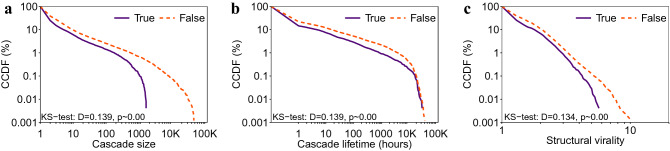
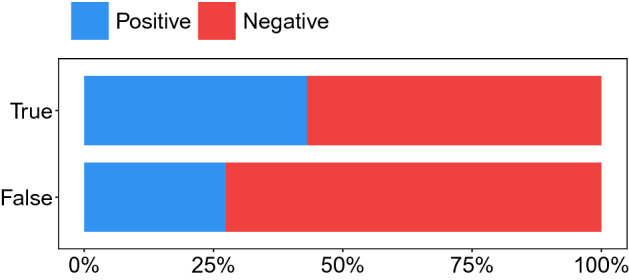
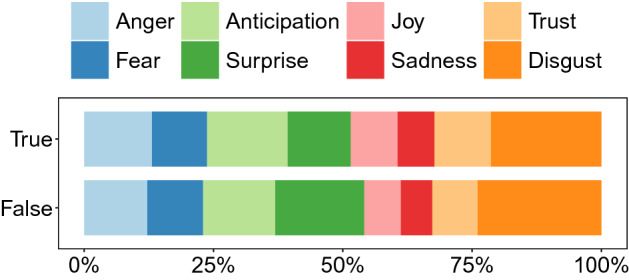
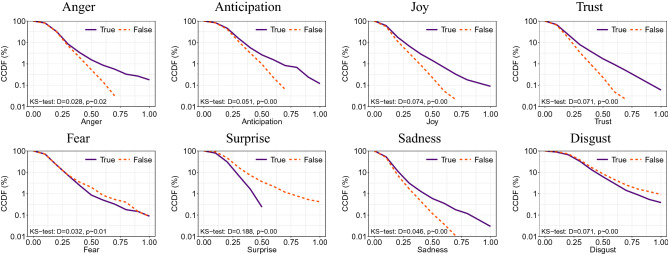
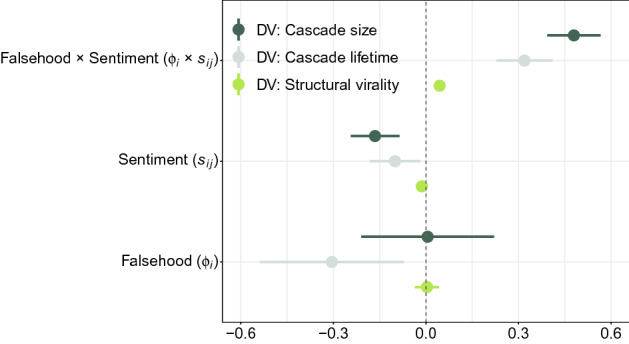
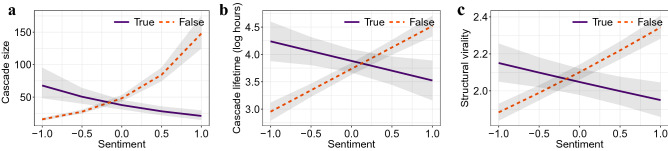
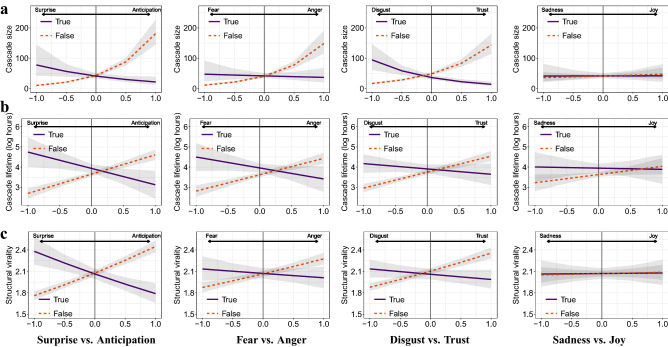
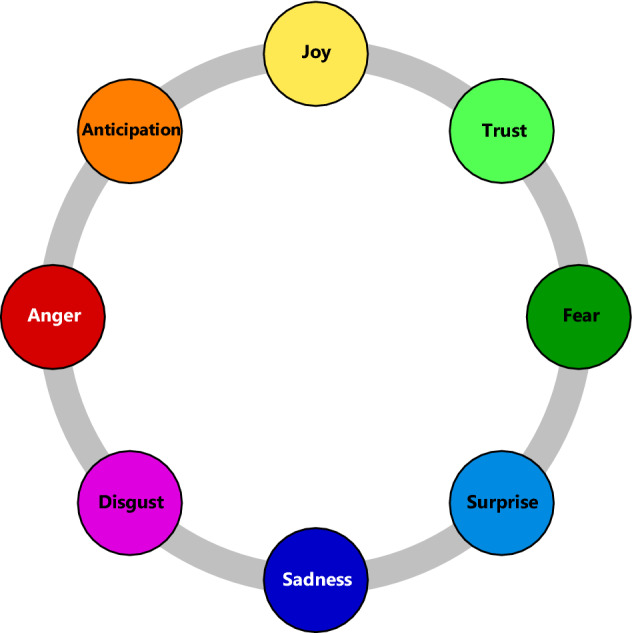
False rumors (often termed “fake news”) on social media pose a significant threat to modern societies. However, potential reasons for the widespread diffusion of false rumors have been underexplored. In this work, we analyze whether sentiment words, as well as different emotional words, in social media content explain differences in the spread of true vs. false rumors. For this purpose, we collected $${\varvec{N}} =126{,}301$$ N = 126 , 301 rumor cascades from Twitter, comprising more than 4.5 million retweets that have been fact-checked for veracity. We then categorized the language in social media content to (1) sentiment (i.e., positive vs. negative) and (2) eight basic emotions (i. e., anger, anticipation, disgust, fear, joy, trust, sadness, and surprise). We find that sentiment and basic emotions explain differences in the structural properties of true vs. false rumor cascades. False rumors (as compared to true rumors) are more likely to go viral if they convey a higher proportion of terms associated with a positive sentiment. Further, false rumors are viral when embedding emotional words classified as trust, anticipation, or anger. All else being equal, false rumors conveying one standard deviation more positive sentiment have a 37.58% longer lifetime and reach 61.44% more users. Our findings offer insights into how true vs. false rumors spread and highlight the importance of managing emotions in social media content.
Overview
The claims and statistics of this paper haven’t been checked yet.
Free: it reads the open-access text and checks the first 5 claims that cite a source we can check. Create a free account to check every claim.
Integrity signals
Registry
Cites
Statistics
Figures
Verification
Claims the paper makes
The claims and statistics of this paper haven’t been checked yet.
Free: it reads the open-access text and checks the first 5 claims that cite a source we can check. Create a free account to check every claim.
Claims other papers make about this one
Each is checked against this paper’s own text: does it say what the citing paper says it does?
In the citing paper
“As such, negativity embedded in online content explains the speed and virality of online diffusion dynamics (for example, response time, branching of online cascades)7,34,35,37,39–41.”
From Negativity drives online news consumption (2023) · cites this paper as [40]
In the citing paper
“The majority of studies on online behaviour are correlational34–36,38–42, while laboratory studies take subjects out of their natural environment.”
From Negativity drives online news consumption (2023) · cites this paper as [40]
Self-check
Percentages, sums and reported differences re-computed from the paper’s own numbers.
The self-check needs the paper’s full text.
Citations
Cites
Multimodel Inference: Understanding AIC and BIC in Model Selection
Burnham, K. P., & Anderson, D. R. (2004) · Sociological Methods & Research · doi:10.1177/0049124104268644 · Cited by 11,648
An argument for basic emotions
Ekman, P. (1992) · Cognition and Emotion · doi:10.1080/02699939208411068 · Cited by 9,646
The spread of true and false news online
Vosoughi, S., Roy, D., & Aral, S. (2018) · Science · doi:10.1126/science.aap9559 · Cited by 8,847
Social Media and Fake News in the 2016 Election
Allcott, H., & Gentzkow, M. (2017) · Journal of Economic Perspectives · doi:10.1257/jep.31.2.211 · Cited by 6,767
Lazer, D. M. J., Baum, M. A., Benkler, Y., Berinsky, A. J., Greenhill, K. M., Menczer, F., Metzger, M. J., Nyhan, B., Pennycook, G., Rothschild, D., et al. (2018) · Science · doi:10.1126/science.aao2998 · Cited by 4,160
Experimental evidence of massive-scale emotional contagion through social networks
Kramer, A. D. I., Guillory, J. E., & Hancock, J. T. (2014) · Proceedings of the National Academy of Sciences · doi:10.1073/pnas.1320040111 · Cited by 3,687
Exposure to ideologically diverse news and opinion on Facebook
Bakshy, E., Messing, S., & Adamic, L. A. (2015) · Science · doi:10.1126/science.aaa1160 · Cited by 3,245 · cited 3×
“(3) The validity of our estimates was ensured by following common practice for regression modeling.”
BackgroundWhat Makes Online Content Viral?
Berger, J., & Milkman, K. L. (2012) · Journal of Marketing Research · doi:10.1509/jmr.10.0353 · Cited by 3,178
Lerner, J. S., Li, Y., Valdesolo, P., & Kassam, K. S. (2015) · Annual Review of Psychology · doi:10.1146/annurev-psych-010213-115043 · Cited by 2,913
Information credibility on twitter
Castillo, C., Mendoza, M., & Poblete, B. (2011) · Proceedings of the 20th international conference on World wide web · doi:10.1145/1963405.1963500 · Cited by 2,593
The dynamics of viral marketing
Leskovec, J., Adamic, L. A., & Huberman, B. A. (2007) · ACM Transactions on the Web · doi:10.1145/1232722.1232727 · Cited by 2,032
Fake news on Twitter during the 2016 U.S. presidential election
Grinberg, N., Joseph, K., Friedland, L., Swire-Thompson, B., & Lazer, D. (2019) · Science · doi:10.1126/science.aau2706 · Cited by 1,803
Everyone's an influencer: quantifying influence on twitter
Bakshy, E., Hofman, J. M., Mason, W. A., & Watts, D. J. (2011) · Proceedings of the fourth ACM international conference on Web search and data mining · doi:10.1145/1935826.1935845 · Cited by 1,689
News use across social media platforms 2016
Gottfried, J. A., & Shearer, E. (2016) · Cited by 1,643
Emotions and Information Diffusion in Social Media—Sentiment of Microblogs and Sharing Behavior
Stieglitz, S., & Dang-Xuan, L. (2013) · Journal of Management Information Systems · doi:10.2753/mis0742-1222290408 · Cited by 1,604
Emotion shapes the diffusion of moralized content in social networks
Brady, W. J., Wills, J. A., Jost, J. T., Tucker, J. A., & Van Bavel, J. J. (2017) · Proceedings of the National Academy of Sciences · doi:10.1073/pnas.1618923114 · Cited by 1,580
Emotion Elicits the Social Sharing of Emotion: Theory and Empirical Review
Rimé, B. (2009) · Emotion Review · doi:10.1177/1754073908097189 · Cited by 1,546
Akinwande, M. O., Dikko, H. G., & Samson, A. (2015) · Open Journal of Statistics · doi:10.4236/ojs.2015.57075 · Cited by 1,534
Do threatening stimuli draw or hold visual attention in subclinical anxiety?
Fox, E., Russo, R., Bowles, R., & Dutton, K. (2001) · Journal of Experimental Psychology: General · doi:10.1037/0096-3445.130.4.681 · Cited by 1,469
Plutchik, R. (2001) · American Scientist · doi:10.1511/2001.4.344 · Cited by 1,419
Prior exposure increases perceived accuracy of fake news
Pennycook, G., Cannon, T. D., & Rand, D. G. (2018) · Journal of Experimental Psychology General · doi:10.1037/xge0000465 · Cited by 1,268
The spread of low-credibility content by social bots
Shao, C., Ciampaglia, G. L., Varol, O., Yang, K.-C., Flammini, A., & Menczer, F. (2018) · Nature Communications · doi:10.1038/s41467-018-06930-7 · Cited by 1,125
Influence of fake news in Twitter during the 2016 US presidential election
Bovet, A., & Makse, H. A. (2019) · CUNY Academic Works (City University of New York) · Cited by 882
Prominent Features of Rumor Propagation in Online Social Media
Kwon, S., Cha, M., Jung, K., Chen, W., & Wang, Y. (2013) · 2013 IEEE 13th International Conference on Data Mining · doi:10.1109/icdm.2013.61 · Cited by 859
Cross-cultural recognition of basic emotions through nonverbal emotional vocalizations
Sauter, D. A., Eisner, F., Ekman, P., & Scott, S. K. (2010) · Proceedings of the National Academy of Sciences · doi:10.1073/pnas.0908239106 · Cited by 789
Lee, A. M., Allport, G. W., & Postman, L. (1948) · American Sociological Review · doi:10.2307/2086591 · Cited by 701
Influence of fake news in Twitter during the 2016 US presidential election
Bovet, A., & Makse, H. A. (2019) · Nature Communications · doi:10.1038/s41467-018-07761-2 · Cited by 701 · cited 1×
“(4) We added non-linear regressors (i.”
The Structural Virality of Online Diffusion
Goel, S., Anderson, A., Hofman, J., & Watts, D. J. (2016) · Management Science · doi:10.1287/mnsc.2015.2158 · Cited by 647
Arousal Increases Social Transmission of Information
Berger, J. (2011) · Psychological Science · doi:10.1177/0956797611413294 · Cited by 600
The spread of low-credibility content by social bots
Shao, C., Ciampaglia, G. L., Varol, O., Yang, K.-C., Flammini, A., & Menczer, F. (2018) · RePEc: Research Papers in Economics · Cited by 574
Evaluating the fake news problem at the scale of the information ecosystem
Allen, J., Howland, B., Mobius, M., Rothschild, D., & Watts, D. J. (2020) · Science Advances · doi:10.1126/sciadv.aay3539 · Cited by 528
Tellis, G. J., MacInnis, D. J., Tirunillai, S., & Zhang, Y. (2019) · Journal of Marketing · doi:10.1177/0022242919841034 · Cited by 494
Reliance on emotion promotes belief in fake news
Martel, C., Pennycook, G., & Rand, D. G. (2020) · Cognitive Research: Principles and Implications · doi:10.1186/s41235-020-00252-3 · Cited by 470
Buzzwords: Early Cortical Responses to Emotional Words During Reading
Kissler, J., Herbert, C., Peyk, P., & Junghofer, M. (2007) · Psychological Science · doi:10.1111/j.1467-9280.2007.01924.x · Cited by 439
(2014) · iConference 2014 Proceedings · doi:10.9776/14308 · Cited by 423 · cited 9×
“We conducted additional checks to validate the robustness of our results: (1) we ran separate regressions for true vs.”
BackgroundMethodResultInfluentialKnapp, R. H. (1944) · Public Opinion Quarterly · doi:10.1086/265665 · Cited by 407
Inside rumor: A personal journey.
Rosnow, R. L. (1991) · American Psychologist · doi:10.1037//0003-066x.46.5.484 · Cited by 390
The structure of online diffusion networks
Goel, S., Watts, D. J., & Goldstein, D. G. (2012) · Proceedings of the 13th ACM Conference on Electronic Commerce · doi:10.1145/2229012.2229058 · Cited by 385
Friggeri, A., Adamic, L., Eckles, D., & Cheng, J. (2014) · Proceedings of the International AAAI Conference on Web and Social Media · doi:10.1609/icwsm.v8i1.14559 · Cited by 382
Bad news travel fast: a content-based analysis of interestingness on Twitter
Naveed, N., Gottron, T., Kunegis, J., & Alhadi, A. C. (2011) · Proceedings of the 3rd International Web Science Conference · doi:10.1145/2527031.2527052 · Cited by 354
Rumor Detection over Varying Time Windows
Kwon, S., Cha, M., & Jung, K. (2017) · PLOS ONE · doi:10.1371/journal.pone.0168344 · Cited by 352
Deep learning for affective computing: Text-based emotion recognition in decision support
Kratzwald, B., Ilić, S., Kraus, M., Feuerriegel, S., & Prendinger, H. (2018) · Decision Support Systems · doi:10.1016/j.dss.2018.09.002 · Cited by 352
Self-citationGoldenberg, A., & Gross, J. J. (2020) · Trends in Cognitive Sciences · doi:10.1016/j.tics.2020.01.009 · Cited by 309
Social sharing of emotion following exposure to a negatively valenced situation
Luminet, O., Bouts, P., Delie, F., Manstead, A. S. R., & Rimé, B. (2000) · Cognition & Emotion · doi:10.1080/02699930050117666 · Cited by 280
SECTION OF PSYCHOLOGY: The Basic Psychology of Rumor
Allport, G. W., & Postman, L. J. (1945) · Transactions of the New York Academy of Sciences · doi:10.1111/j.2164-0947.1945.tb00216.x · Cited by 240
Protecting elections from social media manipulation
Aral, S., & Eckles, D. (2019) · Science · doi:10.1126/science.aaw8243 · Cited by 209 · cited 9×
“(2) yij = β0 + β 1 xij + β2 φi + β T 3 bij + β T 4 (φi ⊙ bij)+ ui”
BackgroundMethodInfluentialThe bursty dynamics of the Twitter information network
Myers, S. A., & Leskovec, J. (2014) · Proceedings of the 23rd international conference on World wide web · doi:10.1145/2566486.2568043 · Cited by 198
How social network sites and other online intermediaries increase exposure to news
Scharkow, M., Mangold, F., Stier, S., & Breuer, J. (2020) · Proceedings of the National Academy of Sciences · doi:10.1073/pnas.1918279117 · Cited by 176
A Bayesian approach for predicting the popularity of tweets
Zaman, T., Fox, E. B., & Bradlow, E. T. (2014) · The Annals of Applied Statistics · doi:10.1214/14-aoas741 · Cited by 163
Talking about others: Emotionality and the dissemination of social information
Peters, K., Kashima, Y., & Clark, A. (2009) · European Journal of Social Psychology · doi:10.1002/ejsp.523 · Cited by 149
Mohammad, S. M. (2021) · Elsevier eBooks · doi:10.1016/b978-0-12-821124-3.00011-9 · Cited by 105
Anthony, S. (1973) · The Journal of Social Psychology · doi:10.1080/00224545.1973.9922572 · Cited by 104
Online analysis of information diffusion in twitter
Taxidou, I., & Fischer, P. M. (2014) · International World Wide Web Conference (WWW) · doi:10.1145/2567948.2580050 · Cited by 91
Plutchik, R. (2016) · Cited by 91
The impact of content sentiment and emotionality on content virality
Heimbach, I., & Hinz, O. F. (2016) · International Journal of Research in Marketing · doi:10.1016/j.ijresmar.2016.02.004 · Cited by 80
Kato, Y., Kato, S., & Akahori, K. (2006) · Computers in Human Behavior · doi:10.1016/j.chb.2005.11.005 · Cited by 79
Meng, J., Peng, W., Tan, P.-N., Liu, W., Cheng, Y., & Bae, A. (2018) · Computers in Human Behavior · doi:10.1016/j.chb.2018.07.039 · Cited by 79
On the relation between message sentiment and its virality on social media
Tsugawa, S., & Ohsaki, H. (2017) · Social Network Analysis and Mining · doi:10.1007/s13278-017-0439-0 · Cited by 69
Role of Sentiment in Message Propagation: Reply vs. Retweet Behavior in Political Communication
Kim, J., & Yoo, J. (2012) · International Conference on Social Informatics (SocialInformatics) · doi:10.1109/socialinformatics.2012.33 · Cited by 64
Emotions in online rumor diffusion
Pröllochs, N., Bär, D., & Feuerriegel, S. (2021) · EPJ Data Science · doi:10.1140/epjds/s13688-021-00307-5 · Cited by 63
Self-citationAnger can make fake news viral online
Chuai, Y., & Zhao, J. (2022) · Frontiers in Physics · doi:10.3389/fphy.2022.970174 · Cited by 54
Wu, S., Tan, C., Kleinberg, J., & Macy, M. (2021) · Proceedings of the International AAAI Conference on Web and Social Media · doi:10.1609/icwsm.v5i1.14196 · Cited by 52
Cascade-LSTM: A Tree-Structured Neural Classifier for Detecting Misinformation Cascades
Ducci, F., Kraus, M., & Feuerriegel, S. (2020) · ACM SIGKDD Conference on Knowledge Discovery and Data Mining (KDD) · doi:10.1145/3394486.3403317 · Cited by 48
Self-citationRumors at the Speed of Light? Modeling the Rate of Rumor Transmission During Crisis
Zeng, L., Starbird, K., & Spiro, E. S. (2016) · 2016 49th Hawaii International Conference on System Sciences (HICSS) · doi:10.1109/hicss.2016.248 · Cited by 45
Conti, M., Lain, D., Lazzeretti, R., Lovisotto, G., & Quattrociocchi, W. (2017) · 2017 IEEE Workshop on Information Forensics and Security (WIFS) · doi:10.1109/wifs.2017.8267653 · Cited by 34
Anger makes fake news viral onlinePreprint
Chuai, Y., & Zhao, J. (2020) · arXiv (Cornell University) · doi:10.48550/arxiv.2004.10399 · Cited by 19
Quantifying Structural Patterns of Information Cascades
Zang, C., Cui, P., Song, C., Faloutsos, C., & Zhu, W. (2017) · International World Wide Web Conference (WWW) · doi:10.1145/3041021.3054214 · Cited by 18
Research works printed but not linked: 1
- Economist The How the world was trolled Economist 2017 425 21 24
Cited by
Negativity drives online news consumption
Robertson, C. E., Pröllochs, N., Schwarzenegger, K., Pärnamets, P., Van Bavel, J. J., & Feuerriegel, S. (2023) · Nature Human Behaviour · doi:10.1038/s41562-023-01538-4 · Cited by 333
Self-citationRussian propaganda on social media during the 2022 invasion of Ukraine
Geissler, D., Bär, D., Pröllochs, N., & Feuerriegel, S. (2023) · EPJ Data Science · doi:10.1140/epjds/s13688-023-00414-5 · Cited by 236
Self-citationUsing natural language processing to analyse text data in behavioural science
Feuerriegel, S., Maarouf, A., Bär, D., Geissler, D., Schweisthal, J., Pröllochs, N., Robertson, C. E., Rathje, S., Hartmann, J., Mohammad, S. M., et al. (2025) · Nature Reviews Psychology · doi:10.1038/s44159-024-00392-z · Cited by 140
“…fear, joy, trust, sadness and surprise) Inferring discrete emotions in social media posts to study whether angry posts are more likely to go viral 167,168 Characterizing emotions across political ideologies 142–144 Measuring the effect of discrete emotions on the perceived helpfulness of…”
Self-citationEmotion detection for misinformation: A review
Liu, Z., Zhang, T., Yang, K., Thompson, P., Yu, Z., & Ananiadou, S. (2024) · Information Fusion · doi:10.1016/j.inffus.2024.102300 · Cited by 133
“Other studies used cascade size, cascade lifetime, and structural virality [15, 16, 94] to analyze the patterns of misinformation spread.”
BackgroundDid the Roll-Out of Community Notes Reduce Engagement With Misinformation on X/Twitter?
Chuai, Y., Tian, H., Pröllochs, N., & Lenzini, G. (2024) · Proceedings of the ACM on Human-Computer Interaction · doi:10.1145/3686967 · Cited by 145
Self-citation
Metadata
- Authors
- Pröllochs, N., Bär, D., & Feuerriegel, S.
- Affiliations
- Justus-Liebig-Universität Gießen (DE)
- Ludwig-Maximilians-Universität München (DE)
- ETH Zurich (CH)
- Corresponding author
- Pröllochs, Nicolas
- Venue
- Scientific Reports
- Published
- 2021-11-22
- Volume
- 11
- Issue
- 1
- Pages
- 22721-22721
- ISSN
- 2045-2322 (ISSN-L)
- PMC
- PMC8608927
- OpenAlex
- W3209046546
- Cited by
- 77
- References
- 66
- Citations by year
- 2026: 12 · 2025: 23 · 2024: 16 · 2023: 18 · 2022: 8
- FWCI
- 14.55
- Type
- journal article
- Language
- en
- Open access
- gold
- doi.org
- Licence
- cc-by
- creativecommons.org/licenses/by/4.0 (tdm)
- creativecommons.org/licenses/by/4.0 (vor)
- Locations
- Scientific Reports (publishedVersion, cc-by)
- PubMed Central (publishedVersion, cc-by)
- PubMed (publishedVersion)
- DOAJ (DOAJ: Directory of Open Access Journals) (submittedVersion, cc-by-sa)
- Open access LMU (Ludwid Maxmilian's Universitat Munchen) (submittedVersion, cc-by)
- Repository for Publications and Research Data (ETH Zurich) (submittedVersion, cc-by)
- ETH Zürich Research Collection (cc-by)
- Funders
- Justus-Liebig-Universität Gießen
- Topics
- Social Sciences › Sociology and Political Science › Misinformation and Its Impacts
- Physical Sciences › Physics and Astronomy › Statistical and Nonlinear Physics › Complex Network Analysis Techniques
- Physical Sciences › Computer Science › Information Systems › Spam and Phishing Detection
- Keywords
- false rumors, fake news, rumor propagation, social media, sentiment, basic emotions, emotional words, viral spread, trust, anger, anticipation, Twitter, retweets, fact-checking
About these checks
Registry, retraction, Cites and statistics results are computed, not judged, with one exception: a printed reference that no index lists is read once by a model before it counts as a citation error. Claims are extracted by a model and kept only when their quote appears verbatim in the text; each cited source is then checked, with a model’s help, for whether it says what the claim relies on. Those verdicts can be wrong — read the claim’s quote and the cited source before relying on one.
Statistics and arithmetic are recomputed, not judged.
Confidence bands are shown only for fields calibrated on our annotated test set. None is calibrated yet, so no band is shown.
What counts as a claim ›How we measure confidence ›How we check this ›
Are you an author, or do you see a problem with this page? Request a review
Data sources
Bibliographic data: Semantic Scholar, OpenAlex, Crossref.
Contains information from the Semantic Scholar Academic Graph Datasets, made available under the ODC Attribution License (ODC-BY 1.0).
Semantic Scholar’s data is described in: Kinney, R., et al. (2023). The Semantic Scholar Open Data Platform. arXiv:2301.10140.
