

Effect of smartphone-based stress management programs on depression and anxiety of hospital nurses in Vietnam: a three-arm randomized controlled trial
Open accessThe DOI matches its Crossref record; 50 of the 51 references it cites were found in a registry or an index; 12 of the 51 sources its claims cite were checked for support.
Abstract
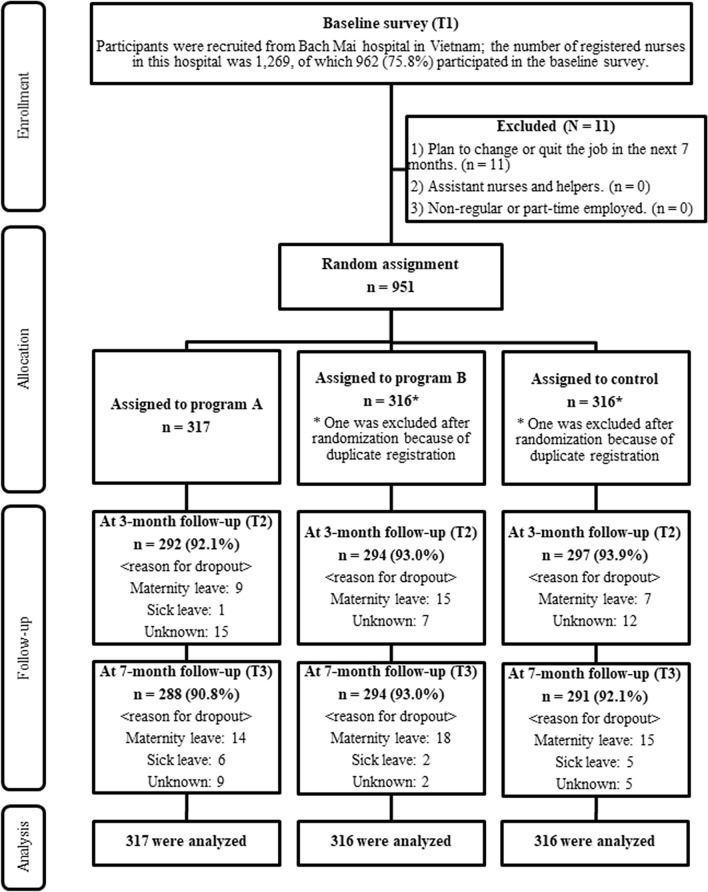
There are growing concerns on stress among nurses in low- and middle-income countries (LMICs) in South-East Asia. It is important to improve mental health among nurses in these countries. The objective of this study was to examine the efficacy of two types of newly developed smartphone-based stress management programs in improving depressive and anxiety symptoms among hospital nurses in Vietnam. This study was a three-arm (including two intervention groups and one control group) randomized trial. Participants were recruited from nurses in a large general hospital in Hanoi, Vietnam. Two types (free-choice and fixed sequential order) of smartphone-based stress management programs were developed. Participants were randomly allocated to Program A (a free-choice, multimodule stress management), Program B (a fixed-order, internet cognitive behavioral therapy, iCBT), or a control group (treatment as usual). The depressive and anxiety symptoms were measured by using the Depression Anxiety and Stress Scales at baseline, 3-, and 7-month follow-up surveys. 951 participants were randomly allocated to each of the three groups. Program B showed a statistically significant effect on improving depressive symptoms at 3-month (p = 0.048), but not at 7-month (p = 0.92); Cohen’s d was − 0.18 (95% CI − 0.34 to − 0.02) and 0.03 (95% CI − 1.00 to 1.05), respectively. Program A failed to show a significant intervention effect on any of the outcomes at 3- or 7-month follow-up (p > 0.05). Despite the small effect size, the present fixed-order iCBT program seems effective in improving depression of hospital nurses in Vietnam. A public health impact of the intervention can be scalable, when considering its accessibility and minimal cost. Trial registration number: The study protocol is registered at the UMIN Clinical Trials Registry (UMINCTR; ID = UMIN000033139). Registered date of the protocol is 1st Jul. 2018. https://upload.umin.ac.jp/cgi-open-bin/ctr_e/ctr_view.cgi?recptno=R000037796
Overview
CoChat Summary
TL;DR
This three-arm randomized controlled trial in 951 hospital nurses in Hanoi found that a fixed-sequence smartphone-based iCBT program (Program B) improved depressive symptoms at 3 months, while a free-choice program (Program A) did not show significant effects on depression or anxiety. The observed benefit was small (Cohen’s d = −0.18) and was not sustained at 7 months.
Key findings
- 951 nurses were randomly allocated 1:1:1 to Program A, Program B, or control; baseline participation was 75.8% of workers (962/1,269), and 24% of participants in each group had mild depressive symptoms at baseline.
- Program B showed a significant reduction in depression at 3 months versus control: effect size d = −0.18 (95% CI −0.34 to −0.02); MMRM estimated effect t = −1.98, p = 0.048.
- Program B did not significantly affect anxiety at 3 or 7 months, and its depression effect was not significant at 7 months (t = 0.10, p = 0.92).
- Program A showed no significant intervention effect on depression or anxiety at 3- or 7-month follow-up.
- Adherence was high in both intervention arms: 83.3% completed all 6 modules in Program A (264 participants) and 86.1% in Program B (272 participants), with no significant difference (p = 0.33).
Methods
- Three-arm, parallel-group, non-blinded randomized controlled trial with treatment as usual control; follow-up surveys at baseline, 3 months, and 7 months.
- Participants were full-time registered nurses from one large general hospital in Hanoi, Vietnam, who could access the internet via a mobile device; 951 eligible nurses were randomized after exclusions and duplicate registrations.
- Primary outcomes were depressive and anxiety symptoms measured with the DASS 21; main analysis used mixed models for repeated measures with group × time interactions under an intention-to-treat principle.
Limitations
- The paper states that participants came from one big general hospital in Vietnam, were mostly female, married, and without chronic disease or baseline depressive symptoms, so generalizability to other nurse populations may be limited.
- The paper states that outcomes were self-reported, which may be affected by participants’ perceptions or work situation.
- The paper states that contamination occurred in the control group: 12.5% reported hearing about the programs at 3 months and 31.3% at 7 months, which could weaken effects.
- Evident from the text: Program A and Program B were not identical in content, so comparing “free-choice” versus “fixed-order” is confounded by program-content differences.
Model-written summary. Check it against the paper before relying on it.
Integrity signals
Registry
Cites
Statistics
Figures
Verification
Claims the paper makes
6 Valid · 0 Not valid · 29 Not checked · 53 Own results and interpretations
The cited sources support only part of this claim — read each source’s verdict below.
In the paper
“To detect a small effect size (i.e., 0.25) or more at an alpha error rate of 0.05 and a beta error rate of 0.15, the estimated sample size was 289 participants in each group.”
§ Effect of smartphone-based stress management programs on depression and anxiety of hospital nurses in Vietnam: a three-arm randomized controlled trial > Methods > Process evaluation
What the sources say
- Could not verifycites [18] Carolan S Harris PR Cavanagh K Improving employee well-being and effectiveness: systematic review and meta-analysis of web-based psychological interventions delivered in the workplace J. Med. Internet Res. 2017 19 e271 10.2196/jmir.7583 28747293 PMC5550734 sourceExperimental — accuracy not yet measured
The Methods (Data Analysis; page unavailable) describes effect-size classification for a meta-analysis, and the Results (Subgroup Analyses; page unavailable) reports some effects of 0.25. Neither addresses a DASS-21 sample-size calculation. Searches for 289 participants per group and the stated alpha and beta error rates found no supporting passage in our copy. (LLM, conf=0.76)
- Could not verifycites [19] Stratton E Effectiveness of eHealth interventions for reducing mental health conditions in employees: a systematic review and meta-analysis PLoS ONE 2017 12 e0189904 10.1371/journal.pone.0189904 29267334 PMC5739441 sourceExperimental — accuracy not yet measured
The Statistical analysis section classifies small effect sizes but does not calculate a required sample size. Searches for 289 participants per group, the stated alpha and beta error rates, and DASS-21 found no passage supporting the attributed calculation. Our copy has no page numbers for these passages. (LLM, conf=0.76)
- Partly supportedcites [41] Faul F Erdfelder E Buchner A Lang AG Statistical power analyses using G*Power 3.1: tests for correlation and regression analyses Behav. Res. Methods 2009 41 1149 1160 10.3758/Brm.41.4.1149 19897823 sourceExperimental — accuracy not yet measured
The paper’s “Effect size measure” section describes a priori power analyses that calculate required sample sizes from specified inputs. It does not report a calculation for DASS-21 depressive symptoms, an effect size of 0.25 with alpha 0.05 and beta 0.15, or 289 participants per group. (LLM, conf=0.83)
hedgedn = 289- Asserted: passes — The authors put it forward as true.
- Checkable: passes — It can be checked against evidence.
- Load-bearing: passes — The paper’s conclusions depend on it.
- Based: passes — The paper gives a reason why it holds.
- Could not verify
The cited sources support only part of this claim — read each source’s verdict below.
In the paper
“A previous systematic review reported that guided iCBT programs with support or feedback from professionals have usually shown a greater effect than non-guided iCBT44,45.”
§ Effect of smartphone-based stress management programs on depression and anxiety of hospital nurses in Vietnam: a three-arm randomized controlled trial > Discussion
What the sources say
- Partly supportedcites [44] Heber E The benefit of web- and computer-based interventions for stress: a systematic review and meta-analysis J. Med. Internet Res. 2017 19 e32 10.2196/jmir.5774 28213341 PMC5336602 sourceExperimental — accuracy not yet measured
The Results (Subgroup Analyses, Guidance; page not given) report significantly larger effects for guided than unguided interventions, and the Methods define guidance as regular written feedback. But the comparison pools interventions with different theoretical bases; it does not establish that guided iCBT specifically usually outperforms unguided iCBT. (LLM, conf=0.86)
- Supportedcites [45] Spek V Internet-based cognitive behaviour therapy for symptoms of depression and anxiety: a meta-analysis Psychol. Med. 2007 37 319 328 10.1017/S0033291706008944 17112400 source
The Results passage in our indexed copy (Abstract; page not provided) reports that interventions with therapist support had a large mean effect size, while those without it had a small mean effect size. This supports the citing sentence’s comparison of guided and non-guided iCBT programs. (LLM, conf=0.91)
hedgedstates a cause- Asserted: passes — The authors put it forward as true.
- Checkable: passes — It can be checked against evidence.
- Load-bearing: passes — The paper’s conclusions depend on it.
- Based: passes — The paper gives a reason why it holds.
- Partly supported
The cited sources support only part of this claim — read each source’s verdict below.
In the paper
“Previous meta-analyses of web-based psychological intervention on improving workers' mental health in the workplace yielded effect sizes of 0.23 to 0.3718,19.”
§ Effect of smartphone-based stress management programs on depression and anxiety of hospital nurses in Vietnam: a three-arm randomized controlled trial > Methods > Process evaluation
What the sources say
- Partly supportedcites [18] Carolan S Harris PR Cavanagh K Improving employee well-being and effectiveness: systematic review and meta-analysis of web-based psychological interventions delivered in the workplace J. Med. Internet Res. 2017 19 e271 10.2196/jmir.7583 28747293 PMC5550734 sourceExperimental — accuracy not yet measured
Our copy (Results, Meta-Analyses Findings; Abstract, Results) reports a single pooled effect for workplace web-based psychological interventions on mental health (stress, depression, psychological distress) of g=0.37, 95% CI 0.23-0.50, so the upper value of the claimed range matches this source. However, 0.23 in this paper is the lower bound of that confidence interval (and separately the subgroup effect for high risk-of-bias studies in the Sensitivity Analysis, d=0.23, 95% CI 0.10-0.36), not an effect size this meta-analysis 'yielded' as a standalone result; the paper's other pooled estimate (work effectiveness, g=0.25) is a non-mental-health outcome. The claim therefore presents one source's point estimate plus its CI bound as if two meta-analyses produced effect sizes spanning 0.23-0.37. (LLM, conf=0.75)
- Partly supportedcites [19] Stratton E Effectiveness of eHealth interventions for reducing mental health conditions in employees: a systematic review and meta-analysis PLoS ONE 2017 12 e0189904 10.1371/journal.pone.0189904 29267334 PMC5739441 sourceExperimental — accuracy not yet measured
Our copy of Stratton et al. (2017) supports the lower end of the attributed range: the Abstract (Results) reports 23 controlled trials of workplace eHealth interventions with an overall small positive effect at post-intervention (g = 0.24, 95% CI 0.13 to 0.35) and at follow-up (g = 0.23, 95% CI 0.03 to 0.42), repeated in Results > Meta-analysis results. However, no passage in our copy reports an effect size of 0.37, so the upper bound of the claimed 0.23–0.37 range is not attributable to this paper (it must come from the other citation on the sentence). The scope also differs slightly: this review pools eHealth interventions delivered by web or smartphone App (CBT, Mindfulness, Stress Management) rather than 'web-based psychological intervention' alone, and its subgroup effects range from g = 0.12 (trim-and-fill adjusted) to g = 0.60–0.69, none equal to 0.37. (LLM, conf=0.78)
plainstates a cause- Asserted: passes — The authors put it forward as true.
- Checkable: passes — It can be checked against evidence.
- Load-bearing: passes — The paper’s conclusions depend on it.
- Based: passes — The paper gives a reason why it holds.
- Partly supported
A result the paper reports from its own data — it cites no other source for it, so there is none to check. The quote shows it is in the paper.
In the paper
“Program A failed to show a significant intervention effect on any of the outcomes at 3- or 7-month follow-up (p > 0.05).”
§ Effect of smartphone-based stress management programs on depression and anxiety of hospital nurses in Vietnam: a three-arm randomized controlled trial > Abstract There are growing concerns on stress among nurses in low- and middle-income countries (LMICs) in South-East Asia. It is important to improve mental health among nurses in these countries. The objective of this study was to examine the efficacy of two types of newly developed smartphone-based stress management programs in improving depressive and anxiety symptoms among hospital nurses in Vietnam. This study was a three-arm (including two intervention groups and one control group) randomized trial. Participants were recruited from nurses in a large general hospital in Hanoi, Vietnam. Two types (free-choice and fixed sequential order) of smartphone-based stress management programs were developed. Participants were randomly allocated to Program A (a free-choice, multimodule stress management), Program B (a fixed-order, internet cognitive behavioral therapy, iCBT), or a control group (treatment as usual). The depressive and anxiety symptoms were measured by using the Depression Anxiety and Stress Scales at baseline, 3-, and 7-month follow-up surveys. 951 participants were randomly allocated to each of the three groups. Program B showed a statistically significant effect on improving depressive symptoms at 3-month (p = 0.048), but not at 7-month (p = 0.92); Cohen’s d was − 0.18 (95% CI − 0.34 to − 0.02) and 0.03 (95% CI − 1.00 to 1.05), respectively. Program A failed to show a significant intervention effect on any of the outcomes at 3- or 7-month follow-up (p > 0.05). Despite the small effect size, the present fixed-order iCBT program seems effective in improving depression of hospital nurses in Vietnam. A public health impact of the intervention can be scalable, when considering its accessibility and minimal cost. Trial registration number: The study protocol is registered at the UMIN Clinical Trials Registry (UMINCTR; ID = UMIN000033139). Registered date of the protocol is 1st Jul. 2018. https://upload.umin.ac.jp/cgi-open-bin/ctr_e/ctr_view.cgi?recptno=R000037796
plain- Asserted: passes — The authors put it forward as true.
- Checkable: passes — It can be checked against evidence.
- Load-bearing: passes — The paper’s conclusions depend on it.
- Based: passes — The paper gives a reason why it holds.
A result the paper reports from its own data — it cites no other source for it, so there is none to check. The quote shows it is in the paper.
In the paper
“Program B showed a significant effect size in reducing depression score at 3-month follow-up compared to the control group (d = − 0.18 [95% CI − 0.34 to − 0.02]).”
- Also stated in: § Discussion · plain
“The present RCT found that Program B, an iCBT program with a fixed-sequential order of modules, showed a significant intervention effect on improving depressive symptoms at 3-month follow-up among hospital nurses in Vietnam, with a small effect size.”
§ Effect of smartphone-based stress management programs on depression and anxiety of hospital nurses in Vietnam: a three-arm randomized controlled trial > Results > Effect of the intervention programs on depressive and anxiety symptoms
plainstates a cause- Asserted: passes — The authors put it forward as true.
- Checkable: passes — It can be checked against evidence.
- Load-bearing: passes — The paper’s conclusions depend on it.
- Based: passes — The paper gives a reason why it holds.
- Also stated in: § Discussion · plain
25 more claims
Create a free account to see all 88 claims and to verify the 39 references still open.
- It may state two separate claims as one. 29
- Probably not a substantial claim. 41
- The quote only partly states this claim. 1
Claims other papers make about this one
Each is checked against this paper’s own text: does it say what the citing paper says it does?
The cited source says what the claim attributes to it.
In the citing paper
“Our study of an unguided universal prevention iCBT program among nurses in Vietnam reported a small effect size on depression (d=0.18 at the 3-month follow-up) [16].”
The cited source says what the claim attributes to it.
In the citing paper
“We found that a self-guided iCBT program reduced depression among nurses in Vietnam during a 3-month follow-up [16].”
The cited source says what the claim attributes to it.
In the citing paper
“A similar pattern was observed in our previous RCT using a similar self-guided smartphone-based stress management program among hospital nurses in Vietnam before the COVID-19 pandemic [16].”
Statistics recomputed
Every reported test result, recomputed from its test statistic and degrees of freedom. A result shows as not adding up only once an independent check has confirmed it.
- Consistentχ²(3) = 1.98reported p = .58 · recomputed p = .577
“χ2(3) = 1.98, p = .58”
- Consistentχ²(3) = 0.98reported p = .81 · recomputed p = .806
“χ2(3) = 0.98, p = .81”
- Consistentχ²(4) = 2.1reported p = .72 · recomputed p = .717
“χ2(4) = 2.10, p = .72”
Self-check
Percentages, sums and reported differences re-computed from the paper’s own numbers.
Self-check results appear here once an independent check has confirmed them.
Citations
Cites
Statistical power analyses using G∗Power 3.1: tests for correlation and regression analyses
Faul, F., Erdfelder, E., Buchner, A., & Lang, A.-G. (2009) · Behavior Research Methods · doi:10.3758/brm.41.4.1149 · Cited by 37,615
Culture and the self: Implications for cognition, emotion, and motivation.
Markus, H. R., & Kitayama, S. (1991) · Psychological Review · doi:10.1037/0033-295x.98.2.224 · Cited by 21,995
Culture's Consequences: Comparing Values, Behaviors, Institutions, and Organizations across Nations
Bhagat, R. S., & Hofstede, G. (2002) · The Academy of Management Review · doi:10.2307/4134391 · Cited by 21,664
Lovibond, P. F., & Lovibond, S. H. (1995) · Behaviour Research and Therapy · doi:10.1016/0005-7967(94)00075-u · Cited by 14,523
CONSORT 2010 Statement: updated guidelines for reporting parallel group randomised trials
the CONSORT Group, Schulz, K. F., Altman, D. G., & Moher, D. (2010) · BMC Medicine · doi:10.1186/1741-7015-8-18 · Cited by 13,371
KESSLER, R. C., ANDREWS, G., COLPE, L. J., HIRIPI, E., MROCZEK, D. K., NORMAND, S.-L. T., WALTERS, E. E., & ZASLAVSKY, A. M. (2002) · Psychological Medicine · doi:10.1017/s0033291702006074 · Cited by 10,327
CONSORT 2010 Statement: updated guidelines for reporting parallel group randomised trials
Schulz, K. F., Altman, D. G., Moher, D., & for the CONSORT Group (2010) · BMJ · doi:10.1136/bmj.c332 · Cited by 9,329
Henry, J. D., & Crawford, J. R. (2005) · British Journal of Clinical Psychology · doi:10.1348/014466505x29657 · Cited by 5,801
Reducing Risks for Mental Disorders: Frontiers for Preventive Intervention Research
(1994) · doi:10.17226/2139 · Cited by 2,073
Online mental health services in China during the COVID-19 outbreak
Liu, S., Yang, L., Zhang, C., Xiang, Y.-T., Liu, Z., Hu, S., & Zhang, B. (2020) · The Lancet Psychiatry · doi:10.1016/s2215-0366(20)30077-8 · Cited by 1,992
Internet-based cognitive behaviour therapy for symptoms of depression and anxiety: A meta-analysis
SPEK, V., CUIJPERS, P., NYKLÍČEK, I., RIPER, H., KEYZER, J., & POP, V. (2007) · Psychological Medicine · doi:10.1017/s0033291706008944 · Cited by 1,586
Ford, I., & Norrie, J. (2016) · New England Journal of Medicine · doi:10.1056/nejmra1510059 · Cited by 1,405
Mental Health Smartphone Apps: Review and Evidence-Based Recommendations for Future Developments
Bakker, D., Kazantzis, N., Rickwood, D., & Rickard, N. (2016) · JMIR Mental Health · doi:10.2196/mental.4984 · Cited by 886
Carpenter, J. K., Andrews, L. A., Witcraft, S. M., Powers, M. B., Smits, J. A. J., & Hofmann, S. G. (2018) · Depression and Anxiety · doi:10.1002/da.22728 · Cited by 846
Scale up of services for mental health in low-income and middle-income countries
Eaton, J., McCay, L., Semrau, M., Chatterjee, S., Baingana, F., Araya, R., Ntulo, C., Thornicroft, G., & Saxena, S. (2011) · The Lancet · doi:10.1016/s0140-6736(11)60891-x · Cited by 698
Preventing occupational stress in healthcare workers
Ruotsalainen, J. H., Verbeek, J. H., Mariné, A., & Serra, C. (2015) · Cochrane Database of Systematic Reviews · doi:10.1002/14651858.cd002892.pub5 · Cited by 563
Workplace interventions for common mental disorders: A systematic meta-review
Joyce, S., Modini, M., Christensen, H., Mykletun, A., Bryant, R., Mitchell, P. B., & Harvey, S. B. (2016) · Psychological Medicine · doi:10.1017/s0033291715002408 · Cited by 525
Preventing occupational stress in healthcare workers
Marine, A., Ruotsalainen, J. H., Serra, C., & Verbeek, J. H. (2006) · Cochrane Database of Systematic Reviews · doi:10.1002/14651858.cd002892.pub2 · Cited by 499
Tran, T. D., Tran, T., & Fisher, J. (2013) · BMC Psychiatry · doi:10.1186/1471-244x-13-24 · Cited by 476
Self-citationHeber, E., Ebert, D. D., Lehr, D., Cuijpers, P., Berking, M., Nobis, S., & Riper, H. (2017) · Journal of Medical Internet Research · doi:10.2196/jmir.5774 · Cited by 408
Carolan, S., Harris, P. R., & Cavanagh, K. (2017) · Journal of Medical Internet Research · doi:10.2196/jmir.7583 · Cited by 385
Meyer, B., Berger, T., Caspar, F., Beevers, C. G., Andersson, G., & Weiss, M. (2009) · Journal of Medical Internet Research · doi:10.2196/jmir.1151 · Cited by 363
Stockings, E. A., Degenhardt, L., Dobbins, T., Lee, Y. Y., Erskine, H. E., Whiteford, H. A., & Patton, G. (2016) · Psychological Medicine · doi:10.1017/s0033291715001725 · Cited by 345
Original Research: Nurses' Presenteeism and Its Effects on Self-Reported Quality of Care and Costs
Letvak, S. A., Ruhm, C. J., & Gupta, S. N. (2012) · AJN, American Journal of Nursing · doi:10.1097/01.naj.0000411176.15696.f9 · Cited by 322
Morrison, L. G., Yardley, L., Powell, J., & Michie, S. (2012) · Telemedicine and e-Health · doi:10.1089/tmj.2011.0062 · Cited by 290
Toh, S. G., Ang, E., & Devi, M. K. (2012) · International Journal of Evidence-Based Healthcare · doi:10.1111/j.1744-1609.2012.00271.x · Cited by 261 · cited 2×
“The exclusion criteria were as follows: (1) Plan to change or quit the job in the next 7 months, (2) Assistant nurses and helpers, (3) Non-regular or part-time employed, (4) Sick leave for 15 or more days for a physical or mental condition in the past 3 months, and (5) Current treatment for a mental health problem fro…”
BackgroundDepression in Hospital-Employed Nurses
Letvak, S., Ruhm, C. J., & McCoy, T. (2012) · Clinical Nurse Specialist · doi:10.1097/nur.0b013e3182503ef0 · Cited by 261
Stratton, E., Lampit, A., Choi, I., Calvo, R. A., Harvey, S. B., & Glozier, N. (2017) · PLOS ONE · doi:10.1371/journal.pone.0189904 · Cited by 252
McTernan, W. P., Dollard, M. F., & LaMontagne, A. D. (2013) · Work & Stress · doi:10.1080/02678373.2013.846948 · Cited by 231
Tan, L., Wang, M.-J., Modini, M., Joyce, S., Mykletun, A., Christensen, H., & Harvey, S. B. (2014) · BMC Medicine · doi:10.1186/1741-7015-12-74 · Cited by 208
Medication Errors in the Southeast Asian Countries: A Systematic Review
Salmasi, S., Khan, T. M., Hong, Y. H., Ming, L. C., & Wong, T. W. (2015) · PLOS ONE · doi:10.1371/journal.pone.0136545 · Cited by 183
Selection of levels of prevention
Offord, D. R. (2000) · Addictive Behaviors · doi:10.1016/s0306-4603(00)00132-5 · Cited by 165
Tran, T. T. T., Nguỹên, N. B., Luong, M. A., Bui, T. H. A., Phan, T. D., Tran, V., Ngo, T. H., Minas, H., & Nguyen, T. Q. (2019) · International Journal of Mental Health Systems · doi:10.1186/s13033-018-0257-4 · Cited by 162
Self-citationWu, A., Scult, M. A., Barnes, E. D., Betancourt, J. A., Falk, A., & Gunning, F. M. (2021) · npj Digital Medicine · doi:10.1038/s41746-021-00386-8 · Cited by 161
Hersch, R. K., Cook, R. F., Deitz, D. K., Kaplan, S., Hughes, D., Friesen, M. A., & Vezina, M. (2016) · Applied Nursing Research · doi:10.1016/j.apnr.2016.04.003 · Cited by 159
Depression in Registered Nurses: A State of the Science
Brandford, A. A., & Reed, D. B. (2016) · Workplace Health & Safety · doi:10.1177/2165079916653415 · Cited by 109
Bhagat, R. S. (2002) · Academy of Management Review · doi:10.5465/amr.2002.7389951 · Cited by 105
Imamura, K., Kawakami, N., Furukawa, T. A., Matsuyama, Y., Shimazu, A., Umanodan, R., Kawakami, S., & Kasai, K. (2014) · PLoS ONE · doi:10.1371/journal.pone.0097167 · Cited by 104
Self-citationTopical antifungals for seborrhoeic dermatitis
Okokon, E. O., Verbeek, J. H. A. M., Ruotsalainen, J. H., Ojo, O. A., & Bakhoya, V. N. (2015) · Cochrane Database of Systematic Reviews · doi:10.1002/14651858.cd008138.pub3 · Cited by 76
Some Economic Consequences of Global Aging : A Discussion Note for the World Bank
Lee, R. D., Mason, A. W., & Cotlear, D. (2010) · World Bank, Washington, DC eBooks · doi:10.1596/13603 · Cited by 74
Caregiver and Clinician Shortages in an Aging Nation
Fleming, K. C., Evans, J. M., & Chutka, D. S. (2003) · Mayo Clinic Proceedings · doi:10.4065/78.8.1026 · Cited by 73 · cited 1×
“(6) Learning support: The programs were fully-automated and self-guided, provided without any professional or therapist support during the learning, to minimize the running cost.”
BackgroundSystematic review of universal and targeted workplace interventions for depression
Wan Mohd Yunus, W. M. A., Musiat, P., & Brown, J. S. L. (2018) · Occupational and Environmental Medicine · doi:10.1136/oemed-2017-104532 · Cited by 72
Duvall, J. J., & ANDREWS, D. R. (2010) · Journal of Professional Nursing · doi:10.1016/j.profnurs.2010.02.002 · Cited by 72 · cited 2×
“The exclusion criteria were as follows: (1) Plan to change or quit the job in the next 7 months, (2) Assistant nurses and helpers, (3) Non-regular or part-time employed, (4) Sick leave for 15 or more days for a physical or mental condition in the past 3 months, and (5) Current treatment for a mental health problem fro…”
BackgroundMethodKawakami, N., Tran, T. T. T., Watanabe, K., Imamura, K., Nguyen, H. T., Sasaki, N., Kuribayashi, K., Sakuraya, A., Nguyen, Q. T., Nguyen, N. T., et al. (2020) · PLoS ONE · doi:10.1371/journal.pone.0233119 · Cited by 49
Self-citationWeb-based interventions for the management of stress in the workplace: Focus, form, and efficacy
Ryan, C., Bergin, M., Chalder, T., & Wells, J. S. G. (2017) · Journal of Occupational Health · doi:10.1539/joh.16-0227-ra · Cited by 42
The Effects of Cognitive Therapy versus ‘No Intervention’ for Major Depressive Disorder
Jakobsen, J. C., Hansen, J. L., Storebø, O. J., Simonsen, E., & Gluud, C. (2011) · PLoS ONE · doi:10.1371/journal.pone.0028299 · Cited by 38
Computer-delivered cognitive behavioural therapy: effective and getting ready for dissemination
Titov, N., Andrews, G., & Sachdev, P. (2010) · F1000 Medicine Reports · doi:10.3410/m2-49 · Cited by 30
Imamura, K., Tran, T. T. T., Nguyen, H. T., Kuribayashi, K., Sakuraya, A., Nguyen, A. Q., Bui, T. M., Nguyen, Q. T., Nguyen, K. T., Nguyen, G. T. H., et al. (2019) · BMJ Open · doi:10.1136/bmjopen-2018-025138 · Cited by 24
Self-citationNational nursing and midwifery legislation in countries of South-East Asia with high HIV burdens
Elison, N., Verani, A. R., & McCarthy, C. F. (2015) · WHO South-East Asia Journal of Public Health · doi:10.4103/2224-3151.206615 · Cited by 15 · cited 4×
“The exclusion criteria were as follows: (1) Plan to change or quit the job in the next 7 months, (2) Assistant nurses and helpers, (3) Non-regular or part-time employed, (4) Sick leave for 15 or more days for a physical or mental condition in the past 3 months, and (5) Current treatment for a mental health problem fro…”
InfluentialRecent advances in computational modeling as a conduit to understand the plant circadian clock
Shin, J., & Davis, S. J. (2010) · F1000 Biology Reports · doi:10.3410/b2-49 · Cited by 13
Research works printed but not linked: 2
- Sakuraya, A. et al. in The 90th Annual Meeting of Japan Society for Occupational Health Vol. 59 327 (Japan Society for Occupational Health, Tokyo, 2017).
- Committee for Medicinal Products for Human Use Guideline on adjustment for baseline covariates in clinical trials 2015 European Medicines Agency
Cited by
Kim, J., Aryee, L. M. D., Bang, H., Prajogo, S., Choi, Y. K., Hoch, J. S., & Prado, E. L. (2023) · JMIR Mental Health · doi:10.2196/43066 · Cited by 106
“More information about the included studies is available in Multimedia Appendix 6 [26-121].”
BackgroundInfluentialNishi, D., Imamura, K., Watanabe, K., Obikane, E., Sasaki, N., Yasuma, N., Sekiya, Y., Matsuyama, Y., & Kawakami, N. (2022) · Psychiatry and Clinical Neurosciences · doi:10.1111/pcn.13458 · Cited by 45
Self-citationMoore, C., Kelly, S. A., & Melnyk, B. M. (2024) · Worldviews on Evidence-Based Nursing · doi:10.1111/wvn.12716 · Cited by 26
Morello, K., Schäfer, S. K., Kunzler, A. M., Priesterroth, L., Tüscher, O., & Kubiak, T. (2023) · Frontiers in Digital Health · doi:10.3389/fdgth.2023.1253390 · Cited by 28
Zhang, Z., Hu, Y., Liu, S., Feng, X., Yang, J., Cheng, L. J., Ramazanu, S., & Wu, X. V. (2024) · Systematic Reviews · doi:10.1186/s13643-024-02565-6 · Cited by 32
“Most studies did not clarify the ways in which allocation concealment or participant, researcher, or data processor blinding was implemented [28, 45–56, 58–60, 63].”
Background
Metadata
- Authors
- Imamura, K., Tran, T. T. T., Nguyen, H. T., Sasaki, N., Kuribayashi, K., Sakuraya, A., Bui, T. M., Nguyen, A. Q., Nguyen, Q. T., Nguyen, N. T., Nguyen, K. T., Nguyen, G. T. H., Tran, X. T. N., Truong, T. Q., Zhang, M. W., Minas, H., Sekiya, Y., Watanabe, K., Tsutsumi, A., & Kawakami, N.
- Affiliations
- The University of Tokyo (JP)
- Hanoi University (VN)
- Tokyo Medical and Dental University (JP)
- Tokyo Women's Medical University (JP)
- Bạch Mai Hospital (VN)
- Institute of Mental Health (SG)
- The University of Melbourne (AU)
- Kitasato University (JP)
- Corresponding author
- Kawakami, Norito
- ORCID
- Venue
- Scientific Reports
- Published
- 2021-05-31
- Volume
- 11
- Issue
- 1
- Pages
- 11353-11353
- ISSN
- 2045-2322 (ISSN-L)
- PMC
- PMC8166974
- OpenAlex
- W3165252667
- Cited by
- 31
- References
- 51
- Citations by year
- 2026: 5 · 2025: 7 · 2024: 7 · 2023: 10 · 2022: 1 · 2021: 1
- FWCI
- 4.27
- Type
- journal article
- Language
- en
- Open access
- gold
- doi.org
- Licence
- cc-by
- creativecommons.org/licenses/by/4.0 (tdm)
- creativecommons.org/licenses/by/4.0 (vor)
- Locations
- Scientific Reports (publishedVersion, cc-by)
- PubMed Central (publishedVersion, cc-by)
- PubMed (publishedVersion)
- DOAJ (DOAJ: Directory of Open Access Journals) (submittedVersion, cc-by-sa)
- Minerva Access (University of Melbourne) (submittedVersion, cc-by)
- Greater South Information System
- Funders
- Japan Agency for Medical Research and Development (JP17jk0110014)
- Topics
- Social Sciences › Psychology › Applied Psychology › Digital Mental Health Interventions
- Social Sciences › Psychology › Clinical Psychology › Mindfulness and Compassion Interventions
- Health Sciences › Medicine › Public Health, Environmental and Occupational Health › Occupational Health and Burnout
- Keywords
- depression, anxiety, hospital nurses, occupational stress, nurse mental health, low- and middle-income countries, Vietnam, mobile health intervention
- MeSH terms
- Smartphone, Adult, Anxiety, Depression, Female, Humans, Male, Nursing Staff, Hospital, Stress, Psychological, Vietnam
About these checks
Registry, retraction, Cites and statistics results are computed, not judged, with one exception: a printed reference that no index lists is read once by a model before it counts as a citation error. Claims are extracted by a model and kept only when their quote appears verbatim in the text; each cited source is then checked, with a model’s help, for whether it says what the claim relies on. Those verdicts can be wrong — read the claim’s quote and the cited source before relying on one.
The claim verdicts this report counts are experimental: their accuracy is not yet measured.
A language model drew the claims from the paper on 2026-10-11, under version 3 of the claim definition (model deepseek-v4.1-flash, prompt extract-v3).
A second model labelled each claim on 2026-10-11 (model jev-1.13-20260917, definition revision gold-guideline-v0.2).
Cited sources are checked with a language model’s help (gpt-6-sol and qwen3.8-omni-flash).
Statistics and arithmetic are recomputed, not judged.
Confidence bands are shown only for fields calibrated on our annotated test set. None is calibrated yet, so no band is shown.
What counts as a claim ›How we measure confidence ›How we check this ›
Are you an author, or do you see a problem with this page? Request a review
Data sources
Bibliographic data: Semantic Scholar, OpenAlex, Crossref.
Contains information from the Semantic Scholar Academic Graph Datasets, made available under the ODC Attribution License (ODC-BY 1.0).
Semantic Scholar’s data is described in: Kinney, R., et al. (2023). The Semantic Scholar Open Data Platform. arXiv:2301.10140.
